
Show notes
Labels: Jonathan Owen Lumi Etienne
Transcript
An automatic transcript, tidied into paragraphs. It has not been proofread, so names, titles and spellings may be wrong, and it does not say who is speaking.
Show the transcript (about 13,100 words)
Speaker 1: Hold your ears, folks. It's showtime.
Speaker 2: People pay good money to see this movie. When they go out to a theater, they want cold sodas, hot popcorn and no monsters in the projection booth.
Speaker 3: Everyone pretend podcasting isn't boring.
Speaker 4: Turn it off and yeah, I'll tell you Oikos New VGA V if they make and keeps on it. Mj. Move, he set it to five. Go on.
It. Devastated is shy enough. Ok. Of you.
T oh Ho dot Shark oe at the J, what are you getting was a FF Moor Fomz? Because he she or to see that. Yo, Alfie, you feel me? November, Kans Ator almost it possible.
MIKE WHITE: Welcome to the projection booth. I'm your host, Mike White. Join me once again is Mr Jonathan Owen. JONATHAN OWEN: Hello.
Good to be back. MIKE WHITE: Also back in the booth is MS Lumi Etienne. Hello. LUMI ETIENNE: It's lovely to be back again.
MIKE WHITE: This week we are looking at the Hungarian film from 2006 Tarmia directed and co-written by Jorge Palfi. The film tells the story of three generations of an unusual family. Grandpa Vendel is in the military and serves at an outpost under the boot heel of his commanding office. Father Kálmán is a competitive eater and Son Laska is a taxidermist.
Hence the name of the film. There is a lot more going on and we are determined to spoil things for each and every listener. Unless they take steps to watch the movie first, you have been warned. So, Lumi, you actually asked for this back in 2022 I believe.
So when was the first time you saw Taxidermy? And what did you think? LUMI ETIENNE: I mean, I thought it was bonkers. It's more fun to think about and to analyze and to wonder how these decisions came to be made than it is to watch.
It's quite a disgusting watch. And the way that I remember this episode coming about is like hearing that you had seen it in the cinema, Mike and just being like, what was that? Like? Were there walkouts?
MIKE WHITE: I don't remember walkouts. This was at a press industry screening at the Toronto Film Festival. So Jonathan's backyard and yeah, I don't remember any walkouts, but I was so in wrapped in this movie. I don't think I would have been paying attention.
JONATHAN OWEN: Toronto audience is a very polite. MIKE WHITE: They put up with a lot of stuff. Yes. And Jonathan, how about you?
When was the first time you saw this one? JONATHAN OWEN: I first saw it in about 2009 or 2010. And I first heard about it through my brother because he's a big fan. Of Amon Tobin who did the score and he had come across it first but had not seen it.
He told me about it. I read a little bit about it before I saw it but not enough to spoil it, but just enough to warn me. I was not too upset by it, even though I am pretty squeamish about anything to do with food in movies. I don't even really like watching people eating much in movies, but somehow I was not too offended or upset.
And yeah, I really liked it the first time I saw it, I was most taken by the idea of the competitive eating in the Communist era that it shows and I thought that was just such a brilliant way of representing that era. So that really struck me and the ending as well, the ending really stayed with me burned in my brain, those final scenes so made a pretty good impression. MIKE WHITE: Yeah, I hadn't seen this one since 2006 until I rewatched it this week and it felt like I just watched it. So many of these images had stuck in my brain, things like first person with the candle and the flame coming out of his dick.
I'm like, how do you forget an image like that? Right. LUMI ETIENNE: And what a way to kick off a film hearing a summary of Taxidermy. It sets you up to expect the expected, right?
Which is another film coming out of East Central Europe that explores the reverberations of political and social climates on three generations of men, right? Like we've seen this before with Sunshine by Isso, a lot of people are wondering like, why so many films from this region are still dredging up the past and especially the events of World War I, and it's interesting how the film really begins with an answer to that question. So title credits are rolling against the back screen and we're hearing this Hungarian man being interpreted in English for a globalized audience.
And he's saying, if something comes to an end, then its beginning will also be important by engaging our senses rather than telling us a narrative in an expected way by engaging our senses by provoking disgust. Taxidermy is like mapping this legacy of trauma onto our bodies and in perpetuating that trauma, it's really asking whether something can be over. Trauma is a wound that doesn't heal, right? And whether Hungary is finished with authoritarian rule, if trauma goes unaddressed, if it keeps being recycled in our bodies and our psyches from one generation into the next and also from the screen onto the spectator's body, it's an interesting way to start a film.
JONATHAN OWEN: Yeah, I really like the way you mentioned the fact that you're hearing that commentary at the beginning before you even see anything and you have the translation into English. And as you say, that is meant to inscribe somehow that globalized perspective. And it's interesting that the film is framed by that kind of Western or westernized eye somehow, isn't it? And there's almost a sort of a self consciousness there that I guess we are making a film in the kind of post Communist era, I guess, with a view to attracting global English speaking audience.
And for me, there's very deliberate way that the film does, that it's a very deliberate tactic to begin it and end it with an English translation. There's a whole kind of discussion about probably I've read more in relation to post Yugoslav cinema about how I guess there is this Western perspective on East Central Europe or on Eastern Europe as a kind of a freak show. And it's about that representation of this kind of stereotypical, savage, savagery. And the film is almost disarming us or it's almost putting that in quote marks.
It's giving that a sort of self-awareness by positioning it within that viewpoint of a kind of global or Western eye. LUMI ETIENNE: It's also interesting because the film itself is a cycle, right? It begins and ends at the same point. But when you actually see the character translating for us, the globalized audience, you realize that the Posh British accent is dubbed, right?
The words don't match the speaker and it's this kind of the globalization is conveyed as an artifice, right? It's like a clear artifice and it matches the very artificial look of the international art scene at this opening, right? With they're all in like pristine white and many of them have cowboy hats, which might be a reference to American hegemony. And it's a very sick look at the globalized international art scene and it's condemning it as wanting to see this savagery as you put it nicely and wanting to see these bodies commodified just as they've been commodified throughout history, right?
And reduced to use value. So yeah, it conveys the savagery in the viewer as well as in the action. There's this great moment where like Laos is feeding the cats and the dads. You skinny idiot.
I can't even look at you and Laos just turns to us and goes then stop looking, right. It's a real condemnation of the potentially grossed out viewer if you're really so grossed out. Why are you still here? What is your current interest?
MIKE WHITE: There's deleted scenes that are included on this DVD, which was a little tough to find this disc, but hopefully it'll be a little bit easier to find in the future. There are, well, there's a ton of deleted scenes. A lot of them are just like little bits and pieces here and there that don't for me add too much the story. But the stuff at the end is what it really adds to it.
And I love that we're starting at the end of this movie and working backwards, we see more of the audience that's there watching this presentation and we see that they have all these, they almost look like pillows that are around their feet and just all of these little Taxidermy things that are around them. We don't see that in the final film or at least it's not presented as clearly as it is in this deleted scene. Also, there's a deleted moment of the doctor who is giving this presentation who is being translated. We actually see that he was witness to the creation of this artwork that in the final film, he's like, oh, well, when I came in and I saw this and da da, da, da da and I'm like, no, you didn't, you're a liar.
You didn't see this. You came in afterwards, but he did see it. He was locked in a cage while this was going on. There's even a moment where I want to say that speaking of cycles, I want to say that the movie almost began when it came to the head being cut off of the body because the head starts to speak.
And I wish these, I did not see subtitles for these deleted scenes. So the head begins to speak and then we go to the camera moves down and it looks like boot prints and then it becomes, I believe the grandfather. So it kind of cycles through with that. So very interesting.
We're seeing decisions being made with these deleted scenes that really change a lot of how this movie is shaped. JONATHAN OWEN: So I guess with that original framing, it's as though LAO would be the one kind of telling the story because yes, he's starting to narrate and I don't really know German, but the actor was German and he's speaking in German. That's what I thought I got the word grandmother somewhere. And so it does sound like he's starting to tell the story saga.
And so that's interesting that originally it would have been framed by his own voice rather than that of the art expert. So that, yeah, as you say, it's a very interesting choice that was made in post production to frame it from the art expert and that kind of Western perspective, westernized perspective. And as you say, the fact that he has actually seen it according to the deleted scenes, he's actually seen this horrible thing happen. Whereas, yeah, because I, when I was making notes, I was thinking about, yeah, how the significance of the fact that he's not seen it in the finish cut and how that relates to.
In fact, there's a critic who's written about this idea that this reflects the falsification of history. And it's about what it's warning us not to take historical narratives with too much credulity and that we should be wary about grand narratives and things. And if those were all decisions that were made later, so yeah, very interesting how that changes it. LUMI ETIENNE: If doctor I go is in the cage watching this self Taxidermy.
He's in our position. But it also underscores that what links these men is trauma, not biology. Right. These, none of these people are biologically related.
Their father and son by circumstance. Yeah. But the through line is a kind of corporeal trauma. MIKE WHITE: The grandfather, it looks like he's having sex with a pig.
It also looks like he's having sex with his commanding officer's wife and it looks like he's having sex with both of the daughters. But at the end of it looks like he's been having sex with his pig corpse. But we do see that the commanding officer has been cuckolded that I imagine that this baby that's born is the grandfather's and he's born with the pig's tail. So kind of mixing the two together.
But when it comes to the competitive eater to the father, are you saying that it is the other competitive eater that got the female competitive eater? His rival, Bella? Is that the father of our final person? Great question.
LUMI ETIENNE: Yeah, I guess fraternity is at least in question. I assumed so. But I have no real basis for that except that we saw them fucking. MIKE WHITE: We sure did.
We sure did. Yeah. And we don't really see the father and the mother having sex. We just see, yeah, the rival, we see Bella having sex with her geezy.
JONATHAN OWEN: Bella is also eating what looks like a pig leg or a pork leg. So I guess it goes back to that earlier sex scene with com combining it with pigs and with food and yeah, there is a kind of, yeah, this is a sort of deliberate kind of parallel there. MIKE WHITE: Bala never stops eating. Even when he's talking, he's eating two times.
Yeah, he really is engaged in this sport. Whereas our, our main competitive eater, he takes breaks, you know, you got to be eating all the time. LUMI ETIENNE: Yeah, if there's ever an advertisement for not eating with your mouth full, it's this film. JONATHAN OWEN: It's just such a brilliant image of that, both like a parody.
It's like an inversion and also like an exaggeration of that ideal of the Soviet era of this extreme physical endurance. Isn't it physical discipline? Which is taken in this other direction we think of that the Stakhanovite image of the highly disciplined athletic body. And it's, it's another kind of discipline.
It's another kind of endurance, I guess. And I guess Soviet or Communist culture, it was all about the celebration of like mass then mass display. And this is taken very literally here. So I just think that's a brilliant kind of carnivalesque parody of that whole period.
LUMI ETIENNE: Really, it really embodies this kind of masculinist expansion that was very characteristic of the Cold War, right? And this kind of this body that grows and grows and doesn't have limits. But thinking about stan, I was also thinking about the idea of the man machine. For example, when we're watching the little boys get inducted into competitive eating, it's in the warehouse and there's this series of pipes behind the boys that you think is just a piece of equipment, but it's actually human anatomy.
It's like a, it's showing the digestive system through, through pumps and pistons. And that gets reflected back in Laos's self Taxidermy machine where machines take on the roles of his body and he becomes a man machine. And in a way he's living out this Soviet and state socialist ideal of the man machine is kind of constructivist ideal in the post socialist period, which also encourages men to interface with machines, right? That the ideal is Arnold Schwarzenegger, which we see in the poster when he's working out so he can't engage with the machine that way and become successful that way by building his body.
But he does it in a different way that also reflects the ideals of the past. It's really interesting. JONATHAN OWEN: Yes, it seems like he goes to a gym, doesn't he? At one point?
And then there's somebody, there's an unseen person telling him about all these various kinds of treatment. And it's all about this idea of like bodily discipline or bodily modification. And as you say, there's that picture of Schwarzenegger isn't there while he's doing his exercises. And we also see later, a little bit later, there's a picture of Michael Jackson as well, which is very telling.
LUMI ETIENNE: Yeah, in terms of this self created body. MIKE WHITE: Yeah, it was interesting. In one article I read they were saying, oh and Michael Jackson is there just to show the westernization of hungry at this time. And I was like, yes, but more to me it's about bodies because there's no more famous changer of bodies than Michael Jackson.
LUMI ETIENNE: And also just in terms of Laos's desire to embody this ideal of the muscular physique, he's going to get the girl. He's so lonely, he can't work out, he can't get a date. But he does ultimately become this ideal form, which is like this Grecian statue in a white alcove. And he does ultimately get there in the end.
But at what cost, right, he has to self commodified, he has to kill himself, essentially. MIKE WHITE: It feels like everybody is using tools and machines. I mean, even when you think about the machinery of the vomitorium that they have for these competitive eaters and that the way that they're spraying, I'm, I'm thinking it is condensed air, but I don't know what they're spraying into their own mouths in order to force them to throw up. LUMI ETIENNE: I've been thinking a lot about the abject lately, which is just, it's this kind of theoretical conception that the object is something that crosses borders and it creates a sense of disgust and discomfort because it transcends borders in this case, it transcends the border between what's should be inside and unseen becomes externalized and very much in our faces, right?
And it creates this disgust and discomfort. And usually in cinema, body fluids are linked to the abject and this kind of monster is a character, it turns a character into a monster. So we think about like the externalized wombs and organs in Cronenberg's films are just like a simple example of a vampire, right? Is a monster because it pulls what should be inside, outside blood.
But what's monster with abject imagery isn't one person? It's not Kálmán isn't really a monster. Certainly not during the sixties. It's the state, it's the state apparatus that sets up this competition that raises young boys to compete in it that has the troughs and it has the young pioneers competing doing their performance.
The whole system is out of order, the whole system is abject and monster. It's interesting, I. MIKE WHITE: Still haven't seen Infinity Pool, but apparently the competitive eater actor is in Infinity Pool. JONATHAN OWEN: There's an essay, I can't remember it, megabus article about the film.
And she talks about on that theme of, as you say, how the things that are internal are presented are represented. And she talks about that sequence at the end where Vash is taking out his own inners and how weirdly beautiful that is just shot in a kind of sensual, sort of slow, deliberate way and on kind of many other kind of disgusting images that we see. It's actually not, I would say an unpleasant sequence. Somehow it is weirdly beautiful and poetic.
And like you say, there is this Taboo isn't there around, you know, this representation of what is inside because we associate it with horror. We associate it with death. But yeah, there is something so poetic about that sequence. MIKE WHITE: When he does cut himself open and sew himself back up, he goes around the belly button and the last shot of the film is us going into that belly button kind of again like you're talking about that cyclical thing.
This is tying us to the whole birth cycle that started way back with the grandfather and now is here with the grandson and then we're going back and back and back and we'll never get out of this. LUMI ETIENNE: Do we come out of moa the grandfather's belly button at some point as well? Is it that literal? Like when he's masturbating?
MIKE WHITE: So maybe, yeah, he's got that candle and he uses the candle. I mean, you know, like one of the most base machines, right? And it feels like he's kind of sucking the flame into him. So then when he does have that explosion with the flame coming out of his penis, it's like is that because he sucked the flame in is the flame inside of him?
Because we also get that moment later on where he's talking to the little match girl from that amazing. I mean, talk about coming out of nowhere just oh, here's this book. He's going to open this book. It's this beautiful pop up book of the little match girl.
And then suddenly he's inside of it and all of the set looks like it's made out of paper. It's so great. And he's just basically a petter ass with this little match girl and starts talking about making stars and then you see him masturbate and the sperm goes up into the sky and goes amongst the stars. I mean, beautiful and disturbing all at the same time.
JONATHAN OWEN: Yeah, because he said something about, yeah. Do you want me to magic up the stars? And of course, it's not until you see a masturbating and that the sort of semen flying into the sky that you realize he's talking about ejaculating and going back to that idea of the naval. Yes, that's really interesting too that it is this image of, yeah, possible rebirth, isn't it?
And also this idea of the way it goes inside at the end where the camera goes inside. To me, it also relates to what the doctor says about the impossibility of representing this kind of interior experience. Cos he says that what we can't really know or what we can't really represent is what Laos's experience was at that moment. And it's almost like in doing that the camera is trying to reclaim or it's trying to explore this interiority.
And I guess it's interesting in relation to Taxidermy too, cos I guess Taxidermy is all about hollowing out or emptying out the kind of organic interior, isn't it of the body and filling it with something that is like a simulation or something that's artificial. I feel that when we start off with Maurice Garvan's sequence, I feel that in that there is more of a sense of there is a sort of a real interior world that is represented in that there's a lot of like dream sequences and subjective images. And it's almost like at this point in history, you can talk about the more genuine sense of an interior world.
Whereas by the time you get to post communism, by the time you get to this kind of late capitalist society, it's as though everything has been hollowed out and like our experiences are not our own anymore and we're in a much more simulated world. LUMI ETIENNE: I started thinking about the void way late in the game when LAO is putting the skin of an orangutan onto a styrofoam. And it's, he's like putting this hollow skin mask onto a form. It's like the eye sockets are looking back at him.
And it's, yeah, like you're saying, like the kind of sense of hollowness after 1989 where previous generations had the possibility of revolting against occupations and against power. But the collapse of the system left this kind of vacuum in which the identities of the past are out of date now. And globalized capitalism is pervasive and its power is diffuse as well. And it's much harder to define yourself in accordance with their opposition to anything specific.
And Laos tries to rebel against his dad's bullying by spending this evening at the gym. But trying to look like this globalized standard of masculine perfection is hardly a rebellion, right? So with no clear oppressor, there's no resistance and he's so he has this kind of void, right? And he's constantly interacting with voids, like you're saying he can't get a date and he's lonely and he never seems to eat.
But his job is also to empty bodies and refill them. So these two kind of discourses of voids and loneliness kind of join when he Taxidermy himself, like he fills his void, the only way he knows how I wonder if we can talk a little bit about genre because opening with a scene in which someone performs this kind of ritual with a candle like he treats the candle as if it was an animate object, an inanimate being really, he treats it as a lover and then he absorbs the flame himself. And it's announcing itself as a magic realist film.
It establishes the realist setting and then it undermines it with something surprising and magic. And I was thinking about August Krosa, amazing book about magic realism in East European cinema. And she writes about how magic realist films often showcase life on the periphery geographically where like borders are really fluid and they get drawn and redrawn and basic facts like your nationality and your military alliance, like are constantly changing. And these are also areas where maybe like superstition and tradition live on and Taxidermy really begins on the margins in some like really rural outpost.
It also seems to create this dual register of like sense and nonsense because I don't think it was just poor subtitles. A lot of times those in power aren't making sense. Like I'm thinking of the military commander and the doctor at the end. And like Sroka writes a lot about how magic realism is a way to reveal what's been censored from the official narrative.
Like what's grotesque, what's been hushed up, what resists easy categorization and so doesn't belong in the grand historical narrative. And it can convey the tension between these contradicting realities. Like the, you have maybe political ideals that you have to live within like communism and capitalism and then you have your material conditions which would seem to contradict the promise of those ideas. Yeah, it'd be interesting to rewa Taxidermy from that perspective and think of, think about it as a magic realist.
Did you guys have any kind of sense of genre for this film? MIKE WHITE: No, I know it's been described as a horror film, but I've never taken it as a horror film. I think the most horrific moment that you get is the self Taxidermy. And some of that reminds me of like, things like, oh, gosh, what was that one by the Soska sisters?
JONATHAN OWEN: Oh, American Mary. No, the other one. MIKE WHITE: Yeah, that was the one. Yeah.
Where there's so much body modification inside of that. But yeah, I didn't really take it as a horror film. I did take it more as a magical realist film, especially with things like the shot with the penis in the flame at the beginning. Yes, that really took me and made me aware that this was going to be a very different film.
But what really grabbed me was the whole thing with the bathtub when the camera is going around and around and showing all of the different ways that that bathtub can be used where it's for food, for making food, for the parts of the pig, for birth. There was a baby like like a bassinet at one point, it looked like it was somebody's was laid out for funeral and just the way that this tub is used in all these different ways. That was really what made this movie special for me. It was once we got to that moment, I was like, oh OK, now I know a little bit more of what to expect because until that point, I thought it was just going to be literally as a movie about a put upon underlying soldier at some weird outpost where it was basically the guy's house.
It felt like it was indentured servitude. It didn't feel like it was military and to hear all of the things that the, that the grandfather had to do for the commanding officer, I was like, he's a slave. JONATHAN OWEN: Basically, various critics have written about the fact that although it seems to be set during the Second World War, there's actually only like maybe one reference to the war. And it feels more that we're in a kind of feudal environment so that I guess in itself is interesting, isn't it as an example of periphery?
Because it's a periphery between different. I remember from Scrod's book that she talks a lot about how magic realism emerges from this context in which you have this kind of combination of modernity and tradition. And it feels like that in this first episode, especially where it seems to be mid 20th century, it seems to be the war era and yet as an environment, the this feels that we're still stuck in a feudal society and it's the society in which I guess the sort of es essential that the sort of fundamental stages of life are all like mixed together, everything happens in the same place and there's no distinction between the place that you bathe in the place that you cook in, the place that you die in.
And again, I guess it relates to this sense of somehow this kind of organic world that will be replaced in the episodes after as modernity becomes more and more prominent. LUMI ETIENNE: What struck me with the bathtub sequence is that we see the tub as an environment for bodies and objects and they just flip back and forth. So it becomes a kind of mix a little like a microcosm mixing ground where you see subjects and objects occupy the same space, which is interesting in a film in which subjects become objects, right?
The body becomes a thing. But it's interesting to think about the tub itself because it has an inscription on it says 1901. And so you see the way that this object really outlives humans. So to turn, ultimately to turn a human being into an object is to grant it the persistence, the staying power of an object, right?
The political system may change. But Laos and his dad will remain as these grotesque reminders these stubborn relics of trauma. JONATHAN OWEN: That's really interesting too, isn't it in relation to Cal Man in the second episode? Because the way that the sports people are treated, they almost are treated like objects to be disciplined and to be given these various instructions and they're treated as spectacle, I guess it's like the body becomes a grotesque spectacle for the benefit of actually interestingly again, in this case, I guess it's not the westernized gaze, but it's the Soviet gaze isn't it?
It's when they're on that boat, on that yacht, they are there just to display themselves for the pleasure of this. What is an important Soviet official? So they are almost like objectified in that sense. But I guess when Carman talks about his experience of being a speed eater and of how he got into that, he talks about this, he says there was a buzz or a thrill that he got from it.
And from specifically this feeling that his body was getting bigger or his insides were getting bigger. And there's almost like a sense of, I don't know that there's a sense of in, I wouldn't take it so far as some critics have where they've said that this is a sort of a rebellion that he beats like this. But there is a sort of, there's a reclamation somehow of his identity through what he's doing. And yeah, again, it relates to this idea of interiority.
And so his feeling is that his insides are getting bigger. He's becoming powerful somehow by doing this. So, yeah, there is a weird ambiguity about that about whether he is an object, whether he's exploited or whether he's getting some pleasure and some sense of identity from doing this, right? LUMI ETIENNE: And it becomes his whole identity.
Ultimately, all he can be is this eating machine and enact this little totalitarian state in his shitty apartment where he's enacting he's enacting power, the same power that was done to him onto the cats, right? He's force feeding them essentially, right? But any system of power, his brain can only be upheld by the unloved undervalue labor of others, right? Which is LAO like cleaning up and emptying his bedpan or whatever it's master.
JONATHAN OWEN: Yeah, it's. LUMI ETIENNE: Like the mask that is stuck to the face, right? MIKE WHITE: We've gone back to the commanding officer in the subordinate. LUMI ETIENNE: Again, Moss is also reduced to an object, right?
As a soldier servant, you are reduced to your use value as a body either way as cannon fodder or as the labor you can deliver until you wear out. And so his sexual fantasies are a kind of rebellion, a kind of reassertion of his subjected, right? He has the power of the gaze. He may have no other power, but he has that power of the gaze.
I wondered if you guys had any thoughts about the intensity of the close ups both during the self Taxidermy scene. But also when Moors Cavan is watching the women bathe because of course, the stereotypical trope is that we cut women up into easily consumable pieces. But these close ups are so tight that you can't really, you can't really objectify these women because because you can't tell what patch of skin you're looking at. Exactly.
They bleed into each other and you're not sure what part of the body you're looking at just like during the self Taxidermy scene, you're not sure do, you know, it can't really be human skin, but you're not sure what you're seeing. It really, it messes with your ability to categorize to make sense of what's happening. And it puts you in this state of suspension where you can't, it undermines your ability to make sense, right? And that's fascinating in a historical narrative where you expect the past to be made sense of for you.
But this film resists any grand narrative, right? It resists and it upends and it messes with your ability to make sense of things. JONATHAN OWEN: Yes, it's constantly sort of playing with perception, isn't it in that way? And also with time period too, because there is, it's fascinating for me how it just slips from one time period into another without a clear distinction.
And the camera again, I guess you get into that kind of spinning motion and then suddenly you are in a different era, Steven Shaviro in his essay, he talks about the fact that actually a lot of the kind of major kind of historical turning points absent. So you don't really see anything about the end of the war. You don't see anything about the Communist takeover, about the 1956 revolution, the 1989 revolution. All those things are absent.
So I guess that relates to this idea of ambiguity or of playing with historical narrative because yes, it's constantly leaving things out, isn't it cutting things out? And yes, it's as though this idea of grand narratives is being scrambled all the time. LUMI ETIENNE: Sensory details are what get passed down generationally. Like a lot of this felt like a story that had been elaborated on or a story that like a grandfather is sugar up and over sharing, right?
These are the squalid details, right? These are absolutely not exactly as you're saying, this is not a grand historical narrative. It's really interesting. MIKE WHITE: Yeah, you really have to bring a lot to this movie in order to even begin to understand it.
Because if you don't know the historical context of a lot of the stuff, it's like what's going on, what's happening, it doesn't give you a lot. Yeah, you would think maybe there should be a voice over to this, but I'm kind of glad that there isn't that it does leave you just participating a lot more. I have have to be a lot more of an active participant to see. LUMI ETIENNE: This pal is communicating to us through our body senses, not by making sense, right?
This isn't a narrative that explains that categorizes heroes and villains in a national setting where there have been so many upheavals and so many historical narratives that are changing constantly. This film is really resisting that. JONATHAN OWEN: That's very interesting in relation to Hungarian cinema specifically, which I guess in the Communist era, at least and subsequently too, was so preoccupied with history and with this narrative of heroism and of villains and of enemies. And yeah, I guess in that context it's even more subversive.
LUMI ETIENNE: We're disoriented, we're nauseous. We're disillusioned. We feel sensorially invaded and our experience is out of our control much like one might feel if one were on going a political upheaval. JONATHAN OWEN: Speaking of the close ups of body parts, one moment that really strikes me is the one in the hospital with Gisela, the wife of Calman when you see the sweat, the bead of sweat from the underarm.
And again, it's one of those images like you say, which is not clear. The first time you see it, you don't know what you're seeing and then you see the drop of sweat drip onto car man's face and then he licks it off his face, doesn't he? And it's almost, there's a weird sensuality to that. But again, he's playing with our perceptions of yeah, of the male gaze with what's beautiful, what's ugly, what's disgusting and what's sensuous and yeah, I don't know what more to take away from that, but I just found it such a striking and weirdly sensual moment.
LUMI ETIENNE: Yeah. And it's also it's abject, right? It's the body fluid escaping that we don't usually see in cinema, but it's also really coherent within Kálmán, right? What, how does he interface with the world by consuming?
It felt like a very almost sweet gesture. MIKE WHITE: I love when we get to see the flash of the fetus that's inside of Giza and or geezy. And that we, that's how we know that she's pregnant and then they have to hide it and say that it's cyst and then how he calls his son a cyst later on that he's just treated like some sort of myoma that came out of his mother. I love that.
And then we also get the fetus again with that doctor. I mean, what kind of person is this doctor that he brings in a fetus to be taxidermied and put inside of a glass ball like a like a freaking key chain. LUMI ETIENNE: This is another instance of subjects becoming objects, right? Because like from the moment of his conception, his aliveness, Leo is constructed as something to be removed, right?
An object to be removed if it's causing problems, a cyst or a fibroid or whatever and just like the keychain, right? Is this fetus objectified? It's sad. MIKE WHITE: And when you wonder what kind of world it is where this doctor can just bring a fetus into a Taxidermy shop and no one blinks an eye.
I mean, what kind of world are we living in that world that that the sun is living in at the end with the grocery store and just those awful awful green fluorescence just makes him look even worse than he normally does. LUMI ETIENNE: Gliding though, right? JONATHAN OWEN: Foreshadowing and the supermarket too. It's really fascinating in terms of the parallels that it has with the scenes in the Communist period because I guess we think of one of the differences between capitalism and communism as being, you go from homogeneity and just mass uniformity to individuality.
And yet it's the same, isn't it? In the supermarket? You just see that big display of the same object with the same brand name and it's almost just repeating that same image of uniformity except that now it's brand names and it's sort of private enterprise rather than state enterprises. What's also interesting to me as well is in the final episode is that you don't really see much of the food.
Whereas I guess in the 1st and 2nd episodes, the food is very tactile and it's very much embodied in this disgusting, disgusting as it is. Whereas in the final episode, everything is in sort of shiny packaging, isn't it? And even the candy bars, Cowman just eats them whole with the wrapping still on. And it's almost as though there's nothing inside and everything now is just shiny surfaces.
LUMI ETIENNE: Like he's, my body can absorb the things that shouldn't be eaten like objects and then he's stuffed with objects later because this film is full of little like foreshadowed Easter eggs. But it's interesting to the brand name on the butter or the lard or whatever it is riga, right? So it's not even a corporate brand name. Maybe it's still invoking the Eastern block in its own way.
MIKE WHITE: Yeah, I love the way that he shoots those cats and makes the cats look so big is there in each time he goes back, even though it feels like it's only a period of days. It feels like those cats are bigger each time we go to it. LUMI ETIENNE: It's feeding time at the zoo. But it's also interesting the way he, the way he cleans up after his father and feeds his father is also the Zook.
He sweeps up, he empties the bedpan and then he dumps the lard in a crate next to the dad with an easy reach. It's, this film is fantastic. It's really coherent in its own way. JONATHAN OWEN: What did you make of the fact that when he's at the supermarket at the check out that he's actually specifying that he's buying like huge quantities of things and yet he only has one object of each thing.
MIKE WHITE: Yeah. It took me a long time to figure that one out that he was bringing all those candy bars back to his father. It sounds like and way more lard than just the one thing that we see. JONATHAN OWEN: Wasn't sure like what the idea was there, whether that he was meant to be just buying more on order or something like that.
But that there just seemed to be something deliberate because of course, it's repeated several times. LUMI ETIENNE: In the sixties. This masculine expansion is physicalized in K's body. But under global capitalism, masculine expansion, or at least like the kind of desirable expansion is buying power and maybe it's something to do with that.
I don't know. MIKE WHITE: Yeah. You wonder where he gets his money. I mean, it's obviously not from the Taxidermy shop.
I don't think he's making money, hand over fist because it sounds like it's a lot of money that he's spending on his dad. Maybe his dad's on a pension or something. He just is so about those glory days when he's watching the, I think it's the 1984 Olympics where apparently competitive eating is now an Olympic sport. That's how we find out that geezy has left him that she's there now, coaching, this looks like an American that she moved over and became an, you know, is working now in America.
I don't know if that's how he's getting all that money for the candy bars and the lard or not. LUMI ETIENNE: But what else does he have in his life though? He doesn't eat, he has one espresso a day and he Taxidermy. I really, I, some, the little isolated nerd in me, really liked Laos, really identified with him.
JONATHAN OWEN: And he doesn't seem to have another place to live. Does he lives either in, somewhere in the place with the father or in the shop itself. Yeah, he doesn't seem to have many other expenses. MIKE WHITE: In that beautiful big area down below the Taxidermy shop where he's doing the self Taxidermy and stuffing his father and all that.
I mean, it's, it reminds me, it's funny because we just watched the Fifth Seal. Another Hungarian film might be the first Hungarian film I've watched in a little while. And that has this amazing kind of brutalist building where all this torture is taking place. And then when they go into the basement of the Taxidermy shop, I'm like, this looks like it's right out of that.
Just all the concrete and the sharper angles and things that, yeah, I was really taken aback by the set design on that. LUMI ETIENNE: Yeah. And there's this moment. So we're in this giant concrete basement slash parking garage.
I couldn't quite tell. And then we're like approaching on a track, we're approaching the self Taxidermy machine which is spot lit in this morgue, kind of greenish yellowish lighting, but we're passing behind these concrete pillars. So the screen cuts to black and it's like the film is deteriorating because we're seeing the spaces between frames almost and it's as Taxidermy is coming to an end, it's starting to disintegrate. It's starting to rot.
We're seeing the gaps reflect something that LAO said to his dad when they were having an argument. He's because he didn't want to stay here and everything rots here. She didn't want to stay here and watch you rot and it's like the film is rotting and there's, there are other self referential references to filmmaking during the self text or you seen like where the intestines get pulled out and they start going on spools like film stock. And I was thinking about like, how is filmmaking, like self text or me?
Like, what is this analogy? And I was thinking that Puffy wrote this, he co-wrote this section of the film. The first two sections are based on short stories, but this one he co-wrote and he would have been about Laos's age. And if we want to read this as an autobiographical statement or an authorial statement is making a film about generational trauma, a kind of autobiography.
And is that a kind of self Taxidermy? Right? Are you preserving your wounds, your experiences in this kind of permanent statement that becomes a commodity, no matter how circuitous your narrative is, there's still a permanence to a film, even a digital one. JONATHAN OWEN: That could relate to this idea of the ending and the beginning with the voice over by the doctor.
And it's this self commentary, there's a filmmaker who now has to make films for an international audience. So I guess that would tie into that as well really that there's this awareness that you're making films about your national, your historical experience, but you're also having to sell them to an international audience. MIKE WHITE: Yeah, I definitely was thinking that same thing with the spooling. It reminded me there was a masters of horror episode, I think it was called Cigarette Burns where a man basically feeds himself into a projector.
And so I was so reminded of that. LUMI ETIENNE: Yeah, I've heard that pig skin, like, pig bodies are sometimes used in filming for like surgery scenes because I guess like a shaved pig looks a lot like human flesh. Did you got, have you heard that? First of all?
And do you think that maybe they used pigs for LAO's body when he's cutting it apart? JONATHAN OWEN: It does look like that. Yeah, it does have that kind of texture somehow, doesn't it? Yeah.
It did make me think of that. LUMI ETIENNE: Which obviously ties into the beginning, right. MIKE WHITE: Yeah. The whole burning of the body and taking all the hair off of it and then all the preparation.
I mean, it's quite a ritual and there's so many, this movie has more disemboweling scenes than I've seen in a long time. LUMI ETIENNE: Yeah. Also the confusion of human and pig bodies is the sexy as well. MIKE WHITE: Yeah.
And definitely pig flesh is supposed to be very, very, very similar to human flesh. I know that there was, I'm trying to remember the name of the artist Heidi, something who created an entire house that was basically covered in pig flesh and invited people to walk through it and to touch the flesh. And yeah, it was, it was intense. JONATHAN OWEN: This is another tangent, but I believe that Barok used pig's blood for the bathing scenes in immoral tales.
LUMI ETIENNE: How did you guys read the sex with the, did you fred it as him having sex with the bathtub full of meat. But remembering a previous encounter with the mom, how did you read that? MIKE WHITE: I didn't for a second think that she was really there and especially when she was talking about, you know, I'm a good girl and yeah, and oinking and then, and then as soon as it started to cut to the daughters, I was like, ok, for sure this is not happening. But yeah, when she came in, it just seemed to penthouse forum, you know, the man who with the family all the time and then the mum tries to seduce him.
JONATHAN OWEN: Took it as deliberately ambiguous really as you say, when it shows the daughters that is clearly meant to be fantasy. But yeah, I saw it as just a deliberate act of confusion. It's that dissolved borderline between human and animal or meat and sex or. MIKE WHITE: I didn't think he was having sex at all with anybody because he's so desperate in the way that he greases up that knot hole and has sex with that.
And then I don't know if it was a if world culture deems the male genitals to be a cock. But I thought I was pretty funny when the cock attack says K that was pretty nice. JONATHAN OWEN: I took it as that. Yeah, I'm not sure how that, whether that a similar sort of slang word exists in Hungarian, but I think it is fairly common isn't it to make that analogy.
So, yeah, I took it like that as well that there was a sort of a verbal joke there. LUMI ETIENNE: Did you guys have a chance to see hukle by any chance? Which is the feature that Paul made right before this? JONATHAN OWEN: Oh, yes.
Yes, I have. Yes. LUMI ETIENNE: Really takes place in a rural village and there are lots of close up shots of animals that are, they receive the same kind of central framing as subjects. So they're really characters in the film.
And there's almost no verbal dialogue anyway, but it's interesting read somewhere. And I'm sorry, I can't wrote this. That animals in Paul's films tend to serve like a corrective function because they are not corrupted by state power. So they serve as little moral centers.
I thought about this when the rooster pecked the penis just being like, what are you doing? You put it away. MIKE WHITE: He's a fascinating filmmaker. Look at that one to look at the one.
What is it, ladies and gentlemen or is it final cut? Ladies and gentlemen? Oh man. What an interesting movie that is.
LUMI ETIENNE: I felt like it had the potential. Like you can do anything. If you're drawing from 500 films, you can tell any story. And I just felt like it just told a basic story and I was really disappointed by it.
JONATHAN OWEN: Have you seen Free Fall? Because I felt that HLE and this and Freefall, I felt were more of a piece. And the other films I've seen felt, as you said, in the case of final cut, felt a little compromised. Somehow it felt as you said, the potential was there.
But yeah, it's a great idea and it, technically it's amazing. But yeah, I thought that Freefall for me was the one that was closest to the spirit and the sort of just artistic level two of Taxidermy. There's some really transgressive and outrageous stuff in there. And again, there is some stuff with animals too.
There's a sort of a sequence that's possibly hallucinatory involving a cow in that. So, yeah, to me, that was the film that I could connect most easily with Taxidermy. MIKE WHITE: I was really trying to get a hold of palley for this episode and was not able to get in touch with him at all. JONATHAN OWEN: He made a sci fi film in 2018 called His Master's Voice based on Stan's Web.
Lem's were very loosely based on Stan's Web Lem's book. And that was interesting. I must say it didn't quite work for me, but maybe the fact that it was mainly in English somehow, it just, it just felt jarring somehow, the presence of many Canadian actors and felt like a kind of a mishmash somehow, but I should watch it again. I'm probably being a bit unfair to it really.
And it's one of those many adaptations of Stanley's Web Lamb. That's stuff is by comparison with the book and I should maybe watch it again on its own terms, but didn't quite live up to his other films. MIKE WHITE: And I haven't been able to track down this 2021 film perpetuity. That one looks interesting as well.
It's not like Hungarian films are just crowding out everything American at the cinemas these days. JONATHAN OWEN: Unfortunately, it was, it was interesting that Taxidermy did get, it got quite a wide exposure really at the time that I guess in itself again comes back to the self reflexivity of the opening and the close of the film where it's this cachet of the freak show isn't, it's the cachet of transgressive or extreme material. And I guess it did work. It did become pretty, the fact that it was on DVD in the UK and I was able to see it at the time.
Bespeaks the fact that it did get some recognition. LUMI ETIENNE: And there were rumors that it was going to be Hungary's Oscar entry, right? Which mental but fantastic. I would love to make the Academy watch this film.
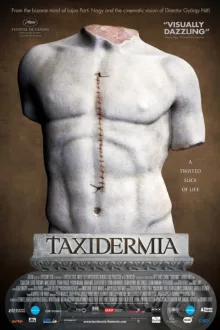
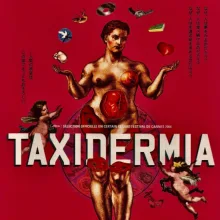
MIKE WHITE: And the, they tamed it so much for the poster with the torso with just the little bit of a stitch down the middle and the two arms missing and the head missing. It's like that kind of speaks to the end of this movie, but not really. And it really doesn't just show you the breadth and depth of this one, right. LUMI ETIENNE: And it's so interesting that the scene that is meant to be the big reveal, the big grotesque payoff is actually like you're saying, Jonathan, like the most beautiful scene and the scene that feels very sincere and it feels like the film is saying, look like bodies really are beautiful.
If they're not being rendered grotesque by state power on the inside, they're quite beautiful. And when, in fact, it's the rest of the film that's grotesque, it's like possession like it was sold as the video nasty where Johnny fucks the octopus. But it's really the world that's grotesque, right? And that scene in itself doesn't stand out as particularly distressing pal.
JONATHAN OWEN: He said something in an interview about how he was wanting to challenge the boundary of beauty and ugliness or I guess between humanity and animals or living bodies and meat and things like that. And it reminds me of something that David Cronenberg said about about disease, a disease can be beautiful. Now, I'm probably missed remembering it a little bit, but it was something along those lines and the fact that that LAO is called cyst at one point and that they pretended that it was a cyst. The doctor kind of was bribed to say that it's quite interesting because it's almost this idea of looking at human life and then looking at these kind of biological processes and rendering them one and the same.
And it's this idea that some kind of disease or some kind of like human malformation can be beautiful in its own way. MIKE WHITE: Well, it's like David Lynch when he was talking about the Elephant Man and how he sees the polyps and things is almost slow motion explosions. And we know how much David Lynch loves a good nuclear explosion. And when he said that I was just like, oh yeah, I can so see that and it's.
LUMI ETIENNE: Also focusing on the body is just such an effective way to communicate, especially for filmmakers figuring out how to navigate this increasingly globalized marketplace, right? In an international audience may not know why a given historical event is important. They might not care but every viewer has a body, right? And there are fundamental things that causes disgust and anxiety, especially in the extreme like vomiting rates.
So bodies in very specific circumstances constitute this universal language. JONATHAN OWEN: Very true because if you think of one of the, but if you about who play, I mean that that already got a certain amount of attention internationally. And as you said, that's a film with virtually no dialogue, there's only like a song at the end. And that's all the spoken language or verbal language that you hear in there.
And I guess one of the other few filmmakers from this region who has continued to be successful after the end of communism is Schmeer and Schwang Meyer again is a filmmaker who speaks entirely in a language of affect and visceral substances. And again, a lot of the power and the sort of international appeal that his work has is based on the fact that there is not that barrier of language and there is that immediate effective quality that his work has. And this film made me think a lot of conspirators of pleasure actually seen with Maurice Gabbani at the beginning where he's fumbling the flame, made me think of those kind of moments of private would be no pleasure in conspiracies of pleasure.
Yeah, that's another possible connection. LUMI ETIENNE: There and schon is so relevant to Taxidermy because all of his work is about objects becoming animate and breaking, testing that boundary via magic realism between subjected and objected. Interesting. MIKE WHITE: Yeah, like those skulls inside of Alice that are still alive even though they're just skulls.
Little o it's so funny to me, Jonathan, you came to this movie through a Man Toan basically just of all the ways to come in. You come in through the music door. I was like, oh, ok. Yeah, because the music, I mean, it's, it's spare, but it's great.
And I love that it's more electronica which doesn't necessarily match with any of the time periods, maybe the last one. But it works in this. JONATHAN OWEN: It works very well. It's interesting, it's almost analogous to the film itself because I guess the film itself is extremely material, extremely physical and yet uses CG I and I guess the music is a mix of yes, like electronic sound and what sounds like very kind of real percussive noises.
And there is that sort of physicality to the music. LUMI ETIENNE: Yeah, it reminded me of Shamana where there were like, it's a very electronic score. But the sex scenes and the scenes set in a factory Zoki had the scores reversed so that the sex scenes of which there are many had a factory score and it, I felt like in a film that's about corporeality to have this kind of mechanized, industrial, digital or electronic scores. Really?
I don't know, it's just, it's a certain, it's a certain atmosphere. It's very interesting. I was thinking about Jonathan, what you were saying about liminal and magic realist films set in geographical peripheries where tradition lives on, right? It persists and I was thinking about this idea in at least in Europe in the middle ages that a woman's imagination during pregnancy could influence her birth.
For example, if a baby was born covered in hair, the best medical minds at the time would be like, oh yes, it's because the woman was looking at this painting of a bear while she's pregnant and or deformities were blamed on pacts with the devil and all these kinds of things. But it's weird to say, but maybe we're all pig babies in the sense that we're warped or shaped by our parents imaginations by their living conditions, by their fantasies even. And attempting to cut off our pigs tails won't do anything if we live in a system that treats us as livestock.
I really want to think more about the pigtail. MIKE WHITE: Yeah, because it never really comes back. I thought for sure that there would be a moment where we get to see the scar or something and it. JONATHAN OWEN: It just shows it wands briefly, doesn't it?
When his pants are quite half way? But that's the, it's fairly early in that sequence. But yeah, after that, there's not much, there's any real reference to it. LUMI ETIENNE: But then he has cat tails coming out of him at the very end.
He's warped by his own imagination rate. MIKE WHITE: Do you think that the son killed those cats? Are those the father's real cats? JONATHAN OWEN: I figured that there was meant to be some kind of struggle between them because you see those big scratches down his back and maybe he killed them in self defense or there was some, yeah, I figured that there was some, in fact, in the deleted scenes, there is a moment where a cat just leaps out.
Yeah, I figured there was some kind of tussle somehow. MIKE WHITE: Yeah. You see the scratches much more clearly in the deleted scenes for sure when he's walking down the hallway and you get that the five big or four big marks across his back. LUMI ETIENNE: Yeah.
And there's that horror moment where he looks around and realizes he can't see one of the cats, that scene where he enters the apartment is truly when it's a horror film, right? MIKE WHITE: Yeah. When you, when you see that flash go by the screen, it's basically the closest to a jump scare that you're gonna get in this one. LUMI ETIENNE: This is just an observation, but I thought it was interesting that lash kind of does what a lot of governments have done in East Central Europe, which is to put the past on display.
Right? There are like these museums all over the region dedicated to the state socialist past where you can walk through reconstructed living rooms and listen to radio broadcasts and read old magazines and look at kitchen utensils and stuff like that. And it's what do we do with the physical remains of these systems of power, right? We com modify them and make them marketable to an international audience.
And I don't know, I wonder if, when Laos Taxidermy himself as well? Is it a statement that I too belong to the past in the sense that I have been warped by my father and my grandfather's trauma? And thus I'm too warped to thrive in this current system perhaps. And so I too am a relic.
MIKE WHITE: The whole thing ends with him. He has no children. This can't go on for 1/4 generation and. JONATHAN OWEN: He's preoccupied.
The thing that he does is his occupation is all to do with death, isn't it? And it's stuffing dead things and, yeah. So I guess that situates him in the past really, rather than in the present of the society that he lives in. MIKE WHITE: Yeah, I was curious even when he's the first thing we see him.
Taxidermy is a bear and I just was like, is that the Russian bear? Am I supposed to be picking up on that? JONATHAN OWEN: He is the second coming of Maurice Gabbani, isn't he? He is sort of the history repeating itself.
MIKE WHITE: And also, I mean, just the color red, especially through the second part of it. We get red all over the place and I love how they're eating that caviar out of the big red star. Oh, man. Oh man.
At first I thought it was baked beans because they had the bacon with it and it's raw bacon. Yes. JONATHAN OWEN: Even with that. MIKE WHITE: Sequence of them having fun together.
That is also in the deleted scenes and it goes on for a lot longer. I mean, it really goes on for a long time to the point where I'm like, is this, this is really going on this long? Ok. I didn't think I love, I love those little moments like the her throwing up on the side of the swing, the park ride and her over on the side.
I just love the framing of this and just he does. You were talking about the close ups. He tends to go close up or very far away. There's not a lot of medium shots in this.
LUMI ETIENNE: It's definitely not the traditional narrative where we expect to see bodies of a certain size and in a certain position. But I'm so glad he had that scene of Kizzy throwing up. And I guess it's not in the final film. But yeah, park rides aren't romantic.
Why do we keep selling ourselves this narrative? MIKE WHITE: Let's go get terribly dizzy and vomit and not even doing it professionally, not even professionally vomiting. I love how he's like I had a vomiting technique named after me. The scenes of the Olympics are also in those deleted scenes, you get the VHS tape that he's watching you.
It's very, very repetitive. Again, it's basically, here's the guy eating, here's geezy over in the sands, go, go, go and then back to him and then back to her and it just goes on and on and on. But I love that they shot it. I mean, it looks very, very vh si really appreciate that.
LUMI ETIENNE: Maybe it was a relief to shoot something pleasurable for a change, right? Like this extended vacation date and the competition, I don't know. MIKE WHITE: The transition to the sun is fantastic that we've got him being the, I'm taking it that he's the runt of all of those babies. And he's the only one that's not crying when we get to see all those babies as we go from 2 to 3 and then we get him breastfeeding with his mother.
And then we move over to this, it almost looks like shattered glass, but it's not that, but we go into the glass and that's our transition into the next one. And then we end up with the ascent of bird shitting on the sidewalk. What a way to go, abject trade. LUMI ETIENNE: Sorry, I'll stop saying that.
But yeah, like if close up on the shit. Yep. But it's interesting to think about the two, the first two as a pair, right? Because they are written, they are based on the same source text by the same author who appears as the corpse in the tub.
So he gets a little Hitchcock cameo. It's interesting to think about the first two protagonists as opposites, right? One is at the bottom of the barrel in terms of power. He's living in a shack with a, he's doing all the worst jobs.
He's scrawny, he's sexually desperate and Calman. On the other hand is massive and he's on his way to becoming an international champion and he's got this lover and he's having a kid and he's on a cushy holiday and he has plenty to eat. Even if he can't keep it so extensively. These men could not be more different, but both of their lives are driven by physical torment and squalor, right?
And both have to hide their desiring gaze and do these exaggerated performances of obedience and each man's body kind of rebels against these constraints, right. Kálmán's body can't stand the strain of competitive eating. He has a heart attack on stage and Moor Cavani has to look like he can't. He, his gaze is too rebellious.
He has to look and he has to, they called it peep. So no, no matter your position with whether at the bottom or the top within these systems of power, the outcome is always physical humiliation and death or near death. And of course, as we move into part three and globalized capitalism, like nothing changes really. MIKE WHITE: Yeah, I did appreciate the whole look at this film as fascism, communism, then capitalism.
And just to see that we're not really better off in any of those systems. JONATHAN OWEN: I was just intrigued by one of the insignias that you see in the second episode where you see the sports event and there is a, it's not real, it looks like it's a made up insignia with seems to be the Hungarian national colors and then it looks like there's a dove of peace on top of two machine guns. And I just, I was just intrigued by the, just the bizarreness of that really. And also I noticed that there's, again, there's a statue that you see with a dove in that episode.
And then at the, in the final episode, you see another statue, but instead of the dove, it has like real pigeons on it. And I thought that was an interesting kind of, it's like a kind of a descent from doves to pigeons between the 2nd and 3rd. So yeah, that was just like a random thing that I noticed like pigeon. Yeah, that's right because the dub is very much an image of the kind of Communist era because yeah, Communist events would often describe themselves as peace forums or peace Congresses.
So that image of the dub is very much tied to state communism. And yeah, there's been this sort of change from the dove to the pigeon between communism and capitalism. MIKE WHITE: All right, we're going to take a break and play a preview for next week's show right after these brief messages in and then you were more you told and that and to those pass got loads of simple the goes and they have on I said yawning in a That's right. We'll be back next week with our second Finnish film of the month.
I'm sure our download numbers are going to be through the roof with all this Finnish content. It's the white reindeer until then I want to thank my co-host Lumi and Jonathan. So Lumi, what's been going on with you? LUMI ETIENNE: I am in grad school and I'm also working and I'm very busy, but I did get to spend my birthday with a bunch of Cine bits from the hellraiser series.
So that's been the highlight of the autumn for me. MIKE WHITE: Were they just like at a restaurant there? LUMI ETIENNE: You know, as one does No, I was presenting a paper conference in Birmingham called Cine Access, which was very fun. It's devoted to poorer cinema and excessive cinema.
And they also do a screening series and they were doing a hellraiser retrospective. So at their big opening gala for all the speakers, they also had a bunch of cast members who were the best mixers academ can't talk to each other. But actors are fantastic. So they were like mixing the room and they signed my birthday card and everything was really?
Oh, wow. MIKE WHITE: Wow, that's awesome. Did you get, did you get to meet the CD head? LUMI ETIENNE: I met the chatterer and I met the woman who has a wound like a vagina in her neck who was like exquisitely dressed like goth goddess.
And I met Butterball. MIKE WHITE: Butterball was the sweetest and Jonathan, you are always up to no good. What's been going on with you? JONATHAN OWEN: I can't top that.
I'm afraid that makes me miss the UK even more now. He's calling me. Yes, I've got a few things that are in the pipeline. A few things that have just come out.
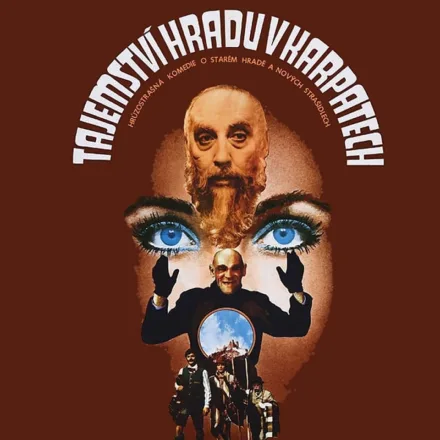
I was very proud to have written the booklet essay for The Mysterious Castle in the Carpathians, which has just been released from the wonderful Amazing Company Def Crocodile. And I have an essay on Czech Cult Cinema, which will be part of a collection called Decolonizing Cult Cinema, which will be out next year from Bloomsbury. Got a couple of other things pending from a couple of other wonderful labels. And I'm also working on Yik Pollack for maybe an essay that I'm going to be working on over Christmas and beginning of next year.
That's been my holiday season, taken care of. MIKE WHITE: Well, thank you so much folks for being on the show. Thanks to everybody for listening. If you want to hear more of me shooting off my mouth, please check out some of the other shows that I work on.
They are all available at Weirding Way Media.com. Thanks especially to our Patreon community. If you want to join the community, visit patreon.com/projection booth. Every donation we get helps the projection booth take over the world.
Speaker 8: Yeah.
Watch
Links & resources
Related episodes
Episodes that share keywords with this one.
The Mysterious Castle in the Carpathians (1981)
Shared: Jonathan Owen
Tereza Brdeckova, Irena Kovarova, Jonathan Owen, Emily Barney
Comments (1)
Adam Bazso György Pálffy has another really interesting and surreal film called "Szabadesés(Freefall)", it consists of severak episodes which are framed by a suicide-attempt of an elderly woman. One of my all-time-favourites of Hungarian cinema after 2000 is Attila Janisch's "Másnap (After The Day Before)", which was inspired by the short story "The Voyeur" by Alain Robbe-Grillet. It is a non-linear exploration of a journey, undertaken by a nameless man looking for a house he inherited, in a desolate landscape full of strange people who seem to know him somehow. There's a crime he maybe commits or maybe not. He has to follow clues in a circular structure, spiraling further and further down to the center of the maze of his own mind. It is visually stunning, slow, full of deliberate repetitions and eerie atmosphere. I highly recommend it to explore, it's definitely worth it.