Special Report · Film year 2026
The Uncut Marx Brothers: Lost Gags, Routines & Scenes from Their Classic Films (2026)
- Special Guest
- David Koenig
Show notes
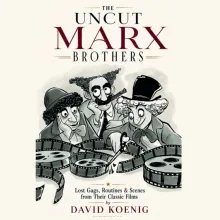
The funniest Marx Brothers scenes may be the ones you have never seen. Author David Koenig spent two years in the archives chasing the scripts, drafts and filmed-then-cut routines behind all 13 of their films, and he joins Mike to talk about his new book, The Uncut Marx Brothers: Lost Gags, Routines & Scenes from Their Classic Films, published October 6, 2026.
Koenig traces how the censors chopped up Horse Feathers (1932) and A Night at the Opera (1935), why Duck Soup (1933) lost two Groucho dance numbers, and how director Leo McCarey filmed the famous mirror routine in self-defense. He explains how a complete Animal Crackers (1930) finally resurfaced, and why Irving Thalberg's MGM wanted the brothers "half as funny." The talk also covers Zeppo's exit and the tangled making of their last film, Love Happy (1949), which began as a Harpo solo vehicle.
Order the book now at Bonaventure Press (opens in a new tab)
Transcript
An automatic transcript from Spreaker. It has not been proofread, so names, titles and spellings may be wrong, and it does not say who is speaking.
Show the transcript (about 7,900 words)
Hold your ears, folks. It's showtime. People pay good money to see this movie. When they go out to a theater, they want cold sodas, hot popcorn, and no monsters in the projection booth. Everyone pretend podcasting isn't boring.
Turn it off. Turn it off! Turn it off! Hey folks, welcome to a special episode of The Projection Booth. I'm your host, Mike White.
On this episode is the return of David Koenig. He is the author of, well, quite a few books about Columbo that I absolutely love. He's back to talk about his new book, The Uncut Marx Brothers, Lost Gags, Routines, and Scenes from Their Classic Films. Never really thought about the Marx Brothers having uncut or cut versions of their films. This book really opened up my eyes and was not only entertaining, but also informative.
Thank you so much for listening, and I hope you enjoy this interview. Well, we've talked twice now about Columbo, and I've enjoyed those talks immensely. I enjoy your books immensely, and then when I read that you were putting out this new book about the Marx Brothers, I was thrilled because... I know a little about the Marx Brothers, enough to be dangerous, but your angle, and I always loved the angle that you come at things. I was like, yeah, great.
I want to know all about the uncut Marx Brothers. What led you to this project? It was, I've always loved the Marx Brothers. They've always been my favorite comedy, everything, you know, or movies or anything. I just loved the movie since I was age nine.
And it was just, they were so unlike everything and everybody else I ever saw. And they played off each other so well, and they're different personalities. So huge Marx Brothers fan. One of the reasons I wanted to grow up and write books about movies and theme parks and such was my love for the Marx Brothers. And I thought, one day I'm going to write a book about the Marx Brothers, and it was going to be my first book when I was in college.
And I thought, you know what? Nobody's teaching me how to write and edit and such, but nobody's teaching me how to write a book. Or I interview really old people that have incredible stories. So I thought, oh, I'll write a book about the Marx Brothers on the side, and then hopefully finish by the time I graduate college. Sort of my own self-education on weekends and such.
So I started interviewing people who worked with the Marx Brothers, and it was great and fun and neat, but I realized, These were all stories I'd heard before in other... I'd read all the books. I was such a big fan that I had them all. And it's like, I can't write a book that's already been written. That doesn't...
It's always so great when you finally get back to the project that you wanted to do for so long. So, I mean, how do you even say, like, okay, now that I've got the... I've learned how to write books. I've written many books now. What's your approach to this?
Well, it always starts... Now, 10 books. I can't believe it, but it is. This is my 10th book. And every single one of them has started from a point of curiosity of me wanting to know certain things about a favorite subject and wishing there were a book about that.
And if I research and find, oh, this sounds like the book I was looking for, enjoy it. That's wonderful. But every once in a while, there'll be something that doesn't yet exist. My first book about behind the scenes, crazy stories about Disneyland. I always wondered, what's it like back there?
And so that inspired my first book. And then the Danny Kaye book, what was it like to work with him and to make behind the scenes adventures of his films? And it's the same with the Marx Brothers. I always wondered, starting from when I was a teenager, I began collecting movie memorabilia. And at that time, back in the 1970s, Most of it wasn't very expensive.
You could get a lobby card for a few dollars and a one sheet for $ 10 for, say, a Bob Hope movie or a Jerry Lewis movie. But I couldn't afford, even back then, it was hundreds and I'm sure it's now thousands of dollars for any original ephemera from a Marsh Brothers film. But what I could afford were the scene stills, you know, the pictures from the movies and what I started collecting because I wasn't really interested in pictures. that were already scenes in the film, because I figured, hey, if I want to see the stateroom scene, I'll watch the movie. I don't need a picture of that. So whenever I'd come across an odd scene that I'd never seen in any of the movies, those are the ones I'd acquire.
And this project was so cool in being able to see, oh, so many of these scenes actually were filmed. They were just cut out. Why? You know, that Groucho's wonderful two dances in duck soup don't exist, but I've got lots of pictures of them. It's because they were actually filmed and then the film was running too long and they had to, you know, snip here, five minutes there.
And it's a great help in identifying how much of that uncut or cut material actually was filmed. So you've been working on this book since you were a kid, basically. Without even knowing it. It's actually true. Yeah, 50 years in the making, but two years in the actual knowing what the heck I was doing.
Wow. Now, I'm going to ask you, sorry, a little off the record, I'm going to ask you a lot of questions that I know the answers to, obviously. I think you know this from our previous conversations, but the audience doesn't know it. They didn't get to read the book yet, so let's tantalize them a little bit here. So, obviously being cut for time is one thing, but then it's so interesting that the Marx Brothers were really coming up, like, How many of their movies were pre-code before the Breen office really put the code into effect or enforced it?
Their first five, they were designed by Paramount Studios originally and made their first film in 1929, The Coconuts, which was a little risque, but not too much. But then the double entendre started coming in force over the next few movies up until 1933 with Duck Soup. And then the production code went into full effect. It was no longer optional because they realized increasingly directors, if it's optional, hey, I'm going to do whatever I want. And it was supposed to be sort of a gentleman's agreement that if you're, you should follow the code and then.
We won't force you to. But as years went on, people started ignoring it to such an extent where it became mandatory. And if you did not pass the censors, approval and their various rules, you could not show your movies in American theaters. So they had to do it, which meant some of the later films, when they then moved to MGM, are sometimes viewed as a little more tame, you know, don't quite have that spiciness that the first ones did for various reasons. But one of them was that they were, you know, during the Code era.
And the unfortunate part, though, is when Paramount tried to re-release some of those free code films, and the censors said, well, you can release them, but this has to be cut out, this has to be cut out, this has to be cut out. And one of their films in particular, Horse Feathers, there's one scene that's just filled with double entendres and Harpo jumping on a woman and all sorts of crazy stuff that takes place in Thelma Todd's apartment and the four brothers rushing in and out as her boyfriend tries to catch him and, you know, all sort of sexual tinged hijinks. And they made them chop that scene up to bits. And unfortunately, all that remains to this day that we know of are that chopped up 1936 version of Horse Feathers.
And what I think in being able to recreate it on the page reads to me like one of the greatest scenes they ever filmed. now only exist at basically half its length, and many of the jokes are cut right out of the middle of sentences. It's just become this awkward mess, what could have been one of their crowning achievements. I mean, even when I was a kid, I would watch these movies and be like, wow, these are really choppy. I thought it was more because it was, I can't say primitive filmmaking, but we're talking 1929, like you said, for the coconut. So it's like almost 100 years now, and would have been more like 70, 60 years when I was watching as a kid.
But I just kept saying, why do these movies have this odd rhythm? And I never really connected that it wasn't the filmmaking. It was the censorship, I think, really played a huge part into that. Well, a little bit in the Horse Feathers and some of the others, but mostly the original prints survive of most of their movies. And the other one that, besides Horse Feathers, that survives in sort of a choppy print only, but it was originally made as a choppy print, was their first film, The Coconuts.
And part of that was primitive filmmaking. But part of that also is when they... That was their first movie. It was based on a Broadway show. So when they filmed it, they just said, film the play, pretty much.
They knew it was like a Two and a half hour play, so they had to cut out some of the musical numbers, but besides that, it was pretty much the play with music. most of the music and it was like an hour and 45 minutes long actually that's not right so it's like two hours and 20 minutes long i think if if i'm going by my memory correctly which for a comedy is you know that doesn't typically work. And in watching the film back, they were convinced, oh, we can't cut everything. This is a true recreation of the play. So they wanted to release it like that. And then they showed it to a couple of previews and they realized at the last minute, we can't release it like this.
So they hurriedly chopped out 40 minutes of it. I don't even know if the director was involved in the editing because it was slashed so haphazardly And that's another of the films. But that's how it was released originally. So there's that missing footage that we hope will one day be found for Horse Feathers, because it was released in a pristine condition originally. There was never a pristine version of the coconuts to release.
And those chopped out scenes in 1929 were, I'm sure, discarded immediately. You're not necessarily racing against time. We're not talking about necessarily pristine. film preservation, but I end up talking about film preservation because if those clips, scenes exist any place, they're probably on their last legs as far as actually being usable film footage. You know, that's funny you say that because I was just reading this morning about a silent film that was just discovered with a big silent star who obviously escapes my mind, a female star that they had, maybe you've heard about this, but they just found this film and And they said, this film is 100 years old and it was just about to disintegrate, you know, but they found this nitrate version and they found it just in time.
And that was my thought was, how many other films have we just missed? You know, that if somebody would have found him a year earlier, you know, we would have had, you know, who knows what, you know, these wonderful movies that are probably gone forever. How was it for you when you're trying to put this book together and researching these movies that are coming up on their centenaries? I mean, Coconuts is going to be 100 years old in three years. Well, fortunately, the written record of the scripts, cutting continuities, production records, which was impossible to get a hold of and look at 40 years ago when I first had an idea to write about the Marx Brothers, because a lot of the people... who held these materials were still alive.
And studios were holding on to a lot of this golden era, what to us is memorabilia or research. And over the years, they've donated those to archives and universities and the Academy Library and such. So now for the first time, so much of this material, researchers and authors can get to look at and share the stories that are in hidden in between them. So it was just a delight to get to view this material and learn these stories and secrets that could have been lost forever. How many libraries did you have to visit or contact in order to kind of mine all of this material?
Well, I think I directly worked with about maybe eight across the country. Fortunately, the furthest ones I was able to get materials sent to me. Or view them online. Everyone local, UCLA, the Academy primarily, and a few others, those I was able to visit in person and spent, I'm sure they were sick of me because every week for two years, they were like, oh no, not this guy again. To me, if I were them, I'd be excited because they have these, if you're going to have a job like that, where you're an archivist or you're librarian working with these precious gems, it would thrill me that somebody was looking at them and they were just not hidden in some dark basement that it's like, oh great, we have this really valuable stuff.
Now we're going to put it in the dark. Nobody's going to look at it. It's like it almost doesn't exist. So to me, I'd be thrilled that people were interested in pulling these things out and discovering this long lost history. How many of these films that they made were based on plays.
There were two that were based on their own plays and one that was based on not their own plays, somebody else. The first two were two of the shows they did on, two of the three shows they did on Broadway, The Coconuts and its follow-up Animal Crackers, which are fairly faith, though abridged versions of those shows, which is neat. So that required a much simpler writing process. Those first two films were, as stage plays, were co-written by George S. Kaufman and Maury Riskin, and Riskin did the screenplay version.
Kaufman didn't enjoy, even though he was one of the greatest writers ever for the Marx Brothers, he did not enjoy working for the Marx Brothers. He thought they were wild and out of control, and he was right. He was not used to running the show. He wanted to be the one to run the show, and they sort of took over. So he didn't want much to do with them there on the movies.
So Riskin wrote those two screenplays. And then on successive movies, they would just get massive amounts of screenwriters who would either work in a giant pack of like wolves, you know, throwing ideas or, you know, tearing one story idea from the other. Or the more organized version was at MGM where they get sets of two screenwriters and two would work on it. And then they pass the drew. their drafts to the next two, and, you know, just as many writers, but, you know, in a much more orderly fashion because they were much more, Harry, concerned about continuity and story rather than just mass quantity of gags. And then after the first couple of films with MGM, they were lured to do one film for RKO, one independent film, because RKO had paid a record sum to purchase the film rights for to the hottest play on Broadway.
It had just, you know, it's like Hamilton. It had just come out. It was sold out for months in advance, even though when they put it up for sale, it had only been on stage for about a week. But it was called Room Service, and it was this farce, you know, people running in and out of doors and such like that. And it was this incredibly popular play that the RKO paid a record sum for, $ 255, 000 for the screen rights, which was, you know, many times what was normally paid for that type of thing.
And they used it sort of as bait to get the Marx Brothers to come over and make a film for them, because those first seven movies they made, all of them were hits, and they just kept getting more and more popular. So they're like, oh, let's get this, maybe this, we could bribe the Marx Brothers to come over. Unfortunately, unlike their earlier stage show movies, It was not material written for them or their characters, so it became this sort of mishmash of trying to be true to the play, yet trying to shoehorn in characters that were kind of like their regular characters, but a little bit different. So, and then their next movie after that, they decided, okay, enough of this, we're going back to MGM, and we're lured back to MGM by MGM promising the same sort of thing, where we're going to take this popular show, And they had the show in mind called Jumbo, which was a circus story.
And they said, we're going to buy this for you, and you'll be the star of Jumbo with all these hit songs and everything. But unfortunately, they were not able to purchase the rights, so they had to create their own Marx Brothers Go to the Circus movie. And the Marx Brothers only ended up making three movies based on stage shows. It was, I don't know, not necessarily... confused about, but I found this very amusing, was the whole thing of how Groucho just would get bored so easily, especially with the jokes that he would have to say, and he was just like, okay, no, I need more stuff. I mean, do you feel that negatively or positively affected the quality of their work?
Oh, wonderfully positively, because it probably made them very hard to work with. I mean, I know some of the writers would get burned out because he'd toss out perfectly good lines and say, I want something new. I've been telling this joke in rehearsals for a week now, you know, the grips aren't laughing at it anymore. Yeah, because they've heard it five times. So he'd want a new line.
So I know that could frustrate the writers, but it works so well on stage because a lot of times, especially on vaudeville and their first couple of shows, including the coconuts on Broadway, is they'd ad-lib so much. And he, more than anyone else, would make up his own lines. And that brought back the audiences time and time again, because they knew they could say anything at any time, and tomorrow's show would be totally different than today's show. And so it made them very popular. And even when they weren't making stuff up, it just felt like they were.
They had such a spontaneous way of delivering their lines and running from one corner of the stage to the other. And it got to the point where when Kaufman and Riskin were writing their third and final Broadway show, Animal Crackers, they decided, you know what, we're going to make sure that as many of the lines he delivers are winners, that they wrote him like a half dozen backup lines for most of the lines in the show, just so he could have something different to do from night to night. Yeah, he could make some up, but here's some other stuff so you don't get bored. Well, Animal Crackers, that was the one, if memory serves, they found a complete print, right? Like in 2015 or something?
Yeah, it's sort of a similar story, or at least started out the same way as the Horsefeathers saga in which Animal Crackers was re-released in the mid-1930s and certain parts were edited out and that became the official version of Animal Crackers for many years up until in the 1960s. Animal Crackers disappeared completely from the United States because of a rights issue. The studio had had bypassed renewing the rights. It didn't think there was that much money in it. And so the rights were tied up with the authors, you know, Kaufman and Riskin, as well as the Calmar and Ruby who wrote the music.
And with the rights all tangled up, them belonging to people who, and heirs who weren't in the movie releasing business, you know, you could not see this movie in the United States. for like 10 or 20 years. I know when I was a little kid and first got into the Marx Brothers, it was shortly before it was sort of rediscovered. And I was so bummed that I couldn't see Animal Crackers. It was supposed to be one of their main films. But finally, due to a petition by students led by Groucho, Universal Studios re-released Animal Crackers.
But the version they came up with, the only one they had was that chopped up mid-1930s version with the, you know, seven missing sections. And so for. Many years, for another 40 years or so, 30 years, whatever it was, that was the only version you could see was that censor cut version. And then now I think it was the British Film Institute or someone overseas discovered a complete print and brought it out on blu-ray and now fortunately that's taking over as the official as the official version because that was the original with all the jokes restored even the spicy ones even you know harpo whacking a young lady on the bottom with a with a rolled up newspaper which was deemed too much in 1936 is is now safe for our eyes to see.
So there is potentially some hope Yeah, well, that's what I'm hoping. And there's another film of theirs that suffered a similar fate, and that's perhaps their most famous film, A Night at the Opera, their first film for MGM. And that was trimmed due to censors' concerns. And since it was during World War II, slightly before and slightly after, the whole time was very nervous about Mussolini and such. So a bunch of scenes were chopped out and some replaced in the film.
And to this day, replacement chopped up version is all that remains of A Night at the Opera. But some not too many years ago, researcher discovered that in the Hungarian archives, there was a more complete print. He said he didn't see the whole thing, so he didn't know how much was restored, if it was the whole fully restored version or just part of it. And so for years, people have been wondering. And then finally, about a year ago, I was able to view that print.
And it does contain a little bit more, but there's still a lot more left of A Night at the Opera that's left to be found. But at least now we know it can be done. There's hope. Right. Selfishly, I want to ask you about Duck Soup, because that's probably my favorite of theirs.
You mentioned a dance scene that was cut out. What other things are cut out of Duck Soup? Well, what had happened with a lot of the cuts for Duck Soup is you can blame Leo McCary, the director, who didn't much care for the Marx Brothers. He was okay with Harpo because Harpo was sort of like the comedian type he was used to working with in the silent film days when he worked with, say, Laurel and Hardy. Even when Laurel and Hardy got into sound films, it was a much more...
It wasn't a bunch of jokes. It wasn't a rapid-fire this. It wasn't dialect humor like Chico, you know, or the monologues like Groucho, which was not his cup of tea for Leo McCary. So he didn't really much care for the Marx Brothers, and Paramount had asked him to direct Duck Soup, but he declined and signed up for another... to direct another movie. But shortly thereafter, the Marsh Brothers went on strike.
And because of back payments for royalties for the last two films, they refused to make Duck Soup. And they said, until you pay us our back royalties, we're not making another movie for you. During time, the negotiations got to a point where Paramount threatened to replace the Marsh Brothers with three other comedians, including Jack Oakey. And nobody to do with the Marx Brothers. So at that time, Leo McCurry agreed to direct Duck Soup, just not with the Marx Brothers.
So he signed the contract, I will direct Duck Soup, and then sure enough, a couple weeks later, the Marx Brothers and Paramount struck a deal, the Marx Brothers came back, and Leo McCurry was stuck with the Marx Brothers. So he had the script rewritten as best he could, but filming had to begin on that certain day of June 1933, so they started filming with the whole second half of the movie, him not being really happy with. So he continued rewriting as they filmed, and so there was a lot of scenes, say, with Zeppo that had a lot of plot, some musical scenes, including two numbers with Groucho, some comedy scenes that he found very loud, where Chico and Harpo break in to the Peasdale mansion of Margaret Dumont, And Groucho discovers them and has them hauled off to jail.
All that sort of stuff. It didn't do anything for Leo McCary. So he had some other ideas that he devised during production of the film. It was halfway done when he thought of a lot of these things. And he just filmed new scenes to replace what he had just filmed, such as that break-in scene, the whole second half of that, where Checo and Harpo get caught by Groucho. he refilmed and had it replaced by the mirror scene where Groucho, you know, or Harpo runs into a mirror, full-length mirror, it smashes and Groucho walks up so he has to pretend that he's his reflection, even though, you know, it becomes comical because Groucho's trying to trick him so he does these ridiculous movements that Harpo kind of follows and Groucho seems to fall for it or at least accept it until...
Chico just the same way shows up. And it's one of the most memorable scenes of the movie. It's based on a scene that McCary had done with Charlie Chase back in the silent film days. But it was just created by McCary in self-defense because he was trying to create more visual humor. He didn't think there was enough of that, and he thought there was too much plot, so a lot of the Zeppo stuff got gone. a little bit of the Groucho and some of the other stuff, because he wanted it to be as much about Harpo as possible.
That's hilarious. I didn't realize that wasn't pure Marx Brothers, that whole mirror scene, because I was just watching an episode of Scooby-Doo, and there's the mirror scene. Of course, Isle of Lucy, kind of almost contemporary, but not quite 20 years later, but that's remarkable. That bit wasn't pure Marx Brothers. That was McCary.
That's great. What's really interesting to me, because I've always heard, oh, the mirror bit that was designed in the silent film days. And, you know, this is a bit that's been I've seen over in things, including Scooby Doo. And it actually goes to silent film in like, I don't know, 1918 or something like that. So when McCary did it, he was in the mid-20s with Charlie Chase.
He was sort of stealing it for somebody else. But when he stole it from himself, he copied many of the mannerisms, the expressions that Groucho would have and the things he would do, like putting on a funny hat and the reflection would put on a different hat. Some of the things were stolen straight, but still he allowed the Marx Brothers to add sort of their own crazy twist to it. And they sort of made it their own. And now whenever you think of the mirror routine, I think most people probably think of the Marx Brothers.
Absolutely. The thing that I like about them is that there was that touch of surrealism to them, like that mirror scene, like when they exchange hats and those kind of things, or one drops the hat and the other picks it up, those kind of things. Did you get into the project that they were talking about with Salvador Dali? I'm very curious how much of that was real or not. Yeah, well, that wasn't...
In fact, somebody has written a book about that. I think it's called Giraffes on Fruit Salad. I think it's the name of it, which sounds like a Salvador Dali project, but they had created an illustrated book of what this film could have been. I don't talk about that in my book because it never got close, and that was never going to happen. There was never anything serious written on that, but certainly...
Dolly saw the surrealistic side of them. And especially in those first five Paramount movies, culminating never more than in Duck Soup, where they did those type of things. And it just sort of started with some silly things that they did on stage. And then there were some, you know, unusual things Harpo would do on stage. And then for the film version of coconuts, Maury Riskin, the writer, trying to add some things, says, well, how about if he starts eating some of those objects, you know, that are on the desk, the bell desk at the hotel, and drinking the ink from the inkwell, and, you know, silly things like that.
And then with every successive movie, they take it up another notch. In Monkey Business, somebody asks them for a You know, a bum wants a dime so he can buy a cup of coffee, so he asks him to help a guy out with a cup of coffee. So he pulls a steaming hot out of his pocket and hands it to the guy. And so those were the type of things they did during the Paramount era. Then when they went to MGM, those type of things were almost forbidden.
Even though they were a great part of their character, their producer Irving Thalberg thought, you know what, you guys are really popular, but you know what? You could be twice as popular if you were half as funny. And he didn't mean worse jokes. What he meant was fewer jokes and a more engaging story. Because, like, duck soup has next to no story.
And it's better for it. And less music, less... Or music by the Marx Brothers, at least. None of these romantic... Or more of these romantic subplots.
You know, the things the audience... will want to see and get hooked on and engaged on. And chief among that, you guys have to be a little more real. People have to identify with you. They have to like you. They have to be on your side.
So you can't do anything that a normal human being can't. You can't be pulling cups of coffee out of your pocket. You can't be doing this crazy, bizarre stuff that you have to be relatable. I think it's the word they use. So they in the very first rough script ever written for A Night at the Opera, their first film from MGM, they tried to give each of the Marx Brothers a backstory.
In all the Paramount movies, they just kind of show up out of nowhere, and there's just these bizarre guys who do these crazy things, but it's, okay, what you do has to make sense. So everybody had an origin story, including Harpo, and it's like, well, why does this guy not talk? He obviously can talk, but he chooses not to. That makes no sense. So they wrote a story in which actually Harpo was the greatest opera singer in the world, but he has laryngitis.
So that was supposed to describe why Harpo didn't talk throughout the movie than just choosing not to. And fortunately, that idea did not last long, but a couple of the other bad ideas they had did. So I think MGM was right in the fact that A Night at the Opera did become, and it's followed by Day at the Races, their most popular movies ever, but they're not as funny. And that's why I like to watch the Marx Brothers. They were also missing, for me, one critical element, which was Zeppo.
Once they made that transition, there's no more Zeppo. Was he just not part of the package? What happened to Zeppo? Yeah, Zeppo, he was part of the stage act originally. He was much younger than the other brothers.
He was about 10 years younger than his three brothers. And they have a fourth brother named Gummo, who was part of the stage act. And then when he got drafted into the army, they needed a fourth brother. And so their mom, the stage mom, Minnie, drafted Zeppo against his will into the act. So he was never really into it.
And they always viewed him as the kid brother who never got anything really exciting to do. He'd usually play like Groucho's son, or sometimes as a romantic lead. But he didn't get many funny lines, even though in real life, evidently he was a very, you know, quick-witted person. And so as a result, he didn't have, he wasn't as invested in the act. He had nothing else to do.
So he stayed as part of the four Marx Brothers, and that's how they branded them, the four Marx Brothers. So at least as long as his mother was alive, he was tied into that act, even into Hollywood. And so he made the first four movies with them. And then at the end of that contract, it's like he's close to, or he's 30 years old. He wants to do things, you know, he doesn't want to be the little brother anymore, who's actually making less than his other three brothers, who are all making the same amount of money, much higher than him.
So he wanted out, He wanted to try different things. He started running his own businesses, became a Hollywood agent, extremely successful, but he didn't want to be the fourth or fifth Marx brother anymore. So he was out permanently. And it's funny, you would have thought they would have at some point said, you know, Zeppo, we don't need you. But, you know, it was him that said, you know, I don't need this.
And he went on to his own successful non-Marx brother's career. And At the time when he first left, the Marx Brothers were a little nervous because they were the four Marx Brothers. He was kind of their lifeline to reality, sort of halfway in, halfway out. He looked, you know, he was the most handsome and normal looking guy among them. And he could be funny with them, but it, you know, he was sort of bridging both worlds.
So they're like, well, can we do it as the three Marx Brothers? And when they lost him, I do agree they did lose that element, that it just made it this nice square instead of a triangle. It was a nice dynamic to have him to play off. And I think they may have realized that at least in A Night at the Opera, because for the romantic lead, they hired a fella named Alan Jones. And if you look at Alan Jones, he's very Zeppel-like, especially in this movie.
He. hangs out with the brothers. He has some hijinks with them. He doesn't go quite as quasi-crazy as Zeppo, although Zeppo never went super crazy, but a little bit. You know, you always knew he wasn't one of the brothers, but he was part of the gang. And starting in the next movie, A Day at the Races, they decided to have enough with that.
Irving Thalberg was gone. There was no reason to listen to the theory about having a fourth Marx brother. So they made Alan Jones strictly a romantic lead who didn't hang out with the Marx Brothers. You know, the Marx Brothers needed some other connection to the love interest. It was no longer going to be him.
And then in all the movies after that, all the romantic leads were separate from the Marx Brothers. They weren't, you know, the fourth wheel, the Zeppo part. That came to an end, that experiment. You know, the halfway in, halfway out, Marx Brothers, Zeppo, who gave way to the one foot in, Alan Jones, then gone after that. What's the most surprising thing you learned while you're writing this book?
The most surprising thing I learned, I mean, there was these crazy little tidbits I'd learned about every movie, especially discovering some of the scenes that were filmed and then cut out of. Some of these movies are just eye-opening. But to me, the most fun and enlightening chapter was about their final movie, Love Happy. And I think part of that was because nobody had ever really, even the greatest books about the Marx Brothers, had never really gone into depth about the making of this movie because it's not one of their better movies. The idea was, you know, they had all, after the big store in 1941 and 11 movies and being together for 30 years almost, they, you know, had had enough as a team.
It was mostly Groucho wanted to be a solo star, and his brothers were like, okay, and they all did their own separate things. But folks tried to, because they were still a successful known commodity, there was always independent producers trying to bring them back. And Harpo thought, you know what, if Groucho can be a solo, and Chico was heading his own band since he was a musician, so he had his own thing. So Harpo thought, well, I should have my own thing. I wonder if I could make my own film.
And he got together with one of his buddies named Ben Heck, who was Charles MacArthur, wrote The Front Page and all these very famous movies and plays. And he would tell Harpo, you know who you're a lot like? You're a lot like Charlie Chaplin. You could, I'm convinced you could star in your own Charlie Chaplin type movie. the kid or, you know, the floor walker or the pawn shop. You know, that could be you.
You're sympathetic. Everybody loves you. You don't talk. You do all this silly pantomime and such a lovable character. I think you'd do great headlining a feature that was a Charlie Chaplin type feature.
So Ben Heck suggested a fella he had worked with recently who used to work with Charlie Chaplin. He was his assistant on The Gold Rush and worked with him on several other movies. And together they created this film, or idea for a film, for Harpo, which became Love Happy. But as time went on, no studio wanted to purchase this film unless it was all three Marx Brothers. And the story of how that producer tricked Harpo into turning his solo movie into just another Marx Brothers movie and doing all sorts of crazy, unscrupulous things behind his back not just behind Harpo's back, but behind his partner in the film was Mary Pickford, you know, who at the time in the 1940s was the head of United Artists in motion pictures and had grown up through the, you know, the teens and 20s as America's sweetheart, you know, this renowned figure.
And so he was doing stuff behind her back and behind Chico's back and behind, you know, all this thing, whatever he had to do to try and get this movie made. So it has the most fascinating backstate, back scene story. but one that had never really been told because the films that resulted is not very good. And most of the Marx Brothers book beforehand, before this, had concentrated on, you know, Duck Soup and A Night at the Opera. And that's what everybody wants to hear about, the making of those movies, not the making of this lousy one, even though to me it was the, you know, the most fascinating production of all. I would say failures are fascinating, right?
That's a good point, yeah. Yeah. So what's next for you? Well, I've got a little more, another Columbo project I'm working on yet to be announced, but that'll be out, a new angle on that will be out next year. And then I might write some more about Disney and some other subjects.
I don't know if I have another Marx Brothers book in me because I've, everything I could possibly find that wasn't written by someone before, I've crammed into these 300 plus pages. Maybe one day, but if I can think of something. But again, something has to come to me when I'm looking for my next book to read. What is it that doesn't yet exist? And that'll be my next project.
That's a good way to populate your own bookshelf. Yeah, that's true. So where is the best place for people to go and find this book and keep up with you? Well, they could certainly learn. Easiest way to get it is usually just through Amazon or another online place. a retailer, they could special order it through their own bookstore.
Or if they wanted to learn about all my books and buy it direct with an autograph, you can get it from the publisher's site, Bonaventure Press at bonaventurepress.com. Very cool. Well, David, thank you so much. It is always a pleasure talking with you. And you gave me such excitement.
The idea of a third Columbo book from you is already like, cool. Can't wait to speak with you again. And I can't wait to read that book. Oh, there's a reason to write it. Yeah, exactly.
Yeah, just to talk with me, I'm sure. Well, thank you so much. And thank you for this wonderful book. I'm so glad that you wrote it. And it was just, yeah, just chock full of stuff that I had never thought of or came across before.
So this was wonderful. Thank you. At last we are to meet him, the famous Captain Spalding. From climbers hot and scalding, the captain has arrived. Hello, I must be going I cannot stay, I came to say I must be going I'm glad I came, but just the same I must be going.
For my sake you must stay If you should go away You'll spoil the party I am throwing. I'll stay a week or two I'll stay the summer through. But I am telling you, I must be going. Before you go, will you oblige us? And tell us of your deeds so glowing?
I'll do anything you say. In fact, I'll even stay. Good. But I must be going. Hooray for Captain Spalding, the African explorer.
Did someone call me Schnurrer? Hooray, hooray, hooray. He went into the jungle where all the monkeys throw nuts. If I stay here, I'll go nuts. Hooray, hooray, hooray.
I put all my reliance in courage and defiance and risked my life for science. Hey, hey! One day in Madagascar, he bagged a dozen weasels. Yes, and all of them had measles. Hooray, hooray, hooray!
I faced a chimpanzee once, so close I felt his breath. The creature looked at me once and laughed himself to death. Hooray for Captain Spalding! That's me! Hooray!
One day I caught an eagle, too big for me to tote. I changed him for a sparrow, a jackass and a goat. Hooray for Captain Spalding! That's me! One day a vicious monkey chased me a mile or two.
I hid behind a donkey, the donkey fainted too. Hooray for Captain Spalding! That's me! I had a guy named Tito. He lent me his repeater.
I brought down a mosquito. Hey, hey! Hooray for Captain Spalding, the African explorer. Hooray, hooray, hooray! The first day I arrived in Africa.
Hooray for Captain Smalling, the African explorer. Hooray, hooray, hooray. The first day I arrived in Africa... Hooray for Captain Smalling, the African explorer. Hooray, hooray, hooray.
The first day I arrived... Hooray for Captain... Fooled you that time, didn't I? Hooray! Hooray!
Hooray!
Comments
No comments yet.