
Special Report · Film year 2026
Best Justice System (2026)
- Special Guests
- Suja A. Thomas, Kurt Engfehr
Show notes
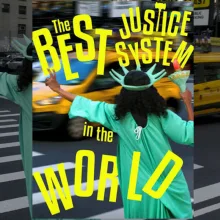
A jury awards $220,000. Then the judge cuts it to $20,000. That verdict, from her days as a New York lawyer, broke Suja A. Thomas's faith in American courts and set her on a ten-year road to The Best Justice System in the World (2026), her first film and a world premiere at DOC NYC.
Thomas, a law professor at the University of Illinois and author of The Missing American Jury, tried articles mailed to 500 judges, a book and op-eds before deciding a movie could reach the people she needed. So she put on a Statue of Liberty costume, took a microphone to the street, staged a courtroom song-and-dance number and went to the UK to see how the system ours is based on handles things. Between the laughs sit wrenching stories of people pushed into guilty pleas and forced arbitration who never got near a jury.
Mike talks with Thomas and consulting producer Kurt Engfehr, editor and co-producer of Michael Moore's Bowling for Columbine (2002), a film Thomas says she has watched 30 times. They cover her Kartemquin Films fellowship, the Facebook message that brought Engfehr aboard, raising a budget of about $500,000, earning the trust of people the courts failed, and why a documentary about injustice needs jokes to help an audience survive it. Engfehr, a fellow Downriver Detroit native, also tells how a writing class at Henry Ford Community College dropped him into film by accident.
Visit the film's official website (opens in a new tab) and follow Suja A. Thomas on Instagram (opens in a new tab).
Transcript
An automatic transcript from Spreaker. It has not been proofread, so names, titles and spellings may be wrong, and it does not say who is speaking.
Show the transcript (about 6,800 words)
Hold your ears, folks. It's showtime. People pay good money to see this movie. When they go out to a theater, they want cold sodas, hot popcorn, and no monsters in the projection booth. Everyone pretend podcasting isn't boring.
Turn it off. Turn it off! Turn it off! Bad boys, bad boys, whatcha gonna do when they come for you? Bad boys, bad boys!
You could watch the interrogation and you've never watched that. No, never. Yeah, you should. Even innocent people will plead guilty because they face such huge penalties. It's sort of built into the system that we have so many cases that, yes, We're going to need an innocence project.
Save the jury! Save the jury! Save the jury! The jury is actually supposed to be checking other parts of the government. The jury sided in my favor and said that they believed me.
You're innocent until proven guilty. No, you're guilty until you're proven innocent. This is a difficult question. I read you prosecuted people for felonies for recording police officers. It surprised me.
With all due respect, I didn't agree to talk about all these other things. Permission to smack him around a little, Your Honor? If I plead guilty, they'll give me one year of probation. If I go to a jury trial, and if I'm found guilty, I'll be sentenced for up to 11 years in prison. Our system of justice is the best in the world.
The smart move is probably to plead guilty whether you did it or not. Kurt, I want to start with you, actually, because I am very familiar with your work and have been following your films for quite a long time. And I'm so curious, how did you decide to get into show business and making documentaries? Well, it was an accident. Henry Ford Community College in suburban Detroit.
Yeah. No kidding. Named after a mall. Great. I'm from Trenton, down river.
So I mean, just, I don't know. Kidding. Oh man. I was right by Riverside Hospital between the hospital and the steel mill. All right.
Yeah. Yeah. I was there between right off a fort between Sibley and Pennsylvania. Oh, I know. My mom went to Sibley School.
Yeah. We used to go shopping at Farmer Jack's, man. Yeah. So, I mean, and A & P. Sorry, that was A & P.
It was Riverview. Farmer Jack's was Trenton. Yeah. Wow. This is a blast from the past.
Did you grow up there? Did you grow up there? Oh, yeah. Yeah. I was there until I was 18.
Then I went out to Ann Arbor. As one does. I used to just basically commute from from my home to. Either Ann Arbor or Windsor. Yeah.
I mean, just every weekend we'd rotate between the two, you know, because Ann Arbor was where the culture was. Right. You know, I mean, so at Henry Ford, I was taking some, I was in my twenties. Actually, when I started, I went back to, I, after high school, I just was just doing random jobs. I was, waiting tables, I was picking up dead people, I was janitoring, doing a whole bunch of different things, and just anything to get money.
And luckily in Detroit, there was a lot of dead people, so I could pick up, earn money picking up dead people that way. And so I ended up going back to school part-time. A guidance counselor from high school was a regular customer of mine at a restaurant. Do you remember Bill Knapps? Yeah.
That's... The cake. Everyone loved the cake and the cake. You get the little chocolate cake. Those were so good.
So, and he, one day he said, he's like, what are you doing? I'm like, I don't know. I'm just hanging out and having a good time. He's like, no, you should do more. I'm like, I don't know.
He's like, just start taking some classes, man. Just start taking some classes. Took him up on it. And I started taking a couple of English classes. I could always write, you know?
So, Took a couple general classes, some English sociology and stuff. And by accident, I took a writing for radio, TV, and film class. Because it was writing. I didn't know anything about TV or film or anything. So, accident.
They had the class in the control room of the student production center. The student TV production center. So, one day, all these kids tromped past me carrying gear. Like, three quarter inch decks with big honking like decks around their neck. And they had the big cameras with the Ikigami lenses and they had boom poles.
I'm like, Ooh, gear. I liked gear. Gear seemed fun. So the next, so purpose of that class was to write things that the TV production students would then produce, whether it's commercials, music videos, or little plays like one act sketches kind of thing. And I did really good.
And it was really fun. I'm like, you know, this is kind of cool. So the next semester, I took the TV production class. And that was it. I was gone.
I fell into the TV and film production vortex. And I spent... over 40 years. And I haven't left it since. So that was it. It was the whole, I never dreamed about TV.
I never thought about it. It was a career. I wasn't one of those kids who had a super eight camera at 10 and was making films with their, their little friends in the neighborhood. That was not me. I was the anti Spielberg.
So no, nothing. I didn't, I didn't know anything about documentaries. Documentaries were a complete accident. It was a total disaster. I was, by that time, I'm in New York.
I've had a career working, I was working at National Video, which was one of the biggest post houses in the country, in New York. It was in New York and it was a huge post house. And they mostly did promos. So I was working with people like HBO, ESPN, and CBS, things like that. And then I went from there and I got a job at HBO, at HBO.
I then ran into a friend of mine, and he was going for an interview with Michael Moore for his new TV show at the time, The Awful Truth, which was on Bravo here in the States, and it was on Channel 4 in Britain. He got me an interview and hit it off, and that was it, man. That kind of turned my life around. And then since then, I worked with Michael on that TV show, The Awful Truth, for a couple seasons, and then He took a break, and then I took a break, and I worked with a friend of mine. We had our own post house in town called Solarium, and we did image campaigns for networks, high-end stuff, HBO.
Again, HBO, Animal Planet, Discovery, and stuff. I did a launch campaign for Nat Geo Network. And then Michael called me up and said, homie, I got this film I want to do. I'm voting for Columbine. Can you do it with me?
I'm like, I don't know, man. So, but then that was it. And then he sent over a bunch of the tapes. And I went from being a short-form promo and ad guy to being a long-form documentary guy in the course of like a month. I had another career.
And that was it. That was March of 2001 when he called me. Since then, I've been, for the most part, consistently doing documentaries. So, that's the... a medium version of my story, sorry. Yeah, yeah, that was it.
So what kind of pushed you over the edge to say, I want to make a documentary? I'm very curious about the origin story of this film. Yeah, thanks. Yeah, it was almost, it had to happen because I'm in New York City right now for the Doc NYC Festival. And when I was a lawyer here in New York City, I had a case that disrupted my sense that the justice system was actually fair.
And when I tried that case before jury, and then I'll just quickly say that it was a $ 220, 000 verdict. And then the judge reduced it to $ 20, 000. I was shocked. I was like, how can a judge actually overrule a jury? And I started seeing all these other problems in the justice system.
And I did all these efforts. When I became an academic, I thought, okay, I'm going to write articles and then I'll send them to judges. So I would send them to like 500 judges. And then. I'm like, okay, I don't know if that's really making change.
And then I made a book. I wrote a book. And then I did op-eds, you know, even like sort of that were pretty far, you know, sort of media outlets. And I realized this wasn't reaching the audience I wanted it to reach because I needed to make change. And so I thought, the food documentaries to me had been something that actually caused change.
I think I really do believe that caused change. And so I thought, I'm going to do this. I'm going to make a documentary. I'm going to try to make it actually funny because it actually, there are, funny aspects to it. And I'm going to try to make it in the way, at least somewhat similar to how Michael Moore had done his films, because people flocked to theaters to see Michael's films.
And they went there just as much as they went for any other film. And so I was like, you know, there's a recipe for that people, and Michael's obviously extremely talented, so I didn't know what I could do to match that, but I certainly wanted to try. Well, once you say, okay, I'm going to do this, what's your process? Do you say, okay, now I have to get a team and do that? Or how do you even approach this?
Because it's a huge undertaking, obviously, as you know. Yeah, there's a film company called called Cartemquin in Chicago, and it made the film Hoop Dreams. So I reached out to them and talked to a guy named Tim Horsberg, who's now at Nat Geo, and Gordon Quinn. And I ended up speaking with them and having a meeting with them. And they said, yeah, this is an interesting idea.
And they said, oh, there's a fellowship that we do for folks who have kind of like some kind of sort of diverse background and As an Indian American, I had that. And so I applied to this fellowship, and that's sort of the kind of beginning. I'll say there's one other beginning, which was three years before that, there was a law student who had done documentaries, and I had asked the admissions person, is there anyone in the law school who actually is coming in who actually has documentary experience? Because we always have these amazing classes of people who have all kinds of experience. And he said, oh, there actually is a man, a young man who actually has done documentaries.
And so I talked with him and he said, oh, yeah, I'll help you think about this. And so when I was actually talking about my books across the country, he said, talk to people and interview them. And so I started talking to people and interviewing them and getting a little bit of interview tape so that I could actually put together a trailer, which is how I actually got into the documentary fellowship program. Oh, that's fantastic. And how do you meet Kurt?
Yeah. So, you know, because I wanted to do this in the style of, you know, Michael Moore, I was who on Michael's team could help me do that. And so I tried to reach out to Kurt and in the beautiful system that we have online, I looked him up and I found out that he was on Facebook and I messaged him on Facebook. And to my surprise, you know, Kurt Engfer, this editor and co-producer of Bowling for Calm, my literally favorite documentary, he actually responded. We initially talked about him coming on as the editor of the film, but he was working on some other matters, so it wasn't going to work out.
Instead, I brought him on as a consultant. He's been on the film now for over five years. That's fantastic. How do you. Decide what stories you're going to highlight.
And kind of as a follow-up, I'm hoping that it wasn't, that there weren't an overwhelming number of stories that you could highlight, but I have a feeling maybe there are. Yeah. You know, one of the things that, you know, I told you about that we have this, my own experience that I thought the justice system was just is Even after law school, I was like, oh, this is a great justice system. And then I learned that it was not. What I started to realize is that all these people started contacting me after I started writing about the system.
They would contact me and say, I can't believe that I don't get a right to a jury trial. People would cry on these messages that they would leave me. They would they write emails to me and I literally get messages constantly. Sometimes every week, sometimes every two weeks, I have a file of my correspondence of people just grieving about the fact that they have had this bad experience in the justice system. And so there are a lot of people who have had these terrible experiences To then decide, okay, this is a story that you can tell in an easy way where the audience is going to understand it.
That is a task. And I learned that as a filmmaker starting in this process. And so you have to, there were a lot of stories that I had to sift through to get to the stories that we ended up featuring in the film. And what do you kind of bring to the party? How's your working relationship with Suja?
Well, it's been five years, so it hasn't totally sucked. And no, working with Suja has been great. A lot of what I do at this point is working with young artists. See, you're going to have to change that because I don't fit the. You're not the paradigm, I know.
But it's not the paradigm anymore anyway. Yeah, so many. Time, filmmakers, let's say. A part of a lot of what I do is work with first-time filmmakers. I enjoy that a lot because when they have energy and this can-do sense of.
Naivete, where they're like, yeah, let's go make a documentary. And like, okay, wow, that's a heck of a sentence there. But most of the times they actually follow through, you know? And so I'm not put off by that. Nope.
I like that energy. And also because normally if someone is decided to take on a subject and make a documentary about it, it means that they're passionate about it, right? It means that they probably have a point of view and they're going to bring something to the table. They're not doing it for the money. They're not doing it because they want a career or they want to do it because of whatever.
This is something that is central to their lives and they usually know a lot about it. I like documentaries because it expands my knowledge, right? It expands my worldview and I want to get something out of that relationship just as much as they do. Like, I don't want to necessarily just be a one-way transactional relationship. So learning more about the legal system from Suja and the film has helped me understand our justice system and also added layers to my watching of Law & Order.
So I think that those are valuable things. What i what i do with suja in particular we she has wanted to inject humor in the film which most documentary filmmakers do not want they try to excise humor they are trying to rip humor out of my just just rip it out anytime it appears they stomp on it like an ant But she was the opposite. So that really appealed to me. I really liked that. Many of her ideas actually did not make the cut.
But the fact that she attempted them showed that she had a great self-deprecating sense of humor and wasn't afraid to be a little silly or to exaggerate things in order to make a point. And obviously, that's part of Michael's whole shtick. I applaud that effort. And I have a kind of a comedy background. I did, when I moved to Chicago, I did a little bit of Second City, but a lot of the Improv Olympic.
Which is where like UCB came from. So I was there for a few years and I studied with Del Close, the guy who kind of started sketch and improv comedy. One of the guys who kind of got it off the ground. And And so I did that for years. And so when I came to working with Suja, I was like, oh, I know where she wants to go.
So I was able to kind of help direct her in certain avenues. Okay, this path may be not so effective. This path, more effective. Especially in the animations, helping her work through the choreography and the ideas about the courtroom scene where the singing and dancing and stuff, things like that. And also rhythm and pacing.
When do you want to get a joke in? When do you not want to joke? When do you want to get to a serious topic? How long do you stay on a serious topic before you need relief from that serious topic? In Suja's film, there's a lot of really heavy cases.
You know, the storylines, the case studies that she highlights are really serious and really emotional. And you can't go from one to the other. So that was a fantastic idea that she had was to try to work humor in order to help the audience survive the stories. And that's kind of what I, I brought a lot to that. Near the end, I helped, I'm also a musician.
So I do, I've had songs on soundtracks and things I worked on and I've had music. That's actually me playing guitar. The Bowling for Columbine sequence in. Bowling for Columbine. I'm sorry.
That's me playing the guitar in the Columbine sequence in Bowling for Columbine. So when we were working with the composer and stuff, I was on those calls and I was talking to Eric all the time. He did a fantastic job. Just amazing, great guy who worked, took notes really well and also just came up with amazing ideas and stuff that just fit everything that Suja wanted to do. And it's helped.
I'm also super experienced in finishing. So I helped out with that a little bit. So just through the course of the film, different issues would come along and I would just step in and try to help out because I had experience in these aspects. And now Suja has experience. She's dealt with stuff she never thought she would be dealing with before.
Now, you know, it's great to see that at the end here, she was taking the lead on things that she wouldn't have done a few years earlier. So, and that's part of the growth aspect, you know, hopefully, you know, by the end of it, I, I, I help mentor myself out of a job. You know, that's kind of the thing. So the next film that she wants to do taking on the, maybe, you know, Congress or something, she'll have a better idea of what she wants to do and, and be able to execute it. So, yeah.
Yeah. And we, we, We didn't get to Kurt, actually, until we shot. So we shot a lot of the film before we worked with Kurt. So we did a bunch of man-on-the-street interviews. We basically shot most of the film before we met.
Does that sound okay in here? Okay. Okay. Okay. I can hear this.
I'm obsessed with sound now that we actually know something about. So we didn't actually get a chance to meet until... I actually had shot good... Well, actually, almost all of the film had... So let me start over.
So almost all of the film had been shot before I actually reached out to Kurt. So I actually learned on the job myself about who to interview them. I actually did the Statue of Liberty costume, actually even tried out other costumes, like a founder costume. There was actually a person... who helped on humor from last week tonight, actually, a friend that I met through doing something in my law job. And so she gave me some ideas back then and some other folks gave me some ideas.
And obviously I had my ideas, but from bowling, we got the idea to do Man on the Street. And I had watched bowling so many times and Man on the Street was a huge part of what we did when we shot And so then when I met Kurt, I was able to come to Kurt and say, hey, I've got all this footage. And I actually described the footage that I had. And he was like, oh, this is interesting. And we really did start working on animations at that point.
And so Kurt has, as he said, he has this incredible humor background, comedy background. And so a lot of Kurt's humor are in these animations where he'll It'll take the serious topic and then it'll make it funny. Even though I know it can be funny, I don't have that ability. For animations, I did not have that ability to actually create that. So you see in the film, yeah, Kurtz touches there.
And as you mentioned, you see some touches, the scenes where I wanted to do a singing scene and I would say to Kurt, hey, I'm going to do the singing scene. This is what I want to do. And he'd say, oh, you know, try this. and this shot might look good. And so that was great. The, I think the best thing that I would, he would take my calls.
I'm so thankful that over the years, Kurt, whatever I wanted to talk and I, you know, cause, cause I, I was a team of one and, and Kurt had other things going on. And, and so I, I would have my cinematographer doing this. So another person, who was doing the animations to do that. But I always knew that Kurt knew how to make a film, and so if I didn't know how to do something, I could call Kurt, or if I didn't feel like I could do something, because, yeah, anyway. So I'm thankful to Kurt that he would take my call.
Well, those are really good balance of humor and very serious topics, and I'm curious when you... Some of these topics are... so incredibly serious and how are you getting your interview subjects to trust you. Yeah I think because I did this you know for years and they the interview subjects know that I have this background and that I'm actually passionate about the subject and that I want to make change I'm not a documentary filmmaker by trade. And so I'm not coming in here to do my next documentary. While I may do another documentary now, they know that I'm coming there from a perspective of having experienced the justice system from the point of view of this is messed up and you guys, unfortunately, are in this messed up system and experienced injustice.
So I think by that just natural way that I'm coming to them and saying, I'm sorry for what happened to you, I'm trying to tell this story to try to motivate change. I think there's naturally going to be some trust. And then, you know, I think you ask the questions that I think they feel comfortable answering and you start to build a rapport. And I like people and I get this opportunity to meet more people by doing this. And I met a lot of wonderful people who had terrible things happen to them.
And I just want to add, I think that a great part of what Suja brings to the table is that she understands the nuances of what they're trying to convey. Their individual cases are so, you know, wrenching and, well, I'm going to say horrifying in some ways, but kind of, and that The fact that she was willing to listen to them was a huge step in them trusting her. And the fact that she took them seriously, where a lot of the problems with the justice system that these people have experienced is that no one actually listens to them. No one actually looks at the case. And she's interested in the case.
She's interested in them as people experiencing justice. these situations and she's throwing them a lifeline in a way because they've gone through so many people that have turned their backs on them and their case that finally someone who understands them is listening and that really. Opened the door to a trusting relationship and um. You know, it's, it's a hard, it's hard for these people because they've had endured years of trauma. And, you know, in some ways she's, she becomes a, she is an advocate. Suja becomes an advocate and almost a therapist for some of these people, helping them out.
The medium of documentary for more than just information, right? It's, getting to truth and getting to um what it means to be an empathetic society you know so now so you waited. The idea of going to england interviewing those folks and by the way i love your question about do we make these people heroes more than we should I'm glad that you directly address that in the. Film thanks yeah well you know going back to Michael's films and you know obviously Kurt's films you know I got the idea from them. They, in their films, they go over to another and compare the systems.
And I got the idea directly from them. And I, when I remember thinking about this, you know, I remember thinking about this and thinking, okay, which systems actually are the best systems to kind of compare and And I had to do some work and I thought about Canada immediately just because they'd been to Canada in Bowling for Columbine. But I was like, no, Canada's not the right comparison. And then soon the realization came that the UK was the best comparison because we based our system on the UK and because there is such a big contrast with their system. And I learned more as I went through the process.
I even wrote an article post this because even on the employment front, they're so different on how they handle cases, where I'll just say, you know, arbitration doesn't, forced arbitration does not exist in the UK employment cases. And I think as well, I'm pretty sure in consumer cases, and we haven't totally had that in the United States. So that's just huge contrast in our systems of justice. And as you see in the film, you see that you hardly win in arbitration. That is, an individual cannot hardly win in arbitration less than 20% of the time versus in court.
So the answer, just to answer your question, it was obvious to me that we needed to do a comparison, that it could be funny. And so I decided to go down that road from learning from Bowling for Columbine, which I've watched like 30 times. How long did this whole process take you? When did you first get this idea to when you actually get to sit down with an audience and see this for the first time? Yeah.
So, I mean, I got the idea, I'd say 2016, that I wanted to do this. I think I was thinking about it, but then I think I kind of dedicated myself to the thought in 2016 when I started talking to people and then started talking to Cartemquin in 2017. Then I did that fellowship in 2019. To give people context, I do have a full-time job as a professor at a law school. So it had to be over time.
But I actually did fundraising. I knew I was going to do fundraising for about five months. And so I did fundraising for five months. I thought I could raise enough money so that I could shoot. Then I started shooting in the fall of that year, which was 2021.
So I think I've got my years off. I think Kurt and I have known each other for like just over four years, but anyway, so I'm sorry. I think I just messed up this question, but yeah. So can you tell me what the question was again? The question was how long have you been working on this from, from the time you got the idea until you actually sit down with an audience?
Yeah. So I've been working on this Since 2016, in the summer of 2016, I watched like 100 documentaries. And I was like, I got to learn about making a documentary. And so I'm going to watch all the documentaries that are kind of the biggest documentaries that people talk about. And I used a Rotten Tomatoes list.
And so, yeah, we've come a long way in 10 years. But in that process, I did... I did fundraising because it takes a lot of money to make a film. And I went to the UK. How did you do your fundraising?
Because, yeah, that is a major part of everything. Yeah, I kind of did a lot of nontraditional documentary sources because I just knew that, you know, if I talked to people and told them about what was happening in the justice system, that a lot of people have a lot of money and a good set of them want to give some amount of that away. And so I just needed to find those people. And so I talked to a lot of people who I know who are my friends and then asked them who they knew. And I would have these 20 minute meetings where I would show a reel that I had created through these years of going and doing these short interviews with people.
And they could see that I had something that was funny. And so they were attracted to that, but they were also attracted to the subject. And, you know, it wasn't everybody who would give me money, but, you know, a good number of those folks gave me money. And I think I had raised, you know, in like five months or so, I'd raised about $ 200, 000. And ultimately, the budget ended up being about $ 500, 000.
And I got a big chunk of money from the Ford Foundation, which gave me $ 100, 000. But yeah, yeah. So you didn't just become an arbiter and arbitrate a few cases? I mean, that's what, 50 grand a pop, right? Yeah, yeah.
I have some lines in my life, yeah. I have a lot of lines. When do your subjects get to see this, and what do they think of the documentary? Yeah, I mean, there's so many different characters, and Everybody's seen their part of the story. I am dedicated to going to each of the places where people are to show it to them and their community.
Everybody has complicated lives. And so. You know, there's some sad stories involved with some of the characters and what's going on with them now. And so it's complicated, you know. But I'm dedicated and they know I'm dedicated to coming to them and having their story told in their community.
And when do you actually get to see this with a full audience? It is screening on Sunday, November 15th as its world premiere at DocNYC. And There's a second screening the next day on Monday, the 16th. And then it is actually online. There are 300 tickets available for online tickets for a limited period between the middle of November and the end of November.
So people can get a ticket for $ 15 and watch it right now. And then we'll see what happens with the film. But We think that it's entertaining and that it could be on a streamer. And that's what we're hoping for. And we hope this is just the beginning of getting this out to the world.
Now that you've made your first documentary, are you raring to go with the second? I mean, Kurt suggested Congress. I don't see any sort of corruption in Congress at all. So I think that's an empty, big old nothing burger there, Kurt. You know, sometimes I overstep.
And I suggest things that are just totally off base. I'm sure that everything is going to be fine. Yeah. But Suja has her hands full with the justice system. I'm sure there's many, just as David Kelly can keep writing law shows from different perspectives, I'm sure Suja could keep making law documentaries from different perspectives.
I don't, yeah, no, I actually have done with law. So I'm not going to do another documentary. Yeah, yeah. I think I have covered a huge amount of material in this documentary. I think, Mike, you probably from watching the film, you understand that.
And I think audiences will understand that when they are able to watch the film. I do have a number of ideas that are outside of law that I'm excited to share. to think about and to work on and use comedy. I mean, that's my style. And I, but the, I will say about it is that I'm someone who likes to be successful. And I think most of us want to be successful and, and it, it takes a lot of work to raise money for a film.
It takes a lot of work to, to do production and do post productions. I, I worked on editing this film for, you know, four years. I, you know, I worked on this for four years, you know, and that, so that's a lot of time. And I think I could actually do this much more quickly because I just have a sense of my own sense of humor now. If I want this one to be successful.
So unless this one's successful, cause I want to make change. I think there's other subjects that I feel like I want to, I want to tackle, but I don't know that it makes sense to do it if you can't get it out to a large audience. Right. Well, where's the best place for people to keep up with you and keep up with the movie? Yeah, so one, I'm on Instagram.
It's sujatomas3. And we're doing a lot of content to try to show people more about the justice system. And hopefully folks can check it out in the online screening. And I'd love to hear from folks as well. So there's an email address.
She can reach out to me, but definitely following us on Instagram, Suja Thomas 3. We're also on TikTok, Best Justice System. But Instagram would be great. Yeah. Having seen the film, I really want more people to see it.
And I really wish you the best success in the world because it is such a great film and such Unfortunately, rich subject. I wish that you had had a dearth of stories to be able to share. But I imagine, like Kurt was saying, you could keep going with the justice system for years to come. But thank you so much for making this. Thank you for having us.
Really appreciate it. Of course. Kurt, thank you so much, sir. And I'm curious, what are you working on next? I am currently producing a film with a good friend of mine, Emily James, in the UK about justice.
The book that came out last year from Cory Doctorow about instantification. Yes. So that's, we just got our first round of development money. So we are, the train has left the station. So it's very exciting because again, much like the justice system, I don't know if we were, how bad our economy is.
So I'm not sure. It, It's a dearth of stories. Good luck with that. I hope you, yeah, you're going to be digging deep for that, I'm sure. Yeah, we are.
It's going to be hard. Okay. Kurt, Suja, thank you so much for your time today. I really appreciate this. Hey, it's been great.
Yeah, thank you. Yeah, he, yeah, he's a coat of swings. He's just about ready to do that thing. I don't want no tears. I don't want no lies.
Above all, I don't want no alibis. This judge is hip, and that ain't all. He'll give you time if you're big or small. Fall in line or this coat is neat. Peace, brother.
Well, here comes the judge. Here comes the judge. Everybody knows that he is the judge. I'm going to Paris to stop this war. All those cats got to listen to me because I am the judge and you can plainly see.
I want a big round table. When I get there. I won't sit down to wonder square. I'm going to lay down the law. They better not budge.
I bust some head because I am the judge. He is the judge. He is the judge. Everybody knows that he. Is the judge.
Who's there? Eyes. Eyes who? Eyes your next door neighbor. Eyes!
Order! Order! Order in this courtroom! Order in this courtroom! Judge, your ownership hides, sir.
Did I hear you say, order in the court? Yes, I said order! Well, I'll take two cans of beer, please. Yes, sir! Yes, sir! won't take long unless i miss my guess i have you out Oh, Judge, you're on a pig meat, sir.
Don't you remember me? No, who are you, boy? Well, I'm the fella that introduced you to your wife. To my wife? Yeah.
Life, you son of a gun, you. Now, everybody know I am the judge.
Comments
No comments yet.