
Show notes
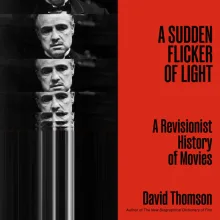
Film history may be heading toward its own ending, and David Thomson wants to look at the whole thing while there is still something to see. The critic and historian behind Rosebud joins Mike White for a Projection Booth Special Report on his new book, A Sudden Flicker of Light, a revisionist history of the movies that took about three years to write.
Thomson traces his obsession to a childhood screening of Henry V (1944), where a dissolve from sleeping page boys to flames lodged in his head for good. He explains why he gave up a place at Oxford for film school in 1960, remembers the time Citizen Kane (1941) played to an empty house and Orson Welles had almost no scholarship behind him, and weighs Pauline Kael's attack on the film.
Then the talk turns to where the medium is headed: photography giving way to electronic images and AI, editing as film's most decisive tool, and why Thomson calls Christopher Nolan's The Odyssey (2026) a hollow sham that may age like The Sound of Music (1965). He also makes the case that The Godfather (1972) still shapes how power looks on camera, and previews his next book, on Mickey Mouse.
What happens to movies when the picture stops being a photograph?
Transcript
An automatic transcript from Spreaker. It has not been proofread, so names, titles and spellings may be wrong, and it does not say who is speaking.
Show the transcript (about 4,700 words)
Hold your ears, folks. It's showtime. People pay good money to see this movie. When they go out to a theater, they want cold sodas, hot popcorn, and no monsters in the projection booth. Everyone pretend podcasting isn't boring.
Turn it off. Turn it off! Welcome to the Projection Booth. I'm your host, Mike White. My guest this episode is the film critic and historian David Thompson, whose new book, A Sudden Flicker of Light, A Revisionist History of Movies, retraces the medium from its photographic origins through the electronic age, with stops at Orson Welles, The Godfather, and Oppenheimer along the way.
A sudden flicker of light is available now. I had a great time talking with David, and I hope you have a great time listening. Enjoy. Well, how did you get interested in film in the first place? I was taken by my parents to see Henry V, the Olivier version.
This would have been in 1945. And they took me to see it, I think, because it was sort of a patriotic duty. Having just won the war or emerged, the idea of the English victory at Agincourt was very romantic. And so I was taken to the film. And it was packed, as films were in those days.
Big theater, 2,000 seats every seat. filled kind of thing, you know. And, of course, I didn't understand it. I couldn't understand the language. But there's a point in the film where the English court is over and knights in armor are in the green fields of Ireland, in fact, where they filmed it, very unlike the France where Agincourt occurred. And I just thought, this is the most amazing, beautiful thing I've ever seen.
Until there was a scene where the French attack the English camp and they set fire to the camp and page boys burn alive. And I believed I had seen the faces of children not that much older than I was on fire. And I screamed. I mean, literally. And my father had to carry me out of the cinema because I was causing such a disturbance.
And I realized that I learned years later that what I had seen was a dissolve. It was two images, the page boys asleep and flames. And at age four or whatever, four, the poetry of it carried me away. I had seen people on fire. And I was terrified.
But wildly excited, and I sort of still am. I mean, the magic and the poetry of moving imagery still gives me as big a thrill as I just get walking in the countryside or listening to music, those things, you know, the great things. And my family quickly learned that if they were looking after me or responsible for me, take me to a movie. It didn't really matter what the movie was. I just loved being in the dark, looking at the light.
Still do. Okay. Well, it's one thing to enjoy movies, but it's another thing to dedicate your whole life to films. And I'm curious, how did you kind of move into more of like the critical writing realm of things? Well, as I said, I went to movies a lot.
I lived in South London, and in the school holidays, I was on my own. My mother worked. My father was away. I would walk, easy short walk, to one of three local cinemas, and I would go to see films. And if the film had what was called an A certificate, which meant that If you were under 14, you had to have an adult, a parent with you.
I would ask strangers if they would take me in. You know, today, the idea that you were allowing your kid to wait outside the cinema asking strangers to take him in, it would be shocking. You'd be sent for social services and criminal charges even. I did it often. Nothing ever happened to me, apart from the films.
So I saw everything. Time went by. As I got into my sort of early teens, I was more or less on course to go to university. I was supposed to be doing all my homework and so on. And in fact, I was sneaking off to movies.
And my mother, in great, great wisdom, I think, said, well, I don't really approve of you going to all these movies. If you're going to go see them, all I ask is that you write something about them. So I would begin to write on yellow legal pads. I didn't think of it as a film review, but forgive me. I was writing a review, and I probably wrote a couple of hundred like that in my teen years.
I found the challenge of saying what I had felt about a film very interesting. At that point, I began to think to myself, well, do I really want to go to Oxford and study history, which was the course I was on, or do I want to do something more directly related to this extraordinary passion in my life? I saw an advertisement for a place called the London School of Film Technique, which was in fact, I didn't know it, but in fact it was the only place in England at the level of higher education where film was studied. This was 1960. So I gave up my place at Oxford and I went to film school.
And a life of ruin ensued. Growing up in the 50s, 60s, and then eventually into the 70s, where you're probably already working at that time, I mean, this is a great era of film. And I'm so curious, what types of movies or what things really kind of blew your mind when you were seeing them for the first time? Well, as a very young kid, I loved adventure. That was often westerns.
Red River. was a very. Important film in my childhood. And it made me just want to be there with that gang of cowboys driving cattle. Not a thing at which I think I would have been very good, but imaginatively, I wanted to be there doing it. And I suppose as I grew older, I began to feel attracted to love stories in a way which, as a young child, I...
I had flinched from love stories. Those terrible kissing scenes, you know, I don't want to look kind of thing. I began to feel, well, kissing looks as if it might be pretty good. And, you know, in the natural. Way of growing up.
And it was in my mid-teens, about 15 or so, that I saw Citizen Kane for the first time. And I had read a little bit. to indicate that this was a very important film. And I went to see it, and I simply could not understand it, but I felt more emotionally moved and sort of mentally engaged than I. Ever had in a film. And I would never have been able to articulate it in this way, but I suppose what happened was that I saw this medium had a depth that really was not sufficiently covered by the word entertainment.
I loved the entertainment value in films, but it was clear to me that they could be as profound as things that also moved me greatly. I mean, I was a huge Miles Davis fan around the same time, and I was reading... People like Hemingway, Fitzgerald, and Faulkner, not always understanding, but really engaged. And I saw that film could be like that, too. And so, I mean, initially, I wanted to make films, you know.
I think any kid who's carried away by the medium wants to do that. And I sort of, I did for a while. And I still am interested in writing for films. But writing about film became my career. And teaching.
All connected. So here we are. At the age of 85. I'm still excited. I'm wise enough to think I probably took a disastrous career direction.
But there we are. You know. Maybe you have a similar story to tell. Maybe you've gone the same way. I don't know.
Look. I love the kind of metafiction that you do. You're kind of mixing both the movies and writing fiction stuff, but especially the Warren Beatty book. I just really liked that, and I liked your approach to that so much. Well, you know, I did...
I don't know how to express this adequately. I did begin to feel that my urge... to make movies and my interest in writing, because I love writing, meshed and led me into writing and thinking of stories about what happened to the characters in films when the film was over. I was really fascinated in that. And when I saw Rebel Without a Cause, which was a very important film in my youth, I lived and daydreamed for a year at least, wondering what happened to Dean and Natalie Wood, the couple who are teenagers but are sort of almost a married couple by the end of the film. And I was really fascinated in that.
And I still, when I see a film that really gets me, I sort of take the characters. Home and live with them. And I think that led me into a way of writing about film stories as if they were constant dreams that one could get into and get out of, as you wished. And, you know, I still am intrigued by that. I have a notion.
I'm not going to go into it in detail, but I have a notion about a book. I'll never write it, I think, but I think about writing it, which is about Warren Bailey as an old man, which is what he is. And I think a man who doesn't really like to leave home, that would interest me as a character study. So I'm still thinking that way, yeah. I think the first book of yours that I read was the Rosebud, the Orson Welles book that you wrote.
What was the state of Orson Welles' scholarship at that time? Because now, you know, you can't throw a stone without reading a Oliver Stone, Oliver Stone, Orson Welles book. Well, I mean, you know, going back in my teens, in the 50s, as I say, I had found a couple of books and there were very few books on film in those days. I had found a couple of books that said Citizen Kane is an important film. The problem was you couldn't see it because we're talking about a film culture, which I think applied in America just as much as it did in England, where cinema showed new films and nothing else.
That was the way the business worked. So that after a film had opened, it's run, it went away. And it was impossible to see old films because all the things that we now take for granted, like television running movies, like DVDs, like streaming, they weren't there. And you might have to wait years to see a film you'd heard about. And I thought in 1955 that The world was waiting to see Citizen Kane again.
And when I went to this little repertory cinema near my house in London, I assumed there would be a great line of people waiting to see it. I was the only person there. Wow. So, I mean, there was no scholarship. There was really no study in Wells.
And if you had said Orson Welles to the ordinary person, They probably would have said the third man. That was the thing for which Wells was most known. I'm sure that was, in fact, the first time I encountered him. And it wasn't until the 60s that people started taking Wells seriously. And, you know, people like Peter Bogdanovich wrote about him and It became generally accepted that Citizen Kane really was a great film and you could see it again.
And then in the early 1970s, Pauline Kael, who was the critic for The New Yorker and. A very, very good writer, she wrote. What really was an attack on Citizen Kane. I think she knew it was an extraordinary film, but I think she thought it had been overrated. I think also she had a certain ambition to write something that would draw attention to her, which it did.
And it sort of polarized feelings about Wells because those people who loved him rallied to his support and a few people understood what Cale was saying, that it was an overrated film, a shallow film. She called it, in fact, a shallow masterpiece. And from that point on, And Wells, of course, was still alive. And one of the things he did all his life was give extraordinary interviews. So he would give very long interviews for television stations, things like that, where he talked beautifully because he was a very articulate, eloquent man, one of the great voices of our age.
And from then on, he became a central figure And I would say that at the level of teaching, the. Director who was most taught. In England and America and outside would have been Hitchcock. I think he's the favorite director to teach. But I think probably Wells was second.
And a rush of books began. And then Simon Cowell began his series. which is still unfinished, many volumes of biography. And as you say, the Wells shelf in the library and in my own office, you can't see it, but it's just over my shoulder. It's one of the biggest shelves, and I only have a fraction of the books that have been done on Wells. But, you know, a great filmmaker, a great raconteur, a great personality.
You know, we haven't even mentioned the War of the Worlds on radio, which was such a big event in 1938, when he was so young. So, so brilliant, and yet an unfulfilled career too, so that he became emblematic of the way ambitions can be crushed in the film business. So, you know, That's a long-winded answer to your question, but yeah, things change with Wells. Well, let's talk about the newest one, A Sudden Flicker of Light, A Revisionist History of Movies, and the subtitle, The Revisionist History of Movies. I really want to dig into that with you.
What does that mean for you? Well, I have seen, as anyone my age will have seen, a huge... expansion in the film library. So, you know, there are books now on individual directors, actors, writers. It's a huge library. And there were a few subjects that haven't been covered or touched yet, but only a few.
But with all the concentration on specific individual subjects, there's been a way in which I think the larger picture has been overlooked. In recent years, I've become increasingly conscious about where the medium is going, and that involves some sense of where it has come from. So I thought that there was a point and a usefulness maybe in writing a one volume, fairly concise, selective history of the whole medium. And I realized that one of the things that would be a challenge in that project was looking past the individual careers and saying, really, what has this medium done for our culture as a whole and for understanding? And even as I worked on the book over the last, let's say, the last three years that.
I've been on the book one way or another. It's become increasingly clear that the medium is in a drastic process of alteration. The thing that we once called special effects, which we thought was cute and clever and funny and cunning and diverting, has become a process whereby the medium that was once photographic is electronic. So that the relationship between us and the reality we're looking at is shifting. And I think by now...
Literally, this has happened, I would say, in the last year. It's gathered momentum in an amazing way. And the ways in which the thing that we call AI, which is like sci-fi magnified to an extraordinary extent, is compromising, taking over, corrupting, diverting the thing that we've all been so delighted to watch and so entertained by. And what's revisionist in the book I've done is really a way of saying, look at the whole thing, because God knows where it is going and what is going to happen to us in the way it goes and what's going to happen to the individuals who try to make films. You know, I lived through, treasure the fact that I lived through it, and I'm sure you did too, You're younger than I am, but, you know, you're close enough in age, you've known it.
We knew the time when entertainment movies worked for millions of people and were also pretty good and pretty serious. Now, you think of films... The 70s was a great moment, the early 70s. And, you know, Chinatown, Taxi Driver, Cuckoo's Nest... and many. Other films like that.
Dark, serious films about the world we lived in, but films you wanted to see over and over again because they were so good. That, I think, that age has passed already. I think that there is an increasing divergence between huge box office films and films that are really interesting. And It came along too late for me to include it in the book, but if I could do a coda, it would certainly include The Odyssey, which is one of the all-time successful entertainments, and I think it's crap. I really think it's a hollow sham of a film, and I feel increasingly that future is coming in which....
Probably the only films really worth. Seeing and talking about and arguing about are going to be very small, personal, difficult films that will be harder and harder to see because they're not going to fit with the commercial streaming process that says, this is a hit. And, you know, The Odyssey is enormously influential in the sense that It convinces the people behind the big business that the big pictures can still work. I don't think they are working. And I think a lot of people kidded themselves about the Odyssey.
I think in a couple of years, the Odyssey may look as dumb as the sound of music. That's my opinion. I found it such a fascinating phenomenon, just boots on the ground and seeing so many of my coworkers and friends driving across the state and spending the night and making day trips to go see this in 70 millimeter. It was wild. Amazing phenomenon.
Yeah, yeah. It was almost as if a great preacher had suddenly appeared. On the horizon, and everyone rushed to him. And, you know, there is something cult-like about it, I think. No, I would say a lot of Nolan's films fit into that.
You would say what? A lot of Nolan's films seem to fit into that. He seems to be this, you know, even with Tenet and bringing people back to the theater after the pandemic, it was such a. Yeah, absolutely. Fascinating thing.
Yeah, yeah. Anyway, that's what I've tried to do in this book. And also, a part of the book, an important part of the book, is the feeling that Donald Trump is a movie. He's an ongoing movie. Some days you think it's a farce, and some days you think it's a horror film.
And it's actually both at the same time, and God knows where it's going. Absolutely, yeah. Yeah, I was curious as far as how you even decided how to shape this book, because it could go off in so many different directions. I'm sure you had to be very careful as far as just what you wanted to keep bound within those pages. Yeah, I mean, shaping it was a big thing, and I was very much helped by my editor at Simon & Schuster, Jonathan Zhao.
Did a great job on the book. I wrote some stuff that I cut. I didn't write some things that I really think maybe I should have done. I wanted it to be a book of sort of 350 pages, a certain workable length. And that meant I had to choose films to concentrate on.
There's a lot left out of the book, but I hope the book talks about the whole thing in a way that The things not mentioned fit into it, too. That's my hope, you know. I mean, I can do another book, you know. I'm only 85. Come on, you know.
Keep at it. Yeah, if you keep practicing long enough, maybe one of these will hit. I might get it right eventually. You said that it took about three years to write this, and I can believe it because it's so in-depth. And I just love that every page was a little bit of a surprise for me when I would turn it.
I'm so glad to hear that because I felt, keep the reader a little bit on guard but off kilter. Don't let them settle into this book. So that I did have a plan that I would be saying one thing and then I would dart away into something else that I can see fitting with it but might not immediately persuade other people that it does. So yeah, there's a kind of, it's a bit like a movie in that it keeps cutting something else that fits once you see the two next to each other. I think, I hope.
What's a very kind of editor's mindset that you're approaching? Yes, yes. Well, you know, I grew up thinking that photography was the essence of film. And I loved films that let a shot play out in time, have the camera move. I love the sort of fluidity of the medium and the feeling that you were watching a real thing.
I would say now that I think the most decisive effect of film. Is the editing. It's the ability to put two different things together in a way that gives you a thing that you did not foresee. It's like the dissolve in Henry V. It's like one shot, sleeping boys, and the flames, and they mesh, and you suddenly get a kind of intellectual, emotional explosion in your head as you're watching.
I'm so curious as far as, was there one particular moment or time that really spoke to you to have you begin writing on this? You mean in terms of actually doing the book? Yeah. I thought it was clear to me in advance that The Godfather was going to be a very important film because The Godfather is without doubt a masterpiece of a certain kind of narrative filmmaking. Everything about it is superbly chosen and composed.
At the same time, it had seemed to me that The Godfather encouraged a kind of male gang mentality that I dislike intensely. And you know, to tie things together, seems to me that Donald Trump is a man who has seen The Godfather far too many times so that he has absorbed it into his being and his language and the way he is on camera. And that is very frightening, I think, because The Godfather is about dreadful people doing dreadful things, and the process of movie has made them glamorous, and they should not be glamorous. So I saw that as being a very important film in certainly the latter part of this book. The Godfather is now 50 years old.
It's amazing, but it feels like a film that could have been made yesterday. A very troubling, disconcerting film. No, I can definitely see that. And yeah, no, I very much appreciated that you were not afraid to talk about trump and and go into that whole arena as well because who knows what the heck's going to happen with this it's one of these you know you're talking about this is a movie and i agree it feels very much like a movie a tragedy a comedy all these things in between a horror film but i can't see the end i can't normally if i walk into a film or if i see a trailer i can pretty much tell you what's going to happen in this film this one i can't see. The I agree with you totally, but isn't it one of the great things about certain movies that after an hour and 15 minutes or whatever, you say, my God, how is this going to end?
How indeed? Will its ending be the ending to virtually everything? Who knows? Who knows? What were some of the biggest challenges of writing this, or can you just pump these out now that you've done dozens of books?
I love writing, and I do not have any trouble writing. I'm very lucky that I haven't had writer's block for decades. I did have it in my 20s, 30s, quite a bit. I can write, but some days what I write may be good, and then the next day, it's awful. And I would say the biggest test and challenge.
I feel is knowing which is which and organizing a book so that you look back at what you wrote last week, you felt, my God, this is good. And then this week, you say, no, it's not actually good. I was going down a wrong side turning then. And I've got to be brave enough to junk that or junk most of it. There's a couple of paragraphs in there that are.
Quite good and that was something I should retrieve and develop. And I think the biggest test I have in writing is that sort of organizational thing. It's knowing what will work and in what order it will work and making those decisions. How many books do you work on at a time? I would say that I frequently will have two or three books.
In my head. Only one of them at a time am I really writing. Another one I might be planning, and another one still I might be regretting that I made mistakes, which I could go back to. So that, you know, I would say three books at a time are in my head. Wow.
Which, actually, I don't think is unusual. I think a lot of writers would say that. I mean, often writers say, well, I really have to concentrate entirely on one thing. And maybe I. I always have other things in my head.
You know, just as I have an ongoing life, I have a wife, I have children, I'm following, I'm getting ready for the 49ers, having a season. You know, I follow Chelsea Football Club in England. There's a whole lot of things that occupy me in a very serious way. And I think concentration is a precious thing. thing, but it's a luxury I don't feel suited to. I like to have a lot going on.
Well, what's next for you? What's the next one that you're just about ready for? Well, I'm doing a book now about Mickey Mouse. Oh, wow. I've never written about animation before, at all.
I was tempted into this by a publisher, and. We will see. But it's about Mickey Mouse and about Disney and about Disneyfication and animation in general.
Comments
No comments yet.