
Show notes
El Goro and Professor Earl Jackson join Mike to discuss Kon's work.
Labels: Earl Jackson El Goro Japanese Satoshi Kon
Transcript
An automatic transcript, tidied into paragraphs. It has not been proofread, so names, titles and spellings may be wrong, and it does not say who is speaking.
Show the transcript (about 10,800 words)
Speaker 1: Hold your ears, folks. It's showtime.
Speaker 2: People pay good money to see this movie. When they go out to a theater, they want cold sodas, hot popcorn and no monsters in the projection booth. Everyone pretend podcasting isn't boring.
Speaker 1: Turn it off. So had you been mash who you got this? So to see ST I know ST you must. What's a, see, you get your kind?
Well, see it's gone out. I don't know how much you have. MIKE WHITE: Welcome to the projection booth. I'm your host, Mike White.
Join me once again is Goro, hey. EL GORO: How's it going, Mike? Happy to be here once again talking about one of my favorite directors. So thank you for that.
MIKE WHITE: Also back in the booth is Professor Earl Jackson. EARL JACKSON: Hi there. I'm really happy to be talking about one of my favorite directors too and it helps to be the same one. MIKE WHITE: We are continuing Japanese month with a request from listener Von Kohlmeyer who probably also likes Satoshi Kon quite a bit, Millennium Actress directed by Satoshi Kon.
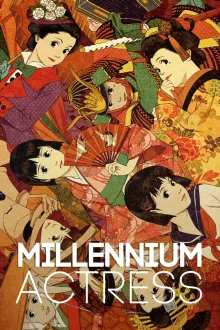
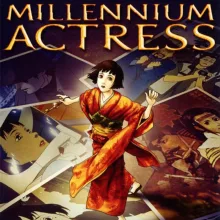
The film tells the tale of Choke Fujiwara, an actress who met a fugitive when she was a young lady who spent the rest of her life looking for him. She's approached by a filmmaker and his cameraman to celebrate the studio. She helped make famous as they learn more about her life. They enter into her memories and films.
As does the audience we move seamlessly between fantasy and reality in this beautifully animated film. So Goro when was the first time you saw Millennium Actress? And what did you think it. EL GORO: Had to have been over a decade ago?
It was a title that I was seeking out because that I mentioned from the jump, Satoshi Khan. I regard him as one of the finest directors in animation ever, regardless of geographic origin and even beyond the realms of animation, his particular style of filmmaking resonates with me on a very deep and personal level and like many people around my age, my very first exposure to him would have been something like Perfect Blue. I distinctly remember the advertisements on it on the old manga entertainment, vhss. And that certainly caught my attention.
But then the next one I saw wasn't until much later, which was 2006 6 is Paprika. And when I watched that was the Lightning Rod. That was the moment where I realized I needed to see everything else he had done. Now, unfortunately, due to things that we'll talk about later, his filmography is not terribly deep, but it was a tremendous journey, discovering these films, Millennium Actress, certainly amongst them.
MIKE WHITE: And Earl. How about yourself? EARL JACKSON: I saw it first in movie theater in Seoul and I didn't know much about it. I knew about Santoshi, of course, but I went in unprepared for it and it absolutely blew me away.
I think he's one of the most important filmmaker thinkers about the interface of technology and subjectivity. The, a live action filmmaker I would compare him to most is Adam Mcgoon. Actually, Adam Mcgoon always does something with technology and loss and memory in his early work. Anyway, I think they're, they're really poignant and Satoshi Khan really hits its Mark in ways that I don't think any other anime person has ever done.
MIKE WHITE: So this was a first time viewing for me and I'm really glad Vaughan had requested this one I have seen Perfect Blue. I was telling El Goro before we started to record that I've had some very overzealous listeners and folks that have followed through the Zine and through the podcast where they're just so outraged about how similar Perfect Blue is to say Black Swan or the other works of Aronofsky. So I watched that and I was just like, yeah, it's pretty good. I enjoyed this.
This is nice. But Millennium Actress, it blew me away. I couldn't believe just how intricate it was, how we just get introduced to everything that they just keep building upon stuff that this idea of them entering into her memories. And then when her memories start to change into movies and that, I don't know if it's, that she can't distinguish between movies in real life.
I definitely think that she can, but I like that they blend those things together. And then as I started to see some of the references become more familiar. There's one shot in particular where it's straight out of a Throne of Blood. And I'm like, oh, this is great and I love that shot and Throne of Blood.
But then to see it recreated in this movie and just that they're able to maintain this and keep it interesting and keep it so heartfelt for the entire running time. I really enjoyed this movie. EL GORO: Well, totally, it may seem like a big shift from the work that he did at the very thriller based work on Perfect Blue into something like Millennium Actress. There's nevertheless very strong points of comparison between the two of them beyond the notion of a young lady working or being in the spotlight, being in the entertainment industry.
But the seamless way he integrates sort of the fantasy worlds and the quote unquote reality suggesting that the line between them isn't as distinct as perhaps we would think. Now in the case of something like Perfect Blue that's presented with kind of a, an element of menace to it. You know, it's speaking to the fractured mental state of our protagonists in there in here. However, it almost feels uplifting.
There's a notion of the reality of Choko it versus her, quote unquote real life and the life on stage, they're integrated. They all parts of this journey, not only for her but also the audience's perception of her personified by our, you know, our cinema, Otago character of Genya. He knows her as this celebrated actress as this icon. And he gets to know the real her in the context of this conversation they have.
But it's all very much couched in the presence of these kind of iconographic roles that she had over the course of her career. EARL JACKSON: There is a structural of similarity between me mania who was the stalker of Perfect Blue and Genya, but Genya is not psychotic, right? There's a major difference, but they both are heavily invested in a person whose real life has very little to do with the images that she's left us. The other difference would be that with Mead, the actress in Perfect Blue who leave the world of Idol to try to become an actress.
She is actually victimized by the characters she creates that doesn't happen with Chiko because Chiko only does the movies to continue her quest. So these characters, it seemed to have no effect on her except as vehicles towards the other that she's aiming at. EL GORO: Absolutely. And it almost feels and again, the comparison to Perfect Blue, the idealized form of the self, the popular perception of it.
In the case of Perfect Blue, it was destructive in the source material. But in this case, it is Choco's own questing. It is her own love that infuses her fictional characters with a deeper amount of resonance. At least that's the implication you get.
It is her perpetual pursuit of this romantic figure from her past that gives her characters greater depth and greater sort of resonance. MIKE WHITE: I love how we are setting things up as a mystery. Even the first time we see the studio being torn down, it's like, what is this? What are we looking at?
Is this post war type of thing? Just because we see all these buildings that have been destroyed. No, it's actually being cleared out. And here you're talking to this actress and then when we have Jena come in and gives her this key, there's two mysteries already.
By this point, we've got the mystery of what is this key, but we also have the mystery of the movie that we see opening up. This whole thing which we don't necessarily know is a movie at first because it's being shown as if it's really happening. It's this whole thing with a spaceship and her taking off and trying to find something. And then we realize, oh, this is being shown on the screen and it's Jena watching this and then when we get to see him rewind the tape that he's working on, it shows the movie backwards or at least some of the highlights of it backwards because it's going through her career that way, which is a nice presaging of what we're about to get, which is taking us through her career more chronologically.
But stopping back in and seeing what's happening in quote unquote the Real World and just that they mix those worlds so much between her memories, her movies and what's happening even in the Real World that he has a cameraman along with him and the cameraman is filming the memories. I wish that at the end of the movie that they had shown what was actually on his tape because we don't know what he's seeing, but he seems to be seeing almost the exact same things that we're seeing, which really puts him and us in the same position.
EARL JACKSON: And he's so important because he's not a believer, right? He selects the objective witness who even still gets drawn in which I would suggest as people who haven't seen these great films of Japanese classical cinema, don't believe that they could actually get drawn in. They would if they actually gave themselves up to them. And I think that's what happens with him too.
EL GORO: It's notable that whereas Geno will actually start taking on the roles in these films, including down to a point where he's basically Zatoichi in one of these movies. MIKE WHITE: He still looks like Zatoichi. EL GORO: Yeah, you but you have his cameraman who is always this kind of third party who is always just being the observer talking about the insanity of it all. But at the same time, never fully immersed within the narrative like Genya is.
EARL JACKSON: That also happens in paranoia agent the fifth episode where they capture the kid who thinks he's some kind of superhero. And but there's two detectives, there's Mani Wa and Yadi and Mani plays the same kind of superhero card game as the psychotic kid. So he becomes part of the psychotic kid's story about the quest against this monster. Whereas the other detective has never played the game.
So he is he remains an objective observer of these two people in the joint fantasy. It's essentially the same structure as it is in paranoia is as it is in millennium actors. In other words, Satoshi Khan is incredibly consistent across his work on the ways people's subjectivity engage with the media texts that they that are, they're focusing on. EL GORO: It has these sort of reoccurring themes and recor even just reoccurring iconography that finds different sort of iterations, different manifestations throughout his career.
And rather than that being pat as, oh, this is a guy playing with the exact same territory I really enjoy the slight different variations that emerge between them and merge between the different sorts of reoccurrences of these particular thematic territory. Again, you compare Perfect Blue to Millennium Actress and then further on into Paprika. It is very much consistent as a singular body of work. EARL JACKSON: The other thing that differs a millennial actress from the others is that it is also relying on actual Japanese film history.
What she's the young girl, I think she's modeled on Takamine Hideko, her early work and then the rest of it, I think she's modeled very loosely on how to Setsuko because how to Seto retired in 1962 and then never gave interviews and what drove her through the films, it also ended her career. It remains a mystery and in some ways, this is Shoko does what Haruko never did. She does open this up to us if. EL GORO: You just watch Millennium Actress and you do see this progression of sort of Japanese cinema from the wartime melodramas that initially gets into Chanba into Jedi Ki into even on T Kaiju movies.
It really does feel like, ok, here is a very sort of cliff notes version of the history and development of Japanese cinema. And yet at the same time, I, there was an interview with Satoshi Khan in the book The Illusionist by Andrew Osmond, where he pretty much out, like he didn't consider himself to be a film historian. He was drawing upon movies he himself grew up with and using that to inform in addition to the research that he was doing. But this wasn't really coming out of the same kind of Otaku fascination with cinema that Genya has.
This wasn't the product of a film historian trying to put, allow me to do a survey of Japanese cinema on screen. That's just how it came out. EARL JACKSON: Satoshi Kani is the psychologist and Genya is one of his case histories in some ways I would think. And, but he has a respect for Ganya.
He's not athos him the way. Of course, NAMI Marin. EL GORO: Was, which was nice to see because you look into Khan's own background and he comes from Otaku stock. He was a geek in his own right and his interests and things like that coming up in the manga world.
And it's nice to see him show that somebody could have these kind of interests without them necessarily going into appropriate enough mania. EARL JACKSON: He's articulate, he and he doesn't just do it for himself. He d he finds a way to make this another statement which is extraordinary and it's such a rich and elegant statement across his work. EL GORO: The Otaku in Perfect Blue was all about possessing the thing that they were obsessed about.
Whereas Gagnon's manifestation of fandom and this shows through, in his actual actions, but also critically in the characters that he takes on. When he himself, it becomes part of the film. He's always trying to help Choko. He is there to support her.
That is his role is as he views the fandom, his giving back. He doesn't want to possess Djoko, he wants to help her. MIKE WHITE: It's so critical when we get shown that he actually was part of her life. That's like a second act twist type of thing where we realize, oh, he's actually there.
And when they show the photographs, quote unquote photographs, which are drawings of course, because this is an animated film and we see him in the background, like focusing on that guy way back there. Oh, there's Jena right there. And that he did play an important part in her life, even saved her life at one point during an earthquake. And that's how he took possession of the key.
Then she gets a key back and I'm like, wait a second, what happened with the key? Because she's going to have to lose it again because he's going to have to give it back to her again in the future. I just love the way that they tied all this together. And then to your point, he's not a crazy stalker guy.
He's just been there to help her this the entire time. And he's just been fascinated and pretty much in love from a distance with this woman who can't love anybody else. She ends up marrying her director Otaki, but her heart is still with this man with the key or the painter as I have him in my notes. And then we find out later on that Jena is also carrying a secret that the man with the key.
He has been dead for so many years. But it's all about her and her quest really. And I think that even if there wasn't a man with a key there and that she didn't run into him when she was a little girl that she would have found something else to motivate her. But it was him that kept her going.
And even with that idea of him not being there anymore, she still keeps going. She still keeps shooting for the stars. EL GORO: The one wonders, you know, that just that notion, if he, she hadn't encountered that man with the key that was coming at a critical time where she was trying to decide whether she would not, she was going to pursue this actor's career. Would that have been the path of her life?
Was it that sort of exposure to romance and that's romance beyond the interaction between people. It's a view into a more romantic world that kind of freed her and gave her that sort of wellspring of emotional content to inform her performances. Would she have become an actress if she hadn't encountered the man with the key? EARL JACKSON: Remember she just gave up when the director tried to talk her mother into letting her go, she had just shrugged her shoulders and left when she encountered the man.
And then I think she manipulated the guys to manipulate her mother about the national film policy to get there. But I do think that this is a kind of turning point that if that was that it's like the mobile structure of the film, there's the film has several structures. There's like interlocking histories, there's the history of her career and there's the history of Genya. But then there's this, the what traverses them is this drive to find this guy.
It's really an amazing constellation of drive and structures. MIKE WHITE: And also the history of Japan. You have so much about Manchuria and the war and just playing against that. Plus Japan's rich filmic history as well.
So, yeah, having these nods to some of these characters and some of the films and we're seeing that all play out and we're seeing it play out in such beautiful ways. There's so many just amazing shots in here where there'll be like a group photograph and she will actually run in from the side and then join the photograph or she's running through, there's montage where she's being transported and I think she's what? On a horse and in a rickshaw and a whole bunch of other things. And she's just moving from left to right across the screen, going through all of these different phases and some of the art style changes depending on what era she's in what transportation that she has.
And then of course, you've got Jena as the rickshaw, the pedicab driver running out in front of her and again, trying to help to your point in India, he's always there trying to move her along and to help her out. EARL JACKSON: There's one poster too. That is really, it's really amazing for it intro textual. It right after she says we were so busy in the fifties.
She poses for a poster where there's a man hugging her and she's much shorter than the man. And the title of the film is Meguri I which just means Encounter. But that poster really is the poster for this three part melodrama. That was an amazing hit.
It was called Kimi No Nawa, which means what is your name? And you know, the very successful it anime took that took that title from that film. Ob obviously it wasn't made yet, but he knew exactly what he was doing with the when you can recognize the film. It's always one that's a major force.
That film actually was produced by one of the people that had been purged after World War Two. This was his comeback as a producer. So there's all sorts of things going on between the lines of this. There's nothing accidental in the things he decides to quote.
EL GORO: It seems a reinforcement of the kind of the political subtext that permeates throughout this. The person that she is pursuing is somebody who's actively standing against the conflict in Manchuria. That this is a, this is somebody who is a dissident in this very right wing government. This time, I think she even mentions before her career started the tilting towards the right that the country was going or it's a reoccurring thing within Khan's works.
You don't hear huge political statements, but it's always there within the subtext just like it's always there in a contemporary of his and somebody he had worked with in various projects, Katsuhiro Otomo, who of course did a AA you can find those little bits of the political commentary though, in the case of Al Qaeda, it's a little bit more on the notes and a little bit more overt than what Satoshi Khan does it. But it's still as somebody like me who is coming from an outsider's perspective. I know there are certain things that I'm missing certain built points of difference that are going over my head.
So laying out, you know, the significance of that film. That's very welcome to me. EARL JACKSON: Now, speaking of Akira, did you notice that there is a sign there for the 2020 Olympics that is in rule talk about forecasting? It's amazing what happens in these anime.
MIKE WHITE: Watching the background, watching all those movie posters and the it looks like fan magazines that are laid out on her table. It's just so rich and I'm like, oh, look at there's that thing from earlier and just catching those and then knowing that there's so many references that I'm just completely missing when she dresses up like a warrior at one point. I'm just like, ok, that tenant looks like Queen Tamiko that I've seen in a movie before, but I'm not sure. So I'm so glad that you guys are here because there were just so many references where I'm just like, this seems like it means something, but it is completely over my head.
But at the same time, I don't feel like I'm lost in this movie. He is definitely taking me by the hand and leading me along. But I think there's a much richer viewing experience for people that are more familiar with Japanese film than Japanese. EARL JACKSON: Culture fan magazines.
Also serve to give us the titles of the film such she did. And these titles are really reflect the language of those periods. Like her first film, which is the fan magazine shows her at a train station and but the title is Ko Shit. Now, no modern film would ever have that title.
Akimi is the affectionate word for you. But shit, Tao is a classical semi-classical Japanese word for yearning or longing. So it's yearning for you. It's a beautiful title.
There is no movie with that title. But then the one where it shows the actress that hates her, the one that, that she shoots in Manchuria is called like the Scars of valor. And there's just this very different feeling with that and those things are really clever and they're just like spread out on her table and then it just keeps going. MIKE WHITE: I was curious what you guys thought of the witch that shows up at one point with the spinning wheel and who gives her, what is it?
1000 year tea So it feels like there's a curse but she doesn't feel too cursed. If anything at the end of the movie, it feels like she goes on forever. She has taken this 1000 year tea and that she will just continue to live for 1000 years. I don't know if that's the thing of her going off into the stars.
But what do you guys think of the witch that continues to come back. EL GORO: On one level, you got a nice reference to Throne of Blood and on the other level, it does support the central theme of this. It's like you will burn for 1000 years in the fires of the passion of love is I'm misremembering the actual line, but it's something to that effect. And that is very much part of her entire journey.
She is in one sense cursed to perpetually be chasing this man that she will never be able to find as we ultimately discover, she was never going to find this man, but she is ever in pursuit. And in a sense that can be somewhat tragic. But then we get the final line where she said it was the pursuit. That was always the point.
That's what gave her the drive for life, that perpetual pursuit. So it's a curse. But at the same time, it's also a blessing because she forever had that thing to always look forward to. And even though it never came, it was the pursuit that she found joy in.
EARL JACKSON: I'm going to go little Freud in this moment because I can't help it. MIKE WHITE: We are all about Freud. EL GORO: So let me light up a cigar and let's do this. EARL JACKSON: That old woman.
First of all, it comes back in paranoia agent too. Almost exactly the same way. But I think she is the drive and she represents the contradiction of desire. Now, let's recall how old Yoko is when she encounters this man, she is probably just going through puberty and she is, he encounters her during that time.
Now, he is not a child molester. He is not actually thinking of her that way at all, but she has fixated on him now. So he is the last object for her. And what the witch says is that this is what you will drive you because that's how desire works.
You get a lost object and then the rest of your desiring career is to find substitutes, but she doesn't find substitutes. She sticks with the lost object. And this idea that even when it's lost, you keep going. The other great cinematic meditation on that is the Maltese Falcon.
Remember they look everywhere for the f falcon and when they find it's fake. And so they don't give up, they say let's go look for it in Istanbul in Constantinople. She probably knew the guy was dead through the whole time because remember she recognizes the soldier that tortured him Right. And she throws him out.
So I think she was perfectly knowledgeable that he was gone. The stuff that dreams are made of, I love it that, well, that's a great tie in because that's exactly the right thing I appreciate that. MIKE WHITE: There isn't, it's a romantic thing that she's pursuing this guy, but there isn't necessarily the romance there though. She does seem to promise herself to him.
And when she, I think she does realize that he is gone at one point and that's when she ends up getting married. But there's still that longing that what could have been would have been, should have been type of thing. And she also gets told quote unquote that he's gone when she finally finds his painting and sees him walk off into the distance inside the painting and turn around and wave and then fade out. I love that scene that we finally get to see what's on that painting and that he's doling out this information slowly through this movie and it never feels just tell me the answer.
I want to know the answer because just like Joko the joys in the journey and seeing how these things are going to play out because it just the way he doles out this information just as great. And I love how we replay things so often like you're talking about the soldier with the scar who had tortured the man with the key. And that would get him coming back both in movies and reality. And then that whole thing of Genya finally hearing the secret, hearing the confession.
It's basically like a deathbed confession. It sounds from the guy with the scar, but he's the only one that hears it. What a great way of storytelling this is. EARL JACKSON: But her anger at him tells us that she knows what he's going to say.
EL GORO: And then her rushing off to Hokkaido, which was interesting that Khan decided to use that because of remembering correctly that he was from Hokkaido. So you got to revisit some of his own childhood, at least a little bit though. It's a bit more reduced into a snowy landscape which again, beautifully echoed later on when he, when it transitions into the moonscape. But it's her running away from that reality be to continue the chase.
EARL JACKSON: That Hokkaido's the snow scape. It's like the white space of the canvas and it's a white space of the movie screen and it's the white space of her fading out. It's just, it's a perfect location. I've actually been to Hokkaido in the depths of winter and it looks exactly like that.
And it's there is something absolutely magical about that snow scape. So it made absolute sense that she goes there. MIKE WHITE: And I love that the photo of her as a young girl comes back again, as the painting she finds on the wall with the message we will meet again. Just that kind of like over stylized younger girl type of look of that.
And then apparently she must have taken that wall or taken that piece because then that painting goes with her throughout so much of the rest of the movie. And then when it cracks towards the end, when the glass cracks and from the frame, it's just ok. Now something is really going to happen here because that painting has been so precious to her for so long. I love just some of the little things that happen in this that you can do with animation that you can't.
I guess you could do it through editing and camera tricks such as she's in one outfit. She says I have to get ready. She closes the door, she opens the door right up and she's completely dressed in a different outfit. It's, this is the magic of what we're doing in this or when she's in the train that has been hit and we haven't even talked about earthquakes, but her whole life revolves around earthquakes or earthquakes revolve around her life.
I'm not sure which the train has been attacked by bandits in Manchuria. And she finally gets this door open and when the door opens, it's in a completely different scene. It's very wizard of Oz when you open up the door and it's in color. But now she's walking into another movie and those transitions just happen throughout this whole thing just so seamlessly.
And we are lucky to have that cameraman character who just panics whenever those things happen. And in my notes, I don't call and this could be wrong, but I don't call Genya a director. He always seems to me more like an editor and it feels like this movie, he's helping to edit some of this, but he's the one that's helping to prompt us into the next shot. The next scene.
It doesn't feel like he's controlling things. He's just helping to shape the story. I would not call him the director of this piece. Even though I guess technically, he is directing this documentary about her.
EL GORO: He's a documentarian. And while the role of the director of the documentary is to shape the narrative largely in the edits, everybody works slightly differently, but most of them will agree that they're meant to be observing and during the time and his role is to be that sort of observer of what's going on. Now, that line blurs when he starts actively entering into it, he can't help himself but become swept up in her narrative. And then as of course, we find out he's always been a part of the narrative of her life going back decades upon decades.
But the one of the things you were talking about is the notion of what could be accomplished in animation. And also pointing out that the seamless transitions between scenes into eras, into reality, into film, all of these things coming together that this, yes, it could, it could very easily be accomplished in the realm of live action. But one of the things that I think benefits from the approach of using animation is it primes the audience to be more willing to accept these sort of dips into serialism. And it's one thing I've talked about frequently is that the easiest sort of venue for serial imagery and just things that defy our understanding is an animation.
Because ever since we're children, we're primed to accept the unreality stroke reality of an animated world. And our, our conceptions of what is possible in the animated world are much, much looser compared to what we experience in a physical world. And so in live action, I think that they, those sort of transitions would have been much more jarring reading in the background. In this, they talked about the notion of using or creating an animated compo the notion of a two D image that is gives the illusion of 3D.
But in the concept of Satoshi Khan, he took that in a more abstract sense. He wasn't necessarily trying to make a 3d effect through, through animation, but rather to blur the lines as to what animation could be and the reality of this animation to blur the lines of what our expectations are. But at the same time presented in a way that just organically flows and part of it helps that we have this kind of outside character in the form of the cameraman to give voice to the audience of what the hell just happened. So that helps ease the transition.
But I still maintain that if while this is everything he did in this film could be accomplished in live action, but there is an intangible quality to make it in an animation that makes it work so much better. And that's true of so much of his work. There have been talks about various people attempting to adapt his material and remake it in a live action context. And honestly, I think the best approach to it is just what Aronofsky did grab some of the visuals because if you try to do it as a whole, you're going to lose something.
EARL JACKSON: He does the same thing and Perfect Blue, but he makes it a nightmare because it's only an anime that we would be sharing her delusion. Those delusions wouldn't work in live action because we would see who the woman is, that's pretending to be her that, that blurring. There has no third party objective viewer. So there's no cameraman, right?
So we are trapped in the delusions and that is why that's scary. Here, we're invited into the living nostalgia of this cinematic legacy, which is remarkable because it's exactly the same technique with entirely different effects. MIKE WHITE: He's doing such a smart job when it comes to your foreground, your mid ground and your background and really separating those out. I think one of the first shots is of a Cityscape and you can really see the planes going off into the distance and they play with that so often in here, like I was talking about her running into a photograph, there might be something in front and she's running behind it and then moving into that mid ground and there's something behind the mid ground that she might move into later.
And just, he's always playing with that and giving us this really wide sense of depth in a two D style in a two D medium, there is no 3D to a AAA screen, but he gives us that illusion so much and he's just playing with that so often and even with things like there's a moment where there are a whole lot of bombs that are being dropped and that almost looks like it's 3d animation just because it's so vivid to see the shapes of those bombs coming at us. EL GORO: Which is always a Mark of what I consider to be just great animators.
And it's the same thing to bring up Katsuhiro Otomo that if you go back and you watch, aka one of the things that you find, particularly if you look at some of the storyboards and the aims of it is whenever they would have a layered shot, particularly with a lot of people, they would individually animate the complete motions of those characters despite the fact that when all these things were layered on top of each other, you would hardly see these characters, you might see a shoulder or a head, but they had actually animated the full body of them because they wanted them to have a reality that even if you can or conceal it with foreground elements.
If you don't animate the whole thing, you're not going to capture the motion quite right. It's not going to impart across it and that it's something that's great animators will always pursue that extra step. It's one of the terms that arose in the animation circles comes from who framed Roger Rabbit rabbit. It's called bumping the lamp that there's a scene in who framed Roger Rabbit where Roger Rabbit hits a lamp and it swings back and forth and they had to animate shadows on Roger Rabbits in order to reflect that swinging lamp.
Now, they didn't have to do that. Everything in that frame was designed at very meticulously, they chose to, they chose to bump the lamp, they chose to go that extra step. And that's largely what separates good animation from truly great animation. MIKE WHITE: There's one moment I'm trying to remember if it's both chou or if it's two women, but the camera seems.
And I'm saying the camera, even though there is a camera when it comes to animation, but the camera is not moving. Everything that it's photographing is again, not moving, but it looks like there's movement where it looks like the camera is moving around one person and then moves around another person to reveal like a new version of them. And it's gorgeous, absolutely gorgeous stuff. And I'm just like, how would you even plan out a shot like that?
How would you plan the dimensions and how people need to look the perspectives as you're moving around their faces and moving to another person and doing kind of the opposite camera move just stellar stuff where I'm like the amount of planning and the artist, the artistry to be able to pull a shot like that off. It's terrific. EL GORO: A lot of talent and not very good, strong labor laws over there which can result in some terrible conditions. But it does make for very good animators.
EARL JACKSON: And also do you remember if you're doing a live action, there is actual real space and there are three dimensional objects in space, whether they're a actors or furniture. But the space in a shot in an anime is entirely metaphorical or it's allegorical. You so you have to have an analog to space to do something like that. I can't even imagine how you formulate a shot like that.
MIKE WHITE: Nothing in this movie feels like it's a throwaway. There's a moment where she's in her, I think in her house and you hear something over the radio or on television about these astronauts. And I'm like ok. I guess this is around 68 whenever the moon landing took place.
And then later on, she ends up on the moon. I was like, oh, no wonder that thing about the moon was in there because now she actually is on the moon. It just, everything plays with everything else and to see these characters recast and move from one to another. Like I said, the man with the scar on his face, we see him several times.
We see things acted out several different ways in a movie. She might be asked this band that came through here, where did it go? And that same thing happened to her in real life and she'll have it happen in a movie and then she'll have it happen again later on just again, the pacing of all of this and doling out of the information and the recasting of these scenes. Very clever.
And I was so glad to see that they weren't just the same things over and over again. They each had little differences that then changed the nuance of what we're seeing and gave each one a new interpretation. EL GORO: I seem to remember and apologies of getting my time run off of this but beyond simply the moon landing. So 6869 didn't were, wasn't the Olympics also held in Japan around that time.
And that was one of the first times that they were, the television became huge and that was 6464. So the sixties was a sea change if I recall correctly in the Japanese movie market because the Olympics were held there. So many people went out to get televisions and that's what gave rise to the television market, which put a tremendous amount of strain on the film industry as you could imagine. They had, they used to have a monopoly on entertainment.
And so to integrate into that, it's these little subtextual things that fly up. EARL JACKSON: I may be wrong but I was guessing that the movie about the spaceship was around 1962 because that's when Haro Seo retired. But I could be wrong. Maybe her career lasted longer than that.
But she was born in 1923 during the earthquake, right? So she would have been 40 in 62 but she would have been in her late forties in 68. I suppose it does still work for sure. MIKE WHITE: Yeah, there was, yeah, the Nata earthquake in 64.
And then there's the Western Honshu Earthquake in 2000 where I guess that's when she dies, which I didn't really realize that she died because it feels like she's very alive. At the end of this movie. EL GORO: It's that Stargate sequence at the end. So she is alive and so far that her memory is going on and she has achieved the immortality through her work and her perpetual pursuits.
MIKE WHITE: I love too that there's a lot of humor in this movie, like the first time they're talking about her and again, because just beautiful women actresses, they never age and then there's a, like a shot cut to her housekeeper who looks very old. And it's like, oh, and I'm laughing at home and it's like, oh, no, she's just the housekeeper. Ok. But yeah, there's so many good jokes through this whole thing as well.
EARL JACKSON: They just are so true of Japanese actresses. If you look at the older actresses, they are still beautiful. I actually match Okada Marino, which was a terrifying experience with. She was 8886 I think when I met her and she is absolutely stunning.
And if you see later interviews of these actresses, they do maintain an incredible beauty. It is partially, of course that we love them through them. And I'm, I am a total, I go for that the actresses of that period. So I'm not necessarily a reliable source here but his certainty that she was beautiful.
I totally understood that certainty. EL GORO: And that sort of comedy which it speaks to another quality that I really appreciate about Satoshi Khan. That despite the fact that there is a great deal of thematic depth that you can find in his films that doesn't make them a slog by any stretch of the imagination. He is an entertainer and he knows how to draw in and guide along an audience throughout it.
This is not a terribly long film. But even in 87 minutes, it just breezes by and by the time it's over, you are almost sad because you've enjoyed the ride so much. And it's even the same with his series paranoia agent that, you know, it's, it's some, some 13 episodes, but they just breeze right by and they'll go in some very heavy territory. There's one particular episode as a warning to you, Mike.
If you ever go out and check out paranoia agent, there is an episode of that show that will absolutely devastate you everybody who's seen it. And I'm sure that Earl, you know exactly what the episode I'm talking about sounds, it will, it will wreck you. That's something you find in a lot of Khan's work. But he is at the end of the day, an entertainer and a damned fine filmmaker.
It's one of those when I'm, when I try to tell people about him. One of the, that's one of the things I emphasize is this isn't eating your vegetables. This is a full course meal. MIKE WHITE: I didn't realize that I'm making my way through his filmography.
That Perfect Blue was his first feature. And then Millennium Actress is his second. So it sounds like I need to watch Tokyo Godfather's next. EARL JACKSON: The paranoid agent I think is one of the greatest things that ever happened to television.
I rank that up there with the Wire and Twin Peaks in some ways. Wow. I'll go with that. MIKE WHITE: Yeah.
Where can you find stuff like paranoia agent? EL GORO: I believe it was streaming on Crunchy roll in the past. But I pick up the, or actually I should say one of my listeners actually bought me the Blu Ray set because he wanted to discuss it on the show. And normally I'm reticent about talking about series on a movie podcast because it doesn't, it represents a certain investment of time.
And I'm a movie guy, but he sent it as a gift. It's OK. If you're gonna buy me the thing, I'm going to, I'm going to watch it. But yes, it is readily in print and I don't know about streaming.
It might be on Crunchyroll. EARL JACKSON: I think it's actually on YouTube right now. I'm sure it's quite illegal. So hurry.
EL GORO: I will say the Blu Ray that I have of, it looks gorgeous. So I will always point to people towards trying to get the highest quality they can, especially with something like Satoshi Kon because his animation is just so beautiful and I'm very grateful he's reached the status he has because there was a time and there's still are quite a few of some Mimoto Oshi ST stuff that has never made the jump, at least in America to high definition that you can get it as a DVD. But especially again, something like Millennium Actress.
It benefits so much from that HD presentation, especially when you get into something like Paprika. Paprika needs to be seen at the highest resolution. I wish I had the opportunity to see that in a theater because to go, wow. EARL JACKSON: It's stunning, literally stunning.
I have the Blu Ray For Paranoid Asia too, but the Japanese absolutely refused to put subtitles on their DVD S and Blu Rays so I can't teach you and none of mine have subtitles. EL GORO: Yeah, I have the Blu Ray from funimation. So it has the English dubs and the subtitles on it. MIKE WHITE: I found a really nice version of Millennium Actress that had a commentary on it.
But unfortunately, the commentary was all in Japanese and there were no subtitles for her. EARL JACKSON: I read, I watched those. Those are cool you and thank you for putting them. I was really surprised to see those.
I've never seen those before. MIKE WHITE: Yeah, I wish this, the commentary had subtitles. That would have been fantastic for me not knowing that much about Satoshi Khan and then also that he passed away so young that he wasn't even 50 he was 46 years old. That's a tragedy.
EARL JACKSON: He left a goodbye letter on his website and the ending is absolutely heartbroken. It's hard to convey it like his last word is Oji Osaki. Now in Japanese when you're leaving it, like you're in an office and you leave before your fellow workers, you say Osaki Seimas, it means I'm committing the rudeness of leaving before you and that's what, how he ended the thing. So he's apologizing for leaving before us.
It's, it's absolutely stunning. He had cancer and he knew it, he knew he was dying for a long time before he did. That's why he wrote the letter pancreatic cancer. EL GORO: And I remember when he passed because again, I'D, it was really after Paprika came out in around 2006 that I became a OK, this is my guy and I was wanting to discover more and more of his work and then all of a sudden boom, he's gone.
So it's just on one level. It's tremendously unfortunate that he has such a limited filmography. But each one of his films are and I count paranoia agent amongst that, even though it's a series, it is such a singular vision and such a wonderful expression of incredible talent that yes, we can lament the fact that he didn't, wasn't able to continue working. But man, the stuff he left behind is so amazing.
MIKE WHITE: Yeah, I definitely need to see more of his work because I'm, I've been so impressed by what I've seen, especially Millennium Actress just really blew me away. EL GORO: If you like the soundtrack from Susumu Hirasawa. The work that he does with him on Paprika is such a good soundtrack. I love the soundtrack for Paprika and a paranoid agent.
MIKE WHITE: Looks like I've got some more watching in my future guys. EARL JACKSON: You're lucky. I love the first time I watched them. So I envy you having that experience soon with somebody like Satoshi Khan, I could just a gush about him rather than be interested in.
I'm afraid though, one of the things that's interesting is like the whole idea of the key because just think about the key is usually the key to a map or the key to the secret. But the key is the secret in this one. It's, it's just glorious, every aspect of this. And also the fact that we are three sophisticated adults who are talking about this and talking about the importance of human feelings without being maudlin and without being suckers.
That's a real accomplishment for a media text to convince us of that. EL GORO: And that's one of the best things about this film is that it is a film that is essentially about on one level death and complete and continually subverted expectations, a dream that is never achieved. But it is a tremendously uplifting movie. It's, it leaves me in such a good mood every time I watch it, I love that quality of that movie just as I love the same quality that pops up and again.
Paprika. Perfect Blue. Yeah, that's a downer of film, but it's still, yeah, I absolutely adore this film. And if people take nothing more away from that, they should certainly, hopefully they would have sought out this film before listening to this conversation because we did speak rather freely about the movie.
But if they're on the fence, consider me this me not only pushing you off but blowing up the entire fence, dive into this film and dive into his filmography. Each of his films are spectacular in their own way. I can't say anything more than that. I adore this director.
EARL JACKSON: It's almost as surprising that he was able to make all of these films because he's so much smarter then general population over the general business world. I'm just so grateful that they let him do this. If you see somebody like I know he did it, but I love Evangelion but there are lots of parts where it's just dead weight. It's just so expository or it's just so self involved.
Oh, it loses me even though ultimately, I love it as a text. I'm never lost in Satoshi Khan. I'm always with him. EL GORO: And in a world where particularly in anime and it's only gotten worse these days where because of the economics of creating these sort of productions, there is a tendency towards let's just recreate and repackage what was successful before and it can result in into, into some incredibly shallow works.
It's one of those things that I'll, I'll talk to people and I won't necessarily describe myself as an anime fan because there is a lot of Drek in there and I have friends that are just, if it's long as it's animated they're fine with it. W way. But there are these works that I will full throated just embrace. And K Khan is absolutely one of them.
And he was able to make these singular works that are on one level, certainly able to resonate with a wide audience. But at the same time, do so in a way that doesn't feel like he's simply pandering the tropes that he is, his stuff is uniquely him. And I think that's one of the reasons they have the kind of the potency that they do. EARL JACKSON: And in both the case of apricot and Perfect Blue, I read the novels and the, this is one of the rare cases where the films are better than the novels.
It's really extraordinary what he was able to, he's like re metabolizes them into something completely different in ways that are just great. EL GORO: And it was interesting when I was doing the research for this, where to read that he had intended Paprika to be his follow up to Perfect Blue. And then due to the fact that the company that would distributed Perfect Blue went out of business. That would that kind of sent it adrift.
I'm glad of that. I'm glad that Paprika came later in his career. Sadly, would, it would be his final film, but that he was allowed, he was able to refine his technique even more. Not that not that he wasn't already operating at a wonderful level already Perfect Blue and then millennium actors.
But I appreciate the fact that that came just a little bit later. EARL JACKSON: You remember there's a detective in it named Kono Kawa who says he hates movies. And it turns out he had made a film and felt guilty that he gave up filmmaking and his partner in filmmaking died young. And so there's like the scene where he's in a dream in the internet, in a bar and they play the movie that he thought that he was guilty for shooting someone.
But it's actually the movie that he and his friends made. And now he sees himself as both the person who got shot and the shooter. It's the most ex incredibly intricate way of giving into this guy's head and it turns out that he gets cured by remembering that he loves movies, which is, I totally endorse that therapy. But there's some, everything that, that Juan has done has a surprise like that, like a complicated surprise.
EL GORO: And that's one of the great things especially as sitting and talking as movie fans that Millennia Matrix and Paprika. They are both about on one level, the transcendent quality of film and the power that they have beyond the medium, the power to re continually resonate with us and resonate with us forever. There is as much as Hollywood likes to trot this old canard out there is magic in a movie and it's one of the things that makes it a uniquely impactful form of entertainment and form of art that can transcend.
It doesn't matter the geographic origins. I was mentioning that I am from a very different culture than Satoshi Kon. And I don't, I grew up at a very different time and yet his movies, his arts have that ability to resonate very deeply with me. EARL JACKSON: And on several different levels, like for example, I can be thrilled every time I see a Wizard of Oz, I can be thrilled every time I see singing in the rain.
And I don't mind that. I'm really glad. I think that Khan mixes this kind of media meditation and intellect with that kind of magic and he's a believer and he really vindicates that belief and what he's achieved. MIKE WHITE: All right, fellas, we're gonna take a break and play a preview for next week's show right after these brief messages.
Speaker 6: Finest kind is available to buy on digital today starring Ben Foster Toby Wallace with Jenna Ortega and Tommy Lee Jones. Two brothers reunited under desperate circumstances are forced into business with a dangerous Boston crime syndicate. Putting their family ties to the test directed by Brian Helgeland. Finest kind.
Get it from Fandango at home now rated R from Paramount pictures.
Speaker 7: So my, I don't want to go, don't know me had to be cheap. Still don't OK.
Speaker 8: So we take sister Joda.
Speaker 7: Yo White P. She said you a spy. A shop when you cancel MTA na raggedy one. Write that, choose you off color to that.
You h you Ika Janet.
Speaker 8: I, yeah, there's no time now to at me that, that you die in, I, that I, my Sanji KKK Emma.
Speaker 7: She can tell you tonight. MIKE WHITE: That's right. We'll be back next week with a look at heroic purgatory until then I want to thank this week's co-host Earl and El Goro. So El Goro, what is the latest with you, sir?
EL GORO: Right now, if, if you've listened to me in the past, you know that I'm the host of the Talk about Rhythm podcast, a weekly movie discussion. And depending on when this episode drops, I'll most likely be in the midst of my annual series of Patreon picks where I turn all the selections over to my Patreon so they can do the work for me and point me in the direction of the movies that I watch. Always a lot of fun because it will frequently, sometimes it will be stuff I've never seen before. Other times it'll things that somehow have fallen through the cracks.
I love the act of discovery and the continued journey of films. I have no idea where I'll be at when this episode drops, but I'm sure it'll be having fun when, regardless of what's going on. MIKE WHITE: Yeah, this one is a Patreon pick for me. So thanks again to Von Kollmeyer for picking this movie out.
And Earl, what's going on in your world? EARL JACKSON: Sir, David Desser and I are coed in the first book in English dedicated to the director Kino Takes. I have two chapters of that. It's called The Films of Kino Takes Times of Joy and sorrow.
It'll be out with the University Of Edinburgh Press and right now I'm just finishing my own book on the relationship of theory and practice in Japanese cinema. I'm doing for directors who also wrote the that Yoshimoto, Kozoro Masumura, Yasuzo, Oshima Nakis and Yoshida Kiu. So doing Kjus film next week, next time we'll be drawing on that. But I'm really looking forward to this, the series of gigs that I have in the UK.
This summer, I'm going to be doing a workshop and I guess it's a roundtable. I'll do a lecture based on my theory book and then there's gonna be a roundtable at the University Of London. And then I'm going to the University Of Sheffield for the Chinook Club conference and I'm doing stuff about the relationship of film and film magazines during World War Two in Japan. I'm doing all all sorts of things.
I talk a lot as you can tell. MIKE WHITE: Thank you so much guys for being on the show. Thanks to everybody for listening. If you want to hear more of me shooting off my mouth, check out some of the other shows that I work on.
They're all available at Reading Way media.com. Thanks especially to our Patreon community. If you want to join the community, visit patreon.com/projection booth. Every donation we get helps the projection booth take over the world about.
Watch
Music credits
- "rotation (LOTUS-2)" - Susumu Hirasawa
Links & resources
Related episodes
Episodes that share keywords with this one.
Close Encounters of the Third Kind (1977)
Shared: El Goro
Joe Alves, Matthew Robbins, Jim Bloom, Douglas Trumbull and others
Comments
No comments yet.