
Special Report
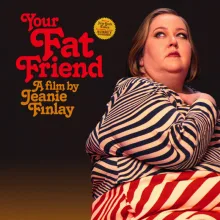
Jeanie Finlay on Your Fat Friend (2023)
Show notes
Transcript
An automatic transcript, tidied into paragraphs. It has not been proofread, so names, titles and spellings may be wrong, and it does not say who is speaking.
Show the transcript (about 3,700 words)
Speaker 1: Hold your ears, folks. It's showtime.
Speaker 2: People pay good money to see this movie. When they go out to a theater, they want cold sodas, hot popcorn and no monsters in the projection booth. Everyone pretend podcasting isn't boring.
Speaker 3: Turn it off.
Speaker 4: Just say fat, not curvy or chubby or chunky or fluffy or more to love or a big guy or overweight. Just say fat. The very first piece was called a request from your fat friend and like 30,000 people read it in a week. Whoa OK.
My aim is to provoke people to question the ideas that we've held on to for so long. The strongest bonding amongst women happens when people are talking about how much they hate their bodies. Oh God. I had a woman take a melon out of my cart and she went, it's got too much sugar for you.
It's a melon. The wellness industry is worth $4.5 trillion. This is like big tobacco levels of just lying to people. It's like they're trying to pull some Jedi mind trick.
It's not a diet. At the tender age of 11. I had already attended kids, fat day camps.
Speaker 5: It was my responsibility. Her size was my responsibility.
Speaker 6: You know, I was always like, my father worried about losing control.
Speaker 5: Having cameras going, sort of makes things bubble up.
Speaker 4: It is a real paradigm shift to look at someone my size. And rather than thinking, boy, I wish that person would put in some effort thinking that person may have put in a great deal of effort and that might have been what got them here as a fat person, you figure out how to disappear yourself. That's the only way I have existed in the world. In the last chapter of the book, I took more from how you looked at yourself than how you looked at me.
Speaker 5: But I think that's how it gets past word.
Speaker 4: Hi, everybody. Welcome to maintenance phase. You will learn and have a good trip.
Speaker 3: If you call. MIKE WHITE: Hey, folks, welcome to a special episode of the projection booth. I'm your host, Mike White on this episode. I'm talking with Jeanie Finlay.
She is the writer and director of the 2023 documentary. Your fat friend. It's a great look at Aubrey Gordon, the your fat friend of the title. She was an anonymous blogger became a best selling author and now she's a podcaster.
Thanks so much for listening and I hope you enjoyed the interview. Obviously, I want to ask you about your fat friend, but I would love to know a little bit more about you and how you even got into the documentary business. JEANIE FINLAY: I'm a filmmaker. I'm based in Nottingham in England.
And your fat friend is my ninth feature film. I'm currently making my 10th. I started making dogs because the conversations I had with people while I was filming them were the most fascinating and interesting thing. And so I just started filming them and that's how I organically became a filmmaker.
And then the BBC commissioned me off the back of my artwork to make a 60 minute film. And then I made a feature for IC and it just as soon as I started making films, I just knew I'd found the thing I wanted to do for the rest of my life. So I've made small films like about the last record shop in Teesside where I grew up to being behind the scenes of the biggest television show in the world Game Of Thrones. But all the films I make share a, I don't know, maybe they're made with the same accent or sensibility.
MIKE WHITE: How do you choose your subjects or do your subjects choose you? JEANIE FINLAY: Generally, I choose the subjects. I've only said yes, twice. That was to HBO and Game Of Thrones and to Freddie Mcconnell when I made Seahorse.
But I decide if I'm in, I'm all in. So usually I have an idea or a story I want to tell and then I go out and raise the money, find partners and then sometimes it's, you find the person to tell the story or you're just already telling a story or the man who would be king. It's like being an archaeologist and you're excavating the past. And with Aubrey on, in your fat friend, I wanted to make a film about fatness.
And when I found Aubrey, I knew I'd found the right person to tell that story. MIKE WHITE: How did you find Aubrey? JEANIE FINLAY: Aubrey went viral as an anonymous writer called Your fat friend. And she wrote this one piece called What I Need when I talk about bodies.
And she sent it out on medium and it went viral six years ago. And I was one of the 30,000 people that read it in the first week. And I'd been researching an essay, film about fatness. And then as soon as I read her essay, I just thought, oh, my goodness.
I want to know who is this anonymous person who's written this essay? It was emotional and making the personal political. I just thought it was a great voice. She just sounded interesting.
So we started talking on the phone because obviously I live in England. It's not a hop skip and a jump to get to Portland, Oregon. But we started talking on the phone and she also, it just seemed interesting. She had this like loud voice.
Her writing is so tender and gentle. And then as soon as I met her, I just knew this was exciting. This was interesting. And then I met her parents and I knew that the different place that they were in, you've got a breeze.
Someone is trying to change the world and bring about sort of social change and help us to have different conversations about fat people in the world. But the fat on our own bodies. And then you've got family who were struggling to even say the word fat. And I like making fools about messy human family drama.
And I felt like I'd found everything that I needed. So this was my direction. MIKE WHITE: How long does it take to get in touch with her? And how long does it take to then end up meeting her?
JEANIE FINLAY: I got in touch with her immediately. It just felt exactly right. And we talked for a while. I think it was probably three or four months until we met.
I was actually out in Los Angeles being interviewed by the showrunners for Game Of Thrones. And I used it as an opportunity to go to Portland and the producers of Game Of Thrones loved that I was backing a new film while I was out there. The executive Game Of Thrones said now that is a producer but, and I filmed her immediately. So I get to know people with a camera in my hand and I did a bunch of all sorts of different filming in Portland and I met Aubrey on the last day and just thought, oh, this is really interesting and then initially her contribution was going to be always over.
But I just love the contradictions of being a big sort of charismatic personality but also being anonymous. How do you contain that? And yeah, like I said, the different place her family was at with a different place, the place Aubrey was at just seemed interesting to me. MIKE WHITE: I imagine being a documentary and you really have to get your subject to trust you.
How difficult or easy was it to get Aubrey to trust you with this? JEANIE FINLAY: Yeah. My films live and die on whether people trust me and part of part of the way I achieve that is by being very careful about the projects I say yes to and also looking, I'm a producer on all of my films that I direct because it means that I can keep the promises that I make to the people that I put in my films. So I know that if I'm promising what the film is going to be called, that is gonna be the name the film will release under.
And Aubrey watched my previous films in particular, The Great Hip Hop Hoax and Seahorse, the dad I gave birth. And she said these are complicated stories that could have been told in any number of different ways, particularly with great hip hop hosts those. It's about these naughty boys who got a massive record deal from Sony convinced the world that they were the next sort of big L A rappers to arrive in the UK in the wake of Eminem. But they were actually two students from Dundee in Scotland who'd learned American accents from MTV and watching pop videos and conned their way into an enormous record deal.
So it's a film about identity and made up sort of personas and with that film, no one is evil or good. It's you want and hu the human condition is an endlessly nuanced thing. So I'm trying to make space for that in my films. And I think that a Aubrey responded to that.
MIKE WHITE: How often were you with her? As you said, you are thousands of miles away and there's obviously scenes in the movie where she's filming herself. How often were you over there? Actually with her?
JEANIE FINLAY: I was over quite, quite a lot of times we're speaking on zoom every week and often more often than once a week, there was a pandemic. So that meant that it was interesting. Like I started filming with Real Deal in February. I picked the project back up in February 2020 ready to really go for it and was out in Portland in February, took out 24 K camera kits left them there because I was gonna be back on March the 20th and had all of these discussions with Abu about.
Do we think this virus is a really a thing? And then ended up having to teach her how to use the camera so we could keep things going because I just, I started to work on your fat friend. Then I ended up making Seahorse and Game Of Thrones the last watch in between. So I was out in L A quite a lot for Game Of Thrones.
And every time I was out I would film with Aubrey and I think I worked, I spent something like over five months in Portland in all. It's not insignificant amount of time to be away from home and to like to be in someone's life and get to know the Pacific Northwest a bit because somewhere I really Portland it's, I feel like it's the Nottingham Of America. Just more rain and more lush I think. MIKE WHITE: Yeah, I was curious how the pandemic affects you.
And gosh, that must have been really difficult just to even do traveling during the pandemic. JEANIE FINLAY: Yeah, it's really difficult and also like the safety, is it safe to fill what should we be doing? And when things was getting easier and once we'd all been in a separate countries for quite a long time, I got dispensation from the American government to come out early. So I came out to the US where, yeah, when the country was still not open to foreigners.
So I was allowed in, it was strange time, strange times like people were still masking on the street in Portland, which was, which is something we never had in the UK, which is very interesting. It's just culturally, very different. MIKE WHITE: You said that you spent about five months in Portland and then there's all the filming that she had to do on her own. How much footage was there for you to go through when they, everything was said and done.
JEANIE FINLAY: It used to be so much easier to keep a track on how many hours of footage she shot. Because there would be a tape, one tape was an hour and now it's everything's digital. It's really hard to say. Probably, I don't know, 300 hours, maybe I know on Game Of Thrones we shot 900 hours.
So I don't feel daunted by anything anymore in terms of the scale of the project. And I work with an editor called Alice Pell who is endlessly creative, but also really mindful of project management. So we always have a plan and we know what's we know what we're gonna do, the crew to navigate this enormous amount of stuff. He's with those unfurling observational stories.
You end up, you have to have an enormous amount of footage really just to, I want the audience to experience what's happening in real time. So we shoot everything all the time. MIKE WHITE: It's a masterful documentary and the moments that you have in there just feel like so many, I guess for lack of a better term gifts, but you're being handed these gifts, even a horrible moment, like when she's Doxed ends up turning into a positive and I really appreciate just that you give us hope and understanding throughout the entire work.
JEANIE FINLAY: Oh, that's wonderful too. Thank you. Yeah, I think that's something really powerful of bearing witness of the things that are happening in real time and it Aubrey and I had a really good sort of communication going on, especially because we'd, I'd, she knew intimately what it was like when I was making sea horse. And that was a, it's a film about a trans guy having a baby getting pregnant.
So there's all these steps in the process and we really on that film, we really got down the, you gotta film everything all the time, the heartbreak and the positives because you can't recreate that stuff. This isn't the joy of making independent doctors. You don't quite know where they're going to go. So there's the moment your fat friend where Aubrey knocks the camera that I've given her over, sits down to tell me on a Zoom what's been going on.
And she says, oh, I had this call from this guy, a colleague, but we might do a podcast together. It's gonna be called Name Ways. Who knew that podcast is now just hit 60 million downloads. And it's really just exciting to hear her talking about just in passing is this thing that might happen because sometimes we don't know what the big events of our life are gonna be.
Yeah. If you're doing retrospective storytelling, you twist and turn those moments, but actually anticipating and making sure you have them in an ob ob dock is, it's part of the joy of it. It's really fun in the edit when you find them. MIKE WHITE: What would you say is the toughest part of making this documentary?
Was it the pandemic or were there other hurdles for you? JEANIE FINLAY: The pandemic was tough but it was tough for everyone in many different reasons. My God, how, what did we all go through for all of that time? My goodness.
I think the things that were tough on this is talking about bodies is messy, complicated, emotional stuff. It made me feel a lot of things about my history with, I'm a drop out from Weight Watchers. I realized that giving people money to make me feel bad about myself was just like being an agent of capitalism. The hell was I thinking?
But it's messy stuff for me, Aubrey being docks but also experiencing enormous anxiety about facing the public. It's really challenging, challenging stuff and these are, it's like tough terrain for her to go through. And also like the film feels deceptively simple, but it is a very tightly woven jumper and the edit was really challenging. It's so funny when you watch the films, when they feel right, they just float and that they can feel very simple.
But yeah, there's a lot of intricate breadcrumb trailing and weaving to get the phone to come together. MIKE WHITE: When was the first time she got to see one of the final cuts? And what did she think? JEANIE FINLAY: So, I flew out to the US in October last year to show Aubrey.
I sat with Aubrey, I sat with her dad and his partner's act. Rusty's partner's act. And then I flew to L A and sat with Pam and we all watched the film separately. So I watched it with them and they were all very open to the process, but I employ non-binary consent on my filmmaking.
So just because you sign up for a film six years ago, doesn't mean to say that we don't get a conversation at the end of the process because people have to live with this and we discuss consent throughout the filmmaking and the film they really enjoyed. And it was, I think that they all told me things that they hadn't told each other, which is a common experience that I have. The film is an opportunity to have difficult conversation. And we, I went home with the blessing to go and grade the film with no cuts, which is really unusual for my films, people always have ideas about things that might be changed and this is it, they respected my vision and just let me go and put the film out.
MIKE WHITE: What has been the response to the film. JEANIE FINLAY: It's been completely gobsmacking and amazing. I thought I'd made this small film that was a itch I wanted to scratch personally and I knew that there would be some people connect to it. And Aubrey's profile has raised enormously since we stopped filming.
It was starting on the rise. And the interest in seeing the film has been massive. And someone wrote on Twitter the other day. If you have parents, you need to watch your fat friend film.
I was like, yes, I love that because I think, I think that the conversations that Aubrey has with her parents as the conversations that any of us might want to have with our family. It's really wonderful to hear parents in their seventies say, hey, I didn't get this right. Can I let's have a conversation about this and to think about the stuff that's done it makes me feel really hopeful about that change is possible societal change. However, films can be a small stepping stone in that thing.
But yeah, we've won a, we won the audience award at Sheffield Documentary Festival. People flying in from across Europe to come and see the film and hear Robbery speak. And it's been amazing. We've just done a week in DC TV, in New York.
So we've just done a week at DC TV in New York, Oscar qualify and we're going out to select theaters in the US and a full UK theatrical tour and loads of our screenings have already sold out. So it's very exciting. MIKE WHITE: You said that you were working on this, on Seahorse and on the Game Of Thrones documentary all at the same time. Is that typical for you to have so many projects?
JEANIE FINLAY: Yeah, I think it's the only way to be documentary filmmaker. I mean, this, this is my only job. I don't do anything else. So I've got a production company, glimmer films and my sort of sweet spot is to have a film in development a film in production and one in theaters or one out the door.
It just keeps things interesting because I like creative challenges and I'm interested in how you can deliver a film of care to audiences so that it feels a good experience and we've been doing stuff on your friend that feels, you know, we're doing some interesting audience stuff, getting theaters to engage with the idea of the size of their seats in the theater and to publish that information. But yeah, I'm always looking for what's the next film? Because I don't know where I'm gonna find it sometimes just get, yeah, it's like falling in love.
You just find something that, you know. Oh yeah, that's gonna be the next film. MIKE WHITE: So what is the next film for you? What's in production for you?
JEANIE FINLAY: I can't say too much about it, but I can tell you it's a northern folk story about some people taking on the UK government. So it's quite political. It's very Dallas's humor and yeah, it's really exciting. We're working with BF I Duck Society to make the film, which is great, Jeannie.
MIKE WHITE: Thank you so much for your time and congratulations on your fat friend. It's a fantastic documentary. JEANIE FINLAY: Thanks so much. I really appreciate it.
Water running down that pipe looks like, ok, use that stupid lock on. No. Biggest.
Comments
No comments yet.