
Special Report
Fred North on Flying Sideways
Show notes
Transcript
An automatic transcript, tidied into paragraphs. It has not been proofread, so names, titles and spellings may be wrong, and it does not say who is speaking.
Show the transcript (about 6,300 words)
CLEAVON LITTLE: Hold your ears, folks. It's showtime. HULK HOGAN: People pay good money to see this movie. When they go out to a theater, they want cold sodas, hot popcorn and No monsters in the projection booth.
JUSTIN ROILAND: Everyone pretend podcasting isn't boring. FRED NORTH: Turn it off. MIKE WHITE: Hey, folks, welcome to a special episode of the projection booth. I'm your host, Mike White.
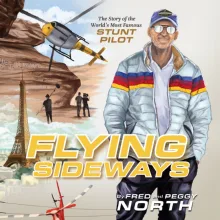
On this episode, I'm talking with Fred North. He's a camera, helicopter pilot, stunt pilot does a lot of great work has been in the business since the early eighties. Had a great time talking with him. He's got a wonderful memoir out called Flying Sideways.
It is available via his site, Fred Dash north.com. I recommend it. And I hope you enjoyed this interview. Let's talk about Flying Sideways.
Your memoir. And my first question is why now, why did you decide to write this memoir now? FRED NORTH: And there was two reasons that it in life. It's always about timing.
So you need the that decision first. Ok, let's do it because you said let's do that one day. Let's do that one day. So we decided to do it during COVID and everything.
We didn't do it during after COVID but there was two reasons. So I was getting a lot of messages on my social media from young kids and young pilots asking how I got where I am today, how they should direct their career to try to achieve that goal. And I'm trying to respond to each of them on social media. It's not easy to understand each person situation, all that stuff.
So I was thinking, ok, the book will be great to explain how it happened because it's not one word to describe you arrive where you are in the life today. So the book was for that reason. And then after people read the book and everything, and then they asked me some more questions, then it's more specific and then I can really help them, give them guidance and ideas. So that was one of the big reason.
The other reason was only if you have kids, but I have three kids, but two boys 17 and 19 and right in that time zone where they're asking themselves a lot of questions, but they don't know kids in general don't realize who their parents are. Like how the parents build their career. They only know from like when they're 1516, that's when they know it start like that. They always, their parents are lucky because they have a big house and they have the life they have, but they don't know what we did to get to that point.
And the book is to explain to them what we had to do to get there and not to give them like, oh wow, that was harder than I thought it just. So they understand there is a journey that lead to success. There is a journey there is if you put it the proper work, then you get to that point. But you have to pay your dues to get where you wanna go.
So that's the two reasons why we did the book, you know, is your relationship with your sons a little bit better than your relationship was with your father way better. I, my father was just pretty tough. So when you have a father that is hard like that, it's harder to connect with the, with them because there is No really connection. I just don't do this, don't do that and then a little bit of not violence, but at the time they were hitting us easy like today, people don't, I don't know if in America but in France back then they were slapping the kids for anything.
I don't know. I, my, at the time in America, he was the same. I think now I think things change a little bit. But yeah, I connect with my kids way more.
MIKE WHITE: Yeah, from what I understand you started your career, obviously in Europe, you come from Africa. You've lived in Europe for so many years and some of your first actual movie work was happening in Europe. Can you tell me was that like for you when you first started to do that? And how was that different than when you came to the US and started making films?
FRED NORTH: So there's a huge difference between movie making in Europe versus in America, especially in the type of movie that I wanna do. I wanted to do, which is action movies because in Europe, most of the movies are more character driven, story driven. The they have a lot of comedy and stuff like that. And then it's more targeted to the performance of the actor even.
Of course they do it in I, but I'm talking about the big movies here like Fast and Furious Transformers or Mission Impossible. It's not that much about the acting. It's more about this action story. That's the movie that I really wanted to do.
That's the work I really wanted to do with the helicopter and my job as a stunt pilot because in France at the time, I was lucky if I was doing three days on one of the biggest movie of the year in France in America, six months. So it's not also the American movie that were coming from America to France at the time. And I was working on those ones. I can only be a piece of it because they were setting up the show in America and everything.
They only get maybe a few days in France and then I was not part of the crew, I was not part of the adventure. So this is why I decided to move to the US to try to be part of the industry whole. MIKE WHITE: You know, it feels like once you started doing your work on film around 96 or so, you just took off the amount of credits that you have is phenomenal. FRED NORTH: Yeah, I really put my energy, my effort, everything towards that job and that industry and it takes it always a little bit.
But there was also a need at the time because in France, there were nobody that were specialized in the film side of it in the helicopter world like back then, ok, a helicopter, you rent a helicopter and then you get the pilot with it in the film industry. It's not like that you get the pilot and then that pilot will get the machine back then. It was not like that. Just let's get a helicopter and whoever comes with it.
So I think I filled up that missing box, you know what I mean? I brought expertise and creativity and then the people, the producers and directors in France back then thought really we can really appreciate somebody like that. So then that's why it took off rapidly took me five years to build to be on my profile. MIKE WHITE: In a sense, you're credited as several different things, helicopter pilot, helicopter pilot for the camera.
Aerial coordinator, stunts. Can you tell me a little bit of the difference between those roles that you play or are they all just the same thing just labeled differently now then and then read? FRED NORTH: And it's just usually, so there's different position within the same film. They need an aerial coordinator because they need to have somebody that can take the script, read the script and tell them if the aerials that are depicted in the story are feasible, what can we do better?
So they need that expertise before eight months before we even do the show. So that's the RL coordinator when the budget is being when the story has been approved, and then you need to give a budget to the producer. That's the rel coordinator. Then when all has been approved, it's the aerial coordinator that choose the pilots, the aircraft that is involved in the permit process because you need an aviation expertise to tell the production.
You need to get FAA permit for this or even if we do some, it's, it's a team effort. So you need, that's the position of the A L coordinator. Usually the aerial coordinator is also the camera ship pilot because at the end of the day, we need the shots. So everything we've been doing, it's centralized to get the shots.
So usually that's the same guy, not the same job because when you get to the camera pilot position, all the aerial coordinations has been done at that point. So you can focus on the flying on the camera ship and get the shots. Then if in that movie, you have helicopters are filmed in the story like a bad guys or arrest you or whatever that is in the show, usually do bad guys often or CIA or special forces. Then there is a what we call a picture ship pilot.
So then I usually put people from my team on those ones unless it's a very stunt complicated. Right? Then I take that seat because I'm the one. Usually when I get the script and I don't want to give them ideas or to be more creative.
So sometimes I don't want to suggest let's do that whiskey maneuver because it's going to be awesome on screen. So I can ask one of my teammates to do the dangerous part that was coming from my idea. But in that case, I am the one to do the crazy flying, but it could be a Monday. I'm a chem pilot, Tuesday.
I do the stunt and then Wednesday back to the chemist. She so that's those three jobs basically in our industry. MIKE WHITE: You know, have you seen the requests for helicopters go down over the years now with like drones and CG I or people still using the actual practical effect of the helicopter to shoot this and of course to do the stunts. FRED NORTH: So No, my work as an, as busy I was for the past almost 20 years.
The truth is Biz Lady. I make the same amount of money almost every year when I'm a freelance. I'm freelancer. So sometimes it's like, I don't understand how it works.
I mean, to $10,000 it's the same thing every year. I don't know how it works. And I'm not even calculating just at the end of the year. Oh, she similar.
No. And there's a few explanation for that. First of all, there is a misconception between drones and camera helicopter. People think because it's flying 01 is going to replace the other one.
And in fact, when you, when you look into it a little bit closer drones, it's a new technology. It's a new toy in a sense, but it's way more complicated to operate a drone than people think for the filming aspect. I'm, I'm talking, you have two different kind of drones. You have the big movie drones, what we call the movie drones at 6 ft wide and they mu you waters, they have all those propellers and then they have the camera underneath.
What happened with those ones because they have M rotors, not one like us. So the one we have with helicopter, it's a pendulum roller. So basically you have one rotor here and you make a turn and there's a pendulum and then you can make your turn gap up and down when you have multi rollers like that, they can't turn because if, because it's not a pendulum effect, No position to each other. When they make a turn, it will drop, they will need a lot of speed to basically glide.
So those ones, the big ones basically only go straight or pull back. If they make a turn, they can, but at very slow speed, it's more like a drift because they stay flat, you don't wanna have too much angle because they will fall. So they limited what they can do. The other problems with those drones are spatial orientation.
So if you take the pilot of the drone and he's on the ground and he needs to control his little ship 400 ft away from him. The guy is No visual. So the only thing he sees is through the screen, what the drone sees. So if I'm asking you, if I'm asking him if there is one tree in the middle of the field?
Ok. And is half a mile away if I'm asking him to do a shot where he has to go around the tree and come back. But I need him to bust the tree like super close and come back. I guarantee you is gonna hit the damn tree.
How does he know that he passed it before he turns? So what happened is they have to pass it, make sure it clears the tree and then turn. But which means the shot is boring. And you take a helicopter, I see the tree, I change my speed.
I just go around the tree. I, if I see a rain born to the side, I'm gonna place that. It's not tragic because I'm, I'm looking all over the place and I feel the machine and I connect with my machine when you're on the ground half a mile away. There is No such a thing.
The other problem with drones that are complicated is the depth of field. The lack of depth of field. It's hard for them to know because it's through a screen. So again, where is the focus?
The focus is on the whatever but not in the back. So it's blurry, it's very hard for them. So all those things and I'm not even talking about the payload FAA regulation. The drone can only be £50 all in draw plus the camera up on the lens.
My camera system is £220 just my camera system. And the reason is because the stabilization of my system is 16,000 times per second. It's a rock solid picture. Whatever the helicopter does, drone doesn't have that they don't have the same zone.
It's not the same animal. So long story short, drones are designed for a certain type of shots that are more something you'll decide on the ground. Can you go from this house and shot to this car for example, but there is No timing. Black camera helicopter will be very specialized with timing, which means you can be afraid you need to shoot a car that, that is underneath, but it's an anti frame.
Everybody is moving empty frame looking down and then suddenly the car comes in when there is a house on the side. So then I need to time that. So I see the house, I see the car, I manage my speed and then I get that drawn when he is up there and it's an empty frame. He doesn't know where the house is per, per the car.
So they can, they cannot do that. It's very complicated. They need another person with the radio, say, wait slow down. But then it doesn't work in an organic way.
So drones are designed to make shots that are pre approved before they go up, which is not what we do. We go and we capture that energy, we capture, it's more creative. We, this is the thing I say, we create the action when the drones tell the action. So all the overlap between the two is only 10%.
So there's a misconception about that. MIKE WHITE: Who do you work with the most when you're on set? Are you working with the production coordinator? The first ad, the director themselves?
What's that relationship like with the rest of the people that you're working with? FRED NORTH: It's an evolution in a sense at the beginning. It's director and producer. When we start the show, it's little bit director by Marty ad and the DP, we'd really talk too much with the director at that point.
Just a little bit. Did you like the shot or more specific? Because usually directors, when we do those Iron Movie, the director doesn't tell us what he was, we know what you want. So, a lot of pilots telling me because sometimes they don't understand why the production would send a guy like me, let's say in Iceland, ok.
The local pilots say why they don't use me. And I'm trying to explain to him. I said the difference is my expertise is not the helicopter flying park, of course, a little bit, but I'm not better necessarily than you for that part. But I'm bringing the film aspect of it, which means the director is not playing with us.
99% of the time there is No director with us, just me and the cameraman, we're on our own. You know, the director will get sick in the machine if he was looking to the screen to a monitor inside the helicopter and that, that screen doesn't move because it's stabilized and the helicopter is all over the place. So anyone will get sick in less than four minutes. So the director doesn't come with us.
So I'm telling the local pilot, would you take that responsibility to give that guy what he what he wants? No, because he usually is like, ok, what do you want me to do? And where should I go? The director doesn't really know that if he's telling you where to go, it's gonna be the wrong place because he's not a pilot, he doesn't know what you can do with the machine.
So you need to do your homework with the director. If I'm working with a new director, I watch a couple of these movies before I'm trying to understand his vision. I'm trying to understand his style. Each director has a little something.
So you need to understand that and then you need to understand the story and then you put that together for him, then you watch what you did and then you can always adjust things, but you've done the 90% of the work. That's why it's an evolution when we do the shoot, it's more d ad because it's more about how we're going to set up the scene. But usually the pilot is the one to tell them, make sure the car is gonna be there. Also with the stunt coordinator, we connect with the stunt coordinator because I can tell him how fast the car is gonna go and how fast you want the car to go.
At what point we have the explosions, then I'm gonna talk to the special effect people. So it's all, it's more, it's become more technical when we're on the show. MIKE WHITE: And before that it is more creative in the book, you talk about that first experience of being on a helicopter and just that it really opened up your mind and really gave you that purpose. What led you into the movie business?
Because you could have just been a helicopter pilot for all of your life. But what made you. Also add that to it and that artistry to it? FRED NORTH: Most of the of the pilots that the helicopter pilots, they have a purpose because the helicopter is a machine that is basically helping humans.
Ok? When you think about it, ok? They do rescue, they do fire contract, they saved homes to be, you know, gonna be burned. They sing the fire crew to there's a purpose to it.
They carry logs from one place to another in the ocean. They go save for the navy, they go save life. So I think each pilot has deep into inside him. He doesn't really and the study that thing or even think about it or they do, but there's a purpose.
So for me, I was looking for that purpose without even understanding. First, I wanted to be a rescue pilot because it's such a noble thing to be like to go in the mountains and do search and rescue. But didn't really find that journey. That light didn't take me there.
And then when I started to do the rally race in Africa, it's like the Barra Race that you have in America, but I was covering that and the stoning aspect of those cars or high speed cars immediately connected to that. So this is why from there then I went to the film industry because back then in France, you have to understand that position didn't exist, it existed in the US, but not in France. It took me a little bit longer to understand that there were a job like that. And then that's exactly what I want to do and it was a little evolution to it.
MIKE WHITE: I didn't realize that you also work with Indian films. I went to see Tiger three. Recently and there's your name on screen. Yeah.
FRED NORTH: Yeah, that happens. It does. MIKE WHITE: Are you ever bound by international borders or can you just fly any place? FRED NORTH: No, I go all over the world.
I would say 90% of my work is outside of the US. It's, it can be anywhere. Usually there is like a trend like for 23 years, I will go more like in the Middle East for a reason. And then the other 23 years is South America.
Then he go to Asia. So there is a little of a trend. It's also good with politics. Of course, of the world politics, Middle East by now, it's not necessarily where we gonna go first.
But a few years ago I was going there a lot, you know, South America. It's been a little while I haven't been there but for a while I was going there 34 times a year then Brazil is the same thing. So it just moving around. Love Africa.
I mean, any continents have treasures. So, yeah, it's all over the world. But at the end of the day I love to shoot in L A close to my house. Yeah, I love that.
MIKE WHITE: What are not, not including your own work? What are some of your favorite, either helicopter stunts or scenes shots that you really enjoy? And was there anything that inspired you when you were building yourself up at. FRED NORTH: The beginning of my strong pilot career?
I was already a full certified pilot, but I really didn't understand exactly what the pilot was doing. So I was trying to understand. So I met a guy, his name is Larry Blandford. He's in my book and he was a cameraman on the first top gun in the US Navy in the jet center handheld camera with all the GS.
And it was not easy back then. And he told me, first of all, Fred, you have to understand that when you are coming as a fault pilot on that movie, you become responsible for the shots you're gonna be doing. And that's the first thing because I thought a producer or director will tell me, Fred, you're gonna go Tuesday at 11 o'clock and you're gonna be showing that car. So it was not on me.
I was just gonna get whatever they want me to do, tickle the box and then move on. I understood that I had to fight to get the proper light. I had to fight to get the proper setup so I can do something amazing. It was my responsibility.
I, there was also a learning curve for that. I also understood that the difference between TV, showing and movie filming. It's when you cover a sport event like a formula one race or sailing race or it with a helicopter, they just want to know who's winning, who's losing and basically what's going on the ground as far as what's happening on the road, they don't really care too much the way you're gonna shoot it. Yes.
If there is a sunset and then you match that to the guy winning, beautiful. But between the two, they're gonna go for the was the winning movie. On the other hand, it's the way you're shooting something that, explaining what's going, what's happening in the story. If the director is telling me, you need to shoot a car going from the airport and going to the city.
Ok. Is it a four second shot? Is it a 45 2nd shot? Because now I'm in control of that time, the director will tell me in the editing, I would love to not exceed 10 seconds or is going to tell me it's one minute because there's a dialogue in the scene.
So with that stuff, then I have to envision my mood like how I'm gonna make it interesting for the audience. I can do it. I can do a very boring one. Take the airport, take the car, go behind the car and show the city du but it's boring.
It just tickle box. I'm always trying to force myself. What can I do for the audience? That's super pretty.
Then I don't want them to know it's been done with the helicopter, but I want them to connect with that shot. That's super cool, so beautiful because we want them to be connected with the story and not with the camera, not with. That's another thing with drones that you wanna, they wanna be careful with drones when I told you before, there was the big drones and then there's also the little drones that are doing more effect. If you should, if you look at any movie, like the one recently called red or something red, something, there was so many drone effect but becomes a drone effect.
It takes that out of the story. Instead of diving into the story through that shot, use it's a drone shot because it's all over the place versus connecting with the story. I'm very careful that to never cut off the storyline and the connection with that story with my camera. If you watch a very nice movie, you don't want to feel the camera, you want to be in the story, draw some, it really a drone effect and I think they have to work on.
That's why I'm telling the guys be careful to not do obvious drone shots to the drone guys because you don't want to see movement that's gonna go straight towards the building, go vertical in the building, go on top of the building and go down. Because what's, what is that, what's the story of that? Is it the POV from Superman or is it just an effect? And then it's taking the audience I think of the story.
So anyway, all that stuff, I understood the technique of what assault pilot can bring and what I can do. And that's what really interesting me as far as the filming higher aspect of it. MIKE WHITE: What have been some of the most challenging shoots for you to do? FRED NORTH: There are a few because I have the reputation to do crazy stuff.
So then people call me for crazy stuff. Sometimes even something that looks simple from the outside may be complex for me. But it's usually they have a big action sequence to do like the extraction to the landing on the train at 60 miles an hour, all that stuff. So it's not just me, it's everything that is around that action sequence that make it heavier as far as the self induced pressure that I put on my shoulders, the liability of what I'm representing as far as the risk for the crew, the risk for my, myself and my crew, it's all that stuff that make it a challenge.
And because what that one little mistake has crazy consequences. So when I do it can be a heavy load on the day. So that one was a tricky one to do. And then I did also a Beverly Hills Cops four that is not out yet with Eddie Murphy.
We did a very complex aerial sequence. Not one extremely complex. There's a lot of moving cars and a lot of moving parts next to the helicopter like a foot from me. So when you have 10 cars around the helicopter and everybody has his own thing to do.
But because we can't talk to each other because it's too many. Like you have one radio channel and my hands are full and they're the same. So we can't talk to each other when we do it and it'll be too late anyway. So everybody has to do what is been rehearsed, but you have 1012 moving parts and one mistake.
It's not pretty. So that one was a challenge. It's not out yet. So as soon and now that the Hollywood strike is over, I'm hoping they're gonna put the trailer, I'm hoping because it was supposed to come out this Christmas or early next year.
So when you get a shit, you're gonna, you're gonna understand what I'm talking about. So that was a challenge and then there is plenty other piece. But those two were pretty big. MIKE WHITE: When you are thinking these things up and working with the director and all this.
I'm very curious how you actually represent. This is what is gonna happen, especially when you're working with your other pilots or just trying to convey your messages. Are you just talking with your hands? You have to have a method of displaying to people.
So they get it in their heads before you even lift off the ground. What is that? FRED NORTH: You usually? So I yes, stick with my hands a lot as friends.
We do that but we also have little toys. I have a little car, a little helicopter and then we show to the crew what? And then they have their own little toys and then we put it usually on the ground and then we show everybody understand where the helicopter is going to be and I can expect where the car is gonna be. So we do that to begin with.
That's the first thing we'll do. Then they usually do what we call a previous which means they have, it's like a little animation of that equ sequence. So then we can see screen directions, we can see what, which car is the lead. We can understand what the director has had in his mind.
And then we changed the British of course, because it not always are realistic because it can be done by a 22 years old guy like 3000 miles from us. The director will tell him how to structure the British, but it's a base, you don't want to take it. And so we go with the previous and then what we do, then we, I spent time with the strong coordinator and then we take again the toys and we redesigned the sequence. Ok.
Then we work with location and then we found a place where we can do this with the director's visuals because he wants buildings or he wants something. Usually you always want to be in the city or some somewhere. So then to prep that sequence because if we're gonna be doing it in the city, they have to shut down 10 blocks for two days, which is not easy to do. So we need to rehearse somewhere else.
So in the case of belly hills cops four or even extraction, we rehearse in a place that is remote like for extraction because the sequence was taking place on a train on a moving train where can we get a train for rehearsing is very hard. That's when production ideas I told them we need a decommissioned runway that is not used anymore. And we take a flatbed truck, we put the train container on the flatbed truck and that we can do old speed testing and all that stuff with the truck. So we started at 20 miles an hour, 30 40 56.
And we went all the way to 80 we found out that the 40 to 60 miles an hour zone was the best zone for the landing on the train. And then the crew, they can follow us driving. So that's an example when we did BESS four because it was supposed to be a downtown L A. We went to the desert, we found a huge parking lot and then we put cones and cars and then we duplicate the street and then we rehearsed for a few days there with a stone coordinator with everybody, not the director, just the technical people, we practice all that scene and when we're happy about it, then we're gonna go shoot it.
So that's the way we structure the action sequence in general. MIKE WHITE: Is there any particular director that you've ever wanted to work with? I think of somebody like a John Wu who just loves to crash helicopters. Are there directors where you're like, oh I wanna be on that guy shoot.
FRED NORTH: No, for sure. Love all the directors that unleash the creativity. Like there's No boundaries. I prefer the straight shooter.
Like if they too twisted creatively, then there's not that much we can do together, but like a Michael Bay, he has No limit in what we're gonna do. And I like that and also his vision for the camera movies are amazing. There is a reason why he is where he is some hard grave that did. Extraction two is more is a like a specialist world shooting all the fighting sequence all the.
But at the same time, he loves helicopter and he wants to do more and more helicopter sequence because I think helicopter is such a an asset for movie making. Not only to shoot the action sequence, but also when you see a badass helicopter coming the noise, it makes usually what he is representing the audience. It's an asset is a production value on screen. Yeah, I love the spreads shooter director.
MIKE WHITE: I have to tell you I loved extracting too. I'm really looking forward to Axel Foley the next Beverly Hills film and I love the book and I'm so glad that you wrote it. FRED NORTH: Yeah. No.
Flying Sideways. Yeah. Yeah, it was, it's a fun book to read. Did you see the C code at the end?
MIKE WHITE: Oh yeah, I did. I haven't scanned it yet though. FRED NORTH: Yeah, but you should because it's all the story we're telling there the videos from back in the day. So you can, you can see you know what we're saying and have a visual of that because we wanted to keep that entertainment connection with the readers.
I think it's pretty cool because you don't want to put too many photos because you take the story out. So you want to put some but then we thought, OK, the C code with technology today anyone will have a phone and then they can watch and you should watch them. They're pretty cool. They're pretty cool.
MIKE WHITE: Yeah, Mr No, thank you so much for your time. This has been great talking with you today. FRED NORTH: You're welcome. So just for the audience to know my book can be a flying sideways.
You can get it on Amazon. You can get it on my through my Instagram. There is a shop link, You can click on it or you can get it through my website or you can get it through any bars and Nobles or any super like that. But yeah, fun book to read.
Speaker 6: I was in the mutual to rest. I'm cutting closely to the voice of reason. Something's gotta kill me. MIKE WHITE: But how to I of for the as a system, create a one even we on TV is lacking and needs a.
Comments
No comments yet.