
Special Report
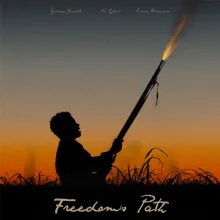
Brett Smith on Freedom's Path (2022)
Show notes
The film is now available to stream.
Transcript
An automatic transcript, tidied into paragraphs. It has not been proofread, so names, titles and spellings may be wrong, and it does not say who is speaking.
Show the transcript (about 3,900 words)
Hold your ears, folks. It's showtime. People pay good money to see this movie. When they go out to a theater, they want cold sodas, hot popcorn and no monsters in the projection booth.
Everyone pretend podcasting isn't boring. Turn it off. How many fights you see? We, I reckon 11 or 12, I'll be damned if I ain't seen no Negro 12 flags.
So let us dig in their graves though. I guess everybody gotta prove themselves. We've been in chains by your kind for years. So use a slave.
Then can you see chains on me all mess around here barking orders. I ain't been no slave since I ran out that plantation. What was all that about? We help and run the railroad will and slaves up north to freedom's land.
The boy, these words is my word. Oh God, you're gonna have to keep on catching me because I ain't gonna never stop running. Ain't no hiding the truth with the truth is just waiting to be found. Goddamn it.
We found it. Thank you. Hey, folks, welcome to a special episode of the projection booth. I'm your host, Mike White on this episode.
I am talking with Brett Smith. He is the director of the relatively new film freedom's path. I say relatively because it came out last year, but it is now available on your streaming platform. Had a great time talking with Brett.
Hope you have a great time listening to it and definitely check out freedom's path when you get a chance. Can you tell me a little bit Brett about your background and how you even got into filmmaking? It didn't take a classic route to filmmaking. I didn't go to film school.
It's not something I ever thought I would do. I've always loved stories and going to movies and things, but I was always into sports and a little bit as I grew up, I was always doing fun, goofy stuff with my friends, little spoof videos on the weekend and love that. But as I got a little bit older, I was realizing the stories I wanted to tell were maybe a little bit more dramatic and emotional. And when I talk to my friends and say, hey, I want you to do this scene, they're like, Brett, I don't want to cry on camera.
No. And so I realized all right, I gotta go get real actors. And so for me, it was a very natural progression of just OK, I gotta learn this or I gotta do that. So I think my film school was hitting my head against the wall a lot and making a lot of mistakes and tripping and falling on my way to trying to get a movie made.
You've made a lot of shorts over the years. Can you tell me about some of those? Absolutely. Yeah.
So a couple of shorts I've done, honestly, they're brutal. My filmmaking team hates me because they're always ambitious and we never have money. So it's a combination of horrible things. One short we did was, it was called Trout.
It's about these boys who are just out stand by me film and it deals with some heavy topics, but it's also ultimately friendship coming of age, adventure story. And that was a film that you learn a lot working with kids. And it's fun to really, I think it really pushes you to the extremes because a lot of these kids haven't experienced some of the things that you're hoping that they can emote as an actor. And so really getting creative and working with just these incredibly talented youth finding your way to be able to tell a story authentically and get those emotions out.
And another one that, that I'm excited and passionate about was we shot a film called Neverland. And that's a film about an inner city foster boy who had nothing but himself and his daydreams to keep him company. And he imagines himself a lost boy in Peter Pan's Neverland. Neverland is reflected in the world that he's teased.
It is not a whimsical kind of place. And that was also another one that learning the process and the skill set of trying to make something look 10 times bigger than it is whatever camera tricks you can do to how can you create Neverland without having a budget to go to Costa Rica or Hawaii or somewhere? And amazing. I think the thing is I learned most about seeing the short films is learning to work with my team.
Appreciate people who give so much when you don't have a lot to give back, you're really in it for the story in the craft. So I think short films are an amazing way to learn, make mistakes and also grow with yourself. And your fellow filmmakers. Tell me about the original version of freedom's path.
What was that like? And how does it compare to the feature? So the process for me to make freedom's path was it's been over 12 years. And so we actually listed it a short film, freedom's path and I think 2015, but it dates that before that.
So what we did at the outset is we shot a concept teaser for the film up in Washington State in the United States. We found there's a local civil war reenactment going on. They were like, we've got to get actors there's 303 100 or 400 people with cannons and they're all in their gear. And so we talked them into allowing us to bring two people on and we just, all we had to do is pay for their wardrobe and outfits.
And we ran around all day shooting everything we could with our actors in the battle and running around and doing these things. And that was really the genesis of the film to be able to show people. This is the vision, this is the tone, this is the field is what we wanna do. And then we had brought on at one point a big Hollywood producer and he said, hey, this is great, but it's like a music video.
Like I need to see dialogue, I need to see something. So shoot me something from the script. So we chose one of the really pivotal dramatic moments from the script, freedoms path and shot that and it was really a test scene. We called it a short film, I think for some marketing reasons and for investors to show what we could do.
But so it's interesting, it would, we never, I even were able to do a proper short film, but it was an amalgamation of highlights and visuals that we would like to incorporate into the film as well as having the great blessing and benefit of shooting an actual scene from the film. So when it was funny when, even though it was years later or something, when we shot the film, not quite six or seven, when that scene came up it was a hard scene but, and it happened to be like 13 degrees that night, which was brutal. But we had already shot at my cinematographer and able to just know exactly what to do and how to get it and even delivery and things.
That was a very nice little blessing in disguise at the time, it was frustrating to have to go and shoot. But it was great because it taught us a lot. And how did you go from that short to the feature? How did that actually get green lit?
And this is your feature debut, correct. This is, yeah, this is again, I didn't take that normal route and I don't say that proudly. I say, I think I'm just stubborn and not very smart. And so what I did is I tried to go the classic Hollywood route.
I tried to attach big production companies or big producers and we had interest, but I found that any time I gave someone, I put the ball in someone else's court, it took a lot of time and it wasn't their dream, it wasn't their baby. And I understand that's totally fine. And also some of the advice they give me when I'd follow that advice. I would actually find myself doing the opposite of that and getting way further along.
And so what I did is after a number of years trying to do the standard Hollywood thing of what the industry was telling me to do. I just said, you know what, I've got a computer, I've got the passion, it, the numbers. And so I spent 2.5 years research between eight and 10 hours a day reaching out cold. I sent out over 4300 emails.
It was actually probably quite a bit north of that and found all of the investors through just cold outreach and it was a horrible process. It was hard, but it's also one of the most rewarding ones because making connections and finding people who truly believe in the project and people that, that I can work with in the future. So that was the green light literally didn't come from anyone. It was just realizing that the green light existed somewhere out there and had to slog through thousands and thousands of nos to find the right people.
So that was the process of at least finding the financing. And then it was a stem my team that I've worked with all these short films and the people that I trust and that have a shorthand with me and we've been in the trenches together. And so when those hardships came, I knew we could rely on each other and we'd come out on top. So that was the green light process.
Maybe more of a red, yellow light. I don't know what it was, but like an orange light. You talked about how your friends wouldn't cry on camera. But here you've been working with real actors for a while now, this cast that you have for freedom's path.
That's amazing. Can you tell me a little bit about them and how they came together? Oh, my goodness. Yeah, I can't say that praise is enough.
We were so lucky and so forth, said to have each one darn Howe plays the lead role of William, our union soldier and RJ Kyler plays the other lead role of kitsch our free men. And it is these two individuals. For me, it was a very methodical process because you have to find the right people. This is truly a drama.
There's a lot of emotion, there 's a lot of nuance and the relationship, the concept of the film beginning having been very fictitious to ultimately arching into brothers and understanding each other from worlds that are very far apart and built and prejudice and all these things. And so to naturally find that rhythm and flow. It's a challenge. And when I got to meet and talk to both darn and RJ, it was one of those truly light switch moments where you see tons of talented actors and you talk to plenty of actors and they're fantastic when you find the actors that are right for the story and the world that you're building and they get it and they understand it and they have those that just that X factor to them specifically for these characters, you just know.
And that, that was one of the most exciting things for those two with, like I tell people because this was a lower budget. Indie. We didn't have tons of prep time. We didn't have rehearsal time.
It was, we RJ and Garen Garen from London are the artist in California, originally from Florida. And they met for an hour, a couple days before the production and their chemistry just immediately and we actually had to pull it back because they'd be so good for it. They'd be joking and they'd actually have a shorthand. Yeah.
No. Yeah. Like we had to wait that on page like six. Not page 10.
So that was fun. And then we had Ewan Brebner, just an amazing accomplished actor, character, actor, brilliant Scottish actor. He played the role of Silence, which was an incredibly challenging role. And Ewan is known for a lot of the comedic, comedic roles.
And so he took on a role, especially with an England, an American Southern accent, things that he hadn't done. And he, people honestly do, don't even recognize him because he really gets into character and it's a challenging one to walk a very fine line to make it believable and not cartoonish or anything. And he did just a phenomenal job and then all of our actors, but Carol suddenly have to call out. She unfortunately passed away due to from COVID.
Give the performance of a lifetime, just a brilliant person. She was amazing, a female Malai who plays the role of Ellis, also just an incredible and accomplished actor. All these, all these individuals give everything Thomas Jefferson Bird, another incredible actor with storied background and also unfortunately passed away tragically. And so having this be their last films, there's definitely an extra weight to that, right?
You're already dealing with significant and substantive content. But then to realize that you're carrying the last performances of truly great individuals and incredibly talented actors that out of weight. But we were so blessed with every single actor who got in front of the screen, a number of actors who had never acted before as their first time. And it was so exciting to be able to work with them and see just their raw talent and yeah, I think it was again, we were just so lucky that they made my job easy.
I just got to sit back and I was honestly, there's a number of times I forgotten to y'all cut because I was just so lost in the performance. Oh, yeah, I guess they have to cut. That was, yeah, let's do it again. So it's a lot of fun and very lucky to have when.
You did make it easy on yourself for your feature debut where you're doing a period piece. And yeah, you've got British actors coming over and putting out the American accent that must have been quite a challenge. It was, it's funny because I first started this project. I talked to a number of people about it.
The story just compelled me and drove me and I talked to a number of filmmaking friends and people and they learn, they said don't do not make this movie. Like it's a period piece. It's got battles, it's more huge and scenic and epic in its nature and scope and do so you're stupid and it, ok, like I have to and there are definitely many challenging things. But I think, I think as I mentioned, the financing process and the process to even get the film to the point of being able to make it, that really was the real fight.
And so anything that how hard that was in the hardships that we dealt with to even get to production, it became amazing. It actually gave so much context because when we are on set and dealing with 90% of this film is the exterior. We have almost no interiors in the film and that makes it challenging when you have rough weather. And we the second worst fall on record in Arkansas.
And so we were navigating mud and tornadoes and everything. You can imagine. It was brutal but made it incredible is going through the previous art shifts realized, don't take it for granted. This is the dream right now.
We're having fun and we're creating and realizing it's a creative process. And so any obstacle that came in front of us, we realized we could get around it because we'd already done the hardest work. And right now it's, this is fun. Any challenge we have, we can overcome it.
And so that was again, another blessing in disguise that at the time out of I was taking the wall and myself or what am I, what are we doing here trying to raise money for this crazy movie on my first one. But it ultimately ended up being one of the saving graces of the films for my, me and my team to say, hey, like we're doing it. So other people who are in the industry that we brought in, they were incredibly talented. They were so stressed about certain things like we got this.
Let's go. Ok, we're making a movie. Here we go. So it was a lot of fun.
And you shot this all in 2019. We did the very end of 2019 right before COVID came in, we shot it in Northwest Arkansas. There was, I won't give you the details of it, but there was a dealt with someone who basically committed fraud. They said that they were contractor, signed everything and it was an investor that was vetted in all these things and we found out that they were never gonna come in and it was a huge amount of the budget and this was a couple of week, the actors were out, we had spent a ton of money and everyone think push to spring.
And literally the two days before production began, we had an angel come through and allow us to close f and we actually had to still raise money while we were shooting. I was actually still calling investors and trying to find the last pieces to close financing, but we were able to get it done and had we pushed, it would have been, it would have been rough. So COVID, it was also as hard as it was for everybody, for the sake of the film. It was a bit of a blessing also because we weren't able, there was no rush.
We were taking our time to really find the film in the edit and make sure we had the right story and we're telling it the way that we felt the need to be told. I'm glad for that one of the few blessings of COVID that you were able to find that film that way. So you even had a limited theatrical release. We did.
Yeah, we did. We were so fortunate enough to have the opportunity to screen through A MC and Regal and working with Byron Allen H BC U go to raise money for certain underserved H BC U, historically Black Colleges And Universities. And so that was a really exciting thing and to be able to get it on the big screen and see it up there. It's an experience, I'll never forget until the next one, until the next one.
So, yeah, what I'd like for you to see that with an audience to see that on the big screen? Terrifying, terrifying. It's funny because when you're in the process of making a film, you shoot the film first, you write it and you think about it, know it, that will really well. And then you shoot the film and you're really know it.
And then when you edit it, you're just, if you're just over and you're seeing hundreds of times. And so honestly, you almost look for opportunities to be able to see the film in it with new eyes and fresh eyes and it's a challenging thing to do. So when you're able to sit with an audience in some ways, you're just terrified because every little mistake that no one else is gonna see probably. But for you, it's like the biggest thing and when it was tense audiences and then it was action in the theaters, I can't touch it anymore.
I change it there. It is, it was, it was really amazing. I think the most, any chance I get, I sit in the very back of the theater in the corner so that I can watch like, how are they reacting? Are they jumping?
When are they jumping in certain parts? Are the parts they laughing at every audience? It's a different. So some will be laughing at or that egg Nemo nor funny.
And it's, it was really gratifying to just see people respond in anyway, whether they loved it, hated it or anything in between. It was just, it was neat to see someone respond to project that so many put so much into. So what's next for the film? Next?
For the sales? So we are out streaming everywhere finally for people to see we're gonna be be finding a more permanent streaming home first of the year and just right now working on getting it out to the masses, letting people know it's there and getting the chance to see it and experience it and hopefully take something away or something from it. And how about for you? What's next for you?
For me working on a World War Two period piece, another period piece. But this is about you. This is about the kids were left at home as their dads are off fighting. It's stand by me meets Dead Dead Dead Pot society.
Really excited about that. And then also I referenced Neverland the short film we did a number of years ago working on turning into a feature and that one like freest that may take, I may be a grandfather by the time that one's done been working on that, getting that ready. That's another one that's like my baby. So excited about those too.
You definitely seem to have the drive and the ambitions or I don't think that anyone would be errant to place their faith in you to get these things done. Now. I mean, go on, I'm not going to wood all the time because every day is different, I'll wake up. I wanna go, I'm gonna go, I don't know, clock in and I'll be a secretary somewhere.
I don't care. I just felt but no, the passions there. Hopefully it sticks with me. So I appreciate that.
Thank you so much for your time. This is great. Right. Thank you.
Go up, who went on all box office people? Please go to the main box office. We don't need it anymore. Somebody had put the line man.
Let's have a hot mic.
Comments
No comments yet.