
Show notes
Find out more at: https://www.quicksandmovie.com/ (opens in a new tab)
Transcript
An automatic transcript, tidied into paragraphs. It has not been proofread, so names, titles and spellings may be wrong, and it does not say who is speaking.
Show the transcript (about 3,300 words)
Speaker 1: Hold your ears, folks. It's show time.
Speaker 2: People pay good money to see this movie. When they go out to a theater, they want cold sodas of hot popcorn and no monsters in the projection booth.
Speaker 1: Everyone pretend podcasting isn't boring. Turn it off. I got wedding stuff to do but you guys are on ring duty. Ok?
Speaker 3: You can just call me Frodo. We call Best Man in Josh's wedding, carrying rings, making speeches and don't forget who's gonna be there. Super crush. I love you, man.
You got this. Ok. Best man, best man, best man, man. We're actually here about a ring.
Did you buy one a couple of days ago? Yes. Yes. Yes.
That's it. That's the ring. Our best friend's wedding is actually tomorrow. If it's your buddy's ring, why did you sell it?
We sort of lost it. -huh. We're the worst men. You stole it.
I got it.
Speaker 1: What's this guy's name again? They violated me. Dick. Richards.
TANNER PRESSWOOD: Dick.
Speaker 3: Dick. We're going to make. SIMON ELIAS: It to that wedding. Which way were they heading?
You try, you try information regarding possible suspects? No, no, we're not gonna steal someone's car. Hi, it's nice for you. Got there.
The cops are after us. Oh, this is bad. Ok. Try to see if you need help.
You can tell us, tell you what you need help. We don't, we need like a rope or a BNE if you'd let us know. Yeah, but I don't, yeah, we're doing really well. So.
I'm never letting you drive in a car chase ever. And again, the car's. MIKE WHITE: Only four cylinder. Welcome to a special episode of the Projection Booth.
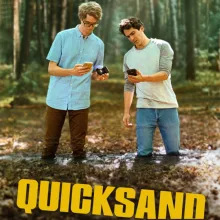
I'm your host, Mike White. On this episode. I'm speaking with three folks behind the film, Quicksand. Director John Paul Morris and stars Tanner Presswood and Simon Elias.
The film opened on September 19th 2023 and is available for a limited theatrical run as well as on demand. Thanks so much for listening and I hope you enjoyed the interview. John Paul. Can you tell me a little bit about Quicksand and how the idea for the script came about?
JOHNPAUL MORRIS: We've been calling it a romantic comedy. It's a story about two best friends who are co best men in their buddy's wedding and they lose the ring just days before the wedding. They have to go on a haphazard road trip to get it back. But we made this movie in Michigan.
We're right between New York and L A but we're in neither. So making a movie in the Midwest is definitely a different type of pursuit. It's easier in some ways, it's much more difficult in some ways, but it's really beautiful area. We've been wanting to shoot something here forever and this was just the right story at the right time.
We wrote the script ourselves. So we were able to tailor it to the resources of the area, the talent that we thought we'd be able to give a platform to. And we definitely tailored it to our, our budget and abilities as well. So it was great to have a story that played to the strengths of the actors and the filmmakers.
And I feel like that's honestly what's carried us so far. MIKE WHITE: Tanner. You're also a fellow michigander, correct. TANNER PRESSWOOD: That is correct.
At least since college. Originally I'm from Texas, but then I grew up did most of my growing up in Indiana. So I like to say I'm a born southerner, but I'm a midwesterner at heart. MIKE WHITE: Tell me more about how you got involved in this project.
TANNER PRESSWOOD: I submitted a self tape audition just like everybody else. And it just happened to be that I was down the street whereas Simon was several 1000 miles away, they just random chance there, Simon. MIKE WHITE: This is definitely not your first rodeo. How did you get involved in this one?
SIMON ELIAS: I also did the audition process when I got like the two scenes, I really loved those scenes and I was like, I really want to be in this project, but I knew it was hard because I was in Colombia and I was like, really hoping they call me or something to know if I had a chance. And one month later they told me like, ok, we're gonna do you a call back and I was like, I'm gonna get this, I love this project. I would really want to be here. I'm gonna get this Chao.
MIKE WHITE: What's the timeline of this as far as when you are sitting down writing the script planning this all out? And when do you actually shoot this? JOHNPAUL MORRIS: After finishing the first draft of my first script, I had a bunch of filmmaker friends. Tell me that.
Congratulations. You've done it. A lot of people don't get this far. Unfortunately, it's not very good.
You need practice. So I started writing a script for practice called Quicksand. And I was super interested to see if we could tailor it to scale budget Michigan. And I think I started the script in 2016 and it really started developing a lot faster.
A lot better when I brought on a writers, Jake Burgess and Brodie Steele in 2018. And we had the script ready to shoot in 2019. When we found our cast, we did our final rewriting to make sure that like the dialogue and the jokes on the parts fit who we actually found in our cast. And we shot in September of 2019, saving a bunch of pickup shots for our action sequences and things that didn't require a big cast and crew having no idea that COVID was gonna come out of nowhere and make those pickup shots really hard.
So our 18 month postproduction plan turned into something closer to double that. But we did get into the film festival circuit in July of last year and we didn't really know what we were doing with that. This is my first movie. So getting in the film festival circuit was incredibly daunting, but the film had legs, which was a big surprise to me for a comedy, getting into so many festivals and doing so well.
We got into the Austin Film Festival, which is a huge surprise to be getting into a festival that scale with the film our size from Michigan and then winning the Clair Film Festival. Wisconsin was super affirming winning audience choice, the hells half mile. And then the ultimate irony is getting best screenplay at the Grand Rapids Film Festival. So me and my screenwriters get to look around at each other as wait, this comedy, that's just full of jokes that we thought were only funny to us.
Did this just win this screen play? It feels like a joke on us, but we're, we're incredibly grateful for it for sure. MIKE WHITE: How do you even manage to keep the actors and part of your crew around for that long extended, you know, these pickup shots that you're talking about? JOHNPAUL MORRIS: We did surprisingly Well, we knew that not everybody would be able to come back six months or a year later.
But we had our same team, we had our same DP. We made sure to get all of our shots of Simon while he was in Michigan because he has a long flight, go back and forth. Freddie shots later. Most of our pickup shots were things that were like action shots or when we need to blow up a building.
We take the time to do that when we don't have actors waiting on us to do all our safety checks. MIKE WHITE: So you didn't just have these guys live with you for the duration of the pandemic. JOHNPAUL MORRIS: I wish I could have, that would have made the pandemic a lot more fun. We could have had another movie written by the time lockdown was over.
MIKE WHITE: It's gonna feel strange for you guys to be talking about this movie that you shot three years ago, four years ago. Now, how is it revisiting this after all this time for you? SIMON ELIAS: I remember when Paul called me and he told me like we need to do some ad r so it's like the sound recording of some dialogue and I was like, OK, and I was in Colombia so I had to do it in Colombia. And when I watched some of the scenes, I was like, what happens here?
What was like, what I'm thinking in this scene? What I'm feeling in this scene. So it's been like three years since we shoot that scene. So for me, it was a little bit challenging at that part.
But it was also amazing to know that they were able to finish the movie as an actor. You at least I try to put everything during pre pre production and production. And when I'm done, I try to close that path a little bit to not get attached some projects to cars because I don't like goodbyes. So I suffer a lot.
Yeah, it was really hard. MIKE WHITE: How was it for you coming from Colombia and shooting in Michigan. What did you think of our first state? SIMON ELIAS: I've never been to Michigan.
So when I went there, it was amazing and being with the locals and Tyler and John Paul, they all showed me around and it was amazing. I really discovered a really beautiful state and also the film allowed me to do this road trip in like up north and all that. It was really beautiful and I really like that. That's one of the things I really love also about movies.
Like you can travel and get to know really amazing places. MIKE WHITE: I'm glad that you guys taught him up north. That's very good. TANNER PRESSWOOD: Yeah.
Oh, definitely. As soon as Simon was in town, I took it upon myself to take him to the sleeping, be over in Glenn Arbor just because that's like a first bucket list items. Ok. We're here.
Dunes. Let's go. We're gonna walk straight to the lake so you can see the big lake and which was also, it was good bonding for us because we had never met each other before and we were about to have to pretend to be the best of friends on camera. And fortunately, it didn't take long for the two of us to really become actual friends in real life.
We worked overtime in the couple of weeks. We really had two weeks, I think less than two weeks from the time that Simon showed up to the time that we started shooting and we just spent like every waking minute that we could together just to really make up for lost time. I don't know what, what was your take on that Simon? SIMON ELIAS: I, we own a little bit of that.
Also through the audition process, the casting process, I think Jump Ball did an amazing work on that because if you can get a really good actor, but if they don't have chemistry between them, not gonna work. So when I met Tater and we really like start spending time together, we really have a strong bond and it was amazing, really enjoy and support each other during the whole process. And I was so also so grateful to him because I was acting in another language in a state that I didn't know was a little bit challenging.
For me. So I really felt support of him and John Paul and the whole. MIKE WHITE: Did you guys do a lot of rehearsals or did you just have to jump right into it because I know this isn't the biggest budget picture in the world? TANNER PRESSWOOD: Well, thankfully, thank you, John Paul.
We did a lot of rehearsing, we rehearsed every single scene and actually there's a reason for that which I'll let John Paul explain. JOHNPAUL MORRIS: We didn't have much money or time, but we knew that we had to prioritize the performances and the characters. So with the money and the time that we did have, we made sure that the whole movie was rehearsed. I required my actors as much as possible to have the whole movie memorized before we even shoot because it's 100 and three scenes and we're shooting the whole thing in 15 days and we're absolutely not shooting it in order.
So having the characters know who they are and where they are in every scene, even if you put the movie in a blender and pull out a piece that they can immediately identify what the mood is and what they've just experienced and whether or not they're breathing heavily or not, That was incredibly important to be able to film 100 and three scenes out of order and then put them back into an edit and have it feel cohesive. So I felt like I was asking a ton of Simon and Tanner, especially Simon. Simon is incredible because he has more dialogue than anyone else in the entire script.
I feel like if you take Simon's dialogue and just cut that out of the script would be half as long and he's doing that in his third language, right? Simon English is your third language. Yeah. So amazing if in the.
SIMON ELIAS: Industry was an American post graduate college student. But we I talked to John Paul because I asked him, I only have two weeks to prepare for this role. I'm not gonna be able to have a really American accent. Even am Michigan or how you say Michigan accent.
So I told him like maybe thinking too much about the accent if I have four months to prepare, of course, I can do it. But I had like two weeks. So we talk about that. You wrote a little bit in the script.
Be able to, I was like a Colombian that lived a long time in Michigan. JOHNPAUL MORRIS: We formulated this idea that I thought was cute that Simon would be a foreign exchange student that he and Tanner, their characters, Ray and Paul could have met in high school and then this foreign exchange student just they become best friends. He doesn't leave, they go through college together. They're spending every day together.
But we already had most of Simon's family cast and they're people with light hair, red hair. No, no Colombian accent whatsoever. I didn't dare ask them to fake it. So instead of being his biological family, we're like, hey, wouldn't it be funny if this was his host family and that hosting an exchange student in high school could turn into this long term relationship that is almost as grounded and consistent and loving as if he were blood and that kind of adoption process I thought would put a nice reflection with his relationship with Ray as well that they're so close that they're basically brothers.
So that idea is definitely in the film that you know, that that relationship is so important, friendship, so important, family is so important that's in there. And I ended up really liking the idea that whether or not you're related by blood doesn't really matter. It's about who you decide your people are. MIKE WHITE: So it sounds like you weren't a real slave to the script that you made your adjustments.
Did you also allow for ad libbing or was it pretty locked down as far as the dialogue? JOHNPAUL MORRIS: Yeah. As time allowed, I tried to give every everybody an ad lib pass for every scene and we didn't always have time for that, but I definitely wanted everybody to have ready to play here. I was trying to look at the script as much as possible as a platform for performance because we knew that we didn't have the resources to make something that would win an Oscar for cinematography.
But I also have to give credit to the camera team that we went in without understanding. And they surprised me with every single scene, the lights they were able to get up and how much their knowledge of the script allowed them to like shape the mood improvisation was really important because performance was really important. So we needed the script to hold the story together and make sure that it moved in the right direction. But if we're having fun along the way, as much fun as possible, I definitely didn't want the way that something specifically was written to get in the way of that.
SIMON ELIAS: And as an actor, you really are grateful with your dire director if he or she allows you to also have a take to just play and have fun because sometimes in those takes, magic happens. And I know like at the end in post production, they gotta be also grateful for that. TANNER PRESSWOOD: And there were also some whole sequences that we shot that were completely improvised. We had the camera team and me and Simon on location and we're just like, ok, go stand there and have a moment and some of that gets montage in the movie.
But like that's fully improvised. So it was a lot of fun just getting to live in the characters like that. MIKE WHITE: What is the current state of the film you're about to have released? Correct.
TANNER PRESSWOOD: September 19th Apple TV, preorder. MIKE WHITE: Today and was Trevor City was that the film's premiere? JOHNPAUL MORRIS: We did premiere the film in Traver City last year and now we're doing a limited theatrical release in Michigan. We're actually doing over 100 screenings in about a week and a half.
The local support from art house theaters, especially picking up the film and playing it for a night or for a week has been amazing. So there's so many people who are suddenly able to get this film in front of them, even though we didn't actually push it through traditional Hollywood Theatrical avenues. We've been able to cover a lot of ground leading up to our September 19th release on Apple TV. So that's been amazing.
Everybody wants to make a movie that people are gonna see in theaters. That's where we fell in love with movies. Really? It feels amazing that it's there and it's a great way to build up to the release on Apple TV.
MIKE WHITE: John Paul Tanner Simon. Thank you so much for your time today guys. This was great talking with you. TANNER PRESSWOOD: Thank you so much.
MIKE WHITE: Congratulations on the film and best of luck in the future. JOHNPAUL MORRIS: Thank you so much, you say sweet.
Comments
No comments yet.