
Special Report
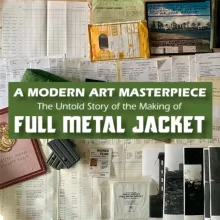
A Modern Art Masterpiece
Show notes
Help make the project a success at: https://www.indiegogo.com/projects/a-modern-art-masterpiece-full-metal-jacket (opens in a new tab)
Transcript
An automatic transcript, tidied into paragraphs. It has not been proofread, so names, titles and spellings may be wrong, and it does not say who is speaking.
Show the transcript (about 5,400 words)
Speaker 1: Hold your ears, folks. It's show time.
Speaker 2: People pay good money to see this movie. When they go out to a theater, they want cold sodas, hot popcorn and no monsters in the projection booth. Everyone pretend podcasting isn't boring. Turn it off.
This is my bro joker. KEVYN MAJOR HOWARD: Is this man? Hi, I'm Kevyn Major Howard. I played Raft Man in Stanley Kubrick's full metal jacket.
And I'd like to introduce you to an exciting new documentary about the making of the film. I think the bizarre stories about Stanley Kubic have been created because, you know, he chooses not to do interviews. And so people have to make up stories about him.
Speaker 4: I am gunnery sergeant Hartman, your senior drill instructor. You will not like me. I believe there's a tremendous amount of violence in there. And I know for a fact that Stanley Kuar is an anti violent type individual.
KEVYN MAJOR HOWARD: A groundbreaking new documentary exploring Cuber's legendary war epic actors are sometimes undisciplined enough not to go home and go to sleep at night and they go out and they come the next day and they haven't learned their prepare yourself for the ultimate examination of this cinematic masterpiece from its very inception, adapting the original novels. Yeah, the script writing process through the stunning art design, the unusual casting process, the challenging UK shoot through post production and its eventual release in 1987.
See the interviews, 34 exclusive. Never before heard interviews with the key players. Private joker has born to kill in his brain. He has a peace sign on his heart symbol.
Here are the perspectives of lesser known contributors such as supporting actors. I'll fix it. Crew members and other behind the scenes personnel, animal mother cuts the head off the sniper, rare photographs, footage, production materials and archival interviews.
Speaker 5: It also suggests the sort of post combat euphoria which you see in the crazy earl's face after he shoots the guys that are running out of the building, that great look on his face of euphoric pleasure. Suddenly the music starts everybody's head about. KEVYN MAJOR HOWARD: An in depth and intimate journey into the making of one of Stanley Kubrick's most revered films told by those who are there.
Speaker 4: You're so ugly. KEVYN MAJOR HOWARD: You can be a modern art masterpiece, modern art masterpiece, the Making of Full Metal Jacket. Your people are no longer maggots. You're part of a brotherhood from now on until the day you die, wherever you are, every marine is your brother.
I always remember this. Marines die. That's what we're here for. The Marine Corps lives forever and that means you live forever.
KEVYN MAJOR HOWARD: If you want to see this film get made and officially be part of Kubrick's legacy. Then check out the different levels of support and the great perks. Please share this campaign with anyone you think may want to get involved. Do you walk?
Speaker 5: The walk looked like something, didn't it? KEVYN MAJOR HOWARD: Thanks for watching Roger out. MIKE WHITE: Welcome to a special episode of the projection booth. I'm your host, Mike White.
On this episode, I'm talking with Kevin Major, Howard Lou Pizarro and Stephen Rigg. All about their new film, a modern art masterpiece, the untold story of the making of Full Metal Jacket. Currently, they are in the fundraising process. They're looking for some funds via IndieGoGo.
I will have a link to that in the show notes. I've backed it and so can you thank you so much for listening and I hope you enjoyed the interview. Luke, give me a little bit of your background. How did you get involved with filmmaking?
How did you get involved with this project specifically? LOU PIZARRO: Well, I come from reality TV, but as far as I can remember as a kid, I remember taking the bus downtown to watch three Shaolin movies for $4. And that was we did it once a month. That was my mom being single.
She would take me and my brothers and sisters out there, the popcorn, just watching different types of movies through the years. And I did an intern one time. I was maybe 20 years old because I wanted to make movies. And of course, went on about my life and he joined the Marine Corps or started a repo company.
I worked for Continental Airlines. I did a lot. And then one day I just got a phone call from Telemundo to do a news segment of the day and the life of a repo man in Spanish. So that was the catalyst that triggered the show idea.
And once put that show together, I pitched it, they liked it. I started pitching other shows where I was in production on that one. And then finally, I made a little bit of money. I did my first film, which so I've done quite a bit of independent films since then.
And then in between that, I've been really good friends with Kevyn Major Howard, fueled by the fall in. He invited me, took me under his wing. I learned a lot out of out of what he was doing. His tribute to our military man to our first responders.
It's amazing and I fell in love with that. And when he calls I come running. MIKE WHITE: Kevin, is this your baby? Is this documentary?
Your project? KEVYN MAJOR HOWARD: It's a collaboration with this team. And I think it needs to be told by the way, I'm Kevyn Major Howard. I played Rafter Man in full metal jacket opposite Matthew Modine where stars and stripes and to continue on your question, I would say it's a team effort and one that needs to be told, I think Stanley Kubrick is a genius film director.
All of us do, but there's a human side to him that I don't think was very much explored. And I want to share some of that limelight with an audience is Stephen Rigg his Stanic Cubic Appreciation Society. I met him on a podcast and we began to speak of perhaps, maybe going down this road. I was convinced with Stephen, he's just a super talent and he understands Kubrick's life.
And so we put these assets together. I brought Lou on simply because the man is very talented at what he does. And he's a former marine, as he said. And I just think again, this story needs to unfold.
We have a new generation of audience, young kids who really have latched on to full metal jacket because Stanley Kubrick is like a fine wine. It just keeps getting better and better. And so I wanna introduce this to that demographic so that Stanley's work is appreciated and continues, Stephen. MIKE WHITE: Tell me a little bit about the Stanley Kubrick Appreciation Society.
STEPHEN RIGG: Back in 2011, a Facebook, I decided to set up a group called the Stanley Kubrick Appreciation Society because I was a Kubrick fan and I just discovered she could make groups and I thought that's an appropriate group to make one off because I was very much into Stanley Kubrick. And yes, so that was 12 years ago. We've got, I think we've got 50,000 members there. Very active membership.
There's a lot goes on there. I haven't got time to read half of what gets posted on there, but it's good quality stuff all Kubrick related. And we've got a couple of guys who admin that with me, Mark L and James Robert Sherman. And yes, that's the Stanley Kubrick Appreciation Society on Facebook.
KEVYN MAJOR HOWARD: Steven and my wife Tiffany had spoke and decided that I should be a guest on his show. And we did, I think it went on for two or three hours. It was a, it was just a bit fun. And the more I began to realize who Stephen really was, I went to Kelsey Howard, the one of the producers on this journey and I spoke to Kelsey and I said, I think this gentleman is worth really taking a hard look at.
He's very talented. He has a great insight into Mr Kubrick. He has a lot of assets untold. And I think that this collaboration could really be benefit to the Standard Cubic Appreciation Society.
That being said, we had this conversation, I explained who Lou was. I explained who some of the team members I'd like to bring in and we all just said something worthwhile. Let's go forward and that's the way this all kind of seeped to the top. It was an understanding of love for the man and the man's work.
And we had an ideal situation where we could collaborate and make it come true when. MIKE WHITE: It comes to this documentary, how do you even figure out what the limits are? Where do you start, where you edit and also where are you at with this actual project? STEPHEN RIGG: I always thought that there should be a good full metal jacket documentary.
There's only been one which was a 30 minute documentary on one of the home movie releases. I always thought he'd make a good documentary and what he has going for it is because it was made in 87 which came out to 87 which does seem a long time ago. But in the, if you look at Kubrick's filmer, it's his second to last. So we've still got a lot of guys around available to talk about full metal jacket.
But I have spoke to a couple of extras from full metal jacket and they had some fantastic stories which also got me thinking that beyond what we've heard, the main cast talk about on interviews here and there in the original documentary, a lot of the behind the scenes guys have got some fantastic stories. So I think what the idea is to hopefully reinterview all the main cast, the secondary cast and anyone who's involved, there's about 30 named cast members on the end credits and about another 70 named extras who Marines.
So to me, there's 100 people to talk to there. So obviously, we're not going to speak to them because there's gonna be a lot of limitations, we'll hand pick it and most of the crew are still around. So I want it to be all encompassing, but obviously, we can't make a seven hour movie, but I want to speak to anyone who's got a great story and which we should in turn tell the story of the making of full metal Jacket. We haven't interviewed anyone yet.
We really approach anyone yet wants to raise some finance so that we know we've got a bit of cash and us to go ahead and do interviews. The two areas that we want to interview are obviously in the States because all the main cast were Americans and they were all out there. But the rest of the supporting actors and crew were are mainly over here in England. So we need to do 22 different locations for film shooting for interviewing the people.
We just want a fantastic documentary at the end of it, that's gonna get, hopefully get some screenings out there, hopefully get streamed and hopefully a few people will be adding it to their Stanley Kubic shell at some point. LOU PIZARRO: One of the things we also want to show. Yes, we want a full length documentary. Again, even early on that, Kevin Gerard was saying, we want this new generation to know this want to live on for ages for another 100 years.
Plus and one of the difference that's we're gonna have there is, yes, we're gonna interview all these cool new people and there's a lot of other interesting new things. But Kevin will touch that because that's his thing because I can't say too much or we get popped out. We get in trouble as we know full metal jacket was not shot in Vietnam. It was depicted but we're actually gonna visit the places in Vietnam.
We're gonna visit, we're gonna go through the Hochi M Trail. We're gonna do these different things to make this documentary so powerful and memorable. People are gonna love this and it's gonna keep on going. KEVYN MAJOR HOWARD: On and on.
Since my making a full metal jacket, my involvement and meeting some of these Marines, I was invited down to 29 Palms And Marines Base in California for a silent drill celebration. And I was a guest of honor that being said after the silent Drill, which was brilliant. I was taken on tour of the base and I was introduced to a memorial monument to a gentleman by the name of Tory L Gray, 19 years old. And as it began to explain this monument to him and his life, he was the individual that jumped on a grenade to save his men.
In Fallujah. One of the first early ultimate sacrifices paid. I walked away from that moment thinking my goodness, the DNA properties of anybody who puts a uniform on is worth applauding, standing back and having your jaw dropping. Aw.
And in response to that feeling I needed to do something as an American citizen to say, I get the message. I understand the message and here's the way I can give back. And that became a gift from my family to all Marines and all men and women of service in any of their uniforms. It was a Marines tribute race car which was emboldened with 864 of our fallen heroes, Marines and their ranks and names applied to the panels of the car.
I did this because I think that the automobile is one of the great canvasses to paint with. You will get the attention of a two year old or a 92 year old. And the story is told when I brought it to 29 palms, a little worried that maybe I might offend somebody didn't know, but you are dealing with an awful lot of people who paid the ultimate sacrifice as the car rumbled into its main gate. All of a sudden, every marine that was in withstanding within visual appearance of that car rose to attention and then saluted as this car idled by, I was invited to the stage.
It was a Montgomery and Ridge concert. I was invited to the stage to unveil it. And I said to every marine sitting there, 5000 plus it doesn't stop here. It becomes the army, the Navy, the Air force, et cetera.
I then turned that into three police national cruisers that carry the names of all those from 9 11. That moment to present dates. I built five Camaros with light bars and told the story of 9 11 itself that all was part of the influence of full metal jacket and introduced me to a way to give back to our heroes to let them know they are not forgotten. And I will applaud them each and every day that I'm alive and that I can share this with the children because these children can't walk into their future with our flag if they don't know their history.
And this is the way you can tell that history that all being said, I have met many a person, a family, a brother, a loved one, a father who applauds the fact that we are who we are as humans and we are who we are as Americans. And that we need to be respectful of each other. And that was what this is, this has introduced to me is this kind of respect that I want to share amongst us all. Simply because as our world is falling apart, America is in decline at this very moment and we need to stay strong and to continue on our freedoms.
And so this influence has been a very big part of full metal jacket within me. And a way for me to tell that story because I do have the ability of a red carpet with full metal jacket on my sleeve being a part of the making of it. So with Steve and Lou, I really appreciate their talents and helping us get this journey accomplished. And it means an awful lot to me personally simply because it's not just full metal jacket that was the Vietnam War, but we have a new war today and I think that they melt beautifully simply because these are our men and women who go to battlefields and then come home with their sleeves and freedom for us in their hearts and fought for brilliantly.
So that's part of why I do what I do with this is to contemporary full metal jacket in today's society and say that soldier that just went to war for you needs to be in your hearts at all times, needs to be in your arms when they come home. Don't sell yourself short. This is Great America. It always has been and will continue to be Kevin.
MIKE WHITE: I know you had been acting for quite a while before you got the role in Full Metal Jacket. But can you tell me what that process of getting that role was like for you. KEVYN MAJOR HOWARD: Been very blessed in my lifetime? Like you said, I've done an awful lot of film.
I'm a young man from Canada at 20 years old that come to Los Angeles to seek out my fame and fortune. And here I was on the doorstep of an industry that was really catering to my age. At that point, there were very few of us at 20 years old, stunning acting and acting classes in Los Angeles because every script that was abound was mostly a 35 year old plus subject matters that dealt with that age group. However, the tide had turned where movies were shifting to the younger crowds and I was just standing in the perfect place at the perfect time to get hired to play a lot of guest stars on a lot of films is scared straight.
Another story was one of my opening films. I love that piece. Again, you're sharing what it's like to be a young man. You're sharing with the world at large and saying to all young men do not follow in these footsteps.
You'll end up in prison, you will be unhappy and you will end up probably losing your life. And so I was able to show that excitement off in that character. That's not the place you want to be. And I got a tremendous amount of applause from the industry itself where they invited me to do more film, more television, a team chips guest starring on Strike Force, et cetera, et cetera, et cetera.
Went off to do a film with Clint Eastwood, then Frank Sinatra, then Charles Bronson. I was really in the thick of the mix of their greatness. And it offered up when Stanley Cuber came along and said, and wrote me a letter saying, if you want to do my film, just write me back and just say yes, I wrote him back and I said that very much. Yes.
And I didn't hear from Stanley for about a year and a half. I thought perhaps, maybe this is just a dream of mine. And then one day I'm traveling through Italy, I'm backpacking, taking a little adventure off in Europe for six months, whatever. And a lady walks up to me, I have tens of thousands of people walking in the streets.
A lady walks up to me. She says, hi, you're Kevyn Major Howard. And I said, yeah, who are you? And she says, Rosanna Palocci, I'm actually Clint Eastwood's agent over here and I went, whoa.
And then she said the word was put out through all of Europe to be on the lookout for you because Stanley's making this film and he wants to know if you really want to do it. And immediately we went back to her office, we phoned up Stanley Kubrick and there it was, the invitation was meant, I said, yes, we talked on the phone. He said, I'll see you in four or five months. And the script was sent and there I was sitting in Greece when it arrived, I was in Santorini and lo and behold, my life completely changed.
This man offered a and still does to this day and it just gets better with a fine wine. I get the red carpet treatment and I don't use it as an ego boost. I use it as a way to share the gift of what my father influenced me with, which was respect and honor and change the world somehow. And so he's offered, Stanley Hubert has offered me that place to change the world somehow and I did it with a 21 car salute to our heroes which still stands today.
In fact, Lou and I are actually been invited to be the grand marshal for the 50th anniversary of our Vietnam vets returning home called the Honor Convoy in Placentia, California October 14th is when it's gonna happen, man, Mr Kubrick, thank you so much for the many gifts you have given to me. I walk into a restaurant and people just know and again, I've been afforded that blessing. Been lucky. MIKE WHITE: It's gonna be interesting with that movie in particular.
It's so divided. Did you ever even meet Ali Erie or Vincent Dinari? Because you didn't share any scenes together. KEVYN MAJOR HOWARD: Funny enough how that all really unfolded when I got the script.
It's based really tightly on Gustav Hud's understanding of Rafter Man and Joker as they traveled together through Vietnam when we got to this set, the script was still intact, but Ali Iy was our technical consultants and Ali early on in the first few days was sitting there with me and I believe Sal Lopez, and he looked at me and he said, Stanley is gonna need an awful lot of extras to play these rules of Marines. And I'm figuring I'm gonna help Stanley out by giving him time and frustration. I'll just grab a bunch of 300 guys.
I'll take him out to a tarmac, I'll have a video camera and that way I can point to the screen and say Stanley use that guy oh and use that guy and that guy right there. And I looked at Ali Erie that day and I went, oh my gosh, I know what you're up to and his wry smile came aboard and I looked at him and I got the message he was really going to tear apart that script and audition for Stanley pretending he was casting for Stanley those extras. The minute Stanley saw that film footage, he tore the script in half and we were off to the rate and that's why it's two separate films.
I was not disappointed. However, with the outcome, I think it's an incredible performance that Ali put in. And yes, I am part of Ali's life in such ways. But I'll say this with my five tribute cars to 9 11, the white Camaros that have the names of everybody we lost in 9 11.
Those five cars with the lights on, escorted his coffin for 100 miles through Los Angeles. And I let those lights burn brightly for all those to let them know. This was a man worth watching. This is a man worth saying goodbye to.
So I had those last moments with R Lee as well. He was a very gifted human being. He cared for his Marines as Lou will tell you. LOU PIZARRO: Not only was he our gunny, but he's our nation's gunny and this world's gunny.
And I always say that because it all the different military around the world, whether it's the Philippines or whoever they have a version of the Marines and the gun is meant so much to them till till this day. So I always like to throw that out. And by the way, Kevin, I love hearing that man. It just, it gives me chills and I just love it.
So Semper Fi to that brother. KEVYN MAJOR HOWARD: Thank you brother and also in this journey because Stephen is who he is. We have a lot of new asset on Ali that we will will share through this documentary and there are people around him that are very much his intimates, whether it's family and or brother and or sons and daughters. These will be also explored as to why this man was as great as who he was.
He was. MIKE WHITE: Yeah, I'm very curious, Steven as far as the just the amount of stuff you've been able to dig up over the years like you said, this movie came out in 1987. So we have all of these years since then to almost retroactively do your research. Tell me a little bit more about that process and some of the things that you're bringing to the table.
STEPHEN RIGG: Obviously, the kind of elements that are needed for a documentary are mainly interviews, also archive footage, photographs and other visual elements. I've been a big Kubic collector for a long time. So I've got quite an accumulation of production materials from the film that I managed to get hold of over the years. Call sheets, production reports that that kind of thing.
Also because I am in the Kubic community with the Stanley Kubrick Appreciation Society. There's a lot of other Kubic collectors in there. We do share it. We've got, I think there's three or four guys in the group who have got hundreds of photographs that they've got hold of relating to behind the scenes on the film.
I know a few filmmakers out there who've got archive interviews that are available for anyone that we got that are no longer available to talk all sorts of stuff, really, anything we need to. If it's available, I feel confident we'll get it. We're also very likely going to use the Kubrick Archives in London to do some research there. There's a lot of materials in there, including some photographs that Kevin's Kevin's character Raman took because you'll remember that Raft man was a photographer, the stars and stripes and he was always snapping away.
It turns out that there was actual film in that camera. And we've recently discovered that Kevin's roles are film, some already developed are in the actual archive in London. So things like that, we're hoping to get hold of you. KEVYN MAJOR HOWARD: You got me so excited, Steve, I'd love hearing all this as a reflective mirror and I'm looking so forward to the unveiling of this journey.
It's gonna be remarkable. So stay tuned for it, please. STEPHEN RIGG: Oh, I'll just mention Lou mentioned earlier about visiting loca locations. Lou is going to have a look at Vietnam.
I'm going to have a look at the locations in England. Most of the Vietnam stuff was shot, Beckton Gas Works, which is no longer there. It's now a retail park. So there's not a lot to see there.
There's no point really visiting that that location, but there are another maybe a dozen sites, locations that you think might have been at Beckton, but they weren't and they were all available stuff like places like Cliff Marsh in Kent, Epping Forest. There were some scenes on in Epping Forest in Essex, the Isle Of Dogs, the Millennium Mills and the Norfolk Broads. They got around the guys, everyone thinks that they filled everything and gas works, but they got around the country a little bit. And also they went to RFs in which is up north So, yeah, so there's all that.
And then of course, passing Born Barracks in Cambridgeshire where all the early training camp stuff was shot. So there's plenty of locations to revisit Lou. MIKE WHITE: Is it too early for you to have started gathering your crew and started thinking about the actual look of the film and these kind of things. Do you have a scheme in mind for when you shoot your interviews?
Because obviously that is such the bread and butter of documentaries. Are you already planning that out? LOU PIZARRO: Yeah. You know what collectively we are myself as a producer, director, I'm always looking for that difference that when people are gonna say, wow, that's awesome.
Like us going to Vietnam, the stuff we're gonna be doing in Vietnam. Not too many people are gonna want to go into the jungle, it's dangerous. There's a lot of things that can hurt you or kill you. I'll be there, I'll be there taking care of business and with today's technology and equipment, there's these cool shots that we can get even when we're doing testimonials or we're doing the interviews.
I have this, these cool ideas that we're going to just interject, we're gonna make this thing memorable and there's a few other things that I promise everybody that's listening is gonna be out of this universe. It really is. And again, it's more of the stuff that we can't quite talk about yet. Now, if you would have had me one on one.
I would be able to tell you, but Kevyn Major Howard hit Jed's kiddy. Just kidding. So, yeah, what we're gonna impress everybody. I can tell you that.
MIKE WHITE: It is currently undergoing funding on IndieGoGo. I have given, I don't remember what level I gave at. I don't think I'm an associate producer cheap in that way, but there are great perks available for this. It's fantastic and.
KEVYN MAJOR HOWARD: There's gonna be new perks. Well announced shortly. We are working on those developing those. So please go back, refresh the page, take a gander at what it is that we're explaining to you.
And thank you very much, Mike for jumping on board that way. Thank you, sir. MIKE WHITE: Now, I don't want to put you guys on the spot or anything, but if you'd be up for talking again in a few months and we can see where the project's at then and just continually update people on this, I would be all for that if you guys are. STEPHEN RIGG: Yeah.
Absolutely. That'd be great. LOU PIZARRO: Absolutely. Short.
KEVYN MAJOR HOWARD: Short from us. LOU PIZARRO: Cloning Stanley Kubrick is, it's just gonna be again out of this universe. How everybody's head about the bed to where we Yeah, and no, I my mouth but my now.
Comments
No comments yet.