Special Report
Ed Solomon on Full Circle (2023)
Show notes
Transcript
An automatic transcript, tidied into paragraphs. It has not been proofread, so names, titles and spellings may be wrong, and it does not say who is speaking.
Show the transcript (about 4,400 words)
Speaker 1: Hold your ears. It's show time.
Speaker 2: People pay good money to see this movie. When they go out to a theater, they want cold sodas full of hot popcorn and no monsters in the projection booth.
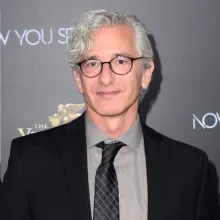
Speaker 3: Everyone pretend podcasting isn't boring life. MIKE WHITE: Hey, folks, welcome to a special episode of the projection booth. I'm your host, Mike White. On this episode, I'm talking with our old friend Ed Solomon, talking to him about his new mini series Full Circle, which he created with Steven Soderbergh as well as his new podcast Word by word.
It is always a pleasure talking with Ed. I hope you have as much fun listening as I did talking with him. You're joining the ranks of the podcasters. Now, how is that?
ED SOLOMON: Are you talking about? Word by word? Yes. It's been fascinating right now.
It's just a live Zoom webinar, but we are editing them into podcasts because they've been so interesting. We've gotten so many people that would either like to be listen or people who didn't get a chance to watch it when it was live. I wasn't even sure I could do it. I had this idea.
I tweeted it out I was like, hey, if I put together during the strike, a series that talks about process, would anyone show up? A lot of people said yes. And suddenly I thought, oh, no. Now I'm might have to do this.
Who am I to try to teach it? The format really helped me out? Because what we do is we do for the first hour, it's me and like, usually two or three other writers. So, although we had one on one with Neil Gaiman last week, the first hour casual conversation, that's easy.
Just have conversations. And I'm asking people whose work, I just really admire questions about their process, which is really interesting. In the second half, we take questions from people who are watching. It's actually ended up being really fun to do something I've become really excited about.
Right now we're every Thursday, we were going 2 to 4 West Coast, 5 to 7 East Coast. But next week we're doing earlier because we're doing 22 writers, Sharon Horgan, who's a writer, actress and Lucy Preble, who are both in the UK and I'll actually be in the UK as well. So we're gonna do it a couple of hours earlier. MIKE WHITE: It must be nice connecting with other people that do your same job.
ED SOLOMON: It is, it, there aren't a lot of upsides to strike. A lot of people get hurt. We all make a lot of sacrifices. One rarely recoups what they lose personally, during a strike time, you're striking for the people coming after you really, the people who struck in 1960 for residuals gave up all their own residuals up till that moment for the right for people coming after them to have the residuals.
And that's the tradition of this. But a lot of people are hurting and one of the small upside to the strike is you out on the pick a lion and you talk to other writers which you never get to do. I don't remember who was during a strike. It might have been.
I remember decades ago, Phil Robinson decided to put together a group of screenwriters to just meet and talk at his house and sometimes as many as 40 or 50 people would come and I hadn't really met a lot of screenwriters until then because you're just so alone in the job. It was great sharing information, talking, getting to know people being friends, realizing you're all struggling the same way and back to word by word. What one of the things that has been really in invaluable to me and inspiring is that all these writers I really admire are struggling with a lot of the same things I am and a lot of the writers who are newer on the continuum of their careers, aspiring or first time or first few times or just trying to break in pre WG I you wanna say, or we all have the same issues.
Essentially, some of us have more tools because of our own experience, to deal with the problems and to be able to share those with people is really helpful because being able to articulate it a little sometimes actually, for me at least helps me understand it a bit more. But hearing other people talk about their process and how different it is from mine can also be freeing because you then go, oh, I don't have to be so married to doing it this way. You know, I've developed habits over four decades that are really particular to me and sometimes it's good to break out of that.
MIKE WHITE: Can you tell me a little bit about full circle? And I'm curious, when was the first time that you worked with Steven Soderbergh? Was that no sudden move or had you worked with him before that. ED SOLOMON: Mosaic was our first time together.
I got a call from Casey Silver who produced mosaic, you know, sudden move and full circle who was an old friend and an old colleague of mine saying, could you meet for breakfast? But you need to sign an ND A and I was like, really to have breakfast with you. We've had 25 meals together over our life and go to breakfast with me and another guy. And they're like, are you a fan of Steven Soderbergh?
And I'm like, you're kidding? Right. Yeah. Fan Steven Steven wants to experiment with this little 10 minute piece.
He wants to do like a 10 minute branching narrative to just see if it's even viable. Would you be interested? And I was like, hell, yeah. And I think honestly the only reason he came to me is the people that he normally works with probably were like, fuck, no, not this, this seems like bullshit.
I was like, this seems interesting. So we got together for a period of time breaking this thing out, trying different things, ways to tell a little 10 minute branching thing that he could shoot on one day, which he did. You went, you know what that kind of works? How about we try something longer like a full on thing.
So I spent about a another a year and a half working really hard on the outline for mosaic. That was the first thing we did end up doing. We wrote about three or 400 pages on spec before HBO picked it up and then finished it up and then Stephen shot it. And that was a very really high point for me.
Created a wind. It was during the doing of that, I got the idea for full circle. But also Stephen and Casey came to me and said, hey, I have this idea. We want to do this kind of kind of movie would be up for writing it.
And I was like, that sounds awesome. Let me give it a shot. So we did that next. And then Full circle was the third thing that we did it.
I was writing, I've been writing the circle forever writing. It took a break, doing no sudden move, took a great shot. Bill and Ted faced the music took and you've been working on it over a course of almost seven years. MIKE WHITE: Now, when you write something like full circle, are you just sitting down a right nil whole darn thing or are you purposefully thinking this is gonna be six parts full circle started as a branching narrative show.
ED SOLOMON: So originally I wrote it character by character and individual storylines where one character's journey would overlap another character's journey. And sometimes you wouldn't even realize that other character was a main character in the overall piece. You'd think they were just a passing almost an extra in one character's life. But in fact, has a giant role in this other person's and they were all interwoven originally was and that ended up being a 586 page spec script, which I knew while writing it this time, unlike Mosaic, which we wrote his or I wrote his branching.
And then we shot as the branching and released as an app that was branching. But I also took the footage and turned it into a linear show. This one, I said, I know this is gonna be both. So let me write a branching version, an entirely different linear version.
But what we ended up doing was taking from the branching, reorganizing it in a way that we wanted it as a linear show and then deciding that the branching shouldn't be so long, but rather should be two hours and very different. Like not even the same kind of footage just we'll shoot a linear show that's six hours long. And then every day when we're on a certain set, we'll finish with one change, cameras change equipment, use the same actors, same set, but shoot a very subjective version of the same thing. And then about, I don't know, maybe 54 or five months before we started shooting, Steven comes to me, he's taking up lunch and I'm like, yeah, sure.
He's so, I don't think I can do that. You just don't think physically we can handle it. And I was thinking, thank God, I was actually thinking to myself, I don't know how we're gonna do this. I guess Steven thinks we can and if he does, I guess we can, but I don't know how I can take care of a full, really complicated six hour weird mystery.
And on top of that, an even more complicated branching show. But he got to me first on that and I was really relieved. It's kind of like when I remember years ago back in college was dating someone and we, I was like, I don't think this relationship is working. I wish we could break up.
But I don't wanna be the guy that breaks it up and she's, hey, can we have a walk and we go for a walk? And she's like, I think we should break up. And I'm like, oh my God, thank God, she's, we said this is the best breakup ever. We were like, both so frick and relieved.
It was hilarious. Anyway, that's what it felt like on getting rid of the branching. Although we worked very hard on the branching, but it wouldn't have made it work. MIKE WHITE: I always appreciate how Steven Soderbergh seems to be up for anything.
Just yeah, sure. Let's do a TV show. Oh, let's shoot this all on an iphone. It just feels like he's always embracing the new, embracing the challenges.
ED SOLOMON: Absolutely. I think the upsides of that are so phenomenal and in terms of always staying fresh and always pushing himself, always experimenting, always doing things that are exciting to him. He has a philosophy that I think is when I could really learn from. If it's not a hell.
Yeah, he doesn't want to do it. I mean, he has a lot of hell, yeah. As you might know, the downside is he can try himself. He works really hard.
But I've never met anyone who can do as many things as he can do and then compartmentalize them and really focus on them. So it's a really remarkable skill set. I've learned a ton and I've worked for him about 10 years now and I've grown a tremendous amount as a person, as a writer, working with some, it's been really valuable and very meaningful to me. MIKE WHITE: I can't get over the level of talent well, in any of his things, but especially in this one, just the cast is remarkable.
ED SOLOMON: When you have a cast like we had or have or whatever you say in full circle. And first of all, you learn a lot as a writer, you get a great actor. Two things happen. The first is they make it sound better.
And partly because they say the words that are written better than you imagine it. But also they don't say the words you always wrote, they'll often filter it through something that's where you learn because these great actors, all of them and I think the folks on full circle were great, the new actors were great. The seasoned pros were pros in the right sense of the word everyone. But they'll be tough on the material.
Even the ones who are incredibly easy going like Tim fan, great guy, super nice guy Claire. Honestly, they also were super nice, really lied to these people we worked with on this show really like it was one of the hardest experiences of my life. Some of the most incredible people and the crew was amazing. It was really nice, good people working very hard.
Anyway, one of the things that they do is they challenge why is this here? Something feels right. It doesn't feel right to me. Something feels weird here.
Why am I doing this? It feels like I'd be over there. It feels like I'd be angry at him more than her. And you hear that and you're like, that's right because they take it down to a truer place, they take it down to a more basic place.
What am I doing here? What do I want? What's the logic they have to believe in the logic of what's happening is to believe in the emotional logic of what's happening. And as a writer, you can often get way lost in your head and think this must happen because I want it to happen and these words will support the thing I want them to say and I will put them in this scene because I want them in the scene.
And you get that is only a tiny bit of it. The real deal is you're writing for human beings to come aboard and internalize and externalized these human beings that you created and that they are now the living manifestation of and that ship sails and they are out at sea with the character and they are doing what they're either going with the guidepost, you gave them or they're that your guidepost doesn't work by the way, this metaphor is not working as well as I'd hoped, but it's like it's their character and you then become the shepherd, but really the person trying to help them become the best version of that character they can be.
But when the actor is a real pro, really good and I've had this a lot with people. You learn about more truthful, better ways, more interesting ways to tell the story, more honest and direct ways, more brief ways. And most good actors don't want more words, you the stereotypes, they just want more words. Most not good actors want more words, most good actors want less words.
Most good actors want to do it in the cleanest and simplest way possible. Not the most ornate. It's a stereotype that's not true. And I tend to overwrite as I tend to over speak like I'm doing now so often.
What I do is I overwrite and pare back and then good actors reduce further good director reduces Stephen Wath and cut. What I think is a masterful 3.5 pages into a minimal one and three quarter pages. And he'll go, he said this year twice we didn't need this and I'll be like, yeah, damn it. He's right.
MIKE WHITE: So do you think a better writer is the person that can get to that base level that you're talking about? Or should you always leave that room for the actors? ED SOLOMON: A good question? I think everyone's process is of course different and everyone's result is different and how they get to the result is different for me.
I don't know if it's better writers, but for me, my result has been better when I managed the relationship between what I wanted it to be and what it is becoming when I've managed that relationship. Well, meaning, here's what I thought it would be and why I thought it would be that and here's what it is becoming with these other people involved in it. What is the value of what I thought it would be if it's veering away from that? And how important is that?
Where is it heading? Is it heading in a new direction? If it's heading in a slightly new direction? What does that mean for the old direction?
And what does that mean in terms of what's already written? And is this new direction better or just different? And if it's better, what is, what do I need to do to change it if it's just different? But equivalent, you have an actor who believes in a version, it's only going to be better, forcing them back into what you thought it was gonna be will be worse.
So by default, they win on that if it's not as good for whatever reason that becomes a conversation. And when I was a newer writer, I would dance around that conversation like not trying to offend anyone and the more comfortable I got with it, the more I could just say wrong with that is this and they go, yeah, but then Bob, I'm doing this which feels like bullshit. Then I'll go. Ok.
Yeah. Ok. I hear that. That feels like bullshit.
Here's what I need, here's what I'm trying to get from it. I feel like you need to lose your shit at him here and she goes, I feel like I've already lost my shit. I'm just making the story of this didn't happen. I feel like I've already lost my shit.
I lost it in two scenes ago. And now I feel like it's about resolution. And then if I'm being honest, I'll go, I need you to lose your shit because we have that scene where your kid overhears you yelling and I want to be on the kid over here and you yelling if I say it just like that and I'm an actor and then I'm the actor hearing that I would be like, fuck you. That's the writer going.
Yeah, you're a, you're abandoning truth for this idea you had in your head. But the way I would say it, if it was, let's say Claire or Tim or any anybody, you know, I'm imagining having this conversation with Claire. I never had that exact conversation but she is, I love her man as a person. I love her as an actor.
She is the like the pro in all the best ways shows up. Does it crushes it questions it when she doesn't believe in it but gives it brings it really brings it if I were having that question with Claire, knowing her professionally as I do and the relationship we've been developing over the course of it, I'd say, you know what I did Clare, I, again, it could be anyone. I'm just making it up as clear. I did that writer thing where I needed to have the kid over here it.
And so I forced you into a position. I'm like, look, that's a thing. We all do like we and if you can say it like that, I go give me a moment because let me see what I can do here. So that because then she might go, what if I'm just again making that?
She might go, OK? She might either go, what's your problem? Figure it out? Which player wouldn't do?
Most actors would then go got it. I see what you mean. Or a better argument is actually like a better way for me to put. This would be if I would say the problem is we have a scene which we've already shot, which is the kid overhearing it.
We already shot that and we can't repurpose it and we need it because it carries into another scene that we can't cut. Let's just say that in that version, the actor goes, got it. Ok. You know what would make me mad?
What would make me mad is to be called back and wanted to reiterate the argument and I said, yelled at him. We've had this argument and be like that feels right and truthful. Great even better. It's more real.
It adds to. And then let's say he's a guy that keeps calling back. I love that trait. What if he's a guy, you can't let it go.
And the next scene, let's have him do it again. Like that's a good version of a collaboration where it brings it to life. She understands the production need or cinematic need to have this kid hear the noise. Let's say if I actually said I wrote it in a way that I liked him hearing the noise, but we haven't shot that I go let me figure out a better way to make this work.
That'd be on me for that reason. So, although they may go, how about if this happens? But most likely we'd both know this is my problem that I created a good actor also sometimes just wants to know, where do you need me to say the line? Weirdly enough, if you're well into production and you've edited a bunch of stuff and they know the gig they've been, they're not gonna go, I wouldn't go there because I don't feel it.
They'd go. All right, you need me to get there. Let's figure out a way to together. But I can do that.
Truthful lake. Yeah. What I would say to a new writer is to the best of your ability because I as a writer has been doing this a while. I had the benefit of having actors do my stuff and you learned so much from it, I'd say to a new writer, get it up on its feet and get people reading it, acting it, direct a few scenes, watch it, listen to it, a act.
It yourself, try it. You'd be amazed what you learn and it's not always pleasant. MIKE WHITE: You're working on the podcast, you're without picking. Are you just fully pencils down on everything else?
ED SOLOMON: The podcast is the only thing I'm doing that's writing related. I'm not picking when I'm in Manhattan. My girlfriend is in London and I've been in London a lot. So is my son and I've also been upstate a lot where my other daughter and I are.
But so when I'm in, able to be in the city, I'll go to the picket line. But other than that, I've just been recuperating from full circle as anxious as everyone else about. Where is the work gonna be as worried? Yeah.
And right now it's just life maintenance and trying to recoup and trying to have some kind of summer without worrying too much about stuff. It's a good way to look for a silver lining, but the only silver lining I've been able to get from it and believe me, I don't, these things aren't, you know, there's, there's not. Thank you. Look at the bright side of the stripe.
I mean, there are a few things you're on the picket line and you meet a lot of writers and that's really interesting. And sometimes I think for people who tend to be workaholics as I have tended to be, you know, being forced to not write is actually healthy. That said I wouldn't, I think the onus is on me to learn how to figure out how to not write when I need a break, not shut down so that I can ever break. It seems like a very selfish way to look at it.
Obviously, that's not something I would want. MIKE WHITE: I can't remember if I've asked you this before. But why was the sequel to now? You see me?
Not called now. You don't. ED SOLOMON: No, you don't. I tried so hard.
I so agree with you. I'm like, it's the obvious sequel and they're like oil marketing says the total. Now you see me has better name recognition and like then now you really, it's the sequel to a movie called now you See Me, which is the first half of the statement. Now you see Me now you don't.
It's about magic. We can so easily make it about now. You don't, I'm so frustrated that they didn't do that. It's so lame.
MIKE WHITE: Ed. It is always such a pleasure talking with you. Thank you so much. ED SOLOMON: Oh Man, Mike, it's great to be on with you again and literally any time you need.
Just let me know.
Comments
No comments yet.