
Show notes
Buy the book at https://amzn.to/3Pd84x2 (opens in a new tab)
Labels: Special Report
Transcript
An automatic transcript, tidied into paragraphs. It has not been proofread, so names, titles and spellings may be wrong, and it does not say who is speaking.
Show the transcript (about 4,800 words)
CLEAVON LITTLE: Hold your ears, folks. It's show time. HULK HOGAN: People pay good money to see this movie. When they go out to a theater, they want cold sodas full of hot popcorn and no monsters in the projection booth.
Everyone for 10. Podcasting isn't boring. GEORGE C. SCOTT: Turn it off.
MIKE WHITE: Hey, folks, welcome to a special episode of the projection booth. I'm your host, Mike White. On this episode, I am talking with our old friend, Nat Selo. He was on the show quite a few years ago when we were talking about Arthur Penn's Night Moves.
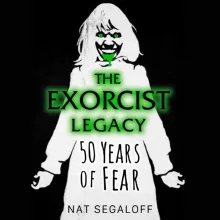
He's back and he's talking about the Exorcist legacy. 50 years of Fear. It is his latest book all about. You guessed it.
The Exorcist and its legacy. Natt writes about all of the Exorcist films except for the three that have yet to be released though. He does talk quite a bit about the new one that we just had a trailer for. Also talks about the original three slash four slash five film.
Oh, man, what a mess. And that's a great thing about this book is he really puts a lot of effort into talking about all the different versions of these films. You heard me quite a few years ago, talk about Exorcist Two, the Heretic and the different versions of that. He gets into that in this book as well as the whole ordeal around the fourth film, which came out in two very distinct versions, one by Rennie Harlan, and one by Paul Schraeder.
You can't really get two more different directors there. All right, be sure to pick up the Exorcist legacy. 50 years of fear, it is available where all finer books are sold. Thank you so much for listening.
And I hope you enjoy the interview. Let's talk about the Exorcist legacy. 50 years of fear. Are you just writing this because it's the wonderful Exorcist or are you writing this because it's the 50 years of fear.
NAT SEGALOFF: It's both, of course, at the end of 2020 I got a new agent whose name was Lee Sobel and he decided to work for me. He said, what's got an anniversary coming up because publishers like Dela on the 25th, their 50th or 40th didn't take as long to realize as a team that the Exorcist was going to be 50 years old on December of 19 73 to December 2023. And that gave me two years to write the book. I did a proposal and he sold it within a matter of days to Kensington Cel, they understood what was going on.
And so then I started to write the thing but since I'd already written the biography of William Friedkin back in 1990 hurricane Billy, I had, how can I put this diplomatically, I had all the stories from when the film was just a hit. But before it became a classic and so I had an awful lot to go on already. And so it was a simple matter just to add all of the other exercise to the first one and then wait for the other ones to come out. We didn't know there were gonna be three new ones when we started writing the book.
But those came about and I must say that David Gordon Green who's doing the believer was so gracious and he gave me an interview before he'd even finished the movie. MIKE WHITE: Yeah, that was pretty remarkable. He and Ellen Burton both talk with you. NAT SEGALOFF: I believe Ellen Burston is simply my goddess.
I love her. I think she's the finest American actress we have today of her generation and she was spiritual and sharp and bright and compassionate and a really nice lady. MIKE WHITE: I thought I knew about the Exorcist and I definitely thought I knew about Exorcist Two, but I did not know nearly the amount that you put into your work. And especially, I didn't know that much about Legion.
Exorcist Three, Dominion Exorcist, the beginning, the Exorcist TV show. I had forgotten that there even was an Exorcist TV show. So you were taking me all down these avenues. I had no idea about.
NAT SEGALOFF: The one thing I left out because I wasn't aware of it when I started doing the book was there. I've been not only a stage production of the Exorcist but they're supposed to be a musical stage production of the Exorcist. I cannot imagine. But I decided not to go there because I stick to film because if I started doing that I'd have to start doing all the derivative films and all the rip offs and all the parodies and I just didn't have enough pages for that.
MIKE WHITE: Yeah, you don't wanna watch repossessed. It's not good. I have. NAT SEGALOFF: So we've all said.
MIKE WHITE: Yeah. Yeah, I was curious as far as what your parameters were gonna be if you were gonna go down because calling it the legacy, I was like, oh, is he gonna go down the avenues as far as other exorcism films, other knockoffs of the Exorcist like Abbey? There were so many different ways that you go with this. NAT SEGALOFF: This was the way that came out about 90,000 words.
And my publisher said, let's go with it. MIKE WHITE: What were some of your biggest challenges? Writing this one? NAT SEGALOFF: People were dead, the people for the original film.
And from, and many of them from Exorcist three simply weren't here anymore. Fortunate. I'd done my leg work back in 1988 to 90 when I wrote Billy's biography. People who write film books get seduced by actors because publishers and publishers get seduced by actors.
The actors probably know the least of anything involving the films. You want to talk to the grips, the production designers, the production managers and people like that and many of them are gone. I was lucky that Terry Donnelly, who was the production manager and the first assistant director, the original actresses was an old friend of mine from years ago. So we connected again and he just told me anything that was of interest and also helped explode a couple of myths that had come down over the years.
So Terry was a good guy, also Craig Mckay, who was like the junior assistant editor on the Exorcist who later edited sids of the Lamb. So he's pretty good. Also gave you some stories from inside the editing room. So it's people like that who really give you the stuff.
MIKE WHITE: I mean that how long have you been in this business of covering entertainment? NAT SEGALOFF: It started on October 17th, 1970. And I remember that day because that was the date of the New England premiere of a version of Julius Caesar that Charlton Heston was in. And if anybody in Eastern Massachusetts is watching and listening to this, I want to extend my heartfelt apologies because I was the group sales director for American International Pictures.
And I sold tens of thousands of tickets to all the high schools in Eastern Massachusetts to put their kids on buses to come in and see this movie, as I said, I'm sorry. But I was the guy who got that job and that's when I got to meet Charleston Teston for the first time. Wow. MIKE WHITE: I didn't realize you would work for a IP.
NAT SEGALOFF: Oh, I loved it. It was so much fun. They were absolutely nuts. And that's the best way to enter the film business is as Harvey Appell, who is a branch manager of a IP in Boston said, if we had a hit, we wouldn't know what to do with it, but we did have hits and Harvey was just a wonderful man.
All the people there were, it was as screwy as you can imagine. MIKE WHITE: I didn't realize how long you had been working in the business and I posted that thing a few months ago when I was doing research on Popeye and there's one of your articles and there, I was like, wow, what there was in the Robert Altman archives. NAT SEGALOFF: I'm an old whore. I did publicity for five years.
And that put me in touch with a lot of people. And then when I crossed the Rubicon and became a critic, a lot of the people I had done publicity for thought I was still a publicist. So they trusted me, but I was a reporter and I quoted them with a certain discretion and it just got me in there because they knew I was someone they could trust. And So when I started covering the industry as an industry for the Boston Herald, I had all these contacts as I'd worked with them for five years.
And so it made things pretty accurate and pretty hairy. MIKE WHITE: Sometimes you talked about the challenges of writing this Exorcist book with all of the people that have passed on. But it feels like you talk to a lot of people. NAT SEGALOFF: I talked to a lot of them many now and also some people had given their articles and had been quoted, there's a lot of stuff out there if you know where to look for it.
I also, of course, through the graces of the Motion Picture Academy had complete access to the private collection of William Friedkin. So I was able to see a lot of the notes behind the scenes, things talks about lawsuits, special everything. And I knew what to look for because, you know, I had known him, I was a publicist, I'm the Exorcist on the local level. So I started right from the beginning.
MIKE WHITE: When did you first meet William Peter Blaney? Was that at the same time? NAT SEGALOFF: I wish it had been. No, he had released his film version of the Ninth Configuration and they sent him on press tour.
So I as a Boston film critic and entertainment reporter had the privilege of interviewing Bill Blatty in Boston when the Ninth Configuration was released, we had a wonderful exchange. He was such a giving man. And then we stayed in touch. And then when I wrote the biography of Billy, I went down to his place in Greenwich, Connecticut where he was living at the time.
Bill glad he moved around a lot. But I spent time with him there and we had a wonderful afternoon and we kept in touch over the years and he gave me so much information that it was, couldn't even use it all in the book. Some of it was off the record. And since his passing in 2017, I'm now able to put it on the record.
It isn't scandalous. It's just stuff like inside workings of the studios. And as he wrote, when I sent him the transcript, he said, please take this off the record that I have enough problems. The problems are over now.
And I'm fortunate. Very lucky to be friends with his oldest son, Mike Blatty. MIKE WHITE: Your archives must just be crazy. NAT SEGALOFF: I gave them to the Motion Picture Academy several years ago and they've been used quite a lot I understand for research because I had not only William Friedkin but Arthur Penn Stan Lee John Milius Paul Mazursky Sterling, Suli Harlan Ellison, it's important to be able to pass on stuff.
And if I didn't have it here, I'd be getting all the calls here for xerox copies of things. So better. The Motion Picture Academy has it. MIKE WHITE: How long did it take you to write this book?
NAT SEGALOFF: About a year and a half to two years. I'm a fast writer. The hard thing is getting the information when you write for newspapers, either make it good or make it by 10 o'clock. That's no question.
But the hard part was just getting all the information together during COVID. You understand. In fact, fortunately because I am a donor to the Motion Picture Academy, I was able to get in among the first six people to be allowed into the library of the Academy. Once they opened again after COVID, it was a privilege.
We also had to sit two tables apart and they checked you for COVID before you went in. Are you supposed to turn your head and cough for COVID? But anyway, it worked out pretty well. MIKE WHITE: Do you work on one book at a time or do you have a few things going all at the same time?
NAT SEGALOFF: Don't tell my publisher who thinks I'm working on one book at a time, but I'm actually working on one book and making notes on another one. But at this point, I'm working on another book for Kensington Citadel. I can't say what it is at the moment and I put off everything else until I get this done because I wanna make sure that it's good. I've got three books in a row for a Citadel which apparently they haven't done before.
This one. The Exorcist legacy in October, I have coming out say hello to my little friend, a century of Scarface about both the 1932 and the 1983 version of Scarface. And then the one I'm working on now, which is set for Father's Day of 2025. It's like having all these term papers do it once.
MIKE WHITE: It doesn't feel like you are slowing down at all because I'm trying to remember. I think we spoke on our Night moves episode. That was just a few years ago. And you have just done so many books since then.
It's hard to even keep up with you. NAT SEGALOFF: It's more than 10 years ago. I got news for you. The Arthur Penn book was 2011, I think.
Who have you been, Mike? MIKE WHITE: I'm waiting to do Penn and Teller get killed, but Penn won't get back to me. NAT SEGALOFF: Teller speaks very well. If you'll give him a call.
Teller is an old friend and just is so funny and he's the go to person for special stage effects, not just magic but blood and all sorts of things. He really knows his stuff just to put a plug in. They're just now taping another series of Fool us. So I guess he's tied up for a while.
But as far as writing the books, the publishing industry may have been closed down for COVID, but I wasn't, I had to do something besides play with my dog. And so typing was pretty much what I did. MIKE WHITE: Do you have a set schedule where you're like, ok, 9 to 5, I'm gonna sit down and just write or. NAT SEGALOFF: Yeah, I know it's whatever my dog lets me, he either has to be walked or wants to be cuddled or wants to be fed.
So I just write any. Anyway, I can't. MIKE WHITE: I can't imagine the amount of work he went through just digging up all the details around, say Dominion versus Exorcist the beginning because that story just felt like it was insurmountable for me as an outsider looking at it all those years ago and trying to keep up with all the ins and outs of that. And I was so glad that you finally put all that down on paper because I just was not able to follow all of the intricacies.
NAT SEGALOFF: It was a sad situation for everybody because Morgan Creek productions who had bought the rights to the Exorcist from Bill Blatty when they went and made extras to three, decided to do prequels and they hired William Wisher who was a, is a wonderful writer. He also wrote Terminator Two. So, you know, he's pretty good and he was working with to cut to the chase. Paul Schrader eventually who was a pretty good filmmaker and writer himself to do Dominion a prequel to the Exorcist.
When Paul finished his cut, the people at Morgan Creek didn't like it. So they essentially told him to go away and they reshot 90% of the film with Rennie Harlan, who was an action filmmaker. And so where Dominion was a very pensive prequel, just since the beginning was much more of an action film with the same director of photography for Dorio Stra, but very different ways of handling the visual storytelling. So I like to refer to it that Paul Schrader made a film and Rennie Harle made a movie but piecing these things together and knowing what people could talk about and what they could talk about was like, somebody gives you a jigsaw puzzle and then throws everything up in the air in the living room and says, OK, go find everything and put it together.
It's all there, but it only fits together one way. That makes sense. MIKE WHITE: And then you've got the Rachman effect as well. NAT SEGALOFF: Yeah, to some degree, both films did not do commercially.
So it wasn't that everybody wanted to embrace the success. Many people wanted to point fingers. But I must say that everybody was pretty honorable in talking or not talking about it. It's a shame.
But the real hero in a sense I think is Morgan Creek productions who, even though they didn't like the film that they themselves had greenlighted, they spent the money to redo it and try to get it right, which they had also done with Exorcist Three. So they've been pouring their money into this franchise to make it work and I gotta hand it to them for. MIKE WHITE: Guts Oh, yeah. Yeah, I never thought we would see Legion.
I never thought we would see that director's version or however you want to call lady's non theatrical release. This is so tough just talking about this because it's not four movies and a TV show. It's eight movies, nine movies, just all these different versions. It's crazy.
NAT SEGALOFF: It is. Anybody who's encountering us talking about it now is probably heads probably spinning like Reagan because there are so many different versions of everything and they're all out there on disk but keeping them straight is a bit of a challenge. MIKE WHITE: And that's one thing I appreciate too is that all of these are available for us rather than hiding one from the public and saying, oh no, that doesn't even exist or don't even think about that anymore. NAT SEGALOFF: That's very important.
In fact, all three or four versions of the Exorcist are out there too. You know, the original one, the version you never saw the director's cut. I don't know the bar Mitzvah version for all I know. MIKE WHITE: But yeah, it feels like we're very much on the same page about the spider walk scene because I remember that was such a big deal when the version you never saw came out.
And I was like, this just doesn't work. Why are you doing this? NAT SEGALOFF: That's something that Bill Blatty and Billy Friedkin talked about in one of the special features and also for the fear of God, which was Mark Kermode and Nick Free and jones' documentary for BC. And that is that right after Burke Jennings is killed.
And the assistant director tells Chris mcneal that he's dead and she is very sad. Then all of a sudden, Reagan comes walking down the stairs now bloody thinks that he didn't give enough of space in there between the two climaxes. But I think he's wrong. I think there's two things about it, even if the spider walk had worked optically.
And technically, and that is if you're Chris mcneil and you see your daughter coming down the stairs like that with the tongue flicking out, you don't go to another psychiatrist. What happens two scenes later you go right to an Exorcist. And so the piece simply didn't fit at all in the film. By the same token, you have a certain build up in the story first, you have Father Maron in the Iraq and then you have these scratchings of rats in the candle flaring up and stuff.
But you had to balance that because as much as you want a careful build up for the purpose of character, both Blay and Fried knew that five minutes after the film opened, everybody knew the girls possessed, which is why they cut out their first doctor seat. Get right to the story, cut right to the chase. And apparently it worked because it's been that way for 50 years. MIKE WHITE: Towards the end of the book, you really get into the philosophy and the idea of faith and looking at the problem of evil.
The question of evil. Are you a very spiritual person? NAT SEGALOFF: Not a bit. I gave up religion for lent.
But I talked to two people who I believe are experts. One of them is a friend of mine who's a rabbi in Washington. His name is Stan Levin and he's made a rabbinical study of the scripture. And he's even working on a new translation of the Torah because there's been so many hands involved in the thing over the years that, you know, you really never really know who meant what or who's doing what.
And although it's sacred text, the Jewish religion is wise enough to know that there's different interpretations. So he's the one who not only took pictures of the Exorcist steps for me and the house where it supposedly took place, but also gave a reading about the history of Satan in the Old Testament and how it's really different from the Christian version of it. It's very, very different. And then we have a folklorist who, who tells us about the history of Satan in literature and in folklore.
The best statement I think actually comes in Max Vonda who was interviewed, I think by Mark Kermode for his documentary, Vonda may or may not be an atheist. But what he tells us is where he grew up in Scandinavia. The devil is a fool. The devil is not a malicious force.
The devil is just an idiot and he's always the butt of all the jokes. And that's the way he had to view Satan when he was trying to diminish his power, when he was performing the role of Maron Michael Scott. By the way, is the folklorist who not only has written, I don't know how many New York Times best selling books, the Legacy of Nicholas Flamel, but is also a good friend and contributed to this book as well. And he knows how to tell a story.
MIKE WHITE: Did not think I would be into it that much. But those two chapters that you have just really had me captivated almost as much as the movie discussion. NAT SEGALOFF: After you've gone through the various exercise, you want to see what's real and what isn't real. And something Bill Blatty has said, it's really what compelled him to write the Exorcist because when he heard about the original supposed possession in 1949 in a suburb of Maryland, when he was a junior at Georgetown University, he said that this is an interesting story where a boy was freed of possession by a priest.
He says, because if you can prove the existence of Satan, then perhaps you could also prove the existence of God and a life everlasting. Now, to my way of thinking, that's like saying, if you can prove the existence of oranges, you also prove the existence of apples. It doesn't work for me, but it did for Bill Blatty who was a deeply religious, very spiritual man and a very funny and kind man. So I'm going with what his aim was in doing the various books.
He wrote his trilogy of faith, The Exorcist Legion and The Night Configuration Stand as a remarkable trilogy. The meaning of faith and of sacrifice and of what religion means to people who believe in it. MIKE WHITE: Ninth Configuration is definitely one of my favorites. I just love that movie.
Yeah, so much fun and so many great actors in that as well. NAT SEGALOFF: He was very good at choosing actors. There's a movie nobody's seen in years called John Goldar. Please come home, which he wrote and also novelized.
Richard Crenna plays an astronaut who lands in Saudi Arabia where Peter Yo is the sheikh and somehow Shirley Mclean winds up there too. Don't ask me to explain it. Nobody could, but it's the two things are of interest. One, the character actors, Fred Clark and Harry Morgan.
And these, every single great character actor in Hollywood was in this film and it's directed by J Lee Thompson who was the template for Burke Dennings of the Exorcist. Apparently J Lee Thompson was really out of his metier. Shall we say John Goldar? Please go moment.
Glad he recognized that made him the character of Burt Jennings. MIKE WHITE: And then Shirley Mclean being Chris mcneil. That's fantastic. NAT SEGALOFF: Yeah, that's how they got to know each other.
MIKE WHITE: I always forget how funny Blatty is until I watch the Ninth Configuration. And then remember? Oh, yeah. He used to write comedies and it comes through there but also mixes the faith in as well.
I think it just hits that perfect tone. NAT SEGALOFF: He was a novelist as well. His first novel, which way to me at Jack is screamingly funny because it's written in his voice and you don't expect the guy who did your mother et cetera in hell is gonna write about somebody going through Mecca. But it's very funny.
He's a very funny man. He could dash stuff off. He was very prolific. MIKE WHITE: Yeah.
Getting up there with you, I would. NAT SEGALOFF: Say without COVID. Thank you. MIKE WHITE: I know that COVID obviously made things difficult for you.
But did it also turn down the noise of other projects that you're working on the day? NAT SEGALOFF: We went into lockdown, which every single project that I had in development here in California dissolved. I was working on a television documentary. I was trying to get a feature made and I was looking for work in general.
Everything just turned to poo on that day and it never found his footing again. MIKE WHITE: I hope we can talk again about Scarface because I have never been able to make it through the Brian De Palma film. But I love the Howard Hawks film that we can have two thirds of a conversation that it is always a pleasure talking with you. Thank you so much for your time.
NAT SEGALOFF: Thank you, Mike. Thanks for the call. The next time you're in town. Zoom me.
Speaker 6: You pieces of shit with daddy issues. Came here for the good pounds or fuck you sit out and shut the No. Yeah, like that. Immensely elastic rhymes with extra Possessed as what the fuck do you expect to bring up?
And you don't you take this second? I'm the devil. Little bit. Yeah.
The winner. Yeah. You, I'll make sure she gets it. No, I'm the devil.
You how much times with in prison sucks cocks in here. I said your man sucks cats in here. Your suck action. Your ma so.
Comments
No comments yet.