
Special Report · Film year 2024
Behind the Lines (2024)
- Special Guests
- Andrew Carroll, John B. Benitz
Show notes
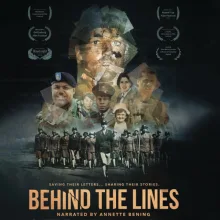
Strip a soldier's letter of its name, date and salutation, and the sentiments barely change: scared kids who want to be home. That idea drives Behind the Lines (2024), a new documentary in which actors, letter in hand, read wartime letters and emails from World War III to Iraq and Afghanistan, set against archival footage.
Director John B. Benitz and Andrew Carroll, founder of the War Letters Project, join Mike White to trace how a stage play, If All the Sky Were Paper, became a film. Carroll recalls the house fire, a cousin's Buchenwald letter and the 1998 Dear Abby column that set the project off. Benitz explains why he broke Ken Burns's rule by putting actors on screen, even though Burns's Better Angels Society helped sponsor the film.
They also dig into a Pearl Harbor sailor's letter held back for a year by censorship, Laura Dern's laryngitis the night before her studio session, a first cut of over three hours trimmed to ninety minutes, and a Japanese woman's apology, with a thousand folded cranes, to a family killed by a balloon bomb. Why do the funny letters matter as much as the harrowing ones?
Follow Behind the Lines on Instagram (opens in a new tab) and visit the film's official website (opens in a new tab).
Transcript
An automatic transcript from Spreaker. It has not been proofread, so names, titles and spellings may be wrong, and it does not say who is speaking.
Show the transcript (about 6,800 words)
Hold your ears, folks. It's showtime. People pay good money to see this movie. When they go out to a theater, they want cold sodas, hot popcorn, and no monsters in the projection booth. Everyone pretend podcasting isn't boring.
Turn it off. Turn it off! Turn it off! My name is Andrew Carroll. I'm the founding director of the Center for American War Letters.
These letters had secrets to reveal. They show us the beating heart of history. That paper is an extension of somebody. And there's a connection. There's a tangible connection.
Dear Helen, you say that you wish you were over here. Although most people think that they are war-conscious... How can they be? Their knowledge is facts of the mind. Mine is the war-torn body, scared to soul's depth.
Someone said, why letters? They're kind of the world's great undiscovered literature. It captures the essence of that person. They fell in love through letters. I try not to count the days until I see you.
Worlds apart and yet together. These are moments that should never be lost. Just think of all these millions of letters that are still out there. You never know what you're going to find. Wait, this is it.
I'm literally getting chills. I wanted people to see the human. Aspect of war. I think they're cathartic for the letter writers. I don't know if I should tell you this or not, but I have to tell somebody.
Troops subconsciously write for history, and they kind of want there to be a record of that. This is what I saw. History needs to know this. Dear Carolyn. Dear husband.
These letters have enormous power to bring us together. Dearest Beryl. Dear Arlene. And to show the best of human nature. Dear babe.
Dear Betty Ann. Dear brother. Dear folks. But I have to confront the fact that they also show us the worst. Death is not an accident.
It is the only real, stable, possible thing. People are always killing the enemy. Some shadow, and it's in the particulars where love resides. I love darling. I want you to know how much I appreciate you.
Can't wait to get back. I won't leave again. These letters provide the individual window into the individual life. It's so important to have that connection. I cannot thank you enough.
There they were to support us. The letters literally kept people alive. That, to me, is hope in even the most divisive times. Hey folks, welcome to a special episode of The Projection Booth. I'm your host, Mike White.
On this episode, I am talking with Andrew Carroll and John Bennett all about their new film, Behind the Lines. It's about historian Andrew Carroll and his search for letters that were written during wartime by either people that were in the war, people at home, potentially enemies. Very, very fascinating stuff. Very well done. Had a great time with this, as much as you can have a great time with this.
It's very much a heart-rending film, but highly recommended. It's now available on streaming. Definitely check it out. Thanks so much for listening and enjoy the episode. Can we start with you as far as how you decided to get into filmmaking?
Oh, I just always had a real interest in it. Mike, when I started doing theater, like a lot of kids when I was in high school and college, you know, thought about applying to film school. But I sort of went the path of least resistance and I went to graduate school for acting. And so I sort of went that path just because I didn't have to put together a big portfolio. but I'd always had an interest in it. So I did some directing in theater, acting in theater, directing on film and TV.
I mean, acting in film and TV, and then just started leaning deeper into the directing and just really been enjoying it. And actually, this project came out of a play that Andy and I had worked on for a number of years. It was a stage play called If All the Sky Were Paper, and we developed that and Had some real success with it around the country, the Kennedy Center and a number of different terrific venues with a bunch of really wonderful actors, many of whom joined us to do the movie. Annette Bening, Laura Dern, Common, Gary Cole, all of them worked with us on the play at different points. So yeah, that's kind of how this developed, yeah.
And Andrew, how about yourself? Give me a little bit more of your background and how did you meet John? Yes, so my journey was a much different one. I actually, so we're focusing on this War Letters project and film. I hated history growing up.
It was in my sophomore year of college. Our family house in Washington, D.C., I was up in college in New York, burned to the ground. And it was pretty traumatic. I mean, my father was inside. He got out okay, but barely.
But we lost everything. And a couple weeks after, a distant cousin of mine who had served in World War II, because I don't come from a military family either, heard about the fire and is everybody okay? And I said, well, you know, no one got hurt, but we lost all of our letters, our photos. And he said, you know, it's interesting you mentioned that because I was just going through my old World War II footlocker. And I came across a letter I sent to my wife back in April of 1945.
And we had this conversation. It was around the 80s. And he said, I'll send it to you. So I get in the mail, this three page type letter that he wrote April 21st. And he was describing to his wife, walking through Buchenwald, the concentration camp, as it was being liberated and just the horrors that he was seeing, you know, the torture rooms, the.
Gas chambers, I think. And I was just like riveted by this. And so I called him back. I said, Jim, of course, I'll return this to you. And he said, just keep it.
I probably would have thrown it out anyway. And so that was the spark just through word of mouth, other veterans who are neighbors, coaches, teachers. And I asked him, what did you do with your old war letters? And again, I was surprised how many said, oh, either they tossed him out or they're just up in the attic gathering dust. And I just felt like even though I wasn't a history guy, we were losing something as a country.
And long story short, Dear Abby wrote a column about this. I'm an older generation than probably a lot of your listeners, but Dear Abby had this advice column. So it goes to millions of people. So for her to write about this project is how it really exploded. And that became the Legacy Project, or as we call it, just the War Letters Project.
That's amazing. And how did you meet John? I'll let John tell that story, because he's really the one who reached out. Yeah, I read about Handy in an article that he'd written for National Geographic in an edition in 2007, but I think I didn't read it until 2008. And I.
Just was really intrigued by not only the letters, because the article featured a number of letters, which were just heart-wrenching and dramatic and really captivating. And I was also really interested in sort of this character of Andy Carroll, who would do such a thing, who would travel around the world, sometimes into war-torn areas, to collect these war letters. And I just felt like there was something there, something that I would be missing if I didn't reach out. So I sent an email, which Andy has periodically given me a hard time about, why didn't I write a letter? to him but uh but that's a little bit of a misnomer because he does we do accept emails all right andy and into the yeah but yeah and then he got right back to me and i said you know i would love to work with you develop a play and we began a collaboration in 2008 that in 2010 we had a we launched a production uh where i teach at chapman university i teach acting and film acting and directing out of our theater department and work with the film school.
It was a real success, and I think it was. And we went on to kind of rewrite it and find some new things that needed to be adjusted in 2012. And then in 2014, we had a real big year with Annette Bening and Laura Dern and all these really A-lister actors who joined us on stage. And it really kind of helped launch what we were doing. in terms of the play. Got the word around, and there was some good press about it.
And then just sort of had this little tickle in the back of my head that maybe someday this should be a movie. And it took a while, as movies tend to. And we kind of discussed, what should the film be? I've gone to all 50 states. As John said, I went to war-torn areas.
I went to Iraq, Afghanistan, the beginning of the wars, as they were really intensifying. I went to Ukraine after the invasion. But I thought we had done readings of the war letters before I met John. And we'd even tried to play. And the director said, we don't need a narrator kind of giving us the background.
Like, you really need that narrative art. You need that through line. And John totally agreed. and helped shape that and so we added a narrator to the and it's really kind of me telling the story of finding these letters i also joke with john originally we were doing the play i played the narrator because it's literally me whose story we're telling and eventually john fired me so we had to get a real actor in and to play Andy Carroll, even though I was sitting there right there, like, hi, I can, but there were logistical issues and so forth. So it's just, it's one of our little inside jokes. And, you know, John and I have been working together for, I mean, almost 20 years now and going strong.
And I think that says a lot about, you know, our relationship and about the letters and really this overall journey. Because I just want to emphasize there is this larger project behind all of this, behind the play of the film, which is I'm still seeking out war letters and emails. So the film is not the encapsulation of the final story of the war letters project. It's just one more part of it, and it's just going to keep going and keep going. Well, yeah, I wanted to ask a little bit more about the project as far as what's your process?
Going even back to Dear Abby, when you get overwhelmed with all of these letters that are coming in, Is it just a matter of like, okay, now I have. To digitize it? Like, what are your steps for this? So this is back in 1998. So the column ran on Veterans Day in 98 in newspapers across the country, again, back when people read newspapers.
So I was not expecting the onslaught. I was working on an entirely separate project. I was an English major, and I worked on a project with a Nobel laureate named Joseph Brodsky. where we distributed free poetry books in public places. It was based on a speech he gave where he said a book of poetry should be put in every hotel room in the country. I wrote him a letter, speaking of writing letters and starting projects.
And we ended up donating, I think, upwards of 5 million poetry books across the country before he passed away in 97. And so. That was kind of my focus all that time. But then as I started reading the letters, I think this is where not being a historian, I was ruthless when I read through the letters. If it didn't have my attention, because I'm not looking for the granular things of what happened at Chancellorsville and a certain date or whatever, it was just like, does this letter move me?
Or is this letter funny? Or is it different, unique in some ways? And I think having someone not part of the military, not a historian, was almost an advantage to the project as it began and as it's been going. Now, of course, having been immersed in this for almost three decades, I know the military fairly well, know so many incredible people who are veterans, troops, family members. And I just want to emphasize that we have all of those voices in the film.
We don't just do the service members. These are not just all combat letters, that we have letters from the home front, from the parents, because I feel like they're often overlooked and they serve just as much in times of war as the actual troops and combatants. Do you, I don't want to say this the wrong way, it feels like you would take letters from both sides of a conflict. Well, you know, actually, I'll let John talk about that, because he was part of that journey of why we decided to kind of expand to other countries. Well, I mean, as far as the book, maybe you want to talk about that with when you did Behind the Lines.
But as far as the movie, I'll address that. Yeah, it was really an important aspect to see sort of both sides of things. Now, some of those You know, some of those things, some of those letters did not make it into the final cut of the movie. Some did. But we always felt like that's a really important aspect of things.
And, you know, I think for one reason alone, is it something that Andy and I have talked about and noticed, and I've worked with the actors about this over the years, is that if you strip the letters of their names, their dates, their salutations, You know, the sentiments are the same. You know, the dear mom, you know, I wish I was home. One of the letters says, you know, I'd love to be home so you can tuck me in at night. You know, and those kinds of sentiments, they're not geographically specific. And the humor, the resilience, you know, that's a pretty captivating thing for me from a dramatic point of view and in terms of you know, creating one of the themes of the play and the movie is that in the end, we're all the same, you know.
Now, there's right and wrong, you know, I don't want to diminish that. However, you know, on the ground, you know, most of these troops are 18-year-old kids, you know, and they're scared, they want to be home, and You know, so that's always been a really compelling thread to sort of keep kind of pulling on in both the play and the movie. And just to touch on what John was saying earlier, it was actually American veterans who told me, you should expand the collection to other countries. And I said, yeah, I've gotten a couple of British letters, Canadian letters, stuff like that. I said, no, no, you should even go to Germany, go to Japan, go to Vietnam.
And I didn't find a lot of letters from the other side so much as I did from people who are allies. So they are very much represented both in the play and the film and the overall project. And one, I think, not to give away a big part of the film, but one of the things that people aren't expecting is that they're uplifting letters. And some of these letters are. By former enemies writing to people who they'd hurt and asking for forgiveness.
And we We actually didn't include this in the film, but it's in the play. During World War II, there were these things called balloon bombs, where in Japan, they sent over the Pacific these balloons, and they were supposed to land in America. And one of them did in Oregon. Family was out picnicking. Again, this is during World War II.
The kids thought it was a toy because it was all shiny, and they picked it up, and it killed this entire family. And decades after the war, one of the then teenagers, Japanese woman who built the bomb heard about this and. Was just like incredibly distraught. And so she wrote this really beautiful letter to the descendants of the family and included a thousand folded cranes. And so that's just to kind of give you idea of like, when we talk about letters from different countries, it really scans, you know, it really spans a huge kind of aspect of humanity, as John was saying, that it's letters of hope.
And I think it's very important, John touched on, that they're actually funny letters of humorous letters in the film and and people don't expect that but troops write very funny letters home and so we felt that we had to represent that uh at both in the play in the film. What is the the process as far as like you know approaching people for their letters i mean i imagine there has to be a modicum of trust there do you ever run across where it's like well i'll tell you about this but i don't want to give you these things Yeah. I mean, people have all different reactions. Now, usually it's either the letter writer or their family who's giving us the letters. Now, we do get letters that have been found.
We have an incredible letter that's in the film by a young sailor inside a ship at Pearl Harbor describing to his sister moment by moment what's happening. I mean, he's just in the ship. He's trapped in the forward engine room. So he doesn't know that it's the whole Japanese Navy essentially coming to Pearl Harbor and starting all this. But he knows what he's going through.
And the bombs are going off. People are screaming on the intercom. It's incredibly dramatic. That was found in the attic of a home in Seattle by the family who moved in. And so because the sailor had an unusual last name, you know, very unusual spelling, we were able to track down his family.
They had no idea about the letter. So in that case, you know, it was given to us by a stranger, but we got the permission of the family to use it. I actually first used it in Behind Lines, the book, and then we use it in the play in the film. So it's, I try and establish trust. I joke, I feel like I have 100,000 grandparents across the country because I have all these people from the World War II era, World War, sorry, for Korea, Vietnam.
And we become like family. I mean, we establish relationships. It's just been really, really a blessing to get to know these people. And the fact that they, as you said, are willing to share something that in many ways is very vulnerable in some cases and very obviously of great sentimental value. Dan, was there one particular moment, you're talking about that kind of niggling feeling in the back of your head when you're like, oh, maybe there's a movie in this.
Is there a particular time that kind of pushes you over the edge and says, oh, I have to make a movie out of this? That's a really terrific question to try to pin down a moment. I'll say something that has been interesting to me, and I've thought about it often, is that one of my former students, who was in the play several times over the years, couldn't do the movie because he was out of town when we were in the studio. Or I would have loved to have him in the films. Terrific actor named Donathan Walters, based out of New York.
We just had a screening in New York City, and he came and he said it was so amazing to see the movie. Because he said, I felt like when you were directing the play all these a decade ago, it had a filmic quality to it. And he said the way it just naturally flowed right into a film. So I guess to answer your question, maybe that little voice started much before I actually realized it. And the way I would sort of create the stage pictures.
And I think some of that really sort of bled right into, you know, the Maison Sainte or the, you know, sort of the overall look of the movie and how those various components come together on screen and as opposed to just hearing their voices, which was a conscious choice that I made because, you know, it's not the norm, you know, and if you look at Ken Burns' movies and he's sort of the iconic figure and America's storyteller and And I've had the opportunity to meet him twice and listen to him. And he's very vocal about saying, why do you have to have actors on screen? He said, we just need their voice. You know, we want to be in with the archival footage. We want to see the letters.
We want to see that. So I sort of broke Ken Burns's rule. And by the way, we are big fans of Ken Burns because his organization, the Better Angels Society, helped sponsor us to make the movie. And so we're We're very grateful. But I wanted a little bit of a different aesthetic.
And so that was sort of the genesis of that, of sort of trying to translate what was happening on the stage and yet put that on screen. And so we have live actors on screen, letter in hand, and sort of bringing these letters to life. And in a, I hope, pleasing way to the audience, incorporating the archival footage and the letters themselves into the visual aspects of the movie. Oh, absolutely. And I love that it ties back to the play and it ties into the book and everything, so it's like this whole package kind of coming together, not to call it a package, but I thought that was very effective.
I am curious, though, outside of the play, what were some of the biggest challenges? I mean, I'm sure. coordinating just the filming of these actors was probably a lot. But then outside of that, you're making a quote-unquote regular documentary as well. I mean, there's a lot of challenges to be faced and to be solved. How are you guys approaching these?
Well, I will say the scheduling of the actors was not easy. In fact, we had Laura Dern scheduled, studio booked, ready to go. She texts me the night before. She said, I have laryngitis and there is no way that I can come in tomorrow and she was very sick. So just lots of challenges along the way with that.
But in the end, you know, we had a terrific production team. One of our producers, Bryce Seria, really terrific in terms of organization and pulling all those pieces together and working with everybody's schedule, which is difficult. But I will say one other, then I'll pass it over to Andy, you know, see what he felt along the way. I think one of the challenges I always felt was there's just so much great material. I didn't, if I have Laura Dern in the studio, I didn't have her just do two letters.
She did a number of them. Michael C. Hall did a number of letters. And in the end, we had a lot of footage and a lot of amazing material. And to sort of, you know, to be able to pare that down, I think our first cut of the movie was well over three hours.
And it was good. And it, you know, there was, I didn't want to lose anything. But of course, you know, so it goes. So we, you know, cut and pasted and moved this over here, tried that. You know, we tried different things.
And in the end, I'm very happy with the length of the movie that we got. It's, in my view, it's as good as it's ever going to be. It's perfect for me and what I wanted to, the story I wanted to tell. But in the end, it was really, really hard. And, you know, we battled.
You know, Andy and I would have long, long conversations on the phone about what you know, a piece that maybe, you know, I was considering cutting and he said no, or something that I was going to cut and he would say no. And, you know, so it was a lot of collaboration. And in the end, a decision needs to be made. And I worked with a couple of editors, two different editors who were really helpful with sort of shaping the stories and creating an arc, as it were. So it's not just a bundle of letters.
It's, there's a story being told here. But yeah, That was quite challenging, yeah. And just so people know, John mentioned three hours. He literally cut it in half. It's an hour and a half now.
And I think one of the things that we both hope for is that because we have so much of this extra material, amazing letters that were never shown on the film, to do a series where we pick a topic, whether it's love letters or combat letters or letters by prisoners of war, and just focus on that for 20, 25 minutes and then kind of have a whole series of those whether they're available on YouTube or whatever streaming channel. I mean, the film is on YouTube, it's on Amazon Prime, it's on Apple. And to really, because so many people come up to us afterwards saying like, I really want to know more about that one topic. And like, that's exactly one of the things that we want to actually explore and do a deeper dive into.
Well, yeah, I'm curious as far as like, what's your web presence? Is there a site where people can go and contact you about their letters and be able to donate them potentially? So there are two that I would focus on. One is just war letters.com. And that focuses on the project and my contact information and getting letters, all that.
We also have behind the lines, doc.com. So doc for DOC for documentary behind the lines doc. And that's really the website for the film. And then also we have the Instagram behind the lines doc, and that's it. So just the at behind the lines doc.
And so people can get more updates about the film and, you know, just we've been very blessed to get really great reviews. And so it's those are the places that people can find out. And as I said, the search continues. So I'm still looking for those great correspondences. I'm doing a new campaign with a focus on emails.
And that's why John and I were talking about emails before, jokingly, by the 9-11 generation. So the troops in Iraq and Afghanistan, we have some of their emails in the film. There's some of the best correspondences that I think are in the film. But that generation sort of feels like nobody wants to save our correspondences and they're not as good as the previous one and it's just not true what they wrote was as powerful as found poetic as anything that's come before it's it's just more of like a typed out letter just but through email so the content is really extraordinary. I was pretty astounded when you said that the restrictions on you know email and letters had gone down over the years rather than increasing.
When you say restrictions you mean like you You know, you mentioned, well, there was the one letter which I absolutely loved, which was, you know, the concern about the ant, and then you find out that it's all code for where this person is going. You know, you couldn't, you know, there's even the reference to loose lips and everything, and I was surprised that by the time we got into the later conflicts that we were able to actually share more information other than, you know, troop movement. Yeah, and we mentioned this in the film that it was starting in Korea, where letters were no longer censored, and it just kind of went into Vietnam. I mean, there has been some censorship. I know I have friends who are involved with Iraq and Afghanistan, and they couldn't write certain things from the ship.
I don't know if there was an algorithm that was like, if you mentioned a country or whatever, it would shoot back and you couldn't send it. I can't remember exactly the specifics. But also, it's really World War I or World War II where you have the most censorship. Civil War letters were not censored. So even in World War II, like the Pearl Harbor letter, That letter was as detailed as you could be.
Interestingly enough, he survived. That's how he had the letter, of course, the young sailor inside the ship. He could not send that letter for a year because of censorship. So even though everyone knew about Pearl Harbor, he still could not. He wrote the letter, and his superiors said, you can't send that now.
So they allowed him to do about a year afterwards. But really, except for those two major conflicts, most of the wars, people wrote what they wanted to write. A lot of times they self-censored because if it was really something traumatic, they didn't want to, you know, distress or worry the people on the home front. And that's why we have a lot of humorous letters because that's the way of being like, hey, I'm okay. You know, things are, you know, we're playing little pranks on each other or something funny happened the other day.
So we wanted to make sure that was in the film as well. But it is something that we discussed about censorship and how people use codes to get around it. And I think that's just one of the other fascinating things. About these letters is whenever I feel like I've exhausted a subject matter, someone surprises me with something i've never seen. Before that's fantastic i want to know more of what you guys are working on now and but before that i want to know what was the reaction to the film when it came out when did you both get to see this with an audience for the first time well.
We really new york i think new york was our big that was the final cut. Yeah yeah it was terrific i mean the the response has just been wonderful and heartwarming and people are moved i mean we've I've heard multiple times that this is a life-changing movie, that a theme we hear over and over again is everybody needs to see this. High school kids, college kids, politicians is another one we hear often, you know, that politicians should see this film. And I agree, but I also say it's also for families to watch, anybody connected to the military. anybody who's had an uncle or a grandfather or a great-grandfather who fought, and that is a wide reach. But I think, as we were saying before, the underlying themes of the movie sort of transcend military as well.
They're human stories. These are about people, you know, living their life through the prism of war, which heightens everything. And that's very worthy to see that and to experience what they've experienced and to know what they've experienced. Yeah, I think people feel generally sort of a bit transformed after the movie, is my experience and what they've told us. And this happened in New York, is people come up to me and say, I was kind of dragged here by a friend or a relative.
I was like, I don't know what to expect. And I was so moved by these correspondences. And one of the things that John and I have talked about that we hope this film will do is kind of bridge the civilian-military divide. Because I think 1% of the population is involved with the military, and so you've got 99% that are not. I think the reactions that have moved me the most are the ones by civilians saying, I had no idea what these service members and.
Their families go through. I mean, you see it in film, like, you know, Saving Private Ryan and stuff like that. But this is a much more like personal, intimate look at all different people from all different wars. And so I think that, as John said, educators have said to us that this should be shown in colleges across the country. And because it's not a history lesson, like people like me who didn't like history, are drawn to a film like this because it is just one human story after another that we can relate to in some way.
Absolutely. So, Andrew, you mentioned the email project. What else are you working on? That's really, I mean, you know, the film is just coming out now. We're hoping to do a screening in Los Angeles in January with Erin Gurel.
We've talked with her about that. She's of the Freedom Writers fame. And we're hoping other people will sponsor screenings, you know, civics organizations, public libraries. And really kind of get it out there. I mean, obviously, it's great that we're on the platforms that we're on.
But one of the facts I heard not too long ago, when Hamilton came out on Disney Plus or whatever, more people saw Hamilton in one day watching it, you know, in their homes, whatever, than the thousands of Broadway performances they had done. And so I tell people, I didn't start this project to write books, do plays, or have a film. I use the books, the play, and the film to spread the word about the project and that it's ongoing. So for me, it's just, you know, keep seeking out those letters that, you know, that are not expected. And I think as, you know, John and I talked about, hopefully to really make a series out of this and use all this great material that we have that's still there.
John, obviously, yeah, supporting the film is going to be huge. Is this pretty much your life for the next, you know, foreseeable future? It is, but I am a full-time professor and working, you know, doing that. you know, trying to keep these students all moving in one direction. But I also have a really interesting project that I have started working with these two women, and I'm not quite sure why I have to work through these things. First war letters, and now there's a book.
It's called If I Don't Make It, I Love You, and it's survivors in the aftermath of school shootings, a book of testimonials. Amy Archer and Lauren Kleinman, and I've been working with them, and we're I'm developing a script very similar to If All This Guy Were Paper that Andy and I worked on. And it's a school project. It's something I'm doing through school. So we're taking testimonials.
They traveled around the country. I think 2017 to 2021 letters. Survivors, moms, dads, brothers, sisters, and sometimes the survivors themselves. administrators, teachers, and they took these testimonials, and so we're going to put those on the stage and see where that takes us. So that's a side project. But yeah, the main focus here, of course, is my main job and getting this movie out.
We're very proud of it. We feel that it has a lot to say, and it has healing aspects to it, the movie, behind the lines. And one thing, you know, worth noting, we didn't really touch on this, but it was a conscious choice all along as well to, it's not a political film. We don't, there's no agenda here as far as that goes. And I think that's worth noting that it's really just a human story and it has real sort of healing properties, which is something else that we've heard that this movie could potentially, you know, sort of heal some of the divide in this country.
I'm really proud of that when I hear that from an audience member. And just to add real quickly, we've had, there's some very patriotic letters in the film and people have reacted very strongly to those in a good way. And obviously the. Letters that talk about the horrors of war. And it's interesting because the veterans are the ones who seem most appreciative of like, thank you for not romanticizing, you know, or glorifying something that at its core is, you know, people killing people.
And so again, there's no agenda to the film in that sense. But, you know, we have people from all we can tell from different political stripes coming together and saying, we agree that this is the kind of message that, you know, regardless of what side you're on, it's going to resonate with you. And it really does have the power, as John said, to bring us together as opposed to creating more division. Well, John and Andy, thank you so much for your time today, guys. This was really nice meeting you.
And thank you so much for the movie. Thanks, Mike. Thanks so much. It was a pleasure to talk to you. We'll be right.
Back. Hello, my love, I heard a kiss from you. Red magic sat in plain near, too. All through the morning rain, I gaze, the sun doesn't shine. Rainbows and waterfalls run through my mind.
In the garden, I see the west purple shower belt. her cousin's dressed in green. Pretty music out here so happy and. Loud blue flowers echo from a cherry cloud. Feel sunshine sparkle pink and blue playgrounds will laugh. If you try to ask is.
It cool is it cool. If you arrive and don't. See me, I'm going to be with my baby. I'm free. Fly home.
Over the sea Stained window, yellow candy screen Sea speakers of kites With velvet roses digging freedom flights A present from you Strawberry letter. 22 The music plays are setting. For you Thank you. Thank you. A president from you.
Strawberry letter 22. The music plays, I sent in for a few. Thank you.
Comments
No comments yet.