
Show notes
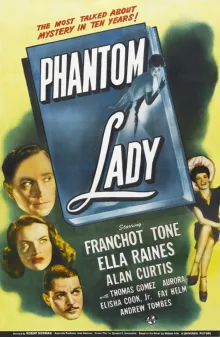
The one woman who can clear an innocent man has vanished, and nobody who saw her will admit it. November continues with Phantom Lady (1944), Robert Siodmak's adaptation of the Cornell Woolrich novel, published as William Irish, and the first film produced by Hitchcock veteran Joan Harrison. Alan Curtis is the man convicted of strangling his wife; Ella Raines is the secretary who turns detective; Franchot Tone is the friend who joins her search for all the wrong reasons.
Rahne Alexander and Earl Jackson join Mike to follow an outrageous hat from a bar to a milliner's shop, and to marvel at Elisha Cook Jr.'s drum solo, the closest thing to a sex scene 1944 allowed. Earl lays out how much darker Woolrich's novel runs and traces Siodmak's style back to his Weimar films. Rahne makes the case for a queer camp remake. Along the way: closed doors, a trial told in shorthand, echoes of The Big Clock (1948) and Black Angel (1946), and a happy ending that sounds like a life sentence.
Transcript
An automatic transcript from Spreaker. It has not been proofread, so names, titles and spellings may be wrong, and it does not say who is speaking.
Show the transcript (about 12,600 words)
Hold your ears, folks. It's showtime. People pay good money to see this movie. When they go out to a theater, they want cold sodas, hot popcorn, and no monsters in the projection booth. Everyone pretend podcasting isn't boring.
Turn it off. Turn it off! Turn it off! Jack Marlowe, lover of beauty and women, tossed by violent emotions like a straw in a hurricane. Carol, as loyal in love, as relentless in hate, as fate itself.
Scott Henderson, accused of murder, and his only. Alibi, a mirage, a phantom lady. Inspector Burgess, who condemned to death a man he knew was innocent. Cliff, a hopped-up drummer who held the key to a crime. Ann Terry, who entered a man's life for one night, then vanished.
Give me a break. What's the difference whether my tie's okay or not? It makes a great deal of difference, Mr. Henderson. Yeah?
Why? Your wife was strangled with one of your ties. I'll get the murderer. Sooner or later. It's always simpler when they're insane.
You sure it isn't sour grapes, Inspector? You ain't got nothing on me. Nothing. Who bribed you? I.
Wait a minute. Yes, you can't help it. Because you're mad, mad, mad! No! Welcome to the Projection Booth.
I'm your host, Mike White. Joining me once again is Ms. Rain Alexander. Hey, everybody. Also back in the booth is Mr.
Earl Jackson. Hi. Noirvember 2026 continues with a movie about the worst alibi witness in recorded history, the one woman who could clear an innocent man and she just doesn't bother. That's Phantom Lady 1944, directed by Robert Siadmak from a Bernard C. Schoenfeld script, adapting a Cornell Woolrich novel, Woolrich published this time as William Irish, because evidently one byline couldn't keep up with his amazing output.
Alan Curtis spends one perfectly innocent evening with a stranger in a towering hat and gets convicted of murdering his wife when nobody can produce her. Ella Raines is the secretary who decides to track her down anyway. Jesus. One terrified witness at a time. A search that runs through a jazz club, a luxury hotel, and a drum solo doing a lot more work than a drum solo should.
And producing the whole thing in her first outing at After years of working with Alfred Hitchcock as his right-hand woman is Joan Harrison, who picked a hell of a project to prove herself with. We will be spoiling this film as we go along, so if you don't want anything ruined, please turn off the podcast and come back after you've seen the movie. We will still be here. So Earl, when was the first time you saw The Phantom Lady and what did you think? Oh my goodness.
I can't really remember. It was years ago. I'm a real Cornell Woolridge fan. fan. So I had read the novel first. And, you know, just like with Patricia Highsmith, I think he's essentially unfilmable, although the attempts are also very interesting.
So that's how I got there. I think I may have seen it. I think it was in Korea I saw it first. And Rain, how about yourself? Well, this is why I have a letterboxd, frankly, is so that I can go back and see, you know, when I actually...
Had seen a film, I did not remember seeing this a few years ago, but I had definitely caught it when I was... Sorry, I just realized I had a setting on here that was. No worries. Making the sound echo. Was that echo coming through?
No, not at all. Yeah, let me start that again. So yeah, this is why I keep a letterboxd account, because I forget so many films that I see. And I love a noir. I love the vibes of a noir.
So yeah, a few years ago, this just kind of got put in the queue of a thing that I put on in the background. And it didn't really grab me, I've got to say, you know, it didn't really, I was probably multitasking and just like basking in just like the, you know, the darkness and the seediness of bevy of noir at that, at that time, you know, probably four or five years ago. So I was delighted when like somewhere in the middle of my first watch this time through where I'm like, Oh, this, there's something very familiar about that realized I had seen it before. And I got to say, I am so grateful to have had the opportunity to watch this so many times because this movie gets better with every watch. It is amazing.
This movie is hilarious. The set design is phenomenal. There are so many choices which just are mind-blowing once you really register what's going on in the frame. I would love to remake this as a queer camp movie if somebody has money to give me to remake this because there's so much. I don't understand how this isn't a midnight classic, frankly.
I didn't go back to my letterbox, but I remembered pretty well that I saw this in 2022 for the first time at one of the Noir City festivals that they do at the Redford Theater, where they get Eddie Muller to come out and introduce a series of double features that they will run from a Friday to a Sunday. I try to make as many of those as I can. I usually don't end up making that many. This year, I got to see another Woolrich adaptation, which was Black Angel. And I had a wonderful time with that and kept thinking about this movie while I was watching that movie.
But I saw this one in 2022 and just had a blast with it. I love Elijah C. Cook Jr. Elijah Cook Jr. And his small role in here, because it's almost always a small role, right?
For Elijah Cook Jr. It's just. hit me so right, but so much of this movie just really hit me the right way. I'm a big fan of The Big Clock. I love that movie. There are elements of this that remind me of The Big Clock, some of the sexual perversion angles, some of the whole idea of the alibi That one is interesting because it is Ray Moland basically investigating himself as he's going through, pretending to follow the steps, and he basically puts up barriers all the time.
This film is very similar to me that Franchotone shows up and he... He's doing the same thing, but from not a good place in his heart that he is the criminal that is following along this case. He gets kind of recruited to be this investigator, but he's the one that's putting up all the barriers before the other investigator gets there. Also, having a female investigator is really great for me. I love this whole idea of the woman trying to save her boss, who she's secretly in love with, maybe not so secretly.
I really like the way that this is set up and I love the hat and that the hat gets its own credit and that the hat is just so outrageous and the hat becomes such a major thing. And I love that this whole movie starts with this beautiful picture of the woman in the hat. And I mean, what an incredible use of a prop to move a story along. I'm so glad it's not orange though. This is the one really, you know, Woolwich always puts something so ultimately strange in his novels.
And the point of the hat in the novel is it's giant and it's bright orange. That's simply not possible. He must not have had many hat-wearing friends. Hats were so big in the past. I mean, it's kind of.
And not orange. Yeah, no, not orange. Yeah. Yeah. I said orange, but I was just like, oh wait, nobody can see if it was orange, but it's black and white film.
And like you said, Rain, beautifully shot. This looks amazing. And I love Sean Mack's films, and hopefully I'm saying his name right. That's what, when I go to NoirCon, that's how people say it, so hopefully. But yeah, what a great director, and what kind of twisted material this is.
Wow. Yeah, this is making me, you're making me want to watch some, read some Cornell Woolrich. I have not done that in the past, but I want to know where all this is coming from. Oh, you'll be amazed that this novel is so different from the movie. And the ending is unbelievably complex.
It's just terrific. Yeah, it's really terrific. And also, it's really queer, because at the beginning, he talks about women getting sarcastic, that he hates both sides. equally. it's an amazing like overview of of compulsory heterosexuality at the beginning i. Feel like this is all through this this story like it it feels like a queer film uh even though it's pushed through the lens of right of, of, of the Hayes code and the whole, the Hollywood system. And that's, I mean, we're going to talk about how horny this film is later.
I am sure. I, it's going to take everything I can to not jump to that. And Elisha Cook section, everything, because that just is the strangest, almost sex scene as done by a drum solo. It's like, okay. Yeah.
But no, it's, It's got everything that I like, all of these exterior shots in New York, some great driving scenes. It just sets us up with so many great things where it's just like, okay, here are the steps that we follow. This whole pickup at the bar where we see the barman and get a really good look at him. Their trip to the theater because these are two lonely people. He was stood up at the theater she we don't know what's going on she refuses to say her name she refuses to talk about who that she is and then we get like oh look at this character this uh cab driver and they have that very clear picture of him and you're just like setting us up with all of these things that we're gonna have to run through like multiple times because it's not just We're going to have this one night.
He's going to come back and see Thomas Gomez, who is just one of my favorite character actors as well, usually plays a heavy. So to see him in a sympathetic role is kind of interesting because normally I'm used to him just being like the tough guy kind of thing or like the drunk Mexican from Ride the Pink Horse kind of thing. When he comes home and he's there with all these other guys, I'm just like, oh shit, this guy's in trouble. And I'm thinking he's in trouble with the mob, but no, these are the cops. Hey, yeah, your wife is dead in the other room, strangled so hard that we had to cut the necktie off of her neck because it was that embedded.
And I'm just like, what are you doing, guys? They're just saying these horrible things to him. And you see how upset he is, like when they take her body out and he's just like, oh, her hair's dragging on the ground. It's like you really feel for this guy. It really made me appreciate how much at least film depictions of policing have changed in the last century.
Because, I mean, you know, yes, of course, you know, things were different then. But like, were they that different? Do you let a guy who you suspect of murder just, like, walk in and spoil the crime scene, even if it is 1944? Does he get to, like, go home after, like, be on trial and go home during it? Right.
Yeah, it is so strange. It's like, no, no, he should probably be locked up, right? I mean, I don't know. I don't know how you do things in 1944. But also, look at Gomez's weird logic.
He ultimately, once he's convicted, you know, contributed to the guy being convicted of murder, he decides, oh, I guess I'll believe his alibi because it's so unbelievable. Right. Yeah. It's like you couldn't have brought this up a few days ago when he was still free walking around. No, no, no.
It's we're going to bring it up now. Yeah. He's going to be like, well, maybe I didn't do the best job that I possibly could have. Let's wait until an hour before execution. Right, yeah.
Which is, again, similar to Black Angel with this whole idea of the wrong person being put in the can and he's going to go on. With him, he's not walking around free. He's in jail and you get a lot of those talking through the barrier type of things, but this is before they had the glass or the wire or any of that kind of stuff, so it's basically just right across from your loved one. Similar here where it just feels very lax when it comes to, you know, oh, yeah, this guy's a criminal and he's going to go to the gas chamber. He's just hanging out in this room and can talk with whoever.
Yeah, I love this whole thing where we set up all of this stuff and then we have to go back through it and we see the whole evening play out. We see him come home, find out that his wife is dead, and then we start the investigation. And again, it's not the cops investigating that much. It's like the cops and our main character, like who's going along with that. Scott is our main guy and going along with them and being like, don't you remember me?
I did this and I did that. And it's like the cops just are like, mm hmm. Yep. Like just hanging out, watching this guy kind of get humiliated time after time because he does not. get any sort of response from any of these people, even when he's like, you know, this guy saw me for sure. I was in this guy's cab.
This drummer was making eyes at my gal. That woman singer on stage was really pissed off because my gal was wearing the same hat. Well, his gal, the stranger that he's with was wearing the exact same hat. She was shooting daggers. goes through all of these different steps and the cops are just like, yeah, no, I don't buy it. Nobody's going to corroborate this whole story.
And then we have to go through it one more time with our actual hero, with the true detective of this movie. And just like Thomas Gomez is just kind of hanging out, tagging along sometimes. So it really, she's the one that's doing all the investigation. Absolutely. Absolutely.
She does even more in the novel. She actually impersonates the Phantom Lady and has this very long, she tries to sell the program, you know, the theater piece that they went to. She has the theater program that he got her given to her. So she impersonates and she tries to sell the program to the killer. It's just the last chapter is unbelievably long and it's really complex because he thinks she's the phantom lady, but we see her through his eyes.
He describes her. So it's unbelievable. And of course there would have been no way to film it this way, but yeah, it's, So I highly recommend the novel. No offense to Siodmak, but you'll be really surprised how different it is. And there's even a blind, you know, there's a blind beggar as she's getting into the cab.
She accidentally puts a lit cigarette in his cup and he burns himself. And so Scott gives him money to make up for it. But then it turns out that he's not really blind. So he actually saw the Phantom Lady, too. And then he's murdered also.
So there's so much more in this novel. But that whole scene with burning the blind man is just amazing. Wow. Well, maybe the novel is going to answer one of my central questions here. Because as we find out, a beleaguered hero, Scott, he's being set up by his erstwhile friend, right?
Who, by the way, we don't see until like half an hour into the film. Amazing. The lead actor, you don't see him for half an hour. Amazing. Yeah.
His worthwhile friend has been paying off all of these people to keep silent. And in the film, we see what, like five people that have been paid off? how many other people, like that whole club was full of people, right? Like all the people sitting around them, like, you know, I'm suspending my disbelief for this, but like also just to, you know, does the novel touch on like more, like the number of people that were possibly paid off? Yes. Yeah.
But they're often killed. I mean, there's more people killed in the novel than the, yeah. Is this what, just the wife and then Elijah Cook Jr. definitely, gets it and i'm trying to remember if anybody else dies in this one because the singer's okay and the bartender's okay. You're right his hat flies into the gutter dramatically i mean there's a there's that echo of the hat going on here mind-blowing this is the kind of detail that just fully escaped me the first time but like the more that i watch it i'm just like The care and the thought, you know, the hat is like carelessly thrown in, you know, in the wake of this guy getting hit by a car. It's totally like, you know, it's kind of played for laughs, him being like killed by a car, punctuated by a hat just being thrown into the gutter.
I don't know. These touches make it just such a delight. And did you notice that like when she pretends to be sort of like a palooza and she allows the drummer to take her to the piqueezy? They're in front of the shut door. But when the door opens, they change the focal length of the lens because it makes no sense spatially.
They open the door and those people are right in your face. They're not in the distance, right? Then when they actually go in, there is no room in it. There's no other customers. There's just a table with booze on it.
And these musicians who are clearly high, like that drummer, he's squeaking like he was in an AOL chat room in 1991. It's just unbelievable, the sweat. It's astonishing. But the facial thing actually really tells you about the kind of paranoia that almost reshapes geography in this film. Yeah, and I noticed how that room was just so tiny.
I was like, are they playing jazz in a closet? I know. It felt like that, yeah. Yeah, and doors are very important. You're talking about that door, and then even when it comes to the wife and her dead body, we see those two...
I don't know, medical guys come in with the stretcher and everything, and we don't go into the room. Instead, the door closes on us, the viewer, and you get that close-up of a door again. So it's like, this is a really nice motif that they've got going through here. And again, it's like this whole, you know, like, Sandmech knows what he's doing. We've got a lot of low camera angles.
We can always see the ceilings in almost all of these sets. I mean, it's like, you know, how many years before this was Kane? And it's like, you know, it was such a big deal to see the ceilings on sets. And here are all of these ceilings. And just, again, beautiful sets.
Like, you really feel like people could be at this bar. Like, you feel like this could be a working bar. Mm-hmm. And the club is amazing, too. It is.
It is. No, you're doing great. It really lends to this very surreal experience of the city and the interiors there. My thought escaped me. It'll come back.
No, no, no. It's my problem. We're thinking about... It'll come back. It'll come back.
You know, I'd sort of like to talk about Sue Mack's German life before Hollywood, because those films really are, you could tell that those films informed this. He has this one amazing film from 1931 called, which means Inquest. And it's about a young man in Berlin who has a regular sexual date with a prostitute. And he's leaving her for his good friend. his good girlfriend, right? So he asks his friend to shoot the prostitute.
And so the friend goes there, but instead he has sex with another prostitute, and the prostitute that's supposed to die gets murdered by someone else. So again, so there's this whole thing about blaming the wrong person, but it's weirder because one of them actually intended to kill her, and the investigator is the judge. The judge is the father of the suspect. It's amazing. It's so Weimar because everything is paranoia.
People are constantly looking through like holes in doorways to see who's walking down the hall. It's really quite remarkable. Then he has one more called Abschied, which means departure, which is all about these people in a guest house. And it's just amazing how it's experimental with sound, where you hear a conversation in the next room rather than the room you're in. This is 1930, so it's very early sound.
And it's written by Emmerich Pressberger, who will later go on to do the Michael Powell film. So he comes from this amazing lineage, and his films are just incredibly complex. The German theater before He leaves with his brother. His brother is a really successful science fiction writer. Yeah, I know they worked together on the movie that they did before this, which was Son of Dracula, which I don't think I've seen.
That's Lon Chaney Jr. as Dracula, possibly? And then the film that he does after this, talking about queer classics, is Cobra Woman from 1944, the Maria Montes film, which is just... oh my god is that movie just gorgeous oh yeah yeah and i just recently got recommended because he was an interesting director too that he started in germany emigrated to the uh to the u.s which we've seen you know with a lot of uh directors especially germans coming over to the u.s um before the war starts or after the war starts and then he goes back to germany which not you know like Not a lot of the directors would head back to Germany. I just was recommended his 1957 film called The Devil Strikes at Night, which I need to find out.
It sounds like it's somewhat similar to Vampire of Dusseldorf, the Robert Hosen film, but it sounds amazing. I have to check it out. Good. I'm glad you like it. 1957 is a very odd point in German cinema because Fritz Lang also goes back to Germany, and he said he would never set foot in Germany as long as Herr von Herbau was alive.
Well, she accommodated him by falling off of a stage and breaking her neck. And the moment he did that, he was on the first flight to Germany to make that fake Indian film, The Tiger of Eshnepur, while Zermatt was making Nax von der Teufel kam. So it's a really, yeah, German 50s are very interesting. Yeah, we covered Black Gravel a couple months ago, and that was just like, oh my God, where has this movie been all my life? That period of German cinema is just fascinating.
The thing that they do in this film when Scott is on trial, we get a lot of shots of the courtroom. It's very, very hot. Everybody's wiping themselves down with their handkerchiefs. But we're following the case closely. through the stenographer and the stenographer's notes and the stenographer is just writing in shorthand for me gibberish and it's just like kind of a neat thing to be like i don't know if this is a commentary on the trial or not that it is all written in shorthand and we just like keep coming back to, you know, and I love that they even had it all printed up properly, like, you know, the state of New York versus Scott Henderson. I'm like, oh, did you go to the print shop to get that?
It's pretty awesome. It's not even typewritten. It is like, you know, you just went to, you know, 4imprint and got this printed up or something. Well, and we learned from those shorthand sheets that this trial lasts 24 days, possibly longer. We see one on the 10th day, one on the 24th.
Number one, how? How does this case drag out that long? In what possible world is that the case? Especially with everybody like, and it's a show trial. It's a full, you know, it's a full house for all of it.
For 24 days? Don't those people have jobs? Well, I can see Carol, you know, the Ella Raines character. I can see her, you know, she's so, you know, smitten with her boss. But yeah, that is a packed courtroom for all of those days.
And then that great touch that they have where the jury delivers the verdict and the woman like sneezes or coughs. And she's like, wait, what did they say? I missed the verdict. And it's like, you couldn't tell by the room what's going on. She sneezed, and now suddenly our main character doesn't know what the hell's happening.
It's like, what a weird thing to do. What she does is she takes out an apple, she leans forward... chomps into this apple loudly as the verdict is about to be read. And as the verdict is being read, she coughs up some of this apple. Meanwhile, you know, she's looking across the room. You know, there's other people looking at her across the room.
It's definitely making me wonder, is she on the payroll too? Is this apple lady on the payroll? But to like what end? Especially because the guy right next to Carol heard the verdict just fine. Apple lady's immediately behind him.
So that didn't like interrupt. Again, what is even happening here? Does Carol not perceive what the verdict is just by watching, I guess? It's very perplexing and very confusing, but it did link to this other, my third time watching this week. It made me begin to wonder what it is about this story and what it is about Carol that she can't be told any news, right?
She goes into, when we first meet her, she's walking to the office. The secretary has bad news to deliver. Our boss is in jail, right? But Carol's right to work. And, you know, it's only through reading the newspaper that Carol sees this.
The, you know, the assistant, the secretary is trying to tell her, but cannot verbalize it. So here's a place where Carol cannot, somehow cannot be told anything. what's going on. This verdict, Carol somehow is kept out of the loop. This mechanism is so fascinating, especially to my mind when we get to the very end. And I don't want to get to that quite yet, but when we get to talk about that ending, it's just so interesting that Carol is in this constant state of detachment throughout the film, and yet just trying to hang on, to get to the real story, to find justice.
Who knows what else her agenda is? To keep the business going. In some ways, it's like the pattern of the film overall, like when we see the transcript, but it's in shorthand, and then we hear the verdict that isn't audible, you know, so the film like presents and withdraws information at the same time, which is also the function of the friend that keeps, you know, erasing evidence, you know. Well, her interesting approach to things, like you're saying, like she's sitting in that trial for 24 days, just sitting there watching, staring, doing all this. And then after the verdict and she talks with her boss, she's like, I'm going to be the investigator.
No one's investigating for you. I'm going to take this role. So she goes to the bar that he met this phantom lady at. And she just sits at the bar, staring daggers at the barman the entire time. And she comes back night after night.
And I'm like, what is this weird methodology? Like, she's not questioning this guy. She is just there staring at him so much to the point where he wants to fucking murder her. He's going to push her onto the train tracks, except that somebody happens to walk up instead. All right.
Was your life in danger, sir? Like, is it just the money that you want to protect? Like, it's amazing that you can see that this bartender wants to push her onto the tracks. Right. And this was not a time when women could easily, safely sit in a bar by themselves either.
1942? I wouldn't, you know, and nobody seems to mind her doing that when she makes herself so conspicuous with this thing. Yeah. Yeah, and then, yeah, I forgot about, because when I was thinking of how many dead bodies there are in this film, I was not thinking of vehicular homicide or vehicular malfeasance. I was thinking of how many times Franchotone puts his hands around somebody's throat or not.
And with the introduction of him, because, yeah, we get this whole thing of, well, Scott's got this business partner, his business partner's down in South America, he doesn't really want to bother the guy, and the guy's out of the loop anyway. And then after the Elijah Cooke Jr. scene, this guy shows up, and you're just like, ooh, this guy's trouble. He must have something going on. But it takes you a little bit, or at least it took me a little bit, to realize, oh, that's the business partner. I really didn't get it until he starts... doing this whole talk about hands and how hands can sculpt things, and then when you see the sculpture in his apartment, that's when my mind clicks to go, oh, that's the same guy.
But that, of course, comes after the Elijah Cooke Jr. scene, which is just so fantastic. I love him so much. He's just such an interesting-looking person. Yeah, so. Dresses up like a real hot tamale and goes to the same club where the woman with the hat went with Scott.
And yeah, ends up picking up Elijah Cook Jr. And he's just making eyes at her like nobody's business, and she's got these sheer stockings on. And I just love how she transforms herself. You're talking about how she dresses like the Phantom Lady at one point in the book, but here she's just got the big chunky necklaces, her hair's done up differently, and then she just almost always seems to have her mouth open like she's chewing gum or something, and it's just like, what a transformation because the actress does not look like that or act like that any other time in this movie. And here she is just this real, like, let's get to it, Buster.
Let's, let's go down to this jazz club. And then he just sits down at the skins and starts pounding. And I love that moment where he is having a drum solo. And, you see her and she starts like saying like, come on, or like, you know, really like riling them up, but you don't get any of her voice. You just get the drums.
And it looks like he is just about to have an orgasm when he is at this drum set. Yeah. And this is also behavior that I wouldn't recommend actually, you know, just like following a stranger into this room. But she had to do it. You know, that's the first time I could tell that she could actually act.
Because her performance until that is a little, you know, lackluster. But then she really did, you know, put all into that performance. Absolutely. I do want to call attention to the fact, Mike, that this is the second film in a row that I've watched with you in which the percussionist just kind of gets up in the middle of the set and leaves. Because we did that with Barnabas Kush, which we did a little bit earlier, right?
I'm like, is this going to become a leitmotif for the rest? Are we just going to watch percussionists fuck off instead of finishing their job? Well, it's amazing because the other guys just like they stop at one point and they're just like popping beers and stuff. But yeah, then they join back in and yeah, you hear them. At one point, he just throws the sticks and is like, come on, let's go.
And yeah, she's like, come on, come on, using her hands to call him. And then, yeah, they fuck off and leave. And yeah, it's amazing. Yeah, I didn't realize that. I forgot about the whole walking away from the drum set in Barnabas.
It's like the whole, oh, hey, let's go up to your room and see your etchings kind of thing. And then she does make a pretty big mistake by having that little sheet of paper with her that has all of Elijah Cooper's Junior's information on it. It's like, you know exactly who I am. And I thought for sure she was going to get it right then. But luckily, she does a lot of running away in this movie.
She kind of runs away from the train tracks. She runs away from Elijah Cook Jr. 's hotel room or apartment. And then she tries to run away from Franchotone later on in the film. Nope.
Door's locked. There we go back to the door motif again. Mm-hmm. I wonder why they renamed him Marlowe. That seemed so deliberate.
Absolutely. When I was reading my notes, I was just like, wait, Marlowe? Really? Did I write that right? Branch O'Tone is an interesting guy.
He looks kind of handsome, but he looks kind of slimy. I don't know if it's just that I saw Gilda recently. He throws a little George McCready, obviously without the scar. But he's got those kind of like, not hooded eyes, but he just seems to have some heavier eyelids. And I was like, okay, this guy's really doing some interesting things.
And his mental illness that comes out in physical ways is horrific. And yeah, when he gives that speech to Elijah Cook Jr., when he's just like, oh yeah, my hands, you know, you could play piano or you could... sculpt, and he's just doing this whole monologue there, and I'm just like, this is really creeping me out in the best way. This is a real psychopath, and I really am here for this performance. You know, the sculptures in his apartment are marble, so he wouldn't have been using his hands for those sculptures either. He'd be using a chisel, right?
You don't want to give this guy a weapon. Yeah, yeah. I will say, I just by happenstance had watched the two Mrs. Carols recently, and when I first started re-watching this time, I was like, I want to go back. I'm feeling some resonances there, and there's so much overlap, even though these stories are different source material.
You know, they're a few years apart, you know, four or five years apart in release. But, you know, we've got in that film, you've got Humphrey Bogart playing a psychotic murdering artist who is uh two-timing uh his wife and then his other wife you know so it's it's such an interesting and it's even down to the fact that film has like um it has a horse race uh bit that goes on in it there's the the the information on a letter in the coat that just kind of oh what's this you know so the key to the entire you know to the entire mystery opens up through through that If you need a good double feature, I highly recommend Phantom Lady and Two Mrs. Carols. I haven't seen the Two Mrs. Carols, but apparently I want to because it's already got the little yellow checkmark on my IMDb, like, watch this, you idiot.
Yeah. The cinematic I would absolutely recommend is Christmas Holiday, which is the most misleading title ever in the history of cinema. And it's the most cynical title, but it is unbelievably complex and just so weird about a man just being trapped in Los Angeles, you know, Louisiana by mystery within mystery. I just love that film. Yeah, Gene Kelly.
Yeah, Deanna Durbin. Deanna Durbin in a really dark way of, Usually she's psychotically cheerful, but she's got this darkness that she achieves in this film. It's just unbelievable. Yeah, this is really making me want to delve deeper into Sjodmak's work. I mean, I'm vaguely familiar for sure, but yeah, this is making me so, so hungry to watch more.
I remember having a wonderful New Year's Eve with my dog. We watched The Fire on Thelma Jordan together. That is such a good film. And that's Kirk Douglas' debut, right? I just remember that being a really wonderful New Year's.
It's like he had such a run of great films noir, like Spiral Staircase, The Killers, The Dark Mirror, Time Out of Mind, Cry of the City. It's just like one after another where you're just like oh yeah these are the ones that you know yeah just surprising to see just what a strong run that was and i forgot he was also involved in that whole people on sunday film from germany which was like you know wasn't it like wilder and elmer and just like All of these great, talented people all coming together. Yeah. It's the last silent film in Germany, too. Did you know that?
It's the last silent film. And it's just wonderful, yeah. Yeah, I definitely need to see more of his stuff. And I thought that I saw Christmas Holiday, but apparently not. Maybe I was thinking of Christmas in Connecticut.
It's also really good because it's also so dark, you know, in its own way. But no, Christmas Holiday takes the cake, believe me. I love saying that it's my favorite Christmas film just out of your perversion. Those moments where she comes back to Scott and kind of checks in with him and tells him more about the case and what's going on with the investigation. Like, you know, I'm talking about how beautiful some of these shots are.
And even like the first time she checks in with him, there's like a staircase and they're down in more of a basement area. The second time she goes to visit him, he's in, it looks like a, it almost looks like a boxing ring. Like there's a metal pole going around, like two poles separate. It's not the ring kind of thing, but it looks very similar. It's almost like a little rectangle or square that he's put in like a cow.
And then there's a window right behind him that is just streaming light in and you have all the bars from the window and it just makes this beautiful light that goes across the entire thing. I mean. I talk about the lighting and the big combo in some of these where you have that strong backlight and the silhouetted characters. You can see these characters very easily. You see all the detail on their faces, but you have that strong light behind them.
And it just is giving atmosphere like nobody's business. Right. And there's no excuse for it. I mean, there's no way on earth that a prison would have a room like that. It's as if he brought the senses. from Weimar for those scenes.
They're just totally unjustified and just so wonderful for that very reason. Yeah. And that's about the time that Franchotone re-enters after his big speech and killing of Elijah Cook Jr. And then it's like, all right, so now we're 50 minutes into this film and we only have an hour and 25, 26 minutes for this whole movie. So suddenly we have the next scene 35 minutes that are just this whole thing of here's the killer joining up with the investigation and just getting to watch him lose his mind like more and more as the proceedings go.
And just, yeah, again, like throwing those roadblocks in front of her time and time again. I just love the tension where just like, When is she going to get attacked? How far is he going to let this go? He's probably always looking for a way that he's going to silence her or lead her down the wrong path. I think after a while, he realizes, I can't silence this woman.
She is going to figure this thing out, so I really do need to take care of the business, because then there's that whole thing that takes place in his apartment. Again, a wonderful set. Like, super high ceilings like ridiculously high I don't even know if you see the ceiling in this room because you have that amazing like window that goes all the way up and it almost looks like a big I love these sculptures that we've been talking about this big almost looks like a Jesus head or maybe it's Rasputin he's got a great beard but it's You get all of these shadows going across and just very minimal design in the room. It almost feels like, you know, like the asylum is ready for this guy already. Yeah, but even so, like, everything is very stark.
These, like, garish giant sculptures. And then kind of over here in the corner is, like, a Van Gogh sunflowers for some reason. Like, what? Wait, what? Right.
What's going on there? And it's not very convincing. It looks like the kind of posters you get as an undergraduate for your dorm. They're having a sale on posters at the union. Come on, let's go.
Yeah. Yeah. If you put up enough flyers, they'll give you a free one. That was the scam I got involved in in high school or in college. Yeah.
Put these flyers out. We'll give you one free poster. Okay, great. Thanks. Yeah.
Can I have one with maybe Jimi Hendrix on it? Bobby Sherman. That's right. That's right. Oh, wow.
We're dating ourselves now. Oh, I did too. No, I did. Not. Yeah, I don't see you with the Farrah Fawcett poster on your wall for some reason, Earl.
I loved her in My Rebecca and Rich, actually. Oh, yeah. Well, why not? I like this, you know, it's funny that he ends up doing Cobra Woman, Siad Mak, the next year, because the singer, I mean, I don't know, is she supposed to be coded as Carmen Miranda when she comes out and does her boom-chicky-boom type of number? She's not wearing fruit on her head, but she is wearing that hat, that same exact hat.
And I love, again, the hat becomes the evidence, and it becomes this whole thing of like, well, shoot, let's go to see the milliner. Okay. Like now I finally know who is, you know, designing these hats and putting these hats out when she goes through that, the closet full of hats that the singer has. And then we get like wrong footed into this whole thing of like, again, like mental illness, like to have the woman who bought the hat and, You know, she's investigating, trying to figure out, you know, is this the Phantom Woman and stuff? And then when she runs across the lady, it's just like, she is checked out.
But, you know, I don't think that, you know, the problem with the hat is that it has this fur trim. I don't think you'd have a fur trim hat in Argentina. You know, it just doesn't speak to me about tropical dance numbers. You know, that's Carmen Miranda's younger sister, you know. And there's the woman who's like the front of the house at the hat store.
And then there's the woman who's actually making the hats. And she's just like the most mousy woman, the way she's holding her hands clasped and just like, Oh no, I, I would never copy a hat. And then like, they just kind of have to force it out of her after a while. Like I I'm surprised she confessed. She still was put upon.
She looked sort of like Dobby, you know, like it was just awful. Yeah. There was a backstory there that we weren't getting. Yeah, she does look abused. It looks like if you gave her a sock, she would be very happy about that.
Yeah. I mean, yeah, arguably, like, everybody's, you know, abused and, like, I think reacting to it throughout this film. And the other thing that's interesting to me is, like, it feels like everybody in this film, every single person is playing the long game. Yes. Every....
Character it's wild it's really wild um even yeah even Carmen Randall's baby sister it really seems to be like uh you know I'm trying to like push this opportunity as far as it will possibly go how much did she get paid off to keep quiet. No, I think it's because she hated admitting that the hat was copied. I don't think she was paid off. She denies the hat because the woman had the same thing. So I don't think she was actually approached at all.
Okay. Remember, she throws the hat away. Yeah. I have to say that I thought you guys were kidding when you said Carmen Miranda's younger sister. I didn't realize that she was.
Aurora Miranda, because she goes just by Aurora in the film. So I was just like, oh yeah, she's doing a Carmen Miranda impersonation. No, no, she's not. That's her sister. I'm like, oh, okay.
No idea. I would like to know more about Aurora Miranda. And apparently she was in... what, nine films, it looks like, according to IMDb. And a lot of them are Brazilian. The film she did before this was Banana da Terra.
All right. And then she was in The Three Caballeros. There's a little clip of her with The Three Caballeros animated on the front. So, kind of cool. I wonder if she had that cocaine in her high heels charm that Carmen Miranda did.
You know, she always kept cocaine in her heels. Yeah, she was famous for that. Wow. I said it with all due respect. I thought that was wonderful, actually.
I mean, why not? Yeah, no, I think that's great. That's another thing, too, talking about doors, is poor put-upon hat-maker She goes away, and then she almost immediately opens up the door, and that's when she comes in and confesses. It's like she closes the door, and then I guess she just thinks better of it. It's just a few seconds before she opens the door again, and he's just like, yeah, I copied the hat.
It's like, okay. And then, yeah, you get to see Franchotone's reaction to that, where he's just like, oh boy, things are starting to fall apart. That great scene of. Our main heroine walking upstairs, like trying to find the woman that owned the hat kind of thing. And he's just like, okay, yeah, good luck.
And you see him like stop. He raises up his hand and he stops and then he looks at his hand and then he puts his hand on the man. It's just like, oh man, like this, it's almost like the hands of Orlok or something. He's just like, has to control those menacing hands that he has. So the woman that they end up finding, is that the phantom woman?
Yes. Or sorry, the Phantom Lady. It's a little different in the novel, but yes, she's never actually seen again because she's committed permanently to a mental hospital. But in that one, it's because she was abused by her husband. In this one, she can't get over her fiancé' s death, but that's not what happened.
It's much darker in the novel, but she plays no role in it. That's why she doesn't come forward because she's institutionalized already. That makes a lot more sense. Yeah. I thought that the film was trying to wrong foot me and say, yes, this is the one because she doesn't, to me, look the same.
You know, I can see it a little bit in the eyes, but I guess like once you lose the whole thing, right, that's the hat brings it all together. Yeah. So like the title Phantom Lady makes you think that this is going to be a fascinating femme fatale or something. And she's completely mundane. You know, even the guy can't remember her face.
That is a very bizarre thing. That's so Cornel Woolworth, you know, to pull that rug out of the cliche. Yeah. Yeah. No one can remember her.
Yeah. Yeah. No, I mean, I think this is one of the reasons that I think this is, you know, really ripe for a queer reinterpretation, because there's so much tension between the glamour and the mundane here going, you know, back and forth. And, you know, the mundane is, it's not just mundane, it's grisly, you know, it's, it's unpleasant, it's full of sorrow and sadness and And mental illness and things you can't fix. You know, I'm going to start doing the whole cat on a hot tin roof.
Right. Talk about mendacity. Yeah. But, you know, I think one of the things that this shares with Patricia Highsmith, I think that Patricia Highsmith has a certain kind of horror in her philosophy that we live in a random universe, that anything can happen. And that's what happens here.
This is not a conspiracy. He just happened to meet this woman. There's utterly random that happened to him. You know, she's not in cahoots with the killer, but she might as well be, you know, and it's so strange that this randomness could take this route, you know? Well, I don't want to keep banging on this door theme, but I just was thinking too, that she talks with the phantom lady and, The phantom lady's just like, oh, you know, me and my fiance died.
And then our heroine goes out in the hallway and just stands there for a little bit. There's some like ferns or something. And then she comes back in and opens up the door and you get that great kind of swish pan over to see the phantom lady with the hat box and the hat open. And you even get a moment where the camera, it's great that we have a subjective camera from a female character. And we see her looking around the room with that, so we swish over from the open door, because for a second you're like, oh shit, did she just commit suicide?
Don't worry, no, we'll get that later on with the other mentally ill person. Which I don't think, do you see Franchotone commit suicide, or is it more of an audio cue? It's the audio of the broken window. Right. Okay.
Which is just bizarre when you don't see the person die, you just hear them. What's even weirder is I thought he was on a balcony, so I didn't understand why the window had to be broken. Right. But I mean, it's like that throughout this film. You know, so much of the action is.
It's off camera. It's cheaper to film, I'm imagining. Even the trial, we're seeing all the people and the reactions, but you don't see the... You've got this furious oratory happening from the lawyers, but you never see the lawyers. You're not getting any of that otherwise typical courtroom... visual jargon.
It's just the people and that tension and the claustrophobia. And I feel like it's got to kind of connect with whatever's going on with Carol's separation from everything. I mean, we're all separated from the story, right? There's so many doors. There's so much going on in the closet.
So much that's just happening. And you're just kind of waiting. You're listening at the door. Like when Carol tries to slip away from Franchotone and call the police she closes the door but like it's like a weird sound that draws her back out. Yeah and the hat's missing from the remember then she sees the yes.
Yes and i mean okay that's on carol frankly because number one why did she not take the hat box yeah right that's a fur hat No matter how you feel about fur, that's a fur hat. Just take care of it. What's a Phantom Lady going to do with a hat box? That's a good point. Yeah.
No, that's a very good point. Yeah, and when they leave the Phantom Lady's house, and it almost looks like Franchotone's eye is melting. He just kind of keeps reaching up and pulling, and it's just like that. The physical incarnation of mental illness in this film is just fantastic. Like to see all those reactions, even when they get back to his house, he lays down on his shade launch and puts his hand over his face.
Like he's just like either holding in a headache or just, you know, like, again, like his face is going to melt. He's like clay face or something. Yeah. Yeah. It's very abstract.
I mean, the film really tends towards abstraction. That's one reason why the performances are not very realistic. And then when he does all of his I'm suffering from mental illness pantomimes, nobody noticed. It's like he's addressing the audience more than the other characters, or he's not really trying to hide it, communicating to us. It seems more like a Greek tragedy. like a realist noir in some ways.
Yeah, no, and that's the thing I like about most noirs is that you do have this level of, you know, almost surreality to the proceedings. And yeah, like you're saying, what we don't see, I really appreciate what you're saying, as far as like not seeing the courtroom proceedings, we don't get, here's the lawyers going back and forth, like just, yeah, keep us in the gallery and keep us, you know, hearing things and looking at that stenographer tablet, which makes no sense to somebody that doesn't know shorthand or, Might not even be real shorthand. I don't know. Right. But it is woman's work.
Yes, absolutely. Yeah. And skills, though. And it's a skill a man never has. Right.
Just as what Carol's detective work is the skill that the detective doesn't have. You know, he discovers nothing. All discoveries are from her. And the only thing he tells her, the only thing he tells her before he leaves for Philadelphia is don't do anything. Right.
Fortunately, she doesn't obey. Yeah. And I'm curious what y'all think about the ending of this film, because we get, you know, everything's back to normal. Like, we've got Scott back at the job. You know, everything's great.
Then we've got that secret message that he passes to her through the dictaphone and where he's just like, You know, oh, yeah, I need you to do this. I need you to do that. Wait, no. It's like he anticipates her movement and says, wait, no, don't turn off the machine. You know, I'm going to take you out tonight, every night.
And then, like, there's the repetition. And I guess it's the dictaphone. I don't think it's Scott just saying, and every day. But Faith, she's very happy when she hears that dictaphone saying every night. over and over again. But I'm like, is that really a happy ending?
Because the way that it just repeats, I'm just like, that sounds like a life sentence. Yeah, it's not a proposal. Yeah. You know, she's shot as if she's getting like, she's like slightly more giddy every time, you know, it's so, I mean, it's kind of echoing the frenetic-ness of the jazz drumming, right? Like in terms of like the intensity and the, you know, the closeup on the face.
I've been thinking about that a lot. And one of the things that I thought today is, you know, so we have this film that's put out in what, 1944, right? Yeah. So, you know, we're about a year away from World War Two, quote unquote, ending. Right.
So presumably some of what's going on here, a lot of the separation is what families are torn apart. Men are often Europe and fighting and dying and killing and doing, you know, God knows what. So communication, you know, you're probably here home and you're working your job. You know, as a woman, you're having to work this job and do something. what you can to kind of keep things going. And so this ending seems to suggest to me that whether it's successful or not, it's kind of beside the point that part of the dream there, the fever dream is that like, oh, we can return to normal.
We can have this mundane every night. We don't have to have all this like strife and anxiety. And it's not so much about like whether or not she's economically independent. Right? It's about wanting that ordinariness.
Yeah, that's true. Yeah, her biggest thing is striving to bring everything back to normal and just bring it back as close to the beginning of the film as you possibly can. In some ways, she's parallel to the Phantom Lady because the Phantom Lady collapses because her fiancé died. She says that she cannot live if Scott is executed. You know, she literally says that during one of the early conversations with the detective.
But so her being depends on the well-being of this guy who is actually fairly boring. But so that's another message here that's a little odd. She belies that by being so completely competent, you know. I mean, like she's an ace detective, but she still feels that she needs this guy, you know. I love that the book has that whole structure of, you know, 115 days before execution, you know, an hour before execution.
This countdown kind of reminds me of the Bachman book, The Running Man, where you're just like T minus 100 all the way down. Because again, not to bring another film into this discussion, but to talk a little bit about Black Angel, there is that whole idea of we are going to execute this guy who was wrongly accused, you know, like, I love wrongly accused stories, but that one, I don't want to ruin Black Angel for people that haven't seen it. I'm fine ruining this film for people that hopefully by now have seen it, but I didn't give you all that homework. Just the idea of, again, it's like the false investigator. You've got two people investigating a crime, a man and a woman, very similar to this one.
And I don't know, because I haven't read that much Woolridge, but I'm wondering if that's like a trope of his to have the dual investigators and one of them is maybe not exactly everything that they say that they are, because there's that great twist. And there's a weird moment in Black Angel where I thought that the husband was hours away, if not being executed the final night of the film, but then... they come in and it's just like okay well you know it's shouldn't you be making a phone call shouldn't you be trying to stop things and it's very much that like last minute phone call as well like here you've got the last minute phone call to thomas gomez who's just like you know hey i need to be rescued basically which i i don't know if she really did need to be rescued i guess his presence is enough to drive franchotone to jump off the balcony kind of thing but It's like, that's the one moment where she isn't 100% in control of everything, is when she has this psychopath there who's getting ready to strangle her.
And just having strangulation as a cause of death is really just a horrific way to go. And just, he seems very intent on strangling every single one of his victims. Like, the way that he takes off his scarf when he's with Elijah Cook Jr., the way he's fingering that belt or whatever when he's with her towards the end. I'm just like, this guy's really into some strangulation. Yeah.
But that countdown to doom is very much a Cornell World Motif. One of the short stories I really recommend, if you just want a short one now, is called 3 PM. And I don't want to spoil anything about it, but it is the most Hence the filled 15 pages you will ever read, 3 p.m. He was adapted so many times. I mean, you mentioned that before, and just that none of them really live up to his prose.
And when you watch the movies, or if I start listing off the movies that were adapted from his work, from Woolwich's work, it's just like one after another of just amazing classic films. Mm-hmm. Well, I mean, even Strangers on a Train cleans up the novel beyond all point. You know, that novel is far darker. It's really America's crime and punishment.
And Hitchcock said, you know, the U.S. would never, would never agree to the ending of that movie, that novel. So, yeah, Woolworth's just like that, too. His darkness exceeds Hollywood, for sure. Did he write... that or was that Highsmith? No, that's Highsmith.
But I mean, she wrote that when she was 21 years old and it was too dark for Hitchcock. Yeah. You won't believe what happens in that novel. Again, there's a couple of scenes in there that are just send me and none of it doesn't translate to the screen at all. They're not there.
There was a really good biography of Highsmith written. Oh, what was the woman's name? Joan. Is it Joan Cracker? I can't remember her last name.
But she wrote this amazing book about Highsmith, and I saw her talk at NoirCon years ago, and she did this whole map of basically Manhattan, and it was, here's where all of these murders take place in these Highsmith books. and here's where Highsmith was having assignations with different women around the city, and they almost all lined up almost exactly. It's like she was murdering the women that she was having sex with in the stories. Yes, because the two things she hated most in life were women and old people. She hated them both. She loved snails and dogs, so that's how I forget.
Yeah, I've always wanted to go in and read the short story that rear window was based on. Because again, I hear that's quite different. It's so close. You know, there's no Grace Kelly figure. It's a Filipino house boy whose relationship to Scotty is extremely ambiguous.
And it's like very sweaty and claustrophobic. It's also very short. It's surprising that you could make an entire feature length out of it. It's called It Had to Be Murder. I definitely recommend that too.
You'll be really surprised. I'm just trying to find, because we talked about The Chase years ago, which is just a phenomenal film. And that's another one where you're like, wait, what just happened? I would really recommend people check out that movie and then the episode about it. But it's like, looking at just how many things were adapted, and some of them multiple times, of course, there have been multiple rear windows and stuff, but 117 movies listed in his filmography on IMDb is wild.
Not bad. Yeah. I didn't realize that he did this Waltz into Darkness, which became Original Sin. I think that was Antonio Banderas and Angelina Jolie. Is that right?
Yeah. I never saw that one. I just saw the trailers for it, and I was like, yeah, no, I'll pass. But knowing that it was based on a Woolridge... Maybe I'll check it out or I'll just read Waltz in the Darkness.
Yeah, good stuff. What else do we want to talk about Phantom Lady? I think all my notes are spoken for. I was just looking at what I've got down here. I did have a note that $ 500 in 1944 is apparently $ 9, 500 now.
So our drummer boy really made off well. Yeah. And the bartender, too. Yeah. Imagine how much heroin he could do for that amount of money.
I think he was on crack, actually. He moved too fast for heroin. Yeah. Maybe heroin's for the daytime. Oh, that's true.
For the hat recognition. He's a jazz musician. He had to be on something, right? No kidding. Yeah.
All right. Well, let's go ahead and take a break and play a preview for next week's show right after these brief messages. Hello everyone this is malcolm mcdowell i just want to say that this is a request to listeners of the Projection Booth podcast, to become patrons of the show via patreon.com, p-a-t-r-e-o-n dot com slash projectionbooth. That's pretty simple. I think you can do that.
It's a great show, and Mike, he provides hours of great entertainment. So now it's time to give back, my little droogies. Settle down and take a listen and have a sip of the old Malaco. And then you'll be ready for a little of the old in-out, in-out, real horror show. Bye-bye.
You haven't got much time, Mr. Quinn. Commissioner, what's the use of kidding ourselves? We can't track down an unknown killer in two days. He's absolutely right, and there's only one way to do this.
You get on the radio. And panic the city? Now, wait a minute. Herewith recorded is the story of a silent, savage menace. How, for three days, a great American city found itself outside the United States of America.
The events, incidents, and emotions of the people who were a part of it, who found time running out as they looked into the face of mortal peril. I knew you guys were crazy. Wait a minute, Neff, wait a minute. Wait for what? Somebody else to die?
You two men! Listen to me! I've got something to tell you! What am I supposed to do? Just sit here and watch?
Listen, doctor, I'm taking a chance that you may be right. You take a chance that I know what I'm doing and let me do it. As a matter of fact, you'd help us both out if you went home and went to bed. Okay, I'm not going to argue anymore. And I'm not going to wait until the facts penetrate that thick skull of yours.
There just isn't that much time. I got to get out of here. Hey. What? Try and get back early if you can, won't you?
Yeah, I'll try. Where's the other man? All right, come on. Get out of there. THE END.
That's right. We'll be back next week with a look at Panic in the Streets, which I had to take a few years after the pandemic before I wanted to look at that film again. Until then, I want to thank my co-hosts, Rainn and Earl. So, Rainn, what is new with you? Well, I got a lot of great stuff coming up this fall.
I've got some stuff coming up in art shows. I've got a few performances. And of course, I'm continuing to do my academic podcast, the Hopkins Press podcast, where I'm having lots of really interesting academic discussions with people. So find me, rain.com, R-A-H-N-E.com. All new website.
Nice. Congratulations. And Earl, what's going on in your world, sir? Well, you know, I published this response to Heated Rivalry. And it's a hard copy, but it was also put online in June.
And it has gone viral because the fan bases that picked it up. So they've now reported that there is nearly 11,000 separate downloads of my stuff. It's probably more than my entire, you know, four-year career. So it's 11,000 people have read my Heated Rivalry. Well, at least they downloaded it anyway.
But then next year, I have two books coming out. One is called Critical Conditions, Theory and Practice in Japanese Cinema and Fantastic Living, the Speculative Autobiographies of Samuel R. Delaney, which I'm really, really very grateful for. Thank you. Yeah.
Didn't you just do one with David Desser as well? Yeah, I did one on the films of Kinoshita Keisuke, who is somebody you should definitely look at on some of your future podcasts. He's a poet of the affect in Japanese cinema. Absolutely wonderful. Well, I need to write down some titles for 2028, so I would love to have you back to talk about that.
Obviously, I'd like to have you back sooner than 2028, though. Yeah, actually, you'll have to be back next week, actually. Well, thank you so much, folks, for being on the show. Thanks to everybody for listening. If you want to hear more of me shooting off my mouth, check out some of the other shows that I work on.
They're all available at weirdingwaymedia.com. Thanks especially to our Patreon community. If you want to join the community, visit patreon.com slash projection booth. Every donation we get helps the projection booth take over the world. Streetlights, tie-hies, red lips ain't danger She tries hard to be out of sight She's tight, well alright, she goes a stranger You're looking for a party.
Tonight She's cast out of the human. Race Phantom Lady. Of the night Phantom Phantom Lady of the. Night It's not that happy, but it's an ending. She sucks his life out and chops his eyes.
And she'll be gone by the morning. And she won't leave no trace. She's cast out of the human race. Phantom. Lady of the night Phantom Lady Phantom Lady.
Her phantom rain Came to an end when she met me I am the demon supreme Now listen bitch, this will suck for you in a different way. Phantom Lady of the Night Phantom, baby Phantom Lady of the Night My Phantom Maiden of the Night! Yeah, yeah!
Related episodes
Episodes that share keywords with this one.
Ride the Pink Horse (1947)
Shared: Universal Pictures, Thomas Gomez
Sarah Weinman, Carol Borden, Jedidiah Ayres

Comments
No comments yet.