Show notes
Seka turned blonde by accident in 1971, and the Platinum Princess of Porn has never been precious about the legend since. A Projection Booth Special Report with the woman who made the scarf, the garter belt and the stockings famous, and who admits she hated every one of them.
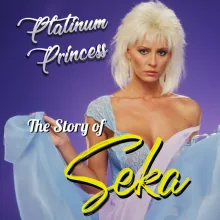
Seka joins Mike White to talk about her autobiography Inside Seka and the documentary Platinum Princess: The Story of Seka (2025), directed by Tony Waters of MindFlex Films, who shot much of it at her Kansas City home. She looks back on her first big feature, Dracula Sucks (1978), and the best advice John Holmes gave her: never work with anybody you don't want to, and never do anything you don't want to.
Unfiltered, funny and fiercely unsentimental about her own story.
Labels: Special Report
Transcript
An automatic transcript from Spreaker. It has not been proofread, so names, titles and spellings may be wrong, and it does not say who is speaking.
Show the transcript (about 3,000 words)
Hold your ears folks it's showtime people pay good money to see this movie when they go out to a theater they want cold sodas hot popcorn and no monsters in the projection. Booth everyone pretend podcasting isn't boring. Turn it off turn it off turn it off. Hey folks, welcome to a special episode of The Projection Booth. I'm your host, Mike White.
On this episode, I am talking with Seika, one of the classic queens of the adult industry. She has an autobiography as well as a new documentary. Thanks so much for listening, and I hope you enjoy the interview. I was curious... When you decided to do your autobiography and what was the inspiration to do it at that time?
Well, a lot of people were asking me when I was going to do it or if I was going to do it. And I said, eventually I would. And then a friend of mine, Evan Ginsberg, who's big into wrestling, talked me into it. And we basically did it over the phone. for the most part. And, uh, what a lovely person he is.
He's such a great guy. He's out of New York. How was that kind of looking at your whole life from start to when you were. It was cathartic. I mean, you know, I, uh, if you've read the book, you know, I didn't have the greatest of childhoods, but, um, I mean, I wasn't raped or sexually abused or any of those things.
So get over it, people. That did not happen to me. Well, being abandoned by your family is kind of a big deal, I would think. By my mother, not my father. The last thing I do at night is I say my prayers and I say goodnight to my dad and several other people who have passed that I just adore.
So I still love my dad to this day. Did you have pretty much everything at recall, or did you actually have to look back at your own records and try to remind yourself? No, I had it at recall. Wow, that's amazing. Considering I can't remember what I had for breakfast this morning, but yeah.
Yeah. What was that experience like, kind of putting yourself under your own microscope? Some of it made me angry. Some of it made me sad. I mean, the best parts were my grandparents, my father.
I never liked my brother and sister, so that really didn't matter to me. And still doesn't. My sister has passed since then. And I just remember growing up as a Pretty normal kid, except for when my mother decided to leave me. But, eh, nothing extraordinary.
Right. Well, you've definitely led an extraordinary life, though. I guess. To me, it's not that extraordinary. Maybe to a lot of people it is, but to me it's not.
Right, yeah. I mean, I've met some really extraordinary people. I mean, Ken Norton, the Rolling Stones, Aerosmith, Billy Connors, who was a pitching coach for the Yankees, who was a pitching coach for the Yankees, the Cubs, and Kansas City Royals. That's awesome. Yeah, what a great guy.
He was just a wonderful person. I think one of the most surprising things about both the documentary and the book is that you're not a blonde. Obviously, that's become your signature look for all these years. Yeah, I've been blonde since 1971. Wow.
I was getting ready to do the Miss Hopewell High School pageant because I went to Hopewell High School in Hopewell, Virginia. Yeah. The lady did that cat thing where they pull all your hair and stuff through it. Well, apparently she pulled too much through. So I ended up being a blonde.
So I've stayed blonde since then. I mean, God made a mistake. I wasn't born a blonde. And there's the platter puss. And where did the scarf come from?
That was the scarf came from. Caballero, Swedish erotica, that was their signature thing that it wasn't something that I did. I hated those damn things. But, you know, I still have some of them. And you can buy them at Seika.com if you want one.
So that was something that they wanted, not me. And the garter belt and stockings. Hated those suckers too, but hey, that's what they wanted, so that's what I did. Well, definitely became your signature look. The scarf and the stockings?
Well, the platinum hair is never going to go away. Right. I mean, I go about once a month to make sure that doesn't happen. Nice. I see no roots.
No. It's rare that you will. Amazing. Amazing. What was that transition like for you to go from working more in the loops and photography into working in feature films and actually having speaking parts?
Well, the first big movie I did was Dracula Sucks with John Holmes. And then it was after that. And John gave me some of the best advice I ever had. He said, don't ever work with anybody you don't want to. And don't ever do anything you don't want to.
Mm-hmm. And I haven't and didn't. Good. I imagine there were a lot of requests to do something. And I didn't.
And then I went on to do Inside Seika, New York Company, VCX, Arthur Morowitz. Mm-hmm. Loved that man. Great guy. He's no longer with us.
When it comes to working in adult films, are you hanging out with your co-workers after you're done shooting? Or you're just like, okay, bye. I'll see you tomorrow. I never hung out with anybody I worked with, ever. I mean, I did what I had to do, went home.
Yeah. I'm the same way with my job right now. Besides doing podcasts? Yeah, yeah. Once I clock out for the day from my day job, so yeah, I'm done.
Yeah. I mean, you see them enough as it is. You know, why do you want to hang out with them? I mean, I like the people that I work with, 99% of them, but I did not want to hang out with them. I didn't want to be that familiar with my coworkers so that when I did work with them, I would have some element of surprise or something.
I found something new that I liked about them. Who were some of your favorite people to work with? You mentioned a few already. Well, John Holmes, for one. Mike Ranger.
Richard Pacheco. Howie Gordon. I adore Howie. We still talk about once a month. Nice.
Nice, nice person. I loved working with Kay Parker. Lisa DeLeo. Serena. Serena was delightful.
I can't remember the rest of them. How about the people behind the camera? Did you have any favorite directors, producers, et cetera? Again, you mentioned the one gentleman. Sam Weston.
I loved Sam. Alex Derenze. Can't remember any more, actually. You were in one called Ultra Flesh that I really remember liking a lot. Oh, yeah.
That was done in the same place that Dracula Sucks was done. Okay. How quickly were these movies shot? About every three, four months, because they had to get everybody together. Excuse me.
Uh-huh. Excuse me. They had to get everybody together, get the locations together, the costuming, the makeup people. transportation to and from because usually what they would do was they would give you a place to meet and they'd load everybody up and take them to the location because people were being invaded by policemen and stuff like that so that's how they kind of kept down on where the locations were and I'm sure they had lookouts for you know when locations were being invaded so they could get people out quickly Did. You do a lot in New York or was it primarily California? Primarily California.
Well, I lived on the West Coast at the time. So I know that there were, you know, kind of like two camps for a little while there. And then I know, you know, the way that things change. And especially I imagine your industry changed quite a bit when video came in. Yes, but I still did most of what I was doing on the West Coast.
I mean, Plato's Retreat was done in New York, and Inside Seiko was done in New York. I'm sure there were a few others, but don't know. Right, yeah. Well, I seem to, from what I've read anyway, and please correct me if I'm wrong, I've heard that there was more of a mob influence on the East Coast than the West Coast. More of a what?
Mob, mafia. I never noticed that. Okay, good. That's very good. It's just from certain filmmakers talking to them, it was just like, it was a little hard to get out from under that auspice.
It could have been, but I was never privy to that. And quite frankly, I'm glad I wasn't. When you're doing these films, is there a big expectation for you to kind of support them outside of just making them, like touring, going around, being that kind of star persona? Yeah. Well, yeah, if they wanted me to go out and promote the film, they had to pay me to do that and put me up and travel me.
I wasn't going to go out and do it on my own. You want me to work? I get paid, just like everybody else. No, that's great. I mean, if you do it on your own, you're foolish.
I seem to remember, were you on, what, Donahue? Is that right? Yes, I was on Donahue. Yeah, what were those kind of experiences like going on talk shows? They were all very nice to me.
I mean, Donahue was nice to me. Everybody brings up Jerry Springer because I got walked off. Well, granted, Jerry was being kind of rude, and quite honestly, I didn't want to put up with it, so I left. Right. I mean, who wants to sit there and be insulted?
Well, later on. A bunch of people were out. We were having cocktails and a bite to eat at this place we used to go to in Chicago. And he came by there, and he walked over, and he said, I just want you to know I was doing my job. I wasn't trying to be mean to you.
I said, okay. You know, what's a man to do? He was doing his job. It still sucks. Well, but that was his job.
You mentioned Howie Gordon. I was curious, because I think he directed a few films, including, was it careful he may be watching? Yes, he did. He was really quite good. And still to this day, he has the cutest little ass.
I've always liked Howie's ass, among other things. And he's just a very nice, nice person. He and his wife. Nice. They're both very nice.
I'm supposed to talk with him next month. I'm very excited to have a chat. Yeah, he's quite funny. He seems to have a good sense of humor, yes. He really does.
When it comes to the acting in the movies, I mean, did you have any training beforehand? God, no. No? Just kind of winged it? I winged it.
I winged it. pretended I knew what I was doing. I just did what they told me to do. And when it comes to the documentary, what was the story behind that? How did that come to be? It was basically taken, and here it is again.
It was taken from my book. The man that did this, Tony Waters from MindFlex Films, he came to Kansas City and did a lot of it. Here at my house. Wonderful. That was, I mean, it's interesting that there's interviews with you, interviews with Ginger Lynn, interviews with Krista Canyon, and then, but it's not your voice doing the voiceover.
What was the decision behind that? Or did you just say, I'm not narrating my own life? That was Tony Waters' decision. And some of it was narrated by me. my voice over time has gotten quite a bit lower. I'm not the spring chicken I used to be.
Well, speaking of, when and how did you decide to retire from the films? When AIDS came along, they were not demanding that people wear condoms. Mm-hmm. And I said, if they don't wear a common condom, they don't work with me, period. I mean, you know, for the most part, I don't think they care whether you live or die, as long as they make their money.
Well, I do. I mean, I care whether I live or die, and I'm not going to die for somebody that's making all the money. I imagine it had to be pretty tough, kind of like anybody seeing the filmmakers making more money than you are as an actress. Well, I mean, you expect them to make more. They do more.
But when I saw the lines at conventions and things like that, I went, I'm not making enough money, so up to my rate. And don't ask me what it is, because I'm not going to tell you. That's very fair. So once you got out of the films, was it more convention work or what did you do after that? I stripped for quite a while throughout Canada and the United States.
And I did a lot of print work for Club and Club International magazine. You didn't really have to worry about the penetration and AIDS and all that at that point, I imagine. No, because I primarily worked by myself. I mean, I would work. girl on girl. And so I did a couple of things, I think with Peter North, but it wasn't hardcore.
Very nice. And I'm curious what you're up to these days. Promoting the documentary and my book and, um, my website, sake.com where you can order things from me, like magazines, eight by 10 pictures, the book, the documentary, um, Things of that nature. When did the documentary come out? About, let me see.
Hold on. When did the documentary come out? About a year ago? About a year ago. Sorry, I had to ask my husband.
No worries. I know how it goes with time. Especially post-pandemic. It's like, it's been that long? I can't believe it.
Yeah. So how has the film been received since it came out? It's been doing fairly well. Well, it keeps making money. That's all I know.
So as long as it keeps making money, it's doing good. And are you still doing other people's documentaries? Obviously, you're doing this promotion and everything, but I'm curious what else you're working on these days. Just promoting my website, Seika.com, the documentary, my book. I did a little push for Mickey Lynn.
Nice lady. And doing podcasts. And that's about it. Sounds like a full-time job. Well, it is.
Out of the morning and into. The street. It rises and falls like teardrops forming puddles at your feet Each step you are taking in any direction The machine plays the same old song all day but rejects your selection And say God, say God knows Say God, say God knows Say God, say God knows How to read you. Like you read. A book And take you like you.
Take a look And when you can't do it. Into the picture. And out of the frame. It binds you up in Reminds you of something. You just overcame.
It's waking up with you And it troubles your. Sleep It comes to you when you're alone And with. Company you keep. Take a, take a nose Take a, take a nose Take a, take a nose I'm gonna take you like you'd take a bath And lead you like you'd read an epitaph. And when you can go Out of the fire.
And into the pan. He dances around like a god But you know that he's only a man You change from your plate clothes You put on your best. Suit It keeps you. In stitches And fits you like shiny skin on a fruit. Say God, say.
God knows Say God, say God knows Say God, say God knows How to read you like you'd read a map And take you like you'd take the. Rap And that you can go Out of the darkness. And into the sun. It's beginning to look like the end of the road But it's only begun You're wishing for guidance And you follow the light If you follow them, well, you're beginning to tell the. Profane from the divine.
And say God, say God knows. Say God, say God knows. Say God, say God knows. How to read you like you read a sign. And take you like you take what's mine.
And when you can go home
Comments
No comments yet.