
Episode 828 · Film year 1950
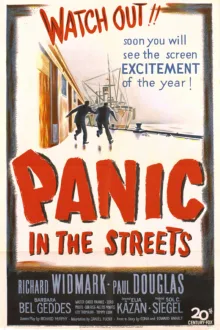
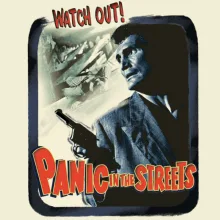
Panic in the Streets (1950)
- Guest Co-Hosts
- Emily Intravia, Maurice Bursztynski
Show notes
What if the thing loose in a film noir isn't a femme fatale but pneumonic plague? Noirvember 2026 rolls on with Elia Kazan's Panic in the Streets (1950), shot on location in New Orleans. A murdered man turns up in the harbor carrying the disease, and Public Health Service doctor Clinton Road (Richard Widmark) has 48 hours, and one skeptical police captain (Paul Douglas), to find the killers before they spread it.
Emily Intravia and Maurice Bursztynski join Mike to argue over whether a daylight procedural with a happy ending counts as noir, and to marvel at Jack Palance, quietly menacing in his first film, alongside Zero Mostel. They dig into Kazan's layered staging, the Oscar-winning story by Edna and Edward Anhalt, the blacklist that soon swallowed Mostel, and Kazan's decision to name names.
After six years of pandemic living, the men who balk at the needle, the jailed reporter and the film's uneasy picture of immigrants hit differently. Who decides what the public can handle?
Transcript
An automatic transcript from Spreaker. It has not been proofread, so names, titles and spellings may be wrong, and it does not say who is speaking.
Show the transcript (about 18,900 words)
Hold your ears, folks. It's showtime. People pay good money to see this movie. When they go out to a theater, they want cold sodas, hot popcorn, and no monsters in the projection booth. Everyone pretend podcasting isn't boring.
Turn it off. Turn it off. Turn it off. You haven't got much time, Mr. Quinn.
Commissioner, what's the use of kidding ourselves? We can't track down an unknown killer in two days. He's absolutely right. There's only one way to do this. You get on the radio.
Panic the city? Now, wait a minute. Here with Recorded is the story of a silent savage menace. How for three days a great American city found itself outside the United States of America. The events, incidents, and emotions of the people who were a part of it, who found time running out as they looked into the face of mortal peril.
I knew you guys were crazy. Wait a minute, Neff, wait a minute. Wait for what? Somebody else to die? You two men!
Listen to me! I've got something to tell. You! Well, what am I supposed to do? Just sit here and watch?
Listen, Doctor, I'm taking a chance that you may be right. You take a chance that I know what I'm doing and let me do it. As a matter of fact, you'd help us both out if you went home and went to bed. Okay, I'm not gonna argue anymore. And I'm not gonna wait until the facts penetrate that thick skull of yours.
There just isn't that much time. I gotta get out of here. Hey. What? Try and get back early if you can, won't you?
Yeah, I'll try. Where's the other man? All right, come on, get out of there. Oh, my God. You two men!
Listen to me! I've got something to tell. You! Welcome to The Projection Booth. I'm your host, Mike White.
Joining me once again is Mr. Morris Breshtinsky. As much as I looked, I couldn't see Darren McGavin anywhere in this film. Kolchak is there. Didn't you see Kolchak?
Apparently not. Also back in the booth is Ms. Emily Entravia. I like to go by Palance in the Streets, Palance in the Sheets. Very nice.
I'll just call you Walter in this one, though. Noirvember 2026 rolls on with a movie that swaps the femme fatale for a ticking clock. Ilya Kazan directs Panic in the Streets from 1950, shot on location in New Orleans with Richard Widmark as public health service Dr. Clinton Reed and Paul Douglas as Captain Tom Warren. The cop stuck babysitting him.
A dead man turns up in the harbor. The Kolchak that we were just talking about carrying pneumonia plague. Pneumonia. There we are. Carrying pneumonic plague.
Let's see. I knew I would get it. A dead man turns up in the harbor. The self-mentioned Kolchak that we were just... Jesus Christ.
A dead man turns up in the harbor carrying pneumonic plague. The kind that skips the rats and goes straight from person to person. And Reed has 48 hours to find the gangsters who shot him, led by Jack Palance, or Walter Jack Palance in this movie, it's his first one, and Zero Mostel before they spread it across the city. Fair warning, we're going to be getting into the whole picture here. If you haven't seen it, track down the Fox Blu-ray and watch it and come back.
We will still be here under a 10-day quarantine. Emily, when was the first time you saw Panic in the Streets, and what did you think? So I may have said this a few months, whenever it was ago, that you had me on for Panic in the Year Zero. Because I have always confused the two movies. And I'm a big both plague fan and apocalypse fan.
So on both of those lists, you will sometimes see Panic in the Streets and or Panic in the Year Zero. So in my head, I kind of had to see them both to separate them and understand them. So I watched this via Netflix disc. Yes, kids, Netflix used to send out DVDs, and if you have a DVD player, it can still work, and I urge everybody to get one. And I was probably about eight to ten years ago.
It was definitely before 2020, but it was somewhat recently where it was just a, I should see this movie, it's on lists of, you know, plagues, and I recall... It not quite being what I was expecting, because I think I was expecting it more of a sort of outbreak-type story, and it's obviously before the outbreak. It's also obviously much more noir than I was probably prepared to sit down and watch. But I could tell, like, oh, this is a good movie. It just wasn't what I was there for.
But what I walked away from, and the thing that I have always remembered, and I can never look at Jack Palance without thinking of it, is that he had to do stunts that stuntmen couldn't. And this, to me, what I walked away from was... I love when you watch a movie where you can immediately spot a movie star before they have done anything on screen. And that's what I think of with this movie, is just Jack Palance is a treasure. And Morris, how about yourself?
I can't be 100% sure, but I'd say that I probably first watched this about 15 years ago or so, because I remember that there was a period where I thought, I haven't watched enough noir. Maybe I ought to have a month where I do that. Would have watched at that time Night in the City, which I also re-watched for this podcast because I want to bring something up about Richard Widmark. Would have watched Double Indemnity and Laura, I think, at the time. And I'm sure some lesser noirs that I can't even remember at this stage.
Watching it again this time, it was almost like a first time because I think the only two things I recall about it was Zero Mostel's performance. probably the end of the film had stayed in my mind. So some issues about, within a 90-minute film, how quickly it is that they predict that the disease is going to spread and how quickly they identify it. Otherwise, I absolutely love this film. I think, as you've gone and said, Emily, unlike a previous film that I joined you to discuss on this show, Mike, which was The Amiga Man, this is a what happens before the potential of an outbreak. And now that I think of it, I seem to have made a habit with talking with you, Mike, about films that are, well, not always about disease outbreak, but we did Pontypool, which is about word spreading disease.
And if you really want to put it in this bag about people's poor behavior, there's on the beach, which is post-apocalyptic. And we're just waiting for the end to come. So, yeah, I don't know. What is it about me coming on the projection booth to talk about these horrible scenarios? But, yeah, look, really.
None of us can help ourselves. We can't. But years ago, I remember loving this and now watching it almost like for a first time. I really love it and look forward to getting into the reads, as it were. Maybe it's not you.
Maybe it's just the way that I choose these films sometimes because, yeah, I definitely... Next week when we have our episode, it's all about another film. Sorry, it's all about... The film is about a guy who is carrying around a little vial of radioactive material and getting everybody sick from radiation poisoning. So it's kind of on the beach a little bit, but plus, you know, panic in the streets.
A few years after this, I think it was from 59, so this one is 1950. Also, we should say this one is before A Streetcar Named Desire. And the opening of this, as we see the streets of New Orleans and all the neon, I love this street that they're going down. I don't know if that's Beale Street or Bourbon Street. I guess it's Bourbon Street.
It's Beale Street in Memphis, but it's Bourbon in New Orleans. Okay. Yeah. I've never been down there. I would like to go.
Yeah. Don't go in the summer. I was there in April a few years ago, and it was hot but not unbearable at all. You go in t-shirts knowing you're going to get hot. It is fairly humid.
Great place to eat, obviously. And this is not necessarily what you think of when you think of New Orleans, but I will always make a pitch for it. The best museum I have ever been to, the World War II Museum. I am not a war museum type person. I like history, but...
I don't know. My dad, I'm not the typical History Channel person. History Channel to me is for the food that built America. But this museum is, I think it's considered one of the best museums in the world. It is laid out in such a fascinating way that it basically walks you through the war in And there's a whole wing on propaganda, but it's both American propaganda and Japanese propaganda.
So you're seeing both sides of it. It is very neutral in that regard. It was by far just the most, the best way of putting this event in a way that you can kind of navigate it that I've never seen before. So if you ever get down there, do that. It sounds like the Country Music Museum in Nashville.
I'm not into country music, but I had a great time at that museum. With this film, I actually remember when I saw this the first time I was working at Blockbuster Video and we had these trailer tapes that we would show. And a lot of them were just like, here's what's new and here's the trailers for what's new. But occasionally they would have little clips from older films and kind of recommending those. And they had a clip from this movie on there.
And this was right around the time that I had been into film noir a little bit in college. This was probably 94, 95, somewhere around there. And by this time, I knew who Richard Widmark was. Of course, I knew who Jack Palance was, but I just loved me some Widmark. I'm excited to talk to you about that, Morris, because he was just such the face of film noir for me.
And it's interesting because I don't even know. I guess this is a detective story. It's not the noir structure where it's flashbacks or here's this guy who's in trouble at the beginning and he's going to be in even more trouble. At the end. Because we actually end with a happy ending, which is interesting.
Didn't we have to with the Hays Code? It didn't have to be happy, but it would have had to have morally resolved itself, I guess. Right, but Witcher Woodmark doesn't get to play and die. Isn't that the thing, though, with the Hays Code? It wasn't necessarily that something required a happy ending, but the villain had to get his or her comeuppance.
Yes, you couldn't have the villain walk away unscathed, which is one of my favorite examples of that is the bad scene, which the Hays Code dictates, spoiler alert, that you couldn't have the ending from the play because the little girl has to die in the movie because she's evil, which I just love the idea that somebody in the office was like, no, the kid's got to die. It's such a weird... Fascinating time in film history for both veterans. Oh, yeah. I remember watching this all those years ago, and I don't know why I chose this year to finally cover it, but maybe we're far enough from the pandemic, because I noticed that I couldn't really watch plague films during the pandemic.
I tried to watch Virus, and I was just like, no, no, this is hitting way too close to home. This one's still hitting kind of close to home. We'll definitely talk about that as we go through here, but... Yeah, I love this setup where it's just these guys playing cards one night and one of the guys is feeling well. I was reminded of Journey into Fear.
We just talked about that on the show where you've got the window opening and the guy sticks his head out and he's so hot and he's feverish, but he's like, I'm freezing. And the guys are just kind of pissed off that he wants to take all of his money and go. And you get introduced to the three main bad guys of Jack Palance, Zero Mostel, and the other guy. And I'm sorry, but I never bothered to look up the other guy. You're competing with Jack Palance and Zero Mostel.
I don't think your name is getting out there. Those are two pretty big personalities. This is Palance's first film, but it's just amazing the way that the camera stays behind him, right? Yeah. He's he's we've got it is back to us and they keep talking to him i mean zero mustel is that little dog from the warner brothers cartoon just like is that right is that right blackie oh yeah black you tell him blackie you know just doing that whole thing it's like okay blackie is definitely a violent person but it's great that we don't really ever see the violence that much he just is very quiet and just like you go take care of this you go do that this is very much.
The man pulling all the strings I don't know whether either of you had listened to the Lux Radio Theatre play adaptation of this film. I listened to this yesterday, only discovering that it was a thing. It had Richard Widmark and Paul Douglas from the film, and they didn't announce any other actor except for, I can't remember her name, but the... lady who took the place of Barbara Bel Geddes. But they didn't mention who played the Zero Mostel part or the Jack Palance part or any other part. The thing I loved about Palance was if you just listened to him and you weren't watching, he's soothed by his voice, but he's got this underlying menace.
Whereas the guy on the radio program was... more like your typical Warner Brothers noir parody, cartoon parody sort of thing. He wasn't quite saying, now say, this is what we're going to do, Fetch. Not quite like that, but it was in that ballpark of playing the noir villain, whereas Palance... Because it's the visual. I think that's the thing is, obviously there are actors who have voices that can do anything, but what makes him so powerful in this movie, it's...
Part of it is, like, sure, how he's shot, and obviously Elia Kazan knows how to shoot actors to get the most out of them, but it's, you know, even the suit he wears, right, this giant suit that sort of, like, rolls on him where it just makes him, like, feel even longer, and he's got those, like, angles to his faces, and he just, the way he stands, the way he stands next to Zero Mostel, it's, there is no question on who is going to win a fight or who is going to survive this. where he can have a soft voice, because when you look at him, you understand why you'd be terrified of him. But if Jack Palance did a radio play of that part, it might not work. I love that they give him that great close-up right towards the beginning, where he finally does stand up and he grabs the card, starts to look at the card, and the way we.
See his profile. Yeah, he was just one of the most striking men I've ever seen. Like, we were talking recently about great faces. That face. Oh, yeah.
Yeah. And amazing to think. Was that his first film? That was his first film. I don't know.
I mean, had he theater? I'm sorry to sound so ignorant here. I hadn't read up. But did he do theater? I mean, was he just, wow, that's a face I've got a part for you because, you know.
This is not making his way through the ranks. He ended up taking over for Marlon Brando in Streetcar on Broadway after Marlon Brando left. So I feel like he probably was, I think he was part of the actor school. He must have been part of that group. But same thing, I meant to look it up and did not.
Yeah, he definitely did a lot of acting on Broadway. He studied method acting under Michael Chekhov. He also worked as a sports writer at the same time. But yeah, he went on to, he would play like Russian characters. I think he's Russian by birth.
And his face actually comes from an injury in World War II. And they had to do a lot of reconstructive surgery. So he had that face. Yeah. I know he played Dracula on Broadway at one point and was the hot ticket for a while.
Oh, I can imagine him being an amazing Dracula. I mean, Frank Langella, great. You know, he's the handsome Dracula. I want to see this Dracula. Oh, yeah.
And I don't know about you guys. Jack Palance also, for me, is always memorable because he was my Oscar origin story of the first Oscars I remember watching is when he won for City Slickers. And I mean, can you imagine a better way to get initiated into like, this is an award show for movies, but you haven't seen any of the movies. Except that year I had, because it was, I think, also the Silence of the Lambs year, right? So when this guy from a movie I've seen comes out and does a friggin' one-arm push-up, yes, it's always going to imprint on a young person.
Oh, hell yes. And the third guy is a great actor. I mean, I love his work with his body. When he's going after Kolchak, who is the sick man, and they cross that amazing shot of the train, And the way that Kolchak just kind of meanders, and then you see that he's meandering right in front of a train, and you're like. Holy shit!
And then he climbs up onto that platform by the warehouses, and then that third guy is just crawling around. He just looks like he's going to... Well, he looks like an animal, the way that he's all hunched over. Yeah. And then, yeah, they attack this guy and shoot him twice, and that really starts the whole mystery, because it's like, what's going on nobody knows who this guy is they have to find out even what his name is you know like he has no identifying marks on him he just happened to come into the city yeah and now he's got the mnemonic plague.
To your point that you raised a few minutes ago mike about is this really a noir film because there's elements that you don't see in a typical noir this opening scene to me, is what defines it as a noir. It doesn't matter what goes on beyond that. It's the villains who are going to kill for money. That opening scene is what makes it a noir to me. if nothing else. And I heard that Kazan used some locals for some of the actors.
And I have to say that some of the guys at the morgue feel like they are, let's say, not professional actors. They're kind of stepping on each other's lines a few times. There's some awkward pauses. But The guy who I'm specifically thinking of is the actual coroner himself. He seems a little rough, but at the same time, he's one of the best characters because he's the one who recognizes what the hell's going on.
And it's just like, get out of here. The way that he's just telling everyone to get out of the room, closing the door, taking care of all these things behind his one-way glass. Well, actually, I don't think it's one way. I think it's just a big old window that they have. And this film does a really good job, and Kazan does a good job when it comes to the staging of things as far as what's happening in the foreground versus what's happening in the background.
Yes. When everybody is hovered over this body and they're talking about the plague, and just right behind there, a woman comes in to identify her husband or some other dead body. That for me was one of those things where sometimes you sit down to watch something and you're obviously like, You know, you're giving your all to it. You're waiting to figure out where it's going. And that scene, that moment of this weird humor happening in the background while the story has started to unfold in front of you is one of those touches that I was like, oh, I'm on board, right?
Separate from, oh, there's a plague and I love plague stories, was just, oh, good, we've dropped something that shows, as a filmmaker, you have a sense of humor and you have... a sense of detail that is going to make me look for it in the rest of the movie. I also like the dialogue contrast there because at that, at that point in time, the coroner, and his colleague have been discussing where they're going to go for lunch. Well, they have to. He's a coroner. He has to either be eating a sandwich or talking about eating a sandwich.
Or flirting with a pretty waitress or something like that. And so there's that. He's not giving a shit about, this is just another guy who I'm assessing who's been found at the docks. And in the background, as you've gone and said, is the seriousness of this lady saying, that's my husband. These two things is perfect.
Staging. I mean, Kazan, he was a theater director as well. I think he was. Yeah. I think this is all really tied to theater stuff.
Yeah. So he knows how to stage things. It's not just about point the camera and shoot. This is very different. This is, yeah, very definitely composed.
And I love that moment. Really love that moment. And that's really the signal for me to watch those background shots when I see her come in. And then after that, it's like, Pay attention to the background. You know, this is not just one plane of action.
He's using multiple planes of action, including the far distant background. Like, keep your eyes open. He's definitely doing some great stuff. And then, yeah, that dialogue where you want to go to lunch. What's going on?
You want some spaghetti? No, you just want to flirt with that waitress. It's like setting the tone so well and then showing us the domestic not tranquility because there's a lot of problems going on here with money when it comes to Clinton Reed, the Richard Widmer character. You've got Clinton, you've got his wife Nancy, and then you've got his son. Yes!
I liked this kid. What's wrong with him, Emily? No, he just showed up and started whining, and I just immediately was like, this is the best we could do. Come on! He could have started singing about how unfair life is, like he did in The 5,000 Fingers of Dr.
T, and how he's never going to be a grown-up. if this movie had suddenly become a musical, but instead it becomes a lesson about how to paint furniture and that the guy down the street is a much better painter than you are dad. Yeah. He bums a quarter off of his father and then his mother gets back and, and she's on with Mark about, Hey, we've got this, what is it? $ 42 bill that is due. And then I love how later on in the movie spends $ 50 to get information. It's like, yeah, I don't have the money anymore.
It's like, It's really nice. I like those little touches. Because we don't get a lot of the household stuff. I think we check in one other time between this and the ending. But it's really nice that we see this scene on a nice picket fence type street of all of this just to show what's at stake for Widmark and what's at stake for everybody in this type of a movie.
Yeah. And I think that second scene also, when he kind of comes home basically to change because he doesn't want to sleep, even though he probably should. And at this point, even though he's been inoculated, he does not want his wife to come into contact with him. So that whole scene is basically shot where they have to, what do you know, stay like six feet apart and they can't be face to face. So it also lets Kazan kind of shoot interestingly because it's then both of them in looking at in the same direction because she's standing behind him talking to him, like talking to the back of his head, which you would normally not do in real life, but it works really well on camera because then we can see both actors at the same time.
And it's just, again, that other way of sort of taking what could be a very, I think, bland scene and bland relationship. Because as much as, like, Richard Woodmark is great, but also he's playing the very upright citizen who is... was kind of by design the least interesting person in the film. So when you then obviously have to get a lot of him because it's going to tell more of the story and give you that context, I think that there's those little touches that make it just more interesting than if this was not a noir, if this was not shot in this style, if this was not made by Elia Kazan. Can we talk a little bit about Richard Widmark? As I said at the start, I re-watched Night in the City.
Previously, I think the only other Richard Widmark film I'd seen had been Pickham South Street. And I think I'd read an article about Widmark that had compared him in this film because he's the everyman who just happens to be a brilliant diseases medical expert. But it compared him to Jimmy Stewart. And the more I thought about it, I thought, Yeah, he seems to be that sort of guy. He comes into that meeting at the town hall and he's passionate about what he's passionate.
And he loves his wife. And it's very everyman, very Stuart-ish. And then I discovered that he'd made a John Ford Western called Two Road Together. Now, I'm not a Western guy for the most part. So I thought, okay, I'll watch this just to see the contrast of the two Jimmy Stuarts, as it were.
And Jimmy Stewart was doing his... his bad good guy, if that makes any sense in this film. And Widmark was the guy with the morals and the ethics and all that. And yet I still saw them as two sides of the same coin. But yeah, there's something in this film about Widmark's sense of urgency. He goes to the town hall meeting and he's pushing.
He's not going to walk out of there without getting what he wants, which is basically... I need the police to be searching for this guy. Otherwise, within 48 hours, we've got a pandemic on our hands and I'm not going to allow that. You can do whatever political stuff you guys need to do, but it can't get in the way of the medicine. And that really seemed to me like a very Jimmy Stewart-ish trait.
I don't know whether it was something in Widmark's acting or the scripting, but if Stewart had been in this film instead of Widmark, it would have looked Equally as great. Just, yeah. Any thoughts there? Am I onto something? Or was this guy who I read about onto something?
Well, it's funny because I came to Widmark via his first movie. The first time I remember actually seeing him was in Kiss of Death. So I always have Tommy Udo in my head, where he... I mean, Widmark is completely... Which is his first role, by the way.
His first role, he comes in as Tommy Udo, who's like a... Well, not even a top-level gangster. He's a low-level gangster who's giving Victor Mature a lot of problems in this. And when he is just, like, tackling like a madman and pushes this woman down the stairs in her wheelchair, I mean, that's the image of woodmark for me always in my head so to see him play a good guy so like when you're saying like oh yeah very jimmy stewart like it takes a lot for me to see him as a good guy even in a role like this i'm just like watching his eyes like he does a lot of great work with his eyes especially after that meeting you're talking about he he's just there with the cop who's he's going to be forced to partner up with tom warren's captain tom warren the paul douglas character and he just like kind of his eyes are down, then he kind of looks over to the side and he's just like, looks back down again.
And it's just like a very quiet moment, but you know, he's kind of chagrined. And when he's just like, was I laying it on too heavy? Because he's going toe to toe with Captain Warren in that meeting. Warren's saying one thing and Widmark is just like, no, you're dead wrong. And they were just going at it kind of like cats and dogs.
So it's a real great thing that these two guys get hooked up together, and then they have to be partners. This movie, for me, at the end of the day, is about this friendship between these two guys and how it starts off as this, I can't even say rivalry. It's not like they're vying for something other than maybe. It's just genuine disagreement between And both of them are absolutely from where they stand right in how they're approaching it. You have a detective who's like, you expect me to solve a murder in two days when there is absolutely no evidence and no witness and you burned our body and what do you think is going to happen here?
And then the other side of it is like, well, if you don't do this, you are going to spread the bubonic plague. So it I really like how... And this actually, I think, to mention the Oscar it won, which is an Oscar that no longer exists, which was Best Story, which was given out until, I think, was it 1956 or 59? And it was generally, I guess, it wasn't the idea for a movie. It seemed to be that Oscar basically went to the film treatment.
And apparently that was very much something in the studio system days of... A film treatment is ultimately what then gets turned into the script. So if you don't have a good treatment, you're not getting to the next step. Just an interesting piece of history, because obviously you don't have that today. But it all has to make sense that you have two very sympathetic, believable men who both have principles and are not bad guys, see things differently, and now are kind of forced to work together.
And again, I really liked how later in that same conversation he has with his wife, where Richard Widmark is basically saying like, yeah, I've been too hard on this guy. He's actually right about a lot of things. So it is like that sort of like, I like a good male friendship. I like a good men teach each other story. Absolutely.
Yeah. And this movie for me, until I saw something like Confidential quite a few years later, it was like, this was the ultimate male friendship movie for me, where it's just like, these two guys do not like each other, but they eventually, first they come to an understanding, and then they actually start to admire each other. And by the end of the day, they can play pickleball together and have a good time. Right on. And even his last line, where it's just like, keep me in your thoughts or something, or think of me.
And I was just like, oh, that's so nice. I'm hoping that they go on a fishing trip together or something. Whatever men did back then. And it's interesting that you've got, in contrast, male connection. It's not a friendship, but with Fitch and Blackie, so Zero Mostel and Jack Palance.
Am I pronouncing that correctly? I don't know. Same. Anyway, so that's a bully-employer-subordinate relationship. And I definitely think that the film is trying to make it between both relationships.
In each case, we've got one guy, Widmark in his case, Palance Palance in his case, that is in control of the situation. Widmark, once he realizes that he's not infallible, will work properly with Douglas and realize, okay, you're good at what you do. I'm good at what I do. Let's pull our resources. Whereas Blackie, it's my way or you're dead.
I mean, admittedly, I don't think Fitch was very good at his job. Like, I think Blackie generally was pretty good at what he was doing. And most of his instincts were pretty on. And I want to just sort of quickly talk a little bit about Zero Mostel as Fitch. Now, Zero Mostel had been a large part of my life.
So yeah, we had the Broadway recording of Zero Mostel in Fiddler on the Roof when I was a kid. And I believe that the reason Norman Jewison didn't choose him for the film was because Zero Mostel would play Zero Mostel in the film rather than Tevye. My favorite story that I can never think of Zero Mostel without having to go through this in my brain. is that he was not happy when he was not casting Fiddler on the Roof, understandably. And then, what was it, like, five years later, Norman Jewison makes Jesus Christ Superstar and hires Josh Mostel to play Herod. And apparently, Josh Mostel would tell the story, and, like, you can hear it in your brain where Zero Mostel, when he found this out, when poor Josh Mostel had to call his dad and be like, Hey, Dad, I got booked in a movie!
It's great news! Oh, great, what movie? Jesus Christ Superstar, great! Oh, who's directing? I don't know, you wouldn't know, Norman Jewison.
And then Zero Mostel's response was, why didn't he get Topol's son to play the part? And I can never, anything, I reference that line probably every week in my household of just, well, why didn't you get Topol's son to do it? I need to see that movie, Emily. You've never seen Jesus Christ Superstar? No, no, of course I've seen Jesus Christ Superstar.
I need to see the movie where... where Josh Mustel calls his father and tells him what happened. That needs to be made. Into a short film. I think that can easily be, oh no, I think that can go on. Because again, you make it a musical.
Right. So coming back to Zip, my father's favorite film of all time was The Producers. My mother hated it because I think 200 weekends in a row of him watching The Producers just drove her mad. But yeah, my father just absolutely adored that film. And so it occurred to me then, well, actually, no, maybe not at that point, but after watching that and a funny thing happened on the way to the forum, and then a film which I've watched countless times myself, which was the 1976 Martin Ritt film, The Front.
Yes. That was my introduction to Zero Mostel. Zero Mostel plays Zero Mostel, but he has a great, like, I think of him in a way like a great musician. He has a sense of dynamic. There's Zero Mostel at 11 and there's Zero Mostel at three.
And he does that a lot in this film where he's telling off his wife. And then when he's talking to Poldy, trying to keep him comforted, don't worry, we'll get the doctor, we'll look after you. All the time, he's Zero Mostel. Yeah, he's a big performer, always. And that's supposedly why Norman Josephson did not want him in the film.
But he does... I think in this film, in a way, it's probably the most... Like you're saying, the most levels you see of that. He really does modulate it. And part of it may have been...
You know, Aliyah Kazan knew probably how to direct someone like that because he was working with a lot of theater people. He was working with people from that school. Mm-hmm. And then, of course, they would have an interesting relationship in the coming years. Well, do you want to talk about that interesting relationship now?
Well, let me just say real quick, it's amazing to me how few films Zero Mostel was in. Like, he was such a part of... Well, yeah, we can definitely talk about that. And I think that's going to lead into what Morris wants to talk about. Because, yeah, I...
He was always such a part of my life growing up. And even he was in The Electric Company, and of course he was on Laugh-In and stuff. I think he's probably got more credits as himself on IMDb than he does as his movie roles. And then really, he didn't do that many movies compared to television work. He did a lot of TV movies and...
I don't know if Marco ever played theatrically. We talked about him several times on the Rankin on Bass podcast because of things like Marco, things like Little Drummer Boy and Little Drummer Boy 2. The movies weren't that many. I mean, we pretty much have mentioned the highlights. I know next year we're going to talk about Rhinoceros, which was a reteaming, I believe, of him and Gene Wilder in the EMSQ play, play slash movie.
It's the movie version of that. I'm very curious to see that one. But yeah, he didn't make that many things. And yeah, one of the reasons was because he was blacklisted for a lot of years. Yeah, his film credits, 1951, and then you have to go to 1959.
Yeah, yeah. He was in four movies in 1951, and then nothing. Absolutely nothing, because yeah, he is blacklisted. I think Barbara Bel Geddes was blacklisted as well. I don't think Widmark or Palance were, but yeah, the blacklist.
I listened to the audio commentary for this, and I never really thought about the one of the commentators was saying like, oh, yeah, noir might have ended because of the blacklist, because so many of the people that were involved in making films noir were victims of the blacklist. I'm like, oh, yeah, OK, I can see that. See, from this side of the world, my entire knowledge of the blacklist came after I watched The Front, which I watched so many times. No, it really is. And at the end of the film, where they're going through the credits, they'll say, directed by Martin Ritt, blacklisted between this year and this year.
Starring Zero Mostel, blacklisted between this year and this year. And yeah, I don't know how accurate, but it's a perfect abstraction. I guess of what those years were about and I love the fact that having someone like Woody Allen in his phase between being the zany wild wacky director of love and death and then going on to more Ingmar Bergman stuff later on it lent itself some humor before contrasting it with the drama. And Zero Mostel is equal parts humorous and sadly pathetic. Maybe his best performance, I don't know.
But he's absolutely the highlight of that film. And I guess he probably felt, yeah, I have to make this one. But it would have been, I imagine, so difficult. I don't know whether he would have seen this film as, yeah, this is revenge to let people know what actually happened or whether he was having heart palpitations while making it because it would have brought back so many memories. But one thing that I'd heard was that he'd made this film in 1942 or 43, which I'd never seen, called Tennessee Johnson.
And that was about an American president who this film... Its detractors had argued, had said that President Johnson had a bad track record against African-Americans and had been poor. And the film whitewashes President Johnson's history. Zero Mostel was one of those actors who was shaking the bars and saying, get this film taken out of distribution. It whitewashes his poor history against Americans. african-americans and it was at that point 43 where mgm said we're not hiring zero mustel for any films so irony about what happens after panic in the streets is that he'd already been black banned well before names were named so in in a way for all that we see about what Elia Kazan had gone and done.
He was the one who gave a black band actor a shot in his film. Yeah. And. And I believe Elia Kazan did not name Zero Mostel. He was not responsible in any way for that.
And apparently Zero Mostel... The anecdote I saw somewhere was that Zero Mostel did see Elia Kazan sometime later in the 70s and did hug him or shake his hand, but also said, like, why'd you go and do that? You know, it's... And the Kazan thing is just always one of those quandaries of... Man, it's, you know, I remember, again, very vividly the 90, was it 97 Oscars or 2000?
It was 2000 and something Oscars. Like, that was really where I think I probably learned about that and where most of the world who had forgotten or weren't born when all that was happening and kind of had it passed. Like, in American schools, I feel like you read The Crucible and that's your understanding of McCarthyism and then you just move on. So when Aliyah Kazan got the honorary Oscar, that was the big kind of revival of educating the public on what this was and what it meant. And it still is a question that everybody, I think, is entitled to have their opinion on, on what do you do with a great artist who does something terrible.
And obviously there's levels of that. And it's something, you know, I think we all as film lovers and I think art lovers have struggle with in every different way that that one was such a particular case where because what McCarthyism did and what naming names did was it really did rob artists of the ability to perform but also there was a self-preservation element to it. I don't know, it's never an easy conversation and I don't think there's a right answer in any direction other than Don't do it. Do the right thing. Well, I'd read something that Paula Strasberg had said, go on, name me.
I don't care. Use my name. That's fine. She gave permission. The other performers who he named names were already names known by the committee.
I mean, it comes down to that same sort of thing, though, that was answered at the end of the front, sorry, spoiler alert for people who haven't seen the front, but where the Woody Allen character is pulled up before Hugh Ack and he's told, listen, you can name names that they already know. And he finds that whole thing still reprehensible, whereas Kazan didn't. He thought, well, you know, it's ethically sound because they already know these people. I'm not going to put anyone new at him. Yeah, all I'm doing is protecting myself.
Right. And again, like, yeah, like if any of us realistically were put in that position where we have families to support or, you know, like our career that we want to save, it's really hard to say in full honesty, like, oh yeah, I do the right thing. No, no, no. I would still stand on my soapbox and not do it. I'd like to believe I wouldn't, but also like there's a, there's a terrible way to be in the system without being to, I don't know.
It's, I'm not defending it because obviously it was the wrong thing to do. But it's something that I think rightfully you have to think about when you engage in their art. I think that to not do it, I think, feels irresponsible. But also nobody is owed an opinion or moral decision that they can't change. I know that a lot of his detractors had gone and said, well, he still had a career in the theater.
So if he hadn't named names and he'd been... by Hollywood, he could have still worked in the theater, which raises the question, was there no unofficial blacklist for the theater in New York? I mean, was it just Hollywood? Was it not Broadway as well? I think it was all Hollywood because Hollywood was, you know, you could see those people and they were on your television they were on you know you know in your your local multiplex or cineplex or back then just movie palace you know that was threatening you know it was that control that these people had that they were going for the masses kind of thing as opposed to oh yeah broadway whatever you know the off broadway especially oh yeah nobody pays attention to that stuff but I think that was the thing was, I'm going to go after these people that are big names and big stars and shake up these trees and who cares about Broadway?
And then, yeah, he ended up having this huge career in the 1950s doing things like On the Waterfront, East of Eden, Babydoll, Facing the Crowd, Streetcar Named Desire. I haven't seen Viva Zapata or Man on a Type Rope, but Otherwise, all of those are coming out between 51 and 57. It was just amazing, this run that he had. I'm certainly toying with the idea of us doing a face in the crowd on sea here at some stage. So good.
So good. But I want to ask, is on the waterfront supposed to be Kazan's justification for doing what he did? Because he makes the contrast with corrupt... behavior on the docks the commission which says no we have no legal framework but we're doing what's right and what's moral and marlon brando saying i have no regrets doing what i did i have no regrets i mean is that supposed to be a parallel to what had happened in the years between making panic in the streets and but they're making a film of waterfront is that supposed to be a parallel i think. So that's what i've read as well yeah it I don't know. Because, yeah, there's always the, what did he think of this?
Which we don't. I know a Sterling Hayden, who also named names, he fucked off on his boat and was just like, I can't face any of these people. Really took to drink kind of stuff. Him coming back in movies in the 70s was a big deal. Him being in The Long Goodbye was.
A big deal. And that tortured character that he plays in The Long Goodbye, for me, it feels like it's very much how he feels about He did not have a good time doing that at all and was just eaten away. Whereas, I don't know if Kazan was eaten away. He definitely stuck around, though, and was just churning out hit movie after hit movie, or at least if they weren't hits, major critical success. So was he playing himself in Doctor Strangelove then?
He might have been. Yeah, those are always interesting for me when you get the blacklisted actors back together. in things like we talked about um executive action a few years ago and that one had probably like six or seven blacklisted people both in front of and behind the camera i mean it's just a fascinating thing when you find out like both and grandpa walton were on the blacklist you're just like oh okay interesting it's like they're supposed to be like american as apple pie and stuff and it's like oh well these were both accused of communism but hey, I stand by the people that were blacklisted like crazy. I don't think that needs to be said. Yeah, I'm saying. There's a film, I can't remember, maybe 20 years ago, I saw about the Hollywood 10.
Not a documentary. This was a narrative. Does that come to either of your memories? Yes, but I cannot remember anything about it. It was, I think, so these directors and they go down to, was it to Mexico to say, right, well, we can work here.
I do remember Hail Caesar. That had a lot to do with the Hollywood 10 as well. I adore that film. I know that there's a lot of people who say it's a weaker Coen effort, but not for me. I love that film.
I've not seen it. I need to. Oh. If for no other reason, I think even its detractors say that, was it Benedict Cumberbatch? There you go, Emily, the musical.
That's right. There's musical numbers. Yeah. No, I know. I'll get it back on the list.
Yeah. Going back to Panic in the Streets and that whole foreground-background thing again, I just wanted to bring up the whole thing of an earlier scene than where we had gotten to narrative-wise, which was the scene of After they find that this Kolchak, who they still don't know his name at this point, that he has a pneumonic plague, the next natural thing for Widmark to do is then inoculate all of the people that have been in contact with this guy, with the corpse. And I love the, again, it's Widmark on one side of the frame, and it's just this other cop on the other side of the frame, because this is before he gets to meet his new best friend. And in the background between them is a cop who is blowing his nose.
And it's, it's so great because he's got like the black or in movies, the black uniform. And then he's got this white handkerchief and it's just like so prominent, but he's again, backgrounded between these two guys. And then Widmark does the natural thing, which is okay. Everybody line up, take off your coats, roll up your sleeves. I'm going to give you a shot.
And that in. There's a guy in 1950 who's just like, why the hell do I need this shot? But it is so different than it is hitting in 2026, where I'm just like, oh yeah, where I'm just looking back at just a few years ago and thinking, oh my God. Well, I did my own research with Richard Widmark, and if I just... If I just go over here to this tailpipe and suck on this tailpipe for 10 minutes, I will be fine.
I don't need this voodoo that you're trying to put into my body. I went to the library, and I found the section where they talk about plagues, and I took the book out, and I looked in the index, and then I found it. Yeah, that hit, certainly. Yeah, and whether it was like, ew, needle, or just the, I don't want you to put that in me. Also then, like, Richard and Marcus just, like, walking around with a needle, like, poking people.
And, like, you are supposed to sterilize first. Does it not matter if we sterilize all this time? Like, are we allowed to just shoot things in without, you know, the little pad first? It's Hollywood. He's a doctor.
He's a Hollywood doctor. He's a Hollywood doctor, yes. But it's an interesting assessment of human nature that as far back as 1951, when they're making this, They could assess that people would behave this. They would behave. There's no falling in line.
We've got a disease. Oh, my goodness. Right, inoculate us, which could be a very Hollywood thing to do. But there was an assessment that, you know, two people, five opinions, and they could foresee what it was going to be like at the next meeting. plague that mankind was going to uh face the next major plague that mankind was going to face and people are going to say yep you're not going to put that into me so yeah as you say we haven't really evolved that far. Well you can do that or i'll put you in quarantine for 10 days he says to the one guy who's giving him some guff and i'm like okay good yeah shut him down shut his ass down and shut down all these fucking cops and other city officials that are just like Well, we don't know.
Yeah, he died because he got shot. He didn't die because of this thing that this crazy doctor is saying, this Dr. Fauci who's coming in here and telling us all of these things. We can't trust him. He's an outsider.
He doesn't even have an accent. And I guess we should talk about what I think is an interesting subplot in the movie, and I don't know where we all land on it, but the reporter, right? So there is a journalist who kind of catches wind of what's going on, and initially they just lie to him and they're able to kind of get him out of the way. But when he shows back up at the wrong time to hear exactly what's going on, and Richard Widmark, as the doctor, says, put him in jail. And the cop, the detective, or captain, I guess, is saying, no, you can't do that.
That is not how the law works. That is not how journalistic integrity and the reality of what the responsibility is to the public. We can't just lock up an innocent man who is not doing anything illegal by telling the world what's going on. And I thought that was a very kind of, again, like something playing very differently today than at that point, maybe. Because from the movie's point of view, you're watching and thinking like, oh my God, yeah, throw him in jail because he's going to cause panic and people are going to leave and they're going to spread the disease.
But of course, you're also looking at it as the other side of, no, but the police officer is absolutely correct. This is how our society works, that a journalist does have free reign to do this and to report what is the truth, and it would be wrong for him not to be allowed to do this. Except now we know the stupidity of the public, and we also know, like, oh no, maybe we do need to quarantine the reporter. So curious where the two of you felt on that scale, and if you had as much... psychological warfare in your brain about realizing where you once believed in integrity and thought that was more important than just locking things down and then the shift. It's been a long six years, Gus.
Morris, what are your thoughts? Yeah, look, like Emily, I think I had issues on either side with it because I thought, yeah, he's right. But In 1951, before the advent of technology, before everyone who had a phone with a camera in it, before the internet, before anyone could post anything that they wanted, but that was still an era where there was tabloid sensationalism as well as more well-thought-out journalism. We don't know. We never know.
It's probably not relevant for the story whether this guy is a sensationalist where he would put something on the front page that says, police, medical fraternity fails us. We're all going to die. Or whether it's a, all right, this is what's happening. Stay calm. This is what we got to do.
Not to mention, as you say, Em, how people are going to respond to it. We know in the 21st century how people respond with everyone's opinion. It's not just about information, it's about opinions. Back then, we all read the same couple of newspapers and we could form our thoughts, but what's going to happen? Are people going to gather, have marches against, well, what are we going to do?
Or are they going to stay calm or are they going to leave the state? I mean, because then it comes down to the whole question of community. Both Reid and Captain Warren are concerned about community. Captain Warren is concerned. He says community is New Orleans.
Reid says community is all of the US and all of the rest of the planet. Because if someone can get on a plane, I think he says, oh, he could be on a plane to Africa and he can spread it there. What is the definition of community? So it's, I see both sides of the coin and really 48 hours. I mean, who knows what's going to happen after 48 hours?
Do they find the guy? Do they not find the guy? Does Reid say after 48 hours, all right, well, let it, because there's no way he's going to be able to keep this silent forever. It's interesting that it never comes out of his mouth. Give me 48 hours before you spread this information.
And in a way, coming back to the film that we watched for the podcast a few years ago, Mike, Pontypool, and it's all about language. It's all about information or misinformation that serves as a metaphor in that film. Language is a metaphor for the disease. And it's people talking on radio and spreading certain words that are going to turn people into walking dead, as it were. Man, watching, I have not watched Pawnee Pool probably in like, since it really came out, which was what, 2010?
Well, a while ago. That is a movie that I imagine sitting down today and watching. And again, it's not post-COVID, it's post-COVID society. I think it's post us learning a lot about our communities, if you will, and What happens when something spreads and brains split in different directions? And I imagine Pawnee Pool today would be an even weirder watch than it was back when it came out, because now you're applying it to your understanding of society in a very different way.
Well, yeah, that was more of a rush limbo. time and now we're more of a tucker carlson. Time yeah as you say um just thinking about it now i'm more terrified just having this conversation now just thinking about it than i was even at the time when we discussed. I definitely see both sides of the issue as well. I'm so curious though, as far as Neff, our reporter character, how he's coded because he very prominently smokes a cigarette with a cigarette holder. And I'm just like, is that some sort of like signal for us?
Is he like a feat or, you know, pompous or what is his character? The only thing you can get through the Hays Code of saying gay character is Maybe? I mean, this movie is so interesting when it comes to the side characters. You see the Black people that are on the boat, the eyes that are on the boat. It's a weirdly multicultural movie, and I think there is another thing that we should talk about.
It is kind of the way, I think, racially characters are divided, at least in terms of immigrants and non. But you're also in New Orleans, and you both... seal and granted it's 1950 there are different things going on but the minute amount of black people in the movie is something that feels like you if you were casting locals you had to work not to ask black people in your movie. Right oh yeah well yeah or you cast very interesting dwarves in your movie like this guy is the newspaper salesman I love this guy. Yes. And it's perfect because, again, it's one more thing where you put Jack Palance, who's, what, 6'4, in a scene with a little person.
And right away, it's like, okay, you've already made this dynamic even clearer. And you've made this man even more intimidating by just doing this once and now the entire film. Like, our first kind of seeing of him, we're always seeing that height difference with anybody he's with. And then also that he is so nice to this little guy and like giving him the money and stuff. And the little guy constantly is like, God bless you, Blackie.
Yeah. Oh, but yeah. And then you've got the Asian characters that are on the boat and Widmark obviously speaks mass, the guy Nihama, which basically that's how are you feeling rather than hello. But you know, the guy says Nihama back and then he can understand him later on when they were talking about, you know, what happened and the, That is the place where the police captain is not very nice, especially to the very loquacious Asian guy. And he's just like, oh, you again, kind of thing.
Yeah. And some things never change when it comes to how we expect our police department to behave. Yeah. Yeah. He definitely, there's the one part where he like grabs the guy and he's just like, you're going to tell us what's going on.
I'm just like, oh, okay. Yeah. Hope your body cam is off. Wasn't there something as well about the good cop, bad cop routine when they go to the Greek restaurant and they both come in saying, have you seen this guy? Talking about the restaurant owner says, I'm not sure why is it that you're after him?
Captain Warren says, none of your business. Just answer the question. Because Warren has... never been in a Greek restaurant. One of his cops says, they serve a shish kebab down there. It's quite a delicious meal, so I believe.
And that really obvious ADR line where the guy says that and his voice completely changes. They kept trying to say shish kebab. The actor just could not get that word. Yep. Reminds me of Iron Man when he wants shawarma.
And I'm like, you've never had shawarma before? You? Tony Stark? Okay. But I can believe these guys not having shish kebab.
And the one guy just being like, oh yeah, shish kebab is really good. I'm like, oh man, shish kebab sounds really good to me right now. And so for all the fact that Kazan was accused of just catering to white, middle-class American audiences, I wonder, given the fact that he was an immigrant to America, whether this film, in a subtle way, maybe all too subtle way, is his assessment of how Hollywood approaches minorities, In films at the time. Is it a critique of that? But maybe it was too subtle for people to get that.
And they just sort of seem like it's another American film of the time that's looking at minorities a cliched sort of way. Because you could see it. There is a reading of this film that is very negative to immigration, right? I mean, you have a plague being brought on a boat by an immigrant who gets off the boat. And there is constant references to, like the Bubonic Plague, of it being spread by rats.
That rats are on ships, and when the rats get off, they're bringing whatever they had to whatever city they land in. And that reading is obviously very negative and uncomfortable, and I... don't want to imagine that was ever the intention of the film. It's very easy to sit back and just say, well, the story, if you're on a boat and then you come off the boat and it's New Orleans, so it's a hub of activity, it makes sense. Again, the story-wise, it makes sense and doesn't feel necessarily xenophobic as a story, but when you sit back and look at it, it's very easy to say, oh, this is a story about the perils of immigrants coming into a city. which is not where I want to be sitting. Well, it's like Outbreak with the monkey and everything.
It's like, oh, this was brought in from, and I can't remember if that was Africa, but it's always like something coming into the country from someplace foreign. I mean, this, again, in 2026, it's a little different as far as like these immigrants, they're coming in, they're bringing the diseases, they're eating the dogs. It's just like they're eating the shish kebab. I think the thing is, though, it hits differently because it's been so in our faces the last few years, but it always was there as a very strong way of thinking, unfortunately. Yeah, yeah.
Oh, sorry, go on. This is a change of subject for a second, but one other thing that this film struck me, one particular scene in particular, sorry, one scene in particular that I wouldn't say that this film is like a near-realist film, like one of the Italian Vittorio De Sica type films, but there's that scene where Reed goes down to the. Office where there are a whole lot of men waiting to see, can they get work the next day on a ship? And he's going to let them know, hey, have any of you seen this guy? I'll give you 50 bucks.
But while they're all waiting to get work, it so reminded me of the beginning of The Bicycle Thieves. And I'm not suggesting that these are the only two films that have people waiting for work, but The Bicycle Thieves is the big one. And it's so down and depressing. And while we're still looking at this film in terms of the role of the media, the role of how America saw immigrants, but there's also this thing about unemployment and ordinary... It's not glamorous.
Ordinary people just waiting every day. Do I have work tomorrow? Do I have work the next day? That really hit hard. And typically in very grueling, uncomfortable work that doesn't pay well and that doesn't, you know, isn't insured.
And all of those terrible things. And again, this is something that is still absolutely true of what it is like in the States. And I mean, I'm sure it's true of other countries as well. I grew up in Long Island, which has a very large population of Hispanic and Latino immigrants. And there are There are places when you drive that you know, oh, this is where the men are there waiting for somebody with a truck to come and say, I need help on my farm.
I need help. I'm doing housework. And it was just a reality of this one place. It's a reality of the country. And it is sad and takes a toll.
And for some reason, a lot of people are angry about it when it affects them in no way at all. All right. Yeah, this is the way that they get the work. Yeah, around here, it's like you go to a Home Depot in the morning and you're going to see a group of guys that are just waiting for that. Yeah, and there's the one guy at that, because I think they're all stevedores, and you might not want to flash all that money around here.
Like, that's a pretty bad idea, what you're doing. And I was like, okay, I kind of appreciate that. And also, that's one of the few times where you actually get to see black faces in New Orleans, which... from what i understand one of the whitest cities in america is that right. I believe so yeah yeah based on you know like american horror story and everything. Probably oh yeah yeah yeah good judge but yeah this is very much that mystery thing where he's like okay i'm gonna do this and he does the exact thing that he suggested that the captain was like you really shouldn't do that like you're not going to get any leads.
I don't know if he gets the lead that way, but there's the woman that comes in and was like, hey, you should follow me and come on down here and talk with this guy. And it's one of the other sailors. And so I'm just like, okay, did he get this because of that? I can't remember if that was how he gets this next lead, but that's where he gives The 50 bucks, I think, is to this other sailor who gives him some information. Right.
Yes. Gives us the name of the boat. Right, right. And that's where we get. Oh, what is this guy's last name?
Emil is his first name. I just I love this guy so much. Emil Meyer as the captain of the boat who just wants nothing to do. Oh, and this guy, like, every time I see him on screen, he is always having a bad day. I think I mostly remember him from Paths of Glory.
He's a real prick in Paths of Glory, but he's just, like, he's one of the guys that is just, like, yelling at people. I can't even remember. It's been so long. But he's not one of the three main guys, and he's not the guy with the scar that I just was talking about because I saw Laura. No, not Laura.
Someone with Rita Hayworth. Gilda? Gilda. I just saw Gilda recently, and George McCready's in there. He's on George McCready's side, I believe.
Admittedly, if you were captain of a ship that is a commercial transportation ship, that does suck. If somebody comes to you and says, hey, you need to quarantine or inoculate all your guys, I need to know everything, because by the way, you have the plague on your ship. Yeah, that'd be a lot of paperwork. Absolutely. Yeah, and. who knows what kind of dodgy thing is again, when it comes to labor, it's like, who knows where these guys are coming from?
Nobody's got their papers. You know, it's pretty much, you know, the one guy who's just like, we're in international waters. You need to follow the captain's orders. Well, yeah, they finally get a little bit more information. I just like how, like we're getting stuff doled out, you know, here and there procedural in that way.
It's, you know, And it's coming back to your initial point about, is this a noir? And, I mean, a lot of it takes place by day, but the procedural part of the investigation, this bit of information leading to that bit of information, it all screams noir, admittedly, in a very unconventional sort of way. Yeah. Well, a lot of, yeah, like you said, a lot of daytime scenes, but very much in that milieu of the underground, like lots of back rooms. Yeah.
Like even when it comes to the guy who owns the Greek diner or runs the diner and he's talking with his wife and his wife isn't feeling good, he goes behind the scenes in order to talk to her. And that's when you find out that she's sick. So you're like, okay, Kolchak was definitely here. And then you get back to Zero Mostel and Jack Palance and they've got their buddy with them. And it's like, okay, he's not looking good at all.
So it's just, and then every time that Palance like, you know, starts putting his hands on him. And he's just like, Hey, yeah, you'll be okay. And I'm just like, Oh, don't do that. Don't get anywhere near this guy. Hands sanitizer, hands sanitizer.
And then we get very sweaty. And the, the scene where the one man is, you know, in his apartment and, uh, they've sent a nurse over and that, I love that nurse. Um, is great. And she's like, totally the logical one is like, really, doctor? And this guy is such a fly-by-night guy.
Yeah. Yeah. This is like the mob doctor who, like, you know, took pills and flunked out of med school and then you call him when somebody's got a bullet wound that needs to get taken out. But the, when this man is dying and he is sweating profusely and just that whole, like, they're touching him so much. Ah!
Yep. Put your mask on. God damn it. It is really nice that, I mean, this movie, like, yeah, Kazan's other stuff gets so much more praise, like, on the waterfront or streetcar or some of these other things, but for me, streetcar named Desire, not streetcar, the musical version of streetcar named Desire, which Ned Flanders shows what How built he is in that. Can't you feel me yell?
You're putting me through hell. Stella! But this is the movie, this is the Kazan I go back to. This is the one where I'm just like, yeah, this fires on all cylinders for me. I love how compelling all these characters are.
And it's very watchable in that way. I mean, Streetcar is filled with giant performances, but it's also, like, giant tragedy. Whereas... procedural that is constantly moving and a breadcrumb leading to another breadcrumb and you have it's not that the pacing is like necessarily consistent throughout because you have these dips of breaking the action for Richard and Mark to go back to his wife and then to have this conversation that's completely separate kind of from the fact that there is an impending plague about to strike but there's something about it that is very just it moves and it doesn't ever feel pained to watch. Well, yeah, when she reveals that she's pregnant, that's pretty awesome. And then that also just doubles down on the, oh, you really need to find this guy and make sure you don't get this woman sick because now she is with child.
Speaking of that too, I'm like, just don't even be in the same room. That's where it makes this yet another aspect about the film is that it can be considered as a character study. Normally character studies are the sort where we can dispense with plot bringing him home to talk with his wife shows he is this guy. He's not just hard-nosed medical officer working with hard-bitten cop on the beat. And I would have liked to have seen a little bit of background with Captain Warren.
Not critical, but getting the two main guys... Well, I guess. Because you find out that he probably doesn't have much of a home life because his wife has passed away, right? And his wife... died of i don't know if they say cancer but it sounds like it was something medical right and that's why he all and again it's kind of like smart screenwriting in that way of early establishing of why this captain isn't going to be so trusting of a medical professional couldn't save his wife so i like that kind of very early it just gives you that little bit of why he's a little bit like nope i don't does feel like we could have had a co-lead that we just don't quite get in this movie for probably length reasons.
And it's only, it's not even 90 minutes, I think, right? Like it's 80, 88 minutes or something. It moves very quick. Very compact. And there's one other thing that we haven't sort of discussed yet, which is Blackie, the whole time, he thinks, not Poldy, is hiding something from him.
The cops are looking for us all. They're gathering us off the streets because this guy must have brought in something big. And we're all just sitting there thinking, yeah, yeah, yeah. There might be a black market for it. We're not saying there's not, but that's not, that's a really good point that I keep forgetting in the movie is every now and then like, and it's where you, that catch 22 of like, oh, if the press was just able to write a very clear story of what, We're not looking for any, we're just, if you came into contact with this person, you're carrying a plague.
Just go to an anonymous, you can anonymously go to a clinic and get a shot. Like, there's a little bit of that. If only we had been clearer about that, then, you know, we might not have had to go through everything. But yes, it is that misunderstanding the entire film. Which is sort of, not resolved, but it's referred to at the very end of the film.
They're sitting in the car. Oh, by the way, we found $ 300 worth of perfumes. Yeah. This whole thing becomes like a bit of comic relief in the last 60 seconds of the film. Yeah.
Meanwhile, you've got these deadly serious scenes. Like when they all meet, I think they're in like a park or something. It's about 15 minutes before the end. And it's like the mayor and Neff, the reporter and some of these other officials. And that's when they're like, okay, we're going to let Neff publish this story, but we need like four more hours before we allow.
Him to do that. And the one guy is just like, listen, I got to go take my wife and kids upstate. And it's like, okay, that is the natural reaction. And that's the reaction that they are really not wanting. This one guy is just endemic of the whole thing.
Exact proof of what's going to happen, which is, yeah, it's not that we are selfish people. It's that we love who we love. And same thing, if you told me, hey, there's a plague and the best thing you can do is... go here and then you told me but you can't bring your cats or husband then no i am not listening to you and that is exactly the case and i love that that moment because it's also very human um just like out of nowhere you just kind of get this little spark of like yeah no i'm of course go to your wife and it also is telling of like yeah this is what's going to happen. Otherwise precisely Yeah, and to go back to what you're saying, Morris, as far as the guy playing the tough Blackie on the radio, the Blackie in this movie, I mentioned him giving the money to the little guy, and then even when he comes in and is there with his friend who's now sick, like, I don't know if he's genuine or not, but he's saying all the nicest things to this guy.
It's not like, if you don't come clean, we're going to kill you or something like that. It's just basically like, don't worry, we'll get you a doctor. We'll do all this stuff. He's a gentleman. No, he understands that you attract people.
Be some bears with honey what is the same. Yeah but with honey then with vinegar or i don't know you attract something with honey rather than vinegar um you take more flies i don't know. Anyway now now i'm curious which one you actually which one would attract more. Well i think on mythbusters they had a pile of vinegar and a pile of shit and they just said okay now in our very controlled experiment, we're going to see where they're in front of an apiary, and they just go, alright, go nuts. Oh wait, no, that's where bees live.
On Mythbusters, they always just wanted to bust the myth. Even when it wasn't busted, they're like, so, because we couldn't not prove it, we're going to say it's busted. No, it was not busted. I was just talking about how nice Blackie is to his friend, and then I forgot about when Widmark finally encounters them. And they. are carrying his friend down on a blanket.
And Widmark's just like, hey, you know, I got to talk to you guys. And Plants and Mustel just take the body and flip it over the side. And this guy goes down between all of these. They're like two stories up and he goes down. And then you hear somebody a few minutes later go, he broke his neck.
Yeah. Just like, oh, my God. Moment so much. I'm glad you brought it up. I didn't want to forget it.
Because I love a, especially in a movie like this, where it is very, you know, it's 1950, like it's still kind of measured and restrained. So you get what is a really shocking act of violence that, yeah, it's obviously a dummy, but you see this body just plummet. And it is, on one hand, it's kind of funny, but also it's like, oh, it is horrifying. And it does just immediately like, oh, no, bad guy. Oh, yeah.
And they do it so smartly, too. The way they flip him up towards the camera and you see the actor go, oh, yeah, like he's... And then you cut. Like, he starts to move forward, too. And I'm like, wow, they did a really good job with that.
Then, yeah, the dummy doesn't look like a dummy. Oh, yeah. And then that poor guy who gets his flower truck stolen, who is just like, hey, my truck. And also, now, hopefully... He's got to get inoculated, too.
Like, they gather, right? When Blackie walks into that factory, he talks, there's a lot of workers there. That is a lot. I hope they had a large supply of that vaccine. I feel so bad, too, that one security guard's just like, hey, Blackie, how you doing?
Oh, Blackie, they're calling for you. And then, like, Blackie shoots this guy cold dead. I'm like, man, he was so nice. He was. He might have gotten the plague anyway, though.
Might not have survived his day at work. Yeah, I mean, Blackie isn't that great a guy, but he's really cool. He does have... He's just an interestingly drawn villain in that regard. So if anyone out there who knows who actually did play him on that radio adaptation, let us know.
He has none of the nuance, none of the charm. Well, but maybe that's why they didn't announce who played him. It was just the three leads, which is nuts. No, they just, they go, sorry, at the end, they go through Richard Widmark, Paul Douglas, Joyce McKenzie, I think her name was. They said, welcome to the stars.
No one else's name is mentioned. And it's, and the, no, not to be fair, because he had a speaking part, they should name it, but Blackie and certainly Fitch are greatly reduced in terms of acting time. There's, I think the whole play, is something like 45 minutes. You add another five, six minutes worth of... And now, an announcement from our producer, Mr.
So-and-so. No, it was an ad for Lux soap. And, oh, this was hysterical. I know that we're moving away from the story of panic in the streets, but at the end, when they were introducing the three members of the cast, and as was Buffett in 1951 or 1952, The MC says to Joyce McKenzie, or whatever her name was, says, and people out there on the radio land won't see this, but you're looking particularly lovely, Joyce. Oh, I thank you.
But it's because of Lux soap, which I always use every day. Oh, that's awesome. Yeah, I used to love listening to those. And I feel kind of bad that I didn't even think to look for that. I don't know if you guys saw, but I actually found the short story that this was based on, found an old, issue of, what was it, like Dime Detective Magazine?
I'm trying to remember. I'll have to look it up here. And the original story was called Some Like a Cold. Dime Detective Magazine is what it was called. Yeah.
And it's interesting because I didn't even think to look for this earlier, but then when you see the screen credits and you see that it's actually a husband and wife that get credited for the screen story, And so apparently it was a... Edward Anhalt wrote the story and then brought his wife in to work on the screen treatment. Which became. What was the name of the screen treatment? Quarantine.
Quarantine, yes. That was going to be the... And that also, I think, reading a little bit about how this movie was received. Because it was critically respected, but apparently it was kind of a flop. It did not make its money back.
And it was kind of seen as. To studios, oh, people don't want dark stories, they don't want stories about plagues, that it seemed very telling of where the populace was in terms of, these are not the stories we want. They do have a Reed character, but he's Seamus Reed, which is funny, but he's a Seamus. And then the hero's a wisecracking private eye hired by Greater Urban Life Insurance Company, which has $ 450 million in policies in the city as opposed to the public health officers. So it's very motivated by like, hey, we need somebody to do this.
We don't want to pay out all these life policies. New Orleans. Oh, that's great. Yeah. It is cholera in the story instead of the pneumonic plague.
And I like that they had to make the distinction of the pneumonic versus the bubonic. They do bring up the plague. They do bring up cholera. The one, I think it was Neff, is like, you're hiding something. I think it's this.
And it's so close to the truth, but just a few facts wrong. I wondered... Because I don't think there's ever been an official remake of this or anything like that. But there was a television movie that I've never been able to find. And I looked for it because it was supposedly based on a book that I had read.
And the book was called The Black Death. And the book was written, I think it was 1980, set in New York where I think it's the bubonic plague comes there. Because one young woman was on a plane, gets off, dies, and has spread it by that point to everybody. And there is a TV movie adaptation. I want to say, is it Kate Burton?
It's somebody very interesting as the lead. But reading the synopsis of the television movie, which I can't find anywhere online to watch or to buy, sounds like it is very much more a retelling of Panic in the Streets. Because I think it is about tracing all the people she was with and who she saw. So I don't know if it's out there. The movie, I think, is called either Quiet Killer... or Panic in the City.
I'm wondering if this is, there was a film which I started watching the first five minutes of, the YouTube title said Panic in the Street. So I thought, oh, is this a remake? I didn't know that there was such a thing. And I watched the first five, ten minutes of it, and I don't know if it's the same thing that you're referring to, Emily, but it looked awful, at least based on these first five, ten minutes. But it definitely looked very, maybe, I'm not sure if it was 80s or 90s, but it looked like a TV movie.
And I'm not trying to be disparaging about TV movies in general, because there's some really good ones, but this did not look like a good one. Did it star Claire Arnold from 90210 seasons four through seven? No? Okay, then what good are you? Apparently nothing.
This one stars Kathleen Robertson as the one who brings the plague into the city. I haven't even seen the movie, and this is what I know about it that made me even more excited. But I'm going to look. So you found it was Panic in the Streets on YouTube is what you're telling me. Yeah, but that's the title in YouTube.
Once I was watching the first few minutes of the film, that's not the title that comes up. But I'll send you a link. I'll have a look. Please do. I'm very curious.
I've been looking for this one. Because I'm looking at that Quiet Killer from 92 with Kate Jackson. And yeah, it's crazy cast. You've got Jerry Orbach, Howard Hessman, Louis Guzman is in here as well. So in the.
Plot synopsis is the real life plague of Justinian that killed half of the world's population in 6th century AD reappears in modern day New York City. As mass panic leads to chaos, a female doctor tries to stop the outbreak. So what's interesting is the book that it's based on, the outbreak has happened. They're trying to contain it in New York, but it's definitely like, no, no, no, the outbreak is there. Now it's trying to stop it from people from spreading it.
The book is called The Black Death, and I bought it at a yard sale somewhere for $ 1. And it was an enjoyable read because it did very much feel like it was Bubonic Plague in New York City, but it also was very dated of the 70s. And I'd seen one Goodreads review that kind of summed it up very well, which was, if you like rats, fleas, or sexist Puerto Rican jokes, this book is for you. So do take that context if you decide to do the reading material first. All right.
It looks like it's 21st century. Hmm. I normally really like Trailers from Hell, and I watched the Trailers from Hell for this, where John Landis basically just kind of fucked around for a few minutes. It was very short, and he even reads the cast at the end while he's watching the trailer, and I was like, you really didn't have anything else to say? It was very poor.
I was like, normally I really like Trailers from Hell. I even like what John Landis has to say. I don't really like him as... Some of the things he's done. Definitely don't like his son.
Yeah, it was very weird for me. And the only thing that I learned from that was that Jack Palance did his own stunts in this movie. Well, because the stuntman couldn't do it. The last scene where Jack Palance is climbing a rope, they apparently tried the stuntman like 10 times. And then Jack Palance is standing there like, I just want me to do it.
And they're like, wait, you can climb a rope? Like, yeah, I can do that. Right, like, I can do it with one hand if you want while I'm at it. And, like, and I'll smoke a cigar with my toe. Like, whatever you need me to do.
And he did it in one take, I think. And I love that. Like, I just, I love when that happens of realizing, like, just how physically capable that man was as well. I love when he's crawling along on the side of the dock. And he looks like a human rat the way that he's crawling along there.
I mean, that's intentional, right? It's, that is what he's doing. He's spreading the disease. And also, I love... Because I love thinking about it sometimes too in a movie when you're watching somebody who has had to run and had to escape something.
And you realize at a certain point you're like, okay, how much more can Zero Mostel go right now? Because he's keeping up with Jack Palance, which has to be very difficult. And so that contrast of Jack Palance not breaking a sweat and Zero Mostel basically saying, I'm dying, I can't do this anymore, is also very enjoyable in there. And that's just a great scene. That's a great sequence of just going through a factory.
I love a factory. That's Child's Play 2. Come on. When you are coming down a chute and having to jump over a machine and all of that, I think it's just great. And that guy who wants to shoot Palance when he's climbing up the rope and Woodmark's like, no, no.
And they just wait and they just watch him climbing. And then they just like, eventually just falls in the water. And then the captain is like, well, now we got to fish him out. Which is probably not going to be easy either, because I don't know if Palance is ready to give up at that point, but maybe he is. Because I'd love to, when they're fighting, you were talking about how Zero Mostel has to stop and they're underneath the dock and they're fighting him and Mostel and Palance is like, on that ledge looking down on everything.
And he just uses his fist and bonk Richard Woodmark right on the top of the head. So good. Yeah. I'm so glad that we got to talk about this one and I'm glad that it lived up to my memory of it because I just remembered liking this so much and I was afraid like, Oh geez, I'm going to revisit this, you know, 30 years later and be like, yeah, yeah, it's okay. But it really lived up to my memory.
It was better for me this time around, I think, just because, again, my expectation was something slightly different when I first watched it. So going into it now, knowing what I was getting, but also, and I hate saying it, but with the last six years of experiencing what Panic in the Streets would have been, had it not ended the way it did, right? Had it gotten out and kind of understanding that and having that different viewpoint of like, yeah, we've been on the other side of it. What everybody is thinking in this film, Obviously, characters have different predictions and thoughts on what would happen. They're all right.
Every one of them is correct about what could happen and what did happen and what one group would do versus what another group would do. In a way, it plays better, I think, today because we've lived through it. Was it one of you that was saying, I think, in the typed correspondence that panic in the streets is probably like a 20th century fox name, a company name, rather than what the name of the film should have actually been, because panic in the streets is what could have been, but the audience coming to expect it, where's the panic? What's happening? We're trying to avoid the panic in the streets.
That's why we're being so mean to Neff, the reporter. Yeah, well, but the paying punter coming to a cinema wanting to see a film, saying, I want to see panic. I came here and paid for panic, and I did not get my panic. Just imagine the angry, you know, I paid 50 cents for this movie. Thank you.
But yeah, this film is super intelligent, a great script. And I think that in the hands of a director that wasn't Kazan, it could have been still okay. A good thriller noir film, but why so, why this, really meets your expectations here in 2026 is because of Kazan. Whatever else we discussed before about what he didn't do as director and a brilliant designer of staging how the visuals look like, what's going to be in shot, he could have been a painter in that regard. It all comes down to that.
That's why we're still thinking about this film so fondly. Absolutely. I mean, yeah. And I would highly encourage you to do Facing the Crowd on See Here because it is, oh my God, such an amazing film. I'm sure you've seen it before.
Yeah, absolutely. I've seen it before. That's why I sort of thought, hmm, it's about music. Right. Okay.
We've got a potential here. Just, yeah, we haven't done it, but okay. It's a hard one though. I don't know. Like, yeah, yes, everybody should see that movie.
It is brilliant. My God, Andy Griffith in that movie is terrifying. But it is also one that it will take me, I'll just say, I want to avoid what happens to all of poor Mike's podcasts when you put stuff out and people say, why did they get political on that show? It was supposed to be an episode about Star Wars. I will say I need a few more elections before I can ever watch that movie again.
Yeah, well, fortunately for me, no one listens to see here, so I won't have that problem. I haven't gotten trolled, knock on wood, in a while, so it's been good. The bad reviews still come in, but not necessarily that many political ones right now. But those are still the majority of the one-star reviews. I can imagine people being...
Did you ever cover to Face in the Crowd? I can imagine. This was when Rob was still my co-host, and we did... Facing the Crowd, Bob Roberts, and Year of the Yahoo, the Herschel Gordon Lewis movie, all three of those as a triple feature just to talk about politics. These days, I would break them out into three separate episodes, but we did them all as one big one back then just to compare how politics were handled in those three movies.
And I love to imagine how many people came to you with one star of you saying, I can't believe they talked about politics when they were talking about A Face in the Crowd. And this was many years before the current trouble that we're in. So this is probably like 2012, 2013. So there had yet to be a golden elevator escalator in our. Before the panic hit the streets, if you will.
Yeah. So anything else we want to talk about panic in the streets? I think that got everything on my list. Thank you. Okay.
All right. Well, let's go ahead and take a break and play a preview for next week's show right after these brief messages. Hello, everyone. This is Malcolm McDowell. I just want to say that this is a request to listeners of the Projection Booth podcast to become patrons of the show via patreon.com.
P-A-T-R-E-O-N dot com slash projection booth. That's pretty simple. I think you can do that. It's a great show, and Mike, he provides hours of great entertainment. So now it's time to give back, my little droogies.
Settle down and take a listen and have a sip of the old Malaco. And then you'll be ready for a little of the old In-Out, In-Out, Real Horror Show. Bye-bye. What? Well, she shines, but how does she teach you?
What's a good fiegel? It's in the battery's pocket, right? I'm a battery myself. Plus, minus. Everyone has energy.
Everyone with a tree. Everyone with a tree. Everyone with a tree. Otherwise, nothing would work. So, I had it, and now I don't have it.
Well, well. I think you can feel it. Well, great. Look, it's like he's showing. Off somewhere.
He's really showing off somewhere. Well, I say total loss of energy. So I'll try it. You know it would work, but you're stealing. It from.
Me. Damn your purpose, but if you take advantage of. People's energy, they'll take advantage of anything. He's going to come back, right? That's right, we'll be back next week with a look at City of Fear.
That's what happens when you have panic in the streets. It will cause a city of fear. Yeah, it's a direct line. Strikingly similar. Yes.
Until then, I want to thank my co-host Maurice. Sorry, I don't know why I said Maurice. Until then, I want to thank my co-host Morris and Emily. So, Morris, what is new with you? Well, still doing...
See here and love that album. Love that album is two episodes down from getting to episode 200, but I am not the man of steel that you are, Mike White. We've probably been podcasting relatively similar amount of time. You've got thousands of episodes that people should listen to. Here we are, I'm only up to 200.
Going to be a lot of fun. I do this thing most years, not every year, but most years where I ask some of my local listeners musician, music journalist type people to talk to me about their favorite discoveries musically of the year. So not necessarily 2026 albums, but things that they heard for the first time that year. And that's always a lot of fun. So I've got a few people coming off of that.
Our next episode of C here that we're recording, going to be talking about a documentary about the zombies called, um, no, no, I can't remember what it, but this is embarrassing. Anyway, we're going to be talking about a documentary about the band, the zombies. And yeah, huge fan. And I wasn't even the one that picked it. My dear friend Kerry picked that, so we'll be talking about that next month.
Not sure what's happening beyond that. I want to just quickly give a quick shout out to another podcast that Kerry and I have been doing occasional guest work on with huge fans of, a show called Real Britannia. And as its name implies, they talk about British movies and In a week from now, we're going to be talking about a wonderful film from the early 80s, originally made just for, I think, Channel 4 television, but was released here in the cinema called Petang Yang Keperbang. I was never a big fan of John Hughes' teenage, coming-of-age type films, but The Brits seem to do it really, really well. And Gregory's Girl is one of my favorite films in that regard.
And Tang Yang Kippabang is another one. Just absolutely delightful. It's on YouTube. I'd recommend that you see it. Those guys at Real Britannia are just wonderful.
Lots of good fun. Know their stuff. Great conversationalists. I know absolutely every character actor, guy with one line in every British film ever made. And they're a lot of fun.
A big shout out to Scott and the Chaps at Real Britannia. Very cool. And yeah, I bring you on here just to shame you about how many episodes you've done. So thank you for just taking that on, just letting me pile that shame and guilt onto you. Yeah, guilt and shame felt.
There you go. Good. And Emily, what can I shame you about? Well, you can shame me sort of about the same thing, but not. It's actually my inability to count or label things correctly.
Because you can listen to my podcast with the wonderful Christine Makepeace at The Feminine Critique, also a Weirding Way Media podcast. And we also, funny enough, based on the numbers, because I number the episodes when I post them, and technically the next episode we're doing, which I'm very excited about because I think it's genius, we're going to do the movie Is God Is, which came out this year, which is fantastic. And I don't understand why everybody talked about Obsession and Back Rooms and didn't realize there was another great horror film made by a woman that came out. But we're pairing that. It's a very kind of dark movie about twins.
So we're pairing that with something cheerier. So we decided to do Twins, the Arnold Schwarzenegger, Danny DeVito movie. That will be a pairing that will, by the numbers, be episode 200. How about that? Except it can't be true at all because we've been doing the show for like over 12 years.
And every December, I do all of the stocking stuff for Hallmark movie episodes. So that's like another, like, dozen almost every year that I just don't count as episodes. And I definitely have posted an episode and realized I gave it the same number as the previous episode. So I'm saying 200 were probably much more. But technically, yeah, our 200th is coming up.
So, hey, how about that? How many girls on film did you do? I don't know how many we ended up doing in the end. Probably not more than 30, which was a. I don't know that I was on all of them.
I might have missed some of them. But that was, yeah, a show that I did with Rachel and a few other really great women of what feels like eras ago and eons ago. And I'm not sure if it's still available anywhere. Would you like me to go in and re-number all your episodes? I can have Claude do that for you if you want.
Oh my god, that would be... Well, because what if that ends up proving that we did like a thousand episodes? Then that's just... I don't know if that's something I'm proud of. I think even on speaker it'll tell you how many episodes you've done, maybe.
Well, let me say my. Little outro and I'll wrap this up. Thanks again, folks, for being on the show. Thanks to everybody for listening. If you want to hear more of me shooting off my mouth, check out some of the other shows that I work on.
They are all available, as Emily said, at WeedingWayMedia.com. Thanks especially to our Patreon community. If you want to join the community, visit Patreon.com slash Projection Booth. Every donation we get helps the Projection Booth take over the world. You're good for something, but you ain't no good for me
Related episodes
Episodes that share keywords with this one.

Beyond the Valley of the Dolls (1970)
Shared: 20th Century Studios
Doyle Green, Dolly Read-Martin, Marcia McBroom, John Lazar and others
Trouble Man (1972)
Shared: 20th Century Studios
Robert Hooks, John D. F. Black, Mary Black, Heather Drain and others
Enemy Mine (1985)
Shared: 20th Century Studios
Barry Longyear, Richard Loncraine, Edward Khmara, Corinne Luz and others

Comments
No comments yet.