
Show notes
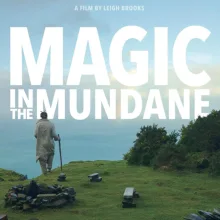
Where does a country keep its magic? After Netflix picked up Hate to Love: Nickelback (2023), British documentarian Leigh Brooks felt done with rock docs and went looking for the answer in England's landscapes, fire festivals and back rooms. The result is Magic in the Mundane (2026), a new independent documentary now on Apple TV. Brooks and his producer and co-writer Adam Carr join Mike to talk about it.
Brooks began by following Isla Macleod two days a month through the seasons. Then the coincidences started: mushroom educator Darren Le Baron turned up, and a man whose near-death story Brooks used to fall asleep to was living five streets from Macleod's sister. More than 19 interviews later he had psychedelic guides, death doulas, pagans and a Wellness Punk, and no idea how to structure them.
Enter Carr, a former video store owner who printed every transcript and mapped the film's golden threads across a wall of index cards, a method he took from Save the Cat! The two explain why nobody in the film argues, how the witch trials found their place in the edit, and why they toured the film as a pop-up cinema, once behind a secret bookcase door.
Brooks calls the film his love letter to England, and he is already shooting a sequel.
Follow Leigh Brooks on Instagram (opens in a new tab) and visit Firebelly Films (opens in a new tab).
Labels: Special Report
Transcript
An automatic transcript from Spreaker. It has not been proofread, so names, titles and spellings may be wrong, and it does not say who is speaking.
Show the transcript (about 6,900 words)
Hold your ears, folks. It's showtime. People pay good money to see this movie. When they go out to a theater, they want cold sodas, hot popcorn, and no monsters in the projection booth. Everyone pretend podcasting isn't boring.
Turn it off. Turn it off. Turn it off. I want to know a little bit more background on both of you. Lee, can you kind of tell me, how'd you get into filmmaking?
I was an edit driver. I used to drive edit equipment around in the late 90s, working on Steam, back in the avids, working on some big films. And then eventually I started seeing enough films where I was like, I really want to make one myself, but I had no real backgrounds. When the internet started really kind of kicking in, then I kind of thought everything was going to go online. And at that point, the people in my industry were more concerned about getting films onto DVD.
That seems to be the golden rule, get it onto DVD, get it into a big chain market and then off you go. And I thought that's not going to be happening soon. So I left and started learning how to film and Started up Firebelly Films about 16, 17 years ago now. And in that time I've made five documentaries, which is pretty wild. Plus doing a lot of other content and working around the world and doing some music videos and meeting some really cool people along the way.
Very cool. Adam, how about yourself? Myself? I started messing around with film when I was quite young, like Super 8 stuff. And I was always...
Totally fascinated with the world of filmmaking. The Dead Zone, David Cronenberg's The Dead Zone was filmed, and I watched them film that with Christopher Walken and Martin Sheen, the Stephen King adaptation. So I was always really, really interested in filmmaking, but it just seemed so unattainable or just totally mysterious. I didn't really know anybody that really worked in it and how to even approach that. And in the early noughties, i'm canadian but i live in the uk my partner and i opened a video store in shoreditch in east london which at the time was half dvd half vhs and it was called today is boring and it was sort of silent films world cinema independent underground things we did all sorts of screenings we screened you know the wizard of oz with pink floyd's dark side of the moon playing instead of the audio dark side of the rainbow and Did all sorts of interesting, we did Twin Peaks marathons, etc.
And the neighborhood at the time was very big with artists and fashion people, a lot of whom were our clientele. And we came into the shop looking for references. Sorry, I'm just getting over a bit of a cold, so I sound a bit like Kathleen Turner. But we basically started getting involved in their projects, in particular, an artist named Christian Markley. who did a piece called The Clock, which was a 24-hour video loop of scenes from films that had clocks in them. At any time that you looked at the screen and then looked at your watch, it would be the correct time.
So it was a tremendous sort of research undertaking. And we sort of helped him with that. And then we started helping people with fashion films, et cetera. So we started producing and making music videos, fashion films, short films, mostly short form content. And then it At some point, I wrote a script for a Cambodian folk horror film.
Not in Khmer. I don't speak Khmer. It was translated. It actually got produced, and I got into writing and directing. But yeah, mostly short-form stuff.
Which was that Khmer film? Oh, it had two titles. There's one, I think it's called The Uninvited, and then there was one called... It was called The Force. They changed the title, and I can never remember which one it was before and after.
I can send you the link afterwards. I didn't watch... I didn't watch it for many, many years because I thought it would be terrible. And then I watched it. I was like, oh, actually, it's all right.
It's pretty good. So I think it's called The Uninvited, but there's also another horror film called The Uninvited, which is quite schlocky. But I can send you the link for a phone call. Awesome. And then how did you meet Lee?
Oh, that's an interesting story. So that was just over, well, I suppose almost a year ago. Not almost a year ago, just over a year ago. Lee and I both live in Margate in the south near Dover of the UK. And my partner and I, we were doing, we decided last year to do a festival around the holiday, well, holiday, the celebration of Samhain, which looks like it's pronounced Samhain as in Glenn Danzig's band, but it's pronounced Samhain, which is the origins of Halloween.
And we did a whole bunch of sort of talks, festivals, etc. One of the things we did was a fire festival. And I got a message from Lee on Instagram. He was making a documentary, which became Magic in the Mundane, asking if he could film it. And I said, yes, certainly.
We're going to film it too. The more cameras, the merrier. I saw the guy with the great camera equipment at the fire ceremony. And we got to talking and one thing led to another. And we started working together on the process of the film.
I believe Lee had been filming for the better part of a year at that time since january 2025 is that right lee. About 10 yeah 10 months yeah 11. Months so lee tell me about the oh sorry go ahead adam oh no that's okay and then we worked on it over the winter the writing lee was filming we were writing together i was in vancouver at the time so we were working over the wire with the same kind of time difference that you you and ourselves are experiencing. Now Lee, how did the idea of magic and the mundane come to you and how did you decide to make this film? Well, I'd made some music documentaries.
My last film was Nickelback, Hate to Love, managed to get picked up by Netflix, which was absolutely insane. And after that, I was definitely, I didn't really think I had much to give to the rock doc scene anymore. And I've also, you know, I've always been interested in the esoteric kind of counterculture and you know, more from an outside looking in. I used to love the Genesis Peorage, Psychic TV, you know, stuff like that. And that's kind of how I got introduced into kind of like the concept of magic, which was like, for me, magic to me was pulling a rabbit out of the hat.
And when I actually read that, no, magic is something that people did, I was like, oh, really? And I started looking at, you know, how people made sigils and intention and what that meant. And I took a few techniques away from that and I've actually used them throughout my life. you know, various things, but nothing really out there. Then I started getting interested in the psychedelic scene and, you know, what people's stories were, what they were experiencing. And, you know, I did a journey myself quite a few years ago now.
And after that, I haven't drank alcohol since. So something in that made it, it was, well, okay, imagine there's something more to this than just the, you know, what I've been told. And I benefited from it. So then I started looking around at the England, you know, I've grown up in London, so it's very kind of, you know, beautiful place, but also really dreary at the same time. And, you know, there was no talk of magic or anything like that where I grew up and, you know, everyone lives pretty normal, normal lives.
And I just wondered where that magic was. I didn't really know much about my own culture. I didn't know much about the country's culture. I didn't know much about the stories of the lands. I didn't know much about nature.
So I decided to go with that question, really, where's the magic in this country? I started looking for it and I started finding it in different places and people were practicing it and people had different methods of approaching it. People had different relationships with nature. People had different relationships with psychedelics. And it was just really an inspiring, emerging filmmaking process.
And I remember when I started off the filming, it was with Isla, who's in the film. She approached me. And said, Lee, I love your stuff. Do you want to, you know, help me with a promo for a pitch that I'm doing for a film council thing, you know, to get some money together? And I said, yeah, absolutely.
And I said, it's really weird you contacted me because I had it in my head that wouldn't it be mad just to follow Isla for two days a month for a year, following the seasons and just, you know, document her life. So I started doing that. And then one thing led to another and that network started expanding and it quite quickly evolved into Young in a Minute. I had more questions than answers. And that's probably why the film is, they've chopped back to stuff because I've, I'm a curious person and the film's kind of set up how I use YouTube.
So I'll be like, you know, on one rabbit hole there and I'm like, what's this? And then I'm on another rabbit hole and I'm on another rabbit hole. So I had lots of rabbits, rabbit holes, but no rabbits, well, no rabbits to put in them. After a while, we started to find more and more people along the way. And there was a lot of coincidences that were happening on the way.
Like, I would think, wow, wouldn't it be really cool to film this person? Then they would appear in my life. So Darren LeBaron came into my life. And then I thought, God, he needs to be in this film. He's so charismatic and so interesting.
And he reminded me of people that I grew up with. And all of a sudden he was in Margate doing the talk. And I went down straight away and said, wait my turn. And after everyone spoke to him, I said, will you be in my film? And he just went, yeah, okay.
And he was in the film. But the strangest one was I was really into near-death experiences and falling asleep. at one point I'd fall asleep to the news, but I didn't think that was too healthy. Still not sure near-death experiences are quite healthy to fall asleep to, but I did. And one of the ones I listened to was Zach, the tapestry man. And yeah, again, I thought, wow, that'd be amazing to film him.
Literally a month later, I was with Isla filming and she goes, Lee, my sister who makes this incredible, who's made this incredible red dress has she she's just met this guy who's built who's made this tapestry just down the road it's really coincidental like she's working on this piece which is insane and he's working on a piece that is absolutely mind-blowing I'm like hang on a minute is it him and she went yeah that's him and I was like you've got to get me in touch and this is in a really remote town in Somerset he was five streets away and he last I heard he was in America you know but here he was five streets away with Isla's sister and And the film went like that. So everyone in the film has not been really picked for many other reasons other than the stories that they tell and the people that kind of came my way along the way.
There was no real kind of process of, I'm going to do this film. It's going to be about this. Therefore, I need to get this argument. I need to get that person countering. I need to do this.
It wasn't that kind of a film. And I love that about the filmmaking process for me. you know, it was a really emergent process of meeting one person, then another. And then I met Adam. We become really good friends. And I learned so much from Adam about the filmmaking process.
I never really had anyone that I could spar with in the edit. I always did everything on my own. My last four films are basically done with a really, you know, small team. The Nickelback was done with just me and the producer, Ben. But editorial notes really only came through and far between from different people.
So, When I found myself having 19, in excess of 19 interviews then, and no idea of how to structure it, I said to Adam, it's really, the film's about Isla right now, but I've got all these voices and don't know where to put them. I don't know what to do. So he went away and. Took all those voices and transcripts and set up kind of like detective, Hill Street Blues, you know, this thread leads to that thread and started to really put the topics that everyone was going to be talking about with and through into the season the seasonal thresholds so that's why every now and then when there is a pause in the talking you've got these lovely little kind of you know nature interludes to give you a bit of a breathing space before you know breathing space before we bombard you with some more information and it started becoming really interesting then i ran off with that and just seeing all these voices were talking about the same subject but from different ways but not having anyone really arguing with each other.
I think everyone has got their own space to say their piece without it being judgmental, nearing, you know, condescending, because these people have got some really beautiful things to share. And sadly, and for me, you know, my life, I get very fascinated with people and I get absorbed into their world as well. And I think that's a really lovely thing to do. So if I was with the wellness punk one minute, talking about Alistair Crowley and going down that rabbit hole, The next minute I was talking about, you know, with Tree Car about consciousness and, you know, the connection between UFOs and demonology and really, you know, crazy fringe stuff, which people think is quite batshit. But, you know, I'm really fascinated by that stuff.
So for me, it's kind of like the books I used to read in the 70s and the early 80s, those mysterious books, you know, of like the the human combustion or the unexplained phenomena. I was always deeply fascinated with that. So it's kind of my love letter to England, my love letter to some alternative people in there, and my love letter to all things that are kind of outside, peering around the corner and behind the curtains at you. Now, while that sounds very, I'll just say it, magical, the way that these people would appear in your life, it also sounds like absolute chaos. So Adam, did you actually have like a a conspiracy board that you were using to tie all these things together?
Because that's what it sounds like you needed. Well, basically, the process was a question of transcribing all the interviews and then sort of tagging sections of them based on topics. And then sort of creating... I always sort of think of it as creating a sort of palette of paints, your color palette that you know you want to work in. So...
I basically organized all the interviews according to subjects, but not just subjects, but also themes and feelings, just vibes. And then in conversation with Lee, we sort of would put things together. I sort of did a suggestive, you know, first, how about we have this and then flow into this and, you know, person A, B or C touches on things. Because of course, all these people are being interviewed not knowing what each other are saying so all the interviews are kind of in ignorance of the other interviews if you know what i mean and so when it wasn't quite interesting how many um how many of the interviews people did talk hit the same touchstones whether that was very interesting so we we sort of put things together that way in terms of trying to find the golden threads i suppose of of the of the fantastic interviews Lee was doing and it was very intuitive and as Lee said we sort of went roughly through the seasons but we were very conscious of the journey we wanted to take people on through the narrative of the film and also how we wanted them to feel leaving the cinema as it were but as I'm sure you know with the film there's lots of different ideas in there some of them contradict each other And yes, no one's arguing with each other, but that's probably because they're not in the same room as each other.
But yeah, that basically was our process. Not to get too nerdy, but what did you actually use for the transcription, the tagging, these things? I'm just curious about what your process is. Yeah, so we basically just transcribed everything. I printed them out.
And I used to use a pen and paper and recipe cards, basically. So I would just sort of... It's one thing to... watch and listen to an interview of someone but it's another thing to read it so go through and read read the interviews and you get something different when you read through an interview and you know each time i would come across a new subject or feeling i would write that down as maybe there'll be other instances of this in other interviews or elsewhere in this interview and just sort of save those up and put them in the margins and then create sort of recipe cards i think the recipe card system or do they call them recipe cards in the uk i think they call them presentation cards in states in canada we call them recipe cards basically yeah you stick them on stick them on the wall i think i learned it from a script writing book called save the cat which is interesting it's how to make a hollywood blockbuster like step by step very formulaic but anyway that's the process they use um it's a good technique whatever structure you're pursuing but that those were the tools basically a giant wall tape and recipe cards and pen and highlighters.
Okay, so yeah, he's completely right. It does sound like if you had some red thread, you would just be making your conspiracy wall. Okay, alright. Yep, yep. I'm the one who got sacked from the force for coloring outside the lines and has this secret room that his life partner doesn't know about in the attic or garage with red thread.
Don't worry, that will be revealed at the end of season one. I did try that technique on my last film and I bought these cards, Fabula they was called, and put them all over the wall and started putting all the post-it notes up there. But my brain does not work like Adam's at all. So I'm way more visual. So I need to see and feel what they're saying.
My films get structured differently, but I think when you do it that way, you need that extra element because you're going to miss stuff as well. But my brain just won't allow me to work like that. I think it's a great way of having two different skill sets. that are pulling in different areas and then pulling together at the same time, which was really, really amazing to do. It really was. There were times when we had certain sections at different parts and was like, no, that really needs to go up there despite where it was.
I think the winch section for me, I needed that a lot earlier, which is where it kind of ended up as well. But initially it was in the Sanheim section, but I thought we probably put people through enough at that point. So, It felt better to move it back. And then actually, then I found soundbites from Darren LeBaron that just really led into that whole, you know, that witch scene, you know, the witch trials section. And just the way he led into that was amazing.
And yet again, there's no, you couldn't script things like that. You have to find those in the edit. And that's the beautiful thing about the editing process for me it's just when you get those little moments and you're like that's gonna work you have to run into the edit suite and my edit suite's in my garden in the in a converted garage so it's kind of my this is this is my sacred space you know this is my little sanctuary and what was interesting you're kind of finding out what everyone's little sacred space is And everyone's got their own little temples of how they work and what they do. As Darren LeBaron calls this, my spaceship as well. So yeah, it's a really, it's a lovely process to be able to do that.
And I'm fortunate that I was able to do that and work on other projects at the same time. This team was small. It was basically me for 10 months and then Adam. There's no one else on this. In fact, Raggy, who's in the film, came in at the last knockings and saved my bacon financially.
So I could actually get a bit of publicity and get everything else done just to get the film out there. Cause I was completely dry at that point is it's, you know, indie filmmaking is, is 90% passion. And then, you know, 10% shit, how I'm going to make it. And then that kind of flips into your passion goes quieter. And then all the admin and everything else kind of kicks in.
But I've done enough films now where, you know, the process as well. So I could take everything I learned from one film. I pour into the next as well. When is the first time you get to see this with an audience? When was that?
Was that in June, wasn't it? Yeah, we saw it in June. Yeah, that would have been at the Garden of Tomorrow Festival in Cornwall, I think. Yeah, it was. And we've been really renegade.
We've been doing our own little pop-up cinema. I bought this cool projector and a screen. And, you know, we go around to all these kind of community spaces or really cool bars with you know, like secret back rooms. There's one we did in the Love Shack where you've got to go behind a secret door. It's like a bookcase.
You open the bookcase and then you're into this secret venue, which is really quirky and amazing. And we had, you know, they've been selling out as well, like 40 people at 75 at one. So not mega crowds, but for me, just amazing to be in that room drinking in everyone else's feelings as they're watching it. it's quite an amazing experience to, to see people's faces at the end of the film and people that are there want to see it. You know, when they're interested in that material, it's like the film is, is going to be reviewed by people that are not into it. And they're going to see it as, you know, and it has been reviewed by people that are definitely not into that subject matter.
And that's okay too. It's not like I'm not trying to convert anyone into this. I wanted it to kind of be, have a bit of a bigger audience than the, than the fringe community that is definitely going to appeal to people. But I think there's probably a few people you can take along that journey along the way with you as well. And I've seen some people that have been quite affected by some of the material in there.
And even just, you know, remembering what they did as a kid, how they were out and the things they'd forgotten, you know, of how to be a bit more childlike or just enjoy their own time a little bit more rather than endlessly doom scrolling. So I think, you know, I think for me it works on many levels. And it's, as I say, it's a long film and it's packed with stuff and, You know, there's probably too much information for some people. But for this film, for me, it just had to have all that in because there were the questions I was asking. Yeah, it's just come out yesterday on 11.11.
And it's pretty much nearly worldwide on Apple TV, which we found out today. We thought it was going to be in the US, the UK and Australia. But I've just seen a load of other territories have come up. But we've done this with FilmHub and they've been amazing. And so it's not even a traditional distributor anymore.
So we're kind of handling all that marketing and everything ourselves. And it's quite exhausting, but it's working. It's picking up that little community as we go. So Worldwide and Apple Prime, I think Google and YouTube and TV are coming soon. And it's on Kinema as well, which is a really cool indie platform.
Do you know that one at all? Yeah, I've heard of that one. Yeah, Kinema is awesome. And that really gave me the confidence to start getting it out there. We organized a few virtual screenings, first of all, just to test the water. and see how it was going.
And the cool thing is with that, you can just re-upload. I was noticing errors and I'm like, fuck, I need to re-upload that. And you can do it. So I've got to say, massive props to Kinema. There's some really amazing stuff on there as well.
And I've just started shooting the sequel as well, which is called Sacred in the Profane, which is based, it's got themes that I've taken from a book by Machia Eliade. And it's kind of definitely kind of, zoning in on a few topics that were in this film but not as many so letting it breathe a little bit more and you know letting some other things come through like you know the art connection with people that are into magical practices was really interesting to me so I kind of I just got back from Florence and I shot a sculptor that left Hollywood he was a real big assistant editor kind of got a bit burnt out by the process and was like if I don't make a go now I'm just going to be churning out work for everyone else and he basically decided to leave the UK and set up in Florence and learn how to sculpt marble.
Oh, wow. Which was insane. Yeah. So I just got back from there. And yeah, there's some other really interesting magicians, I should say, that I've met along the way.
So it's expanding that world a little bit more. It feels like it's in the same universe. But yes, I think it'll be a bit more edgier in parts this one. But, you know, the rabbit hole is big, you know, and it's vast. And there's a really crazy book.
Is it Manly P. Hall? The Secret Teachings of Ages, which has kind of got a lot of this stuff smashed in it. I think he saved a lot of books that were going to get destroyed after the war from Atlantis Bookshop in London and then created this kind of like encyclopedia of stuff. So, you know, it's just such an interesting scene and it doesn't, it's not just about now and how it's, well, actually it is more about now and how people are using those tools from back then to kind of like, you know, work now in different ways that I'm really interested in justice magic, where people are working on different sides of the world to affect social change.
So it's really expanded my mind socially to different things. And yeah, again, I've got to thank Adam for that because I've learned so much about things I had no idea about, you know, to do with the world and how it works. And, you know, things that I thought were pretty set in stone are clearly not. And so it's been a real incredible experience personally. So even if this film didn't come out, There's a topic in the new film that we're discussing at the moment.
And that's what's more important, the process or the end result. So if you're an artist, it's all about the process. Once that project's done, you're out and you're into the next line of inquiry. And I heard someone else say, an artist never retires, he drops dead. And I had to think about that.
And I was like, what does that mean? Does that mean you're going to burn yourself out and die early? And I was like, no, you just don't stop creating. You don't give up. You give up your job, but you don't start.
Some people do, but I don't think I will. I don't think I'll ever stop creating stuff. And for me, it's just all about self-discovery and learning as much as anything else. And then hopefully if I'm doing that, there'll be something that someone else can take away or leave. At the table.
You know, it's up to them. So with this new film, is Adam being called back? Are you doing that with Adam? Once I get the readies in, right now I'm absolutely broke. So I've got to go solo like I did on the last one.
And plus, Adam's got a ton of projects on as well. So that's a conversation we need to have a little bit further down the line when I give him another 30 interviews. But I promise, Adam, if that happens, it will be in much better shape. In fact, I just sent Adam the first six minutes as well. So I need to speak to him about that as well.
At some point. It's a very, because you're putting yourself out there and sometimes you don't see the wood for the trees. You need someone else to look at it objectively. And, you know, that's the beauty of working with Adam. He's been amazing to work with.
And long may it continue. Lee, how many projects do you work on at the same time? I've got my daughter. That's quite a big project. I've got my house.
That's a big project. But work-wise, it could be, you know, I work for a lot of different clients. I've got real cool tech companies from the UK, music videos. I could be working on three, you know, between two or three projects at any one time, as well as my own stuff. But I do everything.
I shoot, direct, edit. Not good at VF. So that, A lot of things get outsourced to a really small, close-knit team. But every job that I do, I'm super grateful for the opportunity to be able to do what I'm doing. I never take that for granted.
And as tiring as it gets and stressful because, you know, someone's exchanging their money for your creativity and your eye and the way you approach things. And that's quite humbling, you know, and it's also something you hold dearly as well because You want them to go away with something they're really proud of at the end of it. And I want that for them. I just did two videos for a friend of mine called The Band's Bullet for My Valentine. And I think, no, is it one video?
Yeah, one video for them. It's just come out the other day. But being as a camera art, you know, someone else is directed. Oh man, it's brilliant. I get to learn again.
You know, I get to be a cameraman and do my shit, but then absolutely learn and drink in what everyone else is doing. So yeah, Sometimes it's nice for me to go in at different levels and not just be, I'll edit for some people. There's a really cool woman I work with called Kylie Olsen that does this program called Life in Six Strings, where she kind of goes off and interviews people like Mick Mars or Joe Bonamassa. And I do little 20 minute edits for her. But yet again, I'm learning about how the cameraman's working learning how they're doing it oh that's cool when they set that up so i'm constantly able to learn from other people which i love i love that.
Right adam lee mentioned that you're working on a lot of projects what are some of the ones that are coming up. Yeah so i'm sort of i've got two feature films that I'm working on. One is in production. It's a documentary about a band called the Savers of Paradise, which were an acid or sort of a early nineties, sort of late eighties, early nineties, acid house band in the UK. The late great Andrew Weatherall was a part of their inception.
They just got back together after 30 years. So I started making a documentary about their rehearsals. Some of them hadn't seen each other in many years. And I think their second gig was Sydney Opera House. So they had a lot of stage fright, anxiety probably to deal with in their rehearsals leading up to that.
So it's a documentary about them. I'm just doing various interviews with people that were connected to the band, but also people that don't know the band. So that's something that I've been working on and off. It's not high on my list of priorities timeframe-wise, but it's been in the process for about a year and a half now. The other thing I'm working on is a biopic.
It's in development about a fashion designer who is a close friend of mine named Pam Hogg, Scottish fashion designer who passed away in, I think it was the 26th of November was the day she passed away a year ago. So I was approached by some producers in the States, one from LA and one from Mississippi about, making a film about her. Originally, it was going to be a documentary, and now it's a biopic. So we're sort of in the process of liaison with the legacy team, which includes Pam's sister, etc. The producers are Patricia and Orion.
Orion recently produced Billy Idol Should Be Dead, the new documentary about Billy Idol, which is excellent if you have a chance to see it. He did the Ian Curtis documentary, Controlled. from Joy Division in 2007. And he also did a film called Shadow of the Vampire with Willem Dafoe and Eddie Izzard about the making of the original Nosferatu, which was a comedy, behind-the-scenes comedy, which I loved. It was sort of supposing what it was like actually making the very first Nosferatu and all the behind-the-scenes chaos of I don't know if it was historically accurate because they had Willem Dafoe as the actor being a method actor. I don't think method acting existed when the first Nosferatu was made.
And yeah, and I'm just, I'm doing a short form and content for House of Hackney actually, which put on the Garden of Tomorrow where the first screening of Magic in the Mundane was with an audience. So that's going to be something I'm going to be filming over the next few weeks. Adam, is there a good place to keep up with you and your work online? No, there isn't. I don't have a website or anything.
All right. I'm really terrible at that. I have an Instagram account, which is cryptically spelled with alphanumerically. It's Adam Carr with fours, number fours instead of A's. But yeah, that would be the only place.
I really need to get a website. No is the short answer. Yeah. And my partner and I also just did a Twin Peaks filming location map on Herb Lester Associates, which... It's quite exciting.
We were in Twin Peaks or Snoqualmie and North Bend, Washington four times this past year researching where various logs were present day compared to where the log was sitting in 1992 or whatever with a three words coordinate. Ellie, how about yourself? Is there a good web presence for you and for the film? Yeah, it's in my. Accounts, www.google.com.
Firebellyfilms.co.uk and then underscore Lee, L-E-I, sorry, at Lee, L-E-I-G-H, underscore firebelly for Instagram. And then we've got the Magic in the Mundane Instagram account as well, which is, I'm putting more content up from the vast amounts of material that was, that didn't make it into the film. I'll start, you know, going to put some more stuff up onto there pretty soon and YouTube as well. And then I'll be setting up another one for Sacred in the Profame. As well.
And then I'll be documenting the journey of the filmmaking as I go, which is kind of really interesting. I've almost mapped out the end sequence as well. So that's a new one. I'm like, okay, once I've got that, I'm now working towards that moment. So I'm going to Egypt with Darren LeBaron in February for nine days.
But that's a bit of kind of like a bustling holiday of always wanting to go to Egypt. And I was like, I want to go to Egypt. Do you want to go to Egypt? And he's like, yeah, it's my 50th. Let's go to Egypt.
I'm like, cool, let's go shoot. So no idea what we're going to do at the moment, but all I know is we're going to Egypt. And some of that footage will probably make it into the film. So yeah, I'm really excited about that. Awesome.
Well, guys, thank you so much for your time. This was great talking with both of you. I really appreciate it. Thank you. And thank you for your excellent questions.
Well, best of luck with the film. I hope that a lot of people check it out. So thank you guys. Thank you. Cheers, Mike.
Appreciate it. Cheers. Have a good one.
Comments
No comments yet.