
Show notes
Follow Wicker on Instagram (opens in a new tab) and visit the film's official website (opens in a new tab).
Transcript
A transcript supplied by The Projection Booth.
Show the transcript (about 2,900 words)
Mike: I remember seeing your film, what, six years ago? Save Yourselves, which was delightful.
Eleanor and Alex: Oh, thank you.
Mike: Was that the first time that you had worked together?
Eleanor and Alex: As co-directors, yes. Yeah. That was the first time we'd worked together. We'd prior to that we were hustling indie filmmakers and, hiring each other on jobs and things like that… big jobs. Yeah. So we knew that we could work professionally together. Yeah. In a professional capacity. Yeah. But that was the first time we'd written anything together, and the first time we directed together. Yeah, it worked out.
Mike: How'd you guys meet?
Eleanor and Alex: On Tinder, it's a dating app. New York City 2015, Tinder.
Mike: Okay. I just spoke to a co-directing couple, and I can never just assume that they are together-together, so.
Eleanor and Alex: I know. Who's that? We don't wanna assume. Yeah. We might be gonna have multiple emerging couples. We know a few of them. That's true. More and more of us coming every day. Yeah.
Mike: How was it working together, and especially writing a film like Wicker together?
Eleanor and Alex: We like it. Yeah, this is our second film together and we've found that the… We've written more than just two films together, and we find the writing process is really fun. And the directing process is very hard, but I don't think that's anything to do with us being a couple. That's just the job. It's actually, if anything, slightly easier- Yeah, exactly… when you have a buddy to go through it all with. Exactly. Yeah. But yeah, it was certainly fun to get into it about relationships and marriage and we got married two months before we started writing the first draft. So it was, all that stuff was definitely on our minds and informing the script, I'm sure.
Mike: Very cool. How did you run across the story of Wicker?
Eleanor and Alex: It was sent to us by one of our producers, Justin Lathrop, who was a fan of Ursula Wills's writing- and had come across this short story, which was unpublished. But he'd sent it to us, and we just loved it. We- I don't know. We just thought it was… We thought it would make for a good movie. Yeah. Obviously, but it was so beautifully structured as a fable, and so lifting that structure and adapting it to a screenplay was a real gift to the process. But also it just seemed like there might be something that we could add in making it a visual medium- given that there's a wicker husband at the center of it. Yeah. So we wanted to know what he would look like.
That's right.
Mike: Were you familiar with wicker before this? Do you shop at IKEA or Pier 1 Imports, anything like that?
Eleanor and Alex: So funny. I met someone the other day who watched the movie and afterward they were like, "I wanna tell you I love the film, but I have a real aversion to wicker." Yeah. "Especially the sound." And he's like- We're like, "Oh." I was like, "How did you do with the movie?" And he's like, "I got through it." And I was like, "Well, we really enjoyed it." Why would you choose to go s- to a film you know you're gonna- I thought that was pretty cool. You know, it's like Batman's facing his fears. Yeah. We do have some wicker furniture in our home. We have a lot of baskets. We also, Alex is- Like that IKEA light that kinda looks like wicker. Yeah, yeah.
That's true, yeah. Well, Alex comes from a family of artists and- Yeah… his grandmother was a weaver. We have a lot of weavings- She, yeah… in our house from her and yeah. Yeah. Yep.
Mike: Yeah, the look of, I hate to say The Wicker Man because as I was gonna call up the other movie, but the look of The Wicker Man is fantastic. Can you tell me a little bit about your production designer and how the design of him came through?
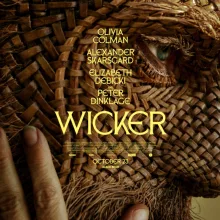
Eleanor and Alex: Oh, yeah. So Weta Workshop out of New Zealand, you would know them from Lord of the Rings and Avatar, and then they decided to do our small indie film. We spent 18 months working together. They had a team of weavers, artisans, and practical effects artists who just worked so hard for 18 months and- Yeah cranked it out. They started with us on concept art, and then it was sort of materials development going back to design and then the design informing the practical manufacture and vice versa, back and forth for a long time. And then- of course, Alexander came on board about six months or so before we shot. Yeah.
And once we had his scan, then it was all about just making it exactly as best we could in his likeness. Yeah, so we all studied his face. And- A lot… and yeah what are the elements of Alexander Skarsgård's face that make him Alexander Skarsgård? And to try to choose how to, we'd choose the weave pattern that could best show that- whatever it is, cheekbones, forehead. But it was an incredibly complicated process. And you find the points you're like, "Where is the most facial movement coming from?" and then you highlight those points and you figure out the weave pattern that will best work for that area of the face.
And then you try to hide seams and, 'cause it's all designed to as if it were real basketry. So the, there are all these people at Weta Workshop who are really t- testing with real materials and putting weave patterns together to make sure that it could all be real. And then it was 3D printed in a, as like a modular 3D-printed prosthetic. So there's 10 pieces that make up the facial prosthetic. Yeah incredible work that really paid off.
Mike: And then was he in makeup fully every single time he was on screen?
Eleanor and Alex: Absolutely. Yeah. He's totally- Yeah, that's what he looks like. Yeah, walking around… totally practical. He never had dots under his face or anything. We never worked with, we never saw Alex's real face. Yeah. He went… We had a couple meals together and that was it, but on set he was the Wicker husband through and through, just like you see him in the movie. Yeah. It was really cool.
That was how we wanted to make the movie, but it was also seemed essential for the relationship to work that it was otherwise a kind of a grounded movie and about these two people and we wanted them to be able to play off each other in that way and there's obviously like VFX involved in the film, but it's like kind of cleanup and making him hollow, those kinds of things. It was fun though because we realized early on you do, get extra VFX capture of s- s- lighting references- Yeah… and things like this just as kind of backup.
But one of the things they realized early on was that there was no need to put tracking markers on his face 'cause his whole face was just full of tracking markers. And he… So we never- Yeah… never would have had to do that anyway. But it was amazing. We talked to some practical effects companies and some VFX companies and we did a lot of research before we started on this process, and everybody said, "Yeah, but you'll wanna get a, like a- A full CG three-dimensional CG build because you'll have to replace it at some point." And we're like, "No. We will not." We just, we were like, "I don't think we will." and the more we worked on it, the more confident we felt in the process. And then even by the time we got to post, we had all this extra money saved for redoing, which we never thought we would need. And then we got to- It was a contingency… contingency money. Yeah. So we then got to put that money into other fun details like more hollowness through his suit. And you can see it's very subtle and like very tactile, but yeah. But really beautiful work. Yeah. We just stuck to our guns and trusted Joe Dunkley at Weta. Yeah.
Mike: I can't imagine what it was like for him to try to act through that and just be in that contraption for so many hours of the day.
Eleanor and Alex: Exactly… so it's pretty intense. And it was certainly a really interesting acting challenge I think for Alexander, because obviously you- Yeah… want a beautiful, subtle, nuanced performance, but in order to do that in that prosthetic you have to really mug underneath the- Yeah. Yeah, I think that was- To get a slight smile he had to- Yeah… a big, big, stupid grin. Yeah.
Mike: And I mean, the entire cast is fantastic. I love Olivia Colman. I love Peter Dinklage. The population of the village is so wonderful and just so many great faces in there too.
Eleanor and Alex: Absolutely, yeah. We worked with a casting director, Kharmel Cochrane, out of the UK, and obviously like we knew Elizabeth and Peter and we cast them early, but- It was like a dream cast… that was amazing. But casting the village was such a fun part of the process with her because it was a lot of comedy actors, like comedians that we- And writers didn't know before. Yeah most of them are writers themselves. They're also writers. Yeah. But it was really just like putting this village together and it was so fun to… You're not just thinking about the way everyone looks, but you're thinking about the comic sensibility- has to align for everyone- Yeah… because there's comedy and then there's comedy. You know- Yeah… there's so many different versions of what that can mean and- So it's like they have to have the same sense of humor as the screenplay in a way. Exactly, yeah. And they're all just so incredible and so fun to work with and just really brought their characters so fully to each day of shooting. It was really fun.
Mike: How did you find that balance? Because when I saw the trailer for it I think a week, two weeks ago, I was wondering what the tone of the movie was. Was it gonna be horror? Was it gonna be comedy? Was it gonna be more of a fairy tale? What was it? So I was unsure when I was watching this with my wife the other night 'cause she's not a horror person, but then she was just like, "That was delightful. That was so nice." There are fantasy elements of course. You have a man made out of wicker. But how do you find that balance between comedy and the more serious pathos of the story?
Eleanor and Alex: Just gotta trust the actors to truthfully humanize both. You know? It's like the best jokes are 'cause they come from a real place. And the romance or the drama also, it just comes from a human place. So it's all them, basically. I guess going back to the screenplay though, it's even in there because we just try to follow the thread- Yeah of the truth of the thing, and not judge it too much. And naturally some things come out funny, and naturally some things come out more dramatic, and we try to just not judge it and let it happen. Let it be what it wants to be. And then it's just the edit, really. Just, yeah.
The edit is where you- That's when you're like you've- Where you fine-tune… you can dial it down, dial it up. Depending on how you're feeling at that point in the movie. Is this too much ham? Yeah. Or is it not enough ham? Yeah.
Mike: Who was your editor on this one?
Eleanor and Alex: Sofi Marshall, who edited our first film as well, yeah.
Mike: Very nice. I always hear that relationship with an editor is very crucial, and you almost, it almost, speaking of married couple, it almost feels like a marriage.
Eleanor and Alex: Yeah, she's our marriage counselor. Yeah.
Mike: Are you a throuple now?
Eleanor and Alex: Yeah… yeah, we're a thoughtful. We, so you write just the two of us writing, and then you bring in like over 100 people, and then it becomes- All these collaborators, this giant beast, and then you go back to just two or three people. Yeah. And then the pressure's on. I felt most stressed in post because I felt like we had gone out and found the gold. We got the gold. You have to get it home. And then we had to get it home. And I got anxious about getting it home. Yeah, especially in those, the last week before you picture lock. That's just like- Oh… the most panic 'cause you're just like- But Sofi's just like, have we turned over every stone? She's such a steady hand. She really is, yeah. She's so logical and- Yeah, she's great… not emotional. Yeah. She's very great at working with us, in particular. Yeah. She's like a Vulcan. Yeah.
Mike: When did you first get to see this with an audience?
Eleanor and Alex: Pretty early on- Sunday… actually. Oh, no. I mean- Oh, we- do you mean like test screening or you mean- Test screenings… the final thing?
Mike: The very first time you saw it.
Eleanor and Alex: The very first time we saw it was like an early cut, and we were, I think, really nervous about it. Nervous about showing it at all, yeah. And we sh- show… It was like friends and family and- Yeah. Yeah. There were some really good filmmakers in the room that we were like, "This is our director's cut." Yeah. Very first cut. So that one was, like, kinda tough.
But then once we got it to a proper stage of showing a rough cut, then it was really fun 'cause it was just like 200 people who decided to show. Nobody we knew. Yeah. And we like to sit in the middle so we could hear how people are reacting and listen to their breathing. But even in that first screening when it was, like, the earliest rough cut, there was so much that we got out of that- Oh, yeah… the discussion. We learned- We learned a lot. Yeah… I always remember when there was someone in the room who said something disparaging about the tailor's wife, and then all these three women just turned around and turned on this person- Yeah, defending her. And I was like- So we knew that it was like- Brilliant. It's working. She's a really complex character, and there's a lot to dig into. And everybody- But if people are fighting about her, then it's good. Yeah. Yeah. We were always celebrating the tailor's wife. That's true. Until… And then we're like, "Oh, I feel like we got…" we turned up some things. We put some lines of dialogue back in that we finally found- what was right. Yeah. Yeah. Just because it is so complicated and you want people to have- I feel like- Just enough sympathy for her. But- Yeah not so much that it's overpowering the whole movie. An underwritten villain is deadly to a movie. Yeah.
Mike: I'm so excited for you both because I remember with Save Yourselves, it came out, what, October 2020? Not a lot of people going to movies at that time. And now having a movie opening wide, it's gotta be such a different experience for you.
Eleanor and Alex: Yeah… this year in particular is a crazy year. Oh, it's such a good year for going to the cinema. There's so many good movies. I feel like people are sort of rediscovering it. Yeah, it's so exciting. Finally crawling out of the COVID hole. Yeah. Yeah. Absolutely. I mean, it feels like an honor to have a movie out in 2026- Yeah. Honestly. We feel very lucky. A lot of good movies. Yeah.
Watch
Music credits
- "The Wicker Man" by Iron Maiden
Comments
No comments yet.