
Special Report · Film year 2026
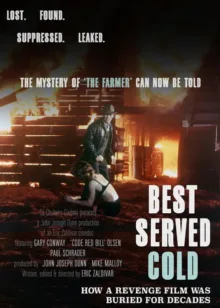
Best Served Cold (2026)
- Special Guests
- Eric Zaldivar, Mike Malloy, John Joseph Dunn, John Schuster, John Santo
Show notes
Labels: Special Report
Transcript
An automatic transcript from Spreaker. It has not been proofread, so names, titles and spellings may be wrong, and it does not say who is speaking.
Show the transcript (about 18,400 words)
Hold your ears, folks. It's showtime. People pay good money to see this movie. When they go out to a theater, they want cold sodas, hot popcorn, and no monsters in the projection booth. Everyone pretend podcasting isn't boring.
Turn it off. Turn it off! So so. I said, The Pharma, what is this movie about? I'd never heard of this one at all.
This wasn't a movie anyone had seen since its theatrical release. How come The Pharma hasn't been released yet? They've released everything else. We want The Pharma. Give us The Pharma.
I was so obsessed with seeing The Pharma that I had actually saved up $ 2, 500. And I offered that as a bounty. Spread the word out on the collector's market. And I said, I'll give $ 2, 500 to anybody who can provide me with a copy of The Pharma in any format. So that's how The Farmer became, in my mind, this sort of holy grail of lost 70s action films.
The story of The Farmer, it doesn't stop. There was nobody there watching safety. They set off this piston, and it literally yanked you off your feet. I remember it quite well. Because it hurt.
He said, oh, we've got this great guy who's going to be the assassin. I said, terrific. I said, wonderful. And he said, yeah, you know, he killed someone. What?
In the 1970s, there was a lot of that returning veteran movie. Returning veteran. The veterans returning home getting into trouble films. Vetsploitation movie. Welcome home, soldier boys.
First blood. Taxi driver. Rolling thunder. They were like surrogate war films for the decade of the 1970s. These exploitation movies were some of the first to address Vietnam.
I realized they didn't make war films in the 1970s. They made these films instead. Thank you. Hey folks, welcome to a very special episode of The Projection Booth. I'm your host, Mike White.
Today, I am talking with director Eric Zaldivar, producer John Joseph Dunn, and producer Mike Malloy about their documentary Best Serve Cold. It digs into the decades-long suppression of the 1977 film The Farmer and the real people who lived through that. I also have a little bit of a bonus. I recorded some stuff about The Farmer years ago. I'm going to include that here as well.
That'll be after this initial interview. Definitely check out Best Served Cold. It is one of those great docs about a lost or missing or suppressed film or kind of a little bit of all three when it comes to this one. Thanks so much for listening. Enjoy.
Mike Malloy, producer here. I wanted to first, Mike White, were you aware that you are in this documentary, even if only in a minor way, via a Facebook screenshot? Oh, am I? Okay. Yeah, I don't know.
You might, this is kind of last minute, but you might need to recuse yourself as host. I got Joe Dante on the other line to fill in for you. Wait, no, he's in the dark, too. But yeah, going back to my original question, how do you guys know each other? He contacted me.
He once gave me tremendous offer. He said, hey, Mike, big fan of Eurocrime. If you ever come up with a doc idea that you could do really kind of low dough, let me know. And I didn't. Then when Eric caught the farmer bug in late 2021, we ended up having a three-way call.
Yeah, I actually looked up those old, because we went back and forth on Messenger and text, and that was from when we kind of were talking about the collaborating one day, it was October 11th of 2021. And then November 8th is when the whole YouTube thing with the farmer happened. And then finally in April 28th of 2022, it's when you're like, hey, remember when we were talking about collaborating? I think I might have something you might be interested in. But prior to April, Mike and I were already getting interviews.
We got interviews with Johnny Popwell was our first one in November. No, December, right? December 2nd. And I had also gotten Gary Conway, the farmer himself, in January of the next year. So I was already piecing together what this was going to be, which was, to my mind, was just going to be a short on YouTube, maybe 40 minutes at most.
And then when John came aboard, he said, well, I'd be willing to put money on this. I'd be willing to invest now, I suppose. That's a good attitude. The interesting thing is that Eric and I have been collaborating on each other's projects since 2008. So it was just a total given that if Eric is going to come up with a documentary idea that I'm going to help on it.
And Eric kind of launched into the farmer idea, digging into its production history without knowing too much at first, as you typically do on a documentary. And turns out that the farmer was produced in the very county that his frequent collaborator Mike Malloy happened to live in. Well, Eric, when did you first hear about the farmer and how did you hear about the farmer? Do you remember? Vaguely.
I think I came across the farmer a little bit after everybody else did in the late 2000s, maybe 08, 09, because I got wind. It might have coincided with me meeting Mike and knowing Mike. He might have brought it up to me. And I was intrigued because like everybody else, it was impossible to see. But I did know that Code Red had announced a DVD sometime in the future.
But we were at that point three to four years in post-announcement. And I'm like, well, what's going on? So it just enticed me even more. And I wasn't super obsessed at the time, but one of those things where every few years I'll remember, oh yeah, what's going on? I wonder if they put it out.
And of course you go back to the boards and you'd find out that they put it out since. And, uh, you know, those, those few years began to, uh, to, to grow in number and, uh, a decade went by, 16 years went by and, uh, yeah. So it was, uh, it was intriguing in little increments, uh, throughout this timeline. Like, oh yeah, every few years I'm like, oh, what's going on with that? Oh, still nothing.
Okay. But then when it was released in, um, on YouTube illegally in 2021, that was obviously full farmer fever for me. And John, how about yourself? When did you hear about the farmer? Probably maybe 10 years before that i mean and youtube and i think it was that trailer that intrigued me because i'm like oh my god this looks like definitely a cult classic for sure it was just such a the narration and looked like reminded me of like a rolling thunder type movie just the idea that you couldn't see this movie anywhere was also intriguing and i think like mike and Eric, I would check in because I knew that Code Red apparently had the rights to this.
I'm like, OK, when is when's Banana Man going to release this? What's going on? And yeah, I kept checking in. And finally, yeah, the same thing that happened with that day when it was announced that it was on YouTube. Of course, I'd missed it.
I was at work. I was like, oh, my God, it's been taken down. You know, does anyone have a link? Lucky enough. Yeah, I was able to get a link for it and watch it that night.
I'm like, even though it wasn't a very good version of that, you can see like, wow, this movie does deliver. But yeah, it was definitely on my to-see list for quite a while. And Mike Malloy, I mean, you've forgotten more about movies than I will ever learn. When did you first come across The Farmer? In 2003, I was living in North Hollywood next to one of the greatest video stores in the country, maybe the world, Eddie Brandt's Saturday Matinee.
They had. on tape, they were still renting tape in the aughts because, you know, they had such an amazing collection. You can't throw all those tapes away. They had every movie ever made, whether they could legally rent it to you or just illegal or just loan it to you in an extra legal way. And they had everything I ever looked for or any of my friends looked for, except for the farmer. And so at that moment, I was like, wow, this really does hold the distinction of the law system of the law.
The Holy Grail. Yeah. And, you know, we're talking about how documentaries, you discover things while you are making them. You know, I don't imagine that you had the concrete plan of what's going to happen with this when you set out with this, Eric. But I'm curious, what did you think this was going to be other than a 40-minute short documentary?
And how did it change after John, you know, brings that offer to you? Hopefully this answers your question. Yeah, it was a 40, as a 40 minute short, it was just going to be a series of interviews and whatever I could get out of that. I could get, I just thought of it as just like, cause this is YouTube. It's not as important.
And now things have kind of changed a little bit. It was just going to be a series of anecdotes if I could get them and so forth. But then once it became a feature, I had to start finding narrative, you know? Not make them up. You know, there were plenty to, as you saw, there were plenty to be had.
We didn't know about Johnny Popwell's running with the law. We had no clue until we started doing research. So, obviously, that was going to be a highlight. The George Memoli thing, it had been known that he was in an accident on the film. We didn't know what the details were.
Had to find out about that and how it affected his career for the fact. It was interesting. And once it became a feature also, it was going to definitely be, and that's the back half of the film, which is just covering all of the Bill Olson antics and shenanigans Code Red's owner. It's amazing how you have so many narrative threads going on in there. And even just like the stories that you're dealing with.
I love the whole thing of Michael Dante almost getting water. And that was a great delight. And More than that, you've got such big personalities. I've had the pleasure of speaking with Michael Dante. I know he's very, he's got a lot.
He's a lot to deal with and in a good way. I really like him, but I'm curious, like, how is it trying to balance all of these personalities? And I'm not even talking about the banana man stuff. Oh, the more the merrier. The kookier these people are or the more flamboyant they are, the better, I think.
It makes for an interesting and compelling doc. Ironically enough, I mean, I shouldn't say this, but Probably the guy who's the most subdued in the doc is kind of the wrong person you want to be subdued, which is Gary. But I think I originally had 16 to 20 minutes of Gary's background as an actor. We talked heavily about law. We talked heavily about Land of the Giants.
We talked about projects that never came to fruition before Farmer, like his ninja script. which there's a little hint of ninja in the farmer because at the end he's in the shadows and he's taking people out. And I brought that up to him because he was fascinated by ninjutsu before anybody in the West was. And I said, are you aware that historically ninjas were farmers? And apparently he did not know that despite his knowledge. Yeah, unfortunately that all had to be stripped back to what it is now because as fascinating as that stuff is to me and maybe to the people present, present company most audience members are not going to put up with old creaky television shows it's unfortunate no matter how well written they are.
Well you should say that you had three separate like day-long shoots with gary didn't you so i think that probably informed your how much you wow this really is story but uh that's probably because you shot him more than anybody else. But i well i came out of where was gary's story regardless because it is you know this is about a guy who who wanted to make who was a tv actor Was tired of doing that and wanted to be a movie star. And it didn't really pass out, Mom. Gary finally did get his ninja movie made, though. It just happened to be American Ninja 3.
Yes. Yeah. Yeah, 3. I think 2 he wrote, right? He's in 2.
He played the villain in that, the lion. You would know better about that than I would. I haven't really dived into those. The second project after the former was meant to be what ended up being over the top. But it was called American Dreamer.
They were going to shoot in 79. They couldn't, with the same. producer of The Farmer, the dentist in Atlanta, Peter B. Mills. And they couldn't find funding. And eventually he got tangled up with Manahem Golem.
And once Golem said he wanted to... Is it Golem or Golem? Golem. Okay. Golem wanted to direct.
Yeah, Golem. I didn't realize that. Yeah. Yeah. Let's not make him into a Jewish folkloric creature.
Yes, there you are. Well, he. He wanted to direct, and then Gary didn't want him to direct for whatever reason. I have this on an interview that we'll probably have if this ever goes to physical media. And so he removed himself from the project, stayed as a screenwriter, and eventually, you know, Over the Top became what it was.
He still holds a screenwriting credit, I think. I think it's story by. Yes, story by. But also, those stories that we have with Gary Conway talking about his television career. It's wonderful stuff, and I do hope that eventually it does make for special features and deleted scenes on the Blu-ray, because I think it's wonderful, and I think people who enjoy the doc, they're definitely going to have a lot of interesting deleted scenes to watch.
Well, it really is a testament to physical media when it comes to all of the people that are clamoring for the farmer, and I imagine those same people are going to be clamoring for best served gold as well. I love that there are these. You know, there's the Who is this Gary Conway mystery? But then you've also got the whatever happened to this film mystery and the will this ever come out mystery. You've got all of these things that you're able to balance so much, so many spinning plates.
And I'm curious, like when it comes to shaping that story, like does that happen in the edit or are you just kind of figuring out all this while you're going along and saying we need to make sure that we capture all of these beats? It's a mix of both. I'm discovering the story as I go along. And, but then there's, there's certain project, there's certain things that I know I wanted to say. And so I'm trying to piece that together as I go along, making sure it fits where it should.
And so that it flows well, uh, cause you certainly don't want a hard right turn or a hard left turn. It'll seem jarring, but yeah, it's a mix of both. Really. I can't give you full details because I spent, you know, two, almost two years editing this and I've, I've mentally blocked all of it from my mind because a lot of it was very stressful. The one subplot that hasn't gotten mentioned yet, and it's easy to overlook because he is no longer with us and couldn't be interviewed, but that's George Fargo, who originally conceived the farmer story.
Unfortunately, this is part of the tragedy of his life. He lived in the shadow of his friend Clint Eastwood his whole career, and he even destroyed his relationship with Clint over the farmer. I think Eric, and I haven't asked John, but I think Eric and I think that that's probably the most poignant part of the whole farmer story. Mike, do you remember that part? Did that jump out to you?
Absolutely did, yeah. Yeah, it was funny because it felt like the movie was kind of circling Eastwood, a lot of it, because of that thread. And yeah, that was a fascinating kind of, I don't want to say sideline, but it was just like this... thread that is going through the entire film and you're just like, well, how is this going to play out? Because even as a fan of The Farmer and the story of The Farmer, I don't remember all of these twists and turns. So it was like coming to it as a very fresh eyes.
You should mention that you have preponderance of 80 and 90 year olds in this doc. That's the race against time right there. To your point about a race against death, I told John this a few months ago and we'll see what happens, but I told John, I was just like, can we get away from all these oldsters and these old... I mean, I love talking about this stuff. This is what I was made for, I think.
At the same time, it's just like, I don't want to feel the anxiety I've felt the past four years of my life where I'm constantly racing against the Grim Reaper. Trust me, Eric, I know all of that because I'm finishing up the Randy Jurgensen story. So it's like. That's the problem with... Well, first of all, film, you can't find money for narratives, okay?
So that avenue of dealing with younger people is close to you. So you can only find money for these documentaries. Everybody's doing a doc now. But if you're going to do a documentary, and a Cine doc particularly, you're going to deal with a bunch of 80s and septuagenarians and 90-year-olds. And these people are going to be shuffling off pretty soon.
Well, guys like us, the 70s is where it's at. And that is becoming less and less viable as a subject every year. And the interest drops all the time. Well, yeah, I meant more, you know, vis-a-vis racing the Grim Reaper, yeah. Well, yeah, I mean, having William Greffian there, Paul Schrader, these are unknown quantities.
I mean, these are, it was so nice to see some of these faces and just hear their perspective on all this stuff, especially, I mean, I'm a big love him or hate him, but I love Schrader, and I just love that you were able to get him for this. Paul Schrader that was a difficult interview to get though because we were dealing with an agent who was kind of giving us a run around for quite a while it was finally that we were just lucky enough to get Schrader's email that we just directly went to him and that's how we were able to get that interview But we, it was quite, I mean, it was a long time before we got that one, but we didn't, we just thought that was great. He had so much to say about George and basically Momoli.
But yeah, it was probably, how long do you think that was? Six months, guys, that we were trying to get? It was over a year. It was a year and a half. It was a long time, though.
It was kind of like, it was frustrating. Sorry. Sorry, I talked over John. Yeah, it was a year and two months. Wow.
But his agent just giving us a run around. He's like, try again. Try again. Yeah, he'd never say no. He'd say, try again in two months.
Could you try next month? Yeah, and then all of a sudden we got the response then when we got to him, actually. But getting interviews, the one thing working in our favor, as I mentioned, is the geography. Eric was based in L.A. He was able to pick up L.A. area stuff.
I'm based in Cobb County, Georgia, USA, which is where the farmer was shot in the cities of Smyrna and Austell. And so I was able to pick up some local Georgia interviewees, interviews. And I'm in Chicago. So, I mean, it seems like everything I work on, basically, you've got one person there. I never, I mean, like for Real Cop, it's the Randy Jurgensen doc.
We have people in New York, Los Angeles. So it's like, it just seems like I'm becoming a veteran of these type of productions. But you were able to catch Fred Williamson in his brief little Chicago window. Yeah, I interviewed him in Chicago, and that was quite fascinating. Beautiful home.
Yeah, I was lucky. I'm actually surprised I was able to get as many interviews in Chicago as I had. I interviewed, you know, the Tom Savini interview and Fred. So, yeah, I mean. Not necessarily for this project, but yeah.
Although they're involved in this a little bit, though, because I did ask them some questions that might make it into this longer version. Ooh, the longer version. The uncut best served gold. Well, just a segment about returning veterans, which. That came about during just our conversations, like, wait, this is such an interesting subgenre, the returning veteran subgenre, and that we kind of investigated that, and we have interviews just with people that were involved in movies like that in the 70s.
So, I mean, I think that's going to be... That's one of my favorite parts of it, actually. Eric is kind of piecing that together right now, but I think, yeah, hopefully a longer version. Directors could hopefully... or at least deleted scenes. I think we got some wonderful stuff where people were involved in those movies.
Yeah, to explain to the listener, we were going to devote a proper 20 minutes to the subgenre of returning veteran movies, which were very popular in the 70s. I kind of think they were a surrogate for war films themselves, because when you think about it, there weren't that many war films. Vietnam was just leaving a bad taste in everyone's mouth, and there weren't that many war films between Bure and Apocalypse Now. And what was a stand-in for war films were these returning veteran movies. And so Eric shot a lot of interviews with the stars and filmmakers of those, and people like Ryder, the creator of the Rambo character, David, some very cool stuff, and, you know, of course, the two writers of Rolling Thunder, Paul Schrader and Heywood Gould.
And so that was going to be a whole 20-minute segment, but then Eric made the correct strategic decision to forego that segment for the festival run and make it strictly about the farmer. But we hope that the version that's on the returning veterans segment started. I think for me, one of the most fascinating interviews of the whole thing is, and I'm trying to remember the lady's name, is it Janice Eamon, the actress from The Farmer? Janice Eamon, yeah. Eamon, yeah.
She was amazing. And I just loved her stories. And just to get her perspective, because otherwise it's like, just kind of a sausage fest through so much of it. And to get her take on things just really felt like a very fresh perspective. All right.
You're, you're thinking of Angel Tompkins. Oh, okay. I was about to say, yeah, it's Eamon. Yeah. Well, another, yeah, female, but yes, yes.
Angel. Yeah. Yeah. Janice Ian or Eamon was a, one of the screenwriters. Oh, okay.
My bad. Yeah. Angel Tompkins then, especially when she was talking about her rape scene, that was kind of harrowing to hear. Well, I like that Angel was there to juxtapose another interviewee. I was like, whoa, it seems like the film really revels in this scene.
And she was there to counter that, to countersignal that with saying, no, I wanted it that way. I wanted it to show that this is a horrific act, obviously. I can't remember, and I think I've purposefully blocked out this gentleman's name, but the associate of the Banana Man David DeFalco. Yeah. Wow.
Talk about big personalities. How was it shooting David DeFalco? Well, that was by... I was going to say Skype. Whoops.
That was by. David DeFalco. David the Demon DeFalco, by the way. He's a very enigmatic figure in a way. He's very tough to pin down.
He didn't want anything to do with this at first. And then one day he just gave me, I'll talk about a hard interview to get. He gave me the runaround for months. And we lived not two miles away from each other during this entire time. David, you'd find him in three places in LA.
You'd find him in his condo. You'd find him driving around in his presumably leased Lamborghini, driving around Hollywood Boulevard and Sunset Boulevard. And a third place might be where he does his commentaries. He does his commentaries for his label somewhere in the valley. Very difficult guy to pin down.
Didn't want anything to do with it. And then one day I said, okay, let me, my big Hail Mary pass. This is like, you just kind of bully him into. It a little bit. He'll love to hear that.
Maybe he hears this ever. I was just like, no, no, no. How about right now on the phone? Right now. Come on.
Let's just do it on the phone. I could just do an audio interview. It's fine. He's like, then that changed. Changed his attitude.
Well, okay. How about like an hour from now we get on a Zoom? And I'm like, yes, that's fine. You know, I had all these grandiose ideas about everybody needs to be on camera, but that's just not possible at this level. That impression is spot on, too.
But does that answer your question? I mean, there's a whole lot of other things to say about David DeFalco, but I don't know if we should. Yeah, you might need to talk to your lawyers first. And I imagine that to deal with. the legalities of the film and that so much of this hinged on an illegal upload. I mean, you had to be very careful, I imagine, when it came to talking about...
Oh, for me? I think we had a little internet dropout for a second. Oh, no problem. I was just saying that I imagine that you had to be very careful when it came to discussing matters that might not have been 100% legal and just kind of dealing again with these nefarious figures. Strangely, no.
I think the doc laid bare the entire story of how the Code Red's hand was forced through an illegal upload, and that person participated in the doc. Illegal, quote-unquote, is a gray market upload. I think the Bernie Convention of 1978 specifies that if something is not commercially available, and it's in the interest of everybody's research and cultural knowledge, uh yeah betterment to to see something. And i'm so curious as far as the movie itself the documentary itself when is the first time you actually get to see this with an audience and where is that. Just recently in fort lauderdale we had a premiere at popcorn's rights and it was seeing it uh seeing him with an audience We know it plays.
We plays very well with an audience. The laughing was on all right places. People were not on their phones. So, I mean, that to me, I couldn't have been prouder of the fact that, wow, people are really into this and that we have a winner. I think that's what we're talking about.
Like, yes, the audience is there for this and that we did it, that people were enjoying it and they were laughing. And yeah, and we, and that's on such a high, the second half. I mean, I can't tell you how much laughter you get with DeFalco and Banana Man. Basically, it becomes a comedy. It definitely does.
Yeah, I'm of two minds of it, because on the one hand, it's great for the audience to end on such a, like a, just a 20-minute solid high of laugh. It's wonderful to come out of a screening that way. But on the other hand, we've kind of monitored the letterbox, and that's the 20 minutes that gets mentioned in all the reviews. And I hate to think about the making of The Farmer, which is plenty colorful. I'd hate to think of that, you know, kind of get lost in the shuffle.
I'm For me, personally, I don't think it does. I mean, I think about things like, you know, the Angel Tompkins interview, like I was saying, the talk of Michael Dante. A lot of the stuff around stunts, that sequence that you show a few times of the guy getting yanked and just like, especially when he gets shot and slides across the street. I mean, these are really great graphic images. And to even think about all of those newspaper ads that you have and kind of tracing, like, where is this playing?
And getting the 47 cent royalty check from Portugal. These are great stories. And just like, what the hell happened? Like I said, there are so many mysteries to this and this whole, like, why do we not know this movie? Why did this get deployed? all of these different places, but yet nobody's talking about this to this day?
I think that's such a, for me, that's the first mystery of the film. And really, that's the one that is the most near and dear to my heart. And then comes the, and what the hell's going on with this Code Red release? Because you could say that about so many things. They've, they, That was their stock and trade, was announcing things and never following through on them.
Yeah, there are plenty of lost films, but there are fewer suppressed films. And this was a suppressed film. A suppressed film where the buying public was taunted with it. Well, I'm going to punish you because you didn't buy this. I'm not going to give you the farmer now.
It's kind of like, you know, so that's, I mean, I remember when we did a Q & A when we compared Banana Man to a Bond villain. And I'm like, I definitely kind of see it. It's like, I'm going to show you. You're not going to get the pharma now. In turn, the audience, the audience, the would-be consumers, they also turned the film into a weapon against Bill, taunting him with it.
What, you mean after the U2? All throughout, like they were trying, like all throughout the 16 years that he had in his possession, they would just bring it up in streams because they knew he was going to go ballistic. Well, I'm curious, John, you mentioned a few things. Well, I think all three of you have mentioned a few different projects that are kind of coming out of this one, the physical media release, hopefully, of Best Served Cold. And then the, is it Real Cops and the other release that you guys are working on or you're working on, John?
Real Cop, spelled R-E-E-L, and it chronicles the life of Randy Jurgensen. basically from growing up during the Depression in the 30s to serving in the Korean War to becoming one of the most legendary New York detectives to movie consultant and actor, producer, writer. He's kind of done it all. I mean, it's basically meeting Randy Jurgensen, I realized, wow, this is really one of the most unique people I've ever met. And his story is just like, just working on it has basically been one of the great benefits of my life. Just like, wow, this is really, After Best Served Cold, it's kind of like, yeah, it's just like, I don't know how I've almost, I've been lucky.
I think that I've kind of like fallen into this. I mean, because basically Edwin Samuelson, the director of Real Cop, he was doing interviews for Best Served Cold in New York. He's the one who conducted the interview with Paul Schrader. So it's through talking with Eddie that basically started talking about his dream project, the Randy Jurgensen story. And that just captured my imagination.
Once again, Randy is a guy in his 90s. Yeah, he's going to be 93. Keeping the team together, though, because, I mean, Mike Malloy, he's been interviewed for Real Cop. Eric shot an interview with Randy's grandson, who's a cop in Florida. So it's just like, you know, I just like keeping the team together also because we all work really well together.
But yeah, that's that project and Besser Cold. I mean, I'm very proud of what I've had the privilege to work on. Well, tell me a little bit more about your label. Oh, it's Kukulin Cinema? Yeah, I mean, for the last three, four years, I mean, trust me, I never thought I was going to be involved in documentaries as much, but I've worked on five documentaries.
And it's always basically, it started with Best Circle, but that bled over into another one, then another one. Then when I was working at Real Cop, I got involved with Steve Mitchell, and his upcoming documentary about Wings Hauser. And my friendship with Mike Malloy, I'm helping him with Bronsploitation. So, I mean, it's like, you know, one project after another. And that's when I started thinking, it's like, wow, I really do need a production company at this point.
I have a couple partners. Well, we have a feature film that we're currently raising funds for, but we're almost finished. We're shooting that in April. It's called Kayla's Going Away Party. We've already signed Bill Moseley.
So that by far the biggest thing I've ever worked on. But it really does start with a best served cold. Basically, it's like I've already reaped the benefits from all the people I've met and oppressed enough people that people have invited me onto their projects to help and just learning so much. Yeah, it's been a wild ride. I've never thought I was going to be a producer on documentaries.
I always thought, I think most people love movies. Oh, I'm going to be a writer director. I'm going to be an auteur. But I'm like, I turned out that I'm pretty good at this producing thing. Yeah, John Dunn is a dream producer because not only is he enthusiastic and has a vision for what is needed, but he legitimately loves the same type of movies that I love.
You know, how often do you find that in your career? Well, tell me more about this Bronsploitation project you're working on. Oh boy, Bronsploitation. It's kind of been backburnered this year because both my parents and my in-laws have been going through health and other issues. Difficulties.
Yeah, I realize that there are three guys. You know how they say that good stories come in threes or fives? Those are the nice even numbers for storytelling. Well, I realize there are three guys that each had a show business career in three very disparate parts of the world. Three guys who had show business careers, all because they looked like Charles Bronson.
One Korean, one Chilean, and one Hungarian. As John was talking about it, connections being made and one project leading to another. Well, when I asked Eric Zaldivar to go shoot, so first of all, the Hungarian Charles Bronson is named Robert Bronzy, and when I asked Eric to go shoot an interview with Bronzy's Los Angeles-based manager slash producer, Eric did that, and he made a love connection, and next thing I know, Eric is writing the screenplay for a bronzy Western based on a old story idea of his and mine. So yeah, it's, you know, the confluence of events and personalities and connections and project. It's interesting.
That's fantastic. And Eric, tell me more what you're working on these days and congratulations on the screenplay. Yeah. When Mike was telling that story, I'm like, wow, I don't, I don't like where this story is going. But yeah, yeah.
Thank you. Yeah. The film came out, came and went and, It exists. It's there. You can see it if you want.
I won't tell you the title. It has some good things in it. I know you should be very proud of it, Eric. There's stuff in it that's good, yes, but hampered by a lot of problems. And maybe some blame to go my way as well.
Maybe. But the other stuff, I'm currently working, as John said, I can't say Vetsploitation. That's not really what it is. The Returning Veteran Segment for best served cold how revenge film was buried for decades yes so that's what i'm currently working on now but of course there's all sorts of things i want to be working on uh in the future and there's certain things that i might find myself somewhat reluctantly but not really because it interests me and for in the nearer future too i can't really. Talk ironically the call right before this i was talking with jeremy kagan about the film heroes which is another returning vet And I'm sure you're familiar with Captain Milkshake.
That's kind of one of my favorite returning vet stories. Yeah, Captain Milkshake will probably get a mention just because the returning vet movie in the 70s, there was dozens of these movies, and they spanned the gamut of different genres. Yes, most of them were revenge pictures and whatever, but there were also horror pictures. There was a 3D picture, if that could be a genre in itself, in the case of Captain Milkshake. Adult movies, dramas.
Coming Home being the big drama. And what's the Bob Clark movie with the son coming home who's basically a zombie? Death Dream. That's the one that I was thinking that was horror. There's a few other horror pictures.
My Friends Need Killing. But that one more specifically is horror. Yeah, Death Dream. And it also goes by Dead of Night, which makes things very confusing because Bob Clark already made a Dead of Night. You tell me.
I lost my train of thought. Yeah, it's what I'm working on. You mentioned Captain Milkshake. There was some other picture I wanted to mention, and I lost it now. But yeah, very diverse group of films, the returning veterans of the 1970s.
Yeah. Well, we all know that. Oh, God. Oh, heroes. Sorry.
Yeah, I just remembered. We tried contacting Henry Winkler. Didn't pan out. Yeah, it's so strange. Henry Winkler does all kinds of conventions and stuff, and yet he was somebody that, for whatever reason, we Couldn't pitch?
John, you have a Facebook for your production company, don't you? That's a good place to keep track of all the stuff you're working on. Yeah, it's on Facebook, Kukalan Cinema, and I've been posting a decent amount on that. Hopefully it's going to start getting more of a following. I think it will now that these movies are being released.
You might need to spell that for the listening audience. Well, hopefully, Mr. Y, you'll leave a link. I have a website which does have all the information on all the films that I've worked on for the company. So definitely click that old link down there.
It'll answer all your questions. Wait, John, you're saying you can't spell Kukulin? I can't spell it. There's an accent above the U. C-H-U-L-A-I-N-N.
Kukulin. A lot of people call it Kukulin, and I'm like, no, I'm going to go by the Sick, bad. Of Kukullen. That's a Pogues song, so I'm going to go by with Shane McGowan's pronunciation of it. It's Gaelic.
Yeah, that was my question. Yes. It's an Irish mythological character, and I always liked the idea that basically I'm a warrior for real cinema, for the integrity of cinema, and that's what I want to do. So that was just my crazy little thought about it. Basically, like, hey, you know what?
We need someone who really loves movies to fight for the integrity of it. Because I'm a film lover before I'm a businessman. I got to learn the business part, though. So that part, I'm getting better. We were lucky to catch John Donne, the film lover, before I became Ruthless Businessman.
Now I'm the tycoon. No, yeah. As per Malloy's point a little earlier, that John has been so... What a dream to work with because he kind of leaves you alone, which is great. Although I would be perfectly fine with a few of his.
Anyways, I would love feedback. Yeah, yeah, occasionally. I mean, he does provide, but maybe not as much as he should, perhaps. But I got to say, it's great to have a guy who not only... It's the most important part because it's so difficult to find somebody like that.
Mike and I are. Interested in a specific set of film, very interested, and it's difficult to find people that you share common ground with. John is one of those people. He's the only one I've been able to find. Well, the crazy thing is, despite working on this for years, it wasn't until Fort Lauderdale that the three of us all actually hung out together in person.
So that was just a treat unto itself that basically like, man, I've spoken with you guys on the phone, had Zooms with you, countless times worked on this movie. And I can't believe this is the first time we've all been in the same room together. Guys, I've got to ring off. I've got another one happening. But before I do that, Mr.
Malloy, you didn't say where people can follow you online. I'm going to let it play. I'm going to let it ride. I don't need any more time online. The American Dreamer.
Five easy pieces. Easy writer. Taxi driver. Important and deeply personal films. Each in its own way has become a classic.
Each told the story of people looking for their own piece of the American Dream. The Farmer is a motion picture in this special tradition. It's a story of a man who takes a stand. A man who says no and means it. A man like Kyle Martin.
All he wanted from life was his farm and a chance to make something of it. Maybe he wanted too much. A one-man farm can't make money. I just need more time. You are a loser.
When they took away his land, the farmer didn't get mad. He got even. When they tried to burn him out. The farmer didn't get mad. He got even.
But when they killed his best friend and attacked the woman he loved, the farmer became the avenger. Columbia Pictures presents Gary Conway as the farmer. An uncompromising explosion of total vengeance. The farmer. He never gets mad.
He gets even. The American dreamer. Sometimes a thinker. Sometimes a stealer. Sometimes a child.
The farmer. Sometimes a wise man. And always so. All right. So before we wrap up, there is a bonus I promised.
This comes from quite a few years ago. I don't even remember exactly when I recorded this. I sat down with two guys who spent years trying to track down the farmer. So this is John Schuster and John Santo, the Johns, not from They Might Be Giants. These are from The Farmer.
They chased it through video collectors, film archives, Columbia's lawyers, and through a whole bunch of rights mess that runs all the way to Sylvester Stallone's Over the Top. So in the interest of being completist, here is the interview with John and John, all about their search for the farmer. Okay, John Schuster and John Santo, you guys are involved in this farmer release that's coming up, from what I understand, and I want to know more about you first before we even start talking about the farmer. So, John, tell me a little bit about yourself. Me, John, right?
He's Shu. Sorry, before we continue, just let me say, do we have something to do with this farmer release that's coming out? Not entirely. And that's an interesting way to engage in terminology, I suppose. I think the thing with us is our hunt to try to track it down.
So as a result, we know a crap load in the background, but this specific release probably isn't something that we have any direct involvement with. Yeah, we are as surprised that it's actually getting a release as anybody else. Well, it feels, the way the timing is, it just feels a little like some hands were forced. And I would like to think that you guys might have helped when it comes to that. If that's the case, fantastic, but doubtful.
I think it is a massive coincidence because there are honestly a lot of things that came into play. Uh, and there are actually, as far as I'm concerned, a lot of things still in play that I'm fascinated to see what your holds for it, but we'll see. Cool. But I think there were some limbs that maybe were shaped. I like that.
Well, how did you guys even hear about this movie and get interested in it? Aha. This is where I got smart shoe. I contacted Gabe. Oh, shoe.
And I have a, uh, our mutual friends back from college. We had a, uh, we have another friend who, uh, roomed with when I moved to Los Angeles. One night, he brought home a movie because he's a massive horror hound. Props to him for that. The American title is called Hell's Ground.
Sorry, what is this? It's from Pakistan. It's a Pakistani film. It's a Pakistani title, something like Zibakana or Zibakana. Anyways, and on it was a trailer for The Farmer.
The trailer is kind of in a strange way. a masterpiece in its own right. I mean, versus the film, it really is just like a, you watch it and you're like, Oh God, what is this? Another rolling thunder? What is really that's the, that's as far as the kind of revenge, not indie, but the seventies revenge film kind of thing goes rolling thunder has this real tactile thing to it that just nothing else touched. So you hoped that the farmer was going to be something like that.
Of course you're instantly, I'm instantly online looking for it. It's not available, trying to find it, start checking out. Other sites that you shouldn't be looking at to check out, to find movies, not there. You know, it was just nowhere. And that's, so that's, and then that's when I got in touch with Shu and I said, hey, I've got a plan or an idea.
Oh, yes. Yes. Okay. Oh, and by the way, as we backtrack a little bit, for folks out there, it's available, the trailer is available online. It's two minutes and it's honestly great.
And it's understandable, if you've seen that trailer, why a couple movie geeks and quasi-movie geeks might be fascinated with the reason as to what the hell is this movie, where the hell is this movie, why can't this movie be anywhere? This movie looks pretty damn cool. And as a result, Mr. Santo reached out to me and said, okay, why don't we go about maybe trying to look into... seeing where this is, what it is, and whether it's disappeared into perpetuity or not. So I made the, I don't want to call it a mistake, reached out to the star of the film, who was also the producer of the film.
That gentleman's name is Gary Conway. Gary Conway is a really approachable guy. And he emailed me back in a couple hours. People, he has mentioned on a number of occasions that when he has gone to done the convention circuit and that sort of thing. People have regularly come up to him and said, I remember watching The Farmer when I was a kid.
I really loved that film. I wish you could figure out a way to release it. This starts a long, circuitous journey that kind of allowed John and I to do a lot of research and find out a lot of behind-the-scenes information in regards to this movie. For those folks who are unfamiliar with Gary Conway, Gary Conway could have been William Shatner. Conway was in an Irwin Allen show that was not Lost in Space, but aired immediately after Lost in Space.
He was the star in something called Land of the Giants. Land of the Giants ran two years. Folks who watch TV on that little block probably remember it perfectly well. Conway was the captain on another network, you have Star Trek, which completely disappears. You have Shatner and Nimoy, who go off into sort of 70s oblivion and then get themselves reinvented about 10 years later, and they become huge stars.
You have in the Lost in Space franchise, although none of the stars in that really made it particularly... immense, you know, there was name value in that. Land of the Giants kind of disappeared. And Conway moved off into a variety of other projects, largely getting out of Hollywood, not entirely, but to a significant degree. He and his wife, a former Miss America, opened a winery in Paso Robles, a winery that they own to this day. So Conway has spent most of his time in the wine business, not the industry, the Hollywood industry business, but has, you know, along the way, dabbled here and there if projects have come up.
And that is part of a very interesting story. And it's a very interesting story. There's a lot of tentacles going on with the farmer that fascinated John and I along the way. When was this? When did you guys first stumble across this trailer and then start this hunt?
2007, 2008. Oh, okay. You saw the trailer in 2007 and 2008, but then reached out to me probably four or five years. No, no, no. It wasn't that.
It wasn't that. Trust me, dude. We've been looking at this a lot longer than that. I know it feels that way, but we've actually been like, the way it started, because the way it started was I had done kind of my initial thing on, okay, I can't find this. Then you're right.
It was probably about six months later. I thought of the trailer again. Back in college, we are Gen Xers of a time when, you know, all you could find was videotapes of things that you wanted to seek out. And it would be a challenge to find things, you know, if you want it, you know, I'm sure they no longer exist, but, uh, Oh God, what was it called? Video something.
Yeah. I remember Goldmine Magazine, and Mike, you might remember them as well. I was. So psychotically nutso about this at some point. I have a circular collecting mentality.
I get in and out of different kind of collecting type things, and the junk in my apartment is indicative of just how that is. But one of the I even reached out to a guy out of Boulder, Colorado, who had VHS tapes of of Hong Kong Jackie Chan film. So bought from him everything he could possibly find. He dubbed those movies himself. I didn't dub them.
He subtitled those movies himself. That was almost 30 years ago. So that's the type of nut jobbery that John and I have, yeah, that you had to go through back then. And we're still kind of accustomed to doing it. Although obviously, as technology has improved, a lot of those avenues have opened up as well.
And Mike, as a result of that, One of the things that was fascinating is that the farmer, with all of these other lost movies that have been recalibrated and redone and kind of found the light of day along the way, it was just equally fascinating that here's this movie with this cool trailer that has absolutely seemingly disappeared off the face of the earth. Obviously, no VHS release, obviously no DVD release, because as you're aware, a lot of the movies from back then didn't anticipate that coming. So there wasn't any reason to plan for that in your model, but then became this convoluted series of weird things that took place that led to it being shelved for decades. What is that story? You talked about how Conway, people would come up to him and say, oh, I remember this.
Were they watching it on TV? How were they seeing the film? Yes. Some people saw it in Germany. Amongst a lot of the message boards, there were several messages about people seeing it on air bases in Germany.
There was a movie theater in New York. So originally, we wanted to see a print. That was our original goal. In modern day, you can find anything. We're like, screw it.
Let's find a 35-millimeter print of this film to watch. So that became the challenge. Um, so, uh, as we were looking around, we found a theater that used to be in New York that had a print that they like was sitting in their closet and they would, uh, show it on a double bill with that, with whatever they had that just. So there were weird screenings like that. Um, what we were able to track down, I believe were five or six prints in existence.
And we know where most of those are. Theoretically, all of a sudden this new, the fact that the new DVD or Blu-ray comes from the original negative. It wasn't interesting. It was a real thing. Popped up in any of our research or things that still exist.
It was not on Columbia's catalog thing. It was nowhere in there. Anyways, I'm sorry. Where were we really quick? Oh, okay.
The gist of it was that there was one of those films with a limited release. And John knows the term and it's escaping me right now, but it's kind of like the... Oh, they four-walled. I mean, the film was originally four-walled by the family. It was actually a very family-based project.
Uh, there was a lot of like David Berlatsky son who we have spoken with. And I actually got, uh, pages from the script, uh, from the director's script that actually showed stuff on set that he was crossing out going, okay, we're going to need to move this to audio and show this instead. And dah, dah, dah. Cause Berlatsky himself was an editor. So he was really kind of, you know, it was a, it was a, the movie itself was very homegrown.
They were raising the money. It sounds like as they were going along, it was very much the old school version of, uh, dentists and doctors, uh, as far as fundraising for it, which of course led Conway to team up with a gentleman from Georgia where it was shot by the name of, uh, first name shoe, last name. Thank you, Peter Mills. Um, and so Peter Mills became the kind of co-producer with Conway on the film. Uh, and, uh, and right.
He, I believe he, I believe actually was a dent is an actual dentist or was an actual dentist. He's no longer with us, but yeah, apparently I believe was a dentist. Uh, Then there were other people listed as executive producers that I had contacted who were also dentists or doctors who had invested in. The film, etc. Sorry, would you like to discuss where the film gets lost?
Yeah, please. Just tell me the story. Okay. So the film gets made. The film gets limited in its distribution.
It then kind of disappears. It's picked up by Columbia. There's a strange thing with the copyright between 1975 and 1977 that I can't quite pin down. And some of that also has to do with the role that George Momoli plays in The Farmer. Because of an accident that took place on that, he couldn't appear in Taxi Driver, which led to Scorsese playing that role.
And then apparently Scorsese believes that that accident is still probably what was part of causing Momoli's ill health later on in life and eventually death. And isn't that the reason that Scorsese is in that film? Yes, yeah, that's the whole reason. He had to fill in for him. So the farmer has this odd connection to Taxi Driver.
And the farmer has this odd, almost Kevin Bacon connection to a fair amount of other projects that we will get to as well, including a very well-known one related to arm wrestling. And the arm wrestling movie is absolutely critical in the direction that this film goes as far as its disappearance is concerned. But there are a lot of, I'll tell you what, In short, Mike, The Farmer, you've now seen the film and a lot of more folks have, and that's great. The Farmer starts on a train. Behind the scenes, the movie is a train wreck.
And it is the parts of that train wreck that are both fascinating, sad, largely the reason that this took as long as it did to ultimately see the light of day. So the, this is true. So the film is shot, they do the four walling, they go through this whole process. And then Columbia has the rights. It just kind of disappears.
And this is during the... I don't know if somebody had a grudge. I don't know why it just sits in the vault. I know that what happened with... I'm sure they received no pressure to put it out on video or anything from Mills or Conway, because Mills and Conway, after The Farmer, had a falling out over...
Apparently, the original story of Over the Top was... co-written by Mills with Conway. Is that correct, Shu? Conway and Mills, according to Conway, Mills, family members of Mills seem to have backed this up as well. Those were conversations that John had. So I may be off here a little bit, but the gist of it was that according to Conway, after The Farmer, the two of them started to have a little space at a production office at Columbia. that they were going to work on projects and other films.
One of those other projects was a movie that Conway had written or one of his family members had, which was the script eventually for Over the Top. He showed it to Stallone, and Stallone basically took it from him and moved Conway. I'm jumping ahead a little bit. Mills wanted to be involved in that. And it was Conway's script and Conway moved ahead with it.
And at some point, then Conway kind of got screwed on the script. Stallone takes the script over and the project over. At some point in the early stages of the filming of Over the Top, and you'll see this in the credits at the beginning, Conway filed a lawsuit against the production. Is that going on in Globus? It was Canon.
It was Canon. Okay. And they had to stop filming. until they settled. And if you look at the credits of Over the Top, because I know at least once a week, Mike, you're watching Over the Top, just like all of your listeners are, of course. there is a credit there that looks like it's placed at a later point that says story by Gary Conway. That was the settlement that they had to reach.
So Conway did get a little credit, a little bit of money over the top, and Mills did not. Because Mills, in Conway's mind, had nothing to do with the project, and so there was no reason for the two of them to collaborate. Mills is thinking, well, what the hell is going on? We were supposed to be involved in this. I ought to be in this as well.
And this led to the riff and the feud that ended their relationship that created the next step in where the farmer was going to go and why it had disappeared. Peter Mills had a copy of the farmer. Yeah, I'm sorry. I will not verify. No, that's not true.
I do not believe he had a copy. I do not believe he had a print. No, no, no. I do not believe the editor. No, I think all the prints and negatives have been sitting in, have been, have been hopping around in the vaults and have been, yeah, have been, are all specifically in a couple of vaults or in private hands.
Okay. That was something that Conway had told. So since I haven't talked to Mills, I can't verify where anything happened to be in that regard. Okay. When I spoke to his widow, I believe, when I spoke to his widow, I believe she mentioned that there was never a print involved.
It was just writes paperwork, stuff like that. Interesting. Okay. Meanwhile, Conway did not have a print. So if Conway wanted to release the film, he couldn't because he didn't have a print.
And I think he just kind of shelved it along the way, probably with just life stuff, and never really pursued it. It would pop up every now and again, and then it would kind of just disappear. It would bubble like lava, and then it would just kind of go under the surface again. And as this is happening, years go by and years go by. and years go by, and all of a sudden, you know, Mike, I'm sure you're aware of all of the stuff with the Olsens up with Scorpion releasing and Code Red and whatever, you know, 13 other companies they're allegedly called who were talking about ultimately releasing the farmer and never released it for whatever the reason was. They've allegedly had access to this for, what, over a decade, 15 years, something like that, and it hasn't gotten out.
It was 2009, yeah. And along the way, at least according to Conway, Conway and Olsen never talked to each other. So, you know, there's this weird kind of, there's a falling out between Conway and Mills. Yeah, there's a weird falling out between Conway and Mills. And then Olsen apparently has the right, and John can verify how he got the rights.
And Conway, you know, has his own rights, but ultimately didn't do anything with it. And for whatever reason, the two of them never chatted with one another. Well, I mean, he just refused to talk to him anymore. Okay. Sorry.
Sorry, Widow Mills. Apparently, so the Widow Mills, it really was pretty spiteful at Conway. Seemed pretty miffed by Conway. And I don't believe she was there when any of this went down. She was the second wife, so... you know, I'm not, I don't know, you know, any, any of that kind of stuff, but there was a lot of bad blood between the two of them because of the whole, uh, uh, over the top scenario.
Um, yeah, cause he, Mills, and this is why I feel like I, I, somewhere in my memory, I, I remember the story being that I thought Mills had helped to develop the storyline with him. Cause Conway had had the script for a long time before it actually got in, uh, Stallone's hand. So, cause he had been sitting on it for a long time and Conway had mentioned it being a, uh, referencing another film, which it is not essence of it. We can cut all that BS out right there, but yeah. So I'm sorry.
I'm just trying to like, I don't want to say the fact that at one point in time, Conway referred to the original script of over the top as the bicycle thieves of arm wrestling. Right. Come on, man. It's not. Okay.
Sure. Maybe it's possible, but doubtful. I mean, I mean, I really, although if you're trying, whatever you're trying to achieve with an arm wrestling movie, You're right. It probably doesn't take much to be the bicycle thieves of, I guess. I mean, if you want to kind of look at the bell curve of it.
So yeah, so it was, you know, so it's just, it itself is just this very bizarre. And then she had mentioned about the lawsuit with Cannon and finally getting a story credit being Harlan Ellison of Over the Top, apparently. It's like, you know, it becomes this, yeah, it's the whole Over the Top, very strange. Anyways, Conway had gotten involved with his, with the winery. He was, you know, that became much more of a thing with him.
And like I said, and as she had mentioned, I think he probably sold a lot more autograph of Land of the Giants at convention. So the rights issue gets weird and foggy because of the spite for Olson or for Conway. Sorry. Mills sells his half of the copyright to Olson. So now Olson claims worldwide rights on IMDb.
It was one of those strange credits where it's sitting next to it. Worldwide rights score. or whatever it was. You're like, that's not a real thing. That doesn't work that way. And so that, of course, made me start investigating that little area more.
And it's like, got it. So Conway never sold his half of the rights. Olson took the half from Mills, claims that, uses that to get the prints out of the storage. And now he's sitting on it as of, I think, I want to say 2009, maybe. It had to be earlier than that.
So yeah, and then we just sat there and you would start seeing people on message boards every so often going, hey, what's going on with this? And we would check in probably every six to eight months, we would have a little resurgence of, hey, let's see what's going on with the farmer. Is there anything new about it? And I ended up speaking with Ken Crane. Do you know who Ken Crane is?
Have you read the book, A Thousand Cuts? Ken Crane was one of the big film collectors in Los Angeles. And he's mentioned in one of those books. Anyways, he had passed away. And by some strange, weird Facebook coincidence, a friend of mine happened to know his widow.
So I was introduced to her and she had this really great little, or I should say they had this great little kind of storefront place that had a movie theater, a small movie theater with probably 50 seats. His film collection was beautiful. I think it was like 11,000 films or something like that. It was gorgeous. Anyways, we had gotten in touch with her to see if she could talk to any of the other film collector guys around, if what they could say about it.
They basically reinforced the myth of they'd never heard about it. They'd reach out to other film collectors looking for the title. Nobody had prints. It was kind of, you know, one and done. So that kind of, but then what we did learn from that, but that got us in touch with, right, that's how we got in touch with the lawyers at Columbia because some guy works in archiving there. a friend of hers put us in touch with an archiver there who then put us in touch with the lawyers.
And then we were able to get a letter asking if we could get permission to check the films out. They had sent us an inventory, which included, I believe, five of the prints were there. The one I was unaccounted for is the one that was at that movie theater. Who knows whatever became of that. Rotting in some guy's garage, unfortunately.
But the three of them were german or french i believe dubbed or subtitled shoe right right then there was a 35 mil that was cropped and 16 millimeter that was not one of them listed under the title blazing revenge right so we knew those were all the prints actually the 16 millimeter had been checked out i that landed in a person's collection which has who has since passed away and now that has wandered around to a different collector right now and then the 35 Propped version, I have no clue. And I have not read the details on the Blu-ray, actually, to find out if it's a 185 or 133. So I'm going to look at that really quick while you ask. Sorry. Mike, how much of that was convoluted and how much of that made sense?
I think most of that made sense. Because I don't know if we got too much into the weeds there with... Okay. Yeah, no, I think we're okay. So what's the next break for you?
Because you're looking at that Code Red website, go into the message boards, nothing's happening. And I'll say this for the record, and you guys don't have to say a darn thing. I've thought about this on the show before, but the guys behind Code Red are a bunch of weirdos. Same thing happened with Raw Force, where it was like, oh, we have this, and oh, we've recorded a commentary, and all this stuff's going on. I'm like, hey, we're doing an episode about this.
Can we talk to the writer, the director? Can you be in touch with any of this stuff? And it's like, no, no, we don't want you doing anything about this because people might take your podcast and use it as commentary for the movie. I'm just like, what the fuck are you even talking about? This makes no sense, whatever you're talking about.
So yeah, they just, they're notorious for just being a bunch of weirdos. Yeah. Well, I, and this is my weird thing. I don't know. I mean, this is my own psychosis.
Probably. I don't even know if it's two guys. Because I spoke to one for several hours who, it was Walter's phone number that I was calling, but the voice was clearly Bill. And it's like I'd seen interviews with him. I'd kind of figured out who this guy, I did my research before I chatted with the dude.
But yeah, he's, again, we talked for over about two hours a night for three nights. It was a lot of loopy conversation and me attempting to try to get permission to see it. And of course, everything was like, well, it'll get stolen. This one guy, one timeline. lots of paranoia stories, all of these other things. That's fine.
The guy's got his own reasons, but it's like, it's, you know, no, it's not. I mean, it's, you can't, you can't let something, you know, die on the, die on the leaf like that. It's just not, it's not, it's not correct. Especially if people actually want to see it. Also, I believe the, the Blu-ray, sorry, is from a negative, is from an original negative, I believe.
So the negative, I don't understand where that came from. I hadn't mentioned that before. He's also, the Olsens are also clearly, the Olsen or the Olsens are also clearly very litigious. And they like to use the intimidation of legal action, whether they're actually able to do anything with it, as threat enough to try to get things quelled. And there have been some instances, including one that happened a few years ago with a fairly, with some well-known... collectors and independent movie folks in John's neck of the woods that were hoping to show it and then couldn't as a result of Olson swooping in and trying to say that you're breaching copyright laws.
So we know that there are copies out there and there have been copies out there for some time, but they've been few and far between. And as a result, there aren't that many people who had seen this up until you know, it finally became available. It finally popped up online through nefarious channels a few months ago, I guess. And then from there, it finally navigated its way. And I think, Mike, you mentioned that it pretty much clearly forced Olson's hand.
And I think you can tell that it forced Olson's hands in that whatever version he has, has zero special elements to it whatsoever. There's no behind the scenes footage. There's no packet together. And you guys are big movie collectors. You have a lot of these Blu-ray DVDs that have a lot of material that goes beyond just the movie itself.
And the farmer looks like a rush job. So when it became apparent that Olsen finally couldn't play catch up to wherever those other copies ultimately were, then it's like, well, crap. Now I've got to throw something out there and hope for the best. And that's pretty clearly, I think, what he did. Well, I mean, and of course, clearly, Mike, as you know, when Olson stated, you talked about getting hold of a copy of The Farmer when it was popping around.
And Olson even stated that, I've got a bullet for anybody who shares my movie or something like that. You're like, you know, unprofessional, sir. Unprofessional. Yeah, well, his whole organization, that whole banana man thing that he does, that's... It's an odd choice.
I mean, it's a decision. It's a strong decision. You know what I mean? It really is. And I respect him altogether for it.
It doesn't work, but I respect him for that. And I guess a lot of the movies that he puts together and a lot of the packets he puts together, they do a good job cleaning some stuff up. Frustrating, though, from a movie collector standpoint, because there are a bunch of other companies out there. Arrow is a reputable company. Mike, you and John have bought plenty of movies from different companies and so forth that do a really good job that seem to be a heck of a lot more on the up and up.
Sometimes, Olsen has the ability to get some material that hardcore collectors would like to get a hold of and And he's the only access that they have. And he makes things, you know, historically a hell of a lot more difficult than you wish he would for a product that people just want to watch. You want him to make money. You get that he wants to make money, went through that process as well. But the hoops that he makes people go through and the frustration that he seems to almost do out of glee, paranoid glee sometimes.
It's a lot more irritating than it probably needs to be. Right. Well, then it's, I looked at IMDb and yeah, that was 2002. So 20 years ago, announcing that they. Had the rights.
Like, really? Yeah. So here's one of the things he did do. Sorry. So this is from December 20th, 2014.
They were going to show a 16 millimeter print of the farmer at the Cinefamily. Let's see, in 2014, it would have been Cinefamily then. So it's no longer the Silent Movie Theater. So basically, it is from his lawyer, it is from Olson's lawyer. saying, please represent that I represent Walter Y. Olson and his company, Scorpion Releasing.
My client acquired the copyright of The Farmer's Turn, Gary Conway and others, the film in 2006, including but not limited to all the worldwide distribution rights to the film, blah, blah. So basically, and it's got four folks of Cinefamily listed there. So yeah, they would not do, there was no Yeah, there was no recourse. You couldn't do anything. You could not do a single thing with the film.
He was holding it hostage, what he's doing. We reached out to them, by the way, and they were totally intentionally mum. Mm-hmm. I believe it. Right.
So what's your next break? I mean, is it when it shows up on YouTube, or is there any sort of movement before that? Oh, that break. I guess the big one, Shu. So there was no...
No, there was zero movement. There was zero movement. And then. We ended up talking to. Our final lead was David Berlatsky.
So Shu had spoken with David Berlatsky once on the phone. He, of course, was pretty elderly at the time and was actually on his way, I believe, to the hospital for some tests and said he would get back to Shu. I think we waited probably eight or nine months, sent out an email again, no response, and then we heard about him passing away. And then about a year after that, we're deep into the pandemic, and who takes a wild swing and ends up with his email. And that gets us all of this fascinating information about how it was made, about how, like I said, all the, all the kind of the family involved in the production.
Cause Derek Berlatsky, he was involved, you know, he was there to help out. Like he was, you know, everybody was really kind of doing this kind of production together and several script pages, saw posters. He did not give me one, but he had an original LP. Right. Oh, yeah.
And the problem was he had a few of them. And that's why I was kind of like, maybe, maybe, maybe, but no go. Oh, yeah. So and then and that was it. And so we chatted a lot about kind of the backstory of the stuff and, you know, what happened on production.
This is the son that you're talking. This is the son of the son of the director, David. Yeah. So David Berlasky is the director, Derek Berlasky. Okay.
I just wanted to clarify. Yeah. Because you said that she ended up with an email and I was like, whose email address? Whose email? Right, right, right.
Yes. Okay. No, no problem. Yeah. So David Berlatsky worked in Hollywood as mostly an editor in the late 60s and early 70s.
OK, he was in he was in a couple he was involved in a couple of really interesting films, too, including Pat Garrett and Billy the Kid and the crazy Dennis Hopper movie that I can remember. Never remember the title for. Correct. He is. And you can see it on if you want to bother to look for the documentary or whatever is going on with that film, you can see it.
Hell, I saw it on YouTube. And Berlatsky is featured in that. Incidentally featured in that is one of the, you know, people who are in essence in the hippie commune with Hopper. That little outtake, it's just not, you know, it's nuts. It's kind of that Jodorowsky era, sort of freewheeling, free love, hippie LSD thing that's going on.
And you can see Berlatsky on film. The farmer is the, go five years later, That film was what, somewhere between 70 and 72, somewhere in that neighborhood. So go five years later, about 75, 76. And this is his first directorial opportunity. Turns out to be his only, the only movie he ever directed.
There are parts of it that you can tell it's got an editor's mindset, which makes The Farmer a fascinating inconsistency. It's at times edited really well, and there are some really good ideas, but the execution is to some degree what you'd expect. out of inconsistent independent film. So it has some really interesting moments, and it has some stuff that clunks along a little bit, which is frustrating, especially in the second act. And its order is a little odd sometimes too, I think. But there's some really cool stuff in it.
And it feels like if he was given... more opportunities from a directing standpoint. He may have been a guy who could have gotten better at it because he certainly understood the industry. The time that I talked to him, the one time, and he was sick going in for tests, he was kind of, he was curt, but clever. And you could tell he had kind of an older sense of humor. So it was, if you gave him shit back, you know, he'd give you shit up front, but if you gave it back to him, it'd be fine.
And you could shoot the crap a little bit. So kind of bummed that the opportunity didn't present itself to talk to him a little bit more and a little bit in depth. But along the way, a few years later, you know, after, after his passing, you know, we probably, I don't know, we waited 18 months, two years, you know, with the pandemic and the rest of it, time gets a little wonky in these, in these things as well. I think Berlatsky died in the summer of 2018. So maybe we reached out to him.
Maybe I shot the shot around 2020. And the thing is that he has a very unique name. And that unique name helped. And he was very cooperative from there. And since he is closer in proximity than I am, John's been able to chat with him on some occasions.
And that was how he was able to come across some of the stuff that he old did. When's the first time you guys actually get to see the farmer after all of these years of looking and waiting? We received a mysterious link like everybody else. We have been doing enough, poking around on enough things and talking to enough people. There are.
Conway himself put us in touch with a few people who had been looking for it even before us. And that's actually how we ended up finding out about the restraining order and some of these other things. But it's, yeah, basically it. And then I was like, so I get it. I send it to Shu.
We throw it on and watch it. We're like, holy shit, this is it. And then from that point on, we're like, people need to see this. So what do you do? So anyways, but another version ends up popping up online that actually, so the version we saw is the, is a clearly a TV one, three, three blazing revenge.
And I don't know. And the one thing we do not know is when I'm guessing, see, I feel that it was the farmer in 1975 and in 1977, they switched it over to blaze bench. And that's where this copyright thing comes in because all of these, there was a lot of weird shifts in time that never made sense between in 77 and earlier. Like the Momoli story makes no sense in that timeframe because, you know, Taxi Driver is 75, right? So is that right?
76, I think. I think Taxi Driver is 76, but The Farmer was released in 77, right? So the timeline doesn't align. That, right. And even Berlatsky was saying, no, no, no, they were like shooting it in 73 or 74 or something like that.
Or even 75, somewhere in there that was a little bit earlier than the ultimate release that it's given. Yeah, so John, your theory is that it was The Farmer first around 75, and then on the second release loop, it became the more exciting title of Blazing Revenge. I mean, that's what, you know, you didn't make your cash, you know, rename it, start throwing the exploitation houses or the drive-in and, you know, let the kiddies have fun. You know, and then, and I believe, and the weird thing was the release date, according to IMDb, like two weeks before Star Wars in April 77. Like, right?
So again, much like, I mean, it's like if, you know, we've seen what it did to Sorcerer, if that was the case then, it's just. It's... Conway has told me this as well, that Star Wars played a role in the farmer's ability to continue, what's it called, four-walling? The four-walling approach. Apologies that I can never remember.
It's never used anymore. Don't worry about it. It's archaic. It's as archaic as a film, man. Yeah, but I'm archaic, so that's a term I ought to be able to remember.
Yes. And it kind of quelled the pursuit of it. He also has mentioned that there was some turnover in Columbia at the time, and part of that turnover played a role in limiting its ultimate release. But there were a variety of other things that happened along the way that ultimately made it not available in VHS and therefore not available in DVD and have taken as long as it ultimately has to get out there. If If we played a small role in shaking enough trees to get this thing out there, awesome.
At the very least, along the way, we were able to see it. And at the very least, along the way, a lot of other people who wanted to see it were able to see it as well. And I think that's ultimately the lesson from this is that's the most important thing. There's a lot of stuff out there that's just been lost. And you don't know how much of it you're going to have an opportunity to check out.
And even if it's inconsistent. Even if it sometimes misses the mark, it's somebody's project and somebody put emotional investment in it to try to get it completed. And you can find some benefit out of that. And especially in projects like this, and again, especially with the Olson situation for a month. Olson held onto this son of a bitch for what, 15 or 20 years?
At that point, what money benefit are you getting out of Have you whetted our appetite enough to move that needle so much that it's going to be huge? Or did the people who would have bought it 20 years ago, they've purchased this version now? And if they've purchased this version now, why the hell did you wait? I mean, just There's stuff out there that would be nice to see. And it would be cool if there was some sort of way or some sort of effort that could be put into place with these sorts of older movies, crack them down, just try to figure out ways to ultimately get them out there.
People can judge for themselves whether they're any good or whether they aren't. And all of that's fine. But I think enough people would just like to see stuff. And that was kind of our mission at the beginning. And in a roundabout way, we were lucky to finally be able to achieve that goal.
And, you know, in the process, hopefully, you know, again, I don't know if we played any role or not in any of this. It's entirely possible that it's all coincidence and we had nothing to do with any of it. And that's fine. But it's been a fascinating journey that we've spent some time, you know, doing, and we've found out some fairly interesting information along the way. I'll tell you in quick order, part of it is that I think, unfortunately, it's a movie that has some good stuff in it on the screen and behind the screen.
It kind of ruined the relationship. And it was probably not, for the people involved, a positive, memorable experience. And that's unfortunate. But nevertheless, they managed to get something done and finally we get to see it. What was your opinion when you finally saw the film?
Fine i mean i was not expecting it to be like uh you know i was i was i was not looking for the uh what do you want to call it the citizen cane of revenge moves or whatever level we're working at today the bicycle thief of exactly yes i was not expecting god damn it i blew that i blew the gag good job shoe i love it yeah let's go take two that's horrible no no no keep it all in it's but yes no we were not yeah it's it's definitely not the bicycle bicycle gee i can't even screw it up we should really seriously let It's, it's the, um, okay. It's fine. It's no bicycle. Thieves of the revenge. Threw that up again.
See, I'm never going to get it out. So I'm not going to worry about it, but no, it's, it's fine. It's I personally, my personal point of is that the first hour it's hour 40, right? The first hour, hour 10 or so is very clunky. And I found that strange from an editor's point of view. because there were things there that I felt should have been moved up as far as like really helping build the desperation of, of the farm concept farm is going.
And then by the time you roll into like, as far as I'm concerned, once you hit the barn fire, once you hit, sorry, folks, he attempted rape and the murder and all this other stuff. And it really turns into the revenge film that, you know, that it's supposed to be. Most of that work. Well, I love, you know, the, the under the car shooting, the shooting ankle that you can also see part of it. Stuff like that.
Like that's, you know, that's just, that's what you want to see in that type of, So, you know, for that part, I really liked it. Was it worth, you know, yeah, I like it. I don't love it. I think everybody's like all the, all of the ratings on, or everybody started reviewing it on letterbox. And I was noticing like, it's getting a lot of like three and a half stars and stuff like that.
Okay. Sure. You know, it's, it's really, it's more, it's free at most for me. Put it in that, you know, whatever your grade scale is, if you're going to a hundred, is it a 68? Yeah.
You know, it's a, it, It's absolutely inconsistent for the reasons that John mentioned. I think the ending is awesome. I don't think it's executed as well as it could be, but I think the ending's really good and very memorable. And the whole weird De Palma through the cafe like one-er, where it's the POV of the guy, and you're like, why are you doing this? It's a very strange, out-of-place shot.
And it's about 20 minutes before the end. That shot's about 20 minutes before the end, yeah. Yeah, and you're like, wait, what exactly is going on here? And then at the end, when the joke plays off, or if you want to call it that, when the callback pays off, you're like, oh, that's a really interesting thing because this POV shot, when all of the customers are looking at him really strange, it's not what you think. You know what I mean?
It's a critical social, it's this aware social commentary. And I think that stems back from it officially being an Eastwood project. I feel like that was backed in when he was doing a little bit more of his social activism, his political activism stuff. The Eastwood connection to this is what? So the Eastwood connection, the original script.
Now, a new name that has popped up on the IMDb, which is pretty new to me, is Janice Amon, who is listed as original script writer. Don't know what that means. Anyways, George Fargo was a director who worked in several Clint Eastwood movies. and had the original story and screenplay credit for it. And so originally it was for Clint Eastwood. I believe the original intent was for it to be a Clint Eastwood movie, which is where I think you get the, I like Shirley Temple line.
If that coming out of Clint's mouth, you're like, oh, dead on. And so anyways, yeah. So to me, it feels like, right, I could have seen where this could have gone. It attempted to be for Clint Eastwood. Didn't didn't work out.
But yeah, Fargo was in he passed away in 81. But Fargo was in Coogan's Bluff, Paint Your Wagon, Kelly's Heroes, Play Misty for Me and Dirty Harry. So all with all with all of these. So that's where that originated. Somewhere along the way, Conway got hold of it.
His father in law shoe. Carmody, yeah. Who I think is... Yeah, it's father or father-in-law. And so between the Fargo version and everything else, I'm not sure who Patrick Regan is either.
And I don't remember seeing that name before two months ago when I looked at this earlier. So it's one of these... Again, it's a weird. it's a. Strange movie that's always shifting and moving and you're not sure who's, I mean, you know, these people like, I definitely know that Janice Amon is listed on the credits as is Fargo. Can't remember if Regan was listed on there.
Probably so. But yeah, it's, you know, like I said, every time we see something, you know, when we saw the movie, we're like, Oh, this is kind of a surprise. We never expected this to happen or this information come from it. But yeah, it's got, you know, it's got, it's got some fun stuff in it. I think it's got some interesting commentary.
I think, um, it could have leaned harder into the, uh, uh, farming aspect of it i thought that you know of course you've got nice little nice little visual ideas of the of putting the farmers out or putting the army uniform on the scarecrow you know just i think the scenes with this is gonna where there's no money the scene of him like asking for money in a bank or whatever and it's clearly him in some room with a single light on his face i need more time you know and it's and it's and so you know i got it you are you know and strangely enough, yes, they needed more time. I mean, it looks like one of those movies that they made it on the fly. And and sometimes you're trying to figure out how to piece together enough money and get enough of a crew together to try to get a scene done or two scenes done or three scenes done.
So, you know, there's expected inconsistency, but there are moments of it that I'm going to remember for some time. John touched on a lot of them. I like the opening scene. I like what it's trying to portray. It gets It goes off on some weird tangents with the mafia connection.
Then it kind of, you know, then that tangent worked a weird way. But I like the last half hour or so. And we haven't mentioned, I think Angel Tompkins is really good in it. Oh, another interesting story. And this would have, I think, gotten the movie out a heck of a lot quicker.
For those who have seen The Farmer, you know that Angel Tompkins is not shy. There was a, Conway had mentioned to me, that he wanted at the time, Linda Carter, to play the role of the Angel Tompkins role. Because he liked her in, was it Bobby Joe and the Outlaw? I think that's right. Okay.
So suffice to say, if Linda Carter had been in that film, at the time, Berlatsky was much more interested in having Angel Tompkins in the film. If Linda Carter had been in that film, my guess is that Farmer would have been released a heck of a lot earlier. given the trajectory of Linda Carter's career and for obvious reasons beyond that. One other note, I talked to Conway. I talked to Conway intermittently. Shortly, he finally got to see it as well.
And it's the first time he had seen it since it was released, since he was running the gamut of trying to get it released from you know, when he'd go to Detroit and it was popular there. And then when he'd go to Cleveland and it was popular there. He tells a lot of stories about how this was a very popular movie in the Black community, in some of the theaters that it ultimately played, and in larger cities like that it did have, it had a connection. And that's why it played at a theater in New York and New Jersey, and why it played in Detroit and so far along the way in some locations in the South. This is the first time he had seen it since.
So it was really interesting and And Conway has, you know, for better or for worse, a very lofty theme about some of this, okay? So, the bicycle thief of arm wrestling, okay? But it was really interesting to listen to him from a nostalgic standpoint, watch it, and just kind of have, you know, remember what that connection was and what the process was. And he was He watched it at, you know, their home with his wife and, you know, they were chatting about it along the way and he was, you know, remembering the whole process. And I thought that was kind of neat too.
It's a disappointment that Conway never got a bleep in print, you know, and could have greased the wheels on this project a hell of a lot early. But he didn't. But, you know, he was ultimately 45 years later, finally able to see it again and he enjoyed it. And and remembered his involvement in it, and I thought that was kind of cool just listening to him discuss that. Just let him peruse that.
Any other films that you're on the hunt for? Can we look forward to hearing about any other titles that you guys are obsessing over? No. No, and I'll tell you what, also, by the way, because we have failed. We have failed.
We saw the film, and we settled on seeing the film on video after we realized we would probably never see it in print. So truly we've actually failed because we have not seen the 35 millimeter print as my understandings is there is, I mean, I, I know who owns the 16 millimeter print. So is there's a, it's possible that it could get shown at a retro house down or that, but it's who knows, but yeah, I would, I would still really like to see, cause I want to hear that sound mix. You know, I want to see, I want to see the visuals the way they're supposed to be seen again, as of now, until we see the Blu-ray, uh, which is from the original Meg, not interpositive. So we'll see how that comes out color wise.
That. But yeah, I would like to see it on screen with an audience just out of curiosity. I would love to see... That's what they wanted, right? That's what it was made for.
Home video wasn't around then. They wanted an audience to see it. I'd be curious to see how an audience reacts to it. So definitely, if somebody out there can put up a screening of it, do it. Mike, I've got a question for you.
Are there movies out there that you'd like to see that are lost? Oh, God, yeah. What's the biggie? Uh, the biggie for me, it's funny cause I just, I pulled up, um, because I've had a want list going for years and of course the farmers on there under the farmer bleeding revenge. And then at some point I saw killer farmer was also a title.
Yeah, yeah, yeah. That was, and I think that may have been like a, you know, the German subtitled kind of, you know, name for, cause I, as far as I know, there were no prints under that. Right. Uh, yeah, there's some. Gosh, let's see.
My number one is Black Fantasy by Lionel Rogosin from 1972. And then Al Freeman Jr. had a film called The Slave, also known as The Fable, also from 72. I would love to see Troika by Fred Hobbs from 69. So there's a whole bunch of them. These are all like indie, small indie, all that era.
Got it. And that's where I think it's really a bummer because it's like we have as far as cinema goes, we have the massacre of like universal and everybody burning all their silent movies back in the day, because it's just to make room for new, you know, for, for new stuff. I was getting tossed yet. Like, you know, that thousand cuts you read about all these film prints tossed out and you don't know what. And so it's, yeah, it's, it's just, yeah, it's suck.
It's there. And we haven't learned that we needed to figure out how to catalog this stuff and really cataloging it digitally. All we need is one, you know, decent blip and all of it's gone. So, you know, so it's a real strange, you know, the best way to archive film is still on 35 millimeter, if I remember correctly. So, you know, it's, yeah.
Yeah. Bring back movies is what I mean. Well, gentlemen, thank you so much for your time. This was terrific. No problem.
Thank you. Sorry, I know you have to go really quick. What did you think? I thought it was very uneven, but I did enjoy it overall. It was one of those, like I said, it's been on my want list for years.
I obviously haven't gone to the lengths that you guys have, but I was just like, okay. Yeah, this works. And I was getting a lot of that Rolling Thunder vibe to it sometimes, but Rolling Thunder looks like it's made for like 10 times as much money. So I kind of like the low budgetness of it, that kind of scrappy, you know, I'm a huge fan of like Timothy Carey. So seeing like, I'm going to make this movie no matter what it takes and we'll use whatever, like you're talking about that, room with a single light bulb.
I'm like, okay, I know what you're trying to do. It's almost Brechtian. Right. Exactly. Yeah.
Do it. You got to do it to do it. But yeah, it's, it's interesting. Anyways. Yeah.
No, I'm glad, I'm glad you at least, I'm glad you got to finally see it. Good. Thank God. That would be great. And let's hope we can find some other lost movies out there as well, because folks should see this stuff, you know, whether they like it or not, whether it's good or not, folks should be able to.
Well, other people, other people put their hearts into it. Show them the respect. Yeah. Well, cool. Thank you, guys.
I will be putting this out over the next couple weeks, I think. Mike, it's been an awesome experience. It's been a pleasure. Oh, go ahead, John. I'm sorry.
Sorry, I don't know if this is possible. Did you want to speak with Gary Conway? Sure, would that be possible? Probably. Yeah, that could probably happen fairly easily.
Yeah, if you wanted to send him my info and let him know what I'm up to, that'd be great. Sure, if that's something that you want to do, yeah, I think that would. Okay, okay. Yeah, yeah. I think if there's anybody else we can think of as far as like, we're more than happy to chip on you, let us know.
Yeah, I'd be happy to. If you could, you have my email now. Remind me, because sometimes I space cadet and I'm a little flighty and can't remember words like floor walling. So, you know, there may be four or five things going on and I space it a little bit. Send me an email, remind me, and I'll reach out to Conway and see if he's interested.
Okay, great. Has anybody seen Kosher Pickle Harry? If you see him, tell him that Herbert is looking for him. Okay, ladies and gentlemen, here we go, the premiere! Farmer John
Watch
Music credits
- "Farmer John" by The Premiers (1964)
Comments
No comments yet.