Show notes
Transcript
An automatic transcript, tidied into paragraphs. It has not been proofread, so names, titles and spellings may be wrong, and it does not say who is speaking.
Show the transcript (about 2,300 words)
Speaker 1: Hold your ears, folks. It 's showtime.
Speaker 2: People pay good money to see this movie. When they go out to a theater, they want cold sodas, hot popcorn and no monsters in the projection booth.
Speaker 3: Everyone pretend podcasting isn't boring. Turn it off.
Speaker 4: There's bears in a hurry.
Speaker 5: You precious. Are you precious sweetie? I got it. Humble and courageous.
What's your name?
Speaker 6: Christian? That was my pretty little. Do you want me to destroy you? Yeah.
My wife sue does not like to fish. Expectations are generally not good for your health. The human thing is not so complicated. I want to see your lights go out.
Both of you. Fuck shit sleep and don't get eaten. Are you the one running around looking like a bear you to myself? Yeah.
Yeah. I just want to help you. MIKE WHITE: It must be hard. Being the center of such nonsense.
If I can't complain, I go with the flow and tape. What comes my way? They called me daddy until you showed up. So you're a funny devil.
I don't know. Demon, live free and die. Let's live free or die. I'm whatever I need to be.
You got to trust me.
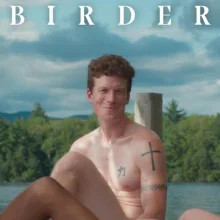
Mike White: Hey folks, welcome to a special episode of the projection booth. I'm your host, Mike White. On this episode, I'm talking with director Nate Dushku, writer, em, and Laurie and star Michael Emery. All about the film Bird.
It is a queer horror film that takes place in the wilds of New Hampshire. Had a great time watching this one. I hope you do too. Thank you so much for listening and I hope you enjoy the interview.
Can you tell me a little. MIKE WHITE: Bit about how the movie came about?
Speaker 9: We're hanging out in the banks of the Green River in Vermont a few summers ago and I don't know this, but in Vermont, there's nudity law that allows you to take your clothes off in certain designated areas just like in the RV park on the side of the road, hike down to the path and the sign of the clothing option will be on point. And this particular spot is where we go some time with our friends who are mostly gay queer folk and it's just this gorgeous stretch of river where you're allowed to be naked and loud and founded and CBO and you out today and there are a couple gay, famous gay cruising spots in the country in the world.
And we wanted to tell our story a big way and we had a small budget. We thought what would be the scariest thing that happened in a scenario like this? And it is just in the pandemic. So when the pandemic was coming to a close, we thought, let's shoot it entirely outside and let's instead chase it in New Hampshire where it's live free or die, which added a little bit of a different element.
And let 's just explore our lived in experience of kind of what it means to be queer living in the world today and that was the beginning of it. And so I would add to that, we knew we had to get a story together. We did and but most importantly, we knew we needed someone who could actually bring it to life that could partner with n as a director. And that led us to Michael because this wasn't a story that any anyone could do.
MIKE WHITE: We needed someone with credible talent but also courage and just the ability to really capture something that like Michael, was there any hesitation with all of the nudity in this or was it more of a challenge for you?
Speaker 4: It was definitely challenging, the film, the role was definitely challenging as you see, it was very, there's lots of layers that really excited me as an actor going into this with this blank canvas in front of me and me allowing to just Nate, gave me the freedom to just make different strokes as Christian and put together this picture. But there was no hesitation. No, the first day of shooting the nudity scene, there was maybe like a second of, oh, here we go. This is it.
We're gonna, we're, we're diving in. But once that happened there, it was such a safe space to shoot and to work that there was no problem at all. There was no question at all of let's do this or that in a certain scene, it was, everything was well constructed and put together. MIKE WHITE: So there weren't like 45 teamsters all smoking cigarettes just off camera that were taking it all in very.
Small set, limited cast and crew and yeah, every, everyone was on the same page. There was no judgment. Everyone was very kind and giving the inti intimacy coordinators we had on set were amazing and always there for each actor very communicated with Nate. Of course, with each scene we shot that involved intimacy and we're on the same page, which was, which is unique for a film because usually there's stuff all over the place.
But this was constructed.
Speaker 9: I think a lot of people think that when you do films like this, everyone just running around nude and improvised and that's maybe how it used to be. You'd be like, ok, here's a bottle of liquor, take a shot and I'll meet you on set kind of thing. But it's not that at all, it's like everyone's wearing robes when you're not shooting. It just, it's a very, everything very controlled and the way it's done that used to not be that way.
But S A has put out some great guideline and you can choose to roll with it or not. I respect some of the filmmakers and actors that are choosing to not be the intimacy coordinators for whatever reason. But for me, for our set, we want him to do it and we did it and we're so glad we did. MIKE WHITE: With you guys being a couple.
How is it working with each other? Awesome. But exactly what you think it yeah would be or could be. It's like there are ups and down and I, but I think overall it's great when you have a partner that see the world similarly to you but different and you can challenge each other and you can, that person becomes your support but also becomes sounding board.
We have this shorthand with each other. I think we were definitely nervous going. So we like we've been together for 20 years. So there's a, there's an intimacy of intimacy, but there's also like an understanding of where it may be helpful to step back and let someone have the space they need to operate and also to step in and say, hey, I think you need to pay attention right here at this moment.
Like I wrote the script. But then Nate helped me turn the script into a shootable script and into a script that he would want to direct. And then Nate has been doing this for his whole life. I'm new to the game.
Relatively I've start, I've been working in film and TV, and writing stuff for almost 15 years now. But that's not a long time. It's a long time, but it's not like there are people that do this, their whole lives since I leaned a lot on his experience. And the one thing that really brought us together that made this a joy is we have a shared interest in aesthetics and art, craft and movies and we watch a shit ton of movies together and TV together and we talk, we talk about it all the time.
Being able to craft something together is awesome. It's really fun when we bring people into our Buffalo and that's even more fun. Like, again, I'm tossing back to Michael, but like having someone who could understand the way we work and like work with him and me and it, but it was very natural. It was very like the, we brought actors into the room to audition and a lot of them were like, this is the first in person audition.
I've had it since because it happened after the pandemic and it was really cool to be in a room. And the first time I met Michael in person, it 's like such an important moment for us all. Like they gotta get us, we gotta get back and that's how this happened.
Speaker 4: When I met Nate NAMI in person. They had such a beautiful dynamic that they let each other take the reins of what was happening. So if you guys remember, I remember auditioning at the call back and I was reading with Amy and Nate was there, gave me notes stuff and it was just having them both there and their dynamic the way they are made the shooting so incredibly easy. And if I had a question, Amy was there, if I had a question about the vision or some type of direction, Nate was there, so they would trade off and it was beautiful that they have them both a fair so I can ask some questions or get some different vibe on the scene or the character or what or what Christian is thinking in this scene leading up to the past scene?
MIKE WHITE: What is your process for finding a character like Christian? And that is such a complex character. In the prep production process? I'd made a whole back story.
I wrote in a journal, I think I wrote about 2030 pages of Christian's back story growing up his mom leaving as a kid and his dad really never being there for them, them having a lot of money and being banded and that abandonment really carried into his psyche that I used, that played a big part of him wanting to be except at this campsite, him trying to manipulate them. I saw him as him wanting to have friends and using his sexuality to get what he wanted from them. But he did have a heart at the end of the day and he really had that sincere side to him.
But also he had that deviant side to him as you saw during the course of his journey through the campgrounds. MIKE WHITE: Yeah, I really appreciated the very deliberate pace for this film as well. It surprised me when things started to happen that I wasn't expecting and then it managed to keep me on the edge of my seat for the entire rest of the film.
Speaker 9: I love that had ever happened here that Michael's performance in the editor. And I just think that this project attracted people and it was like, I could hear it in their voice like when someone comes to the table and says, I want to be a part of this and that's the kind of person you want to work with. And I think Michael had the first time we saw Michael's Gates and then obviously, we met him in person and he just, it was like he was reading the lines and it just felt like I was talking to him, you know what I mean?
He, I didn't necessarily know everything that he was doing to create his back story. That's his work. But when he came to the, when he was on camera, it was just, it was there, it was like this was a real person and I don't think there was, that's why we chose Michael because there was not really many other people that I think could take the words and just make them feel like it was a real person we're talking to. And again, the compassion, I can tell that he saw Christian as a human.
And I think that my goal on camera is the poet of the f and we were waiting to find that people like, what kind of film are you making? I think calling it we're hard isn't really staying and not queer, horror has or horror in general, not queer are people think camp, they think blood, they think up. But we wanted to find somebody just embodying his character and have it be deeper and scarier. And when Michael's mouth, it just like the, this is the time we want this we want.
And I think when we set out to do it, we wrote the screenplay to be as simple. And then Christian is a character. We wanted that to taken by a actor and inhabit it and become whatever it would be. And the idea of group for ma is really a very, just simple fable.
It's like a very simple journey. C tale. Be careful when you say I consent to this, make sure you're looking in the earth and I really get what's there. It was designed to be simple but have very complicated and complex crafts.
People taking these simple walls turning them into what they became. MIKE WHITE: Well, fellas, thank you so much for your time. This is great talking with you. Sorry that we can't go for longer, but this is wonderful and congratulations on the movie.
It 's terrific. Thank you for your time. Yeah.
Comments
No comments yet.