
Special Report
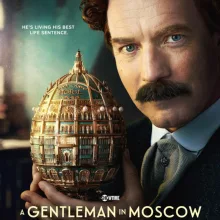
Victor Molero on A Gentleman in Moscow
Show notes
Transcript
An automatic transcript, tidied into paragraphs. It has not been proofread, so names, titles and spellings may be wrong, and it does not say who is speaking.
Show the transcript (about 3,900 words)
Speaker 1: Hold your ears, folks. It's showtime people pay good money to see this movie. When they go out to a theater, they want cold sodas, hot popcorn and no monsters in the projection booth. Everyone pretend podcasting isn't boring.
Speaker 2: Turn it off. State your name. Alexander Ilya Rostov occupation. It's not the business of gentlemen to have occupations.
Your class is a threat against Russia. Therefore, it is the judgment of this committee that you be returned to the Metropolitan Hotel where you will remain for the rest of your days for the last four years. I have been a prisoner of en suite 317 of the Metropole hotel. It has a window, at least just about fit on this bed.
Ah, g sharp. I believe times have changed since our glorious revolution. Most of my friends are dead. My house was seized and burned.
You must never leave if you do it, I'll be waiting. Well, thank you. You have carried out your duties with the greatest courtesy available to you. Hello.
Hello. I like your mustache. Oh, thank you. How are we gonna survive these endless days?
Stuck in this hotel? I have a key that opens every door. There are rooms behind rooms and doors behind doors. In this hotel, everyone could be watched.
It's a dangerous place, especially for you. She's an actress. Ah, I've seen her films. They're not very good.
I'm afraid they're quite ill behaved. I always think behavior is a matter of handling. Yes, I'm sure you do be very careful. You are still a prisoner here.
So I betray who I am and no to you, everything in this new world comes at a cost. You could disappear. We could start again. This is still my cook.
What's she doing? I believe he's refusing to be beaten. They can take away your house, they can take away every seat. I can't take away who you are.
MIKE WHITE: Hey folks, welcome to a special episode of the projection booth. I'm your host, Mike White. On this episode. I am talking with production designer Victor Molero.
He is known for, well, quite a few things. He's been working in the industry for a long time, but I talked to him well about a lot of things, including what he is getting quite a bit of recognition for a gentleman in Moscow. It is a limited series that is playing on Paramount Plus stars, Ewan Mcgregor. It's about a gentleman in Moscow.
Thank you so much for listening. I hope you enjoy this interview. How did you get into production design? What was your path to that?
VICTOR MOLERO: It's funny because I never thought that I will be able to work up movies and on TV. So it was it more they choose me than I choose to do movies. So I was studying in Madrid fine Arts and I remember the colleague, some friend told me they need help a short film and that's how I started very soon. I was finishing my degree as fine in fine arts.
And of course, I always was very, very young. I was very crazy about films. And I remember that my fam my parents and that's maybe something that I need to be grateful when we were having the summer in the south of Spain. There was always a night when I was trying to have a bit of fun as AJ others and there was let me in the door cinemas so that when I was a kid that would never happen now.
But in my time, my generation was a way to, it was possible there was no serious rule about that. So I was, there was always every, almost every night putting me in the outdoor cinemas and I watched a movie and I think this is how I developed that crazy love for movies and films. MIKE WHITE: Were there any films that you saw that really inspired you as a young person? VICTOR MOLERO: It's funny because there was a movie that was very, it took me very touched me a lot and maybe because it was too strong for a child and it was death in Venice.
Yeah, I know. But it was, it, something is in my memory as a really strong movie, maybe I was 10 or maybe 12. But I remember that movie creating my memories, something really strong special because of course, I'm sure that I never understood the movie but when I watched it later II, I was still very, it's a very powerful movie and yes, so I think that movie, I have something like in my memory that it was like, why so strong the image of this movie and that's why I was so attractive for something that even I couldn't understand.
MIKE WHITE: When I was doing my research on you, I found several pieces that were available through sites like ebay and stuff. Are, were those yours or is there another Victor Molero that would decorate or create like furniture or boxes or any of these things? VICTOR MOLERO: That's really funny. I it's really great that you say that it, I'm coming from a family with a long story, seven generation and the seventh generation that they do furniture, they are artisan.
So that's it is in my DNA. So it's that I have been, it's a very creative family from the south of Spain in Granada. And they developed this kind of medieval furniture called Bargen. And it's a really, it's a, it's one of the most important Spanish design furniture.
And they have been doing that for many generations. And I'm the only one that I just decided to go for different way or path. And, but yeah, I feel really proud of that. It's a small family artisan family that they have been always doing this job.
So it's great that you found that my family have a workshop in the, in the south of Spain. I was the older work in my family, the older brother. So my future was almost done. But I decided that I wanted to have the instinct to do any of the things and I wanted to study fine art.
So with the skills to study fine art, I went to Madrid and that's how everything. So in a way, I never follow it. But it's true that I forced in a way, the way to be in Madrid in the, in doing my degree and I get grab this opportunity to do the short f and I met a producer in that short film and said I'm going to do a feature. Would you like to come as a trainer?
And I said, yeah, of course, I go. So that's how I did it. I was really lucky but because that was in the nineties and in 19, in Spain, there was many young director. Very interesting like Julio Reden or Alejandro Meva or Almon Nova, of course, and the energy of that moment was very creative, very good.
So I was in exactly in the best moment at the best time. So that's, that's life when you are in that moment you felt and you are around people that are very interesting. So that's how I was very lucky in a way. MIKE WHITE: Was savage grace.
Was that your first English language feature or had you done English language movies before that? VICTOR MOLERO: I did it. But as a no, as a decider, it was my first English movie as a decided. And it's funny because my English was really poor.
If I'm honest, I remember that a product, a producer, Spanish producer called me for that. I think the director met another Spanish designer but never went really well along. And suddenly they called me and said, will you be happy to do that? And I went crazy because it was my first time doing period and I met John Colin and we it was really great because he said I went really honest.
I said this is my English, you can try to do my best. But this is how and I said, I think we are going to find a goat and we have the same way to see things. So I think we are going and it was incredible because we became friends. I improved a lot of my English and at the same time, I have one of my best experience as a designer because I, in a way, I think I force myself to be in to think out of the box because I was as a designer in Spain, I was, everything was easy.
Was I understood that for me it was good to have the challenge to be in a more uncomfortable space. But I understood that was make me even stronger and more and even enjoy more. And it was, I remember with us, one of the best experience in my career at our school, Tony. It's amazing with Julia.
We went really well and everything red mine was, I think his favorite movie. It was really cool, an amazing guy and everything. It was really very tiny, very independent movie. It was like five weeks.
We shoot the whole production in five weeks and we should only in Barcelona. And it was, you remember it was a period start, start in the beginning of the 20th century and starting New York, Paris in the thirties, I think in Barcelona, Majorca London. And we shoot the whole thing in Barcelona. So it was very crazy, but we developed a way to do it in a, in a very creative and interesting way.
MIKE WHITE: New York looks so different from Paris looks so different from London, looks so different from Barcelona. How do you approach that to actually make these sets look like they are from these different eras as well as different locations. VICTOR MOLERO: What I learned in that project? I think the key thing was to find the location that was, of course, wasn't possible to go exterior because the good thing Barcelona is quite European city.
And I think you need to understand how is the place, the location that you have to Paris in Barcelona was easy. And even we shoot some exterior as a Paris for the strength that we had and the budget that we had. But we create different space. For example, for New York, we found a hotel that is that kind of American hotel very with that kind of old times flavor.
And we of course, we dress in the way that so the way was to try to be flexible. And I think to find Tom Cali is very creative man, a very interesting guy and we create that kind of language about the most important thing was the character. So it was to create that some that that environment for the character that was believable and I think we did it. But yeah, it was a big challenge but to be a young decide that it was.
MIKE WHITE: How was your approach then versus what you do now? Like how have you matured and grown over that time? Because now it's not a big deal, I imagine for you to do a feature. VICTOR MOLERO: Always is a big deal.
It depend, have more experience. But still every project is a challenge and it's still a like and I think I better when I out of the box, when I need to think or solve things out of the box. And I think will be, I think I will not doing this job if I, if I, if I was feeling that I was done or I did everything. So I think I'm learning in every project and I would like to have that feeling of a new challenge every time is what I'm trying to look for.
When I choose a project or the project, choose me. That's, it's dependent. But I think for me, I think one of the most important thing when I sign in something is my instinct, my intuition. So I think and for me, I'm really guide by the story.
So I need to find the tools for me, my tools is the spaces and the location and then the color or texture. So to find a code, a visual code to create the story and to give a background to the story that is adding layer to create the story more interesting under the dialogue and the acting of we have. So for me, it's the key thing for designer and it's what I try all the time. So always it's a challenge.
But to follow my intuition is something that I would lend with time and that give me a kind of security more confident on that. MIKE WHITE: Now, how do you actually communicate with your other designers with your director? I mean, do you build little models? Do you draw a lot?
What is that way do you have mood boards that you share with them to get them more in your same mindset? VICTOR MOLERO: Yeah. One of the things when I work, when I work in a project, it's funny because today I need a new project now and I, today I put all my department together and I show a mood board. So for me, it's very important to create a mood board that is giving is giving the flavor of why we are trying to tell.
And the concept that I'm trying to achieve in the whole story, if it's a feature film or it's a series. So for me, that mood board is key. That's why the research quite important and I created, I have many files that I'm trying to create and I movies, images of movies or even art or photography. I use a lot of photographer and I try to create a mood board with visuals to give what I'm trying to achieve.
And of course, after that, I design and do concepts and I tried to give to be more specific in every part of the story. But from the beginning, the first stop is to create a mood board. And I think is the best way to start our conversation, even with the director or the producer about if I'm in the right way or not, or you know, what is my proposal? MIKE WHITE: How have you found or have you found TV?
Shows and films? Are they different for you? Is there a different approach you have to take for one work versus the other? VICTOR MOLERO: It to me because my, the 1st 20 years of my career, I was doing feature in the Spain because the quality of Phoebe at that time wasn't great.
But when I met a di a British director in Spain and I, and he brought me to UK. So now I'm in London by the way. But so that's why. And when I came to UK, that was like maybe 12 years ago and I started to do TV.
And series, it's true that now the quality in the Spain of TV series is really good, but at that time, it wasn't. So I think it was very good below or to work on film. I found that maybe because I started doing a film, it for me still is the process. The creative process for me is coming from the story.
And I think I don't do any difference to that. Sometimes the series are more a product than a film and it could be something more arty. But for me, I need to work in a, in that creative process to have the best of I can for the project. So for me, there's not a really big difference, of course, in a series, sometimes you don't have only one director, you have 3 3d Dops and you need to chair or a showrunner.
It's different in a way. And for me, my creative process, there is no change if I'm honest with you. MIKE WHITE: Are there any types of projects that you've always wanted to do? But I haven't had the chance to do it yet.
VICTOR MOLERO: I've never done science fiction and I will love it. I would love to do science fiction. It's something that I've never done. I've done fantasy, done, be done, done.
But I've never done science fiction. It's a gender that I love it. I have some possibilities but was never the right one. So that's why I never did it.
I hope that will happen. Some women might get rid of what were some of the problems that you need to solve when it came to a gentleman in Moscow, there was, I think the bigger challenge was time because the producer, when they call me and I started the project, they were thinking that maybe we will find a location to do the whole series in the North of England. And I had the experience to work in the North of England before I did a series in that area. So when they told me that I said that's never going to happen because it's, it's true that never, it was impossible to find a hotel with that kind of slave war in all in at the beginning of 20th century in Bolshevik time.
So it was impossible. So when I said it, the producer looked at me and said, maybe you're right, but we don't have enough time because it was all the deals were, was closed with the actor and everything. So I started to reset really fast and I designed, I think it took me to design the hotel 10 days. That is not so it was a really big challenge.
And of course, there was another child that was by it because, well, the thing that was important was the scale to have the whole series in such a kind of set and don't and the audience don't get bored or the camera don't get lost in trying to achieve what, what need to achieve. So for me, it was really important to create that kind of love and feeling of the story. And you know, these, these things about there is room behind rooms and doors behind doors. So it was really a big challenge for that to create what is in the book and to be faithful to this beautiful story that Amo Dos wrote.
So it was too many challenge as you can see, but we did it and it was great and it was always, I always say the real Metropole in Moscow. It was built in five years and we designed and built in five months or Metropoli Hotel. So you know, it was like this is a big difference. So it was crazy.
It was a bit crazy. But we did it, we did it and I'm sure I has been one of the, my best experience. MIKE WHITE: Do you ever supplement your designs with like computer generated things? Do you have your set?
And then here's a green screen over here that's gonna be replaced with something else later on. VICTOR MOLERO: Yeah. Yeah. For example, the fad of the hotel we built only the door, the main door, a little bit of the facade.
But around there was a green, a blue screen to I design the whole fad because the actual metro poo we wasn't allowed to use it for rights. It was difficult to achieve, to try to have the right to use it in our time. So I redesigned the fat and we did it in ce I visual effects. So yes, but I was in charge of design as well.
That and yes. So we did it in several times. There was some part of the set that we needed to add. For example, the stained glass copula on the top of the lobby.
It was of course, as well. A bit of ce I work there, but most of the sets were are handcraft and I was really lucky because I have an amazing team from the North construction. My construction manager was Paul Paul Ward and I work with a fantastic talented team that, that helped me to do such a kind of shipment. For example, when I was designing the hotel, we create a 3D model, a digital 3D model that even help to the visual effects department to understand how was the death and the scale the volumes, the shapes of everything.
And I think at the at the same way, it's really useful because you can, you can give the director a sense of space because of course, they don't have the skill that you have been developing with your being a professional in this. So it's really a great tool for everyone to understand the spaces and how you can move with the camera and how you can create that kind of labyrinth. And it is the entrance, the lobby, the lead and the Piazza that was the restaurant, everything was together and I would create a mezzanine around the lobby.
So I was trying to create the possibility to be very cinematic with the camera around the set and be very, very give a good space to the camera department to develop the direct with the director to develop the story. But yes, I started very soon use using this kind of tool because it's really useful, very useful. I think that even I would say at the end of the nineties, when they start started to appear this kind of programs. MIKE WHITE: You said that you just showing off your stuff this morning already.
Is that your next gig or do you have something else lined up already? VICTOR MOLERO: Yeah. No, I'm starting a new project, but I'm not not allowed to say too much story. But yeah, I'm, yes, I'm starting a new, a new series.
I'm going to be on this until December. It's going to be another long trip. MIKE WHITE: Mr Melero. Thank you so much for your time.
This is great talking with you. VICTOR MOLERO: Thanks to you, Mike. Thank you so much. I've been great.
Ok.
Comments
No comments yet.