
Episode 674 · Film year 1969
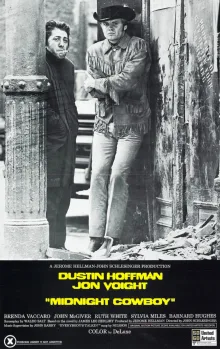
Midnight Cowboy (1969)
- Special Guest
- Glenn Frankel
- Guest Co-Hosts
- Jon Towlson, Chris Stachiw
Show notes
Chris Stachiw (The Kulturecast) and Jon Towlson (author of the Queer Cinema Classics book on Midnight Cowboy) join Mike to discuss the movie. Author Glenn Frankel discusses his book, Shooting Midnight Cowboy: Art, Sex, Loneliness, Liberation, and the Making of a Dark Classic (opens in a new tab), and the documentary it inspired.
Labels: 1969 Bob Balaban Dustin Hoffman Glenn Frankel Jon Towlson Jon Voight
Transcript
An automatic transcript, tidied into paragraphs. It has not been proofread, so names, titles and spellings may be wrong, and it does not say who is speaking.
Show the transcript (about 19,800 words)
Speaker 1: Hold your ears, folks. CHRIS STACHIW: It's showtime. People pay good money to see this movie. When they go out to a theater, they want cold sodas, hot popcorn and no monsters in the projection booth.
Everyone pretend podcasting isn't boring. JON TOWLSON: Turn it off.
Speaker 4: Everybody say fortune and none of my own is that Joe Buck. Yeah. Where is that, Joe Buck? I'm Joe Buck from Texas and Rico Rizzo from the Bronx.
Are you sure you heard what I said? My name's Rizzo. Now you heard him? His name is Joe Buck.
He's a Cowboy. Just just came in from Texas. Cowboy. I ain't a for real Cowboy, but I am one hell of a stud.
He, the only one thing I've ever been good for is loving. You're the only one too. And how come you ain't scored once the whole time? You've been in New York cause I need management.
Let's go. I'm walking here. What? Get the c those, which ways right out a check a night in the morning, they call the bank and stop payment.
You were gonna ask me for money. Oh yes, ma'am. I'm in business. You were gonna ask me for money.
I will win. Y you thick Texas long horned bull. They're laughing at you on the street. What?
You got me up here for? Ready for some hard work. So I'm ready. Verify.
You're a nice person. Joe. I should never have asked you up here. It's gonna be a lot easier for you, Joe Buck.
You're a lovely person. Really? I'm gonna use you. I'm gonna run your riot where you'll be on 42Nd Street.
I'm a truly dangerous person. I am. I'm impressed. You're a killer.
Guess who I am. Oh, it's me. She's hooked. I'd lie.
A Cowboy. I'd say she was good for 10 bucks, but I'll ask for 20. Why are you laughing, Joe? You really a Cowboy.
Listen, don't get sure of anything. Ok? I'm sure I don't think I can walk anymore. I'm scared.
What are you scared of? You know what they do to you when, when they know you can't, when they find out that you can't walk? 00 Christ in a. MIKE WHITE: You just welcome to the projection booth.
I'm your host, Mike White. Join me once again is Mr Chris Dash. CHRIS STACHIW: Can you tell me the way to the Statue Of Liberty? MIKE WHITE: Also joining us is Mr Jon Towlson.
JON TOWLSON: Whoop T I on boy, who. MIKE WHITE: On this special episode of the projection booth, we are looking at John Schlesinger's Midnight Cowboy. It is the story of Joe Buck. A hustler from Texas who makes his way to the Big Apple in order to, I guess, get laid a lot and make a lot of money and live out a dream and really more than anything, make connections with people and end his terrible loneliness that he has suffered for almost all of his life.
We will be spoiling this film as we go along. So if you don't want anything ruined, please go ahead and track down the movie. Come on back and we will still be here. So Chris, when was the first time you saw Midnight Cowboy, sir?
CHRIS STACHIW: It's one of those movies that's definitely been on the list of things to watch. I think at this point in 2023 everybody knows Dustin Hoffman's line from the movie. I'm not even going to, I'm not even going to reference it because if anybody listening knows anything cursory about this movie, they probably know that line, right? I guess maybe the Henry Nelson song or the Harry Nelson song.
But I also can't imagine that the Harry Nelson song is as associated with this movie all the time. Now, in 2023 the way it probably was back in the day. But just recently you invited me to be on this episode and I took it as the opportunity to finally watch the movie. And it's a lot, it's a lot in a way that a lot of these kinds of movies from this time are movies that are important for a number of reasons and I'm sure that there will be many reasons that we will talk about that.
I'm not even currently even thinking about because there are multiple angles to come at this movie. From obviously the Vietnam angle, the gay angle, obviously, which I'm sure we will talk about given that I am gay and I know we're gonna have a huge discussion about kind of the homosexual tones of the movie. So I enjoyed it. I will say it's a lot, but I think it's meant to be a lot for a number of reasons.
It's not meant to be a movie that you just watch. Unassumingly. It is an entertaining movie. It is a, again, I don't know if it's a fun movie but the performances are what carry the movie through and man that Jon Voight guy, whatever happened to him.
I heard he was on a boat with an anaconda. Eventually. I don't know. Jon Voight has had a weird career.
I have not seen him in a whole lot. And now I understand why Jon Voight had a career that lasted as long as still has. Because if this is one of the things you're known for, again, Dustin Hoffman is known for a lot of things. But if he were just known for this, that would be enough is my point.
I think that's how important this movie at least presents itself is received as such, but just recently and I enjoyed it immensely. It's not a movie that takes itself lightly and I don't think the audience should expect to just wander into Midnight Cowboy for a good old romp because it's not that, but it's in a lot of ways, if that's all you're getting from it, you might be missing the point somewhat. MIKE WHITE: And John, how about yourself? When was the first time you saw it?
And what did you think? JON TOWLSON: Yeah, probably around about 1984. I think it was showing in a little cinema in the small town. I grew up in the East Midlands, in the UK town called Grantham.
It's probably best known as the birthplace of former Prime Minister Margaret Thatcher. MIKE WHITE: Try not to hold it against them. JON TOWLSON: You tells you everything you need to know about the town really. And the, and the town had a little cinema called The Paragon, which was li it wasn't much more than a cow shed that had been built a couple of years before.
They used to show occasional sort of repertory screenings. And I used to go along as a young film buff. And I remember they showed the Good, the bad and the ugly, which was one of the first time I saw that. And then this movie Midnight Cowboy, which I'd heard of but had never seen and didn't really know anything about.
And I went to see it with a very close friend of mine and we were completely engrossed in it. And I think that screening changed me in a way. It was really an extraordinary moment. What struck me about the film, the themes of it, the loneliness, the kind of repressed homoeroticism of it.
They all hit me quite strongly because I was about 16, I think, 16 or 17 at the time. And the performances because me and my friend, we were studying acting, the local college and we wanted to be in the theater and we were just really struck by the relationship, I think between Joe Buck and Ratso and we'd left the cinema and we became Joe Buck and Rats. So in the way, we were related to each other, we adopted those persona and my friend did a particularly good sort of nasal twang of Dustin Hoffman. You want a cup of coffee and I'm walking here all of that kind of thing.
So the film really, really hit me hard and resonated really, really deeply with me. And as I became more interested in movies and started making movies of my own. I really started to study the film and I remember just being really taken by the editing techniques of it, the use of the camera and so on and so forth. It was just one of those films that I just thought if I ever want to write a book, I wanna write a book about Midnight Cowboy.
And I ended up writing a book about it and specificly talking about the themes of it from a sort of queer perspective. And it's been quite a long journey, quite an interesting journey for me, that film. And I think what I saw in it is what a lot of people saw in it in terms of Joe identifying with the character of Joe. But so, yeah, a seminal film for me.
MIKE WHITE: I think I saw this one probably on VHS when I was maybe 1617 years old and definitely liked it, but I really didn't know what to make of it quite a bit. It had such a, such an odd flow to it just that we start in Texas, we follow Joe. But then we get those flashbacks throughout. Well, even right from the very beginning, we are flashing through past present, maybe even a little bit of future when he is quitting his bus boy job and fantasizing about what he wants to say to his boss.
Yeah, that editing style really captivated me and really made me appreciate what good editing can do. And then also this film operates on such a great level when it comes to the audio and just the contra posing of the commercials with the action on screen. But then you also get the advertisement as far as the billboards, whether it be on Joe's journey across the country via the bus or whether it's the billboards that are in New York City, you constantly have things outside of Joe Buck commenting on Joe Buck's story, which I love and I saw it again.
They must have done like 1/50 anniversary screening because I definitely remember seeing this on the big screen. So maybe 2009 would have been the 50th anniversary or no 2019 would have been the 50th anniversary. But I know I saw it, maybe it was the 40th anniversary of it then because I definitely saw it theatrically and seeing it on the big screen is amazing. The cinematography is fantastic.
It's so well put together and yeah, it's just, it's always been part of my life and then you see it parodied in things like Seinfeld or other things. I mean, the Seinfeld one I used to love when they would do movie parodies because they would just kind of come out of nowhere. The whole thing of like the door closing on Kramer's apartment and it's the end scene from the Godfather, things like that. But the whole thing of I think it was George.
No, it was Jerry and Kramer on the bus and it just is that whole end scene from, I mean, the most, one of the most heartbreaking end scenes of a movie ever when, when it comes to Midnight Cowboy and then they turn into a joke, but it's, it was a good joke. This movie, obviously, it's been there. All my life came out in 69. So, Midnight Cowboy has been part of the cultural discussion since I was a kid.
It was nice to finally sit down and watch us more with a critical eye and just see how they were putting this movie together and then to read your book to read Joe Frankel's book, to watch the documentary about it just to learn about all of the things that were going on behind the scenes. And I am really curious as far as you know, I want to talk to you about your reading of it because it's an odd experience that it was based on a book by a gay writer. It was directed by a gay director. You have gay themes in here, but then your two main characters have a relationship, but it's more, I guess homoerotic than homosexual.
But and then there's Ratso is just so homophobic all the time. I mean, just dropping the F word like crazy through this entire movie. It was kind of wild to think about that relationship that these two guys had. And yeah, just to watch this as a, as a master class of acting.
Just it's incredible. CHRIS STACHIW: So I had obviously heard that it had a place in queer cinema, but as someone who had never seen it, I didn't know what to expect going into it as how it would identify itself as queer cinema. And I think it in some respects bristles at the fact that it. I don't know.
Again, you mentioned a lot of the people involved are, are queer. And so it's, I know why the movie got an X rating and that was one of the, one of the horrible reasons I got an X rating because, oh, my God, I mean, the queer lifestyle and my other people might turn out to be gay. Like, yeah. Correct.
Especially if they're seeing it presented in a way that isn't constantly derogatory, Jesus Christ. But it is weird because to your point, like, there is a lot of, there's a lot of homophobia in the movie and it does more or less come from Dustin Hoffman's character. But if they're presenting it in a very matter of fact way, it's just the relationship between the two main characters is not the typical relationship of 1969. And that might be at least like the most basic way.
Right. It's just these two guys have a different relationship and then I would err on the side of it is, it's a very homoerotic queer relationship. But again, the movie seems to not want to necessarily go all the way. Which again, I understand, but at the same time doesn't make it any less queer cinema.
MIKE WHITE: It's almost like a retelling of the odd couple. You know, when you get into the apartment scenes, the condemned apartment with Razzo and Joe, it's very Felix and Oscar as far as, you know, the ones I mean, neither one of them is very fastidious, but at least, you know, Ratso has his whole thing, like, where he won't change his clothes in front of Joe. He has to have a private room. He wants his or private area that he can change his underwear in and those kind of things.
Yeah. And then to think that this came out, I think this came out the same year as Bush Cassidy and the Sundance Kid. So you've got these templates for buddy films going on here because I know we've had buddies before in cinema before this. But really this to me kicks off a whole new area era of buddy films.
You know, you're going to start seeing, you know, like you're busting or freebie and the being or these kind of things where you start to get people that are paired in these unlikely situations and they become fast friends or eventually, you know, reluctant friends, but eventually friends by the end, I mean, the relationship so much of this movie for me is Joe Buck learning how to care for other people and be cared for because we get this whole thing of him as a young child. And I love the way that they use flashbacks in this because you could start, it could be a narrative, you know, start at the beginning with little Joe Buck growing up and you know, you get that kid in front of the very first opening shot where you have that amazing shot of the driving movie screen and you have the little kid on the horse in front of it who's just dwarfed by that screen.
I mean, to me that is Joe Buck. I don't know if it's supposed to be, but that is him there in front of this big wide lonely movie screen on his little horse rocking back and forth and then you get to see how he's dumped off by his, apparently his mother, like he doesn't even know in the book who his mother is. He's got three mothers basically. And then they drop him off at Sally Buck's Place and that becomes this relationship and the whole thing.
I mean, there's this weird incestuous stuff the way she calls him lover boy. But I like that we get all this stuff doled out through the movie and we get to have those things compared against what's, what is happening in his life at that moment. What is bringing on those thoughts. So, I really like that.
We are following Joe and sometimes I don't even know if we're supposed to, if he's privy to some of those things that we are seeing or if we're just being told, you know, this is what happened to him and now look at what's going on in his life right now. JON TOWLSON: I think a lot of that sort of associative editing that's in the film arise from Schlesinger trying to find some sort of cinematic equivalent to the novel. I sort of novelistic stream of consciousness way of getting inside Joe Buck's head, getting inside his past, what makes him tick and so on.
A lot of that probably evolved during the filming. I don't know how much of it is apparent in the script, quite linear. They had a lot of problems with the editing. The original editor really didn't see eye to eye with what Schlesinger wanted and Schlesinger brought in his editor he'd worked with in the past.
But as a film buff, I find it quite intriguing that the film that Schlesinger had made before Midnight Cowboy was far from the Madding crowd. And Nicholas Roeg was the cinematographer on that movie and a lot of the editing in Midnight Cowboy is very Nicholas Roeg. Roe. And I guess you could say sense of the association, the fact that it's almost like a kind of intellectual montage of what's going on in the consciousness of the character.
So I do wonder what kind of conversations Schlesinger and Roeg had while they were making far from the Madding crowd because Schlesinger was already developing Midnight Cowboy as a script while he was shooting that film. And even before then, and some of the problems of adaptation from novel to film probably things he was working through. But I've heard people say it feels a little bit old fashioned now. Midnight Cowboy because of that editing style.
That seems like new Bell V sort of new wave. French, new wave suddenly, I guess you don't see it much now. You don't see it very often. But at the time, it was probably a little bit more familiar to audiences than it is now.
So they audiences probably accept that kind of to and fro in time, that sort of moving around in time thing. CHRIS STACHIW: I like it a lot and I think it works really well to allow us to get inside the head of Joe Buck. And again, obviously this for as much as Dustin Hoffman does, I think steal the show in a lot of ways. It is so much Jon Voight's movie and Joe Buck's movie and all of that, we don't see any Ratso flashbacks for a reason.
It's Joe Buck because he's the main character because we see the entire story through his eyes. And would it, would the movie have worked just as well for me in terms of it being a narrative about his character if there hadn't been flashbacks, probably. But again, getting inside the character's head just gives you that one more kind of turn of the dial to get a fully realized character. And it is a fully realized character, even with those, even watching those early screen tests, I don't think anybody else could have played this role.
At least not the way that it's played here. And obviously duh. That goes without saying because if anybody else had played it would have been markedly different. But the sense of childlike wonderment that Joe Buck has is really reinforced by seeing his reverse childhood, one might say, or childhood that atypical childhood again, not, not to make cast aspersions, but it just goes to reinforce this is where this guy came from.
And this is why he's reacting the way that he is. And again, did I need that? No, but it just helps to further reinforce that this guy is there is very little pretext and pretense to this guy like at all, he is just wandering around, just am amazed by everything and that's perfectly fine. But boy, a guy like that in a city like that.
And that's what happens. MIKE WHITE: A city like that in a city at that time, I mean, 19, the late sixties in New York City was a real rough time and we've talked about, obviously Chris talking about Barney Miller, some of the stuff that was going on in New York in the seventies. But it was right there in the sixties as well, especially in the late sixties, especially seeing Times Square, seeing all those hustlers just hanging out in front of the movie theaters. And it was, they really capture that so well.
And I think that the work of the DP on this was just so well done to get that kind of wash of neon through everything. And just even to see some of those things like Joe walking along and he's got his radio and everything and then we cut from night to day and he's almost in the exact same place as beautiful match cut and then cut from that back to night, back today, back to night just to show that passage of time that he is just out there every single day, pounding the pavement, looking for tricks and not finding anything.
JON TOWLSON: I think the DP had quite a lot of trouble with his crew initially because you wanted to do things a little differently. And that was, this is the where, you know, Midnight Cowboy was a kind of a forerunner. I think it's a Progenta or the sort of new queer cinema that came in the nineties with things like my own private Idaho. But it's also a full, a big 4runner for the sort of the new American cinema as well.
A and dps like Bill Moss Sigmund and Haskell Wexler would plow the same Thor as Adam Adam Hollander did in Midnight Cowboy. And they were essentially using still photography techniques and using available light and filming into the sun and still all the and getting camera flare in the lens. All these things were considered to be unprofessional by Hollywood standards in the late 19 sixties. And I think Hollander was as well as Schlesinger.
They found it really tough going with the New York crew who were season, film, season film crew used to certain ways of doing things. But long come these guys want to bring some sort of new realism to the film and having to go against a lot of the conventions of the late 19 sixties. But I think it does lead to this in this extraordinary sort of dazzling visual technique. That's not only, you know, it's not only, it's not just flashy, it actually brings a lot to the movie in terms of the kind of intellectual content of the movie.
The commentary on the character, the commentary on the life and times that you just get through the contrast of the sound and the image, as you say that, that sort of political commentary that's running through the film about the economics of the city where one point he's walking along and they're saying eat steak every day, they could barely put a meal on the table. Schlesinger really wanted to put a lot into that film and he just used every kind of cinematic means to his disposal to do it and invented new ones along with his crew.
And I think the key people are Adam Olander and the editor and the production designer of the film who just went against some of the kind of accepted ways of doing things and the actors, of course, who, who, who just Dustin Hoffman, we all know the lengths to which he would go in this sort of method, but he really does become the character and dresses as the character and refuse to not be the character. Even during the sort of lunch breaks they'd go off to the local restaurant they couldn't afford to have a caterer on.
So they used to go and eat at the local restaurant. Hoffman used to turn up as Ratso and embarrassed the rest of the cast and crew sitting here in the restaurant eating and drinking as Ratso would so, yeah, an extraordinary film. MIKE WHITE: It's amazing too that this was the follow up to the graduate. We're going to cover the graduate in 2024.
And that this was the role that he took next. He, it was almost a role that he took first. He actually or his agent called Schlesinger's People. And we were just like, hey, he really wants this role, but he's got this call for the graduate.
You know, can we make this work? And it's like, oh, don't worry very far, you know, it's very nascent stages for Midnight Cowboy. So he went ahead, did the graduate became almost like a little sex symbol after the graduate, which is kind of tough for me to imagine, you know, thinking of Dustin Hoffman with all the roles that I grew up with him in the sex symbol stuff. Aside, he was a huge hit for him.
The graduate was, and then to take this as his next role pretty risky. But I really like that. He really showed his Rings just within his first two films and then he would just go on from there to, I mean, little big man, Lenny Kramer versus Kramer Tootsie. I mean, just, he constantly, I mean, straight time is one that we talked about on the show a long time ago.
He just could do so many different types of roles. It was fantastic. And the thing that, you know, Chris you're talking about, this is all from Joe Buck's POV and that's true. Except for one point, which is that there's a moment where we get a Ratso fantasy.
We have a lot of Joe Buck fantasies. A lot of Joe Buck's dreams nightmares. But we get a moment of Ratso which starts off as a dream, like a very pleasant experience that ends up being a nightmare. And I like that.
We are cross cutting that with what's happening in real life and just that, that is affecting him, seeing Joe possibly screw up a deal with a potential client. And his Razzo's dream starts to slowly change into him being by this pool and all these ladies calling out to him or him on the beach with Joe. And I love that moment when he's running and he looks back at Joe because, you know, in his fantasy, both of his legs work really well. So well that he's beating Joe in this foot race and he get this great John Berry music, this kind of light and fluffy thing that's going on and then it starts to change where the women are more demanding.
And pretty soon he's being almost chased by them into the pool and that's where the fantasy ends. And that's where he thinks that life is crashing down around his ears again. I love that. They have that because otherwise it is all Joe Buck all the time.
And by the way, just as an aside, there's another Joe Buck that's out there in the world. Like a real guy named Joe Buck. I think he's like a sports announcer or something for the MLB. Ok.
Yeah, because I would see Joe Buck trending on Twitter all the time and I would just be like, what's going on, what's going on with Midnight Cowboy. I had no idea that there was this other Joe Buck out in the world, but apparently there's two. CHRIS STACHIW: It's really popular with the Twitter crowd is his catch line. JON TOWLSON: Where's that Joe Buck?
Where's that Joe Buck? Where is that Joe? CHRIS STACHIW: But I do think though, Mike to your point about the graduate and this movie coming back to back for Dustin Hoffman, obviously, the graduate movie I haven't seen in quite some time, but in the documentary about Midnight Cowboy that came out last year, they talk about the graduate and they talk about this movie a lot. The idea that the graduate ends on is one of again.
Hello, Darkness, my old friend, we go back to that old ditty right there at the end. It's not hard to understand what the movie is getting at in the final frames of the graduate. And then I think if you were to transition directly from that movie to this movie in a lot of ways, it has that same idea. It almost ends the same way with two people on a bus going off into their future together just in this 11 of them doesn't make it.
But that might be the kindest gesture of all is that they don't make it. At the beginning of this movie. Obviously, we have the character feeling an immense amount of loneliness. And then by the end of the movie wouldn't say he's in any different of a spot.
I would say that the loneliness may be even more deep and immense because now he has had that moment of connection with someone and he has gone as far as one human being could go for another person as far as I'm concerned. And then again, it ends on the same note of you're embracing your friend's dead body, but there's still that immense note of loneliness because again, what does he do now? And that's, and I, and I like that's where the movie leaves us with him in the same way. It leaves us in the graduate.
I don't need to see anymore. I can imagine what happens. But I know that loneliness is involved at a cellular level for all of the queer tones of this movie, I think the just the sense of otherness which promotes a sense of loneliness within people who feel other, regardless of the otherness that they feel I think is an important, especially in this day and age is as close as we all are. And as far as we've come, feeling other is still a thing and being made to feel lesser because of your otherness is still a thing that sense of loneliness is it's ever encompassing.
It's at every turn, every corner, there is a sense of loneliness that these characters are trying to escape. And again, I think maybe the theme of the movie and the takeaway is you can never escape it. You can only, I don't know, maybe prolong the lack of loneliness that you're feeling because I don't think anybody's ever not lonely. I think it's just how un lonely are you and for how long, because I think it's just a matter of at some point, you have to deal with it.
And I think that's obviously where these movies lead these characters is now, you have to deal with it again. So how are you going to go about dealing with it? I like those two kind of similar ideas being explored. I just think this movie obviously like it's at the core of this movie, maybe more so than it is at the core of the graduate.
JON TOWLSON: I think there's maybe kind of an ambiguity towards the end of in the white count. I think what you've just said is really valid. And it adds so much to the film in terms of the power of the film that he's left on his own again. And you really feel that sense of loss because you thought this was it.
He was gonna find somebody at last that he could relate to and be with even though it is a bittersweet ending for me, because the thing is that he's gone through this journey for me, which is the fact that he has had this relationship with Rats. So whereas before he really didn't have anybody and he didn't even really understand how to relate to anybody. He just thought that he was only worth selling his body to somebody and that was the only thing he was worth. But by the end of it, for me, Joe Buck has gone through a journey where he's learned in a way to love somebody and allow them to love him.
So for me, it's not a happy ending, but it's an ending where there is the possibility of a better life for him there. Now, he's given up this fantasy of becoming a hustler in New York, which was never gonna work anyway. We all knew that and the audience kind of knows that. And he's going on to maybe starting a new life.
And the fact that he may well meet somebody and find things easier this time around because he's overcome some of his problems from his past as well in the course of his relationship with Rat. So, but again that I think the beauty of the film is it does have the ambi ambiguity where you can read into it so many different kind of conclusions in a way and draw from it what's important to you as a person, just as a sort of side note in the book that I wrote. What I found really interesting was one of the big fans of the film is Tom Servini, who's the best special effects makeup artist of Dawn of the Dead and all the rest of it.
And Servini had gone to Vietnam and come back sort of a shell of a person. We had to turn off his emotions in order to survive being in Vietnam. But when he came back, he found that he couldn't turn his emotions back on and he just drifted through his life as a sort of zombie in his own way and his marriage fell apart. And eventually he found himself in a movie theater watching a movie and it just burst into tears and suddenly all of his emotions suddenly came back to him when the movie was Midnight Cowboy.
So I think it's a film that is very cathartic for people in so many different ways. And there's the queer reading, but there's all sorts of different ways in which that film connects to people, which is, I think maybe what Schlesinger realized why he didn't want it to be seen as just like a queer movie thought it would be, it had much wider appeal to audiences of all, all types. MIKE WHITE: When you look at Joe Buck's relationships throughout the entire movie. I mean, he is, he's used, he's used constantly.
You've got Bob Belian who gives him the blow job, but he has no money and Joe Buck lets him go. It doesn't even take his watch because his parents would be mad. The very first woman that he successfully picks up Sylvia Miles, she ends up getting $20 from him. She doesn't pay for his services.
She pays for hers and it's just, there's so many of these times, Bernard Hughes towards the end of the movie. I mean, even when you look at the scene with one of the scenes with his grandmother, she leaves money a mantle which so reminds me of, you know, your money's on the dresser kind of thing, you know, like, ok, there's a TV, dinner in the oven, honey, here's some money and then she leaves. I mean, he's just being used over and over and over again. And then he's got the connection with Crazy Annie, the Jennifer Salt character.
And that one that's fascinating to me, this whole thing of him being part of this gang and they have this orgy with her and she seems to really fall for him. And she keeps saying like you're the only one, you're the only one. And then later on there's an assault by the rest of the gang on Joe Buck and Crazy Annie and the cops are there and she, I think she basically accuses Joe at that point unknowingly because she says he's the one, he's the only one. And I don't think he goes to jail for that by any stretch of the imagination.
And I don't think that that is part of the book because I was curious to see if that was in there. There is a gang rape but there isn't this, let's say gang bang rather than gang rape because I think Crazy Annie is very into that. That's her kink is being with all of these different people. But I don't think that that retaliation is there and especially Joe Buck being raped by the people that used to be his friends instead.
What happens is one of the guys who is there at the gang bang. He approaches Joe Buck and he wants to be used the same way that Joe Buck used Crazy Annie. So basically Joe Buck fucks this guy. And then when the guy gets married like three weeks later, I think they say in the book, Joe's very hurt that he wasn't invited to the wedding because he has no idea.
He's just, he's just a piece of meat. A lot of times, you know, this empty shell and he wants to make these connections. He thinks that he has a connection with this guy. He thinks he has a connection with Crazy Annie.
But then things happen and they are either taken away or go away and he's left completely devastated. CHRIS STACHIW: Even the idealized idea of what this guy has in his mind of what he will find in New York. My podcast is pro sex worker. Your podcast is pro sex worker, obviously.
But if you are a sex worker, this is the idealized world that you would like to live in is what he's believing. Waits for him in New York. All of these gorgeous older women who want an young man, a good looking, a blonde haired guy to show up and have sex with them because they're bored. That's his perception of what's going on.
Now. Is he a big dumb hit from Texas? Maybe? But again, like everybody's gotta have a dream.
Everybody's gotta have an idealized situation that they would like to live in and that's his. And yeah, when he gets there, the reality is the people that will be using you are the one they will be using you, dude, not the other way around. And it's that he doesn't realize it fast enough or he never realizes it at all. But again, that's the point of one of the points of the movie.
But I like that idea of this guy just can't seem, he can't seem to figure it out either because again, like to figure it out would mean to escape this situation that you find yourself in and he is not capable of figuring it out because he doesn't have the tools yet. And again, like he starts to create that relationship with Rat. So which helps him, like you mentioned, John transform as a character, but it's that relationship that helps him transform. He can't do it on his own clearly because he's a guy who moved to New York City thinking that there were just going to be lines of older women lined up ready to have sex with him, which so far from reality, it never even happens.
JON TOWLSON: In the book, the rap. So relationships not as central as it is in the movie, Ratso doesn't even enter the book until like halfway through. But in the movie, I think what Schlesinger does is that he says actually Ratso is the pivotal character. He's the character that enables Joe to overcome the things that have happened to him in the past.
And I think there's also that sense that in the film, Joe is much more homophobic than he is than the character is in the book, in the book, Joe is essentially bisexual or you could call him omni sexual. And it's not a problem for him actually having sex with men or women. Whereas in the film, it's a big problem for him having sex with men. It's a problem he has to overcome.
Really, he has to overcome that homophobia in order to allow his feelings for Ratso to fully develop, allow him to reciprocate in this, in essentially what Rats so's feelings are for him. There's a really extraordinary moment in the film, which is where Razzo's helping Joe to get ready to go and go and be an escort and he's helped him get his clothes clean and he's cut his hair with all of these kind of domestic scenes. And then Rats. So you get this love shot of Ratso gazing almost adoringly at Joe and he's going, isn't that bad for a Cowboy that close up is so important because you realize at that point, actually, Ratso really does adore Joe, not necessarily in a sexual way, but he needs him.
But Joe is like his relationship with Rats. Who is that Joe doesn't realize what it is to be loved. He can't, he can't reciprocate it cos he'd never known it. And so he takes it for granted in a way he takes Rats.
So for granted and the big, the big threat in a way in the film is less. So in the book is Joe gonna walk away from rap? So is he actually gonna unwittingly walk away from the one person who's only ever cared for him in his whole life and eventually he doesn't. And the Barnard Hughes character is so important.
I see the Barnard Hughes character as being almost a kind of a s a symmetrical character to the Bob Balaban character. Earlier, these two repressed, gay guys repressed. This is what will you will be like if you repress your feelings and Joe is in danger of becoming those two characters, if he represses his feelings, and eventually he breaks away from that in order to choose Rats. So and that's what he does at the end, he chooses Rats.
So over that, over his dream of making it as a hustler with rich women in New York. And so for me, that's why the movie is quite an optimistic film. Because it's about Joe's ability to learn how to love, which that, that lyric in nature. Boy, the greatest thing you could ever learn is to love and be loved in return a simple sentiment.
But it's for me, that's what makes the film tick. MIKE WHITE: I like to when he is making that trip to Miami that he sheds his skin one last time because he has been since pretty much the very first time we see him. Even when we see him in flashbacks, he's in costume of some sort, he's got a little Cowboy hat or I want to say he's in like a little army uniform or something when he's just a kid. But, you know, we mostly see him in that Cowboy get up and he is not a Cowboy whatsoever.
But he knows that that appeals, knows that that's a trope and tries to put on that trope and he gets to see other guys other hustlers on 42Nd Street doing it much better than him. We get to see other people in Cowboy regalia and they don't look nearly as garish as he does. He's got that fringe jacket. You know, John Wayne don't have nothing on my fringe game.
Hello? Like one of those types of things and he just looks, he's, he's cartoon, he's basically a cartoon character and even when he meets Ratso the first time and it's just like, well, I'm Joe B, I'm gonna buy you drink. And what do you think about that? And it's just like he's so big and it's the whole thing of him getting smaller and smaller and smaller and then eventually just getting rid of that Cowboy outfit until he becomes somebody else.
And I am very curious. This is one of those movies where you wonder and Chris, you touched on this before you wonder what happens, five minutes later, what happens? Five minutes, five days, five years after this movie ends because we don't know. Does he ever adjust?
Does he ever find friendship? Does he find love? Who does he find love with what doesn't matter. Just, yeah, it's, it's takes that slice of just a few, I guess it would be a few months of Joe Buck's life.
But then you get those flashbacks that builds it out to his whole life. But really those few months of him in New York trying to make it and not making it just really gives you such a wonderful slice of life of these, like you were saying before these fully formed characters where you feel like, you know, and you feel like they know everything that has ever happened in their lives, love. You know, you don't get flashbacks of Rats. So like you're saying, but you do get stories of Rats.
So you get him visiting his father's grave and it seems to be like I know that I'm not going to make it. I'm visiting my father's grave for the last time and then that he even steals the flowers off of the other grave and just uses it's such a Ratso thing to do. And you get his story about his dad breathing in the wax from the shoe shining. And I love the shoe shining scene, especially when the cop sits down next to Joe and you get that look on Razzo's face and then the third guy sits down and he's so he does a great job of shining those shoes but does not want to become his own.
Father. Does not want to have his father's fate. I love those moments in here and this whole movie is filled with little moments where you're just like, oh, that was a great scene or that was a great moment. Like when they're dancing to the frozen orange juice commercial song while they're freezing their asses off in that shitty apartment condemned apart.
I should say. Yeah, that those kind of things just bring this whole movie life. CHRIS STACHIW: When I like the idea that Ratso is actively avoiding what he perceives to be his father's fate. But in the end, the fate that befalls him doesn't live even half as long.
Like he again, the A I'll just go off of the age of Dustin Hoffman around the time that this movie came out. So the guys in his late twenties, early thirties, like his dad lived longer than that. Again. It's, it's that weird idea of I'm avoiding this thing that I don't want to turn into.
But in not wanting to turn into that I have become something I'm much worse, but something that is even more injurious to my health because again, like he's smoking and he has a limp and we don't know what so many of these things, what is really going on is again, left up to ambiguity, which I think is smart because again, it allows us to project or infer or how however you want to interpret it. But I like that the movie also just doesn't necessarily need to say what he's dealing with. Specifically, we just see him through the usage of the film like language.
Watch him slowly deteriorate on screen and it's showing not telling and I appreciate it because again, like Dustin Hoffman's performance is, again, you both mentioned it already. I think he is the main character of the movie in a lot of ways. Like he is the one who pushes so much of the movie forward because he has to, he's almost at the end of the day, like the sacrifice that the movie needs to make for Joe Buck to have that transformative moment is someone has to pay for it. And Ratso just happens to be the one and he's willing.
And in a lot of ways, you wonder if he's willing to make that sacrifice as a character. And I don't think he would want to, but the way it's shown, it's like someone has to make a sacrifice for these two guys to get what they want. Joe Buck makes his sacrifice. And then Ratso is again like the ultimate sacrifice.
But I think ultimately he is the main character of the movie. It's just he has such a transformative part of Joe's Bucks like journey in the movie that they're not able to be really removed from one another. JON TOWLSON: I think there is a, well going back to what you were saying about him being on 42Nd Street. There's that and the whole thing about hustling in the way it's presented in the movie is that they're trapped by their economic circumstances.
You know, that Joe, he just, he's not gonna make it as a hustler because he just doesn't know the ropes and there's a lot of competition there and he's, he's unwilling anyway to go there to do what he needs to do to be his success as a hustler. And, you know, Rao is unwilling to follow in his father's footsteps and be a shoe shine because he thinks he can be trapped. But he's already, he's trapped in something even more dire economically. So I think there's really that kind of sense of entrapment in the film that just pervades the film for me, which comes from their economic circumstances.
So that's, and that, that colors the whole feeling of the film that you feel that they've gone to this, they're in the, they're trapped in New York. They want to escape the place. They wanted to go to this almost utopia that they think it's gonna be coconuts and orange juice and they had no idea the reality of going there. But at the end, you're so this oppressive feeling of being trapped is so hard to escape in the film that you feel that the ending is colored by the whole sense of entrapment.
But the thing is at least they have each other and that comes through in the book as well in one of the segments in the book, never made it into the film where, Joe goes to this place where there's a client, like a mother and father double act who, I don't know, pimping these young girls out. And Joe's kind of sitting there in his place thinking what an awful place, but at least the mother and father have got each other even this dark place. And I think that's the thing that kind of pervades the film is that even some somewhere as rotten as New York is in the way it's portrayed in the film in that era.
At least Joe and Rat so happy each other until they don't. And then, so that what you get the ending could be perceived as kind of a down, you've. MIKE WHITE: Got those other characters that are in the book like Perry, the guy who basically seems like Satan himself sometimes just the way that he, I can bring you whatever you want, Joe, whatever you want, just let me know and I'll make sure that it happens. And that goes into this whole thing of Joe wanting to get laid and this mother and son when you've got this very strange relationship between this mother and son, which really echoes some other relationships from earlier James Leo Herlihy stuff.
I was unfamiliar with him and with his work. And so doing this episode really opened up that for me and seeing more of his fiction, more of his acting. I didn't realize that he had had other books of his adapted that he was an actor. He shows up in different films.
So this was a real eye opener for me to know about this character that I never really knew about before the actual author of Midnight Cowboy. And also, I'll be honest to learn a lot more about Waldo Salt, the screenwriter and to learn how he injected himself into so much of this. You know, Chris, you mentioned that documentary. I love that you get the shot of him drawing on a postcard and like this is me and then you get that later on in the movie of Joe Buck doing that.
I like that. They took all of these stories from real life to like the body in front of, I don't remember if that was Tiffany's or where that was and everybody just stepping over for it and Joe looking down and just being so amazed that people aren't helping this person out, but that's the city, that's the big mean city, other movies where people will talk about how horrible New York is. I mean, taxi drivers get to come in this timeline, but I love just the wide eyed innocence of like what nobody's helping this person out.
It's like, sorry, we got places to go and places to be. JON TOWLSON: Yeah, I often wonder what the story is. It be great if you could have a little sideline and we find out why is this guy on the pavement outside of Tiffany's? What's happened there?
Has he, has his engagement gone wrong or something? What's happened? And then the, there are the other little, the characters, some of them recurring characters, the strung out mother with a mouse with the toy with a toy mouse and her son in the cafe, she's running the mouse over the son's arms and head what's going on there. MIKE WHITE: Then I think she shows up again.
JON TOWLSON: Yeah, if that is her, it might not even be her, but it could well be her, which is the strung out woman who's flitting between the doorways. And I guess they're there to show Joe's alienation from his environment. Really. He is going, I don't understand what's happening here.
Well, I think a lot of that arose from actual observation on Schlesinger's part when he first got to America. And I don't think he'd actually been to America before or he hadn't spent very much time in America before midnight. Cowboy. So he brought that outside his eye to the things that were going on.
And I remember reading an interview where he says that the wonderful thing about a place like New York is that all of these dramas are being played out in public. Whereas back in England, they'd all be happening behind closed doors. And that really fascinating that that will be happening. And, but there's, there's also you say Wald or what w or so brought to it was this whole thing about the media and the media's influence on people.
The things like Joe's kind of sitting in the bathtub watching the T the pay TV, where you got to put the coins into the TV. And he's watching the Poodle that's being dressed up on the television and the other stuff about the media, the orange juice ad and all of the other things that the use of the media. I think you mentioned this earlier, Michael when you wrote it in your sort of menu thing about what that, that little news piece about. What do you look for in a man where women on the street are being questioned it?
What is it they look for in a man? I think that wor so soul is kind of like having gone through the sixties. It really was asking about the influence of the media on people's psyches there. And that even going back to that little boy that's outside of sitting on the little play horse in front of the abandoned cinema screen in his Cowboy outfit saying is that Joe Buck, it could also be seen as a comment on the influence of cinema on people's psyche.
The idea that we've all grown up with Cowboy movies. We all have this idea of the Cowboy persona even up to the sort of Marlborough man and the idea that's what makes masculinity and so on and so forth. So there's an awful, so many layers to the movie. And one of those layers is that sort of idea of the media and media messages being contrasted with the root, the harsh socioeconomics of Joe Buck and Rao's lives.
MIKE WHITE: So much of this movie has to do with screens, you know, you start with that screen, it almost looks like that driving movie screen is outside of Joe Buck's little room that he's in. And then you've got, you know, the sex that he has with Crazy Annie is behind a screen at a movie theater. I don't know if they really make that apparent in the, in the movie, but that's definitely there in the book and then the blow job with Bob Baban. I mean, that's one reason why they're flashing back between what's going on with Bob Baban and then what's going on with Joe and his memory and flashing back to Crazy Annie and basically trying to dredge up good memories to help him complete.
And then, yeah, you've got the TV screens and you've got all of the TV that goes on when he's having sex with. I think it's Sylvia Miles. You get all of the flashing images on the TV and that becomes really, you see more of that than you see of the sex and even the whole thing too, of the projection of images, Joe Buck is constantly looking at himself in mirrors or mirrored images and then talking to himself just like, you know what you got to do or like who is that handsome devil and slapping his own ass type of thing.
It's so much of him, like you said, thinking about that idealized state and trying to be that, trying to project himself onto that and be that TV, or movie Cowboy when he can't be that he is not that inherently, but we are shown so many different images throughout this whole thing. Yeah, I love that, that layer, that salt brought to it. And you've got that video layer, you've got the audible layer. I mean, notice really the last time I was watching this, how you go from everybody's talking at me through so much of this movie to then it just stops playing and there's a lot of times where there's no music and sometimes no sound or like slushing you will bring in certain sounds that you hear and the walls are so thin in apartments that like with the John, is it John macgyver?
Like that scene or mcgibbon, you can hear the people screaming at him because he's so loud in his own apartment. You can hear the other voices. So we've got everybody's talking, it kind of drops out and then we go into that John Berry Midnight Cowboy theme and that gets played several times which is the loneliest song and one of the most depressing songs. I mean, this musical piece that he has and then eventually we move back into the Nelson towards the end, kind of to say, like, things are going to be ok, even though that's a really depressing song as well.
When you listen to the lyrics, I. CHRIS STACHIW: Love it though. I love it. I love the song.
But it's, yeah, it's a real, it's the perfect song for this movie, right? Like absolutely underscores the themes and the ideas of the movie perfectly. JON TOWLSON: The Nielsen song. Going back to what you're saying, Mike is that, that this thing about Joe Buck's identity, that's his problem.
He doesn't know who he is. Who am I? I'm Joe Buck, but who's Joe Buck? Is he, is he a man?
Is he a queer? Is he, is he a stud? Is he a husband or is he a son? But he just doesn't have a clue.
And it's even more difficult because everybody's talking at me. You've got all these images bombarding him saying this is what you should be, you should be a Cowboy, you should be this, you should be that. And I think a lot of the way we identify with him because of that. You go, yeah.
Most of us are confused throughout our lives trying to make sense of our lives, trying to make sense of our identity or find our identity. And I think maybe that's why I found the film so powerful to me when I was 16 or 17. And why a lot of audiences have, do find it so powerful because they really identify with this thing about Joe who just doesn't really know how to proceed with his life and be hi his true self. MIKE WHITE: You get those few moments where Joe is flush with Cash where he is very, very happy and you know, comes in, he's just, oh, I got this, I got that and I love how Ratso kind of undermines him.
Like, well, I could have stolen that. I could have shadow lifted so much of the things that you are buying. Why are you even bothering to buy this? But yeah, he goes out when he finally scores when he scores with Brenda Vaccaro towards the end of the film, he immediately goes out and buys all this medicine and buys all this stuff for Ratso.
I love that. I love that he has that compassion and that like you said, he's, he's growing now. He's growing into a real human being because I think one of the reasons why we do identify with Joe Buck so much is that he is such a cipher. You know, he doesn't have that identity so we can see ourselves in him a lot better than if he was I am this.
I am that this is all I will ever be. He is such a fluid character in so many ways that it's very easy for an audience to identify with this person who has no identity. JON TOWLSON: You can't have an identity without relating to somebody. Seems to be what the film is about.
That scene is so powerful. That turning point in his character because he's left literally left Ratso out in the cold in the snow. He's with Brenda Vaccaro and he can't get it up because he's worrying about Ratso RSO is there in the back of his mind is the well being of his friend. And then the film really is almost slips into really pinpointing the sort of queer aspect of it a little too much in some ways because there's the questioning of his identity with Brenda.
Put, puts a little bit the words out on the Scrabble board with his gay. Oh, is that your problem? And then of course, he is faced with that choice that he suddenly there's a possibility of him becoming achieving the thing he's always been aiming for throughout the film that he may well have cracked it with the high society ladies who've got all their friends who can provide him with further clients, but he is forced into making the choice making decision at that point is, does he abandon Ratso for this dream or does, or does he decide to stayed with his friend looked after his friend?
And that's what he decides to do. CHRIS STACHIW: Well, I like the idea that even at the, we've talked about Joe Buck going to New York at the beginning of the movie and the idealized version of what he's getting himself into. I also like the idea that the note that the movie ends on is they were going to once again an idealized version of somewhere else. What does that mean?
And we never find out what that means, but to leave the characters where they leave them as opposed to the doors opening on the bus and then walking out, I think it again to further reinforce this idea of you might get what you want, but you might not know that what you're getting is not at all what you need. But again, like ultimately, the characters do get what they need in this movie to get to that point. But, oh man. JON TOWLSON: Yeah, because there's the moment where Joe who was on the bus and he says, you know what I've been thinking because I ain't any kind go slow.
I'm just gonna get a job. What kind of a judge? Some outdoor work? And in the book that's really expanded that actually Joe is gonna get married in his own mind.
He is gonna get married, doesn't even have to be a blonde woman, he's gonna get married, but Rao is gonna be living with him almost as their child because of his disability. And so they're gonna look after him. So it's a very interesting conclusion for Joe in the book, which is more kind of concluded is the idea that Joe is planning now to live a kind of a normal life, a kind of ostensibly heterosexual life but not quite. There's the fact that his relationship with Rats, though with a man, another man is the key relationship that's really opened him as a person.
There's been, that's provided his sort of therapy in order to become a whole person. And maybe the book and the film are talking about the idea that love can take any form. It's just that love itself is an important thing. It doesn't matter who it's with as long as it's reciprocation.
MIKE WHITE: All right, we're going to take a break and we'll be back with an interview with Glenn Frankel, the author of shooting Midnight Cowboy art, sex, loneliness liberation and the making of a dark classic right after these brief messages. JAMIE BENNING: Join me, Jamie Benning on the filming entries podcast, particularly if you enjoy stories like designer Nilo Rhodes Jiro convincing George Lucas to push him around to help gain the support of his crew on the ailing Howard, the duck plan, the door opens. It's George.
Everybody gasps. George makes a bee line to me and literally against the war. Or hear puppeteer Tim Rose's emotional story behind that iconic Admiral Akbar shot in the return of the Jedi. I believe that war is something to be proud of but not to sell or how Star Wars editor Paul Hirsch tackled cutting so many successful films.
The thing that I learned from working with the department is that tension depends on a clock. You need to have the sense that time is running out. Maybe Oscar winning sound designer, Mark Mangini's insightful chat about his work on Blade Runner 2049. Not a, not a single sound from the original Blade Runner in the new film, a great deal of inspiration.
That's the film You Ment podcast with me, Jamie Benning. MIKE WHITE: Obviously, I want to ask you about your Midnight Cowboy book, but really curious about you because you've been reading for a while and I'm curious how you got into it. GLENN FRANKEL: I was a longtime Washington Post reporter, even foreign correspondent when I got back the States after a long time Overseas, I didn't wanna, I think being a foreign correspondent gets stale pretty fast when you're not actually there witness the things we're hearing now over the Israeli Palestinian War.
Anyway, I wanted to do an American book and I'd always love the Searchers. That's pretty American. I thought, thrilled me as a kid. There had never been a book except for that of those little British Film Institute books, which are lovely, but there'd never been a full scale book.
I was out of Stanford University, teaching journalism and I could get to LA, I could get to Monument Valley. So I started out with that and it worked really well and I enjoyed it. I found out like the first weekend that there actually was a true story way back at the beginning, about a nine year old girl had been kidnapped by Comanches in East Texas in the 18 thirties. And that was the basis for a lot of Texas legend, frontier, legendary figures.
And if we'd gone to high school in Texas, we would have had it as part of the curriculum. But I grew up in Rochester, New York that opened up a whole new part of it for me. I wasn't just writing about a movie. I was writing about a true event and that was something my training if you will at the Washington Post was very useful for because I'd been Overseas, I'd cover these kinds of conflicts of two sides fighting over the same piece of land, two sides really trying to destroy each other.
And the Texas and Comanche Wars had gone on for 40 years. They had the longest war on American soil and really brutal. So I ended up writing a book that not wasn't just about the movie but was about the legend and how the movie just becomes part of the legend. And I stumbled from that one into High Noon in the Hollywood blacklist, which was an obvious thing and right up my alley in terms of politics and discovered that I always thought High Noon was a good movie, but I didn't think it was a great movie, but we have a little session down at the University Of Texas where Charles Ramirez Berg of film studies professor who actually knows a lot about movies made the case for High Noon and again, I just fell into it.
Midnight Cowboy is a much newer movie and much more modern movie and more contemporary and its values and then its concerns and it just seemed like a logical way to go after doing those two sort of classical westerns. I could do a movie about a guy who pretends to be a Cowboy and who's moving east rather than west. And it just fit for a lot of reasons. The first thing you look for, has anybody else done this?
Is there a really good movie book that's kept me away from Citizen Kane and the Godfather and a lot of things I'd love to write about, but they've been done and done really well over the years. But Midnight Cowboy again fell into that category of touched upon in biographies of say, John Schlesinger and other people, but never really focused on. And it turned out to be really a great gift. It's such an interesting complex movie.
Plus a lot of the people who made it are still alive and we're happy to talk to me about it. So I feel like I really lucked into a movie that may be just a little bit underrated. Certainly John Schlesinger, the director is underrated. I would say he's not in the New Hollywood Pantheon with Scorsese or even Mike Nichols or Spielberg, all those people.
He's a little left outside of that for a lot of reasons. But I think Midnight Cowboy holds up as well or even better than almost any of the movies of that era. It's more groundbreaking. It's the only x-rated movie to win the best picture Oscar.
There's a story behind that which we can get into if you like. But it, and it also was a movie that reflected that era and it's a very anxious, difficult era in American politics and in American life. And yet at the same time, culturally, it's a very fizzy, interesting, lively time when things are changing in the culture and certainly things are changing in Hollywood. So it gave me a lot of ground to cover and a lot of interesting things to write about.
So I just dived in and found myself way over my head and just tried to float to the surface. If you work at these things long enough, you pretend in any way that or you tell yourself that, you know what you're talking about. I really love doing it. I love the people I met.
So I felt very lucky. MIKE WHITE: So when you put on your reporters cap and dive into a new project like that, what's your method? How do you even go about doing your research on things? Because that was a thing because I read your high new book I've read the Midnight Cowboy book.
I wanna read the searcher book. The breadth of all of the information that you're bringing to me is fantastic. GLENN FRANKEL: I appreciate the comment. I'm well trained.
I been a quarter for a long time and you're often thrown into new situations and have 24 hours or less to come up with something. The great thing about writing these kinds of books is I have all the time I need. And the first thing is to try to read everything I can to know what's out there and read about these really interesting people and then try to figure out how I can reach them. Some of them I can't reach because they passed away.
Some of them are very hard to reach like Dustin Hoffman or John Boyd who are still very wow, their era of being big time celebrities may be over, they still were very big in their time, especially Hoffman. I begin the long process of reading about them and strategizing about how I might get to them. It's just accumulating all kinds of information. The thing about writing about a Great Hollywood movie is there's lot you can gather.
There's a lot I need to know about the era. It helped with Midnight Cowboy a bit that I was young and in New York when this movie was made and the time this movie reflects, I was going to Columbia University and I was like, I think 19 when I saw Midnight Cowboy for the first time. So I have my own sense of what New York was like. And even though I'm not in the book at all, it really does reflect my own feelings and experiences of the period and going to movies, becoming a movie person all through that time.
I bit off a big subject, both in terms of the movie and in terms of the era and you just read everything and then figure out where the archives are. I've done this. This is my third making of the movie book. So I know the motion picture Academy Library pretty well.
I've got pals, the New York public Library at the Billy Rose Library there. I've got re archivists are my best friends. It's like gathering sources to do a news story almost. You collect people who you admire and who know a lot and who know a lot more than you do.
And then for each of these books, I've gone back to these people and they've helped me and they've steered me to other people. Of course, you build it almost a tree of phone tree, an email tree and you just see. And the lovely thing would be that Cowboy, as I suggested earlier, almost everyone involved in it. They're awfully good.
They were the best Jerry Helm and the producer put together a wonderful group of people with Schlesinger was involved. Then it, they got Marion doty, the great casting director who I'd never heard of yet. She's so crucial to the movie and unfortunately, she's passed away, but there's a documentary that's done on Marian. She wrote a memoir.
She has friends, some of the people who worked for her at the time, it's like natural, just go around and acquire what you can and look for the holes and acquire more. And one person leads you to the next one, as I say, and one interesting document leads you to the next. And I'm finding out all kinds of interesting things as I go along, for example, that Marian was bitter that she didn't get a single card credit. How that happened.
What that meant, why she isn't why she doesn't get that kind of listing even though she's so crucial, the movie, what the X rating was really about and why it is X rated was another story that I actually heard. I'm trying, I remember who first told me there was something wiggy about that. But eventually I had just found Steve Farber who was on the, on the board as the student representative of the ratings board. So I got to Steve, he'd written his own little book about it way back in the early seventies.
And so the fact that the ratings board actually rated it R and that United Artists, the head of United Artists was uncomfortable because this is a movie with some sex in it. It's all cold and transactional. But some of it's gay sex and some of it's straight sex and he just was really uncomfortable with that. And that what I loved about that was it told you something about the era.
He really did believe that if young men like me or you watch that movie, it could affect us and cause us, I don't know, to turn gay. I'm not quite sure because they thought of homosexuality, not only as a, as a disease, but as a contagious disease. It is like COVID and writing about all of that, just the doors begin to open other doors open. This one was the richest one I've done yet.
I think in terms of really being able to go deep into these things and learning a lot that I had no idea. I just gaily waltzed into this thing as I do in every book knowing that I don't know a lot and then having the wonderful experience and it is fun to research these things, getting all this material. So you just, I just started at the beginning. It was more clear to me in this process that the stories that people tell about themselves and about things like Midnight Cowboy.
Sometimes they're not all true, even with the people like Jerry Hellman was wonderful to me. Yeah, the producer we spent, Jerry had suffered a serious massive stroke years earlier and everything was difficult for him, but he couldn't have been more warm and glad to see me and it and his wife was very helpful, but Jerry is the one who's peddled partly peddled the story. They rated it x after we won the best picture Oscar, they wanted to put it down there. But they wanted to, they asked if we just take out one frame, can we take out one frame so they can claim it's been edited?
That's just not true. That just didn't happen. And Jerry and John Schlesinger who also told that story refused to take out 11 frame and yet the board gave them their are OK. So I learned that II, I think the biggest surprise to me was to learn how much homophobia there was in liberal, tolerant, politically correct New York City in the 19 sixties.
Late in the game, people weren't at demanding that gay people be put in prison. But still there was this sense and I attribute some of it to the priesthood to the Freudian psychiatric priesthood of the era who had a lot of influence in New York. Everybody who had enough money was an analysis. It's like a bad Woody Allen movie.
And so that, that sense of wisdom to discover that conversion therapy wasn't invented in some the basement of some Baptist church in Arkansas, but in the offices of psychiatrists all over Manhattan. And so learning about that and reading things in the New York review of books or The New York Times that were rather shocking in looking back at it and interviewing people from that era. It's not that surprising, but that to me at the time, I wasn't expecting that to be as intense as it was. And therefore helps explain why Midnight Cowboy is such a groundbreaking movie.
That was probably my biggest single surprise. MIKE WHITE: I was really glad how in depth he went to into the music and I had never realized that that was not a song written by Nelson. I thought for sure that Nelson always did his own work. GLENN FRANKEL: He mostly did and he didn't wanna do.
Everybody's talking is producer, Rick Gerard Gerard talked him into it because they needed one more song. Rick thought and Rick had heard the song the original that much I knew because I'd been, I'd been in New York at that era and I knew who Fred Neil was. My brother is a great guitar player and he and I grew up on people like Fred Neil and these kinds of songs. So I knew that Fred created it and that, but John Schlesinger heard Ne Nielsen's version from Ariel Ballet.
Nielsen only did it. As I say to placate his producer, he wanted only his own songs on it. And the song is crucial to the movie, that song. And then the song that John Berry created the instrumental, the Midnight Cowboy theme, the harmonica theme.
Those are wonderful songs and anyone who's seen that movie, they're in your head and you never leave them. Schlesinger loved the enigmatic feel of everybody's talking that it's not a narrative. It's not like in High Noon. Do not forsake me on my Darling.
Where you're getting the story of the movie told, literally, Schlesinger found something much more as I say, enigmatic to the center of Joe Buck's soul from that song. And I think we all such a beautiful song with, we all feel something from it and it's so rhythmic and the way Nielsen does, it is so wonderful, of course and lesser or strings it all the, all through the movie uses it over and over in ways and it's a major factor I think in why people remember that movie and why the movie is so good. It every contributor is at the top of their game in that movie, Marion John Berry Composer, the man in charge of the music Schlesinger himself.
There are so many people, the supporting actors not to mention Hoffman and Voight. They're all and that's why costume designer Anne Roth, the star of Barbie. She's got a like a 12th rolling Barbie and she's terrific and she's the key to the movie and so much Anne Roth. And that didn't surprise me because she's got that kind of personality and she was, she designed every costume for that movie.
She said everything and it fits perfectly too. So you've got, I'm not downgrading the auteur theory. I'm not, I'm not either pro or anti auteur theory, but in this movie really is the collective effort of a wonderfully talented group of people. MIKE WHITE: What was the toughest information for you to dig out or what were some of the toughest parts of putting the book together?
GLENN FRANKEL: I start out always thinking if I don't talk to say Hoffman and Voight, it's no big deal because they've given so many interviews and I'll just use those. But immediately when I tell anyone, I'm working on a book a bit about Midnight Cowboy, their first question is, have you been able to talk to Hoffman and Voight? And after a while it was annoying at first it was hard. Hoyt wasn't that hard to get in the end.
My reporting skills came in handy. Voight Voight makes a lot of small movies these days and he made one in Wisconsin and he gave a Wisconsin reporter an interview because that's part of the job to sell the movie. And I got to the Wisconsin reporter and said, how'd you get the void? And he got me to Apr woman in L A who wasn't supposed to help someone like me.
They'd only on pr for the movie, but she is a very nice person. Her name was Liz Rodriguez and she said she works in the same building as voice office. So she literally walked up there and told them I'd been writing them and getting nothing. And Liz got me through Hoffman was even harder.
He has pr people who work for him. I think their only real job is to make sure he never knows that someone like me is trying to talk to him. He was a very big movie star and he has still has a lot of infrastructure to take care of him. And it was right after the Me Too movement which singed him a bit.
And so he really was lying low, but I managed to make friends with his brother, Ron, real friends with his brother, Ron. We're good friends now and Ron knew what I was looking for and Ron helped me out. So eventually I got to Hoffman and it was great and the reason I needed to talk to these guys wasn't that, that they hadn't talked about the movie many times, but I was particularly interested in their working together because this is really a joint performance in every scene. Hoffman is not.
But the heart of the movie is the relationship and the evolving partnership of these two men who are God's loneliest creatures. And Hoffman, this was Voight's first movie and really one of Hoffman's early movies. He'd done the graduate. He was a big star all of a sudden nonetheless, he wanted to be play this character part.
And so the two of them needed challenged each other. They helped each other. They had known each other before, but they weren't friends or anything and yet here they are and I think they're fabulous. And so talking to each of them about the other, it was very useful for me and really was important to the way I viewed these two guys and what I wrote about him, which isn't anything terribly original based on what they and other things have been written.
But I think it emphasized a little more as I say, this collaborative effort, what it was like to work with each other, what it was like to work with Schlesinger. And I just thought they were fabulous to talk to about these things. MIKE WHITE: How did you get involved in the documentary? GLENN FRANKEL: Nancy Bsy called me up after she looked at the book, she looked at my other two books too and at first she wasn't sure which one she wanted to do, but this one made a lot of sense to her.
I'd never heard of Nancy. She'd made, this is a woman who a little bit like me. She'd moved in her career as a documentarian and in her early sixties, after a wonderful career of doing many other things and being a film editor, photo editor at The New York Times. And she had made some really terrific movies.
And so I looked them up, she sent them to me and her approach was she didn't wanna just do a making of the movie documentary. She wanted to do something about New York and about America, her vision of what that was far wider than mine in the book, I stick mostly to New York and the Hollywood and things changing there, Nancy. And so I thought, why not? But this was all Nancy's doing.
I helped her as much as I could. But from the beginning it was clear it was her movie, not mine. And so I just, and I'm amazed at what she did in the end because she really fulfilled her vision of it. It's a very sense of visual imagery and how to move from one thing to another.
And her almost like stream of consciousness connecting of things again, part using the material that the images and the music and everything I thought was really quite wonderful and I can take no credit for that. It's all Nancy. I can't do structure like that. I just do narrative structure.
This happened and that happened. That's all I know how to do. But Nancy really went every place she wanted to go. So I'm so glad she did it.
Sadly, she passed away just as it was coming out really. And but I'm glad it got out. I'm glad she finished it. I'm glad it got out because I think it's a real tribute to her and it's, she's done other great movies.
But I think this is really her ultimate statement of all she learned. I'm just so sorry. She's not here. To enjoy the more she saw some lovely reviews and she got some audience reactions.
But boy, be so much more if she were still around. MIKE WHITE: Have you picked the subject for your next book yet? GLENN FRANKEL: I'm chuckling because, yeah, I've been working for a couple of years now, a book about Brian Epstein and the Rise of The Beatles. And it's been, it's been really hard, much harder than the movie books.
There's so much written about The Beatles, but there's only a bit written about Brian and he was a very private man in many ways and he had never really, he was Jewish, he was gay. He was utterly devoted to them. And so I thought he would be a great way to retell the founding story. But from the point of view of someone who was really essential to it, someone who without him, it wouldn't have happened.
And yet at the same time, someone who was a bit overlooked for a variety of reasons, it's been really tough. I'm almost done with a draft. I don't have a publisher. I'm not sorry, I did, I'd like to get back and do another movie book or two because they're simpler.
But I'll get this done and hopefully someone will publish it, but I can, maybe he'll put me back on. We could talk about a hard day's night or something cinematic. MIKE WHITE: I would love that when it comes to the movie books. How do you make your choice or do they choose you?
GLENN FRANKEL: As I said, Searchers was pretty straightforward. I'd loved it since I was a kid. When I got back to America, I needed an American book. And Searchers.
What's more American than John Wayne and John Ford going to Monument Valley he knew came up because we had, I was already at University Of Texas when Searchers came out and we did a little sort of series of Cowboy movies. I did Searchers with the head of the radio TV film department, Paul Steckler, then Charles Ramirez Berg did High Noon. He was, he made it sound so interesting and I'd seen it and I'd liked it a lot. So I just researched a little, found that no one had done it before.
I had to ask myself, do you really wanna be a movie book writer doing Searchers? That's one thing. But if you do High Noon, you're gonna be a movie, book writer. And I thought, why the hell not a really interesting movie?
And the blacklist is an amazing, incredibly anxious, difficult moment in American history, not unlike the moment we're in now. So for me, an old Washington Post reporter, that was, that, that was fine. That was fine. And so I've just stumbled along from one movie to the other.
I still haven't been on a movie set. I don't know many people in Hollywood, but the people I do know are incredibly helpful people like the late Nick Redman, who knows more about movie music and about how things are done and why Schlesinger used everybody's talking and how he used it, the High Noon music, which is also essential. So people like Nick have been so helpful to me and I have a group, I have a group of sources as reporters would call them out there. So if I do another movie book, that's fine.
It fits my sensibility in my time in life. I love writing books because nobody cares what I'm doing. My wife would like to know if we're going to L A or somewhere. But other than that, no, when I sign a deal, nobody bothers me.
Nobody says, oh, you ought to write this way or that way. I just, I can do whatever I want. And at my, you know, advanced age, I like that freedom and I take full advantage of it. I'm very fortunate I got the best training, you could get to write about anything and I have taken full advantage of it.
It's great. And movies I love these movies. They're so interesting. And I've watched, I don't know a lot about movies per se, but I know a hell of a lot about three movies and I know them very well.
And so I just stumbled into it and I just, I'm just one fortunate son of a bitch. MIKE WHITE: I look forward to the next one. I definitely want to read the Brian Epstein one and then whatever you come up with next because you're doing great work. GLENN FRANKEL: It's very kind of you.
As I said, I feel very fortunate. I always try to look for a movie that hasn't been done, or at least not in the way. I'm gonna do it and there are plenty of them still out there. It's, I feel very lucky.
MIKE WHITE: Thank you so much for your time today. This was fantastic. GLENN FRANKEL: Thanks, Mike. I appreciate you doing this.
Speaker 8: I would say it was one of the best I've seen this year. All right. If you like that type of picture first movie in a long time that moved me enough to just get on the verge of tears. Whatever you hear about Midnight Cowboy is true.
Parts of it are grotesque, fabulous. Frightening. Started to depress me terribly contemporary. Whatever you hear about Midnight Cowboy is true.
All that. I expected it to be morbid, filthy. I thought it was tremendous, touching, disgusting, but it was terrific and I'm really not in shape to talk about it right now. Dustin Hoffman.
He's grown up since the graduate, John Boyd. He is something else. Midnight Cowboy in color from United Artists Entertainment, from Trans America Corporation. It's so real.
I thought it was very pitiful. Tremendous. I'm using all these adjectives, but they are that good. This picture has been rated X.
MIKE WHITE: All right, we are back and we were talking about Midnight Cowboy and we've made several references to the documentary about Midnight Cowboy, desperate souls, Dark City and the legend of Midnight Cowboy. Very, very interesting documentary. The way that Nancy is it Bsy, the way that she put it together. I really like this type of filmmaking.
It feels kind of stream of consciousness, but it's definitely not. You can tell that there are themes that she's dealing with and then moving from one to the other to the other. And John, I'm really curious about your take on that since you are so familiar with this film. What were your thoughts on the documentary?
JON TOWLSON: I agree. I think it's a, it's a very interesting way of doing it and I think it's kind of remains true to the spirit of the film in a way and also to the spirits of the novel and to just, just, just to the discourses that are arising from the novel in the film. There's so many discourses coming out from Glenn's book, from my book, from the documentaries and the things you were talking about that kind of looking back New York and representations of New York at the time, Vietnam Stonewall. And all of these things, of course, of inter interconnected in a sort of, in a sociopolitical sense.
I think it was very beautifully woven together in the documentary. CHRIS STACHIW: I liked it a lot. It reminded me not, not so much in what it was driving at, but just the way it's presented of Rodney Asher's room 237 in terms of just like that stream of consciousness and obviously, that's about a movie. This is about a movie as well.
So that kind of helps in terms of the, how it's being presented. But I love a documentarian that has a unique way of doing things. And yeah, I resonated a lot with the documentary. I enjoyed it a lot.
It was really well, really well done. And yeah, I, anyone who's willing to take a format like documentary and pare it down and really give the audience like you, I'm just gonna give you enough and you need to trust me as the filmmaker that I know what I'm doing. That is the way I came, came to this documentary because again, it's, that doesn't hold your hand and it doesn't need to. And I think that's what I enjoyed about it the most is that she does a great job in conveying what she needs to get across without beating you over the head with it constantly with talking heads.
Like so much of it is presented just with, again, just like moving pictures with no explanation. MIKE WHITE: Yeah, the cross cutting, the going from one image to the next and just showing you the similarities, the differences, this just those counterpoints I thought was really, really well done. And when it comes to the talking heads, I was really so glad to see the way that she used this very shallow depth of field. And so that people would kind of come in and out of focus as they're moving through.
You get that a lot with Jon Voight and to have a non crazy Jon Voight in this documentary was really nice as well. It's like, I guess if you keep him on target and keep him like talking about the past, you're gonna be ok. But I mean, this is one of the few films that he hasn't gone back and said, oh, I was wrong for making this or I was being manipulated by the liberal media, like coming home one of his other fantastic roles that he had now, he just like, oh, no, no, no. You know, forget that that was, that was all liberal media garbage.
I don't, I don't, don't associate me with that stuff, but luckily he hasn't sold out when it comes to Midnight Cowboy. So there is that he was great in it. Everybody that she talked to was really brought a lot to the conversation and just, yeah, especially really talking about what it was like to be homosexual in the late sixties in New York. And just that this movie happened to coincide very closely with the Stonewall riots.
I was really glad that you can kind of go beyond the four corners of the screen and see what the rest of the world was like. Both right before and right after this, you. CHRIS STACHIW: Did mention Jon Voight not being full crazy. But there is a moment in the documentary where it seems like he's about to go and be like, and it was when they were talking about him, I guess he was being asked by Abby Hoffman to say, oh, I don't want my Oscar nomination.
And there's that moment where they're talking to him where it's, he really wants to be like, I don't believe in that bullshit anymore. And it's, he's like there at that moment, but I think he realized like this probably isn't the setting for this. So he backs off of it a little bit. But yeah, I think it's, it's like Robert Davi, unfortunately, like, I enjoy the things that I've seen them in, but this day and age, unfortunately, we know we, it's, it's like with pro wrestling, it's now I know the secrets now.
I know everything now. I know the way that you are. It's, I can't unknow that unfortunately. And especially if there's nothing wrong with being outspoken as far as I'm concerned.
Like, it's not a, it's not a matter of being canceled or not. It's about finding your audience. And if you want that specific audience and you want those people to listen to you and you have a belief that your opinion matters more to them. Be my guest, not for me, but all right.
But yeah, it was like there was a moment where he was like, he could have gone there and he chose not to. I was like, man, a little bit of self restraint being practiced. Ok. Interesting.
MIKE WHITE: Yeah, I'd be curious to see the outtake around the home. CHRIS STACHIW: Don't ask me about coming home though. I have no interest in talking about that. All right, Jesus John.
JON TOWLSON: Is one of those things that you think, what do I do? I separate the art from the artist. Maybe because he's still a great actor, Ray Donovan. He was fantastic in that TV show.
Well, yeah, you just go oh spoiling it for me. I mean, knowing what he really is, what his views are, is spoiling it a little bit. But I still think he's a great actor even today. Despite himself, it.
CHRIS STACHIW: Is hard to do. But I think if you do what we do, which is watch a lot of movies and a lot of television, I think you owe it to the people that are listening to you are reading what you write to try to be somewhat objective about this. And yeah, like his politics aside, like if this was the only if Jon Voight retired after this movie, you'd still be talking about Jon Voight in this movie like that, this role in Midnight Cowboy is such a defining role that if this was his only role, we would still be talking about it in 2023 this movie would still be relevant.
Even without all the other things that he would go on to do. Coming home in Deliverance. JON TOWLSON: It's him and often together really, isn't it? It's that kind of the dynamic between them is really extraordinary.
I think they were talking about getting Michael. So and to do Joe book, weren't they originally? Which he's quite like, I'm an actor. He's made no impression on me whatsoever.
I've seen him in the Frankenstein Frankenstein, the true story. He played the creature in that and I think he's in things like the gun ball rally and, but I don't really. CHRIS STACHIW: Who he sure is. JON TOWLSON: As far as I know his career really didn't go anywhere.
At least he's not, not made any impression on me at all. So I just think that was an incredible piece of good luck on Schlesinger's behalf. And I think actually Schlesinger was pressing for Sara and I don't think he wanted John Boy and he realized later that, that he was, he was mistaken and he said maybe when he saw a few of the scenes that Boyd was doing, he realized that Boyd was absolutely the right choice for this, but it just goes to show that just that wrong casting decision with and we wouldn't be talking about Midnight Kel Bourne probably, you know, and what was the other movie he was in with John Joan Fondue.
It was a good movie, Sydney Pollack. They shoot horses, don't they? Have you seen that movie? It's a good movie.
But I, again, I don't remember anything about Michael Saracen and this is not to denigrate Michael Sara and it's just the roles he's taken just don't seem to have allowed him to do anything particularly memorable in his own. Right. It just seems to be a boil to other people. And I think if he had have been cast as Joe Burke, it would have turned into Dustin Hoffman's movie.
And that, that and just imagine the kind of imbalance that would have created cos it's not really wraps out a story. It's Joe Buck's story. Yeah, that, but for the grace of God goes the casting agent. MIKE WHITE: Yeah, it sounds like Sarazen's people priced him out of the movie and they were like, oh, well, we'll get, we'll go back to the pile and the pile had John Void at the top.
Sarrazin to your point. He and kind of to my point from earlier, he is also a cipher. He is nothing in, they shoot horses, don't they? I mean, I like his performance but he really, it's people acting upon him, it's not him acting upon people.
It really becomes the other people in the film. It really is Jane Fonda's movie when it comes down to it because her personality is a lot bigger than his and that one. So, yeah, I'm really glad that we dodge that bullet nothing against Michael S and he was great in gumball rally and he's been good in other things that I've seen. But yeah, this is Jon Voight's real piece de resistance.
JON TOWLSON: When you see Boyd's screen test for Midnight Cowboy is not fully a Joe Buck yet, but there was, there was so many things there that you think, how could they not have seen that? There's a moment where I think Waldorf sots off, off screen feeding in li in lines and doing an improv and he says, would you make it with a man? And Boyd says I'd make it with a fucking sheep. And you just think that is kind of Joe Burke from the novel when an actor gets the sense of the character gets the smell of the character, I think that's, that's been then the casting, right?
But you do wonder what all the kind of politics behind the scenes about and but, and you bring in the whole thing about packaging and agents and the studio pressuring wanting certain people and who wants who and how do you think? Straight? I think it was a lot of it was just good luck that the boy was cast in the end. MIKE WHITE: So I would be remiss if I didn't bring up the porn parody of Midnight Cowboy, or at least you would think it would be the porn parody because it is called Midnight Plow Boy from 1971.
The poster says, meet the original Hollywood hillbilly as he plows the fertile fields of sirens and starlets in a nonstop search for the most willing women in the world. It is the story of another hick who goes to the big city this time. He's looking to go to Hollywood and wants to, he doesn't really have a motivation. He's not, he doesn't want to be male prostitute.
He just seems really dumb. He can, he captures the dumbness of Joe Buck. It is John Toll as Junior and we get to see him, get picked up in a car at the beginning and the wife of this couple moves to the back seat with him and starts fooling around with him. But I quickly found out within the first few minutes of this movie, this is a soft core film, not hardcore.
There was no penetration whatsoever. There was just a lot of boobs and butts and kissing. I think you get to see genitals, but which is more than you do really a lot with Midnight Cowboy, but there's, they're not being put to use explicitly, let's say. So it's, it was a strange movie.
It's got a great theme song, but then they end up using that the melody for that through the entire rest of the film where it's nonstop music where when you turn off the movie, which I did very quickly, you feel a sense of relief because you don't have to listen to that music anymore. But basically Junior just so for folks that want to know, Junior ends up driving a portable, like a portable whorehouse, he ends up living with all of these prostitutes and their pimp buys this van. It's kind of a Winnebago. It's very similar to movie that you and I discussed Chris.
It's very similar to Citizens band as far as the mobile whorehouse that they have in that. So, but yeah, it's, it's, it's not that good, but it's worth the price of the admission for just the theme song and the incredible credits which are just basically people's names written down in chalk on the street and you follow Junior along as he goes past each one of the credits. So not nearly as inventive as the credit sequence in Midnight Cowboy, which I really like that opening sequence. CHRIS STACHIW: Well, it's a, it's a double feature on something weird video with the also hilariously titled Country Cousins with two Zs Cousins spelled Cuzins.
Yeah. The sexy Southern double feature as something where video was selling it. Great. I think this, we should use this as an opportunity to mention and you already mentioned it.
This movie is rated X. Sure, sure. That was the thing that I had always heard about Midnight Cowboy before seeing it was rated X. And when I watched it again, after having done all the research and everything, understanding why and for what reason and everything just watching is, this is the most Tame X rated movie I've ever seen beyond even Airplane is less tame than this movie and that movie is rated PG.
It's, it was shocking to me because again, all right, if you're gonna rated X for the reason, you rated it for, go for it. But tell me that's not discrimination. Tell me that there's not another reason for that because that's what it was. MIKE WHITE: Well, I wanna thank you guys so much for joining me to talk about Midnight Cowboy.
This has been a blast. So Chris, what is going on in your world, sir? CHRIS STACHIW: Staying busy making a podcast over at weird. Anyway, media.com where you and I work on plenty of stuff monthly.
And then I have a weekly movie podcast called The Kulturecast where I talk about movies similar to this but similar to. MIKE WHITE: This and John, as the Americans say, what's the haps with? JON TOWLSON: You just put out another book. It's called 40 Cult Movies.
So check that out and we talked about this actually when we recorded your podcast on Dawn of The Dead. And you said, what are you doing? And I said I'm thinking of writing a book called 40 Cult Movies. I wrote the book.
It's now out on Amazon's. Check it out. MIKE WHITE: I definitely will, I always enjoy your books, John. So I will be sure to pick that one up as well.
JON TOWLSON: Thank you for inviting me on brilliant talking about this movie with you both. So thank you very much. MIKE WHITE: Well, thank you and thanks to everybody for listening and thank you so much. If you want to hear more of me shooting off my mouth, like Chris said, check out the other shows that we work on.
They are all available at waiting way media.com. Thanks especially to our Patreon community. If you want to join the community, visit patreon.com/projection booth. Every donation we get helps the projection booth take over the world.
Watch
Music credits
- "Midnight Cowboy" - Faith No More
Links & resources
- Become a supporter of The Projection Booth (opens in a new tab)
- Buy Midnight Cowboy on Blu-ray (opens in a new tab)
- Buy Midnight Cowboy by James Leo Herlihy (opens in a new tab)
- Buy Desperate Souls, Dark City and the Legend of Midnight Cowboy on DVD (opens in a new tab)
- Buy Midnight Cowboy Queer Film Classics by Jon Towlson (opens in a new tab)
- Visit the official Glenn Frankel website (opens in a new tab)
- Buy Midnight Cowboy by James Kendrick (opens in a new tab)
Related episodes
Episodes that share keywords with this one.

Carrie (1976)
Shared: New Hollywood, United Artists
Joseph Aisenberg, Nancy Allen, William Katt, Piper Laurie and others
Close Encounters of the Third Kind (1977)
Shared: New Hollywood, Bob Balaban
Joe Alves, Matthew Robbins, Jim Bloom, Douglas Trumbull and others
Mad Dog Time (1996)
Shared: United Artists, Buddy Film
Larry Bishop, Dina Lipton, Bryan Connolly, Andras Jones


Cutter's Way (1981)
Shared: United Artists
Jeffrey Alan Fiskin, Arthur Rosenberg, Ann Dusenberry, Lisa Eichhorn and others
Comments
No comments yet.