Show notes
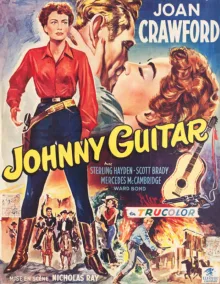
Andras Jones (opens in a new tab) and David Kittredge (opens in a new tab) join Mike to discuss this unusual Western.
Labels: Andras Jones David Kittredge Joan Crawford Sterling Hayden
Transcript
An automatic transcript, tidied into paragraphs. It has not been proofread, so names, titles and spellings may be wrong, and it does not say who is speaking.
Show the transcript (about 17,000 words)
Speaker 1: Hold your ears, folks. It's showtime people pay good money to see this movie. When they go out to a theater, they want cold sodas, hot popcorn and no monsters in the projection booth. Everyone pretend podcasting isn't boring.
Speaker 2: Turn it off.
Speaker 3: To Johnny Guitar says he has to point A, I'll see him later. There'll be plenty going on here soon. Tell me why did you pick this spot to be? How could you possibly know that the railroad was coming this way?
Some time ago, I ran into your surveyor and we exchanged confidence. Not take a good look. We want the dancing kid in his bunch. You're one of them.
Someone holds up the stagecoach. Your brother is killed and all you can think about is hanging the dancing kid. You know he didn't. We're taking you and your men into custody.
Eddie, you can stop spinning a wheel. We don't want you here.
Speaker 4: I saw the stage being held in. What? Why didn't you ride down and help him with? MIKE WHITE: What this?
Speaker 3: Listen good cause I'm only gonna say this once in 24 hours, I'm passing a law against gambling and drinking any place outside the town limits. You've got no call asking us to leave. I'm not asking. I'm telling you if you're smart, you'll ride out of here and you won't come back.
That's what I should do, Mr Guitar.
Speaker 4: Yes, ma'am.
Speaker 3: You still want the job fooling with a strange woman. Can bring a man a lot of grief.
Speaker 4: You a strange woman.
Speaker 3: Only to strangers. What's going on with you two as I jump, you'd better stick to your dancing kid. You'll live longer. Johnny down there.
I sell whiskey and carts. All you can buy up these stairs is a bullet name John. MIKE WHITE: You t welcome to the projection booth. I'm your host, Mike White.
Joining me once again is Mr David Kittredge. Save yourself. Also back in the booth is Mr Andras Jones. ANDRAS JONES: When you boil it all down, what does a man need?
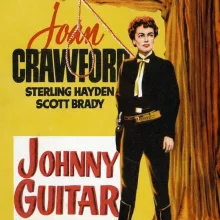
Just a smoke and a cup of. MIKE WHITE: Coffee Western Month continues with a look at Nicholas Ray's Johnny Guitar released in 1954. The film stars Sterling Hayden as the titular Mr Guitar. However, he is outs shown in the film by Joan Crawford as Vienna and Mercedes McCambridge as Emma two women with a history.
Actually, everybody's got a history in this movie. We'll definitely be talking about that and we will be spoiling the film as we go along. So if you don't want anything ruined, just go ahead and turn off the show, watch the movie and then come on back y'all, we will still be here. So, Andras, when was the first time you saw Johnny Guitar?
And what did you think? ANDRAS JONES: The first time I saw it must have been on some sort of afternoon TV. My mom would always have the old movies on, during that time in the week that they would show on our local TV stations. But I'm sure I saw it more recently when I started to get into Nicholas Ray.
And my reaction to this film is one, I have to very few others. But what's the, I'm just blanking right now. What's the Pt Anderson film with Joaquin Phoenix is the detective, inherent vice, inherent vice. I have had the same experience with that where I get about one third into the movie and I'm full, I get enough movie out of this in the 1st 3rd, I get that with some David Lynch films and even some Kubrick films.
I think I had that reaction with, to Eyes Wide Shut even though, I mean, it's different if you're in the theater if you're in for the ride. But if you're watching it on some other device, some movies just give you so much at the beginning that you walk away, stunned in the middle of the movie. And this is that movie for me and having, and that's why I love podcasting about movies. Is it gives you a reason to stay and stick it through and watch the whole thing and I've watched it about four or five times this month and there's so much to talk about in this film.
It is. So it reveals so much in repeat viewings, especially the more you know about Nicholas, the history of everyone involved. Really the story of this film inside and out is just books could be written, should be written, maybe have been written. But yeah, that's my experience with Johnny.
MIKE WHITE: Guitar and David. How about yourself? DAVID KITTREDGE: I probably was looking to be a Nicholas Ray Completist if I had to guess. But it was several years ago and I just remember being really thrown by it.
If you're looking for a movie, that's a Western. That's Joan Crawford and I don't know who would look for a Western. That's Joan Crawford except for me and many of my friends. But it's, it's a very unexpected film I think is the best way to say it.
Big takeaway from me was it is a packed movie. Agree with Andris. It was not too much for me though. I wanted more.
I was a glutton for this technicolor soaked four by three high melodrama. And anyone who is of my persuasion and a friend of Dorothy will appreciate the hell out of the wild saturated perversity of this entire film. This film is dipped in testosterone and estrogen and then run through a technicolor optical printer. The film is that a 10 going on 11 going on 12 and that's only in the 1st 30 minutes.
And one of the things I do want to talk about is the first act of this film, which is so crazily unconventional it, for just from a structural standpoint, one really needs to talk about it because it's nothing but seething standoffs at any point in the 1st 30 minutes. It's all, it's almost all interior in that one location. It almost plays like a play like 30 or 40 minutes, the first act of this entire film and yet it's like the seething everything is gonna break into hysterical violence at any point, these this tension.
And of course, Joan Crawford is Maxim. Joan Crawford in this film. If you've ever thought of Joan Crawford as like kind of an icon as you know, you have the idea of Faye Dunaway playing her and mommy dearest. This is that this is entirely, you can just picture her off camera going home, demanding Tina get her the ax like any point in this movie she is, everyone wants to fuck her.
Everyone in this movie wants to fuck Joan Crawford. No, you do have to swallow that. That is the gimme from this movie. You have to be like Joan Crawford is like an insatiable sexual force in this movie and everyone needs to throw themselves at her, but she can hold her own as she does over and over and over and over again in this movie, somehow the damsel in distress and the protagonist and everything in between at any given point in this movie rapidly.
Yes. If you're, this is a great movie, you might have heard a lot of projection move podcasts where like we're like going to, I think my last one was a while ago. It was like Die Laughing with Robbie Benson. It's just this, we're not, this is not one of those episodes.
This is a movie, this is a movie, genuinely great movie you need to see. It's up there with the canes and the vertigos and the seven samurais and 8.5. It's in that league and the fact that Nicholas Ray, the director did this and rebel without a cause in what two years or back to back, it's oh my God. There are these moments in cinema history where a director is on fire.
This is that this is that period and this is that director and as they say, in death of a salesman, attention must be paid if you're a cinephile. MIKE WHITE: The very first time I saw it, I was probably early to mid twenties and it was too much for me. I couldn't handle it. It was just like, like you both have been saying like the first act is freaking nuts.
Just how much stuff happens, how much we are being force fed of all of this information and how I mentioned before about, you know, oh yeah, he's a man from her past everything happened in the past. This movie feels like it is a sequel to something that we've never seen before and they don't care. They're just like, oh, well, I had this relationship with this guy and I, and she had this relationship with this person. Da, da, da, da.
I'm like, what the hell's going on here? What did I just get dropped into? It plays with so many of the Western conventions even from the very beginning where you get Sterling Hayden going across this landscape and there's this huge explosion, you're like, what the hell is going on? Oh, it's the railroad.
It's the encroachment of civilization which plays a huge part to this. And then he goes along a little bit more on his horse and he sees a stagecoach robbery and I'm like, wait, are we in like 3, 10 to Yuma? What's going on here? He doesn't do anything about it.
So you're like, what kind of person is this? And then you realize once he gets into the bar into Vienna Saloon, which I believe she owns 51% of that saloon. Don't fuck with me, fellas. This ain't my first time at the rodeo.
We end up saying, oh, you don't have any guns on, you just carry this Guitar, ok? And you're like, what the hell is going on with this? What is happening with this Johnny Guitar character? And it's so unusual that it's called Johnny Guitar.
When really he takes a backseat to everybody. He has never thought about him at all of this movie. No, no. I mean, he's acted upon, yeah, he's acted upon.
He's not an actor in this movie. I mean, he is Sterling Hayden. So he's freaking amazing. But yeah, this is so much Joan Crawford's the voice in the, oh God, it's so good in the cast of this.
Fantastic. I just love everybody that's in this and you get the stuff that's going on at Vienna's saloon, which is also a gambling establishment. And I love when he comes in and you just have all the croupier standing there. No one else, no one else is at the saloon.
And how she comes out is just like start spinning that wheel, Eddie. I want to hear that wheel spin and the wheel plays such an important part in this, especially as it is. Attention is on the wheel. ANDRAS JONES: Eddie.
When Sterling Hayden walks in, I feel like he is entering a David Lynch World. I can. Everyone's all about David Lynch and Wizard Of Oz. I'm watching this.
I'm like this has everything this could be directed by David Lynch as a part of one episode of Twin Peaks that lodge obsession with the smoke and the coffee, the just the colors, the creepy silence and them just looking at him. It, I just, I feel like Lynch an inspiration seeping out of this at every turn. Especially that first act. Like the odd musical nature, the sty act, the overacting that all works.
Just that opening when he walks in, that's enough almost. I need to stop the movie there and take a moment because it's so rich. And I was, and you're right. I was saying as I was watching, it was like everything in this movie is so sexy.
It's just hungry, erotic energy pulsing through everything and it's, but unless maybe if you're a kid, it doesn't reach you so much because you don't have the older and the more decrepit you are, the more receptors you have. DAVID KITTREDGE: I think you can feel it though, you can still feel it as a kid, right? And it's clear that David Lynch was super influent by Ray's work and this film in particular, a lot of other filmmakers too, you can see shades of hateful aid in here. You can see a lot of stuff like a lot of movies rip this movie off or at least took great inspiration because it's so and the sexuality is extremely, there is of course straight sexuality in here, very overt and very explicit, but it's or explicitly expressed.
But it's super queer. This movie is super queer and just runs that line of implication and I don't know Subterranean subur queer energy and a lot of that, of course, is Mercedes McCambridge and can only be described as one of the most full throttle double barreled performances of any supporting character, villain in history. If you have never seen a movie villain Mercedes McCambridge in this movie because she is just on another dimension. She is on another level.
I don't even know what planet she's on. She does these evil things and it looks like she's having an orgasm when she's doing them. She is beyond David Lynch. She is beyond Paul Verhoeven.
She is in this other realm of perverse queer, evil ecstasy, craziness. And yeah, they should bottle that. I would have a bottle of that. Wouldn't you have a bottle of Mercedes and the Cambridge in Johnny Guitar energy.
Just take a little go out on a Friday night. See how you fuck up your life. I don't know. ANDRAS JONES: I think that's pro that probably is just what they use to make Vance at this point.
DAVID KITTREDGE: You know what I'm sure it found its way in a lot of drugs and not all of them legal because she's on and she is somewhere else. She is flying high over this movie somehow. Looking down on it at the same time. ANDRAS JONES: One of the things that to me is unavoidable about this film is its relation to the blacklist and the Hollywood blacklist and the anti red scares.
And it's like, so I just feel like it's important to set the stage because first of all, in reading the Mc Gilligan, the Patrick mcgilligan book, I listened to your interview with him during the, in the lonely place episode. But reading that he says that Ray only thought of it as blacklist analogy when the French critics started accepting him and reflecting back what they got out of this film, which to me is insane. I don't know how that's possible. He's got Ward Bond who was one of the leaders of the anti-Communist witch hunts in Hollywood as your evil evil sheriff guy as he, I don't know if he's a sheriff.
He's a rancher, evil cattle baron guy leading the Lynch Mob with Mercedes McCambridge. You and Sterling Hayden had to name names or do the compro they're all compromised by the blacklist, Philip Jordan, the guy who's writing it, quote is, was known as one of those fronts for blacklisted writers. So you think there's got to be blacklisted writers working on this script that Philip Jordan is taking credit for either Nick Ray was lying or he is truly an idiot savant that he could make this film as a director and not know that he was doing that.
And then his film Run For Cover, which comes not very long after this with James Cagney is also basically the same movie. It's an anti posse, anti Lynch Mob very strong strongly throughout with people delivering monologues about how the evil of a posse and the evil of a Lynch Mob. So that's one of the things that I'm really looking forward to exploring in this is how this is such a blacklist movie. And also very curious to hear from the two of you, if you think it's possible that Nicholas Ray could have been unaware of that.
MIKE WHITE: I don't think he could have been unaware just the scene with Turkey. So one of the, we've got Johnny Guitar and Vienna and Tom who's played by John Carradine and then these three croupiers, they're kind of central to Vienna Saloon. We've got, as you mentioned, Mercedes McCambridge and Ward Bond and a bunch of other character actors who are the townspeople who are very against the railroad coming into this area because they are all these cattle people. They don't want the railroads to come in and disrupt them.
They don't want this new town that Vienna is basically promising. She's very much Jill from once upon a time in the West where they've got, she's got this area that she knows the railroad is going to stop at and she's just waiting for progress to catch up with her. She's waiting for that railroad to come right by her door so she can open up this town and make a lot of money. And then you've got the dancing kid.
I just love his name and I love that. The dancing kid criticizes Johnny Guitar. That's no kind of a name. But you got the dancing kid, Bart Corey and Turkey as his henchmen.
And at one point they catch Turkey and I know it's a long preamble to get there. But at one point, the Lynch Mob catches Turkey and they're like, just tell us that she did. It. Just tell us that Vienna was in on this.
If you tell us that Vienna was in on this, you'll go free. Everything will be fine. I mean, it is so Joseph mccarthy, it is totally what they were doing in Congress. ANDRAS JONES: Yeah.
And it's clearly what they said to people because the people who are in this movie are the people, the survivors of the blacklist. The ones who were like Turkey Sterling Hayden as tough as he is. He buckled, Nicholas Ray, he buckled, he bent the knee to this thing and they are like the fact that they all end up on this not quite poverty row but the lower end side of the street making this Western almost like a garage band. It's unavoidable.
They all have to and you can feel it. They all have to be feeling it. That scene is that you're talking about great greatness in this movie. That scene is one of the I missed it because I didn't get to the end of the movie so many times.
But that's an amazing scene. DAVID KITTREDGE: One of the other things that this movie deals with that a lot of westerns deal with is the end of an era. It's the end of the West. It's like we're out here in the West, but there's only a matter of time before the railroad comes and brings everybody and it's all different and there won't be all this wide open space and movies like The Wild Bunch deal with it very explicitly.
This movie deals with it very explicitly. And it's interesting from a political standpoint when you look at what Vienna stands for, which is, I'm the new, I'm making my ST this is new territory and then it's like the forces of the old, the forces of the witch hunt, the uber capitalist, not really even capitalist because she's a capitalist. But the monopolists like the, basically we own all of this and we want to own you too. And they're like, wait a second, you own all of this.
How much is enough? I'm just over here doing this thing and it's very political and that politics actually seeps into the sexuality aspect of this and how sexuality and relationships are dealt with because Vienna is no angel. She's no virgin. There's, it's made, it's implied more than once.
I think that she did something to get a lot of money. We never find out what, unless I'm wrong. ANDRAS JONES: I think we can, I think we can assume that she. DAVID KITTREDGE: Kill her rich husband or did she just outlive him, whatever, at any rate?
She has a bunch of money. ANDRAS JONES: Maybe I'm totally missing it. I have just assumed when she's talking about this, that she was a prostitute. Like she left and she made money sleeping with lots of men because he's like that.
How many men have you forgotten that whole thing? And that's how she made her bank and now, and she did enough of it. So she got respectability and through cash. MIKE WHITE: I was assuming that it was prostitution as well.
Especially when she talks about how she got the tip about where the railroad was going to be. And she says that what she shared his confidences or something, a few. Yeah, there we go. So I was also under the assumption that she was kind of again like Jill from once upon a time in the West, a call girl or a saloon girl or something at some other place.
And she moved to this area and that's why the people hate her as well is that she is a tainted woman from Albuquerque. Maybe I'm also curious about her name Vienna, like as this post war Western, Post World War Two Western. I mean, her name was Vienna in the book in the original paperback by the paperback only came out a year before. It was basically, I mean, the paperback is dedicated to Joan Crawford.
So I have a feeling that the author just written in tandem like, yeah, and was like, hey, I really think that this is a vehicle for you. But yeah, Vienna, I mean, at this point, it's divided into what four quarters and different people own different parts of it. Like I've seen the third man. So this is what, where I'm coming from with this as far as like, well, there's the French quarter and this quarter and that, and it's like, she's kind of, to me she's almost the city.
She's kind of ruined, like the city is right now and trying to, like, rebuild herself the way that they're trying to rebuild Vienna, the actual capital of Austria. But I don't know, it could be stretching a very, very far with something like that. ANDRAS JONES: No, I was thinking the same thing and it's, but it's also, it's not just the end of an empire, it's the beginning of an empire. It's a transition as place at the center of multiple different empires.
Yeah, I think it's, it can't be complete, like, it's written by an author who must have thought about that. MIKE WHITE: Yeah, they definitely change the book huge. I was reading the paper back and it was weird that the paper pack, it was a second printing and it was already a tie to the movie, but it didn't have any sort of thing on the cover that talked about, like, you know, see the new film, you know, none of that kind of stuff is still the old painted cover. It looked gorgeous thing was falling apart, unfortunately.
So it was like, as I'm reading it, the pages are falling out, it's very, very different than what we see. On screen. What's really remarkable to me is that the whole book starts with Tom, the drunk, who ends up being the John Carradine character who maybe he's a drunk, but he doesn't seem like it. It seems like a pretty good guy to have on your side and he ends up taking a bullet for later on.
The thing with Tom that I really like and it's not even Tom thing. It's the croupier. One of the croupiers might be a, when he breaks the fourth wall or so, it seems like he's breaking the fourth wall after Johnny Guitar goes into the kitchen to get some food with Tom. And the croupier comes walking up to us, the viewers and starts talking about how Vienna is more man than a woman or more woman than he's ever seen kind of thing.
And he's talking to us and then you realize, no, he's not talking to us. He's actually talking to Tom and Johnny Guitar inside of the kitchen. I was just like, whoa, what's going on? ANDRAS JONES: And just to be clear, he says, I never thought I'd work for a woman.
And like it. DAVID KITTREDGE: This is a very subversive movie. The gender politics alone, correct me if I'm wrong. This is like either the first or one of the first westerns with the most the protagonist and the antagonist as women.
This is women fueled women powered movie. And it's really about a woman exercising control over her own destiny and the implication that she got there through either prostitution or marrying some whatever she used her body to get there. And now she's juggling what, two men who want her three if you count Turkey and she just wants to get what she wants. And we don't even know how she feels about anybody, any of these men until what, like halfway through a little more than halfway through.
She finally and even then is she just saying that is she just saying that to get what? Because she needs something at that moment. Is this just utilitarian? I'm not that cold hearted though.
I prefer to think that it's sincere because, you know, it's Joan, we're all, we all have to have a soft spot for Joan. ANDRAS JONES: And we all have to, and how can you not love Sterling Hayden? I have to. DAVID KITTREDGE: Admit I could not get General Ripper's voice out of my head whenever he talks.
And I know this is a thing. It's, I, this is a personal thing. It's because I grew up with Doctor Strangelove.
Speaker 4: I can no longer sit back and allow Communist infiltration, Communist indoctrination, Communist subversion and the international Communist conspiracy to sap and imp purify all of our precious bodily fluids. DAVID KITTREDGE: I was just like two moments away from hearing him say that at any point during this movie. And I think that's a cross I personally have to bear. ANDRAS JONES: And we don't want to go down the whole Sterling Hayden rabbit hole.
But I feel, oh, but it's a great rabbit hole. Great to talk about those because that is to me, sort of the beginning of the later era grizzled haunted guy that we're going to see in the long goodbye. And also at the end of 9 to 5, I. DAVID KITTREDGE: Brought that up to my fiance.
I was just like, by the way, this is not only the general from Doctor Strangelove, he's also the Da X Machina. And 9 to 5 is what I'm like. He's the chairman of the board. He comes down and he's sends Dabney Coleman to Brazil.
He's what I'm like, yeah. ANDRAS JONES: It's him. Think about that. The end of that movie, the punishment the guy gets is a promotion.
That's crazy. But this is maybe the end right around the end of that golden boy, perfect man thing, the Sterling Hayden had. And so to me, it's easy to see the di to feel the difference because this is the more like the guy from the killing or suddenly or any of those really great ones with him. And it's again, such a metaphor.
Everything in this movie is a metaphor for something else. But Sterling Hayden was like a war hero came out of the war. Golden boy, the hero of film. And then the next thing he's a known Communist.
The next thing he's the broken alcoholic in long goodbye. It's crazy. That you can do that with almost everyone in this movie except. DAVID KITTREDGE: Mercedes McCambridge became Pazuzu.
MIKE WHITE: Yeah, exactly. Obviously, we have to talk about some of the fashions and stuff in here as you're talking about the sexuality. I mean, to have two female stars in here that are going at it and they have almost the exact same haircut. Both of them have this very, very short haircut and so much of the time Joan is wearing her trousers and her shirt and her little neckerchief tie, very, very Manish dress that she has.
There's one moment where she wears this white dress and it is so different from everything else. And I love how quickly she gets out of it. DAVID KITTREDGE: It's like wearing a lantern. It's like wearing a lantern, right?
MIKE WHITE: And then she, it gets set on fire. ANDRAS JONES: The hair thing. If you remember from the book about the Patrick mcgilligan book, that was a huge sticking point for Joan Crawford. She really wanted Mercedes McCambridge to have to dye her hair blonde and she refused to, which also we should bring up.
Speaking of Joan Crawford as like Vienna as the controller of Vienna's Joan Crawford was the producer of this movie. She hired Nicholas Ray who was her lover at the time leading up to the making of this film, but they had at least according to the book had separated before the beginning of this film. So Nicholas Ray is his boss, is his ex-girlfriend, who's the star and the powerhouse of this film, which, you know, again, I'm probably repeating, I'm repeating something from the book, but it's interesting that he had that relationship.
James Mason was the producer of Bigger Than Life. And Humphrey Bogart was the producer of in a lonely place. So he has this sort of topping from the bottom kind of quality to his, to his direction where he's just sneak, he somehow manages. If you look at the history.
DAVID KITTREDGE: Of directors, this is not an uncommon thing. Like they will either have been in a relationship with someone that they end up working for or involved with them in some kind of personal way, not necessarily all professional, not necessarily even romantic, but the thing to remember about directors that people not in the industry don't understand this, their whores literally in the Dipalma. If you ever saw that Dipalma documentary, the one where he's like the is it Noah Baumbach? I forget who did that.
It was the, it was a documentary anyway, it's basic. Yeah, it's like literally him just talking for 90 minutes. And one of the best things he said, and this was echoed by a lot of my friends who happen to be directors. It was just like there is no planned career, basically, it's whatever happens next.
So directors even then scramble for whatever project they can get off the ground unless you're like at this point, Chris Nolan and God I don't even know who else it's instructive to think that even a few years ago, Spielberg almost didn't make Lincoln because he couldn't get the money for it. Steven fucking Spielberg could not make a movie with Daniel Day Lewis about Abraham Lincoln and it almost went to HBO or something crazy. And it's this weird dance that directors do with projects, with talent, with money, with producers and it goes back forever.
And when you think of someone like Nicholas Ray who was a very, you know, he was subversive, he was very leftist, he was very free spirit. He was very free, like free love, all of this stuff which he later got in trouble for in the conservative fifties and everything. And unfortunately, was alleged to have buckled under house un American Activities committee. Although I don't think that was ever verified, but it was implied that he did something because he wasn't blacklisted, like people who did nothing.
It's very instructive that such a free spirit and such an experimental filmmaker as in some a filmmaker who's willing to push himself beyond any kind of comfort zone to make really out their work, which this film absolutely is and rebel without a cause is thematically but maybe not an execution. That's a much more traditionally executed film, a great one. And also about outsiders like this one, outsiders, subversives coming in to try to live their authentic lives and being put down by these forces, these either the system or the government or capitalism or whatever.
And it's that street that runs through all of his work, which is why I think his art really holds up. ANDRAS JONES: And speaking of rebel without a cause, even in that one, James Dean isn't the producer, but he Nicco, according to everyone who worked on it, Nicholas Ray still found a way to make himself subservient to his star in making that film, which I just think I've worked with a lot of directors. I wish more directors figured out that trick instead of the leading by dominating or manipulating from the top. DAVID KITTREDGE: I would say actually that most working directors in Hollywood don't follow that Otto Preminger kind of thing that they do.
ANDRAS JONES: I found it to be more of a passive aggressive, like doling out flattery like it's you can feel, I guess with, I haven't worked with Martin Scorsese, but I think with a lot, I worked with a lot of legit directors who are, you know, who make things and get things done. But that I just feel like Nicholas Ray probably had a real gift for being, giving off the air of being incredibly smart and sensitive and sh if he allowed, if he's shown that on you and said, I'm, you're the star of my movie, I'm going to follow you rather than I'm going to tell you where you should go.
I think it just made him, I think that's why he got such amazing performances out of not just the ones we're talking about, but like Jim Jamie James Cagney or Richard Burton, they are unique performances that these people give. Bogart. Of course, that's a fantastic, yeah, just aching. There's an aching that I just feel like that must be the tone of the relationship he has with his stars that it is really a love affair, something going on there.
Not necessarily physicalized, but that just to work with that guy and be have the talent to be able to resonate with it though. That's why you get Rebel without out of cause this is a. DAVID KITTREDGE: Director that loves actors, clearly loves actors. And that in this film that in Rebel, that all of his films really to get to go to rebel for just one last moment to get a performance out of Sal MLO who was not a household name at that moment.
But that performance that vulnerable, that dangerous a performance that is a very dangerous performance and it really did define his career moving forward for the rest of his life better or worse. But it's an indelible performance and James Dean, indelible performance. And a lot of this film, Johnny Guitar could be explained by. Yeah, he followed Joan Crawford.
This is like looking into Joan Crawford's looking inside her brain is like, what Western would you do? Joan? It's, it's a Western where I'm strong except I'm feminine. I'm a damsel in distress and saved at the last second except I'm also kick ass and put everyone in their place.
I wear fabulous outfits with these big red beaming, shining colors and I'm super butch. Except when I'm wearing this flowy white dress and playing a piano and telling the men to go away. It's very what you would imagine her inner Western monologue to. MIKE WHITE: Be her playing that piano in front of those red rocks.
So like her saloon must be built up against the rocks and part of one of the walls basically is the mountain and so her in that white dress in front of those red rocks. And I know they're probably not real red rocks. I'm sure that that's just all shot on a sound stage. It sounds like Joan very much didn't want to be on location and she would use body doubles in some of the longer shots and then her in front of backdrops, the closer shots.
So I'm like, ok, that's fine. It gives this film this odd artificiality at the same time. Like you get some great outdoor scenes and especially towards the end of the movie. But so much of this as you guys were talking about, this is stage bound.
No one that there was a 2004 musical version of this because we're all in one location for it feels like half the movie. This is not the act structure of this movie is pretty odd. DAVID KITTREDGE: The 1st 40 minutes are basically in one room, one room, the 1st 40 minutes of this entire movie and yet the script is so good. You set up how many characters all of these people and what they want.
It's insane like screenwriters, if you ever want a crash course in how to set up a movie, maybe not stick them all in a room in 40 minutes. But look at the efficiency of how the script is written in the first act and how it sets up. Literally everyone, you know exactly who they are, you know exactly what they want and you're invested, you really care about these people and what they want and even the dumb ones, Ernest Borgnine staggers in and does his stupid shit. And you're like, I don't know why he's picking a fight but I get it.
He's the dude that picks fights, ok, I get it and turkeys, he just wants to prove himself. And the Whistling Kid is over there doing this thing and Sterling Hayden, you don't know what he's doing and then you find out what he's doing and even the croupiers, how many characters do you meet? It's, it has to be like at least a dozen and yet they're so in clear, they are so clear and they don't feel like cardboard cutouts. They don't feel like cliff notes of characters.
You feel like they're real people in this weird artificial World. And I would love to talk about that more because the artificiality of this film is very much emphasized in the production design in the costumes, the impossible costumes. And I say impossible because she's wearing these clothes that if you wore them for five minutes in this location, they would not look like that. There's no way you could keep that dress that white for more than two minutes in West with blowing dust everywhere or that those red, that, that wonderful outfit with the gray top and the red kerchief or something.
MIKE WHITE: Oh yeah, it's like a yellow shirt. DAVID KITTREDGE: Oh yeah. And the yellow shirt, the bright yellow shirt, it's like looks like these clothes are comic book saturated. ANDRAS JONES: And what's so funny is like they go out of their way to make sure their eyes are covered in dirt.
When they come in, these, their faces are covered in dirt but their outfits. DAVID KITTREDGE: Are, their outfits are runway ready. They look fantastic. So you're always in this World.
That's not really the World. It's a World, it's this World, but it's not the World you're in this dream. And this is one of the reasons that this film, I think the best way to describe it as a whole is it's hallucinatory. It's like you're watching a hallucination and there are very few films you can say that about which is why this film is so great and so special.
Remember the scene where it's about halfway through the movie and Sterling Hayden goes up to her and they have this conversation about he's like a posse is like an animal. It moves like one of things like one and she's just OK. Ok. So we have this wide shot which is obviously on location of her walking to this bridge or I think it's her, it doesn't look like a body double.
I think it's her. And then we cut to the most obvious studio rear projection you have ever seen in your life, literally like one cut to this other cut and it's, there is no way. This is the same location. This is so obviously a backdrop and they're in there in front of this plastic fence that they're leaning on and it's just like that was not the fence.
This is different and you have to believe that this was intentional. I don't think this was just a way around things. They intentionally made it so heightened and impossible that you're never completely in the reality. You're always experiencing the reality but not really buying the reality and their performances which are heightened play into this too because you can never really believe them because they're all so arch and the lines are so perfect and the comebacks are so tight that it's just people don't, there's nobody who acts this way or speaks this way ever.
MIKE WHITE: I never want to be like the oh movie error guy. But I know exactly what shot you're talking about because I noticed when they're walking down that bridge, it feels like the Sun is coming from one way and then when they cut, it's actually a sunset. So the Sun would actually be coming from the other way. So I'm just like, ok, I almost like you did that on purpose because you could have flipped the negative and made it so that the Sun was going in the right direction.
But instead it's so jarring or just. DAVID KITTREDGE: Change the backdrop. That was intentional. ANDRAS JONES: Nicholas Ray's sneakiness as a director comes in because you could see it being a situation where he looks at and is Joan isn't gonna go on set and they're not gonna give me a budget to do this.
And I feel like like this was the only his second one with color, using color. And if you watch the flying leathernecks, there's a couple of scenes where he uses super bright yellows and like he's taken his first hit off a new drug and he's like, wow, you put a big yellow in the middle of it and this starts to something else starts to happen. And I feel like there's a lot of moments in this where he takes the cheapness and he takes what Joan Crawford is in, is interested in on stage and he just says, OK, you can all be cared about that.
I'm gonna focus on colors and setting up weird dreamlike situations. So that in this thing that I'm probably not gonna get to edit, you're going to have to make my movie instead of the movie that you all think you're making. And so I think it's, I think it's intentional but it's not intentional from the outset. It's like these are the cards you're dealt with.
As you said, a director can't make a plan. They, a director can work with what they're given. And that's where you have him doing this magical thing, which is, I think exactly what you're talking about is turn making it dreamlike, but it's like they gave him a bunch of shitty options and he turned that into a perfect cinematic moment that we've now talked about for five minutes. MIKE WHITE: Don't forget by the way that I call it her ketchup and mustard outfit where she's got the red tie and the yellow shirt that's actually Turkey's clothes that's after she comes in and is soaked and they've been traveling and she's like, oh Turkey's got some clothes and yeah, so she's using his dress, which I thought was great.
Fits are great. ANDRAS JONES: And can we talk about how Turkey and the dancing kid are basically James Dean and Biff from Rebel without a cause? Just, it's like their grandparents in the old West. MIKE WHITE: Yeah, that whole gang.
Just the dynamics between these four guys where you've got Turkey, the young guy, you've got Bart played by Ernest Borgnine who just is always bucking against the dancing kid. I didn't realize I'm trying to remember the name of the actor. That was the dancing kid. I didn't realize he was Lawrence Tierney's younger brother.
I'm like, oh yeah, yeah, I was listening to thank you. I was listening to a commentary today and the guy was talking about that. I was like, oh OK. And apparently he got cast possibly because Nicholas Ray slept around a lot and Nicholas Ray was sleeping with the sister in law of Scott Brady.
I believe it was at the time and not Tierney's wife but somebody else like another brother or sister or something. So, and then you've got Royal Dano as Corey who has this hacking cough and they talk about how the dust isn't good. And the very first time you see the gang, it's all of this dust that is flying around and again, I'm sorry to keep beating on this horse. Their entry into Vienna is exactly the entry of Cheyenne and his gang in once upon a time in the West.
You hear all the shooting outside, you hear hooting and hollering. You don't see any of that action outside. You just get them coming in to the saloon and then turning around and then you get to see that they're faced with this entire mob. I mean, it's, that part is different but just the way that they enter into the saloon and you're talking about how everybody is very well defined and I agree with you except for, and I think this is very important to point out the posse the whole town.
Basically. You've got Mercedes McCambridge. You've got Frank Ferguson as the marshal and you've got Ward Bond as John macgyver's, you could hold a gun to my head and I would not be able to tell you anybody else that's part of that posse because they are basically faceless and just stand around in the background. They are that mob and they're ready to become mobify.
And I love that. So much of this movie takes place after Mercedes McCambridge brother Emma Emma's brother is dead and they go to this funeral. And so everybody's dressed in black for the second half of the movie. It just makes it amazing how colorful the outfits are of Vienna and everybody else versus the black of the gang that's coming to get them to the posse that's coming to get them.
ANDRAS JONES: Now, when you say that you wouldn't recognize anyone from the posse, there is one member of the posse you would recognize because he went on to be the sheriff who shot Bonnie and Clyde. MIKE WHITE: What Denver Pyle, I didn't see him. DAVID KITTREDGE: Yeah, that was the Dukes of Hazard guy. ANDRAS JONES: Oh my God.
He has that like the one like the Richard Dreyfuss line from the graduate. Like he pokes his head and you want me to get him. I'll get him and. MIKE WHITE: Then I didn't realize that that was him.
He looked so different. I'm used to him with that big old beard and the scraggly hair and everything. ANDRAS JONES: Total Uncle Jesse referring back to the book. Supposedly the dressed in black thing was a reference to the MC A agents.
He was referenced that they had a dress code of black suits. So take that was on the set, they referred to him that is Lou Wasserman because again from the book Nicholas Ray, Lou Wasserman was his age who kept him safe through the blacklist times. During the time they were working together. Nicholas Ray was having a torrid affair with Louis.
Lou Wasserman's wife who wanted to leave Lou Wasserman to be with Nick Ray and that led him to cool it with her. But talk about you gotta be freaking smooth to pull that one off. DAVID KITTREDGE: I think our listeners are getting a really good impression of who Nicholas Ray was and the kind of artist he was because yeah, he's that guy. He's that guy.
He's the guy who would sleep with the wife of one of the most powerful people in Hollywood while you're trying to be a film director. I don't, I don't think his middle finger could have been up higher to most of the power structures in Hollywood for as long as he and you can see like the filmmakers that love him later are all the ones Almodovar. Oh Almodovar excuse me, I would say his name wrong or even Scorsese. Scorsese is huge fan of Nicholas Ray.
ANDRAS JONES: If you have you seen Run For Cover? I have not. There is a guy, there's a sweet an actor who joins the Lynch Mob in that who I swear Dicaprio based his character's look in killing the killers of the flower moon on this guy. This member of the Lynch Mob from Run For Cover.
It's crazy. This is another piece we're talking about the gang and this is 1953 right? DAVID KITTREDGE: It came out in 54. So yeah, 53.
They shot it in. ANDRAS JONES: I'd say rock and roll is not really a thing. It's barely a thing yet. Elvis, I don't think has, has in his big contract with Capitol Records or, and this movie is such a rock and roll movie, the guy Johnny Guitar and the dancing kid and the music and the guitars and even the way the game comes in, they're like a rock band.
They feel like the monkeys rolling in and they're laughing and winking at each other. DAVID KITTREDGE: And who was the blackboard jungle, Bill Haley and the comments or whatever they're called. ANDRAS JONES: And that's something about Nicholas Ra. I feel like he is smuggling the future into these films, whether it's through the queer politics, whether it's through the youth energy or the music and the rock and roll and the cultural signifiers.
It's crazy. He's, it's almost, it feels shamanic, his directing style feels like I don't know what I'm doing, but this is coming through me and you're gonna all have to deal with it because I'll be gone. It's super subversive and it's, and it is meant to speak to your subconscious, the fight between Ernest Borgnine and the way that Nicholas Ray deals with it because first of all, you were talking about how you get the sense of who Ernest Borgnine is. And I feel like the most Ernest Borgnine shot I've ever seen is the look on his face.
When Tom, I think it is takes his knife and he gives that smiling look of we're gonna have a hell of a fight and then they go out there and then we have a scene with the dancing kid and Vienna just talking Johnny Guitar. We do and I wish they didn't cut to this fight for one because the one shot where they cut to the fight and I'm like, that's the fucking editor Nicholas Ray did not give that cut. The whole thing is they walk out, they have a fight, we hear it. We have this overwrought dramatic scene and then they come back in is that the first time that was done on film?
Because that is such a fantastic. We don't need to see that fight and to have it be that it's the fight starts and it's all set up for this macho moment. And then we get Vienna and the dancing kid in this film in the scene that we really want to see, it feels like the most films would cut to the fight and we'd lose that dialogue and we'd come back in at the end of the dialogue. But instead it puts us right in this Douglas Circ scene while this fight is going on around outside.
DAVID KITTREDGE: It's and it's good that you brought up Douglas cirque because Douglas Circ, there's a lot of things to talk about with this film and how it relates to Douglas Circ because it's very much in that kind of vibe. It's been many years since I've seen the Quiet man. But doesn't the quiet man end with a giant fight that takes place forever. But then it gets so boring that cut to people talking about it while it's happening outside.
I don't remember this, something like that. It's like I just remember they're fighting for a ridiculously long amount of time at that movie for no reason whatsoever really. Because when he wants to marry his sister and they decide that a fight is the way to deal with it. MIKE WHITE: I don't know, it's not the brother that wants to marry the sister, right?
Because I've seen that on Porn Hub a few times. DAVID KITTREDGE: No, it was John Wayne wanted to marry Maureen O'Hara and her brother didn't like him. And so they have this fight that lasts forever. And then the very last shot of the film.
I think they come in, they're battered and bruised and bloodied except they have their shoulders around each other. They're like, like we male bonded and then they're demanding that she cook dinner just. ANDRAS JONES: Like the end of the movie class where Rob Lowe and Andrew Mccarthy have a fight because of the, because Andrew Mccarthy had had sex with Jacqueline Bisset who was Rob Lowe's mother. I just saw it on a TV in a bar like this earlier this week.
And so it's, I was. DAVID KITTREDGE: Gonna say that is the first time I've thought of the movie class in a very long time. ANDRAS JONES: That's probably a difference in terms in terms of what hit us at a certain point in our life and stays in our brains. DAVID KITTREDGE: Don't underestimate the charms of Rob Lowe and Andrew Mccarthy's circa 1983.
MIKE WHITE: This is pitched so high. This is very cch and as far as just the melodrama is Drips with the melodrama like just characters. Why do you hate him? So just all of these like you are really in Mercedes is the person that does that the most.
But everybody else is pretty much on her same page as far as like, I am going to give you a line reading that you have never had before. And here it comes. DAVID KITTREDGE: I will say this and this is high praise. If you know me, this is high praise.
If you remade this movie with a drag queen as Joan Crawford and a drag queen as Mercedes M Cambridge. It could be amazing. Amazing. And literally, you could do it.
Shot for shot line for line. You wouldn't have to change a single line. You put Jack Plotnick or somebody as Vienna. I don't know if Jack Plotnick, he plays Evie Harris and girls will be girls and a lot of other stuff.
He's, he has a lot of really fantastic youtubes because all of her reactions, like even when she's on, remember her dress got on fire and she just turns to the camera in this medium close up. She goes, Johnny, it's just like this and it's the most acting you will see ever. You don't believe it for a second. You're just like, that's Joan Crawford acting like Joan Crawford and Johnny Guitar in her medium close up.
She saved up all day for this moment. MIKE WHITE: She's and apparently everybody hated each other when they were on set. Like there was one moment where Mercedes Cambridge gave such a performance that the crew was applauding and Joan was just like, no, no, that's not good. Just all eyes on me.
DAVID KITTREDGE: Nobody wants to hear how the sausage is made. Ok. That's all I'm saying. Some of your favorite movies.
ANDRAS JONES: Get up here is a bullet in the head. DAVID KITTREDGE: Some of your favorite movies have stories that if you had been on set you've been like, oh God, I can never watch this the same way. ANDRAS JONES: Just imagine Ward Bond is the guy leading the charge against all these people. And he's on the set.
Went in there in that scene with Sterling Hayden. How do those guys even be in the same room together? That's amazing to me. I think you're right.
I think Gus Van Zan picked the wrong film to do a shot for shot remake of. DAVID KITTREDGE: Wow, actually, that would have been amazing. ANDRAS JONES: Vigel Mortenson as ST in the Sterling Hayden role. Come on.
DAVID KITTREDGE: Who could play Vienna and who could play like me like Mercedes, MCC Cambridge's role? ANDRAS JONES: I would be curious to see that era. Gina Davis maybe. Ok.
DAVID KITTREDGE: But who, now if you did it right? MIKE WHITE: Who, now it's Ben De La Creme and Jinx Monsoon. DAVID KITTREDGE: Oh my God. Jinx Monsoon would be absolutely fantastic.
Can we a I the man? It's just like let's just shoot them on green and they put them in the movie? I would watch this movie to hell. Oh my God.
That's fantastic. Please get, get them on the phone link that their next show, Johnny Guitar. They don't even have to write jokes. They could just do this, do exactly the screenplay and have it be amazing.
MIKE WHITE: Yeah. I'm surprised Peaches Christ already put it on. We have dipped into the 2nd and 3rd act a little bit, but so much of our talk has been about this first act because this is the movie guys. This is just, it's astonishing.
DAVID KITTREDGE: The first act is astonishing. Like the 2nd and 3rd acts are great too. But it's like you're in it's your 40 minutes into this, 100 and 10 minute picture, literally 40 minutes in and you're still in this one location. And it's, I remember watching him like we're still in this fucking bar and yet I don't wanna leave.
This is amazing. This is all happening. It's, but it shouldn't work, it should not work, this shouldn't work at all and yet it works absolutely amazingly. MIKE WHITE: Yeah.
And I love this whole thing because towards the end of this first act, the Ward Bond character is basically like, OK, that's it. Everybody, you know, the bars shut down and everybody has to leave town. All of you criminals have to leave town. Yeah, he just decrees that and the marshals like you can't do that.
You can't just make a law right now. He's like, yes, I can, I'm doing it. I love how the marshal is so subservient to the businessman. You know, I've never heard of that.
That the law follows commerce. I mean, that, that just, I'm glad that's only a movie thing. It doesn't happen here in real life, but it was just, I love how he's just like, yeah, that's it. You're all out of town and it drives the bank robbers or drives the gang to then rob the bank and then you have that whole complication too where it's, oh, she just happens to be at the bank the day that these guys are coming in to rob it and everybody else is at the funeral except for these poor two guys that work at the bank.
I don't know how they got stuck with this shift, but they're there. And I love this whole thing again, the inside, outside thing that we're talking about as far as what you see on the inside of the bank versus what's on the outside of the bank. And I love how Johnny is just outside, hanging around again. He never steps in.
He doesn't solve the problem. He doesn't go oh the bank is being robbed here. Let me either help out or put this robbery down and we know he's the fastest gun West of the Pecos which is a big surprise moment for us in the first act of this where we find out he's, he doesn't just play Guitar. He's also one of the best gunfighters ever to live in the West.
ANDRAS JONES: If you're into shooting actual guns at guns, he is the best at shooting his gun at other guns. MIKE WHITE: I read an article that was talking about that damn shot shot glass. That happens. That shot glass.
Oh my God. ANDRAS JONES: About the sexy that, why is that so sexy? Why is that shot so fucking sexy? It's a glass spinning around and then he picks it up with his hand but for some reason, that's one of these super erotic shots in this film.
And I think you're right. It's like something is coming from Nick Ray's alcoholic subconscious that that's why he loves drinking so much because of something that tells us something about his feeling about alcohol. That and also Nick Sterling Hayden turning over the glass in the scene with Ernest Borgnine where Ernest Borgnine tries to get him drunk. Also very sexy.
MIKE WHITE: You know that if that shot glass falls, that all hell is gonna break out that the piece that is there between the very limited piece that's there between the gang and the mob, it's gonna be broken and then that shot glass eventually does fall but falls right into Sterling Hayden's hands and he's just like, oh here, you know, let me get a cigarette from you dancing kid and let me get a light from you Ward Bond and let me just give this little speech about how a cig cigarette and a smoke and a coffee is just the way to go.
And he's got that little dainty blue teacup that he's holding. I'm like, how do your finger, your fingers won't even fit inside of the hole for this teacup. Like what? It's just this great image and again, this blue teacup that's just like screaming its way off of the screen because all of these colors are popping so much.
What was this the process we call like true color. And there were so many years where they were just like muddy awful transfers of this film and then finally, it was given the proper transfer and it was like your eyes just pop out of your head with the colors in this. DAVID KITTREDGE: I think we have to take a moment to talk about the cinematographer Harry Stradling because he is a true Hollywood icon. I'm just going to go over some of the films Harry Stradling shot in his multi decade career.
I'll go from the latest back. Hello, Dolly nominated for Academy Award Funny Girl nominated for Academy Award. My Fair Lady won the Academy Award, Gypsy nominated for the Academy Award nominated and T Maim nominated for an Academy Award guys and dolls nominated for an Academy Award. Streetcar named Desire nominated for Academy Award.
Going back to the Picture of Dorian Gray in 1945 which is a really arresting film which as has that big color reveal moment in it, which is just so amazing, won the Academy Award for Picture of Dorian Gray and he had us, he had a couple of kids, I'm sorry, one son, Harry Stradling Junior who was an amazing cinematographer as well. Some of his credits include Little Big Man 1776 for which he was nominated for an Academy Award. This is the Sun the way we were the big bus. One of my little favorites can't really defend it.
That's really funny. So dumb. It's so dumb. But I love it.
Talk about a Hollywood legend, Harry straddling. You can't talk about the history of Hollywood without talking about people that are face in the crowd. People like Harry Stradling who so much of Johnny Guitar is about the look and that insane, like not just the insane color and the color process, but just the look and the feel and the version I saw was 133. But then I read somewhere that it's sometimes projected at 185.
So I don't know what the quote unquote real ratio is supposed to be criterion channel. I think it's 133 but still even in that frame, it's just it you just don't see many movies that just look like living dreams like this film does and it takes an enormous amount of craft to achieve something like that. ANDRAS JONES: I'm looking at his filmography. So Streetcar was 51 that's black and white.
Johnny Guitar is 54 guys and dolls that's color in between. He does angel face, Andre Cleese and the lion, Hans Christian Anderson, which I imagine that has to be in color. And then a lion is in the streets. DAVID KITTREDGE: And yet facing the crowd in 1957 very famously black and white, really effective contrasty, hypnotically crazy black and white.
ANDRAS JONES: These guys are just getting to play with color in a way like there's something about the low like this, just a cowboy picture just AJ. Let them do, let the crazy guy, let them do their like weird stuff. Like it feels like early Beatle. Like the first time the Beatles have a four track of, we don't know we're doing with this.
So we're just gonna crank things up to 10 in a way that you won't once you get more subtle. And I think it's that lack of subtlety. MIKE WHITE: It's funny that you brought up my fair lady because as soon as you said that I was like, oh, well, there's the black and white scene in that there's the whole horse race where everyone is dressed in the black and white, very similar to what we're doing with this posse here where you get that little bit of white around Mercedes M Cambridge's neck but she's in black otherwise.
And that she cares more about vengeance than the death of her brother. It's allegedly vengeance for the death of her brother. But don't you believe it, even if he was well alive, she would be all about getting Vienna. So when her veil flies off while they're riding off and you see that veil on the ground, you're just like, oh yeah, she doesn't give a shit about any of this stuff.
She just cares about getting her gun off. ANDRAS JONES: Hey, can we talk a little bit about the gang's hideout? That opening, that wet and wonderful opening that lets them into their lair and allows like all of our characters to get all wet and sexy. MIKE WHITE: Are you saying it's a vaginal opening in this rock face?
ANDRAS JONES: I would say Yonic, you dirty minded man. I'm, I'm speaking of sacred, the sacred iconography of the feminine. But then when we get into their, talking about other films referencing this, when they get into the lair, I just kept thinking about all the deleted scenes from Heaven's Gate with the gang in their lair. There's feels like a band, it feels more like a band dynamic than an outlaw dynamic.
And it got that same feeling of these are just a bunch of mad people in a cabin and the more we can hang out with them the better. It's a wonderful break from that interior of the lodge. But now we're back in another interior. MIKE WHITE: That is pretending to have that big window with the exterior out there, which I like as well.
Poor Corey, poor Royal Dano just hanging out on a bed through so much of this movie, just coughing his lungs out. And yeah, you get that whole thing. I didn't realize at first when I was watching this that the way that Bart is basically being Judas and tipping off the posse like, oh yeah, right through here. This is how you get into this very cleverly hidden area for these guys.
And I'm so curious how big the area is once they pass through that waterfall because it feels like they ride for a long time. And then other times it feels like once you pass through that waterfall, boom, you're right there at their cabin. One of the craziest designed cabins too. It almost looks like Frank Lloyd Wright designed this thing with the stilts and the big staircase going up.
It doesn't look like something that you would have period accurate. ANDRAS JONES: Nicholas Ray studied with work with and studied with Frank Lloyd Wright. So that's a nice connection. DAVID KITTREDGE: It goes down to this whole rabbit hole of, ok.
How did he build that? Did he bring in? Builder? Did he do that all himself?
Did he cut the wood? Like how did he get away with nobody knowing that this gorgeous hideaway thing is there ever, it's like when I saw the Andromeda strain and they come into this like Arizona wilderness and there's this like lines. Yeah, a lot of money has gone into removing all the worker like the tire tracks from all the vehicles that constructed this thing. I'm like, you would have needed like hundreds of people to construct this gigantic underground virus lab or whatever.
Did you have them all killed? Like where are these people? Like where did you put them up? How did you do this?
So, yeah, I just, or you only live twice that layer in the bottom of the volcano. It's where did they get the contractors to do that? We're specter and we want to build this giant layer that would cost hundreds of millions of dollars today at the bottom of this volcano with a fake glass, whatever thing. And just is it something I shouldn't think about?
But I do. ANDRAS JONES: Maybe that's why they put up with Ernest Borgnine because did he do it as the only one of that group that I could see actual doing hard manual labor. Turkey's pretty soft, royal sick. DAVID KITTREDGE: I can't see Ernest Borgnine with blueprints pulling out blueprints.
Ok. The first stilt has to go over there. It's a load bearing stilt. I did all of the math on this to make sure that the load bearing stilt will.
No, no, Ernie. MIKE WHITE: No, he's very much a blunt instrument in this movie, which is how you use him. I mean, Ernest Borg, not God, love him. He's so good and I just, every time he's on screen, I don't care if he's a villain and he's the worst of the villains here.
He's almost as bad as Mercedes M Cambridge. But I love watching him. I love checking out what this guy is doing because he's making choices with his acting every single time. ANDRAS JONES: He's super fresh right now.
Like he's just coming off from here to eternity. This is like his seventh film and I think it does look like from here to Eternity does a lot to establish that early Borg nine character. He's gonna subvert with Marty. DAVID KITTREDGE: I was just gonna say how far after this was Marty, it couldn't have been that far because that was the movie that made him a major star and got him an Oscar.
Right. ANDRAS JONES: If you watch Bad Day at Black Rock, he basically does the scene with Sterling Hayden and the drinking. Exactly. They completely repeat the scene.
That's the thing to do with him. And that's, it's was brilliant for him to then get Marty. But he comes back and Run For Cover the same year playing a very similar role to this another bully smiling, that smile of his. DAVID KITTREDGE: Get Me Borg Nine.
We gotta roll, get him on the phone. He's got a smile and stab someone and be crazy. MIKE WHITE: I also appreciate later on when they're questioning Sterling Hayden as far as like, why didn't you save Turkey? You know, because eventually I mentioned the scene of Turkey being railroaded by the Lynch Mob.
And so, you know, just not just say, just tell her she did it, just just tell us that she did it and he finally ends up nodding. It's this very, you know, I mentioned Judas before. It's this very big moment of betrayal. Kind of feels like Peter now denying Christ, but.
ANDRAS JONES: Vienna tells him to do it right. That's true. She gives him permission. That's the whole thing you think maybe he would have stood strong except that she tells him to save his life, which makes the betrayal even more.
She actually, for some reason believes that this mob might spare him and just take her again. More of probably Joan Crawford's view of herself. The one who's willing to die for her vision and she's so betrayed by this mob. MIKE WHITE: But yeah, when they take both Turkey and her and string them both up, the death of Turkey is freaking brutal man.
So brutal. And then this whole thing about putting Vienna, you know, also has the noose around her neck. She's on this horse and no one will crack the whip and make this horse go except for Mercedes McCambridge, Emma small coming up here and being like, if none of you will do it, I'll do it. And she's just so angry about stuff and then that great escape that Sterling Hayden is up there undoing the knot or takes the rope off and then they just ride off into the distance.
I love that whole moment but got that death of Turkey man. It's so funny because next week we're going to be talking about the Oxbridge incident and the Oxbridge incident and wow, talk about a brutal film that is really up there as well. ANDRAS JONES: You know, we should talk a little bit about the Peggy Le. Let's talk about Peggy Lee.
DAVID KITTREDGE: Because she gives me fever. MIKE WHITE: I was very surprised that this does have the Peggy Lee song but that it comes in at the end most of these movies because we're doing, you know, this is one of many films that we're doing for Western Month. And so many of these movies start with the big ballad, you know, the 310 to you, Mug Frankie Lane coming at you. And this one, yeah, the Victor Young score is pretty bombastic and there are sometimes where I'm just like, whoa, ok, we really know that you're here, Victor but that they save the ballad for the end.
That was very interesting that they switched it up. And also, I think this is the first time this month that we're talking about the ballad of the song and that it's a woman singer. So again flipping it how we've had, you know, Frankie Lane and all these other male singers doing these songs. And here you have a woman singing at the end of the movie which breaks all these other conventions.
ANDRAS JONES: This is where we have to wonder how much Nicholas Ray knows that he's making this quintessential feminist queer rock and roll Western and how much she's just like juggling. What's he, what he's got and try having fun with color and revealing stuff that he does that there's no way he could even really be aware of. I don't know what your takes like the authorship question of this film because you see why the French saw this. And we're like, this is an auteur, this is a guy who was clearly in full control of the medium.
But if you learn about him, you know, he's like anything but, and yet the product is the product of some kind of perfect vision. But from a guy who couldn't possibly have had that clearer vision, that. DAVID KITTREDGE: Bunch of critics in France, the Calle De Cinema people, the Truffaut and all those guys, movies were for the longest time just viewed as like a low rent escapist, whatever. It's like a time out at the movies was just like a basic thing to do, not considered art, not considered high anything.
And it wasn't until I think the late fifties, early sixties and the French new wave started and you started seeing the French mostly spearheaded this like reassessments of people like Hitchcock, John Ford, Howard Hawks and Nicholas Ray and like viewing their work, not just as escapist entertainments that were meant for a wide audience across the mostly the United States, but also the World, but as art itself and it was that kind of thinking that led toward the end of the sixties when ticket sales were plummeting because of television.
And Hollywood was spectacularly out of touch. They were making these westerns that they've been making forever and these big budget musicals and These Roman Epics and they were all losing money or not all of them, but most of them. And then they brought in those like that group of directors that formed the Hollywood New Wave and debated the most amazing time in Hollywood studio history. You suddenly had Michael Cimino William Friedkin, Stanley Kubrick John Borman, Hal, Ashby Robert Altman.
ANDRAS JONES: Don't forget who kicked it all off. The guy from rebel without a cause. Dennis Hopper. DAVID KITTREDGE: Oh, yes, yes.
Yes. Dennis Hopper actually was interesting because they wanted to give him the golden keys, but he was so crazy that never worked. His subsequent movies weren't studio movies. They were still psychotic independent films.
ANDRAS JONES: So this is again, but this is that sort of unconscious like magic of the time. The shamanic thing about it is like Dennis Hopper is there in rebel without a cause it defines him. He did not like Nicholas Ray. They had, they fought, they were both having affairs with Natalie Wood and yet this film put him in the place where he was this shamanic device to kick down the door and create the thing that all the other more, more disciplined directors would come in and stand on the top of Dennis Hopper's success with Easy Rider.
The same way, much more disciplined directors would come in and stand on the top of Nicholas Ray's success. Again, this is stuff that you can't. This is the stuff that I love about studying film history, the things that you couldn't have planned that are yet perfectly scripted. DAVID KITTREDGE: But at the same time, Dennis Hopper, two things I don't want to not give him credit because he deserves credit, but nobody thought you should.
ANDRAS JONES: He I think he's a very bad director in a lot of ways, but. DAVID KITTREDGE: Nobody thought Easy Rider was going to be anything like even the people who made it didn't think it was going to be like a thing. And it ended up being, I think like the third highest grossing movie of the year or whatever, it was something crazy. It was a huge hit that and the graduate a couple of years before, which was this low budget youth comedy became the biggest hit of the year.
Literally, it grossed all of these big gigantic budget movies that Hollywood was churning out. And it was at that moment with Hollywood saying, we don't know what the hell is going to play anymore. Like none of our textbooks work anymore. And that brought in this entire new look and vibe for Hollywood Studio Cinema and you can see it in Bonnie and Clyde, you can see it in Borman's point blank for sure.
Oh my God. What a great film. You can see it. And who's afraid of Virginia Woolf, which of course was done before that, but it's, you can see it at all over the Wild Bunch, any of Robert Altman's movies, like all of these movies going through the seventies.
And it took really until the late seventies for all of that wonderful. We'll take a risk on this filmmaker and his crazy vision even though we as executives know, don't get it at all, which is fantastic. ANDRAS JONES: Bring it back to Nicholas Ray. Many people would say the same thing about him.
There is a lineage of something that bring get getting us back to Nicholas Ray that we want as an audience as film, maybe not even as an audience as film lovers. We want the stories of the wells and the Nicholas Rays and like the people who took the wild swing, the Coppola and Apocalypse now or even the Coppola and one from the heart, he only killed his own studio with that one. But that's the exciting story. But like, you don't know if you're Michael Cimino making Heaven's Gate or you're Francis Ford Coppola making Apocalypse.
Now, when you're in the middle of it. DAVID KITTREDGE: Or William Friedkin making sorcerer Martin Scorsese making New York, New York Steven Spielberg making 1941 or the movie that's been taking up my life for the last several years. John Borman making Exorcist to the Heretic. There were a number of films and Heaven's Gate was the one that capped it all off.
But because it was the most egregious, it was the worst and it was the worst time because it came out what like three years, four years after Star Wars and five years after Jaws or something like that, Jaws was 75. Star Wars was 77. Heaven's Gate was like late 80. Then it was pulled and then it was released in 81 at 100 and 40 minutes or something like that.
This is a film that is born out of subversion and it's just in the casting, just the fact that there are two leads and they're both women and the men in it are either, they have characters certainly, but they're largely supporting. And even Johnny Guitar, the titular character doesn't do a lot. He does a few things and he saves Vienna. Not really a spoiler at one point, but the arc is not his, the climax is not his, he doesn't really have much in the way of character development.
He just is, he's just this thing. It's all about Vienna. It's all about Vienna and Mercedes McCambridge and the Battle of Wills between these two women in the West and the crazy sexuality. That's just under the surface of everything.
ANDRAS JONES: When I'm watching this, I'm like, who do we treat? Who am I the Mob to this? Mob thinks that they're right. They totally think they're right in doing what they're doing.
Who's the modern day Vienna for me or my life or who I see in the World who is being targeted by the mob? Because I think that's like the ultimate lesson of these, his two films about the mob is like when the mob is attacking is when you need to stand up for them, for the person for Turkey, not after he's dead, not after the house, it's all burned down. You need to stand with them in the heat of the moment when everyone is, no, Vienna is evil. We got to get rid of her.
It's the only way to save the town is to burn the witch. If you don't stand up for the witch, then you're one of the mob and burn. MIKE WHITE: They do. I mean that, I found it interesting that the footage of Vienna's place burning down has been used and reused in all kinds of mediums, especially, apparently burns down on Bonanza quite a bit.
Yeah, because it's a great, great footage, you know, but let's go ahead and use this and obviously it was a whatever they were shooting with the building burning down. Those were not the actors going in front of it, they were going in front of a rear projection. So you got that nice clean plate of Vienna's place just crumbling to the ground. Kind of like this does not answer your question, Andreas, but I just wanted to inject this, this whole idea of Johnny is not our main character, even though the movie is named after Johnny Guitar.
Apparently there was a TV pilot that was done five years later called Johnny Guitar where basically Johnny, it's almost like a route 66. Johnny goes around with his Guitar and his six shooter and solves problems for people that lasted one episode, never picked up for series. And I was like, how misguided are you that you actually thought that Johnny Guitar was the main character who played Johnny Guitar in the series, Johnny Guitar in the series was William Joyce. Ok.
Yeah. Who had a long, long career. He was speaking of great films from the seventies. He was the senator in the parallax view.
DAVID KITTREDGE: I don't know how you would make this into a TV show because it would have to be about Vienna or Vienna and Johnny Guitar and no one can play Vienna. But Joan Crawford, would you want to be an actor and take over that role? There's no way to do that and succeed. ANDRAS JONES: They wanted Barbara Stanwyck for the Mercedes McCambridge role.
I think Stanwick, they're not gonna get Stanwick for a TV show with William Joyce but. MIKE WHITE: But I could see her playing, playing Vienna on the small screen. ANDRAS JONES: I'm really glad it was Mercedes Mccain Bridge. But can you imagine if it had been Crawford and Stanwick.
DAVID KITTREDGE: It would have been a different vibe for sure. Stanwick probably would have been more grounded. ANDRAS JONES: Yeah, I like actually, I like this. DAVID KITTREDGE: She would have been, I feel like she would have been, she would have been more grounded and less histrionic.
But the reason this film works and the reason Mercedes and Cambridge works is because from frame one, she is, you just look into her crazy eyes and just, oh, you are gone, you are out there. You are in some dimension of rage and sexual frustration that none of us can really like fathom right now and you just need to get through it. And I think that's why that performs so amazing, so indelible. Again, one of the, if there's a top 10 movie villains list, I would absolutely put her on it.
MIKE WHITE: Well, she takes the man she loves, apparently she loves the dancing kid or at least has feelings for him. And that's the one person you get to see shot almost point blank and you get to see the bullet wound right in the center of his forehead. Very graphic for 1954. DAVID KITTREDGE: Certainly, it's extremely and ecstatic.
ANDRAS JONES: He likes being penetrated by Mercedes McCambridge. That is clear. And in the book, the dancing kid is Mexican is another thing that he does not like I wonder if the film is telegraphing those racial politics in any way I was looking for it. MIKE WHITE: That would really add to the complication because of this whole thing of she can't love the dancing kid.
She can't have feelings for this guy because he's of a different race from her and would have been looked down even more. I think they should have kept that because I think that would have even complicated the story more and also made it a little bit harder for him to be part of society because I could see the dancing kid like, oh, I'm going to turn over a new leaf. But I think whether he was a former robber or not for a Mexican to join the regular white society because you have all these white, you know, everybody that's part of that posse is white and I think all of them are men except for Mercedes McCambridge.
ANDRAS JONES: Yeah, Anthony Quinn is the dancing quit as the dancing quiz. MIKE WHITE: He'll get, he'll get murdered next week on the Oxo incident where he's got that great little mustache. All right, we're going to take a break and play a preview for next week's episode right after these brief messages.
Speaker 8: Bring home the All new movie Mean Girls buy on digital. Now, New Stud Katie Herron is welcomed into the top of the social food chain by a group of popular girls ruled by Queen B. Regina George. In this new twist on the modern classic Mean Girls buy it on digital today and get over 30 minutes of fetch bonus features available at participating retailers rated PG 13 from Paramount pictures.
Speaker 9: Hello, ladies and gentlemen, ever read this book? A lot of people have and they found it was one of the most vivid powerful stories they'd ever come across. The book reviewers thought so too top notch ones like Clifton Fadiman, the experts stump on information, please. And a noted critic, he sort of summed up the way I feel about this story when he said, I think it's sort of what you might call a masterpiece.
I couldn't put the book down and I'd finished it. And right then I knew more than anything that I wanted to play in a picture made from this story. Well, I was lucky enough to do so. And while it's not ethical for an actor to talk about a picture he's in public, that is, I'm gonna do it anyway.
The Oxbow incident is the thrilling dramatic story of the old West. And it's fabulous characters as they really were down in.
Speaker 3: Texas where I come from. We'll just go out and get a man and string him up. That's right. I say stretch him.
It ain't just a rustler. We're after it's a murderer.
Speaker 9: If you got any doubts, Teddy, I say, let's call off this party. Take it back to judge like Davies wants, this is only slightly any of your business. My friend, remember that hanging's any man's business that's around. That's just a brief idea of what you'll find in the ox bow incident.
We at the studio think it's one of the most daring and unusual pictures ever made. Jammed with emotional and dramatic impact from the start to the amazing climax. When you see it, we believe you'll agree. MIKE WHITE: That's right.
Like I have said many times before we are going to be wrapping up Western Month with a look at William Wellman's the AO incident until then I want to thank my co-host Andras and David. So Andres, what is the latest with you, sir? ANDRAS JONES: The work with the World is Wrong podcast has taken a back seat. And my last thing that I did was an interview with Marilyn Moss who wrote the book about the dark side of the pharaohs.
And she got me really interested in the work of John Farrow who sounds like a terrible person, but who also his filmography is amazing. Talk about a haunted director like Nicholas Ray in the sense that he seems like an unconscious sort of dark shaman who was seemed like he was driven more by his personal demons than by his Desire to make great films. And yet all of his films are just dark and haunting and rich. So if people want to check out that episode, they can check that out.
And I did a whole season with Paul Williams, the director who you've had on your show, Mike and a show that I was a guest on. So that's where the World is wrong lives. I have just finished up a record. I don't know if listeners will know, but I, for many years, I put out records and toured the country with my band and I've been working on a record for about 10 years called Recognize De Escalate and Decode, which is something that I wish someone had been able to say to Mercedes McCambridge mob before they destroyed the vision that Vienna was living for.
And the first single for that, it comes out on January 19th and I'll be coming out with singles every month until the record comes out on April 19th, 2024. People can find out all about me and my music, my website previously, yours.com or Andras Jones.com will get you there if you want to use my name to find it. And who knows? I may be coming to a town near you soon.
I'm probably looking at you, Mike, particularly. MIKE WHITE: There are some music venues here in Detroit. There are a few. ANDRAS JONES: I'm planning to come out in April.
Maybe we can set something up. MIKE WHITE: I would love it. Absolutely. And David, how about you?
What's the big exciting news from you, sir? DAVID KITTREDGE: Oh, I finished the project I did before. This last one was Queer For Fear. The History of Queer Horror, which is on shutter.
I was the lead editor and I was a producer and by episode four, I was the co executive producer, which was really lovely. It was executive produced by Brian Fuller of Pushing Daisies and Hannibal fame and he is fantastic. I'm so proud of that series and we were nominated for an Emmy, which was amazing. And my first nomination, which is cool.
I can call myself an Emmy nominee now, which is lovely. We did not win, but it's a pleasure to meet me. So that's on shutter. If you have shutter, go watch Queer for your History of Queer Horror.
And then for the last year, for all of 2023 it's been my documentary which is called Heretics. It's about John Borman and the making of the film Exorcist to the Heretic and how it was technically and thematically audacious and ambitious. It had the biggest budget in Warner Brothers history and was such a profound disaster that they had to recut it while it was in wide release. It is an infamous film that is some misguided people seem to think is one of the worst movies ever made.
It is not, it is just not a horror movie and very strange and different. And I ended up interviewing Linda Blair Louise Fletcher in one of her last interviews, John Borman Rospo Pallenberg, a lot of the crew that were, there are still with us film critics, Garrett Brown, the inventor of the steady cam for whom this was one of his first movies. And it's a fantastic documentary. We are trying like hell to get a cut done and we hope to premiere it this year at the festivals.
And if you want to support, go to Heretic movie.com, I don't have a link up there but I will before this goes up have a link on there to donate because we have been fiscally supported by a group called the film Collaborative, which is a nonprofit out here in Los Angeles. And what you do is if you want a tax deduction, you can give money to the film Collaborative. On behalf of Heretic, you will get a tax deduction and the movie will get that funds and help us finish and that would be great. So Heretic movie.com, but take a look at Queer for fear on shutter if you have it.
And yeah, that's basically been my entire life for the last couple of years. MIKE WHITE: Thank you again guys for being on the show. Thanks to everybody for listening. If you want to hear more of me shooting off my mouth, please check out some of the other shows that I work on.
They are all available at Reading Way media.com. Thanks especially to our Patreon community. If you want to join the community visit patreon.com/projection booth. Every donation we get helps the projection booth take over the World, play the Guitar, play it again.
Speaker 2: My journey. Maybe you're cold but you are so. Yeah, John, they call Johnny. Hey, Johnny Guitar.
What if you go? What if you, I love you? What if you're you can become? I know a journey.
Johnny was Five Giants a call. Johnny. Johnny get tired.
Watch
Music credits
- "Johnny Guitar" - Peggy Lee
Links & resources
Related episodes
Episodes that share keywords with this one.
In a Lonely Place (1950)
Shared: Director Nicholas Ray
Patrick McGilligan, Steven Rybin, Will Scheibel, Steve Anderson and others
The Mephisto Waltz (1971)
Shared: Writer Ben Maddow
Jacqueline Bisset, Rahne Alexander, Andrew Nette
The Chase (1946)
Shared: Writer Philip Yordan
Francis M. Nevins Jr., Maitland McDonagh, Cullen Gallagher

Comments
No comments yet.