Show notes
Order your copy today at https://amzn.to/3QuKsVA (opens in a new tab)
Labels: Special Report
Transcript
An automatic transcript, tidied into paragraphs. It has not been proofread, so names, titles and spellings may be wrong, and it does not say who is speaking.
Show the transcript (about 10,000 words)
Hold your ears, folks. It's showtime people pay good money to see this movie. When they go out to a theater, they want cold sodas, hot popcorn and no monsters in the projection booth. Everyone pretend podcasting isn't boring.
Turn it off. Hey, folks, welcome to a special episode of the projection booth. I'm your host, Mike White. On this episode, I am talking with AJ Black.
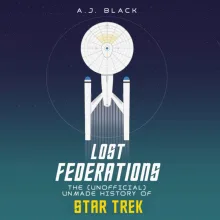
He is the author of, well, many things and he's been on the show several times, but right now he's going to be talking about Lost Federations. The unofficial unmade history of Star Trek talked a little bit about that back when AJ was on our Star Trek, the motion picture episode, but he writes a whole lot more. I had a great time talking with AJ as always. Thanks so much for listening and I hope you enjoyed the interview.
I'm taking it. You're a pretty big fan of the show. What gave you that idea, Mike? That is.
Yeah. Ever since I was a kid, ever since I was a kid, I remember watching The Search For Spock when I was around seven years old and I had it on VHS. So that would be 89 something like that. So, it was a few years old by then.
That was the first one I remember watching. And then it, as I got into my teens into the nineties it was everywhere on television. You couldn't escape Star Trek, ultimately. And I didn't, and it got its claws into me.
And so my starting point was very much the eighties movies with the old crew, even though I hadn't seen the old series and then the nineties TV shows and I was just hooked from then on. Yeah, I guess the nineties were probably the best time to be around with. You were a Star Trek fan because you had TNG, you had Voyager, you have D Space Nine Plus, you had the movies all coming out at the same time because that was, I wanna say early nineties, you still had Star Trek Six and then eventually you had generations. Yeah, that's a great time to be alive.
If you love Star Trek. It really was that nineties period. I think they had, what was it? Four movies during that time?
Most of which were the next generation movies by then, apart from obviously the summer breaks that they used to have in network television, I don't think there was a period during that whole decade that Star Trek was not on air from 1993 to 2000. And then it changed after that. But that is an astonishing amount of television because each of these shows had seven seasons. Certainly next generation Deep Space Nine and Voyager, all of which at various points overlapped each other.
It was an absolute boom time and it 's getting back to that a little bit now. But because of the fact that they don't do as many episodes anymore, they might do 1013. If you're very lucky, you're never ever gonna have that period again where you're having 2425 episodes of Star Trek, a season, sometimes twice over. It was the golden Age.
And I think I've said that in this book and before it was the golden age of Star Trek. Really? So tell me about how this book came about because it is so exhaustive in its research. And I can't believe just the amount of work that you must have put in to make this happen.
But how did the idea for this even come about? It was a combination of, I think two things specifically, the first being that I wrote a previous Star Trek book called Star Trek History In Us during the pandemic. That was my pandemic project when I wasn't working. Basically, lots of people had pandemic project.
And that was a cultural history of Star Trek going from the very beginning from the 19 sixties all the way through to the early 20 twenties essentially. And while I was doing that book, particularly when I was talking about the motion picture, which was 1979 the first Star Trek movie, I started to realize particularly with that film, how much stuff about the production of it and all of the things that didn't happen, that I was leaving out of that book because it would have been, I'll get to that, but it would have been a whole other book.
So I was a bit like, OK, this is all really interesting. And I think previously I'd had an interest in films that were never made. I'm sure you've read it, Mike. But David Hughes is the greatest movies never made.
I think the book is called, is an example full of all those kind of projects, things like, I don't know, Paul Verhoeven's Crusade with Arnold Schwarzenegger or James Cameron 's Spiderman that we never made a few years ago. I bought that gigantic tashin book. Have you got that? Have you seen that, Mike?
You probably, I bet you've got it, haven't you Rob Mary? Gifted it to me? So, yeah, I did have a copy of that. Yeah.
Ok. It's incredible that book, like all the Tian books are amazing. Obviously, I'd always had an interest in the unmade movie thing. I, for years, I've wanted to do a podcast on it and I think someone has, someone's beaten me to the punch on it to combine those two things.
I love those kind of projects that were always the possibility was exciting of what could have been with all of these filmmakers et cetera. And then as I started to look into it with Star Trek, I realized there were so many of these examples throughout the whole history of it, both in at mo in the, at the movies and on television. That's when I went. Ok.
Yeah, there is another book here and I realized, I think the reason that I wanted to do what became Lost Federations is that there had been a huge amount of research done and a huge amount of relaying done for various different people over the years, creatives, filmmakers, et cetera about a lot of these projects. But I'd never seen it all in one place or the majority of it in one place. It was scattered over all kinds of different areas on the internet in various different other books, some of which were really old now, some of which were out of print.
And I thought actually I'd love to read a book where all of this is together where you can create a narrative from the very beginning from the sixties, all the way through to the modern day and tell the story of Star Trek that never was made. And that was it. And then I was like, OK, I'll try and do it. And there we go.
We did an episode on Star Trek the motion picture just with that. There were so many different things there was the, what was it called? The Plane Of The Titans. There was the one about JFK and I was so glad to read more of the JFK stuff because that was one where there was little rumors, little hints out there as to what that could have been.
But you really gave me more information than I had ever seen before about that. That was the intention because so many of these projects have been hinted at over the years or people might say, oh yeah, you might have heard in Star Trek fandom or elsewhere. Oh yeah. Have you heard they were gonna do AJ FK Star Trek movie?
It's like what? And turns out there is more information out there. It's just not super aware, it's not super available or it's hidden under a lot of different places bringing that out was thrilling because I think especially for a lot of those older movies, there are some real right turns or left turns or wherever you wanna put it that would have created films that were so different and not necessarily better, but so different from those beloved eighties ones that we got, whether it's the motion picture or the wrath of Khan or the Voyage.
Hope these very deliberately eighties loved adventure science fiction movies. But imagine if we lived in a world like where we'd got planet of the Titans, I know we discussed this on the motion picture episode. So listeners who've listened, always listened to the projection booth will, will have heard some of this before. But that film would have been fascinating because it would have existed at a point where it 's very much playing off the beats of things like 2001 A Space Odyssey.
It would have existed at a point where science fiction wasn't happening really in American cinema. It was only until Star Wars where that really took off and then everyone wanted a slice of that pie before then it was really low key and it wasn't happening very much. But planet of the Titans in the mid seventies would have been this gigantic, philosophical strange example of where they go back to the ancient start of humanity and they help them find fire and all this kind of thing and directed by Philip Kaufman at the time as well would have been so interesting to see that.
And there was so much work done. Planet of the Titans particularly is one where there 's a hell of a lot of research out there and a lot of testimony and drawings and all that kind of thing because there was a lot of work put into that before it ended up morphing into what became the motion picture. But I just find all of this stuff just eternally fascinating because I think with science fiction, particularly with these kind of films, there is so many possible jour possible journeys that that the Enterprise and this crew can take Star Trek can go anywhere and do anything.
And he proved that really throughout all of the TV shows and all of the movies, et cetera. I just loved learning about, like you say, about these things, like the idea that maybe Spock was gonna be the guy on the grassy knoll track, like the JFK assassination and just things that sort of blow your mind a little bit. That would they really have done that? And why didn't they do that so often?
I was reading this thinking, researching this guy. They should have done that idea. It was so good, but for all the different reasons, it never, a lot of these things never happened. The thing I like too that you were doing.
So you've got 60 years plus worth of material or yeah, 60 years, pretty much stuff. And you are able to tie those things together. Like you mentioned the podcast about movies never made. That was Steven Scarlata is doing that.
And he also was the producer of Kosky Dune. And one of the most fascinating parts about Khodorovsky is doing is where they trace. Oh, this was an influence on that. You've got the desert planet and Star Wars, you've got the costume designs which went into alien, you've got this and that and just all of these things and you are able to do that with the Star Trek Universe and able to say the time travel idea, eventually morphed into Star Trek Four.
And this idea that was thrown out, eventually morphed over here. I love that stuff. I love where you're able to trace those ideas, how they morph and pass from one show to another. And plus, like I said, we've got basically a dozen TV shows and a dozen movies.
It's crazy to think of just all of these different incarnations that you're able to trace these through one medium to another. Thank you for saying that's great that you got that from it. That was genuinely the idea. But so many little ideas that ended up carrying through into be it the TV shows, be it future movies, even if it was unconscious, even if there were certain characters or certain ideas that just kept on circling around or would be revisited even unintentionally.
And I think that's part of the fun of this kind of project because it quite often it was different teams creating different ideas as well, but they would feel the same as what things were suggested before I loved. I did love making those connections to be fair. And I think you really start to see that as the movies and shows progress and particularly on the TV shows actually, because they do have a lot of overlap and there's a lot of people working on these different shows that connect up and that was funny. It was a bit, it was a bit of a jigsaw, I suppose, trying to put that together.
Tell me about the research because it must have taken you so much to uncover all of these things before you even started to make those connections. Cards on the table and say a lot of this was pre-existing research. So I can't claim that I've dug out a million new things and I've spoken to a million different people because actually, what I found in terms of actually tried to get people to talk about some of the older ideas is that there's still quite a bit of reticence actually, because I think a lot of them genuinely feel they're gonna use this again.
You know, a lot of these ideas, they sometimes they don't wanna give it away because I think they think either in Star Trek or independently of Star Trek, they can actually create these ideas again. So I found that interesting, like I managed to speak to one of my heroes, Nicholas Meer and he was lovely and he was very polite and very kind. He turned me down a little bit and he, and he did it in such a nice way by saying, yeah, he said that I'm still hoping to make my car spin off thing or whatever it is. So I can't really tell you anything.
He wished me good luck with the book, which was really sweet of him because he is a good example of somebody who, if it wasn't for him, the Star Trek that we did get wouldn't exist. He absolutely laid down a visual and stylistic template for Star Trek that was unlike anyone before except Roddenberry and the p and arguably Roddenberry himself was influenced by a lot of other very strong creative people in the sixties, people like Herb Solo or Gene Coon at the time who did as much to create the original Star Trek as he did.
There was a lot of that there. But the re in terms of research, it, like I said, it was a lot of it was scattered. A lot of it was digging into the amazing resource that his memory alpha, which is the Star Trek Wikipedia database, which is incredible. It's like the borg, it's taken on a mind of its own and it's just spreading.
But in that there are tons of links to deeper research, deeper interviews done in fanzines and magazines like C Fantastique that go back decades, some of which are available online, some of which aren't some of which you have to try and get them on ebay. So there was a lot of that just digging down. It was a bit of a rabbit hole for a lot of these to find the right quote or to find the right piece of information. And then there were other books, there were some fantastic testimonials like William Shatner's movie Memories was a very good one because he talks a lot about things such as the deleted scene in generations where you would have seen Captain Kirk Skydive at the very beginning.
So he talks about filming that sequence and that was something I was keen to do as well to try and find interesting little moments for films that did happen and for projects that did happen where there were things that were filmed or were planned that didn't end up working their way in there. A favorite of mine is that the Cork, the character from Deep Space Nine, the Ferengi bartender, he was supposed to be in Star Trek insurrection. The movie in the nineties filmed the whole sequence where he's on Pleasure Planet in a bathing costume or whatever.
And there's a still out there of this and I don't even think the scene was ever released itself, but he talked the army Simmerman who plays court, talks about this in an interview about shooting that scene. But it never made the movie even though at the time they were really hot on trying to have little crossover things crop up. And a lot of these films, you'd have a random, you'd have Whoopi Goldberg crop up at a wedding and say she's got no other part of the plot. But so it's those picking out those kind of things, tho those were the little gems.
A lot of those came out of this kind of research and digging in and a lot of them were like I say, hidden in books that had, that had long been since been out of print. But there was, there's some, there is some tremendous resources out there. I would encourage anyone who's interested in the Star Trek phase two project to go and read the Lost Years by Judith and Garfield Reeves. Stevens, who are both big cheeses in the Star Trek world in terms of writing novels and doing research and things.
But they put together a tremendous history of phase two, which it in itself is a huge what if moment for Star Trek, that would have been a sequel series to the original series back in the 19 seventies and heavily informs the motion picture and a lot of the next generation actually cos there's various stories that that took place eventually in TNG and that's a great resource. So there are some very good independent resources out there that were really brilliant to utilize and draw all of this together and find all of those little connected and that there were people who did give me their time, Ronald D Moore who again is another hero of mine who and started on the next generation.
He then was a major part of deep space. Now, I did a little bit for Voyager, although don't ask him about Voyager, he doesn't have good things to say. Well, I actually do find his interview actually, he did a probably wh t probably about 20 years ago. Now, he did an amazing interview where he in detail, he put, he described all of the things with Wager that did his head in and they could have done differently.
And he's brilliant. It's a kind of candid set of revelations about all the things that Voyager should have done that you never get usually from anyone. And it was, it's fantastic. He was great.
He gave me a few bits and Bobs about some of the things they didn't do. Some of the things they wanted to do on the next generation particularly. And the biggest one being they wanted to kill off will Riker and replace him with a double who had been created in a transporter accident, which is a very good episode. Second chance is, it's a very good episode and then he reappears in Deep Space Nine and he's a villain and Jonathan Franks has a lot of fun with that, but they wanted to completely get rid of Reiker and bring him in which would have been really bold.
It would have been a hell of a bold move to do that in the sixth series of a long running television show. But it, these shows didn't work like that. Then I'm not convinced they do now, a lot of the time there's still that cold feet about those kind of bold choices. He was great and I had a lot of time with Andre Bormanis as well, who was science advisor and a writer later on Enterprise.
He was brilliant. He would, he just talked to me for ages and there was so much that I told him about that I couldn't put in the book. Cos he starts talking about how he's worked for NASA and all these and he was lovely and he was fantastic. I feel like there could be a whole other piece that I should do about Dr Paul Mattis based on what he talked to me about, he just loved talking about it.
He just wanted to share and he wanted to go over it. And he gave me more specifics about the season of Enterprise. They wanted to do Enterprise being the prequel series set, something like 100 years before the original series, which was about the formation of Starfleet essentially. And the first Enterprise that goes out there, he gave me more detail on how originally they wanted that to be Earth based and they wanted it to build up to the chip launching at the end of episode 20 or whatever again, which would have been a much bolder serialized television idea and they didn't do it.
And instead they did a very formulaic, let's just do Star Trek. It just happens to be 100 years earlier and it's not great really in the mo in the main, I think what came out of the research and speaking to these kind of people are finding these things is, were so many bolder choices in many ways. The irony of Star Trek's logo being to boldly go quite often, they didn't boldly go anywhere. They tentatively repeated themselves or they tentatively went there.
And with a lot of these lost stories, there are a lot of bolder choices they could have made that they didn't. And so the research was thrilling. It was hard. It took a long time and then it took a long time trying to make it all connect and create a narrative.
But it was great fun. It was great fun. And it, and it's, it was nice that they go back and proof the book and read it and see it all laid out. And obviously with any book, like once you've written it and you have a little bit of distance, you go back to it and you go, who wrote this?
Did I write this? That's, it's such a strange sensation. You just don't remember doing it half the time? Yeah, that's definitely helps out with proofing because then you can talk about the idiot that wrote the previous draft.
Yeah, exactly. Yeah, we wrote this garbage. The history of the show is so rich even when you just look back at the very first series and see all of the contemporary science fiction writers that were working on that at the time. It's what Rod Sterling was doing with Twilight zone being able to take your Charles Beaumont, you William Nolan, all these guys and just throw them all together in a pot and see what you come up with the seed bed of stories that were there in those first three seasons of the original series would then go on to influence all of these things.
And then even those original seasons, they had different versions of those things too, which I was so glad to read in your book. Just that felt like how did he get the keys to the Kingdom for these things? Because it was amazing to read. Oh, they would have gone here.
They could have done this because they were under so many real world pressures at the same time. Yeah. The story of how Star Trek came to be and that first three seasons, it's a saga. It really is a saga.
Oh, yeah. Could have been a book just I. Feel like you could absolutely write a book just on the creation of that show. And I'm surprised nobody's done that actually.
Oh, maybe I've just thought of my third Star Trek book Mic Live on this podcast. Maybe because it is in some way, the most interesting period. Obviously, the creation of a show is always interested, but particularly in that period in the mid 19 sixties with somebody like Roddenberry who was such a character. He was such a gregarious character.
He had such a life before he even wrote, Star Trek. He was writing and developing TV SE series for years beforehand. He'd been a fighter pilot in the war and he'd had all these experiences. So he comes to Star Trek, he's already middle aged and he's had a hell of a life and he wants to create something that is in part.
I think it's that whole thing of middle aged men trying to create a version of themselves. But in space and he definitely does that with elements of Kirk and particularly elements of the first character who would have been the captain, whose name was Robert April. And there is a whole and amazing pitch document and my first chapter is called Star Trek is and that's what this document was. It was this pitch doc document called Star Trek is and it listed all of the very original concepts for what would become Star Trek episodes.
And it's an amazing thing to go through because there are so many threads that go into actual episodes that were made in Star Trek, the original series, but so many things that weren't ever done. You know, the one I love is that the one I think it was called a question of cannibalism on the document. And this almost became the first movie because back in the 19 sixties, at the end of the 19 sixties, when the w the first conventions were going on. I think there was one called World Con is where Roddenberry's talking about how he wants to do a prequel series set at Starfleet Academy.
And this is a prequel movie I should say set at Starfleet Academy with a young Kirk and a young spark and a young mccoy. And that runs through the entire history of Star Trek to the point of they finally do it partly in the JJ Abrams films and they're finally going to do it next year with a TV show. It 's taken 60 years to get to the point. They're actually gonna do a Starfleet Academy thing.
But right at the very beginning, he wants to do a film. And at that point based on one of those original Robert April specs, which is about going to a planet and they find a race of sentient cows or sentient versions of cows that have been harvested for meat, essentially. And it's always one of those classic sort of Star Trek allegory stories. It's about rampant capitalism and oppression and murder and all these things classically brewed up in a sci fi concept.
But that, that became the basis of the film treatment. And then they took it to Paramount and Paramount basically went, I'm not sure this is gonna get him in on a Friday after Friday evening. I'm not sure it's kind of the romp we're looking for a really sort of hardheaded sci-fi tale about murdering cows. So they did do that in the end, which I get, I understand that completely right from the very beginning, a lot of these original concepts were then bleeding into potential film ideas and then scripts for the original series and the animated series, which isn't something I talk a lot about in the book, but was quite important in the early seventies as that connective tissue between the original series and the next iteration, the movie phase two, et cetera.
But like you said, along the way, there were some incredible writers linked to all this. Harlan Ellison was one in particular who did city on the edge of forever, which is recognized as one of the most iconic star Trek episodes ever made in the sixties. And he was a really combative, difficult character quite often. And he got, he had a lot of arguments about various things, but there were, there were so many, they wanted to go for the top caliber science fiction writers.
They wanted to get people like Theodore Sturgeon. They wanted to get people like Philip Jose Farmer who goes on to do w Newton the world Newton Universe, which is just the most insane pulpy thing ever. He does that and they get, they try and get, they get him. He's pitching ideas and things like this.
I love that aspect of it because quite a lot of the stories these people pitched didn't make it, but they're fascinating. They really are fascinated because they, you can tell they come from these particular science fiction minds of the era. And they would have made some incredible episodes. Had they been bolder, like I said earlier.
Speaking of bold, you talked a little bit about some of the missteps along the way. I consider Enterprise in Voyager to be huge misses between the first season of Voyager where they're just, oh, this is gonna get us home and you're like, that kind of defeats the purpose of the show or they're fucking around now. The Holodeck all the time or you get Enterprise with that horrific opening song, which I'm just like, did you try to steal this from Firefly? What's going on with this?
But for me, there were so many missteps when it came to the movies. The post post star Trek six, some of those movies, the JJ Abrams ones are, are fine. The second one really hurts my soul. But a lot of the generations movies, with the exception of First contact, they're hot garbage to me.
And there must have been so many other ways that they could have gone with that. When they bridged the gap between the next generation and the movies that with generations, they were caught between a rock and a hard place in a way because they wanted the paramedic, still wanted to feature Shatner Nimoy et cetera because they were well known. They were well known on screen. And I think they were jittery at the idea of grading people like Patrick Stewart, et cetera to the movies because at that point, people now would think, oh, Patrick Stewart making a movie, of course.
But then it wasn't, this was before x-men, this was before the Star Trek films had been a success. And really star Trek has never been a massive box office winner. Really. It's always done really well in America, but internationally, they don't do anything at all.
They've never really made a lot of money. So really the only ones really that have booked that trend are the, are the first two Abrams films. They did well because they were something slightly different. But the original ones, none of them were really gigantic successes.
So they were always at that point, much more small scale and they felt much more, they were extensions of the TV series and I think with generations, you especially felt that, that it was an extension of the next generation and it wasn't particularly a movie in its own, right? Nor was it the TV show either? Because they had to Wedge Kirk in there and they had to have a cameo from Scotty and Chekov and Nimoy just said, no, they wanted to get him back a Spock and he went, no, you're giving me like five lines. Why would I do it?
No, why would they do? They were caught between a rock and a hard place with that one. And then I think as it goes on the problem. I think they have really.
And this maybe is connected to the fact that there is so much Star Trek out there back when the movies were happening. That was it until 1987 when the next generation airs. It was just the films, Wrath of Cards. Search for Spock, et cetera Voyage home.
They were the only Star Trek things out there. So they had the space to really. And you had the nostalgia factor for a lot of the kids who'd grown up in the sixties. Now, they're adults, they're introducing their own kids to these middle aged crew who are really charismatic and funny.
And the movies are quite light and fluffy in the main or just completely off their trolley like the final frontier. She's just nuts, but they're a good entertainment. But then when you get the next generation movies, it's hard really. With the exception, like you said, of first contact, which does have aspirations of being a bigger thing.
And he tries to be much more of a blockbuster kind of adventure. When you look at things like generations or you look at insurrection, they very TV, show partic particularly insurrection and insurrection for me is the one is the one that could have been genuinely brilliant because there was an amazing book that was written the Time J insurrection was made called Fade In. And it was a making of that film by Michael Pillar. Michael Pillar was again probably outside of Rodden Bri and the sixties, some of those sixties crew and Nicholas Meyer, Michael Pillar was the guy who set the standard for what Star Trek one television would be.
He was the guy who came in the third season of next generation. And he completely revamped the whole thing and he made that showing to what it was without him and what and the people he brought in that show would might not have got as far as it did really? So he deserves a massive amount of credit. He sadly died not long.
Only a few years after an insurrection came out and faded in was unpublished for years. He'd written this brilliant book in which he'd gone through all of the intentions for insurrection, which he's been asked to come in and write because generations and first contact were written by Brannan Brager and Ron Moore, both of whom knew their Star Trek inside out, but particularly both of them were still very busy with the TV, show TV, series. Braga was doing Voyager in the main and then he'd go on and do Enterprise and Moore was doing Deep Space Nine.
They, by the time they'd done those two movies, they, well, we've done it all now. We don't know where to go. So they got Pillar back in, even though he'd left the franchise by this point to come in and he 's, he has these incredible ideas about wanting to explore the fountain of youth and wanting to go back to Joseph Conrad's Heart of Darkness, which insurrection in the in is essentially a version of that really. They refer to it as heart of lightness because it was a lot lighter.
But the original ideas were much darker, it was much stronger, it was much more powerful and gritty and this incredible amount of information. I just scratched the surface if you read that book and the documents around it. Insulation could have been a fantastic exploration with an incredible villain who a very apocalypse. Now story who goes up the river basically and loses all perspective and just got milk watered down and watered down to the point where you end up with data going a bit crazy and Picard and Wharf singing HMS Pinafore to calm him down.
Yeah, there's nothing wrong with that, right. It's fun hearing Patrick Stewart go oh British to all that kind of thing, but it's not really the height of powerful drama. These are all examples of where you could have had much stronger properties, but they end up becoming a victim of, I think the lack of scale. The one as well was the fact when they hired John Logan in the wake of Gladiator to write Nemesis.
I remember the excitement about that genuinely at that point because he was an Oscar winning writer and this was the next generation's big ending. It was, it was supposed to be the big finale and it was a really bad movie in the end. And again, lots of interesting concepts and ideas that just didn't happen. And I see what you mean while I enjoy genuinely, actually all of those movies as a Star Trek fan on some levels, they do pale in terms of comparison, certainly to a lot of the original movies, but also some of those Abrams ones because even though it's not the same star Trek, I think Abrams and those films deserve credit for actually revitalizing the whole thing.
And I don't really think we'd be at a point now where it's much more in the public consciousness and much as I don't love all of it, Mike right now on television, it's never looked better. They've never thrown as much money at it. He deserves credit for that. Really?
Yeah. Contemporary Star Trek is a little rough in spots. I feel like Discovery has found its footing. The first season was a little rough.
Second season, maybe a little rough as well. At least Michael Burnham doesn't cry every single episode, which is good. And then strange new worlds. I found the first season great.
The second season just felt like they never hit the accelerator at all. Just felt like they were swimming around in the some very familiar waters, but at least they're better than Picard. And hopefully one of these days will get more of these Kelvin Universe films because those, the 1st and 3rd, the third, to your point about insurrection third, felt like it was a TV episode for a TV series that never existed. Yeah, I think with the, with Beyond they, which is the third one they wanted to because it was the 50th, the 50th anniversary, the 50th anniversary.
Yeah, because it was 50 years. They wanted to create something that was very much an homage to the original series that, that you say that story could have been an original series plot really much more than the fir the previous two Abrams films. And obviously that one wasn't directed by Abrams. It was just in Lynn, it was a different kind of thing.
The production of that was a bit of a mess because they had a change of scripts and Simon Pegg ends up writing that with Doug Young. So a lot of that change is original plans for are very interesting ideas around time travel, which they were gonna do in involving the Vulcans and this kind of thing. They go by the wayside and then beyond doesn't really do very well really. He underperforms certainly compared to the previous two.
And I think a combination of that and them thinking, what do we do now, what do we do next? Then a couple of years later, the pandemic comes along, throws everything out of whack and subsequently, you were approaching now 10 years since there's been a Star Trek movie which hasn't happened ever. I don't think that's ever happened. I don't think there's ever been that level of a gap.
E even in the point between Nemesis which was 2002 and Star Trek 09 where Abrams reboots it, that was a dark period because Enterprise finished halfway through that. And there were about two or three years where everyone thought Star Trek was dead forever. That was he was gone at the end of the naughties even. That was only a seven year gap.
And as of next year, we've hit that seven years and there is no chance of a Star Trek movie coming out next year. Cos they haven't even filmed one and they haven't even decided, I don't think on what they're doing because there have been a litany of possibility since a lot of which are chronicle in the book. And I try and go into the one that I thought was gonna take was where they get Chris Hemsworth back. Cos Chris Hemsworth pops up in Star Trek 09.
As Kirk's dad dies early on and they were gonna get him back for a big time travel story. It was announced Hemsworth saying I'm looking forward to going back to do Star Trek four. This was something like 2017, 18, I think and then contract contracts break down. Chris Pine 's contract breaks down and then Paramount start to go.
Ok? Why don't we do other things? Why don't we do? Oh, hang on.
We've just had a call, we just had a call from Quentin Tarantino who wants to make a Star Trek movie. Why don't we write a script? Given how I know, I know you're not the biggest fan of Tarantino, Mike. You must, you must have groaned a little bit when you heard that, that news I.
Did because Tarantino loves this whole historical revisionism lately. So I was just waiting for a parallel Earth story and those sometimes can be pretty tiresome. Yeah. And that was his plan.
That was what he apparently wanted to do. He wanted to remake a piece of the action, which is a gangster planet and in the parallel worlds theory, which I mentioned the book which is a well known Star Trek thing and it got as far as the scripts and, I think Marquis Smith who worked on it with him who wrote the rev revenant, he's talked recently about how they w they wrote a script. It was there and then Tarantino being Tarantino went. No, I'm not gonna do a Star Trek movie as my last film.
And I don't think I didn't, I mean, I don't think anyone seriously thought he was gonna make a Star Trek movie even before once upon a time in Hollywood came along. But the fact that they were entertaining, this is a test is a Testament to how they had no idea what they wanted to do with this franchise. When the, then you have, there have been various people who've come on. SJ Clarkson was supposed to have directed a film that they've never come to pass.
Noah Hawley was working on a script for an entirely different new thing that it would have involved a deadly virus that spreads across the galaxy and then COVID happens and they go, no, we're not doing that. I'm s if I, to be honest, Mike, I'm the most sad that one didn't happen really because one thing that I'd love to see them do is something they've never had the, had the bravery to do and make a Star Trek film with no previous actors or characters in it. And they almost did it in the after Enterprise. They made, they wrote a script for it was called the beginning and it was going to be about Kirk's, it was gonna be before Enterprise.
It was gonna be about Kirk's ancestor and it was, would have been a thrilling exploration of the mid or the early 22nd century or whatever. And it would have been a proper war movie essentially which, you know, Star Trek has flirted with doing war movies for years. Walter Kenig wanted to do it in the early nineties. He wanted to do a version of early flanders Fields, which is a fascinating story instead of what became the undiscovered country Nicholas Meyer is massively inspired by World War Two submarine movies, which in the wrath of God, the movies with Kurt Jurgens as a captain and all this kind of thing, it go into the wrath of K and so the beginning would have been an amazing and I chronicle a lot of that in the book and that would have been an amazing film I think or amazing trilogy they wanted to do.
But again, they got cold feet, they didn't do it. They did Abrams film. So I would have loved to see Hawley get the chance to make something completely new for Star Trek separate from the TV series, but I don't think it will happen. And to be honest, from a strategic point of view, I understand the logic in making Star Trek Four with Pine Quinto Saldana, all those guys, but they're not getting any younger.
They're all gonna be cruising towards middle age now. So you're actually gonna hit the point where they're almost as old as Shatner and Nimoy and all these guys would have been when they did Star Trek the motion picture. It's weird. What do they do now?
Do they reboot it again? Do they do cos the motion picture essentially rebooted it in some ways, it made them older. And no, it's in a really weird place in terms of cinema right now. Star Trek.
I understand where it 's all going on the TV side. But they seem more keen to make things like TV, movies, actually TV, movie events than they are making actual big cinematic films and listen, get it. I've always believed Star Trek is best on television. Even though I think the wrath of Khan is one of the greatest movies ever made.
Star Trek is truly a television show and it works best on television. But equally, there have been some brilliant films and it would be great to see it properly there in ac in a cinema once again. But there's right now, Mike, there are more unmade Star Trek films in the modern day, which is good for me than there are actual films. And I'd love to see that change.
What would Brian Fuller have brought to the show because he famously got canned right before Discovery really started. Going, I think Fuller would have es essentially done a version of American horror story. I think in a way in terms of the anthology or Fargo, which is what Noah Haley did an anthology version of Star Trek. He wanted, he wanted to do Discovery or certainly the first half of the first season of Discovery, which was about Klingon fundament, fundamentalism and a war and that kind of thing.
And he wanted to do that as a prequel to the original series. But then he wanted to go and do something in the next generation era and he wants to do what Picard ends up doing not the same, but he wanted to take that e era and follow up from things like Voyager Deep Space Nine, which for 20 years were a big unknown. And Picard has filled in a lot of those blanks mostly in a way that I would never have done personally. If I'm honest, quite disappointed with a lot of the choices that were made Fuller would have done something much, much more in line with what Star Trek is because he understands it.
Whereas I'm not convinced a lot of the people writing in Star Trek on television really do. Or actually they're too big a fan themselves. I think that's part of the problem. They're actually mega fans and they don't quite have the perspective that people like Fuller or Ron Moore who also would do it very well if he came back, they understood they had the distance and the respect from it, I think, to properly do it in a really interesting way.
And I think had Fuller had done that, been able to do that anthology idea instead of Discovery which he very quickly is booted out of and isn't really involved in, I think it would have been, we would have, it would be very different now. And again, I keep this keeps being a recurring thing. It would have been a lot bolder because they would have been able to tell things in a very different way. It might have been in some ways, a bit more like the Marvel Cinematic University that they're doing short series, that various different places and points within this universe and whether they would have weaved it into a hole, who knows?
But I would have been quite happy to see 10 episodes set in 24th century, 23rd, century, 22nd, 26th. So I think you'd have done that and I think it would have been fantastic and I'm sad, we never got that. I think that outsider's perspective is so important. I think that's why Nicholas Meyer really struggle with wrath of Khan because he wasn't slavish to the original.
And he was, let 's change this up, new uniforms. We're gonna make things more like the navy. We're gonna embrace the naval aspect of this. We're gonna go for Horatio Hornblower meets that boot and I thought that was great.
Yeah, absolutely. I couldn't have said that better because that's exactly what it is. It's that respectful distance and not being slavish to the history of it. Roddenberry was massively inspired by Hornblower.
He's on record as saying that, but he didn't equally didn't do the naval kind of thing that Mayer really leant into visually in terms of the language that he used that he brought in, that then filtered into Star Trek that then the later shows they retain elements of that, you know, that I think something that is that, that the franchise has got away from that formality which I think they run away from these days because I think they worry it will alienate audiences. That was the point. That was the language. That was, it was like Shakespeare.
And I think that that was something that Maya said it was like Shakespeare. And that's why you would put in lots of Shakespeare illusions in the wrath of Khan in the undiscovered country, which itself is a line from Hamlet. He did all that because he understood the language of Star Trek had that. And in interestingly, he was involved with Fuller on Discovery.
At the very beginning, he was a creative consultant. He was pitching ideas in, I think he was there when they were creating the idea of Michael Burnham and them being a mutineer, having a mutineer is your main character, all of which are really interesting, different ideas and he very quickly also parts ways I think because he, they rubbed up against the reality of Paramount saying or CBS all access at the time saying we need Star Trek to be modern. We need it to be thrilling. We need them to be saying fuck.
The moment that I realized that's what they were doing was the point that I was like, I don't think this isn't for me anymore. With the exception of lower de which is the spoof comedy, which is very good and very knowing and lampoons the thing with a lot of love. I honestly don't think it's for me anymore. And I'm not saying it shouldn't be made because there are a lot of people who love it, but I can't because it doesn't feel like it's the same thing anymore.
And that makes me sound like such a old man shaking his fist at Cloud Mike. I really don't mean it though that way. I mean, it, in the sense that I think the things that people like Maya did things that, that Fuller would have done, they were artists who I think were able to have that, that awareness of the core ideas of Star Trek and what it was trying to say without necessarily needing it to be something that a corporation or want or something that fits into a, an existing language of television. And I think that's where Star Trek has ended up going, perhaps inevitably and that's why these kind of people aren't involved anymore.
And again, I hope that changes, but I don't think it will on the television side, which g, which is why I'd love it to happen in a movie. And there's still a chance it might, there's still a chance someone like Noah Hawley might come along and make a film and that would be brilliant. I think the Orville is probably the best Star Trek show on the air right now. Yeah.
Yeah. Even though they're not on the air and I'm waiting desperately for them to come back. Yeah, I haven't seen all of the Orville, actually. I think I've only seen the first season possibly.
So I've got a bit of catching up to do with the Orville. But I know that it's a lot of people have said to me that it's, it is essentially like the next generation really in terms of what it's doing. It is like a nineties Star Trek show. And I think that I've always been a proponent for them pushing the idea of the franchise forward.
I'm not suggesting for a minute that they shouldn't make Star Trek in a modern context. I'm not saying it has to be just like the nineties but equally all that, all it seems to do right now is try and pretend it 's Star Wars quite often for one thing. And also it just recycles the same characters, the same ideas, the same settings over and over again instead of doing something genuinely innovative. I mean, look at, well, look at how the card ended, the card ended with it was basically the same plot.
Yy, you as the search spot where they, where they steal the Enterprise, but they all get back onto the old. And once I saw that happening, part of me was a little bit. The fan in me from the nineties was a little bit. Oh wow.
But then the critic in me went, oh my God. Like what's going on here? Why are you doing this? And so I think that's the thing it is in this push pull, I think right now between what's best for it in the future and for it to survive for another half a century and what is going to get it commissioned by people who just wanna make money, they just wanna keep selling the same characters.
It's the same story with all the franchises, Mike, isn't it right now? Or cinematically? Or television star Trek is no different, unfortunately, and the quality is suffering, I think as a result. You are never one to not be working on a ton of things.
What are you doing these days? Other than talking about your Star Trek book? I am working at work at those sort of things. I'm doing lots of podcasting on my, we made this.
So I'm one of my favorite things I'm doing right now is I'm doing a nineties movie podcast at the movies in the nineties, which I must invite you on. Actually, cos we'd have a great conversation. So I'm just doing particular nineties movies picking them recently. We did the Age of Innocence by Martin Scorsese, which was brilliant.
So I'm doing that, which is a lot of fun and I'm writing various bits and Bobs and my next book, he's focused more on television. It is the story of the TV series lost. So that's gonna be chronically in the history of it, digging into a lot of the mysteries and the characters. I've already spoken to a few of the people involved, hoping once the actors strike lifts whenever that is, I can then start getting more people to come and talk to me.
But I've had some fun conversations with some cool people already. Yeah, that hopefully will be out next September because that's the 20th anniversary of Lost, which makes me feel extremely old. That's when that started. But that's a lot of fun so far cos there, it is an insane amount of my publisher has already told me.
Please don't make it as long. That's the best book because, and I said to be honest, that's gonna be difficult because there is a lot. But it's, it's proving very enjoyable so far. Tony, where's the best place for people to keep up with you?
And your work. Quickest I place is via my link tree. So that's link Tr dot Ee forward slash AJ Black writer. You'll get links to the books work I'm doing podcasts, et cetera.
So it's all there. Thank you so much. I look forward to the next time we record. Absolutely.
Thank you, Mike. I really appreciate you indulging me to talk about my book. And so yeah, really appreciate it. And thank you, anyone who listens to this who goes and buys a copy, it's hugely appreciate.
And it's a great book. So definitely pick up a copy. Perfect for the holiday. It's Life Jim, but not as we know it, not as we know, quiet Jim but not as actually person.
It's life Gym but not as we know it. Not as we know it, not as we know it's Life gym but not as we, oh, we got a worse than that. It's life Jim but not as we know it, not as we know it, not as we know it's life Jim but not as we know it. Not as we know it.
Captain. Yes. Each to so well it's life Jim but not as we know it, not as we know it, not as we know it's life Jim but not as we know it, not as we know it. Katherine on Wednesday.
Comments
No comments yet.