Show notes
Mike and Rob discuss mockumentary films, serial killer films, and the confluence of the two in works like John McNaughton's Henry: Portrait of a Serial Killer and J.T. Petty's S&man.
Labels: André Bonzel Benoît Poelvoorde Rob St. Mary Rémy Belvaux
Transcript
An automatic transcript, tidied into paragraphs. It has not been proofread, so names, titles and spellings may be wrong, and it does not say who is speaking.
Show the transcript (about 13,000 words)
Hold your ears, folks. It's showtime. People pay good money to see this movie. When they go out to a theater, they want cold sodas, hot popcorn and no monsters in the projection booth.
Everyone for 10. Podcasting isn't boring. Turn it off. That is me, Remi, I'm a filmmaker and I'm making a film about Ben.
A man of many talents. He was a connoisseur of fine foods, a first rate poet, a philosopher and a composer. But what fascinated me most about Ben was the intensity he brought to his work. Ben was a killer, an extremely clever and creative killer.
Mommy almost to the point of genius. He could hit a moving target, sight unseen and strike at a moment's notice. He was a consummate professional. He was quite a guy.
So when he asked us to join in the fun, we felt honored. I mean, he was the star of our movie and who were we to say no afterwards we all celebrate into the night and what a party it was for a short while. At least until things got way out of hand man bites dog. It's a comedy about a serial killer that goes straight for the jugular.
But whoever thought it would be banned in countries like Sweden and Australia. After all, we were awarded the International Critics Prize at Cannes. I mean, even in Montreal, they thought it was a smash. And when we got to L A, they told us it was provocative and powerful, maybe even the best film released this year.
Welcome to the projection booth. I'm your host, Mike White. Join me Once again is Mr Rob Saint Mary Cinema Cinema. This week we are looking at the 1992 Belgian film Man Bites Dog, directed by Rémy Belve, André Bonzel and Benoît Poor.
The film is a mockumentary about the serial killer. Ben played by co-director Benoît who is being followed around by a camera crew who captures some of his more outrageous adventures, but also his thoughts about life, beer and more. We're going to be spoiling this film as we go along. So if you don't want anything ruined, please turn off this podcast and come back immediately after you've seen this movie.
Don't even wait a minute. It was released on DVD by Criterion. There's no sign of a Blu Ray release as far as I can tell, it's streaming out on Mac And Criterion channel maybe, but it's, it's out there. You can purchase it, maybe you can stream it whatever.
I'm not gonna tell you where to stream stuff because that changes by the moment you're on your own. Rob when was the first time you saw a man bites dog? And what did you think, sir? The first time I saw it, I remember the trailer.
I don't know if this is the trailer that you can use on this show or not. But I remember it was a, it was a black and white trailer but from what I remember because it 's a black and white film. Duh is that it had like a voiceover to it and it was Meet Ben. He is this and he likes that and it was very, very light and fluffy and of course open and then there's all the montages of where he's shooting people and explaining how much ballast, how many rocks you need, how many pounds of it.
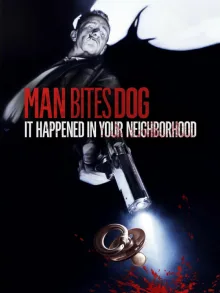
So sink small children and old ladies. And I just remember the original trailer and just being God, what is this originally? It may have been Fox Lorber or somebody put it on VHS. And I remember seeing it had to have been around the time it was out on VHS because I remember the box art specifically, it said man bites dog and it had been with kind of a gun like this.
It was all real up close. Must have been around 94 or five. I was still in high school and I remember that I really liked it. And the guys, this is what ties me back to the my silly little vampire movie was when we were making that movie.
We really liked this from time to time. We had certain catch phrases and things that we would say on set. We were working and one of which was just screaming cinema at the top of our lungs because when he gets drunk in that one scene and just starts talking about like waxing pontifical about film and how much he loves film. But it's interesting to watch it because I saw it obviously before I was a journalist and a broadcast journalist.
Obviously I was in radio, I wasn't in TV, but I have made a documentary and things like that. So watching this before I was in journalism, I thought was just a fantastic satire of journalism much the same way that, that natural born killers satirizes the cult of celebrity and broadcast journalism in a different way in this period in the nineties. So it just really had an impact on me. I haven't seen this.
I owned it for many years in the Criterion edition. Like I said, I also think I saw two different versions of it and we'll talk about that later because there is a censored version of this movie. And I saw two different versions because I remember seeing the first without the one scene and then I had the Criterion version which puts that scene back in. And anyway, I could talk a lot about this movie before you tell me about your first time seeing it as you can tell, I may have been the reason they doing this on the show.
As I said, you should do that one on the show. You're right. And I slotted this into our shock Tober coverage just because it is a very horrific film. It's not necessarily, I guess it is scary just to see Ben, but you also have the humor and really, for me, it's more that examination of their roles and responsibilities of journalists and filmmakers and saw this one all the way back.
It was 93 when it was playing in the U SI, saw it at the Michigan theater in Ann Arbor. And I've really, I've only seen it twice now. I watched it once for the show and I watched it all those years ago and watching it again, it felt like I just watched it yesterday was so fresh in my mind. I remembered so many parts of this, not every single nuance necessarily, but I was really familiar with the material.
It made such an impression and I just always had such a soft spot for mockumentaries, but especially really well done mockumentaries. And this one is really good and I love the pacing. I really was paying attention to how things change both in front of and behind the camera with the camera crew and got it sick and funny all at the same time that it just really made a great impression on me and I was not disappointed to go back and I thought I was gonna be a little squeamish now that I'm an older person and I've seen more of life and violence kind of freaks me out a little bit more.
But no, I was still laughing my ass off at this movie and just having a great time, Benoît is just terrific more than Man bites dog. The short film that was on the Criterion laser disc. I think my friend Mike Thompson ran off a copy of that on VHS for me and I watched that over and over again. I rewatched that one again yesterday too.
And God, that is just so great too. What a smart thing to put together this fake trailer that kind of tells you a story, but also doesn't and just has all of these kind of odd non sequiturs so well done and Benoît just chewing up the scenery and what a perfect main character to have a Man Bites Dog because he is so charismatic and you never know what he's going to do. He plays on that line of sanity and insanity so well that there are so many times where I just feel like he's gonna snap sometimes he doesn't and you're just waiting on the edge of your seat.
What's this guy gonna do? Because you never know where his head is at. The great thing about this movie to this is why it was an inspiration to me as a young person is, it really is a very cheap movie. Do not mean that in a bad way.
This is a movie that much like a few years later when I was working at the theater in 99 when Blair Witch came out that it was able to take kind of bits and scraps of things and to use characterization and conflict between the various characters and things like that. It's not built on special effects. It 's not built on big budget. As a matter of fact, if this had a little more money, it might not be as effective.
It is because it's in black and white that it lends this sense of realism to it. It's like the joke that I made, I can't remember what movie we were talking about. I was joking about how they cleaned up Texas Chainsaw massacre and I go, no, it's supposed to look shitty, lends a sense of doom to it. If, if it looked too good, then it would lose some of its edge.
And to me, I feel that way about this movie and that you have this lead character in Benoît, who you get the feeling that basically they're all playing themselves in certain is heightened version of themselves, them and the film crew to a certain extent and that's really what lends the credibility you get the feeling that this guy is just, that's why they want to follow him really is that he's just a character. He's just a fascinating person to talk to and to hang out with. Granted he does kill people but he does it with such a charm that the only person that I can think of that has the same kind of charm as him.
And, but you'd have to go back 30 years earlier. Is Belmondo to me. I see Belmondo in him. I see that kind of slick Frenchman.
Although he's Belgian cigarette smoke and talking philosophy because in here, like he really loves architecture and he talks about how shitty the apartment blocks look and he's got a certain view of the world, he's got a certain sense of reality to himself and he's total narcissist. And I mean that in the clinical sense it's very, oh we're buddies and everything's good and then someone says no, and he 's turns like that, it's fucking watch it. You know what he can do? And it's, are we all gonna go along?
Ok, we're all gonna go along to the restaurant and we're all gonna eat and he's got this kind of very personality driven sociopath aspect to him. It's putting them up against and we can talk about other killer movies following the killer type movies later if we want. But I'd much rather hang out with him than Patrick Bateman any day. And way more than Henry Porter of a serial killer, which that I saw Henry right around the same time and most striking part of Henry for me was when they have that video camera and they start recording themselves doing these crimes.
So just that kind of similarity as far as there's moments in the movie where Benoît is watching himself or one particular moment where he's watching himself on screen. And up until that point, the way he interacts with the camera versus the camera crew changes throughout the movie, like he is very into talking with the camera crew, especially Rémy, the director very into talking with him so much of the time and then he starts to shift and start to talk a little bit more to the camera. Sometimes he will direct, directly address the camera, but it still doesn't feel like he's making that next step.
As in, I'm talking with the viewer. It feels like he's more talking to Rémy and the other guys from the crew. André especially through the camera rather than talking to me at home or sitting in that darkened theater. I don't know if he has that thought as to there are gonna be people watching this.
Even when he's watching himself. He doesn't really talk about how are other people going to perceive this? Yes, he is very full of himself. And I know exactly what you're talking about with that.
Let's all go to the seaside and have a great dinner and God, no, sorry, I can't do it. I made plans and oh, just that ice comes into his stare and otherwise his face, he smiles so much in this movie. Sometimes it looks like one of his eyes is a little lazy or like he's doing a cross side thing. So it just looks really goofy.
He's got like a big nose and plastic features and I can see what you're talking about with Belmondo because Belmondo, he's a handsome guy, but at the same time, he does look a little goofy sometimes and Benoît is right there with him and just that energy and you feel the energy from Benoît throughout this whole thing. And he's so proud of himself when he's talking about how to weigh down these corpses. And you get that really early in the film. It's like the second scene, maybe.
It is the scene right after the credits because the first scene is him on the train and he's on the train and he sees this woman and then we're in it. They don't fuck around you are in it. It's him strangling this woman on the train and she's trying to fight against him, watch him squeeze the legs out of this person and then it cuts to the credits and the title and I actually really love the original literal title. Like I understand why it's called Man Bites Dog because that is a phrase towards news report.
It's not Dog Bites Man. That's interesting. It's Man bites dog. That's interesting.
So that's what you think about as a journalist, right? But the original title, which often at least on the Criterion and on the version that I watch will have the original transcription, the original Literal French. And it was, it happened in your neighborhood. So I like the idea that the filmmakers had this idea that they were just, this is just a common thing.
This is why I'm following someone who's your neighbor or something. So it adds a different kind of texture when you think about that title. But coming right off, that strangulation is him by the quarry. And we see the quarry over and over and the quarry actually becomes kind of a pit of hell for the filmmakers as we get towards the end and where they have to really come to terms with what they've actually been doing because viewing it through a lens is one thing, but actually having to deal with the aftermath is another.
And so he 's explaining in that first scene after the credits, all the weighing down of various. So we really get from that is how long he's been doing this because he explains, children are more porous bones, they're lighter. So you have to use four times the amount of weight. But the other end though he's like dwarfs, you only have to use twice a late because they have more dense bones.
So therefore, even though they're smaller, like a kid, they're more dense. So it, he explains all of this and there's like a math to it and he says it with such a glee. This is a craftsman. This is a guy who knows his work.
This is a guy who really enjoys his work, regardless of anything else. He obviously gets off on the work. There's something about it. Most of the people who he kills are complete and total strangers.
This is not like a vengeance thing. This isn't, oh, tracking down the people that made fun of me in high school. Oh, I'm killing ex-girlfriends or people that wronged other people. Although he does mention a few times certain people that, that did something wrong to someone and he took care of them for them.
But really, it's just him presenting himself to us. But it 's really interesting because you were talking about how he changes and how he engages. I really think the act structure is more based on the filmmakers and how the filmmakers change more than anything. And that's the thing that's really sneaky about the structure of this movie is that typically when we're watching a lead character, we're watching them and we're watching their arc and while Benoît's Arc moves a little pretty much kind of step like he 's a shark.
He shark does what a shark does. But the filmmakers, they go through these stages and those stages of how they relate to him and how they relate to what they're doing and what they come to understand about themselves and what they're doing and the ethical questions that they have about what they're doing really? Is the act structure in here more than anything? And you think about those things.
Do you hear the filmmakers voice asking questions when I'm watching a documentary? Do I know that there's someone behind the camera or is it just that kind of Errol Morris type of camera set up where it could almost be a machine trying to look into your soul and not even have a person on the other side of that camera? Is it something like that? Is it something where you hear the questions?
Is that something where the filmmaker accidentally gets into the shot? Do we go full bore Michael Moore and have him as the main character of the documentary. There's so many different levels to that. But with this, it's like, all right, when we go and meet Ben's grandparents and his mother, oh, there's Rémy in front of the camera and he gets addressed as Rémy and we figure out that he's the director of this thing.
And then, oh, we see a little bit more of Rémy when he's talking about this, just Rémy starts to come out behind the camera more and more. And then you start to hear about who is a Patrick is the first sound guy. And then you hear about André, the cameraman, maybe we see André's hand at the very end of it. But we don't really see André and don't hear from André the entire time.
And he, even though it's that whole thing too of the wartime photographers, like you're taking those photos of these horrible things. How do you resist the urge to put down the camera and help out somebody when you go from the passive viewer to the active participant as they're the active viewer stage in there as well? You think about the horrible stories of the newspaper photographer that carries around a teddy bear with them wherever they go. So if there's a house fire, they can put the teddy bear down and then take the photo to make it more tragic.
There was a child in this house type of thing. How much are we manipulating reality? How much are we staying out of things versus becoming these active participants? And yes, I totally agree with you.
And I don't think too talking about three act structure. I don't think that's any coincidence that we go through three sound guys and each one becomes more and more of an active participant. It's victor by the end of it. I can't remember the last guy, but he is right there.
He's barely behind the camera. He's almost always in front of the camera and there's even the moment where he's just like him with his microphone and Ben right there and he's trying to remember what he's recording. Ben is like doing a musical thing. Or something.
But he's just like right there with the microphone. And he also, there's a pretty awful gang ray played Rod. By that time in the story, there 's no hesitation, Rémy and the sound guy are right. There they go first they die and there's no cajoling.
It's you just boom, they are right in there literally and taking turns with this woman before Ben even does anything. And it's just, wow, we have gone completely off the reservation here folks. And that for me was fascinating from like I say, watching this on two levels. One is watching it from the standpoint of when I first saw it when I was younger before I was a journalist.
And then after I was journalist and then now today journalist by trade, if you're a carpenter, you're always a carpenter. I can build you a table, I can report a story. It's fine. I know how to do it, but it's not what I do in my day to day life.
So the, it's just interesting to me now to see where that line is because there are things that and I'm not saying any of my former colleagues or people who I didn't work with at various places, other news organizations that sometimes I just felt like that's inappropriate. Like they were just way too close to the subject or they were just they, the way they handled certain stories or the way that they handled certain things I just felt it was completely inappropriate, not my ethics, their ethics, the ethics, the way that they wanted to do it.
So it's interesting for me now to watch it through that lens because it really is all good satire really is about showing up the foibles of something and to point to a different way of doing it to say is this the way that we should be doing it. And that really what they did is really kind of great, great. Look at that because you see them get sucked in and they get sucked in because there's a force of personality. And what I mean by that is with Ben, he is dangerous.
He's also manipulative, emotionally manipulative, narcissistic sociopathic in that way. So that 's also difficult. But I also think there's an aspect of this is a really good fucking story. And as a journalist, I'm a really, I really wanna tell this story and I'm gonna be able to tell it in a way no one else can tell it, but they get corrupted in doing so that they be because they move from being observers to being participants and it gets further in, it gets further in the further in.
You go to the point where there really is no daylight between them. By the end. To be honest. There's one thing that I really picked up on re-watching this yesterday versus 30 years ago when I saw it, which was the economics of everything that then pretty quickly in the movie, he is talking about how he will murder a postman the first of every month.
So then he can go through the mail and find out the pensioners and then go and murder the old people. Serial killer. Is this because he's there for the thrills. He's there for sometimes the revenge like you're talking about.
But a lot of it is he's there for the money. And when he goes in and robs an old person, he's just, they look like they don't have much money, but they've got money everywhere. And then André Remy, I know you guys are, you broke students here. Let me help fund the film.
And after a while he is producing the film that's being made about him. He is the one that is holding the keys to the kingdom. He's the one that's giving them money for this stuff. They become beholden to him in that way because he's, well, Rémy even says at one point he's like, oh, I might not be able to continue this.
We're running out of money. And then next thing you know, it's be, it's like, oh, no, here you go. Look at all this money that 's hidden under this mattress here. And oh, there's some stuff up here along the tops of the, this armoire and all.
And then later around too, he's walking down the street and he's talking about these housing projects and like you said he's very into architecture and he's just the brick is this awful red color and every single building looks the same and you get to see just how run down everything is and his hideout is so run down and you just get to see this and decay everywhere. And at one point later on in the film, he moves into a more upper crust type neighborhood and that's where things really start to go wrong for him is when he goes in and he punches that woman in the face and she's having a fit on the floor.
He eventually finds the husband and that's also where it's like, oh, hey, bring that microphone closer and he breaks the guy's neck. That was a pretty good sound effect, wasn't it? And then the little kid and again, making these guys complicit and in turn making us the audience complicit, but it's just, hey, help me kill this kid or let me find this kid and they're running around and like turning on the spotlight that they have. So they're lighting up the backyard and they're helping find this kid.
Also, in another point he's being fired at by one of his enemies is, oh, here you let me see the zoom lens and they zoom in on where the guy is. And then I love how Ben just sneaks out from behind him and murders him as these guys are active with the camera and with the microphone and the equipment much less. Oh, here. Let me help you.
Ben, let me weigh down the bodies. Let me go down into that quarry. Like you're talking about, let me go down in the quarry and try to hide these bodies. He's not even doing it.
He's up above yelling down at them. Just what kind of slipshod job or doing, André put the camera down and help these guys out and he's way up there yelling down orders to these guys who, like you said, it's a pit of hell. You get to see all those dead bodies that are down there that he's just been dumping one after another. Even in his hideout, he 's got all these corpses that are around that look like they're part of the furniture.
By that point. When Patrick gets killed, there 's no emotion on the loss from Ben. None. And this is ok if the movies, there's three act structures for the crew, this is about 30 minutes, 25 minutes in some.
And so this is like the first one where it's followed by Rémy talking to the camera. He's in his kitchen or something. He's like, oh God, he's Patrick's dad. Oh fuck my God.
This has just gotten out of hand. This is just going too far. He's his girlfriend is pregnant. He was gonna be a father is all this.
It's just terrible. And then the next sound man dies exact same set up in the kitchen. Oh, God, he's dead. The same girlfriend, of course, is the other sound guy.
She must have a thing for sound men. I don't know, it's women who date bass players and bands or something. Of course, she's pregnant with his child. So it's, oh God, like he's got to be father.
Oh my God. What are we gonna do that shift as you were saying, where, as soon as he gives them the money really is the downfall. That is the first real piece of it. Because if you look at the way it's structured, ok, you could say before that there's some things that are real, tells where it's OK.
They're trying to keep that distance, they're trying to keep. And there was the thing also that I noticed I was watching at this time was I noted when Rémy comes forward and he engages more because in the first few scenes, they're very behind the game. You don't see them, you don't hear them. They're really trying to be verite to a certain extent where they're like, we're not here, we're just doing a thing.
And as soon as he goes to see who I write down as granny snuff because that's what he yells at that old woman and she has a heart attack like he doesn't shoot her. He just yells at her and she goes, he goes, I knew that I could kill her with a heart attack because you see this, these pills, those are heart pills. So I know she's got a bad ticker. So I figured if I just screamed at her really hard and just jar her really well, that would be it.
I could just kill her that way. Instead it's much easier. And he's so proud of himself that he saved a bullet. It's her that he goes, lift up the table cloth and there's all this money under the table cloth and then he goes into the mattress and he's like, just be like, throws the money.
See, he told you they got tons of money, which was the other line that, that I love in here he goes, avoid young couples. They stink of poverty. It's unpleasant. The only thing that breaks from form in this movie is like Ben's fantasies.
There's like a poetic scene, Ben doing this poem and it's like the mayor, the mayor, the sea and he's like running down the sand dunes and he's naked and there's all the, it's just ridiculous. It's almost if some, someone gave some film and a little bit of money to some art student, some sophomore art student and said, here just go make an art film, go make a short three minute thing to a poem or something. So it's like a bad poem. It's very obvious in everything, but it's hilarious.
Like, it's this bit of humor and if I remember correctly, it ends with him because he's so drunk when he's doing this, he like ends with him puking where like it cuts back to him. He's like puking and they're like, oh here and they're all sitting around the table and they have to prop him up. He got bad muscles. That waiter was like, hey, I wouldn't recommend that you order these and he's just like, get the fuck out of shut up.
Just, he's so rude to that waiter and then ends up throwing up. And because again, that's the narcissism. That's the, I know you don't know shit. And then he blames him like he blames he goes, it's this fucking waiter.
It's never him. He's never at fault. It's never, he got drunk, he ate too much or whatever, he took it too far. He's never the cause it's always other people.
Speaking of other is he is, he's very racist. He's homophobic sexist. It's so funny because he kills a black guy this night watchman and he's just, oh man, oh I feel so bad for killing this guy and then he starts to go on about, oh he should be at this club and like fucking white women and stuff and just starts going on and he's pulled down his pants. I wanna see if what they say is true and then he's, I don't want to touch him because I'll get eight.
He knows that it's wrong that he's saying that he even apologizes, but he's completely serious. And as he goes through this, you just find out like what a horrible person he is even on top of the murdering, you get all those montages of him just yanking all of these people. And I love that first montage of him shooting people comes right after he is playing with these two little kids that have a gun and he shoots both of these kids, this toy gun. He shoots both of the kids.
It's just like mine or whatever. And then you get that montage that quick montage of him just murdering all of these people with his gun. And you get that a few times through there and you're talking about the lyricism and stuff. I was so confused when they started playing this old timey movie within the movie of these half naked women dancing around.
And then you find out that it was his grandfather, his stag film that he had. It was like his great grandmother or someone is one of the, one of the ladies in there or something. And then his grandfather starts telling this whole story about how he fooled the guy by buying a couple pairs of panties. And then saying, oh, these belong to Brigitte bar and he made 200 francs off of them.
He's, oh, these days, it'd be so much more money of the 800 francs today. Depending on how you wanna comment on that. You could say this is a generational thing. His father, his grandfather, who he obviously adores because he talks about himself.
But the family also owns a store which my understanding is that's actually his family store in real life is from what I read a corner shop or as we call him party store here, little Bodega. And so his mom and his grandmother and his grandfather all worked there and everything. As I was watching this, I couldn't help but think of and then he gets caught, he gets caught. In all the things that lead up to that are, are pretty great.
There's like all of these little things that start to chip away. I'm trying to remember. There's one part of the, of the movie because we haven't talked about his social network. He's got the three relatives.
I didn't realize that so many things happen in threes in this movie. He's got the three relatives. He's got the three documentary filmmakers, three dead Sound guys by the end of the movie. And then his three friends, he's got what Betty who feels like she's a prostitute that he used to see or something.
And then she got old and he has found her, she got kicked out because again, here's another economic thing is he's talking about all this urban renewal that is happening and that they just kicked Jenny out of her house rather than put her into a new place. He's got, is it Valerie? Valerie who works in the art gallery. So he's got a small group of friends.
But you can also tell that those friends are loose in that they all know who he is. They even asked at one point. Do you know what he does? And some of them go, I don't ask too many questions.
I really don't wanna know. So you get the feeling that they know, but there's also this thing where it's almost, maybe they're held in place by the fear what we saw with the crew where when he turned and it was like, I'm the clown and then all of a sudden it's, we're going to eat. So it may be that they're really only friends with him out of fear that they're concerned that if they're not nice to him, that they could be the next one who ends up meeting the end. And then there's the third friend who we see a few times because Ben has all these different lives.
So when he's with Valerie, he plays piano and he's there critiquing. What was that? No, that was a F sharp. So why did you play an F natural?
And I'm just like, whoa, where is this coming from? Then when he's with this other guy and the guy's name, but he's there. He wants to be a boxer. And that was one of the moments.
So that was the moment of downfall is because he thinks he's a boxer. He gets laid the fuck out by this other boxer puts him in the hospital. They, we see the friends come in. We have a welcome home party and this male friend of his from the gym.
I'm trying to remember what he says to him, but it pisses Ben off and Ben just is ok and I remember what it is. It's his friend is talking with Valerie whispering with her and he 's laughing and he doesn't say what he was laughing about. He just is laughing and that triggers paranoia inside of Ben. And that's what ends up getting his friend killed.
The guys. Give him a holster. So he's, oh let me get my revolver and he starts like playing with the revolver. Very Travis Bickle turns and then shoots his friend right in the head.
No one makes a fucking sound. Jemmy and Valerie both have blood all over their faces. Nobody wipes it off. Rémy has blood on his food.
So he's quote, not hungry anymore. And there's Ben going, why aren't you eating? Come on, what's going on? He said no, I'm not hungry anymore.
And that, that is when you start to really see everything starting to fall apart because it's very shortly thereafter that we get the revenge killings that are going on Valerie and then we get the revenge killings on his mom and grandparents. And that whole thing is both funny and horrific at the same time that when we find Valerie, she has a flute shoved up her ass. When we find his mother, we don't see it, but he comes out holding a push broom and he starts to go off about was it a flute this time? And I was like, holy cow.
The thing that's great about the revenge killings. And this is the thing that I like about this movie is there's also another crew that they come across one point and they come across the other crew doing basically the same documentary that there's another guy that they're following who does the same thing the Nightingale. They have video equipment though. And Ben asks him, he goes, Rémy, what is this camera?
And he goes, oh, that's a video. He goes, is it better or is it worse than what we got? He goes, oh, it's not as good as what? So he breaks that and they kill the whole crew and they kill the guy too.
He kills the Nightingale right away. And that's when the film crew comes in or the video crew. I wanna say that Ben hands a gun to Rémy and Rémy is the one that kills his counterpoint on the other side or kills the sound guy of the other crew. That's what it is.
Here's the competing artist, please, you're an artist, please take, take out your competition. You can't allow this. And the thing that I really love about that is that there could even be another one because if there's this revenge killer out there too who's taking revenge on Ben Wa for all of the things that have been going on that adds an extra layer. They're only following one of these guys.
That's the thing I find hilarious is that it opens up your mind to go. Oh my God. There could be, at least there 's, at least two could be three. Maybe four could happen in your neighborhood.
Exactly. And that's where the title is. But then other crew, when he kills that other crew looking at the timeline in my notes here is right after that, they go back to the bar and so they keep going to this bar. There's this like local bar, local pub and Benoît keeps messing with the bar maid.
Come on, show us your tits and all this, she likes it and she could tell that he obviously doesn't, she's as tired of his silly ass and it's out of that that he like starts singing and cinema, cinema and all that and they get pushed out of the bar. It's get the hell out of here enough. That is the scene that was because I believe the BHS version I saw maybe the original theatrical that went out, maybe not in the US but somewhere else. But didn't have the rape scene, didn't have the gang rape scene from what I read because it was may have been Criterion or when it was maybe there was like a second issue on VHS where it was like, this is the full three minutes were added in because that scene goes on for a little while and it's disturbing and it should be, that's really where it becomes like point of no return.
I understand why it's there. I understand why they cut it. That was probably the difference between A, an R and an NC 17 back then. But that really is the point in our return that when the crew do that, this is more than just following along and helping put the body in the trunk of the car or whatever.
You're now no different. It's a level of degree. Now that scene in the bar where he's making a special drink and it's the dead baby boy where he 's got the counterweight on the cube of sugar and whoever's weight. Olive, Olive.
Thank you the Olive and the sugar and whosever Olive comes up first they lose. That was something as well. Just everything is a little twisted in this movie. It's right after that where you have this, it's like the hits keep coming.
So you go from the gang rape scene to the birthday shooting where he shoots his friend because they get him the holster to the dead bodies in the quarry, get down there and hide those bodies. The next scene is Ben editing the film. He is literally at the steam, which if you're a filmmaker and you worked with actual film back in the day. He's actually at the editing bench editing.
He's, he 's watching the attack really of the mailman scene that we saw earlier and he's winding it back and forth. It's a new mailman scene. It's, he does it again and since he still has the big neck brace and all this stuff from when he was laid out in the boxing ring, he screws up when the mailman gets away and that's it. That's the nail in the coffin.
But I love how he's there. He's got his glasses on and he's got a little cigarette in his hands and he's just staring at Rémy and he just starts to talk about, you could have stopped him. And it's of all the times for you to not be complicit in helping me out here. This one is gonna send me up the river.
He gets brought in and put on trial and this is where I'm reminded of. And if you're looking for a closing song would recommend Warren Zevon's excitable boy in that his mom is like, but he's such a good boy. I don't understand this. Can't be real or did you end up here?
You're so good. You're so kind to everyone and then all the revenge killings that happened and all that fun stuff. Breaks out of prison after he gets put in there gets picked up by the camera crew. Valerie isn't there.
So they go to her place to find her and that's when they find her dead, goes to the shop, finds his family dead and they're back in his old hideout. That's where you could see the dead bodies that are on the floor. And he's talking about leaving town. He goes back to reciting his little song poem that he does.
And that's when he gets shot in the head. And then you get to see the whole thing switches to slow motion at that point and you get to watch the entire crew except for André. But you know that he's dead because the camera is on the ground and you end with this canted angle in slow motion with this smoke coming in, it's really a striking shot and you just watch that smoke just billowing in slow motion. I guess the third sound guy's name was Vincent.
And so you get to see him shot in the back and then it's odd because just last week we talked about Island of Doctor Moreau where there was no soundtrack until a final music cue. Same thing with this week, which is very odd that we talked about two movies without a soundtrack in a row. That ending is great. I love that last shot.
I don't think it 's as good when we talk about because really this movie for thinking about it and you have to think about and granted it's this movie. But thinking of the internal logic of the film itself as a document that was created. So the question I have is were they editing up until the end? And then that last piece was someone found this after all the filmmakers are dead and put it all together because the conceit of I was talking about Blair Witch, is that OK?
This is all found footage and then someone put it together after we found the footage, the kids disappeared when we were there, which is, of course, cannibal holocaust. So the question becomes to my mind who put this together? You know, did they finish it up until that last show? And someone slapped it together.
I don't know, I guess we could torture ourselves with that but there's, but just that, that last shot, I just love how it really sums it all up. It really gives you something to think about it. Like the mag just rolls out a lot of mock documentary or mock film in that way works on a similar concede, probably most humorous version of that is the end of Monty Python, the Holy grail worth of camera stop and the camera rolls out. I just love that kind of the film ends just rolls out.
That's a really good question. There's another question I have for you and I don't know if I was reading too much into this, but before he gets knocked out in the boxing ring, there's him getting suited up for boxing and there's a woman who's a cleaner there and he says, oh, I got her this job and there's a little kid there as well. The look that he exchanges with the woman, it feels like they had a relationship. And then after that I'm thinking, is that little kid his.
Because there's a little kid and then isn't there like a teenage girl? And he's, hey, you me, we should go do something or something. The way she stands away from him makes me think. Oh, they have a history.
All right, we're gonna take a break and we'll be right back after these brief messages. Step into the gallery. Dear friends for horrors, Nightmares and Spooky Tales. This is the midnight viewing podcast and we like to discuss the frightening world of television horror anthologies from Rod Sterling's Night Gallery to Tales from the Dark Side to Hammer House of Horror and more.
Father Malone Chris Stu and Mike White will be your docent during this midnight viewing available wherever you download your podcasts from Weirding Way Media dot com. All right, we are back and we are talking about man bites dog and I know we talked a little bit about a couple other films. I mentioned Henry Porter, the serial killer. You mentioned Patrick Bateman and American psycho.
But what kind of other movies play with the Form Rob. Another one to think about in terms of Killer in film. And we did this one on the years ago on the show is peeping Tom, that one obviously is a little bit different, but it still gets into kind of the psychology of someone who is a killer. Obviously, I don't wanna centralize Europeans and by any means of Belgians or French people, people in the French culture, which obviously Belgians are Belgians and French or French.
But there's some kind of loose tie. I don't necessarily know if we would make a film like this in the US. The closest we came to something that would be this kind of fun like you were talking about Henry, portrait of a serial killer. It is a hard watch.
It's like solo or something. This is important. The closest that comes to this is although it's big and blown out and huge is natural born killers in terms of a satire in terms of let's follow a killer who's got swagger and they're fun to watch. They do horrible shit, but still fun to watch.
I don't know if that's something about us as Americans or something about a European sensibility, but it seems more, maybe people are more willing to be. I don't want to say lighter. There seems to be a willingness to have that tonal shift in a way that just don't hear. I don't want to make some sort of broad sweeping statement, but it felt like in the early nineties when this was coming out, we were just in the middle of a serial killer.
Boom. You mentioned natural born killers, which I want to say came out 94. There was Silence of the Lambs. In 1990 we mentioned Henry Porter of a serial killer.
There were things like California with a K gosh. What else? It just, oh copycat. It just felt like there were so many serial killer movies and these are like mainstream being released at theater, serial killer movies, not independent stuff, not lower Tier, things, not shot on video things.
It just, it's amazing to think of just how many serial killer movies were coming out at the time. I don't know if we still have that after the house that Jack built that Lars Von Trier. It feels like I haven't heard about too many other serial killer movies. Like we have the closest was some of the Richard Ramirez stuff and some of the other killers that they were doing when it came to American horror story.
But then it feels like now with Netflix, it is all true crime all the time type of things. And what you get now is like Tiger King where it's like one of these people, if not, both have probably murdered people. Ok. Cats and kittens.
The thing is, and I got cast, my thought back to when I was young because the movie came out 30 years ago. It was 1415 years old at the time. And I'm trying to remember in the late eighties and early nineties that a lot of this probably has to do with a couple of things. I remember when I first started collecting comic books and this was 1991.
There was a big hubbub about because garbage fail. Kids opened the door for non sports collectible cards. And I remember that the guy who owned the comic book stand at the flea market that I worked at was like, asking me, should I carry these serial killer trading cards? And there was a lot of news stories and I guess he decided not to do that at the same time.
And this is in Natural Born Killers where the whole interview with Robert Downey Junior's character of Wayne Gale and Woody Harrelson's character is Mickey that has to do with I believe Geraldo Rivera, either interviewing Ted Bundy or Manson. So in that period, in the late nineties, Bundy was alive and doing interviews. Manson was live doing interviews. John Wayne Gacy's paintings were selling.
There was a guy who was selling John Wayne Gacy paintings. Dahmer happened in the early nineties like 91. If anything, we were also in a time of psychologically because the thing I remember was a lot of times they would show these interviews or they would have these stories of these people and it was all predicated against psychologist or a psychiatrist who would explain what is it about these people. What causes this, that where does this come from.
And this was also the period before, to be honest, that was the most scary thing at the time was random killers, Serial Killer in that way. That was like the scariest shit today. It's a mass killers and there's a difference in the case of Ted Bundy. It was like he just kept picking up, I don't think it was nurses or something.
He had a thing for, he had a certain type or there were certain killers that had a certain type. There were nurses and definitely the sorority down in Florida is what of the most? Dahmer was killing all gay men. There was a certain mo there was a certain type and then wasn't to say that you didn't have mass shootings because you did.
I remember there was a mass shooting in the late eighties at a mcdonald's in Texas where it was like some guy went in there and shot 10 or something. And then of course, you had the post office shooting where the term postal comes from because there were so many shootings of post office, including one right by us where we grew up in Royal Oak was one of the first one in the nineties. You had the psychological interest as a culture. We wanted to psychologically understand these people that came out in news media and it came out also in film.
Now it's shifted where now we're in a place where we're dealing with mass killers we're talking about a guy who walks into a Walmart with an AK-47 or an AR-15 and shoots the place up and it's a completely different frame. It's a completely different idea. I don't even know how to explain, articulate exactly what that difference is. But it's like an explosion of violence versus a methodical planned over years kind of thing.
The bad over years planning kind of thing had a narrative to it in some way. It had a, there was something about it that really fired us in that era and I can't, I, like I said, I was only a kid. I was still in high school, middle school, but there was something about really stuck in our heads as Americans. There was something about it, Manson obviously being if you were gonna crown a king of this, he represented that although he himself really didn't do anything.
It was Bundy who did everything Manson was like, he was like Hitler, he was like the guy who executed the plan, but he didn't kill directly. It was Ted Bundy, it was Dahmer. It was all of those guys who, those are the guys who actually did John Wayne Gacy with the 30 boys buried in his crawls face, terrible stuff. We definitely had a bit of a resurgence of that over the last few years with things like all the C SI S the criminal minds, especially criminal minds.
That one night after a while I just had to stop watching because it was just so upsetting to see some of these things and they just had to keep coming up with different Serial Killer every single week. Law and Order SVU is pretty horrific when you think about the cases and stuff really. With what was it? Mine Hunter, the HBO show, the David Fincher Show.
It feels like we never got that third season. Maybe one of these days we'll get the third season, which is such a shame because they were building to the third season throughout the first and the second season. So it's, we're all here with Blue Balls now. But it feels to me like that was around the shift of, we always, we've had reality TV for 30 years as well and it feels, oh, no, Netflix is now just eating everybody's lunch when it comes to true crime documentaries.
And there isn't a case that goes by that doesn't have some sort of either half hour or multi hour stuff. The biggest, one of the biggest hits last year was the Dahmer series that they did. It was just so many people talking about Jeffrey Dahmer. And I'm just like, guys, I don't need to watch it live through all of the trial and all that kind of stuff.
So, a lot of my coworkers weren't even born yet. Thing that's really fascinating about Dahmer. And because I interviewed DF back DF who wrote my friend Dahmer who went to high school and was friends with him. It's a beautiful book.
I haven't seen the film but the graphic novel is amazing. Df said he goes, the thing that was really interesting about the armor was he goes, he actually spoke like he told them everything, like they put a tape recorder in front of him and he just spilled his Gods and said that this is what I was up against, this is what I was dealing with and just explained everything. He goes. Some people who did these kind of crimes, they didn't say anything, they kept it to themselves or there were those who reveled in it in a particular way or it just depended on who they were.
You can even lump in someone like Unabomber in there too. It was just something about also the randomness, the randomness of the acts that were, it's the same thing with the mass shootings too that we've had over the last 20 odd years. But it really feels it's hard to project myself back there just to remember because this was at the time when you had a show like America's Most Wanted or you had cops or you had, we grew up in an era because we're old where there were missing kids pictures on the back of the milk carton where it was, there were all of these things that were around that were saying that random ass shit can happen and the world can be scary in random ways, but it didn't feel totally chaotic.
It didn't feel like everything was chaotic. It felt like every so often something someone could come in and just grab something and would disappear. It's just interesting to think about that. As a Gen Xer.
There's a guy who 's in his mid forties thinking back to when I was, I don't know, 10 how the world was presenting itself to me at the time. The film was pretty good. I remember that came out six years ago, right around this time. Have you ever seen the film Sandman, which is S Ampersand ma N, that's a really good one.
That was JT Petty film. And I really, I've always been impressed by his work. He did this really super clever thing where he was making a documentary and he's got Carol J Clover Men, women and Chainsaws in there. He's interviewing Bill ZB who does these just awful, Nick Zed would say that they bad type of films really not good at all.
Fred Vogel from toe tag pictures. He's got all of these threads and he's going from one story to another. And one of those stories is actually a fake story. As he's going through this.
It's Billy Bob makes all of these movies where he's cutting people open. Very was that guinea pig series type of just gore film type of things. And as Petty is exploring this and interviewing people, he starts to realize that one of the people that he's interviewing, maybe the movies that he's making are real and they're not all stage stuff. And so then you get into the whole snuff film type of scenario and there was of course eight millimeter and all of those things as well.
It feels like we went from Serial Killer into snuff a little bit. But Sandman from 2006. And again, one of the reasons I bring it up is because the serial killer aspect and then also because it's a documentary and it's so close to a real documentary, but he subverts your expectations because one of these things is not like the other. For me, I was trying to think of other films that are like this in terms of using reality in that way that plays on the tropes of documentary to build in a sense of reality.
While I was doing my research for Man Bites Dog, I found an article that was talking about two other movies that I haven't seen or sorry, three other movies that I haven't seen, one called the last horror movie, one called Zero Day and one called Auto Head. And I've not seen those but the article, the author writes about them as if they were in the same breath as Man Bites Dog and just goes from one to the other comparing and contrasting. I wish I this article just says problematic allegiance with charismatic killers.
Man Bites dog, the last horror movie and Zero Day and then Auto Head also gets talked about, I don't remember which book this one is from, but it was a great article and these others are, they're a lot newer, especially the last horror movie they seem to talk quite a bit about. So other people are trying to play with it but it just man bits. Dog was so successful. We talk about like that period of early to mid, maybe even a little bit into the later nineties just as that golden period of independent filmmaking.
And this one just felt like it was such a natural addition to that. And there were so many movies that were American films like Chris Statue and I talked about the Spanish serial killer film and it was just like, oh, this feels right there in that independent film movement. And I would say that this just like you were saying, the cheapness and everything, somebody watches a movie like this just like how you could watch El Mariachi and just be like, I could do this. And that was the whole thing with so many of these filmmakers go out and make your own damn movie to Lloyd Kaufman.
Just here you go. Look at us. We made El Mariachi for $8000. I can't imagine that the budget for Man By Dog was much more than that.
That's the thing that you know, and I hate to sound like some sort of nostalgic man. But being the age I was when American independent film, the second wave of American independent film, because to me, the first great wave is 67 to 80 or so. 82 the New Hollywood and you can go a little further back and pick up some of John Cave stuff in the late fifties and into the sixties, of course, but to me this second wave, which of course was brought about by while he sits in a jail cell rightfully, the Miramax company really being a big focus of it between the late eighties and the mid nineties.
Just that whole period of stuff for me going to the main art theater, going to Maple Artery, going to Detroit film theater, working at Thomas video renting from Thomas video. Just so much good stuff came out in that period of American independent film. That's part of the reason why film threat was so great when it was covering that stuff back then. That's why the importance of the work you were doing with cashiers are just all of the scene culture that came up around it.
It was this, it was just an amazing period of film. And especially if you are a young kid like me who is just so interested in movies and looking at film and going, how can I make something like how can I do something that's credible and that's why reading as you brought up El Mariachi reading Robert Rodriguez's Rebel without a crew was a fucking revelation to me. This is a great book about how he made El Mariachi or looking at this movie and going, you can use a form and you can use a certain form and if it has faults with it, that's fine because you can play within the faults of the form or in the case of local hero who I bring up from time to time on the show.
Sam Rainy going look when he was a little bit before that, but in the late seventies going look, we can make this movie for drive ins because drive ins a market and we can make a low budget horror film with our friends and see where it goes to me. Just that's what made it, that period of film was so impactful to me that even though I only made with my friends, that one film, it's still put into me that you could be creative that you could do it. It was an extension in a way of the whole diy spirit of punk rock in a certain way that if you have a band and your friends have some money and you can put the money together and you can press your own records and put them out and some of your shows and I don't know if anyone thinks that way anymore.
It seems like film isn't film that way anymore. Things change. But it's just interesting to me, things change, people change hairstyles, change interest rates, fluctuate, but you'd end up with no hair. Like we did.
The other thing I wanted to talk about in here and this has been the real sad part for me is Ben Wash. Should have been a actor that we saw more of. And I know that he did other films in Belgium. I remember when I went to Cannes, there was a poster of him in some movie and I was like, oh, like he's still around.
I was so excited that was back in 99. But the only movie that he's been in that I've actually seen as of late and it's just his voice and it's subtitled obviously for me to enjoy it is Town called Panic. And I don't know if you've seen town called. I know you are a big fan and I wanna say André is one of the guys that's behind that movie, the guy who is behind the camera, but I love Town called Panic for anyone who doesn't know what this is.
I guess it started out in a series of short films. It's a Belgian production and it is the crudest little animation when we were kids. And definitely our parents generation had these things you could buy like these little toy sets. I don't know if you remember you had those little green army men that came on the little base because their feet were stuck on the little base so you could move them around.
So it was an Indian, an Indian American native Indian with a headdress. Then there was like the cowboy and then there was a horse. And so it's the three of them reminds me a little bit of aqua teen Hunger Force where it 's like the three of them all live in a house together and they hang out and they always get into these really surreal adventures and stuff. So I guess it started as a series of short films.
It may have been for TV. I don't know, but then they made a whole feature and this was maybe, I don't know, 10 years ago or so the DFT showed it and I went in cold. I didn't know exactly what it was. All I knew was that one of the voices and I can't remember which one it is off top of my head was Ben Wash from Ben by stock.
I fucking love it. Town called Panic is hilarious. It is a hilarious little animated film about, like I said, the misadventures of these three. If you like something like a Hunger Force and you know what that is, you would probably like town called Panic.
I need to correct myself right here. André did not have anything to do with the town called Panic. It is the fourth credited screenwriter Vincent Tavie who has a lot of stuff to do with that André ended up, I also feel like Tim Gunn when I say André André, he ended up, he directed a few things and produced including one very recent. So I'm looking up the title right now.
I downloaded it last night, but I can't find subs for it yet. One called Flickering Ghosts Of Love Gone By and also Benoît is in that as well. So that was good. And then I found out that Rémy killed himself back in 2006.
And I don't think that he did much work. Otherwise there was a weird sequel to Man Bites Dog that was listed on IM DB from, I wanna say 20. Well, that can't be right, can it? No, I hope not.
I hope there's no sequel. No, but no, it is from 2012 Man Bites Dog. The sequel. Ok.
Luckily he's not in it. He's credited as writer, probably because he came up with the characters and it is directed by somebody named Declan Hurley and it's three people in it. And Peter Hurley is, playing Ben, so Declan's brother, I imagine. But what the hell is this?
I couldn't find anything about that anywhere but odd. And then Benoît, like you said, I see him every once in a while just showing up in like small things though. He was in, we talked about Jeco Van Dor Meal's Total, the hero a few years ago. And he was in Van Dor Meal's 2015 film, the brand New Testament as God.
So he's getting around still. But I wish that he had become this international superstar. I know he's older now. It's 30 years from that film.
But when I saw Man Bites Dog and then I saw the Guard films. I'm like, this is B Mando. He has that kind of juice, that kind of swagger to him. But town called Panic.
Gotta do that on the show one of these days. Yes. Maybe I can find Mr Tier. It's worth the time.
I love this film. If you've listened this far and you haven't seen it, I don't know why you're still listening. You should probably have watched it already. But hey, whatever he likes to download numbers, that's all I'm about is chasing those numbers, chasing the dragon or chasing the numbers one or the other one and the same.
All right, before I nod off here from my drug habit, we're gonna take a break and play a preview for next week 's show right after these brief messages. Great. What do you have? What?
And to the I saw it wasn't real part of this. I am a watchman have come to destroy him. Keep starts Friday at the factious cinemas, grand cinemas, Alderwood Lewis and Clark and Kent Six. That's right.
We'll be back next week to look at Michael Mann's the Keep until then I want to thank my co-host Rob Saint Mary. So Rob. What is going on, sir? I have finally finished for those who have been listening over the years.
Jesus, this guy, all he does is go to school. I have finished my masters, so I'm happy with that. I'm an educated fool. Congratulations.
And so I finished that three years of school. Now I'm out and about trying to figure out what I'm gonna do with myself. Maybe I'll be on a few more episodes. We'll see.
I talked about this on the last episode. But if you haven't picked it up yet, do yourself a favor, especially if you're a fan of his pick up Andy Rau's book on Watermelon Man, which includes my introduction in the front to the film. Very proud of that book. Although I only have a small part in it.
As a matter of fact, we have a part in it collectively, Mike in that our interviews from our episode were transcribed in there from Watermelon Man. You did that interview? I don't think I had anything to do with that either way. It's mentioned as projection booth but had a little bit of a hand in that.
So make sure that up if you're a fan, Melvin rest in peace salute outside of that. Just enjoying myself. Thank you so much, Rob for being on the show. Thanks to everybody for listening.
If you want to hear more of me shooting off my mouth, check out some of the other shows that I work on. They are all available at waiting way media dot com. Thanks especially to our Patreon community. If you want to join the community, visit patreon dot com slash projection booth.
Every donation we get helps the projection booth take over the world is his are the.
Watch
Music credits
- "Excitable Boy" - Warren Zevon
Links & resources
Related episodes
Episodes that share keywords with this one.
The Wild Bunch (1969)
Shared: Rob St. Mary
Walon Green, Alfonso Arau, Lilia Castillo, Kathryn Jones and others

Comments
No comments yet.