
Special Report
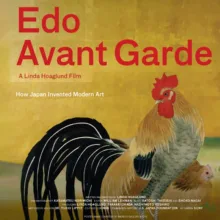
Linda Hoaglund on Edo Avant Garde
Show notes
Find out more about Linda at her website, http://lhoaglund.com/ (opens in a new tab)
Transcript
An automatic transcript, tidied into paragraphs. It has not been proofread, so names, titles and spellings may be wrong, and it does not say who is speaking.
Show the transcript (about 4,300 words)
Speaker 1: Hold your ears, folks. It's showtime.
Speaker 2: People pay good money to see this movie. When they go out to a theater, they want cold sodas, hot popcorn and no monsters in the projection booth.
Speaker 3: Everyone pretend podcasting isn't boring.
Speaker 4: Turn it off.
Speaker 5: What we have here is one of the most incredible perspectives I've ever seen in a Japanese screen. What is the viewer's perspective supposed to be?
Speaker 6: So no more ning. So ma ma ga na you will get this deal. No, no ning much. Is he no cheap out there?
Camino me, Mia. She's a student.
Speaker 7: Are you k know ny I do you know N and D got to Chicago and Mexica listening. She didn't know Chikara Mo Khali Khali just told you only you to fix it.
Speaker 8: Ko K me the rest on it. So those came out. So did Ihkit last night? Do you want this name or?
Yo, yoga receipt must know the name of yo, yoga receipt can look. So you talking and all that? MIKE WHITE: Hey, folks, welcome to a special episode of the projection booth. I'm your host, Mike White on this episode.
It is the return of Linda Hoaglund. She was on our battles without honor and humanity and Battle Royale episodes. And now it looks like I'll have a chance to meet her as she's coming to Detroit. She's gonna be showing one of her feature documentaries this time.
It is ao avant garde. It's gonna be showing at the Detroit Film Theater on Thursday, October 19th, as well as a workshop on Saturday, October 21st and Smack Dab in between. We have a screening of the Seven Samurai, which Linda did the subtitles for that is on Friday night October 20th to keep up with Linda and all the things that she's working on. Check out our website al Hoaglund dot com.
That's lhoagl un D dot com. Thanks so much for listening and I hope you enjoy the interview. Tell me about how you got involved in this event in Detroit because you're doing both the screening of the documentary. Plus, you're doing a workshop, correct?
LINDA HOAGLUND: I directed and produced a film called Edo Avant Garde, which reveals how Japanese artists from the 17th and 18th centuries, 19th as well invented modern art. If you will and I hope you'll come to see the film. It's being screened by the Detroit Film Theater on Thursday, October 19th from seven o'clock. And what happened is that I finished the film late in 2019.
But unfortunately, the pandemic had its own plans. And so many of the screenings that had been planned for 2020 were postponed. And so instead many museums actually streamed the film including the Detroit Institute Of Art. So there had been streaming event in that in 2020 21 actually.
And that was so popular with Detroit Institute Of Art membership that they've invited me back for an in person screening in their incredibly impressive theater, which I'm very much looking forward to. In the meantime, the National Museum Of Asian Art commissioned K 12 arts curriculum inspired by the film. And so we worked on that last year. And on Saturday, October 21st, the Detroit Institute Of Art is hosting educators workshop about the curriculum.
And so both of those events are happening a little bit later this month. MIKE WHITE: How did ado avant garde, how did you decide to even make that film? LINDA HOAGLUND: Several years ago, I was visiting Yale University for a screening of one of my earlier films and they had an exhibit of large scale Japanese folding screens which are called bio. And one of them depicted a raging river with boulders and gold clouds, gold leaf clouds above and below the river.
The depiction of the landscape was so stylized that it almost looked like abstract art to me. And when I looked at the date on the label, it said 1600. And I was so shocked to see abstract art from 1600 that the name Edo Avant Garde popped into my head instantly. EDO EDO is the name of the era the Japanese historical era that lasted from 1603 to 1868.
And there was 250 years of peace and prosperity. And there was an incredible profusion of all kinds of artistic expression during that era. And so I began researching art from the EDO period, predominantly on American museum websites because my research coincided with the beginning of the implementation of something called open access, which means that works of art that are no longer under copyright. And by definition, EDO work is no longer under copyright because the EDO era ended more than 100 and 50 years ago.
All the artworks are available on museum websites, not only to preview but also to download. And after previewing approximately 30,000 works of art Japanese EDO art in American Museums online, I chose about 1000 that I thought fit by description of my, that fit my definition of what I consider Edo Avant Garde, which is artwork that was pushing the envelope of artistic expression at the time. MIKE WHITE: It's very hard because I know that we were talking about a period of time, 250 years. But how many artists do you think that there were working on this during that era?
Is it just impossible? LINDA HOAGLUND: It's absolutely impossible to know how many thousands and tens of thousands probably in part so much of it has been lost actually between earthquakes and fires which swept the major cities. And because Japanese homes were built of wood and paper. They were extraordinarily vulnerable to fire and of course, tsunamis and war.
So we're only see a fraction of what proliferated at the time. And also the work is vulnerable to the passage of time because it's made out of silk and paper with wood frames. They have to be restored. Certainly, the large folding screens b must be restored, fully restored.
Their backing has to be fully restored once every 100 years or they simply fall into dust so they're very vulnerable. And we're really just looking at a fraction of the work that was created during that time period. MIKE WHITE: What kind of person would have those screens? And was it like with us where it is, you have art, art if you have prestige that it's associated with that or is it just every person would want to have one of these in their home?
LINDA HOAGLUND: The folding screens, the bio were large enough that you really had to have spacious homes or castles if you were a samurai to commission and own them. What happened is that the work of art that I that mostly interested me that I'm calling Edo Avant Garde was not commissioned by the samurai or the samurai class or those in power, which would have been Buddhist Temples. The work that interested me was largely commissioned by the merchant class. Now the merchant class, according to class hierarchies designed and enforced by the shogun, the merchant class were in the hierarchy.
They were the low, lowest. But as the EDO era prospered merchants became very wealthy because of their low class status. There were rigid restrictions on how they could manifest their wealth. For instance, they could not wear Kimonos that were made of silk on the outside, which is why you find silk lining on many Kimonos because the lining could be silk, but they could not make ostentatious displays of their will, but they could commission art and they often had very large spacious homes.
So many merchants were literally tripping over themselves to commission bio folding screens by the most popular painters of their time. MIKE WHITE: My mind is still reeling a little bit when you're talking about looking at 30,000 pieces of work and narrowing it down to just quote unquote 1000 that you're dealing with here. That just how long did that even take you? LINDA HOAGLUND: Oh, I don't know.
But what I did know is that I'm going, I'm really making a film about Japan's great national treasure. Yes, I did film. Couple of actual national treasures. We're talking about the mother lode of Great Japanese art and I owed it to myself and my viewers not to screw it up.
My co producer was NHK, the Japanese national broadcaster. They have rigorous standards and I was coming up, I came up with something of a, my sort of my title EDO Avant Garde. It may sound radical that it may sound radical when I make the statement that Japanese artists of the EDO era invented modern art. But in fact, the impression is painters of France would not consider my theory radical as you see in the film.
Even Van Gogh was quoted as saying, I owe all my art to Japanese art. They were so confounded and impressed by the works of Japanese art that they were seeing, arriving in France after Japan opened its doors in the 18 seventies. And so many would say that there would not be Impressionism. Had it not been for the influx of Japanese.
They were predominantly, they were seeing prints, they were seeing wood block prints, but the wood block prints really were expression of the innovations that were most apparent in the large scale folding screens. And so my thesis is quite radical for those who are not familiar with the French and the great debt that they themselves agree, they called the influence of Japanese art. In the late 19th century, Jon IA, they invented a word for it. So it's not a radical theory to people who are familiar with the art history, but for those who are not for people who believe that it's the impressionists and those other painters who invented modern art, it's a seemingly radical proposition.
So I had to get it right. And I also didn't want to overlook any works of art. MIKE WHITE: Yet you are a stickler for details. I can't imagine you leaving any stone unturned when it came to doing your research on this.
LINDA HOAGLUND: Ultimately, we were able to get permission to film about 200 works of art. There were some works that simply we simply couldn't get permission for. But thank goodness because I had trouble finding way my editor and I worked hard to incorporate the works that we did film. It's a film and it's not an art catalog.
So you have to be smart and wise to edit the material and the 200 artworks in a way that's not overwhelming to the viewer. But yes, I guess I suppose you could say I am a stickler for detail, what. MIKE WHITE: I really appreciate too the way that you shot this movie and that it feels like the things that aren't, the screens are as beautiful and as carefully chosen as the items that are on the screens, things like the water, the flowers. It's such a beautifully filmed movie and just the way that you were talking about your editor, just that pace of things I think really draws you in and helps the viewer along in that journey.
LINDA HOAGLUND: Thank you for pointing out the beautiful cinematography. The film was shot by Kasamatsu Nori Mihi who is a veteran of 50 Japanese, more than 50 Japanese fictional films. He's been nominated, I believe six times for the Japanese Academy Award for cinematography and he's won it once he's an extraordinary cinematographer and he always carries at least 25 lenses with him. For instance, when I wanted the close up of the Azalea, he had just the right lens.
I said, Phil, please film it so that the Azalea just films the screen fills the screen. And he was able to do that working with a crackerjack assistant camera person. And we were, our goal are united, we were united in our goal to try to imagine how EDO artists might have seen nature as they would have with a combination of both all for its beauty in a time before electricity, in a time before any kind of industrial invention, in a time before clocks in a way, but also with a great deal of in a way fear for the kind of havoc that nature could also cause whether that be tsunami or fire.
So we were interested in imagining how EDO era artists might have perceived nature. And that was the goal was to try to seamlessly edit between the screens and the kind of nature, timeless nature that might have inspired them. MIKE WHITE: Tell me about your human subjects because you obviously take such great care when it comes to the artwork. But how did you find the people that actually were talking to you about these works of art?
LINDA HOAGLUND: Originally, the film was titled The Guardians of EDO Avant Garde. Because without human Guardians, as I said, they would over time just crumble into dust. And so there aren't many types of guardians among them curators and collectors, but also scholars. And I it was very fortunate in that very early on, Yukio O Lippitt, the wonderful brilliant Harvard art historian agreed to be my film's advisor.
And his involvement really upped the game if you will. I just was interested in people involved with Ed O art who have something original to say. And the two major Japanese historians, actually, there are 33 Japanese art historians, one of them is actually contemporary art historian. He's a gentleman Sarahi Noy who sits in front of a folding screen and talks about how he feels like a wild animal, looking through the grasses at the beautiful flowers.
But, and, but they're just really brilliant, smart, thoughtful art historians who are willing to engage in a kind of a philosophical investigation of what might have inspired the artists and what they were up to. But the most important thing I think that they all share, especially, of course, the contemporary art historian is that they don't approach the art as though they're approaching history. They approach the art as if it could have been made yesterday. And so they don't treat it with kid gloves, they look at it and enter the world of the folding screens as if it's fresh and new.
And that, that was what was most important to me. MIKE WHITE: Not easy making a movie at all. It's a fun challenge, but it's always a challenge. What were some of the biggest obstacles that you had putting it together.
LINDA HOAGLUND: Early on in the research process? I received the very generous support of a major Japanese classical art dealer in New York. And he invited me to his gallery the night before he was shipping off folding screen to a collector who had purchased it. And he said that he always has a ritual, which is that he looks at the work of art that's about to be shipped off in candlelight.
The way EDO collectors might have seen it, no electrical lighting at all and enjoys a bottle of sake with his office mates. And he invited me to see that and join that. And the minute the lights were turned off in the gallery and then the candles were lit. And in that instance, in that moment, I could see something coming back to life, the gold leaves shimmered, the painting gained a kind of depth that was not visible in the electrical light.
And from that moment on, it became the holy grail to be able to film a scene like that in candlelight. And as you might imagine, I didn't even bother asking the museums for permission because there was no way that a museum could risk lighting a candle anywhere near their precious collection. But I was fortunate to find an art dealer in Kyoto, Japan who felt comfortable and he shared major folding screen that I don't think has ever been exhibited for the public. It's been in his family for a long time.
And so that kind of became the holy grail was to find one who'd be willing to let us film their precious folding screen and candlelight. Otherwise just coordinating schedules between seven museums in the United States that we needed to because of a limited budget, we had to leap frog and just film and fly and film and fly and coordinating all those schedules and logistics was quite the feat. I had a wonderful production coordinator who helped me with that and finding all the crew, the essential crew, we traveled together, but otherwise we picked up a crew along the way.
So it was logistically challenging but incredibly rewarding. MIKE WHITE: How long do you think it took you to put this together? LINDA HOAGLUND: If you include the research phase, it was five years, it was a challenging endeavor. It took a while to raise the funds as well.
But I would say five years. MIKE WHITE: You were doing this for five years. You wrapped up what 2019 showed the film around then? Obviously, like you said, the pandemic happened.
Is it strange for you to go back and look at this now and to see this so many years later? Are there things you're like, ah I would have changed that or I should have done this differently or are you just very satisfied and being able to show this? Now to a wider audience. LINDA HOAGLUND: I'm just thrilled to be able to show it on the big screen.
I don't tend to have regrets when I'm done with the film I'm done. I don't look at any of my films that I've made and wish I'd done anything differently. Honestly, I know when I'm done, a lot of people say, oh, I could keep on editing forever. I'm not that director, but it's a completely different experience showing as I hope maybe you'll see on the big screen at the Detroit Film Theater.
We shot it in four K and it's a digital cinema package, which is the equivalent of a 35 millimeter film print. And although I'm sure people purists would disagree with me on that, but I think it's a visual experience that's comparable and which is frustrating for me to know that people could just be basically be watching it on their laptops. But now we had the L A premiere two weeks ago in L A. We're screening it in Portland.
It's screened in Minneapolis. I'm hoping that many more premieres around the country will be happening next year as well. MIKE WHITE: We talked a little bit about your screening on the 19th. You've got the workshop on the 21st, but right there in the middle on the 20th, there's a screening of the Seven Samurai which you had a hand in doing a new translation of the subtitles.
What were some of the challenges as to revisiting that film. LINDA HOAGLUND: I was approached by Criterion The Criterion collection many years ago. Quite sure it was it, I mean, it was at least 15 years ago to res subtitle about seven major crew of films that were in their collection that are in their collection. And of course seven Samurai was the greatest honor really of my filmmaking career to be able to res subtitle that the original subtitles were horrible.
I don't like to badmouth other people's work, but everybody agreed that they were terrible. And especially because the most important, I hope many of you will come to the special screening of Seven Samurai On October 20Th at the Detroit Film Theater. I don't know, I can't remember the last time I saw it on the big screen. The most important goal for me in res subtitling it was to highlight and delineate linguistic barriers that existed between the peasants and the samurai that were just as real as their class barriers in terms of wealth and privilege.
They really spoke two different kinds of Japanese and they spoke that way in the original. And then you have the Mifune character Chico, who speaks a kind of a amalgam of both and to linguistically delineate those class hierarchies was really critical for me keeping up with Kurosawa and his fellow screenwriters. There are some of the greatest screenplays of all time. The ones that Kurosawa wrote with his collaborators and just trying to keep up with everything that they brought to the game of filmmaking and make it apparent in the subtitles was a huge challenge, but a tremendous honor.
Obviously. MIKE WHITE: How did you do that? How did you delineate between the two types of languages that were being said? Because you have to do it in a visual way.
LINDA HOAGLUND: The easiest way to put it is that the samurai speak a more formal Japanese, the peasants speak a more informal in some cases coarse or frank. I think the samurai tend to speak in euphemism and the peasants tend to be a lot more frank about life and death and everything else in between. But also choosing words that are, we have so many synonyms in English and always trying to reach for the oldest verb to suggest the time period in history to shy away from words that are more contemporary and choose especially verbs.
But other usages that suggest an older time period without going Shakespeare on everybody. MIKE WHITE: I can tell you it has been 30 years almost to the day that I saw seven Samurai on the big screen. So I am very excited to see it again on the big screen with subtitles that I've never seen before. Oh, wonderful.
LINDA HOAGLUND: I look forward to seeing you there, Linda. MIKE WHITE: How do you spend your time? Because you are doing so many different things all the time. Do you have every single day is a different adventure for you or do you just have a few projects that you're working out over a long period or what is that like for you?
LINDA HOAGLUND: So I do a lot of different things. I guess that's true. I don't subtitle as much as I used to. Once I became a director myself, I think some directors shied away from hiring me just because they think of me now as a director myself, I still subtitle several films a year.
But I also, then I'm when I'm making my films and I'm working on distributing them or marketing them, but I also have corporate clients to support me. So I work with Japanese Santori, Sho Toyota Uniqlo, et cetera doing some of their international branding for them. So I suppose in that sense, every day is a different day, I've actually taken it upon myself now to write my first screenplay. We'll see how that goes.
MIKE WHITE: This is your first narrative. LINDA HOAGLUND: It is, it is my first narrative. It has nothing to do with Japan. I have no idea where it will take me.
If you don't start making something, nothing will happen. So here we go. MIKE WHITE: You're based over in Hawaii. Were you affected by the fires recently?
LINDA HOAGLUND: No, fortunately, I don't live on Maui. I live on Oahu. So those the fires were very far away. We're grateful for being surrounded by beautiful nature and we're always grateful for rain.
Yes, I live on Oahu, about 30 minutes away from Honolulu in a beautiful town called Kailua. MIKE WHITE: Oh, very nice. What else do you have planned for coming to Detroit? Do you have people already lining up to take you to different places?
LINDA HOAGLUND: I am looking forward to meeting in person and working with the museum staff, looking forward to exploring the museum and I'm not quite sure what else we're gonna be up to, but I hear Detroit is a wonderful city and so I'm looking forward to exploring it. MIKE WHITE: Fantastic. I hope that, I can make your acquaintance when you come to town. Thank you very much, Linda.
Thank you so much for your time. This was great talking with you.
Speaker 4: I know you. Only some, you. Oh, no, no, only he. George you, your for your here.
Are, are you so your honey? I see. Pokemon. S No, we all to you.
What not? Yeah. 00, sorry. Oh, k na call.
I know you, we saw you. Oh, you it to your Jo Jo, your oh, oh. Oh cool. Nay.
He, I see no more. She, oh, what? Yeah, he, oh, so cor no secret.
Comments
No comments yet.