Episode 641 · Film year 2003
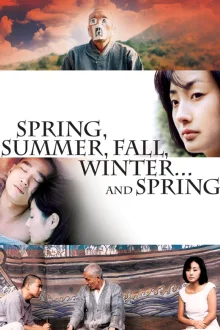
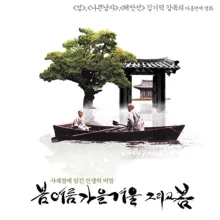
Spring, Summer, Fall, Winter... and Spring (2003)
- Guest Co-Hosts
- Beth Accomando, John Atom
Show notes
It’s a meditative film about a young man and his master as they pass through different stages of life represented by the different seasons of the title. The film stars writer/director Kim Ki-Duk as the adult version of the young monk and Oh Yeong-su as the older version of his master.
Labels: Beth Accomando John Atom Kim Ki-duk
Transcript
An automatic transcript, tidied into paragraphs. It has not been proofread, so names, titles and spellings may be wrong, and it does not say who is speaking.
Show the transcript (about 13,700 words)
Speaker 1: Hold your ears, folks. It's show time.
Speaker 2: People pay good money to see this movie. When they go out to a theater, they want cold sodas, hot popcorn and no monsters in the projection booth.
Speaker 3: Everyone pretend podcasting isn't boring.
Speaker 4: Running off. I have. Oh, you just nasty. And I, you.
MIKE WHITE: Is welcome to the projection booth. I'm your host, Mike White. Joining me once again is M Beth Accomando. Also back in the booth is Mr John Adam.
How you doing? We continue our month of requests with one from John Adam himself. It's Kim K Ducks, spring, summer, fall, winter and spring from 2003. It's a slow meditative film about a young man and his master as they passed through different stages of life represented by the different seasons of the title.
The film stars, writer director Kim K Duck as the adult version of a young monk. And y so as the older version of his master, I'm not sure. Actually, it's all the versions of his master. I'm not sure if we're gonna be ruining anything for this 20 year old film as we talk about it.
So if you haven't seen that And yeah, and I it's a warning but I'm not, we're not going to censor a discussion is what I'm trying to say. We're going to talk about spoilers. But like I said, I don't know if there's anything to spoil. So, Beth, when was the first time you saw this film?
And what did you think? BETH ACCOMANDO: I saw this film when it was released here in the US? And I was reviewing it for work. I had not seen a lot of Kim Key Duck's films prior to that, I think I'd seen a couple, I took it as a very meditative film and very much on the cycles of life, but I didn't have a lot to compare it with at this time.
And for thinking about it, after seeing a lot more of his films, I really felt that it's an anomaly in his work. It feels very different from a lot of the other films. Much more kind of contemplative and reserved and it's like the violence that normally fills his films is mostly off screen and referenced. So it's an interesting one to pick out of his films.
But and I loved it when I saw it. I did appreciate it even without seeing his other films at that time. But I think it might have been brought here with Our San Diego Asian Film Festival, which I know brought a couple of his films over. So I think that's how I got introduced to most of his work.
MIKE WHITE: And John, I'm curious about your first time with it as well as why this one for your request. JOHN ATOM: Why, why this for the request? I don't know if I can answer that. I think it was choice of the moment.
But as for my first time, it was a while ago, it was not on Cinema. I saw it on home video and it was, it was a time where I was just obsessed with Korean Cinema and I was watching almost nothing but Korean Cinema. It was around the time that I discovered old boy, which we've covered together on your podcast as well. And even though I was watching almost exclusively Korean Cinema, this stood out as unique, just like Beth.
It was the first Kim Kik film that I had seen it. I immediately made me seek out other films by him and I do agree that that spring, summer, fall, winter and Da Da Da, spring or I forget if the Da Da Da is before the end, I'm not sure but it is different. It is strangely more commercially accessible. He's very uncompromising as a filmmaker, even though some of his films are pretty interesting to see.
They're generally very strange, sometimes too violent. Sometimes the violence like Beth said is, happens mostly off screen. But the suggestion is too, is still brutal enough that it doesn't have the same commercial viability. Whereas I feel like Spring Summer et cetera is pretty tame for other stuff that he's done and he has other films like this.
So this would not, he has, he's been a pretty prolific filmmaker up until his death in 2020. But this one is my opinion and maybe that's why I recommended it is, it hits the perfect balance of being typically what you think of as an art film, very meditative, very philosophical, very personal for the director if we end up talking about that. But it's also I think very approachable. I think you can watch this and enjoy it.
And even someone who's not necessarily interested in analyzing film can just watch it and enjoy it and maybe get something out of it. MIKE WHITE: So I was pretty reticent when you suggested this for your Patreon pick because I had only seen one other Kim Ki Duck film. I saw a bad guy in 2001 and I'm gonna do my best Gene Shallotte here when I say bad guy more like bad movie. BETH ACCOMANDO: You didn't like it.
MIKE WHITE: I did not like that movie. It seemed to go on forever and it was just. JOHN ATOM: Did you rewatch it? MIKE WHITE: No, just left such a bad taste in my mouth.
I just didn't want to have anything to do with it. And then I think I've stayed away from Kim K Duck films ever since then. Based upon the one viewing of the one film, which is really unfair. JOHN ATOM: In my defense.
I did ask you if you, I was happy to pick another one if you didn't want to. But you said no, let's do that one. So don't, don't blame me for it. BETH ACCOMANDO: Well, what was it about it?
That left the bad taste. Just curious. MIKE WHITE: I just seem to remember it was very slow moving. It just felt like the violence was unearned at times.
I barely remember the movie more. I just remember the visceral reaction I had to. It just going, oh, I'm not a fan. JOHN ATOM: I don't know if that was your reaction.
But it's usually when people say that Kim Ki Duke is a misogynist on screen, that's usually the first movie that they tend to bring up as an example. At least in my experience, I don't necessarily agree with that characterization, especially for that movie. I think maybe there are later movies where he's more of a misogynist, but I think he's portraying misogyny as opposed to being misogynistic. But it is definitely something that has bothered a lot of people, especially in the way, it's essentially a couple of Gangsters who for no wizard other than spite, turn a perfectly fine college girl into a prostitute.
So it is a very provocative film, especially for the time they came out. I'm, I'm curious to know what Beth thinks about it since she seems very, she seemed to like it more than you did. BETH ACCOMANDO: I know he gets labeled a misogynist, I tend to take films like on individual terms rather than trying to slap a label like that on them. And to me, the thing that really struck me is the classism in the film.
And you may say that like they did, they turn this college girl into a prostitute for no reason. That whole opening sequence is about this lower class guy sitting next to this pretty college girl and she being offended by his presence and calling her boyfriend and the sense that he doesn't fit in and she's condescending to him and that she wants to put him in his place, not to defend the actions they take. But I don't think it was just, like, randomly. Oh, cute college girl.
We're gonna turn her into a prostitute, I think. JOHN ATOM: Oh, absolutely. I agree. Yeah.
I think if you look into the film, if you, there's definitely a lot of class issues in there. I think the one we're talking about a completely different movie now. So I apologize about that. But the one.
BETH ACCOMANDO: But it's about Kim Kuk. JOHN ATOM: Yeah, exactly. So, it's, and it's actually not a bad entry into spring. But the one thing that I, if I recall a review that I remember reading one issue that a lot of people do is not so much with the beginning of that film, but with the ending where the woman chooses to be a prostitute and to be essentially give up her agency for what the male protagonist wants to.
Because that's what really happens to the movie is that all these particular, these two Gangsters who turn into a prostitute and then want to be like their her knights in shining armor and constantly keep promising to help her escape, escape out of that life, even though they brought her into it, as opposed to say, want to give her freedom, but it's a fake freedom because they want to essentially remove any agency, any agency from her character, which I think is what the point of the film is trying to be and why the film condemns that kind of behavior.
But the ending is I think what people found a little bit hard to justify. BETH ACCOMANDO: Yeah. And I read it more in classist terms and I think that's the thing is, it depends what you want to latch on to and which part of the story kind of speaks to you more or that want to react to more. And I do think he's a bit of a provocateur.
Also, I do think he likes to push people's buttons and that's part of why he does these films. But to me, it's also this sense of I'm gonna bring you down to my level, to my class. And for this particular scenario, it was a prostitute. And I think somebody referred to it as a reverse pygmalion kind of story.
But again, to me, that opening scene was interesting too because I think it was in one of the articles you sent us Mike, there was a quote about his apology that Kim Key Duck made. That was very extreme. I'm sorry, I made you watch this excrement. I'm sorry, I've dragged out and that apology scene at the beginning of the film where the soldiers beat up the guy and tell him to apologize to this girl and he just remains silent.
I thought was an interesting kind of counterpoint to Kim K Duck's own apology for whatever offense he was accused of at that point in time. JOHN ATOM: And I don't remember if it was for this movie or a different one, but most of his movies did not do very well in the box office. And he sent faxes to all the bleeding newspapers, essentially blaming them for giving not necessarily bad reviews because I still think his movies were well received critically in South Korea, but for essentially scaring off the audience. And he's always been, I think he's trying to give this persona as he doesn't care about his commercial appeal.
But I think he's always been someone who does actually care about his films doing well commercially. And that's why he embraces the West eventually later in his career as opposed to his. BETH ACCOMANDO: Well, I think it's also the West embraced him and his films tended to be commercial failures in Korea, but they did very well Overseas. And I think I've seen some references to that.
He's, he is one of the more like acclaimed and respected directors Overseas in terms of awards and festivals. He's been at in box office that he's gotten for his films. MIKE WHITE: I found it funny that the author of the contemporary film directors book about Kim Key Duck that she didn't like, I can't remember. It wasn't a bad guy.
It was another film and she had the same kind of reaction that I had. And then she's, then I finally saw Spring Summer et cetera. And it was such a different film and really started to appreciate his work after that. I was like, OK, because it's amazing to me that bad guy was 2001.
This is 2003. It feels like this is a completely different director that made this film though. You're talking about the provocateur type of things. There are elements of this that remind me a little bit of Lars Von Trier.
The whole idea of the set being so particular, having the old masters Temple be out in the middle of this pond or lake or whatever it is. And then the way that they have these doorways inside, but people still go through the doorways, but there are no walls, there's the doorways but no walls around them. Which the first time I was watching this, I was like, wait a second, how come I can see the little kid? But I see the old man and there's a door there.
But yeah, there's absolutely no walls going on inside of this. JOHN ATOM: Yeah, there's this artificial discipline that is self imposed by the mong. There's one, I think only one instance in the film where that is broken and it's broken for matters of lust. But you did mention Lars V Tria.
And I think that's a very good comparison. The one thing that this kind of reminded me of is Tarkovsky stalker because the way the film opens is the camera leans into that door outside the temple and the door opens and creates the perfect frame. And that reminded me of the end of stalker where the camera goes into that other side of the zone, never understand what poky the main. But I know that he's always trying to make that point about the separation between the film and the filmmaker or the filmmaker and the audience.
And I always felt this film is trying to do something similar. And I think it's no coincidence that Tiki Duke is actually either movie, he was not an actor. He did not make a habit of appearing in his own film, but he specifically chose to actually do this. So I do think there is something that he's trying to make us aware of the camera being very present and that the doors are this artificial framing frame around the picture or the story that we're about to see.
BETH ACCOMANDO: It's a very theatrical device too. And I think part of, I think a lot of what criticism he received too was some critics did not like the worlds that he created. And on a certain level, this one is like opening these doors into this very specific world that he creates. That when we get this aerial view of it, we can see this one tiny place, the floating monastery on this pond.
We don't see anything of any other kind of civilization, city world. For all we know it could have been sent trees ago except for the fact that we get some contemporary characters walking in. But when you just look at this place and a part of me feels like he was saying, all right, this is gonna be my world that I create. Everything that you see and everything that there is, it's not the real world that's out there.
So I'm not giving you that context and it felt is specifically created as this unique space for him to operate in. JOHN ATOM: Yeah, if you describe the movie to someone quickly on paper, they could say, oh, this could easily be a have been a play. You know, it takes place on one location is the plot of the film is pretty simple. It's pretty straightforward what happens.
But as the film is actually executed, it's very cinematic. It has almost a dialogue which you get to get a you can get away with that on a play. And the characters have no names to add to what you said about this artificial words. There's only one name and one of the detectives when he just abs and he tells him to put, take Coffs away, I think.
And he says, Detective Choi, other than that, there are no names in the story. Just the sort of the titles, the apprentice, the monk, the woman, the mother, et cetera. MIKE WHITE: I think it's false simplicity. I think there's a whole lot more going on with this.
But I like that. They present it in these simple terms. Yeah, we start off with the seasons, we start off with spring. We start off with the young man being very young in this case.
And the whole thing of him, he's a kid and he's doing things that kids do, do kids hurt animals. Yes. Sometimes they do, do they do it on purpose. Hopefully not.
And they don't realize that there are other things outside of them and the way that the old man teaches him this lesson, the kid, but he finds a fish, a frog and a snake and ties rocks to them and luckily one of them survives, but the other two don't. And it's really heartbreaking when the kid realizes just what he has done. But I love that the master does the same thing to him by tying this huge stone around him and saying, if you don't take care of these problems, the stone is gonna live inside of you forever. It'll go right inside of your heart and you need to make amends to be able to carry on with your life and the kid can't, which comes back in the end though, the stone tied to his heart comes back in the end.
BETH ACCOMANDO: It's also the weight of guilt and it feels like that stone is tied to almost every character in Kim Key Duck's films. One of the charges when they call them misogynistic, they say, why can't we have a normal female character? These women are always victims or they're like self mutilating, whatever. But the thing is I don't think there's a normal male character in his films either, but I do think his characters all carry that stone with them.
And when see Rewatching Spring now, after having seen a greater number of his films, I really thought that sequence meant a lot more to me in terms of understanding his work. And I felt, oh, that makes sense. JOHN ATOM: I think it's not only all his characters who carry the same stone, but I think if we're to believe that this is an autobiographical film, I think the director carries that stone. And I don't think it's coincident that he is actually the actor who does in that scene towards the end, who actually carries that stone to the mountain, which from what I read was not scripted was improvised on the spot and he actually did climb that mountain with a couple of cameramen following him.
He was something like 3000 ft of climbing and negative 22 °F when he did it, that was something that he felt he had to do it. And I do believe that he was a complicated person and not to defend people who do bad stuff in real life. But there's usually a sort of a psychological trauma that often leads to people abu abusing people who abuse others are often people who have been abused themselves in one way or another. At least, I think that was the case with Kim Kiki if we're to believe everything that he said about him, if his behavior on set and so forth.
BETH ACCOMANDO: Yeah, I have to confess, I know nothing about his personal life. And I know that when I mentioned that I was going to be talking about his work, I had one person say, I hope you talk about the fact that he's a monster. And I said, I don't know what things he's been accused of or what things he might have done. I just know his work and I think we're at a point that it's harder to talk about films just on their artistic merit now where it feels like you have to know more, you have to vet the filmmakers and the message of the film has to be clear and precise in a certain way for you to talk favorably about them.
And as a critic, I don't wanna have to vet all the filmmakers. I want to be able to look at the work that's on the screen and judge that particular thing not to defend what people might do in their personal lives. That's like a whole other thing and they're responsible for their actions and need to take the consequences. But I see his work and there are things in his films.
I am always fascinated by films about unlikable and unsympathetic people. I don't want to go to the movies to see role models. It's boring. I want to see where people go wrong where they're flawed, where they're vulnerable and like what makes them that way?
Do they, can they triumph over it or does it ruin them? That's so much more interesting to me as a work of art. And so I really gravitate towards films about an unlikable, unsympathetic or sometimes unfathomable people. So that's one of the reasons why I like his films is because his characters are not generally sympathetic or easy to understand.
JOHN ATOM: This is one of my favorite movies, definitely one of my favorite Korean films. And I, even though I think the Me Too movement in Strong Korea in South Korea is, has been very strong and based on anything that we're finding that's been happening in the entertainment industry in South Korea everywhere. But South Korea, this has been a problem for a while. Apparently I'm inclined to say that maybe he definitely, if at least three women and there's more that kind of have come out anonymously, but there's three main women which have been called woman.
A woman. B and woman. C, we have spoken about he and his frequent co co-star, the actual, the actor that's in bad guy, sexually abuse them and even rape them or would not give them roles without sleeping with them. So that apparently that's been a frequent practice in South Korea Cinema.
And I'd be inclined to say maybe there's something there just because of the ubiquity that's been a problem in South Korea. Maybe that's the reason why he can do such a good job at portraying damaged people and people who are not role models. And I don't want that to be the prize for having good bad people on screen. But I don't think there's quite any filmmaker today.
It may be a few, but there, you can definitely count them on one hand, the filmmaker that can really portray like the damage, especially when it comes to issues like class or even more meditative existential issues like they're portrayed in spring, summer, fall, winter and spring that the people who truly carry a stone have a stone in their heart like he does, they just, there aren't that many today. MIKE WHITE: I think if you have lived that perfect life, you probably don't have that many interesting things to say and it's probably damaged people that make some of the most interesting art that we have.
I agree with you, Beth. I'm not a big, oh, we gotta make sure that this filmmaker has a spotless record before we even talk about their work. I love Polanski's work. Do I love Polanski?
No, but do I love his films? Yeah. You can't deny that the guy is super talented and makes some very interesting and challenging works. And I'll say the same thing about Kim Keto.
I didn't like bad guy. I will maybe go back and check it out. I will maybe go and check out some of his other works because this movie really was a great experience for me just to see that it plays out. And I thought for sure I was when I heard, oh, this is about seasons and people and the way that they change and I'm like, this sounds like it could be the most boring film that I've ever seen in my life.
But I was right there with it the entire time I paid attention. I made sure that I was, had phones down all that and just really got sucked in by this movie and just had a great, I can't say a great time, but it definitely kept me very interested in this whole time because I'm saying it's not like a feel good movie that you're going to watch us at a party or something but definitely has something to say. And it says it in a really interesting way. BETH ACCOMANDO: Like John mentioned, it's very cinematic.
It's a beautifully shot film and there is hardly any dialogue which I think that may also contribute to why it's successful internationally, is easy to watch these films and understand them because so much information is just conveyed visually, but he definitely has craft in terms of how he designs his shots and how he shoots it. And like that monastery floating in the middle of the pond is just, and it's interesting again, after seeing the aisle where there's a lot of these kind of, I don't know what you call them in Korea, but they like these little house boats floating on the water.
The context of the aisle was very different for those floating houses, no serenity or calmness in those, there was murder in quite a few of them. So it was interesting seeing it in contrast to that other film is revisiting a certain visual style, but with a very different context and thematic impact. JOHN ATOM: And if you do choose Mike to watch more of his movies, his first decade, I strongly recommend after that, his quality dropped quite a bit, especially the last decade before he died. But just my opinion, there's a quite a cathartic element to the film, especially in the third Act In Fall where he comes back and then he has to repent for the crime that he committed.
It's never clear. We don't know if it's the same woman that he left with or he just moved on. And this is a completely different woman that he's spoiler alert, he kills. But when finally he leaves and we see that moment where the boat stops moving and we see just the look between the apprentice and the master and that the master wants to cry, but he's just trading prevents him and then they leave and then the master commits the ritual suicide.
I cry every time I watch this, it's, it is. You said it's not a feel good movie, but there is that cathartic element that like a lot of good tragedies have that sort of make you cry in a way that makes you feel good. MIKE WHITE: Indirectly speaking, I am curious as far as that particular section because both the student and the master do the same type of thing where they raid out the character for door and they put it over their eyes and over their mouth. And that seems to be the closing of everything for at least the master when he commits suicide.
What is that for you guys when it comes to the student as far as him closing off and him performing all these rituals in order to be kind of try to cleanse himself of his guilt of that stone that's inside of his heart. BETH ACCOMANDO: I wish I knew how to read Korean. So I could know exactly what was, written on some of those pieces of paper. But I also got the impression that the student was trying to commit suicide as well.
And suicide runs through all of his movies. At least all the ones that I can remember it seems like a very strong theme. And again, that's tied, I think a lot to the notion of guilt. These people want to die because they've done something that they can't live with.
So I'm not exactly sure it, same thing with, he writes on the wood on the floating monastery and then he has to carve it out. I understand the concept of what they're doing, but I don't know, I couldn't read what the actual words were that they were writing there. And I was very curious to know. I mean, I, if I had more time, I would have called my Korean friend and asked them to translate.
JOHN ATOM: I've seen two different types of sides subtitles, one that translated his door and one other that translated as shut or closed. And it could be one of those things that the same symbol. I don't know if Korean is like Chinese, I don't know. But it could be one of those things where the same symbol means different or similar things depending on the context.
But I always look at that as the student read about that ritual suicide somewhere and just chose to perform it without necessarily understand it. Whereas when the master repeats it later, he truly understands the meaning of it. And another thing, it's tempting to try to interpret this movie as a Buddhist movie. But the director has clearly said it's not, he doesn't really know about Buddhist Buddhism and he didn't, apparently he didn't bother to do any research that was just like a very broad framework that he chose to make the setting.
But it's not something that he really knew about. And a lot of people have criticized this movie as being very superficially Buddhist. But that's missing the point again because that's not really what the film is trying to do even though it is set in a Buddhist monastery. BETH ACCOMANDO: Yeah, I think Kim is Christian.
JOHN ATOM: In a couple of interviews that I managed to find on YouTube. He does seem to be proud, not necessarily proud but advertise the fact that he has no formal education and doesn't have education as an artist. I think the best is he went to Paris at one point to study painting and he flank out like the first week and then spent the rest of his time there selling paintings on the street or something like that. So it's definitely not someone who grew up as a Buddhist or if he did, he paid that much attention to it.
MIKE WHITE: And that whole thing of him bragging about his lack of education or at least that's how the author of that contemporary film director's book, took it and then she actually saw him introduce a film and he explained a little bit more about what he could do, how he could be educated. And just that he wasn't even allowed to be educated in Korea because of his social standing to your point from earlier, Beth. And he ended up going to Paris and learning more about art and street culture of Paris and all these things.
It's oh OK. Kind of redeemed himself in her eyes at least. And then that helped with me as well. And yeah, to your point from earlier John also.
Yeah. Very. Not a Buddhist film. Apparently a lot of people were just like, oh, I'll up in arms about how dare you, this isn't real Buddhist stuff.
And he's Yeah. No, I never purported it to be. JOHN ATOM: Kind of like Fargo when they say this is based on a true story, which is just, just bullshit claim. I think this is the same thing.
It presents a Buddhist monastery, but it's nothing to do with it. MIKE WHITE: I'm trying to look up what it is that he carves on the deck and I think it's a prayer the. JOHN ATOM: Heart Sutra apparently, which, which I know nothing about other than that's what it's called. He probably opened up an encyclopedia and said, what's a cool Buddhist prayer I can put on my film and that's whatever fits in this 10 by 10 piece of wood that we have on the floor.
MIKE WHITE: It's very interesting to me because of the door character because that's, yeah, it is a Chinese character and I don't know how similar it is to the Korean version. And if you're Chinese, you would say they stole everything. All of Asia's culture is all taken from Chinese. But I know that's a very chauvinistic approach to it.
I always find it funny that when we talk about turning things on or off or just we have so many different words for stuff when I was in China, they definitely, it was like, do you want me to shut the light? Do you? And I'm like, what? Shut the light, shut the door.
But they were like, no, shut the light rather than turn on or turn off. It was shutting. I was like, well, that's an interesting way of presenting stuff, but it's like, we don't make all these distinctions about, we turn on a light but we shut the door or close. JOHN ATOM: The light in a lot of languages.
There is in Greek too. There's one word for open and one word for close and you do it the same for the TV, the light, the door, the anything that can be closed, there's just one word. MIKE WHITE: It really feels like he's shutting the door on his own life or trying to. And then the master is no, we're gonna do this and he paints out all that and then makes him do that.
Meanwhile, the it feels like his anger. He comes to them so angry and it dissipates as he's doing the Sutra. And when the cops take him away, it feels like he's very much at peace. And it's very interesting that we stay just with the older monk.
We start or I should say just stay with the temple rather than going off with the younger man that we just stay in the one location. And we don't see the young man's journey. We get that from context of when he comes back and what people say about him or what he says about himself when he comes back because we could just leave this beautiful place and follow his story. But I think it's much more interesting that we are there with the old man and there with the temple the entire time.
BETH ACCOMANDO: Instead, that was key again to that notion of him creating his own world and universe and not diluting it by taking us outside of it where you can have points of reference that you might be able to say you're not recognizing this or you're not taking into account this. It's nope, I am keeping you right here on this floating monastery where you have to deal with just the parameters that I give to you. And it is true that a lot of what we hear tangentially is like the stories that you do see in bad guy or in the aisle like you feel like he could have made a whole separate film on that young monk leaving and marrying the woman and then killing her and then fleeing back to the monastery.
But for this particular film, that's not the point he wanted to deal with. And maybe this is Kim K Duck's attempt to cleanse himself of some things and to see if he could use film in a cathartic way that didn't have the same violence that some of his earlier films did. MIKE WHITE: And we should also say that this is a very magical place. There's the rowboat that he has and it's just one boat.
And the young man goes across in that very first chapter, he leaves and goes and is doing all these things to the snake and the fish and the frog and then the master shows up and it's, how did he show up? There's just the one boat? Is he actually even there? That was my question, is he there or is this almost like an astral projection of him or does the boat just come when he calls it?
Because there is one moment where he's trying to get that boat back and it does seem almost magical the way that he's able to just grab on to a little piece and pull the whole thing over to him. I like that. We don't have to have that explanation. Jeez, there's only one boat.
How could it get over there? It's, I don't care. This is the story that's being told if you're caught up in that. What are you doing there?
JOHN ATOM: There's this hint of supernatural or mysticism that it stays with you throughout the entire film. And I think that's from a practical point of view. That's maybe another good reason why he stays on the monastery because once you go to the city and you follow the lives, you can't maintain the same like a unknowability of what's happening? What is really?
Are there any supernatural things going on here or anything like that? Whereas the minister is this sometimes enclosed in fog or sometimes moving along the water, sometimes the boat moves by itself, stuff like that. It maintains this illusion of mysticism. One thing that kind of always stands out to me in the summer segment where the woman comes and of course, this is the this outside force that comes in and like dis disrupts the harmony in quotes.
That's another female, that's maybe the only female, meaningful female character that comes into this film. But of course, they struck, they strike a relationship with a young monk and they have sex. And one thing that always bothers me is how does he know what to do because he has no frame of reference whatsoever about what sex is. What I don't know, maybe I'm, I'm bringing the discussion to a point that we shouldn't go to, but it's definitely a big deal because he jumps straight into it.
He knows what to do. It looks like he knows what to do. They have the discussions with the master about. I'm gonna listen here, Billy.
I'm gonna teach you a couple of things. Only missionary and when you grow up we'll learn the other stuff. So, it's, it's, I think, yeah, it takes a bit of a leap of faith. MIKE WHITE: Yeah.
They bring a lot of pornography to that monastery. I don't know if we get that or if that's just in the deleted scenes. But there's just like boxes and boxes of pornography. Yeah.
And that was one thing that I found interesting when the young man leaves that he takes that Buddha statue and then the rooster and I'm just like, is this pack reference? I don't think so. But for me, that was pretty funny where it's like, all right, I gotta take my rooster and leave. JOHN ATOM: The old man does come back with pets every once in a while.
There's even a Yoda quote. Lust brings desi what, what is, I. BETH ACCOMANDO: Think it leads to possession which leads to murder or something. JOHN ATOM: Yes, something like that.
So it's very Yodo, like one thing leads to another that leads to a bad thing eventually. That's the formula. And I, at first I thought, oh, did, because, like I said, it's very tempting to think this is a Buddhist film and I thought, did George Lucas steal that from Buddhism. But I think it's just probably the other way around.
It's probably from nowhere. And Kim Kauk most likely took it from Star Wars or something like that. MIKE WHITE: It is very similar to the four pillars of faith of Buddhism. Life is suffering, suffering comes from desire, eliminate, suffering, and you eliminate the desire.
And then I think the next part is follow the eightfold path or whatever is the last of those, which is always a cheat to me because it's like here's the four rules and the fourth one is, here's another set of rules to do. It's like wishing for infinite wishes. You can't do that. You have to come up with four solid rules.
JOHN ATOM: Ok? So there's a valid source there. MIKE WHITE: But yeah, they Buddha didn't talk too much as far as I know about murder. But yeah, there were a lot of parts in here where I was reminded of Siddhartha and the Buddhist story and just the cleansing of the self, the way that the master when he comes back after having murdered his wife.
The way that the master is like beating him and putting him through all of these paces, like trying to purify him is what I feel is what he's doing with that. BETH ACCOMANDO: Well, and again, I started watching a number of Kim Key Dick's films before getting to spring again. I was trying to watch him in chronological order. I didn't get through all of them.
But seeing it in that order also made me think and again, in that context of him making that apology about his films. And I'm just wondering if he made this film to say I'm gonna deal with exactly the same things I've dealt with in my other movies, but I'm gonna give it a different veneer. And then let's see what you say just to see if, I don't know, almost like a slight of hand trick. Like I'm gonna try this because the sense of the seasons and the sense of a cycle and the sense that we end where we began with another young child coming and doing a very similar kind of cruelty to animals.
All his films feel like they are about these cycles of violence where one person hits one person and then that person goes and hits somebody else and then that person commits another and it's this chain reaction. And in this film, instead of specifically showing you this act of violence leads to this act of violence, you still get that sense of this ever ongoing cycle and circle that keeps repeating itself. And if these kids are gonna keep coming through inclined to violence as their first thing, like, what does that say about us or what does that say about his particular view of the world?
Is man, you know, in nature left to his own devices, is he inherently good or inherently evil. You know, it's the lord of the flies thing. Like what, what is that truth? And to him, I feel like he's saying no, we're kind of inherently bad and we need something to kind of correct us.
Otherwise we might continue on that path. JOHN ATOM: After rewatching the movie when you get to that first spring and you see the master sort of watch, watch this, the apprentice from, from the rock up as he's torturing the animals. You definitely get the sense that he's rewatching his own youth, almost like a time travel movie where the old person goes back to watch their younger self and make sure that the future happens again or something like that. So there's definitely that repetition very intentionally inserted into the film as for whether or not he's trying to tell us that maybe man is inherently bad.
I definitely tend to not like that interpretation because I feel like he would like to be a little bit more open ended than that, but maybe who knows? I mean, there's really no other way to kind of view the child's behavior because he's not, you could make the case that he's just an animal, right? But he's not, he's not like hunting to eat, he's torturing for amusement, he's not killing the animals, he's torturing them for just for a couple of laps. But then he's also become sad.
He doesn't, he doesn't become sad because the master beats him. He becomes sad because he realizes the consequences of those actions. Not because, you know, he's afraid of the punishment that the master might give him after he finds out that the animals have died. MIKE WHITE: I think that this is very unfair of me but spoilers for the Squid games as I'm watching this movie and a Y so is the old monk.
I know that he's capable of horrible things after seeing the Squid games. And so I was just like, is he really benevolent? Is he really this nice old monk or is there something else going on? So, like I said, I don't think that that was really there, but I'm looking at him in a way different way after he was the old man in the Squid games.
BETH ACCOMANDO: If it was me, I would have stopped him at the first animal. Like I wouldn't have just watched if his point is, I'm going to teach him a lesson. The price of that lesson was the life of two and could have been three animals. Now, you may think that animals of that size are inconsequential, but I would have stopped him right away, not let him get that far.
So, you know, there's a part of that monk that I'm going, shouldn't she be saving those lives at that point and figuring out a better way to teach the lessons so that you don't have to sacrifice little animals. But I think. JOHN ATOM: Probably by Korean culture. I think the life of a fish or a frog is probably not, not viewed as, I think everywhere.
Not, I don't want to single out Korea. But I think for a lot of people, the life of a fish or a frog. And what else does he tortures a snake? Snakes, I think are important in Asian and Buddhist mythology.
If, if anything, once the master dies and then the next, I think it's winter we see a snake essentially sleeping with him. I think snakes because they shed their skin and they're like reborn or new. So they've always symbolized rebirth. And I think, I think at least that's I always interpreted as the snake being the next reincarnation of the master and it just stays there.
He's even under the clothes. When he first arrives, he takes the clothes over and the snake is right there. He's not scared of the snake. Of course, even the little kid was not scared of the steak, which was amazing to me how a kid actor could just look at a snake and just grab it and then throw it away out, freak the hell out.
I think snakes are important. So him torturing the snake and the snake dies and that's where he cries the most. So it's definitely a big deal. And I think he makes Kim Kdu has made no apology about the animals being really hurt in the movies.
He doesn't use any trickery to, or fake animals or CG, I, of course, this was too early for that, but at least by Korean standards. But, yeah, he's saying no, all the animal violence is real and he's even said that maybe one day I'll have to answer for that. But for now that's the case as for the, his reputation as a provocateur in South Korea and everywhere else. I wonder if that's a little bit exaggerated or maybe he like exaggerated himself.
Take pride of it because if you really watch other South Korean movies, they're not exactly tame. You have old boy, you have memories of murder. BETH ACCOMANDO: There's extreme Cinema across Asia, but the violence in each country has a different tonal quality. So like in Japan, you have Takeshi Miki, the extreme of that is a repressed society rebellion rebelling.
And in Hong Kong, I feel like it was before the changeover. It was the sense of losing control and not having anything to do. And in Korea, it really feels to me like it comes from this painful division of a country and all the violence always seems to have pain on like both sides that so many of these films you mentioned old boy, everybody that film, like you can feel pain on multiple sides. And a lot of times it feels like there's a sense of betrayal also entrenched in that as well.
JOHN ATOM: Sure. But Kim K Duke that much worse than his Korean contemporaries because he's definitely singled out and I do think there are maybe a couple of cases where he does cross the line. I don't think I've seen anything else quite like the aisle with the couple of the famous fish hook scene scenes. There's two of them, I think so.
Yeah, there are a couple of instances where he crosses the line, but on average is he that much worse than his contemporaries And I feel he's portrayed like he is and maybe that's a little bit unfair of the local critical community. BETH ACCOMANDO: And the aisle got the extra boost of, I forgot which critic it was who gagged along with the scene in the aisle and then went out and passed out in the theater lobby or something. I mean, you do that and then you immediately have a certain amount of cachet that's been bestowed upon you and people.
It's like back to the time of the exorcist and more recently Blair Witch Project where people are going out and throwing up and. JOHN ATOM: Yeah, so there's a bit of marketing used to maybe amplify that. But I compare like I can't help compared to some of his most violent or most extreme moments with Gaspar Noe and Irreversible. And I'm not a fan of that movie.
I genuinely think that's a sadistic movie. Paddle off as profound and a lot of people disagree with me. That's fine. Whereas whatever Kim Ki Duke shows such moments as extreme violence, whether shown or implied, like the ale, like the bad guy we really have.
He really takes some time to show why that is and what is that sort of the individual feelings of the protagonist? It's not done for show. It's not exploitative, it's not manipulative. It's I feel like ugly and genuine and it just always comes from a place of understanding and place to force you to think about like the norms that he's trying to either portray or disagree with.
BETH ACCOMANDO: That's potentially why people are more upset with it because people don't like to think people like to be told how to feel. And a lot of his films, you do have torn emotions and I think it's difficult. I think his violence is genuinely disturbing, which is how violence should be like, you should feel a little queasy when you see violence on the screen, you shouldn't be able to laugh it off or see it as a joke. And I think the more disturbing and realistic and conflicted, you feel about it, the harder it is for people to deal with it and an easy way to deal with it is say, oh you're, you the filmmaker are a bad person and for making me feel this way.
And I think there's a certain aspect of that in his work where the fact that we're uncomfortable with it makes it harder to deal with in some of the Japanese films that are extreme violence. It's so over the top that you don't have an emotional connection to the characters in the same way that you do in some of Kim's films and that makes it easier to accept. Oh, yeah, the filmmakers just going over the top. But I think when you have a hard time deciphering what the filmmaker's point of view is that makes it more difficult for the viewer because you have to think about it and you have to weigh what it is about the film that you like or don't like because I think some of his criticism has been and maybe he really is a horrible person.
A lot of that criticism has been more of a personal attack on him which might be justified. But I think that's also part of what makes it more difficult for people to view his films and look at the artistic or creative value of what he's doing. JOHN ATOM: If you look at the some of the articles that Mike put the shared folder, a lot of those predate any revelations about these potential assault allegations, et cetera. And to be fair to the Korean community, he's been pretty well awarded by various Korean and film festivals and award like this film Spring, summer, fall, winter and spring will receive their the Grand Bell Award for best film and best director I think, which is the Korean equivalent to the Oscars.
So it's not like he's been completely ignored. By Korean Cinema. He has been recognized somewhat by the Korean Critical Society. It's mostly commercial success that has eluded him in his native country.
MIKE WHITE: I want to know what you guys think about the winter sequence and especially the woman that arrives with the scarf around her head. That's such a striking image, especially because it's, I believe it's purple. So it stands out even more than if it were any other color just, is that a natural color for what, where they're at? What do you guys think about her and bringing this baby?
Of course, that's going to continue the life cycle. But who is this person her anonymity? BETH ACCOMANDO: That is key even at the point again, spoilers for anybody who hasn't seen it. But the fact that she dies and he makes one attempt to unveil her and she stops him.
But then when she dies and he pulls her out of the water and he goes to remove the scarf. The filmmaker pulls us away to say I'm not, I'm gonna keep her anonymity. You also, it makes you wonder like how did that young mum monk first appear at the monastery? Was it a similar sort of situation?
Is he dealing with his own thoughts about how he arrived at the monastery? Does he want to look at this woman to try and figure out did my mother do something like this? And what kind of a face does that person have? I do think it's part of that whole cycle and it made me think about what the monk might have been considering as to his own origins.
So for me, that was the key part of that. JOHN ATOM: And another thing that I thought of the first time when I saw that's the woman that he abandoned or potentially killed for the time. Doesn't make sense because he's been in prison for a long time. He's quite old now and that woman would most likely also be old or older, unlikely to have a baby.
Although who knows? So that kind of made me think, maybe not literally but metaphorically, that sort of a kind of life that he left behind a family and a wife and someone who he can take care of and can take care of him. I'm not sure if that's what the filmmaker intended. I'm not sure why maintain anonymity, but maybe there's that guilt that he feels for killing her as was the same person and he does not deserve to see her face or she does not want him to see her face.
MIKE WHITE: I think that all of those are valid interpretations because I like that. We don't know. And I especially like what you were saying, Beth, as far as not ever giving us that privilege, taking that away and making us wonder who this person is forever. And I personally wonder if, when he looks at her face, if he even knows who she is.
I don't know if he does. But yeah, this whole idea of now we're continuing the cycle. I found it so strange. I didn't realize that the US version when they released this was different than the version that I'm used to or that we saw, which is they cut out the little boy putting rocks inside of the fish, the snake and the frog again at the end, they go from him on the rowboat to the Buddha statue overlooking and I'm just like, wait, what, why would you cut that out?
Because, yeah, it continues the entire cycle. JOHN ATOM: Which is such an important scene. It's such an important scene to leave out. I guess it's a little bit more violent than the first scene where he just ties a rope, a little string around them where he's just shoving them into their mouths, which is a bit more violent.
I don't know why American Hollywood would draw the line there when there's films with people just shoot each other constantly. But I don't know, I don't know what the process is, what the protocol is. But yeah, it's such an important scene. It's such a, it's, it doesn't, the film doesn't make sense without it's, it just opens a whole lot of questions that he doesn't answer.
And the whole idea about the cycle being repeated is just completely left out of the movie. BETH ACCOMANDO: Censorship is such a bizarre thing. The idea of what can stay and what can't I think it was John Waters who had gotten, it was John Waters or David Lynch or David Cronenberg who had gotten an X or something. And he said, what do I need to remove?
And the sensor says we don't know, but we just know it's offensive and it's that sense of, we can't put our finger on it, but your film makes us uncomfortable and we can't tell you to trim three seconds here or cut that scene out and it'll suddenly be in our rating. It's, it's too far gone. So like the idea of what to remove, to make something palatable always baffles me. JOHN ATOM: And that's still the version that's available if you, I don't know, I don't know about every platform, but if you get it on Amazon Prime or Google Play movies, whatever that thing is called now it's, that's still the version that they have the, without the final scene present.
That's what I watch. That's what I watched the first time a few weeks ago I watched on Prime and that's the version that they had. And I was OK. Did I accidentally hit the fast forward button and I missed that scene.
But no, it was just, it just cuts abruptly to the, to what is the actual final shot? But they missed a little bit part in the middle there. BETH ACCOMANDO: Yeah, I used to work at a TV station where I would have to censor movies to go on the air, which was a horrible job. But we had gotten Brazil from Universal and the version we got has a happy ending because the dream part of it is presented as the end to the film in that version.
And I was so outraged. I was like, we can't show this version. And they said no, that's what they said, that's what we show. And it was just, I just could not understand how a studio could butcher something to that degree.
And mis completely misrepresent like what the film is. And I think removing that sequence from this film does a similar disservice. MIKE WHITE: I'm curious after he makes this film, do his films change. Does he go back to the more extreme stuff or does he adopt more of this style moving forward?
JOHN ATOM: I think more of this style is the one, the few ones that I've seen. So he made two other movies immediately after this. So Samaritan Girl or some are, is his girls and three are and they're both very similar. They don't really have a lot of violence.
So one of them is about the friendship between these two teenage girls that it's been a while since I saw that one, I forget if they're sisters or they're just friends that essentially come from unhappy households. And the other one is about this drifter who goes into the homes of people takes showers and then leaves and eventually he goes to prison and learns how to be a shadow to basically walk behind people without being noticed. It's a very fascinating film but they both have the same approach. They're both very meditative, very nonviolent for the most part.
And they very, also, I think commercially, perhaps a little bit more accessible. BETH ACCOMANDO: After this point, his films do have a different quality. I think Samaritan Girl and Three Iron are closer to his earlier films in terms of an interesting and dark complexity to them. Yeah, I haven't rewatched some of the, there's a few of his really recent ones that I have not had a chance to see at all yet.
But yeah, it is, it's a turning point, but I do think it stands separate from a lot of his other films. To me, it does feel very different and I'm not sure what prompted that or why he decided to try that. If somebody took his name off of all these movies and showed them to me and did three of these things belong together would say, oh, yeah, I know that's gotta be a different. JOHN ATOM: Filmmaker, Pieta from 2012 who, which he won the Golden Lion for that was more like some of these earlier violent films.
The bad guy, for instance, there's a lot of violence. It's an interesting film. I don't know that it deserved to win The Golden Lion. I was very surprised by the fact that it did, but it is an interesting film and I think I've seen only one film of his.
After that, he's made a film every year, sometimes more than one. So he's pretty prolific. Whether they're good or not. He's happy to, he's a, he's called in one of the interviews.
He called himself a film worker. He's just happy to make films. He doesn't care if they're good or not. He just makes what he likes.
BETH ACCOMANDO: I think he's somebody who never had a formal film education. So I think making a film every year or twice a year was just his way of teaching himself. I got to keep making these things so I keep learning so that I can keep doing it. MIKE WHITE: Yeah, for some reason, I was getting a little bit of Imamura vibe while I was watching Spring Summer and I was reminded, it's not nearly as outrageous, I guess it was the sex scene reminded me a little bit of warm water under a red bridge, but of course, different ending to that sex.
This one has an old master feel. It's so interesting that this is a upstart filmmaker provocateur. But right there in the middle of his filmography, it's oh, yeah. And then I can do this if I want to is almost what this movie feels like.
Oh, you have problems with the way that I make these movies here. I'm gonna give you something else and this looks like an in memo, it looks like a tetra guara. It looks like something that you just are not familiar with from Kim K Duck at all. And it, yeah, I can do this and I'll even start in it and I'll even sing the end theme song to it as it plays out over the credits.
BETH ACCOMANDO: Seeing all these films together. Again, the motif of water is in almost every film, reflections in the water, people drowning. There's two films I think where there's suicides in water. It was just interesting to see.
And then this film you're surrounded by water living in this monastery, but he seems very obsessed with kind of the quality of water. JOHN ATOM: I do sometimes wonder if this film would have been bigger if he had come out at a different year or maybe even later in his career in the filmmaker's career because 2003 was a just a bang year for South Korean Cinema. So you have an old boy that came out the same year. Save the Green Planet Tale of two sisters.
Members of murder came out the same year. There's another famous Korean thriller, a public enemy. I think I'm not 100% sure on that one, but I think came out the same year. And then also you had the Lord of the Rings, which was a huge box office success pretty much all over the world.
So that, so this came out at a, at a time where it had like a lot of competition. So I wonder if you maybe would have gotten more attention? Had it come out maybe a couple of years later or two or three years later, it was submitted by South Korea as the Oscar nominee for that country, but never made it into the list. And I wonder maybe a little bit later would South Korea had gained a little bit more of a prestige internationally like it has now.
It has like it has has now if this one, because this does look like a film that maybe the Oscars would appreciate more. I don't know, maybe I'm wrong about that, but I feel like it didn't get the kind of attention that he should have if he had to come out now or later than he did. BETH ACCOMANDO: I can't predict Oscars. I can never tell what they would go for.
My introduction to Korean Cinema or my more contemporary introduction was tell me something. And she and I remember seeing those films at a festival and thinking these kick ass and they never got picked up, they didn't get released. I didn't see it. And I was going like who?
There's some amazing stuff. How come nobody's picking up these movies? And it took a number of years before some, I was watching these films on, I think they were like Hong Kong laser discs or something that I was renting from a karaoke store. And that's how I was getting to see some of these or else festival screeners from the New York Asian Film Festival.
But other than that, my. JOHN ATOM: Understanding is the way the sort of the popularity of Korean Cinema is that from the late nineties to about 2010 Korean Cinema started started to get noticed in festivals, you know, among Cinephiles outside of South Korea. And that was very big for them, but it didn't quite have that commercial success. And then I think after 2010, it also started to have some commercial viability, especially I think with the advent of streaming services which helped a lot.
And it got to the point where Korean films started getting released in theaters in the US. And you have Korean dramas which have been popular since the mid 20 tens on things like Netflix and Hulu and things like that, which is, which certainly contributed to the rise of popularity of things like Parasite. The point is that this quality from Korean C of my Korean TV has always been there since I say the late nineties in my opinion. But it just took some time to get to the point where it is that popular that successful with not necessarily just Cinephiles, regular movie goers and Netflix watchers.
BETH ACCOMANDO: One of the things I appreciate about Korean Cinema is that the way it embraces Melodrama as a good entry point for getting people hooked because Squid game was totally Melodrama but amped up with a lot of interesting elements and content, bit of horror and all this other stuff. But it hooks you with the Melodrama with these characters who start out, the main character starts out as being completely unlikable. He's like rude to his mom and debt ridden and doesn't care about anything. But it sucks you in with these kind of very basic emotional hooks.
And what I find is a lot of American films when they try to use Melodrama, like they don't embrace it like they're embarrassed by it and it doesn't work. But a lot of these Korean films, even the Park Chan Wook stuff, there's a lot about them that's emotionally fundamental in terms of how they pull you into the story. And I love it because then they also have this element of kind of extreme storytelling that takes left turns that you just never expect. JOHN ATOM: Oh Yeah.
Melodrama in South Korea go like peanut butter and chocolate. It's present all that moves. Even Kim Jeewon when he remade the famous Japanese animate Gene Raw or the Wolf Brigade. Of course, they changed a lot.
But the story they placed in South Korea and they made the story similar. But the one thing they added a shit on of his Melodrama otherwise it's sort of like bit for bed the same. But a lot more Melodrama in the South Korean version. I wasn't a fan of that remake.
But certainly you can see what it is that makes it, especially South Korean. MIKE WHITE: I've been hooked on extraordinary attorney Wu for the last few months, I watch that every time I go to donate platelets because it's on Netflix and I can watch it with subtitles and I love it. JOHN ATOM: Just one last thing. What do you make of the pets?
So, the first scene has a dog, summer has a chicken. Fall has a cat which I felt very all the animal cruelty in this film. Him holding the cat and using it as a paintbrush made me feel really uneasy because you can hear the cat meowing the whole time. She does not want to be in that position and it follows a cat and then the winter is a snake which I think is the reincarnation of the master.
And then I think in the last scene is a turtle which the kid also shakes up. I don't know if there's any significance. Like I said, we're tempted to look at these from the Buddhist point of view, but I'm not sure if that's anything or they're just random animals that he thought of picking. BETH ACCOMANDO: I vaguely remember when take care of my cat came out the Korean film that there was a discussion of the fact that cats are not valued much as pets that they're not considered.
I don't know, I just remember, I vaguely remember that I could be wrong but that was one of the reasons why the title was taking care of the cat. I don't know. Yeah. I don't know what to make of the pets because they all disappear.
We never see the puppy grow up. JOHN ATOM: We can make the assumption that there's been an enough years that maybe they died of natural causes. Hopefully they didn't eat the puppy because that's also a thing that in certain parts of South Korea is happens. But hopefully, I think maybe the most charitable interpretation is that after every season, there's enough years that have passed that maybe it's just, it just died.
BETH ACCOMANDO: Dogs die quite a lot. And address unknown. Was it address unknown? Yeah, I think so.
That one though did have a disclaimer that no animals were hurt. None of his other films had that disclaimer. But that one did, that one was a little rough as somebody who's a dog lover. The only other thing I wanted to mention is that I had read somewhere that there was an actor cast to play the adult monk who ended up not being in it.
And that Kim Key took on that role as a matter of practicality. I don't know if that's true, but if he did take it on in that respect, and then you mentioned that the carrying the stone up the hill was an improvised scene that adds a different dimension to the film in the sense of maybe it became far more personal than he intended it to. And that journey up that hill was a reflection of either his struggle to become a filmmaker and to get on top of his game that way. And also the guilt that he was carrying with him for whatever he might have felt was his burden.
Because I don't think you can make this many films about people carrying those stones and not be carrying a few of them yourself. JOHN ATOM: I don't know a lot about his filmmaking style. I don't think he's particularly hitch, hitch in the sense that he likes to control every aspect of the film. I think, I think he's quite comfortable with rewriting right in the middle of shoots and changing things and trying new things.
He's a pretty, pretty fluid filmmaker. So it would not be surprised me, surprise me. That thing changes like that happen in the middle of even of a very important film like this. BETH ACCOMANDO: So perhaps this is his most personal film.
We don't know. MIKE WHITE: Oh, it's definitely one of the most different. All right, we are going to take a break and play a preview for next week's show.
Speaker 8: Her name is Carla by day. A loving mother, mommy by night. I've been a pretty bad boy. She's the princess.
I think you deserve a good spanking. His name is Walsh. Are you married? No, by day an ordinary guy by night he's a vice cop.
Come on, his name is Ramrod day or night. He's a hustler on Hollywood Boulevard their worlds collide in Vice squad radar under 17. Not a bit of parent. MIKE WHITE: That's right.
We'll be back next week with another Patreon request vice squad until then. I want to thank my co-host Beth and John. John. What is the latest with you, sir?
JOHN ATOM: I don't know if I mentioned it last night, but V Cinema is no longer active as a website. Is it finally shut down after so many years? There's still archive on that. What's that website?
The way back machine? If people want to find it, then all, all my reviews and all the wonderful reviews that people wrote over almost two decades, no less than that, but a long time nevertheless are still there. And I'm, I'm also doing a podcast with previous writer from, from the Cinema called Heroic Purgatory, an Asian Cinema Podcast. And we're actually covering the New York Asian Film Festival.
I actually did that in the last episode and there's also some written reviews on the site. If anybody is interested, they can check it out at Heroic dash purgatory dot com and Twitter with the same name. And that's it for me. I hope I didn't forget anything.
MIKE WHITE: And Beth, you are one of the busiest people that I know what is going on with you lately. BETH ACCOMANDO: I'm still working at K PBS. I have a Cinema junkie podcast and my blog so you can go to K PBS dot org slash Cinema junkie. But my heart is in my film programming, which is I work with film geek San Diego at the Digital Gym Cinema.
And we have a yearlong action series that we're in the midst of. We've got a Jackie Chan police story coming up. We also work on what we call Bonkers Half Ass Cinema, which is half assed midnights, which is midnight movies that get you win at 10 and out at midnight. Because in San Diego, it's hard to get people to a midnight movie.
So we've got that. We'll do, we'll be doing a secret morgue which is Horror Marathon in September trying to bring as much unique and interesting programming to San Diego that we can, that's outside of mainstream theaters because that's the stuff I love. Everybody can see. Barbie and Oppenheimer whenever they want.
It's a little harder to see who killed Captain Alex in a theater. MIKE WHITE: It shouldn't be that hard to see who killed Captain Alex. Oh man. Do you have VJ talking over it as well?
BETH ACCOMANDO: I don't know which version Agfa has to allow us to screen, but we will find out we want to do a Ugandan film night. MIKE WHITE: Thank you so much folks for being on the show. Thanks to everybody for listening. If you want to hear more of me shooting off my mouth, check out some of the other shows I work on.
They're all available at waiting way media dot com. Thanks especially to our Patreon community. If you want to join the community, visit Patreon dot com slash projection booth. Every donation we get helps the projection booth take over the world.
Watch
Music credits
- Original Soundtrack
Links & resources
Related episodes
Episodes that share keywords with this one.
Comments
No comments yet.