
Special Report
Mary Patel-Gallagher on Holistay (2023)
Show notes
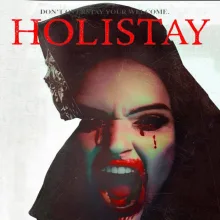
On this special episode, Mike talks with filmmaker Mary Patel-Gallagher about her 2023 horror film, Holistay. The film is now available to stream.
Transcript
An automatic transcript, tidied into paragraphs. It has not been proofread, so names, titles and spellings may be wrong, and it does not say who is speaking.
Show the transcript (about 4,700 words)
Speaker 1: Hold your ears. It's show time. People pay good money to see this movie. When they go out to a theater, they want cold sodas of hot popcorn and no monsters in the projection booth.
Everyone pretend podcasting isn't boring.
Speaker 2: Turn it off. Not bad. I know we're gonna have a good time here. Hello?
Is anybody here? Who are you? We have a reservation here. You just reserved this house for four days.
We just got here. Do you guys mind if we stay here tonight and figure it out tomorrow? Is this some shady dude out there? What did you actually see Tony?
Whatever boss is gone. Someone's in the house? Well, how did anyone get in? What's wrong with you, man?
It looks like you haven't slept in days. The craziest sound in the middle of the night, man, screaming screeching. So if I believed in ghosts, I'd say you heard a and she's a female spirit, but legend has it. When a Ban Wael across the board, someone is gonna die.
It's probably just somebody playing a joke. Well, it looks like we're all alive. Made it through the night. MARY PATEL GALLAGHER: Hey, folks, welcome to a special episode of the projection booth.
I'm your host, Mike White. On this episode, I am talking with Mary Patel Gallagher all about her feature film, Hola Stay. It is a story of two couples who both book a house in San Diego where strange things begin to happen. Had a great time talking with Mary.
I hope you have a great time listening to it. Enjoy the interview. Can you tell me how did you get involved in filmmaking and tell me a little bit more of your background? Because from what I understand, you used to actually work in journalism in Philadelphia.
Yes, I was a political journalist in the Philadelphia City paper from 95 to 2008. I started to produce political debates for Comcast, Pennsylvania's a very pivotal state with elections. So it was a lot of action going on. A lot of people in and out were a great time to do debates for the big elections.
And then I did a documentary called electile dysfunction. In 2008, it came out, it took me about two years to shoot and I enjoyed the producing part of it. I had also been on the board of the Film Society for about eight years and got to know a lot of producers and actors. And so I decided I moved to L A in 2010 because my column got downsized out, out of the paper, right?
Like they all did and then now the paper got sold out. It's no longer around, but I started working on features with other people's features. And then I had started thinking about doing my own project. I had a pilot movie that I was working on.
I had funding out of Ireland, but it fell through during COVID. So then I started thinking about something else to do and came up with this Horror Sweller movie Fall Day. And that's how I arrived at that. I started it about two years ago, I finished the script in February last year.
I already cast it and then I wrote the script and then I shot last April and came out post and after all the notes from the industry people finished in March. And then of course they releasing it, they're releasing it Tuesday on Amazon Prime video and bod streaming. So most movies take a while to get done so longer than others. So I'd say it's about a two year process.
And so journalism for me is over in terms of reporting, but I do storytelling. So that's why film works for me and politics is sometimes full of stories anyway. So I got a work out. You said you had a pilot movie?
Now, was that a pilot for TV? Or was that a movie about pilots like actual airline pilots? It was about pilots. It was called Wheels Up Three Irish commercial airline pilots who fly regularly from Galway to LAX, get stranded in LAX or in a baggage handler strike at LAX airport, they get stranded in L A for a week and all their adventures.
It's a comedy drama that was gonna be partly shot in Ireland. And my funding was from Ireland. And then because you couldn't get anybody over from Ireland, you couldn't go to Ireland and Ireland. So that was all in lockdown for a while.
So that kind of just went away. But that was what I had been working on. And then I thought, well, let's just do something simpler that I can do here. I shot it here in Vegas.
It takes place in San Diego. Ha State does. So that's where that ended. I could resurrect Wills up.
I just have to retool a bit. But Hall is a trilogy. So I'm working on Hollow State too. You said that you cast it before you even wrote the picture.
Is that right? I knew some actors I wanted to work with and two of them had been in Ws Up and I thought it would be a good opportunity to work with them. Two of them I put in to stay and then the other, one of the couples in real life is married. Well, I had cast Steven Martini and I cast Gabrielle through his wife for the G A role, Aaron Gavin.
I already knew she had been cast wheels up and I put her as, and then I cast Gavin of for who lives out here in Vegas through a friend and a friend who lives in the Bay Area and he is Irish. I wanted Irish couples for this for this role. And then I cast the Ban. She and my friend John, her Irene from childhood.
He does off Broadway in New York. So I already knew he was gonna do the Druid. He also did some of the music for the film too, is only six people. We have six cast members.
So it's easy. What's the role of Ireland in your films? My husband's from Ireland. He's been here 30 years now in the states that he's still very Irish.
We're going to Ireland next Thursday for three weeks, Ireland is filled with lots of stories, ghosts, castles. It's a great place to think about anything in the supernatural world. A lot of people out there in that part of the world, they only believe in ghost and it's part of their culture wells up, didn't have any ghosts in it, but it had Irish elements. And so I decided I liked the theme and Aaron is Irish Scottish, like, wanted to carry those themes through when I was thinking about how I would write this script.
So that's how I arrived at the Irish theme for holiday. What made you decide to work on a horror film? I like horror, but I like what I call ghost story horror. I'm not a fan of slashers.
I'm not criticizing anyone's work or anything like that. I just can't, I can't watch it. I can't do it. I know scare tactics is really big for a lot of people in horror.
I say more. My film is more like a thriller than a horror. One of my favorite horror movies is Halloween one, John Carpenter. That was simple.
It was easy to watch. It was the fear tactic was there. It was all done with lighting and music. I know that was an old movie in 1978 I believe.
And CG I wasn't well prevalent back then, but it worked. Another movie that I admired that came later in 2008 is the strangers that didn't have any special effects. It was all story driven, character driven, those the kind of stories I like, I like Alfred Hitchcock. He's probably one of the best writers directors of that genre, even though it's psycho itself is just evidently scary.
Even today storytelling is big. I like light is a very slow down. It's, it percolates along and then you have the ending like Hitchcock, a letter filmmaker, I admire that has a good story to tell is. And like Shaan, again, these are movies that you can watch and have a story behind it as to why these things are happening, which I think is important if you have too much desensitized action in a horror movie too.
Much blood. Too much killing, too many cadavers flying around you just say, oh, there's another killing. Now, that's just me. I know people like that, that I liked it.
I do a movie that I can, that I would watch. How was that? Having your cast already set and writing your roles to them. I can feel where that might be liberating.
And at the same time I can also see where it might put you in a box. Why do II I had in mind with the characters, what they were going to be and I knew that this particular group would fit the character. I didn't. So it was a very easy shoot in terms of their characters, Fred Sin and Brana, I wanted them to be a very good looking Irish couple, very polite dresses.
Well, acts appropriate, want their wife, so to speak. These two were perfect for it. I didn't, the others were more renegade. Steven Martini is a very good character actor.
I knew he could pull this off. I had just met Gabriela. I wanted a Latina for that part. She was a model.
She had done some acting again. It's a small cast. So I could imagine if I have do more projects with bigger casts. It so then you get a casting director to come in and work with you on that and I'd like to do that in the future.
I do know some great casting directors I knew that was them, that they could do this easily because we only had a six day shoot. So what you don't want is to burden them or burden the story with a character that requires a lot of mental twisting out your insides become this particular person. Now, I know that a great actor can do that. But in this case, I wanted somebody who could ease an actor who could easily just flow right through it because we only had a six day shoot and then, and not a lot, they had a lot of prep time but actors, they don't always do that.
They wait till they get to the scene before they evoke themselves even though they've memorized their lines. But I think it's hard for an actor unless you could rehearse all you want. But until you actually get with the other cast members and you're actually doing it, that's when it comes alive, you could rehearse till the cows come home. But until you're on that set and you're interacting with them, that's when it comes out.
That seems amazing. A six day shoot. It was challenging for the crow, not for the cast, but for the crow because they wanted to gun those through one night till two in the morning. And I said, you know what guys, it's up to you.
You know, if you want to do that, we have another day, I let I had a another day and a half. But they said no, we're just gonna get it over with because it was night time. All this equipment was out there. You don't shoot and sequence, you know, you shoot where your stuff is, right?
So if they're gonna do an outside day scene, you're gonna do all your outside day scenes because your, everything's there, you move inside, everything in that or night, everything there, out front back. What, wherever the action is time and money come the grove set up. How long is it gonna take to move this question? How long is it gonna take to light the scene?
That's where the time comes in. So if you do one location, which is not uncommon in a lot of horror films, there's a house or a cemetery or a church or hotel. I was just looking at the shining right one location, it fits the story and if your budget is limited, don't have weeks and months to do something, you can just move into one location. It's still moving, but it's not moving down the street.
You don't need a van. You don't have to move across the city or in other parts of the world. No, I was amazed at all these different, these huge budget films, the $250 million films, they have multiple locations and it's just amazing how it all just at the end it all flis together, but it's a lot of work to get all over the place and then you have different rooms everywhere, things like that. But that was not my movie.
My movie was one crew. Six Days. Where did you get your crew from? They're local.
They're all alum from UN LV. University Of Nevada. Las Vegas. It was hard to find local brick Nevada film office liked it.
If you would get locals, right? You could import them from California, which is where all the crew is. But then you're talking cost wise. Now you have 10, 12 people, you have to figure out where they're gonna stay.
Right? And so you have that and then want to utilize local talents. Where are they here? So I reached out to Professor Warren Cobb and used to be an executive at Paramount.
He teaches production at MLV, which actually has a huge film school. It's as big as US c it's huge. Out here, I had no idea. They'd have such a big film school out here.
Never want students because there are students and they're not reliable. Lots of times they're just not because they're students and they're busy, they have classes or whatever you want. Graduates who are recommended who were already out had been working for a while, right? So that's what you're looking for.
All the alumni West. So he recommended DP John Tiia who had graduated a few years ago. Now, mind you, these were all older students had, they were older, they were older, I mean, they weren't 20 they were like late twenties because they had gone to school later. So they were already out, had been already out in the working world.
We weren't dealing with 18 or 20 or 21 then we were dealing with 28 29 30. So they had already been out of school, had gone to school later and had gotten out a few years ago, had been working in the business because Vegas might not have a lot of film going on, but they have an awful lot of videos going on. All the casinos are hiring you for their splashy promotional videos. That's everywhere.
So they were, they're working, they also will travel too. So I he through John, I got the Gaffer, the sound engineers and then the pas were through, they were just wanted to be on the set. So they were very helpful and that's really all I had. Looking back next time, I'm gonna get an ad, I thought with six characters, I'm fine with that.
I can deal with it. I know that. Nah, you need an ad, you need the ad to come and be the barking dog in the room. Let's go people 20 minutes, 20 minutes and on set.
You need somebody like that, I imagine with that size of crew and the short timeline and everything you probably had to wear a lot of hats. I did, I wore a lot of hats, I produced it, wrote it and I directed it. The writing was over once you write it and of course, there's always changes. Not many, the character would say I, my character would, or the actor would say my character wouldn't say that like that.
He's gonna say it like this and I'd say fine. The character, that's your character. You think it's more natural? I wanted, I like natural flows.
I don't like where you watch it. So scripted that somebody is not going to talk like that, they pause, they flat. You don't want too much of that, but you want some of it. So you forget you're watching the movie, you just think you're looking at a bunch of people, right?
Actually, so they were allowed to have some creativity here and there. Although they have the script because you need to follow in the story. I wanted them to be calm them and feel comfortable in that. So that when the audience sees it will look very real.
And I think that's any director's objective. So taking off the writer hat, putting on the director hat, it's a producer too. You're cognizant of time cost and money, that's your job to. So you're looking at that, but then you're also looking at the creative flow of it.
Directors sometimes have, don't pay much attention to how much time it's taking for the scene or how much or where is the catering arrived yet? They're hungry. Where's the food? They have people that do that for them.
So next time I'll get the ad. But I arranged all the food delivery and had logistically I did all that. I have to say I shot the film in my house so I had control of the environment. I knew where everything was going to be.
I knew where to get the catering. I knew where the equipment was gonna go for the night. I knew where the scenes were gonna be. Didn't matter if we were outside till two in the morning.
I didn't have to worry about being out of somebody's house by eight o'clock in a location because I went through that. I look at locations and they had all these restrictions. You have to be out by eight. You can't do this, you can't do that.
Half of them, half of the locations, the owners lived at half that in the house. So where are they going during shit? And now you got more people, more noise and got more and then their friends come over to watch it. Oh no, you have to have, you have to have minimal people in a shoe for noise and just distraction.
So the house is a house. The house was supposed to be in San Diego. I shot it, Vegas. San Diego, Vegas.
I didn't get as long as we don't see the mountains in the background. That's fine. I shot it. I decided to put it in San Diego.
The story because San Diego has daytime activity. Vegas is everyone's out at night in Vegas. No one's gonna be home at night base. If you're vacation, you're gonna be out strip Raymont, wherever San Diego.
I lived there for five years. There's Seaworld, there's the zoo, there's Safari Park, there's boating, there's fishing, there's all kinds of day stuff. So it's not uncommon. You will be home at night and that's when the stuff started, right?
So yes, you do. I did wear many hats. Yes, answering your question. Yes.
Can you tell me a little bit about the post process? And we took a long time in post. She the editor, she didn't start till the end of May and she was supposed to start earlier, but she had some commitment before that. And so we started and so the every week we would go through frames and things and discussion that went on.
Then we did, then we decided to do some pickup shots in July and then we were starting trying to put together the opening montage. What's that gonna look like? We were gonna go down and do pick up shops in San Diego but really nothing happened outside. So we, that was the thought process.
And then October, we had a draft. I had industry people look at it, my distributor and his team looked at it. They had notes. I had some actually a studio producer came over with his crowd and they watched it and they had notes.
So we retooled, we like the suggestions. And then we had a draft by end of February, early March and then after that, and we had it out. So the distribution, OK, we're gonna do a July 26th release. So we worked towards that.
It all had also entered at film festivals too. So you can't show it in the festival if you're already out in the Ether. So I had entered it in some festivals and I got honorable mention in the New Hollywood festivals I will mention is a new director and the director festival. But July end of July is when they decided to put it out.
And so in March, you're doing all the deliverables for the distributor, you're giving them all the information, they want all the technical stuff and then all the bios of the actors and all your comments and all this and that. And so that's a whole rush through to get to the April because when you're going up on streaming, you have a nine, a 90 day window that the distributor works with the site. So they want 90 days. So you have to get that in or a date for you to make July, you have to have it done by end of April.
What was it like for you finally seeing the movie with an audience when you're playing at these festivals? I did not make the New Hollywood Festival. I did not get into Galway Film Festival. That's a tough festival to get into.
I had wanted to do that. They say they take all genres. But I noticed looking back a lot of it is drama, a lot of dramas is not a lot of part or thriller. So I have not seen anyone in the festival.
Of course, when I had my industry, people watching it as a little edgy stand in the background because you've seen it 500 times. But so you stand in the back and they're at night because in the dark darker room, I don't have a, we did it in my house. I had the big TV and I have some open windows. So it has to be at night.
I'm doing a private screening the day it comes out on Tuesday, July 25th with about 25 people. So I'll gauge their reaction. It's hard to tell what people are thinking. Obviously, you want everyone to like your film, but you have to be realistic that not everyone has been a like fellow, but you try to get people there like a film festival.
They're interested in this particular subject. This is their thing, they like these kind of movies because I said, I know a lot of people and I said, when I was, my friends decided to have this screening for me and I said, let's think about who's going to come to this. So you invite like-minded people. You're not gonna invite all your friends because they might not like that particular movie and they may just be watching it to be polite.
But that's not your audience, your audience who's gonna watch any movie is going to like the movie that they like comes in the movie. If you tell me your favorite actor and he's coming out in the film, I'm sure you'd be going to it. That's where it drives people into theaters way back in the old days of the studios, they had fun tracks and it's, oh, it's a Cary Grant movie we have to go see or it's a Catherine Hepburn movie we're gonna go see. So it's all driven by, by casting.
I think today it may be a combination of both. What kind of movie am I seeing and who's in the movie? Because the first thing that you ask when you're going for any kind of financing is who's in your movie, right? So in order for me to get that actor in my movie, I have to have something to give his agent.
This is the A list people, right? Pepti, you want to get those big names. So we're working on two almost, there's the script and then we'll probably shoot next spring because Gavin Ofoe plays, then he's shooting a drama in Ireland. He's leaving in September and he's back in February.
So that's getting, there'll be different people in this movie, but the two will be still be in that two, Ben and Brown and without giving too much away, they will be in the. So it has to be around scheduling also. It taking, you need time to like right now I'm busy promoting the film and then I'm gonna take a break, right. You have to have a mental break for a little bit and then you start thinking about things, ok, let's get this and time moves very fast.
You start things start. We're already in what? Half the year, right? Half the year is over already.
And the next thing it's gonna be Christmas and I'll be giving you Christmas greetings and it'll be near your others. My mother said once you get past 25 everything flies by, it's how I stay two and then three after that, that's my plan. Yeah. Is there a good place for people to keep up with you in the film online?
I'm on social media. I'm on TikTok, Facebook and Instagram. I don't have a website for the film because they're obsolete for films. I think websites are good if you have a restaurant or something.
But after the film is made, it's made. Yeah, you always have to feed a website IM DB is like the websites for your films, right? So you have that and just promotion, you put up posts and let people know what you're doing, doing these podcasts is a great thing and I certainly appreciate it. I'm sure all the indie filmmakers and whoever filmmaker really appreciates the time an effort that people like yourself might take to help us get out there.
So I thank you very much for that. You help us tell people what we're doing, Mary. Thank you so much for your time. I really appreciate this.
Oh, thank you. I really, again, I it's people like you that help us get out there. I'm sure you have all kinds of interviews with all kinds of famous people too. But for us little people, we love it.
Speaker 4: Yes.
Comments
No comments yet.