Special Report
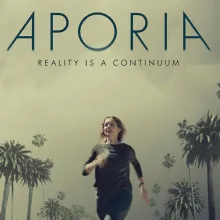
Jared Moshé on Aporia (2023)
Show notes
Find out more about Mr. Moshe at his website: https://jaredmoshe.com/ (opens in a new tab)
Transcript
An automatic transcript, tidied into paragraphs. It has not been proofread, so names, titles and spellings may be wrong, and it does not say who is speaking.
Show the transcript (about 3,300 words)
Speaker 1: Hold your ears, folks. It's show time.
Speaker 2: People pay good money to see this movie. When they go out to a theater, they want cold sodas of hot popcorn and no monsters in the projection booth. Everyone pretend podcasting isn't boring.
Speaker 3: Turn it off. That is the prettiest. You're selling your Saturn rocket. Well, your dad gave you that.
I don't want it anymore. I was like, it is so mad. I just want to strangle the man that did this to us.
Speaker 4: There is a science to everything we can save them, believe it or not. This was supposed to be a time machine and now it's a gun that can fire a bullet into the past. All we need is a target. You know.
That's impossible.
Speaker 5: Right. You forgot the soda again, didn't you? Sophie? What's going on?
Speaker 3: You were killed by a drunk driver.
Speaker 5: This just doesn't make any sense.
Speaker 3: I have the wrong shift note.
Speaker 5: Looks right to me. Are there any changes that cannot be tied back to me?
Speaker 3: It's way more complicated than that. It screws with your memories.
Speaker 4: We have this power. Why shouldn't we use it?
Speaker 6: It's too risky.
Speaker 5: Hey, Riley, we did something that no one has ever done before, but there is no undo button.
Speaker 3: Second floor room 2 16. Oh my God.
Speaker 4: It's an awful feeling to lose those you love. But if we save her everything resets.
Speaker 5: I want to see Riley grow up. I want to see her go to college. I don't want to lose you. MIKE WHITE: Hey, folks, welcome to a special episode of the projection booth.
I'm your host, Mike White. On this episode, I'm talking with director Jared Moshé all about his latest film called APO. It is a science fiction film, one of my favorite types of science fiction where it's very much set up in the real world, think primer or time crimes along that line. The movie just played at the Fantasia Film Festival and is opening in select theaters on August 11th, 2023.
It is well worth your time and I hope you enjoy the movie as well as the interview. Can you tell. Me a little bit more about you and your background? Especially how you got into filmmaking.
JARED MOSHE: I from New York outside the city originally and I went to liberal arts college. I was always interested in film, but I really didn't know how to get into it. So I did like the interning and so forth. And then I moved to New York and I started interning at Jonathan Demme's production company.
I worked there and then as people left or I moved so I switch jobs. I kept getting promoted. I was an assistant Ed Saxon and Peter Sarath and who were his producers at the time when they were making like adaptation and truth about Charlie and stuff like that. From there.
I actually became a film sales agent for a number of years and then I started producing and then I guess it was a fun dance in 2011. I was there with two films, a film that won slam dance that was called Silver Tongues and a film called Corman's World, which was a documentary about Roger Corman, that it was one of the eps on. And after being on that experience of making that film, I'm just embracing that, just make your movie at those. So I was like, all right, I'm going to start hustling for myself.
And so I took all my years of knowledge and was able to put it together to go make a movie later that year. And that's how I transitioned into writing and directing. And that was the first feature Dead Man's Burden.
Speaker 9: Now you've done two westerns as directorial efforts and now this film, it's not a western. So why the westerns and then why not a western for this one? JARED MOSHE: I love westerns. They are one of my absolute favorite genres and every film is a miracle.
So you don't know when you make your first one, if it's going to be your last one. So I'd always wanted to make a western. So I decided to make a western as my first film, which was insane if you think about it. Like, all right, I'm gonna go, I have about $200,000 and I'm gonna go make a western on location in New Mexico with horses and guns.
And we're shooting on film and I've never directed anything before in my life. It's crazy, but it was awesome. And then I wasn't sure what I was going to do next if I was gonna follow it up with a western or not. But the character of Lefty had lived with me for so long.
I needed to get him out into the world. And so that's why that became my next project. And sci-fi is a genre that I love almost as much as westerns. I would be watching the good, the bad and the ugly and then I'd go read Isaac as much.
So I really wanted to play in that genre a lot. And after making two westerns, I always decided, you know what I wanna do a sci-fi movie and I want to do what I do with westerns, which is use the tropes of the genre to try to explore the characters of the world. A pori is one of those sci-fi movies that is really smart, which is such a compliment to you because it makes you think and it makes you really pay attention. I'm curious how you even came up with the concept for it.
JARED MOSHE: There's two different things that were happening at once when I first wrote it, I had become a father in the past year and a half. And that experience suddenly made the world a lot scarier, a lot more visceral and made everything feel a lot more uncertain. And I was really grappling with that feeling of uncertainty and trying to wrestle with it as an artist and a filmmaker. It one way for me to really do that was through writing and creating a story.
So I was trying to figure out how I was gonna do that. When I remembered this random idea I'd had at some point in the past of what if there was a gun that could murder people in the past. And I wrote it down and I was like, oh, that's cool. But I don't really know what to do with it.
There's so many big ways and obvious ways to go with it that it could just feel, I don't know trite. And it occurred to me that like, maybe I could use this sort of mechanism or this in the government or this idea to allow a character to try to control the uncertainty in her life and wrestle with it. And I do really appreciate that you have this female protagonist rather than that being yet another male story. And just that everything is colored through her experience is fantastic.
JARED MOSHE: I really like finding characters that are, you don't expect in these roles. It been so obvious to have some rich guy in Beverly Hills who had all the resources in the world make a machine like this. Instead, you have this woman who is, you know, played by Judy Geer, a character you least expect to be in a lead role in a movie but deserves to be lead role of every movie because she's so good who is living on the edges of L A in a very month to month life and she get back, goes to a machine that is the most powerful machine in the world that looks like it's a fire hazard that was built by a dude who is an Uber driver who is also has no resources and scrapped it together from ripping apart fridges and junk trucks and had it in the spare bedroom of an apartment in a neighborhood that people are just like cutting through on their way to work.
But to me that is so important as a storyteller to explore areas that we don't expect to be seen. One of my favorite things about directing is working with my actors, Judy was who we cast first. She was the dream for Sophie. And thank God she responded to the material and she and I were able to sit down and talk about it and talk about the character and really the emotions that she was feeling.
And she and I ended up going through the script line by line, talking about it in full detail and really not doing a read through or rehearsal, but just talking about why the lines were there, what she was feeling and what felt true to her version of the character and my vision of the character. And that's something I did with all my actors eventually. But once we have Judy on board, I knew I wanted a Mao who was the opposite of her. Whereas Judy is very emotional, she has a very expressive face.
Eddie gets shaggy has incredibly deep and expressive eyes and there's a stillness to his performance as an actor when he plays the almost something cerebral to him, which to me, very much encap sured who I saw now being and would play in great contrast to Judy who is all energy in motion and he's stillness and he creates a sense almost that like he's the rock in the family, which I think it's a much more complicated truth to that. So we got Eddie A and then for Jar I Pay and Maie was always who I wanted for that role.
Pay has is one of the best actors out there who is also like Judy underappreciated in America and Eddie, they're all under. I think these are all very underappreciated actors who are so talented. Pay brings so much humanity to all his performances. He brings so much amp to every character and you really see that in a separation, I think is one of his best performances.
And I wanted to find a Jabir who could bring that empathy to his character because he's the character in my mind who has made the moral calculus in his head and is willing to make tougher decisions and accepted the world is not black and white, it is gray and sometimes you have to sacrifice for the greater good and having a character who could actor who could bring that and humanize, that was so important in payment. And then Faith Herman actually, who was we got lucky, I got to audition her, which is so cool and so lucky because hey, she's just such a talented actor especially and this is us and the Shazam movies and sheets.
And it's amazing when you can audition an actor because you can actually talk to them and see how they react and feel for them as a performer. Whereas when you're just going out into the world and making offers, you're like, it's still, it's a leap of faith in a way. And I felt like when I auditioned stage, she was a rare talent who could convey the disconnection that she was feeling in a way from her family in a way that felt very true and awkward in that between early teen years. What were some of the most difficult parts of making this movie?
JARED MOSHE: Oh my gosh, we had to shoot 100 and three pages in 17 days. It was insane. And we were shooting in COVID, we had to do COVID protocols and all that stuff which also slows you down most. The entire film is incredibly difficult.
We were all over. We shot part of it in El Sereno and then we shot other parts of East L A and then we were in the valley near West Hollywood at some point. We're bouncing around after a while and we were doing this, you know, you know, shorthanded with very tight knit crew and not a lot of money and not a lot of time. But what we did have was just, everyone is really engaged in it.
Everyone wanted to be there. We got COVID shut down at one point and we only lost one or two crew members the only because they had other gigs they had to go on. But everyone else wanted to come back. Everyone wanted to be there despite like how insane what we were trying to do was it became a real labor of love for everyone, which is really lovely.
Now, if you had all the money in the world, what would you have done differently? JARED MOSHE: Had more time. I've had more time. I would have slowed down if this movie was supposed to be kind of gritty and designed that way.
There are a couple of locations I probably would have swapped out. It would have been small things, but it would have said the same style and the same view on the same vibe. I just would have had more time to get some scenes. There are a couple more handles I would have gotten.
If I had all the money in the world, it would have just been like, let me spend a little more time on getting these places not have certain things feel rushed. It was just, I wish I had more days if I could look back at this. One thing is, I wish I had more days and also I wish I wasn't so terrified of COVID. That was the other thing.
If I had all the money in the world, honestly, I just wouldn't have been as terrified of COVID because I've been like, all right cool. We'll just be fine. We can pay everyone, we'll just extend, we shut down. Every actor gets COVID, we'll be fine.
There's a level of stress. I think that could go down in terms of just what we were kid to pull up. But I wanted the movie to feel the way it felt that it was happening. It could really be happening in this little corner of L A that people at least expected to.
When did you actually shoot. JARED MOSHE: It in July of 2022? We shot that. Yeah, that was when we shot.
It was summer. It was hot. It was Fourth of July. It was fun.
It was a nice time to shoot those some days got really hot in that house because you can't run the air conditioners and I don't do well in that kind of heat as well. So there's lots of me like thinking about how can we keep this cool? How can we keep this cool? So, have you had a chance to see it with an audience yet?
JARED MOSHE: I did, I saw it for the first time with the audience in Fantasia last week. And it was incredible to see people react and watch it. So you could feel as they connected in and hear the laughter at the moments. They laugh and feel their hearts and their throats when their hearts and their throats.
It just, I could feel it connecting with people and that was so such an incredible experience. You're getting a wide release the next week, I think. JARED MOSHE: Yeah. Well, go is releasing us in the select theaters next week and on August 11th and we're gonna have a full 30 day theatrical window so people can go and see the movie in theaters, which will be fantastic because I think this movie, I think all movies benefit from some from being on a screen in a theater to me.
Movie theaters are a solemn place where you can go and you can connect and it's not like you could turn off your phone or be free from distractions for 90 minutes. I'm gonna say 90 minutes to two hours. But at this point. It's 90 minutes to 3.5 hours.
I still wish I could be a little tighter. I wanted to have it all under 100 minutes. But those credits, man. I love that you have some special effects in there but it's not just sci-fi and futuristic.
It's so disarming with the way that it feels so natural, so much of the time. JARED MOSHE: Thank you. Yeah, I really wanted it to feel natural. I didn't want to do big sci-fi.
I think they would have taken you out of the story and been, I don't know, I think the entire aesthetic is sort of Rube Goldberg together and I wanted it to feel that way. I wanted it to feel like this could be happening in a neighborhood anywhere around us. It could be happening in the place next door and you wouldn't have any idea. And I think keeping the V FX limited in that sense really helped.
Do you know what's next for you? I have a couple of things. JARED MOSHE: Unfortunately, our industry is in a point. The A MP TP has put our industry in a position where they don't want to make a fair deal with actors and writers.
So, you know, it's what will happen. I do have another sort of sci-fi film that is set up with producers and by it see that, you know, maybe we can get going, we'll see. But beyond that, I just hope the strike gets resolved sooner rather than later so that I can get some of these other projects I have percolating out into the world. Does that put you in a weird position being part of a guild and then on strike?
But then supporting a movie all at the same time it does. JARED MOSHE: I 100% support, you know what the WG is doing. And I'm out there picking, I'm picking, I'm bringing my kids out there. We're picking all the time.
But as a director of this movie, I have the freedom to be able to support a or an indie film. It's important to be able to get talk about it in some way or another. I absolutely 100% though. Think the guild deserves to be out there fighting all writers and actors deserve to be paid for their work.
Is there a good place for people to keep up with you in the movie out online? JARED MOSHE: Yeah, you can follow me on Jared Moshé on Twitter or no? Or you can follow me on Instagram at GD Moche or there's a page on the Well Go Usa website for Jared. Thank you so much for your time.
This is great talking with you. I really appreciate it. JARED MOSHE: This is awesome.
Speaker 10: Thank you back your skin. You are Yeah. Yeah. Whispering arms.
It because it's not the.
Comments
No comments yet.