
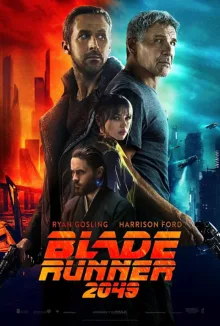
Show notes
Rob St. Mary (opens in a new tab) and Chris Stachiw (opens in a new tab) join Mike to discuss this ponderous sequel to Ridley Scott's 1982 original.
Labels: Chris Stachiw Denis Villeneuve Harrison Ford Jared Leto Ridley Scott Rob St. Mary Robin Wright Ryan Gosling Sci-Fi Sean Young
Transcript
An automatic transcript, tidied into paragraphs. It has not been proofread, so names, titles and spellings may be wrong, and it does not say who is speaking.
Show the transcript (about 21,500 words)
CLEAVON LITTLE: Hold your ears, folks. It's show time. HULK HOGAN: People pay good money to see this movie. When they go out to a theater, they want cold sodas, hot popcorn and no monsters in the projection booth.
Everyone pretend podcasting isn't boring. GEORGE C. SCOTT: Turn it off.
Speaker 4: Every civilization was built off the back of a disposable war force. But I can only make so many happy birthday.
Speaker 5: There is an order to think that's what we do here. We keep order. The world is built on a wall that separates kind either side, there's no wall. You bought a war.
Speaker 4: You're a cop. I had your job once it was good. I know what do you want? I wanna ask you some questions, the key to the future.
It finally bring it to me. They know you're here. I always told you're special. Your story isn't over yet.
There is still a page left. MIKE WHITE: Welcome to the projection booth. I'm your host, Mike White. Joining me once again is Mr Rob Saint Mary.
ROB ST MARY: I know what's real, you know, real real from drug reel bore and Sore. MIKE WHITE: Also back in the booth is Mr Chris Dau cells interlinked within cells, interlinked Sci-Fi July continues with a look at Denis Villans. Blade Runner, 2049 released 35 years after Blade Runner. It doesn't hold the title for the sequel released farthest from the original, but it's up there.
It's the story of Kay played by Ryan Gosling. He's a Replicant who is experiencing memories where he thinks he's the chosen one. A product of a Replicant and human pairing. Of course, that Replicant is Rachel and the human is Rick Deckard, which I guess settles the whole thing about Decor being a human or Replicant.
Now, doesn't it? We will be spoiling this film as we talk about it. So, if you haven't seen Blade Runner 2049 please turn off the podcast. Go ahead and watch it.
We'll still be here. So, Rob, when was the first time you saw Blade Runner 2049? And what did you think? Sir?
ROB ST MARY: I saw it in the theater. I hadn't seen it since until I watched it for the show and I remember liking it. But with reservations, there were things about it that I, at the time when I saw it when it came out, I was like, I don't know because I'm still in love with the original that I think anyone trying to make a sequel is coming in for harsh judgment. It's just, I was really in a place where I'm like, I don't know how this is gonna hold up and I think I went in with a bit of an attitude.
But on the Rewatch, actually, I liked it more, I think this time around than I like it when it's out in theater. So there's a lot in there that I really like and aspects of it that I'm looking forward to talking about. And I'm still holding to a lot of my old stuff from the episode we did when dinosaurs roamed the earth on Blade Runner. So a lot of that stuff still holds.
MIKE WHITE: And Chris, how about yourself? CHRIS STACHIW: So similarly to Rob saw it in the theater, didn't Rewatch it. Which for me is surprising because I normally don't just do the one watch thing given like yourself, Rob and I'm sure Mike you'll say the same thing or echo it in some way. Blade Runner was a big movie for me growing up.
I had a Blade Runner poster on the door of my room growing up and I grew up in the nineties slash 2000. So again, it was a movie that I loved. And so that was what motivated me to go see the sequel. I think you mentioned spoilers, Mike definitely spoilers for the original Blade Runner too.
Obviously, I think that goes without saying, I think in a lot of ways this is a sequel that you might have a hard time with some parts of it not having seen the original. But all that aside, I was glad to Rewatch it for this episode because it's something I wanted to come back to and I enjoyed it a lot more this time, but similar to Rob, I have reservations about certain parts of it, certain plot points, certain aspects of the storytelling, that decisions were made and I'm sure we'll get into it. MIKE WHITE: Definitely.
No spoilers for Blade Runner Black Lotus, a 13 episode series that I had no idea even existed until today. So I didn't get a chance to check that out. But like you guys, I saw this in the theater. Unlike you guys, I got to see this movie in a censored form because I saw this in China where they do not like to have nudity on screen.
So there were parts of this movie I had never actually seen until I did a Rewatch for this episode. And also like y'all, I didn't really watch it until I did the Rewatch. I, even though I knew I was watching something censored, there were some very obvious cuts and I'll talk about those as we get there. Just no desire.
Yeah, I'm very ambivalent about this movie. Is it interesting? Yeah. Is it gorgeous to look at?
Yeah. Is it long as fuck? Yes, it felt so long and it felt like people were just talking in slow motion sometimes I'm like, let's pick up the pace here guys, but I feel like will just continue to make longer movies as he goes along. ROB ST MARY: It really does have this, I guess I would call dream pacing or sleep pacing.
It really feels he really wants to bring you into sort of a mood. It's almost like a mood piece at times. It's not that I need fast cuts and things like that far from it. But sometimes it just really feels like you're watching something.
You're like, how long is this scene? Is this a half hour? Just this one scene? But again, it's so beautiful.
It's so visually rich. You're also blown away by it. I think I had not quite the same kind of pacing issues with Dune, his version of Dune when I saw that does have that. It's just so visually beautiful and that's really what I think probably was the sales point to the general audience.
Probably whoever was producing the sequel said to make it really beautiful for the kids that aren't hip to all these little plot points that you're gonna put in here. So at least they'll go, oh, that looked really nice. And that girl who plays the A I, she's really hot. CHRIS STACHIW: There's some of it in the original Blade Runner with the visuals, but I think deny Villeneuve has a for me, it is almost in this movie, it's beginning to see it.
And then in June, I think it's even more present. It's visually mastered laboratory in a lot of ways like I am appreciative that we live in a time and a place where technology can be utilized to show us, not only interesting things to see, but also stylistically interesting things to see things that we've seen before presented in an interesting way, which is a lot of this movie is ruin presented beautifully, which you can go see ruin. And sometimes it's beautiful and sometimes it's not, but in this movie and in June especially, but in this movie, it gets in the way of trying to tell a story that feels like it has a path that isn't just we're going there and we'll get there when we get there.
And those moments were fun the first time and then the 2nd and 3rd time I watched it, I was like, man, I don't need to be in this world every time to appreciate it, but De Ville is gonna do it anyway. So there you go. Like the Robel Mannato, stuff, like a lot of the stuff in the movie feels like I've seen this once and I'm not sure I need to see it again to appreciate what the actual narrative of the movie is driving. MIKE WHITE: Despite having not seen this for six years, there are so many images and so many scenes that when I was rewatching this, they were second nature, I had just memorized them while I was watching it.
And so rewatching it almost felt a little unnecessary. I just had remembered so much of it. There were a few little things here and there that I didn't recall. And some of the order I might not have recalled, like I really didn't remember just how many times Jared Leto was on screen.
I thought he only showed up maybe twice. But I think there's a few more than that. But it's, yeah, there are so many images the MNA that you were talking about. Of course, when he goes to find Decor, even the fight with Dave Bautista at the beginning and all of those images leading up to that and just that Lone Tree is so visually arresting that these images and these scenes had burned their way onto my brain.
So I was just like, yeah, OK. Yeah, this is very familiar stuff. I just thought that things happened a little quicker has passed faster in the theater I think, than watching it at home on video because there was one point where I had to pause it so I could get up and use the bathroom. And I was like, holy shit.
I'm there's still an hour left to go and I thought we were just about done with this movie. ROB ST MARY: Part of the reason maybe that it embeds visually is how much mirroring there is in here. And what I mean by that is there is a lot of scene set up that is similar to the first film. So everything from the opening credit Crawl, which is its own version of the text about replicants.
This and all of that, the thing with the eyes, certain the movement of the car towards in our head, Tyrell building in the first film, there's a lot of, it's just a lot of kind of coupling of these similar scenes, which I believe is not a coincidence. This is him implicitly showing us that while things have changed, they are still very much the same and that a lot of these scenarios are similar. It's just he's trying to talk about these things from a different perspective and even certain characters that are totally different characters, they're completely new characters that have similar resonance and mirroring to ones that are in the first film.
So I think that might be it in that in terms of it's triggering these kind of multilevel memories for lack of a better way to explain it. MIKE WHITE: Which is very appropriate for a movie that deals with memory so much and maybe even more so than the first movie. It feels like the first movie, the Ridley Scott movie was, it was obviously it was very complete. You had a very well thought through story.
And I guess this one just feels like it's taking the those ideas from the Scott film and kind of reconsidering them. So there are visual rhymes definitely to your point. But it's let's take a look at memory perception, all of these things and push them a little bit further and then add to it even more about love and what it means to be human, the whole idea of souls, those kind of things. It's, I don't want to put down the first movie because I like the first movie even more than the second movie, but it feels like that one is like a 101 and this one is, you're moving into a 301 type of look at that.
It feels like you really need to have a lot of other things that you've seen before you get to this film and can start to unpack this movie because I've seen this movie obviously just two times now. I've read a ton about it, but it feels like there's still a lot left to uncover with us. ROB ST MARY: And to echo what Chris said earlier, I couldn't imagine somebody being dropped into this film, watch this movie without any knowledge of the first movie. This really is a sequel that if you don't understand those things and those mirroring, I think you'll get something from it, but it's really gonna feel like a long process to get somewhere and you're not quite sure why it matters so much.
It's because I'm trying to, it's hard to think yourself into ignorance, but I just had a moment where I was like, ok, if I walked into this without any knowledge of any of this stuff, what would I get from this movie? MIKE WHITE: Who is this Decor guy who is this woman with the weird hair? That walks in, that gets shot in the head. Just those things, much less what this world is.
CHRIS STACHIW: I think it's a beautiful failure in a lot of ways because again, like I enjoy this movie, but there is, like you just mentioned, Rob, there is absolutely no way you would watch this movie. If you did not like the first movie. Even this is, there's the first movie and the second movie are of a piece and in such a way that genuinely, I think if you watch this movie without having seen the first movie, you would ask yourself, what am I supposed to even be entertained by, in a lot of ways? Because I wonder how much of a not pass.
But I wonder how much of like you mentioned, I can't unint that I've seen the first one and I enjoy it. But I wonder how much I'm giving a pass to this movie as well by just being, I like the first one and I'm willing to go on this journey. The first movie was not a financial success and it always tripped me out that they were like, let's make a sequel to this movie that, that I guess people are really into and it has a big pop culture presence and that was never really the case. It has a presence, but its presence is felt more as something that has inspired other things to be more exciting and entertaining and go different directions that it has gone.
But people aren't necessarily, like, beating down the doors for a Blade Runner sequel. A certain group of people were and a certain group of people got that movie. But like to think that this movie would ever be like a financially viable mainstream movie. Always, it made me so, just tripped out when the movie came out and I was like, it didn't make a lot of money.
It's, yeah, it, yeah, it wasn't ever going to. MIKE WHITE: Why would you think that. ROB ST MARY: It's not a space opera? Just put it that way?
It's, is a philosophy film at its core is what I've always saw the first Blade Runner film as it's existentialism and it's the value of what life means and how do we live it and all of those things about limited time. And so unless you want to wrestle with philosophy as an entertainment, it doesn't really lend itself to big popcorn film. That's just how I've always felt about it. And that's probably part of the reason why I love it.
And part of the reason why I'm not typically a big sci-fi fan. It's one of the few sci-fi films I think I'm more of a horror film fan if someone were to push me towards a genre than I am over science fiction. Because science fiction just, it at times, doesn't it, at least in the film versions just seems to water down the philosophy, satire and social discussion that you can have. And I don't think this one does, that.
I think this one definitely has conversations. And especially in here when we get further into the questions around the idea of slavery and Replicant is basically a standard for slavery or subclass. That's expendable, that's property. MIKE WHITE: Not just slaves, you know, you, yeah, you said subclass and we're gonna have to talk about the role of women in this film because I think that we are really supposed to.
I hope that this was not made sexist on purpose. I think it was made that way. I guess I should say it was made that way on purpose to bring forward the ideas of women as second class citizens, women being in these roles though women have abilities that men don't have. There's this whole like the womb is sacred, right?
The whole thing of Jared Leto like touching that woman on her belly and just being like, oh yeah, you can do something that I can't do. I can create life, but you can really create life. And he's trying to come up with that perfect Replicant that can self propagate and that will help solve his problem, which is I need more slaves to be able to take over the universe. Basically, I'm the I'm the God creature.
He talks about how he makes angels. He compares people to angels or replicants to angels all the time and he just is so full of himself. When it comes to that. I'm surprised he doesn't have the creation of man up above on his ceiling with like him in both in the God figure because he is just such a crazed egomaniac that he is picking up where Tyrell left off and thinks that he can make the perfect Replicant and really is there to help out everybody by conquering the universe because we can't live on this shithole planet anymore.
CHRIS STACHIW: But the interesting thing is this movie also, like it has the opportunity towards the end of the movie where there's a scene between letto and bored and they're going back and forth. And instead of mining the topic of God and creation, like letto has been really reinforcing by mentioning angels over and over again, they miss the opportunity because instead they want to get bogged down in the stupidest conversation that anyone can have about Blade Runner anymore, which it is he a Replicant or isn't he?
And the movie takes an opportunity to have to throw its hat into the ring halfway on that as opposed to leaning on the subtext of the scene, which is talking about, there's a creator, a K A God and his creation in the room with a person who has also created life that was thought to be impossible. And instead of mining that whole thing there about God's in the room together and all that, they go, maybe you're a Replicant or maybe you're not. And it's, oh my God, really? Even Hampton Fancher who has said he is not a Replicant.
That's a Ridley Scott thing. Like this is the opportunity you have to squash all of that. And instead of leaning on this interesting idea that they've already started presenting about creators and creation and slaves and slavery, they just, they punt to the old chestnut that everyone who wants to have the five minute Reddit conversation of is he is a Replicant or not? They want to do that?
And it's like why I thought we were making this movie to continue the conversation, not force ourselves to constantly look back and worry about this again. Trite conversation that was created by Ridley Scott. Ultimately, like that was a decision that he made. It's I really wish that hadn't been here either because I don't think this movie needs that.
ROB ST MARY: I'm gonna thank Chris for opening up that bottle and I'm gonna take a big drink of that wine going to the first episode. I made the point that deer is not a Replicant that he is a human because if he was a Replicant, it would completely destroy the value of Roy sacrifice. There would be no reason for him to do what he does. And that the idea is that the intelligence understands the value of humanity and therefore saves it.
And so to me, I've always felt that way even more so watching this version to me I see this as the idea of evolution that this is a hybrid between, even between the two. But going on further into this idea of humanity, the one thing that this film is missing, that the other one had that I felt like added stakes to the fact that replicants exist in this city is that there's very little humanity in this film. Unlike the first film, like there's people on the streets, they're like all over the place. He's at the noodle bar.
It's just lined up. There's just so many people now, I understand that there's been apocalyptic shit that's happened and mass extinctions have been happening. But there's almost part of me that goes, if it's that fucked up, then why are we even bothering to send Blade runners out to kill the fucking replicants anyway? Because there's no humanity left anyhow, except maybe a handful of people that live in very specific areas.
So there's part of the idea like to my mind philosophically was that the Blade runners were supposed to be there to save us from these creatures that could kill us. They're, they're cops. Basically. They, the idea in this universe is supposed to save us from the chaos.
But if there's no reason to save you from the chaos because there's no people there. It almost seems self defeating. I'm, there's part of me that's like looking at this and going, this is the most you could have made this whole movie with like four people in a room. It seems like no one's here.
It's very desolate and I don't know how to feel about that. If we're talking about questions of humanity, it almost becomes. And I was thinking about this, who's actually a human in this film because a lot of the main characters are replicants. So there's the assistant to Leto's character, there's Kay who is, I almost get the feeling that it's almost like the joke that people have put online years ago of like the Si and the Alexa and the Google like talking to each other.
Hey Google, repeat that Alexa Simon says, hey, Google, repeat that. Hey Google, repeat that. Is this what this is right now? Is it the director and the storyteller having a conversation about Senti and A I?
And what happens when A I comes to some sort of knowledge of the self and then how will it debate and handle its issues among themselves outside of humanity? Like I'm like, I think that's an interesting conversation, but it doesn't feel developed enough in that way. CHRIS STACHIW: The movie touches on those things again in the scene with love and Robin Wright where she's, we can't lie. But I'm gonna tell him you tried to shoot me first.
It's whoa, you just said you can't lie but you're going to lie. It's like they have those ideas in there and they're just not interested in minding them, which is weird. For a movie that's two hours and 43 minutes because you have a lot of time to really get at the core of these ideas. And really, again, you don't even have to do it with the dialogue.
You can do it by just a look or a glance or subtextual. And for some reason, the movie, again, it's just, it has in its mind that there are things that the first movie didn't answer that it wants to take a crack at. You can be your own thing here. MIKE WHITE: I've always liked the idea of that.
Deckard is a Replicant and is not a Replicant. I like holding both of those ideas in my head at the same time and this movie helps me with that because there are times where I'm like, obviously he's human because he's older. Well, they've taken off some of the age limitations to these or we are the next model replicants. They talk about the six, they talk a lot about the eights and they never talk about the sevens.
I don't know if he's a seven also. He's living in Vegas where the radiation levels are off the charts. So, can a human do that? No, I don't think so.
But there are other things where it's, that seems like a very human thing. So I like to try to consider both options constantly and just continually judge them and second guess myself. So it's a little bit of a Yeah, it's that philosophy. One of one thing that we're talking about, it's, is this world determined or do you have free will?
Who knows? You know, who, how can Joy be a complete fabrication? But yet she can light his cigarette with her finger. I don't know how that happens.
CHRIS STACHIW: The first movie doesn't necessarily ask the question about Decor being a Replicant. That's a host thing like much later. But that conversation persists because it allows you to like you mentioned to view the movie either way and there are benefits in both directions. Again, I'm like yourself, Rob.
I necessarily, I just pick a side and I'm good. But the first movie is about a man who has lost his humanity, finding it through the replicants who like we've mentioned value it. And then the second movie is a Replicant who's more human than the other humans he interacts with. But to what end?
Why? I guess? And that's the first movie answers the questions that it asks. The second movie just asks the questions and doesn't answer a lot of them, which is unfortunate because they are important and interesting questions.
Definitely worth asking that you can have plenty of substantive conversations around. MIKE WHITE: Yeah, it is tough to even tell who the humans are at times. I'm guessing that madam is a human and maybe Jared Leto's a human. They bring up this idea that replicants can't hurt anybody and we'll talk a little bit more about the other movies that they made.
I fucking hate this whole idea of supporting films for the movie that you're watching. But there were three shorts, at least that were made for this film. And there's one where they basically have a robot, have a Replicant commit SIU because they can't hurt any human. It still doesn't add up to me because I know like you're saying, love is saying, I can't lie but I wanna say that you've tried to shoot me and then later on she's kicking the shit out of Decor.
It's ok. I guess you can hurt people. It's just, I guess Jared Leto could just be lying that these replicants can't hurt anybody. CHRIS STACHIW: Well, and aren't those people that Ryan Gosling shoots out in the wild real people?
Are they replicants too? He just starts shooting people point blank like Robocop prime directives. These are not like that's what I think of when I think of those you can't hurt people. It's the Asimov and it's, you forget that you said that like at any point.
MIKE WHITE: You punch poor Lenny James right in the freaking face. And it was smart that they talk about Kay being a Replicant right off the bat. Basically, as soon as Dave Bautista is slamming him through a wall and kicking the living shit out of him, I'm like, there's no way a human can take this step of beating. He must be a Replicant.
So we learned pretty quickly and then we get the baseline test and all that, which again, that was really fascinating to me and I wasn't sure what the hell was going on the first time I watched the movie, but I enjoyed it. This whole thing of him answering, responding. I was just like, ok, is this how we've updated the voice comp test? Not really.
They don't have a voice comp in this. They've got the little eyeball checker, but obviously they're baselining him and he answers correctly and they call him constant K the first time and then the second time he's off the charts, he's nowhere near his baseline. ROB ST MARY: To me, it just seems like some kind of Scientology auditing or something, psychological testing or way for them to understand his emotional status in that he's not gonna go crazy and he can be controlled in some way. That's why I always from the beginning, like you were saying that fight and all of that stuff.
I'm like, no, this is definitely a Replicant there. Not for one minute. Am I believing that that he is a human? There's no way you could take that much abuse and walk away like that knowing what we know from the first film.
And then that whole kind of process to me seems like an inverse of the VK thing from the first film as a way to calm the whatever the mental emotional center that is built within. MIKE WHITE: And I love this idea of using Nabokov's Pale Fire as his baseline. And that she has the book later on in the film and you hate that book and she throws it aside or throws a hollow image of it aside. This whole idea of.
Now I had to go and dig up what Pale Fire was just that. It's this poem like we can tell that he's spouting poetry when he's talking about interlocked cells And it sounds a little bit like a poem. But that it's a poem by a fictional author named John Shade. Who then, and then the poem is being basically annotated by another character, another fictional character Charles Ken Boat or Kin.
And you get to see the thing being interpreted by another person. It reminds me a little bit of House of Leaves where you've got. Here's the story, but then here's all the footnotes and the footnotes tell a different story than the main story. And you have those two things kind of like how I like to have Decor be a Replicant and a human.
At the same time, you get these two stories going on at the same time and you're like which one's real? Which one's not? Which one should I pay attention to do? I have to pay attention to both of these things.
How does the one affect the other? And so I thought it was very smart to use that as Kay's Baseline. And of course, we can't really talk about Kay, who's a good Joe Joseph Kay. Of course, he's very much modeled after good friend Kafka and his Joseph K character from the trial.
And I think he used Joseph K in another story as well, but mostly from the trial. So just putting him in this nightmare world where all the forces are turned against him. CHRIS STACHIW: For me as someone who hasn't seen Ryan Gosling in a lot of things, I've seen the Notebook essentially and I've seen Drive and I've seen this and I'm not sure I get what his ura necessarily is, but I will say whatever it is works perfectly in this film because he plays this detached Replicant who is going on an emotional journey. He is the best part of this movie without a doubt and he makes the movie worth watching because the performance he turns in is really good and empath you empathize with his character and like the brutality of the world that they live in.
You can see it on his face in every scene and he just looks, I've never seen an actor look so for Lord in every scene, but Gosling is just forlorn in every scene. Even when he's dealing with Anna De Armas. It's just the weather, you can feel the weight of the world on his shoulders. MIKE WHITE: Yeah, I'm not that experienced with Ryan Gosling.
I have not seen the Notebook but I have seen Drive. I mostly know him from the nice guys is where I really have seen him the most, but he makes me want to see more movies with him because he does turn in such a great performance in this. And then I guess I've seen him do comedy as well because the Papyrus skit on SNL, the whole little mini movie where he's obsessed with the title of a guitar being done in Papyrus. And just how dare the graphic designer use such a lazy font for such a huge movie.
It's freaking hilarious. And he does that very well. ROB ST MARY: I was thinking of the of early work of his that, that I saw because I haven't seen a ton of his work either. But there was a movie that came out in 2001 called Believer that I really liked where it was based on a real story of a guy who was a Jewish person who became involved with Neo Nazis, kind of a undercover story in that way.
And like I said, that was, I think he's about the same age as I am. I think he's like his mid forties. So he would have been in his early twenties when he did that. And I thought that was from what I remember seeing that I thought was excellent.
So he could really put in these really emotionally nuanced pieces. And especially in here, it's, they're building these robots, these replicants. They're, they're really echoing back the environment in which they live in, why there's not a feeling that they're being created in a way that's supposed to ignore the reality in which they exist. It seems even in the first film, it was like that probably the closest who came to any sort of real emotional core was probably risks character who had a little bit more of a warmth at times, but they all seem very mechanical in certain ways, which used to be the way to be able to figure out.
I guess who was playing what role? Which is why I think it was confusing because it was even part of me that was going, I was willing to accept that Leto's character was human, but I was all bets were off for me and the rest of them, I was just ok. If you're the human overlord who wants to live eternally through your works, then what about all these other people who are in here? Are they?
And like I said, that just brought up this whole question for me about then really? Who are you protecting? Then if there's Nobody around, if humanity doesn't exist here anymore or if everybody, if it's such a small contingent of people because everybody got off the planet. MIKE WHITE: Yeah.
Apparently all those thousands of, tens of thousands of Asian people that were living in Los Angeles. Apparently they all got to leave because I can barely think of any Asian people. That are in this movie at all. And we have just gone completely away from one of the things that really stood out in the original Blade Runner where it was OK, we have pockets of Chinatown here and here and now it's like growing and merging and even Gaff, he doesn't speak the language that he used to speak with, which was that kind of all the different languages, especially Chinese and Japanese in there.
So it was just like, OK, what happened to all the Asian people? ROB ST MARY: That was what I believe I sent you guys an email on, there was a writer who talked about this film and said it's interesting how much it uses Asian symbolic symbols and design and characteristics, but there's no Asian people. So it's like what happened. But I just thought that was really interesting because in that article, they brought up a lot of science fiction that will often borrow in that way.
And then there are no lead characters who are of that. CHRIS STACHIW: I think even when they're using, when he's using that computer that has the DNA, it's speaking what sounded like Japanese maybe or some derivate some derivation. Yeah, it's we mentioned the visual arresting this of the movie. It is beautiful to look at but the scenes of the city itself, they don't have the same visually arresting impact that the first movie does.
There's plenty of other things that are Las Vegas, plenty of things that are but like the cities and that end up feeling lesser because you mentioned already, Rob, like, they don't feel like it feels like a video game in a lot of ways, like a bunch of NP CS just walking around and you're never gonna actually interact with them. Even the character bumping into them seems unrealistic. But the city in this movie of Los Angeles feels like the city in Cyberpunk 2077 when it came out, which is a reference. If you played that game, you'll get, it's just de void and barren of really any sort of interesting things to get involved with or see or look at it.
Anyone who's seen the original movie can remember the show on that giant screen. Like it's such a memorable piece of imagery and here, I guess it's Anna Dias in one scene that's doing their own thing, but the city ends up not being as big of a character as it was in the original movie, which is a shame given we have all this seemingly all this technology now to do a better job. MIKE WHITE: Theoretically. Yeah, when they set the three prostitutes on decay, that scene is supposed to be the bustling city and I probably shouldn't even be able to hear what they're saying.
There should be so much noise and just think about the traffic crossings, the vehicles, you get some vehicles like the garbage truck or the street sweeper. Yeah, that's great. But I want 10 times as much of that. I want pure chaos because the city of Blade Runner, 1981 was ants crawling over each other to get to a certain place.
There were just that commotion going on at all times and this one is so sedate. It does feel like, well, the last person on earth, please turn out the lights. It doesn't feel like there's that many folks here. And it's odd too that they start off in the outskirts out in the quote unquote country with Dave Bautista doing the worm farming and things because that was verboten.
Like we got that one shot at the end of 81 where they, I think he just reused part of the opening of the shining for that. And then even in subsequent versions that Scott edited, he would cut off when those elevator doors were closed. We would never get the outside world. And here we start in the outside world and we're continuously going out to the outside world.
We're going to the orphanage, we're going to Las Vegas, we're going to the worm farm. And then the shots inside the city, like we said, just feel empty. They feel almost as empty as that outside world. I think we see more people scavenging outside near that orphanage than we see in many of the city scenes.
CHRIS STACHIW: Feels very set bound. Really? All those scenes in Gosling's apartment. Yes.
It's a very interesting apartment. But we all, it doesn't feel of a piece of that building like he walks into that door, it says, fuck you skinner on it. We understand the world a little bit. And then the moment the next shot takes place like we're on a set now and it's, this doesn't feel like it's part of the world which again, hey, we got it in the first movie, so maybe we didn't need it in the second movie, but they showed it anyway.
So they were trying to do their own thing. It's just, yeah, everything else ends up feeling a lot more interesting and just fun to look at because again, we hadn't seen any of it at all. ROB ST MARY: I think it's also a feeling of for me like a lack of lived in to a certain extent. And I'm thinking about how they stage certain shots in the apartment that are supposed to echo the first film.
There's certain framing and devices like where he's at the sink and things like that. And the apartment here is much more austere. It's cleaner, it's brighter. Like the apartment like Decker's apartment is that film noir light through the Venetian blinds has a haze in it.
There's things in the shadows that you can't quite make out. There's a real lived in like you can smell it, to be honest, you can smell this apartment and in the case of Kay's apartment, it feels very antiseptic. And so it doesn't feel as lived in. It doesn't, even if he was human, it doesn't have a lot of humanity to it.
Which maybe that's the point thinking about it is he's trying to make this thing of saying he's human, but he's not because he's not, it's not as lived in. So, of course, it would be more storage for a machine than it would be storage for a human. So I'm just trying to think through what brings that weight that I felt in the first film that even if it's not a direct stakes, it's a feeling of stakes because you understand the reality of the world that's built and what the story builds for you in terms of what is the danger.
And in here, I don't feel like there is as much of that. I think that there's some interesting conversation about A I and kind of emotional resonance of A I, especially with the Joy character at times. But like I said, there's not so much humanity in here that it makes emotion. It doesn't leave me that emotional.
As a matter of fact, the most emotional thing in here was, it was funny because I watched this video on YouTube and they go, yeah, I didn't expect to cry either when they killed his fake girlfriend. It was like that was like the place where I felt the most emotion was the director was able to build in enough emotional stakes with the Joy character that when you know the little device gets smashed by Leo's Hench woman, you actually feel something. CHRIS STACHIW: It's kind of a shame because Sylvia Hos turns in a Anton chaur level performance as love like she is very intimidating.
And I think that to your point, Rob, like they're, they don't, it's not that they don't because they, she dispatches Davis David Dalma in one chop to the back of the neck, but it, they never build beyond that. It's ok. So she's gonna fight another Replicant like we've seen what that means. MIKE WHITE: Can I just say that?
I think it's hilarious that his fake girlfriend's name is Joy and it's spelled Joy. I mean, every time I see it, I don't know about you guys, but I just think Jack off instructions. ROB ST MARY: If you know what that, if you know what Jo I means, yes, you can't help but giggle. CHRIS STACHIW: This is not Jo I dash co.
MIKE WHITE: Or ce I Yeah. Yeah, I think that they had to have done that on purpose because she is basically, she's not real and she's just going to be there with you in spirit anyway and not be able to physically touch you. It's basically gonna be a Jack off session thing. ROB ST MARY: That's interesting too.
And this was pointed out in the in the video because it didn't register the two times I saw it is. So he buys her for himself and he's got this overhead unit which reminds me of a, like an old projector or something that you would have it built in the ceiling and that's how she's able to appear around the apartment. So that, and she keeps asking him for this. And I can't remember the emulator or whatever, which is the little pocket like version, which is like the size of a pan or something.
And so the point that they're making is that the product is selling itself is upgrade. It's, the product itself is saying, oh, it would be so much nicer if you could do this. And it's like a way in which like they were referring it to how like online marketing is or social media marketing. It's, oh, the thing is trying to sell you up.
It's like you want fries with that kind of that kind of scenario. CHRIS STACHIW: And then I love the scene where Ryan Gosling realizes it was seemingly all just advertising. You're a good Joe. Oh, no.
Oh no. That's what she calls everybody. ROB ST MARY: And that's one of those scenarios where we're supposed to feel the humanity for him because it's almost, oh, if that was us, we're supposed to put ourselves in his position and be like, oh say there was this woman I was with and then she went away and then we found that she was doing the same thing to someone else. We'd be like, oh, I guess I'm not special.
It's just interesting to me that didn't have the same reaction to the big Joy scene. The big billboard interactive billboard scene, I thought it was visually beautiful, but I just thought it was really interesting to look at. I didn't really feel anything for him. I was just, and like, it didn't hit me in that way.
CHRIS STACHIW: Well, and they do something interesting with the lighting too where the way that she's lit is reflected on Ryan Gosling where he is both pink and has the blued out eyes the way she does. And then when she says you're a good Joe, he takes that thing off and she obviously moves back and then he doesn't look like that anymore. And again, like to your point, it's visually interesting, but there's like a stunning lack of emotional attachment to any of this going on. And I know the movie is trying, but.
MIKE WHITE: That's supposed to be the big motivation for him to then go save Decor because at that point, he's lost Deckard. He is basically off the case kind of thing. I need to put your gun and your badge type of thing and he is wandering home and that's when that happens and then it's, oh, now I have to go save this person because really one thing that we haven't talked about is the whole idea of he's really, it's a Pinocchio story. I'm surprised that freaking Steven Spielberg didn't direct this movie because it is so much him wanting to be a real boy and him thinking that he's a real boy and thinking that he's basically the Messiah.
It's no coincidence that Vi Neuve goes on to direct Dune another Messiah story. But in this one, he thinks he's the Messiah only to realize that he's not that the memories that he thinks that he has aren't his memories. They're the memories of the real Messiah, the virgin, almost virgin birth, but definitely not a virgin birth. But the whole idea of being able to procreate with a Replicant and which also throws into the question, was it two replicants procreating?
Or was Decker a human? Was he just special in some way? Was it that Omni Vincent a Moore love conquers all? And he managed to get Rachel knocked up just because their love was the truest love of all.
I don't know. ROB ST MARY: Life finds a way. He's not the Messiah. He's a very naughty boy.
The whole thing about that where he believes that that kind of felt that was probably in a way in a roundabout way. The closest to some kind of film noir aspect to me where it's, you're like the characters led to believe something about themselves that is not true, that eventually is paid off later, but it becomes a motivating incident that kind of motivates the character to figure out what the hell is going on. And the original film plays on certain film noir, private detective type tropes. And this one is, that's the incident, the payoff in the end with that is that I find it interesting that it's the one character who to me is a, again, a mirrored character.
I feel the character, I can't remember her name offhand who plays the one who creates the memories who lives in kind of the bubble that she in a lot of ways is very much JK who's visited by the replicants and is outside of the mainstream and he has an illness and therefore he can't go visit Mr Terrell and work for him. He has to work from a, he was doing remote work years before any of us were. So it's one of those kind of deals that it plays well in terms of building a reason for the character to figure out what's going on because otherwise I don't think he has, doesn't really seem to have much motivation beyond that in the film.
MIKE WHITE: Her character's name is Anna Stella, which for some reason, whenever I see her last name, I always think sterile, I honestly think that Jo I is supposed to think stand for what I think it is because Marietta, the Mackenzie Davis character to me seems so much like her name is calling the Mind Marionettes just because she's another puppet and she's another Replicant and she's the one Replicant out of the three prostitutes that comes over to him. And didn't you hear your friends? Don't, you know, what I am, she's like, yeah, that's OK.
And later on we find of course that she's part of the resistance. And so she was, she's been a Replicant this whole time as well. Again, to your point who isn't a freaking Replicant? CHRIS STACHIW: And I like that she has a dig too because you can see that she think, you know, that even the replicants who are viewed as lesser by the humans are viewing the A I technology or the digi holograms as lesser because Daus goes quite now at the beginning of their and then at the end as she's leaving, she's no, you quiet, you quiet now.
There's not as much in you as you claim to have. And it's like, it's interesting, that kind of the delineation between, oh I'm, oh, I can just shit rolls downhill. Right. Well, the head chef gets to be an asshole to the sous chef and the sous chef gets to be an asshole to the line chefs and the lion chefs get to be assholes to the waiters and the waiters get to be assholes to probably, I guess Nobody because they have their own tea boy.
No, don't do that. Bless myself. I can stab you. But it's that weird thing of you realize your place very quickly by looking within the strata that you're maybe ignoring and I like that they play on that.
They just don't play on it enough. There's, it's there. I just want I want them to take that step because they're the filmmakers and I'm the audience. ROB ST MARY: Going to the question of subclass and the idea of slavery and things like that.
You can transpose that onto society and talk about kind of order within an out group. So for example, you could look at queer community or you could look at communities of color and how they will batting order each other based on what the larger society will say. So you will hear this sometimes from people who get upset with others about within an out group will say, oh, there's things like colorism like we've talked about before or hair texture or certain education levels or certain ways of presenting. And so I was looking at it from how the various replicants in A I which to me are all lumped together, have created their own order within their own out group and how that kind of plays out.
And I thought it was interesting that it was brought because you would hear something like this when talking about it within an out group where it's oh you know, killing your own kind, which the De Bautista character says or the whole thing. Oh, you don't like real girls. So that to me seems like digs at a character who goes, oh, so you're making divisions within this strata that has been imposed on us by the power structure as members of an out group which like I say, I think that's another interesting line of philosophical discussion.
But it just, again, it doesn't go far enough, you could really go deeper into that stuff if you wanted to, if you really wanted to get into these questions of how the replicants view themselves and how they work within a society that is not where you're supposed to go out and kill your own kind. Literally, like in the case of K, even though he is a programmed being, how does that mess with your psychology? How does that mess with your own sense of self? MIKE WHITE: And now with these replicants, the idea of him having implanted memories, why do they do that?
Is it just to help them somehow psychologically? Because if you know, you're a robot, you would know that all of your memories are false or you should know, she. CHRIS STACHIW: Says as much she's, I give it to them so that their responses feel authentic. And what's weird is Ryan Gosling says at one point, like I wasn't born so I don't have a soul as so you think so low of yourself as a Replicant that you don't have a soul and that's a judgment you're making on yourself.
How do you feel about the A I then that don't even have a corporeal form? Are they like scum beyond scum? And to your point, Rob, as someone who's bisexual, we're effectively told that we don't exist in the gay community, which is a very real thing that again you would assume. Oh, LGBT Q, we're all here and we're all pals.
Yeah. As someone who's bisexual, married to a woman, a large portion of the gay community would go. You're not identi you're not visibly out. So you're living an easier life, quote unquote, which I get the argument but whatever.
And there is some of that here. It's like you said, you don't like real girls. What does that mean? Nobody's real at this point.
There is Nobody who is real other than Robin Wright, who makes a pass at Ryan Gosling anyway. ROB ST MARY: And I will, will take a drink from that wine. Yes, I agree with you because I am also on that same spectrum with you as well, sir. So I understand what that is and I think that's probably why as a bypass man myself, I think why movies like Blade Runner originally were interesting to me or in some of my other readings, they were talking about how you could get into readings of things like vampires or zombies as this.
Not quite living, not quite dead living in this kind of intermediate space where neither group wants them kind of thing. It's really interesting how all of this kind of plays out. And then like we were saying, there's always this question within our groups of how our groups maintain themselves and how they organize themselves. And it's sad for me also to see as things have gone on right now the way in which certain groups outside of an out group are trying to pull apart out groups.
So, for example, right now, with all the things with transgender folks and how there's been a real separation between what I've heard, people say, oh you guys over here, the L you know, the G's, the BS, we're all good but the Ts gotta go over here and trying to separate and stratify into me. Just see us all as one big, one big group. But it's interesting kind of how all of that when you look at a society and you look at out groups and you look at how out group plays within this world. I don't know, I just wish they would have went further with it.
CHRIS STACHIW: And to your point about other is we have Batiste at the beginning of the movie who has other himself by living out in the middle of nowhere so that he can not run into people and be outed as a Replicant. And then we have Decor as a human again or Replicant, depending on who you, depending on what day of the week it is. You have him other himself as well by going out into irradiated Las Vegas and living on his own. And it's weird because again, the guy who seemingly had his humanity restored at the beginning of the first movie has once again rejected humanity.
But this time again, you could make the determination in the first movie at what choice he made to reject his humanity vo or not. But it's a tacit rejection in the second movie. And I think for me looking at all the things that Harrison Ford has come back and done in the last 10 years. This is the one time I have enjoyed him coming back because it feels while his character doesn't need to be in this movie for a number of reasons.
And the movie doesn't need to focus on him even if it's not him on screen. They, he plays it perfectly. The other, the other is that he is embodying, he plays it perfectly, which is the realistic nature that Harrison Ford didn't want to come back and do this because he doesn't like acting clearly. But also the character has other himself intentionally so that he doesn't ruin or destroy the life of the actual Messiah.
But it's, it feels true to life and it actually works. But boy Harrison Ford, like we haven't talked about Harrison Ford in this movie at all yet. But talk about the thing that's like looms over the movie. Large one might.
MIKE WHITE: Say going back to what I said earlier as far as when I paused the movie and I realized there was still an hour and 47 minutes to go and I thought it was almost over, I thought for sure. Oh, yeah, the next scene Harrison Ford's gonna be in it and then that kind of kicks the movie into higher gear. But no, it took a lot longer than that before he comes into it. And I agree with you.
I don't know if he necessarily needs to be here. I just don't know. I don't know how this movie would play without him. It's good that he's reunited with his daughter at the end though.
She's stuck in a bubble like he was different bubbles. But, and two, I'm curious, is she really allergic to everything or is that just something that somebody told her and locked her in there? Is she a prisoner rather than actually has difficulties with the outside world? CHRIS STACHIW: That's another interesting discussion pat that they don't go down, which is, I honestly thought that her being in there was AAA Dodge or a con just so if she went to the doctor, they wouldn't be like there's something weird going on here.
Just say I have a compromised immune system and I have to be a bubble boy. Ok? Got it like we've controlled everything essentially. That was the way I read it.
But that's the good kind of ambiguity you can introduce into the movie. And then they're not interested in having that conversation about someone who is also a slave to something that they don't even know about slave to their destiny. One might even say, but Harrison Ford is begrudgingly in this movie, but that works. Actually, I just don't think he needed.
What Decor being in this movie doesn't add much other than a big old helping a fan service. That's really what it feels like. MIKE WHITE: And there's certain things that he does where I'm like, I'm not really sure if I would buy him doing that, like him shooting Ryan Gosling and knocking him over the balcony. I'm like, ok, maybe he would do that.
But then the fist fight that happens in the casino with the Elvis impersonator and everything or with Elvis, I should say it just goes on for a while. It looks nice, but it doesn't really add anything because they eventually become buddies. I, they're Nobody's friends in this movie. Nobody, everybody is so freaking cold.
And that was the thing I always liked about Harrison Ford in the first movie was just how cold he was and that he was acting like a Replicant. In fact, if anything, I think deer was colder than a lot of the replicants, I think Roy Batty definitely had more emotions than Rick Deckard. CHRIS STACHIW: They get the share of a glass of whiskey together and there's millions of bottles of whiskey in Las Vegas. And what is Harrison Ford eat and all the other questions that they're not interested in asking but interested in introducing an interesting scenario for us to see a lot of this is just the cult of cool, which we have all heard of and have talked about.
It's the Boba Fett thing. Oh, you've introduced him living at the top of this Las Vegas penthouse. It looks cool. I, yeah, but to what end?
MIKE WHITE: And of course, things like Blade Runner were presaged by things like creation of the humanoids and other, what is real, what is not type movies, but by this time by 2017 when we're watching this and I see this old guy living in Vegas alone. I'm like, seems like Resident Evil Three. And I'm just like, I keep thinking of like other movies while I'm watching this movie. And I'm like, oh yeah, that reminds me of this other thing.
And I'm like, it shouldn't remind me of all these other things. But it's just that so much time has passed 35 years have passed between the first one and this one that I'm like, oh yes, sci-fi has moved on and we have done all of these other things. So I just keep thinking of other movies while I'm watching this. How many post apocalyptic movies about questioning your humanity?
I could even talk about freaking I robot around here. You mentioned Asimov and the Three Laws and everything. Hell thank God Will Smith doesn't show up. CHRIS STACHIW: You're gonna disagree.
And Rob, I don't know how you feel about this. Why is anybody doing any robot? Anything? And the first two seasons are great.
Westworld answered a lot more of these questions and posed them a lot more interestingly. Than this movie has any interest in getting into. And yes, it is trite. And yes, it spins itself into circles that are not necessarily ever resolved, but the platform through which they have the conversation is a lot more engaging and interesting.
And that's a shame because like you've mentioned, but we're so far into the future now that Blade Runner felt novel, but now it's like, and Blade Runner need to come back. Other people carrying the Torch and Blade runners nudging them out of the way to grab it out of their hands for a while. It's, it's kind of like Prometheus in a way. We need this, there's other alien movies that have come out since that do the alien thing just as good or better.
We don't need you Ridley Scott to come back. Like the only one of the biggest saving graces of this movie is, it's not Ridley Scott directing it. It's Deville. So there is a unique vision brought to it, but unique to what end.
ROB ST MARY: It's probably a reason why I didn't go back and revisit it. It just, I, even though I've seen the original Blade Runner dozens of times, it still has something for me that fires in a way that this doesn't and I can't quite put my finger on it. MIKE WHITE: One thing that works really well in the original is the soundtrack. I love the Vanella score for that first one and this one you get hints of the Vanella score.
But then you get the Zimmer stuff and really until it gets really noisy and distorted, I wasn't that interested in it until towards the end of the movie when it started to sound more like daft punk score for the Tron sequel, another sequel that we really did not need but had really cool music. And this one I was just like, oh wow, this is really cool music again, but didn't need the rest of it. They're like I said, visually arresting things that are going on. But even thinking about love when she is bombing all of those kind of scavenger type guys that live in the junkyard.
That's pretty cool seeing all those different shots and just, it's all very well put together great editing on here, but I'm not looking for excitement, but I'm looking for something to grab me and take me on a journey. It doesn't have to be shoot him up, punch him up type stuff, which is always weird when we do have like little action scenes through here or. Oh, yeah. Now he's fighting Dave Batista.
Yeah, you won't see another fist fight for quite a while in this movie. And that's ok when I think about Leon's fight with Deckard in the first movie and that you just know that Deckard is fucked because at that point, thank you, Ridley. I'm not thinking that Deckard is a Replicant. I think he's a human and he's about to get his clock cleaned and thank God Leon gets taken out because otherwise we would have a dead Decor on our hands.
CHRIS STACHIW: You know, I can't help but wonder, deny Villeneuve's kind of body of work has gone from a sci-fi thing that some people think is an action thing to yet another sci-fi thing that people think is an action thing. I think Blade Runners action is much more compelling in the moments where it happens than in Dune because Dune was a snooze fest. But that's fine. It's fine.
Not everything can be David Lynch's insanity. But what's interesting is the moments here really work. Those action points really work. But Blade Runner is not an action movie, like the stakes are a Replicant hits a human and they're fucking dead.
Like I again the David Des Mack and thing like if he's a human, he's dead. If he's a Replicant, he's dead. But I'd like to believe he's a human. And that's just the real disgusting, horrifying reality of getting hit in the neck by a Replicant is they effectively seemingly sever your spine and you're just like a head on a stick as they say, and Wolf Creek.
But yeah, like the action scenes are good. It's just again, make that movie then if you want to, there's nothing that's weird. What's weird is like we keep saying, I don't know what I'm supposed to get out of this and it's, I don't know what they were putting into this. I don't know what they wanted this to be because I, in a lot of ways I get what the first movie is trying to be.
The original version and the director's cut in this movie. It's like you put a lot of feelers out into the world and you didn't decide on one, you decided on all of them that sci-fi can work that way. But the really interesting conversations are had at a much smaller level about the broader topics, but you have to get into them a little bit more to get to the stuff. That's interesting.
You can't just go, what if a robot didn't realize he was a robot? What about it? Let's keep going. Whoa time out.
That's an interesting starting point for an idea. Let's go a little further. MIKE WHITE: And just again, the weird echoes things like the horse rather than the unicorn. But we'll just take those original ideas and we'll twist them a little bit and I guess we're supposed to think that they're new, but they're all just twists on things that we saw so many years prior.
It is a unicorn though. ROB ST MARY: To me, I can see the use of the difference between the horse and the unicorn as the unicorn representing a rare thing and then the horse being the beast of burden and it's just, it's become standard. So it's, we've taken away the thing that makes you unique because in the world before I always got the idea that replicants weren't everywhere, that they were only off world and that there was only a few that came. So therefore, that would represent this idea of a unique thing.
But in the world in which we exist now, everything is Replicant. So it seems so therefore, or there is no humanity anymore. So therefore, it's not unique. It's standard, it's beast of burden unless I'm reading too much into that horse thing.
CHRIS STACHIW: Oh The horse prop is actually a unicorn with its horn broken off when they do a close up shot of it. You can see a square on the forehead of it. When this in the doctor badger scene with the actor from Captain Phillips, they show a close up and you can actually see. MIKE WHITE: It's totally that guy.
Yeah. Ok. I think in my notes it says I'm the captain now. Takes the Yeah.
ROB ST MARY: Yeah, that's right. Look at me, I'm the Replicant now. CHRIS STACHIW: But there's a little square in the middle of the forehead that looks like it's been snapped off like a horn was there. So I think it even further to your point, Rob, it's like the, it's that transformative nature of at one point this was a unicorn and now it's the horse.
ROB ST MARY: There's another thing about symbolism of this moving through to a place of broadness and the it was in this YouTube video that I watched on it because I thought it would be interesting to see what other people have come up with. And it had to do with the Dave Bautista character in which his name is Sapper. And a Sapper in military is a, goes back to when they used to do siege warfare. And it was someone who could break through walls.
So obviously, he breaks through a wall in that fight. But the idea of they're breaking through a wall between humanity and replicants by having this Messiah character. This is supposed to be the breakthrough. So I just think it's interesting that the things that used to be unique have become commonplace or they've become not as valuable in certain ways unless Leto's character.
I was like, OK, I can understand why. As in his God trip, he's, I need to create this version that can do that. But then there's part of me that's, well, if you're a capitalist, why would you want to give it away for free if you're really into the business? And that's really what it's about and about selling it and about making the money.
No, you wouldn't want them to breed because you'd be like, I control the breeding. I make the money I make these, I'm, I'm Henry Ford. I don't want model ts that regenerate themselves. I want to sell you another one.
CHRIS STACHIW: Unless he just sells them. MIKE WHITE: The operating system starts licensing it out. CHRIS STACHIW: Yeah, they have the ein, right? Like that.
Like you mentioned, it's up, it's an upgrade that the program is asking for. I actually really like Jared Leto in this movie too. I love his character and what he does with it and waxing poetically and with the level of hubris that real people hopefully don't have at least ones we don't interact with on a daily basis. I like where he goes with it and that's a surprise given it's Jared Leto.
MIKE WHITE: I think Jared let gets a bad rap. He definitely can be a dick quite often and definitely plays dicks very well. But I really like the guy like his performances most of the time. Yeah, he can be super silly and things like that Gucci or whatever.
That was the house of whatever with Lady Gaga. He's just playing a cartoon character. But there are other times where I'm just like, oh yeah. No, he's he was in Jaco Van Dom's Mr Nobody.
I still think that's a fantastic film and I think he got the shit handed to it because people don't like letto now. And I'm like, no, this is a great movie and I think he does a great job in it. ROB ST MARY: I've always liked him, but I will admit that it took me a while to warm up to him when he started to get roles in the late nineties and early two thousands because I kept thinking of really Jordan Catalano. Really?
I'm supposed to take this guy seriously. MIKE WHITE: He's always been Jordan Catalano to me too. ROB ST MARY: Yeah. As a Gen Xer who grew up with that show when it was in high school, I just had this built-in bias against him.
So I had to fight through that and now I don't think of him that anymore. CHRIS STACHIW: The first time I saw him was an American psycho and I loved him there, but it was the conduct post. That kind of just I get it. I can, I can concede.
He's a fantastic actor. It's just, he's not personally not my cup of tea, but he is a great actor. It's just his roles. He's very Nicholas Cage.
He just does a lot of things. He's very prolific in the kinds of roles that he takes because he played the, he played the Joker the year before this movie. MIKE WHITE: Yeah, he kind of reminds me of Joaquin Phoenix where I'm just like, I don't know if I like the person, but I definitely like the work and also like Joaquin, he seems to just get into the roles incredibly, just really dives in with these. ROB ST MARY: And I have to say his, one of his best performances recently was at the Met Gala where he dressed up in that full cat costume that I saw the photo of I was like, look at that thing.
That's amazing. I'm like, look, he looks like a cat. It's incredible. If you haven't seen the photos, go, look at it's hilarious.
MIKE WHITE: This is such a modern Prometheus type story. I agree with you that I don't think that because Doctor Victor Frankenstein wanted to create life, he wanted to do the things that women could, he wanted to do the things that women could do. He wanted to have that power to create life. Wallace is creating life.
But I don't know why he's obsessed with creating life in the biological way. Having that ability to create a female Replicant that then can create more replicants. Does seem very disingenuous to me. It seems like he would want to be the one who is in control of everything he feels, it feels to me like he's the kind of guy who would be there for the quote unquote birth of every single Replicant and look upon them and touch their head and judge them and do all this kind of muckety muck stuff and then send them off into the world like a beautiful butterfly or something.
After they've just been born from their cocoon, he feels like a total egomaniac. So to give that power to the replicants does seem completely unbelievable to me. ROB ST MARY: The only thing that I can extend from this is one of my favorite psychological theories from a death and dying class I had, which is called Terror management theory. Ok.
Walk with me. Terror management theory is the idea that we all know as humans that we're going to die. So we look to create legacy beyond our days. This is often done many different ways.
People have children, they create works of art, they put their names on buildings, they invade other countries and take them over all of these things are ways in which people will try to etch their name into the history books in a way that will extend beyond their time. The only thing I can think of and this is also being the blindness issue that he has is I was reminded of kind of the kind of concept of the blind watchmaker. The idea that the God who creates the universe winds it up and then lets it go. And the only thing I can think of is that he knows he's human, he knows he's limited.
If he can create this, then he will have created something that will extend and live far outside of him. And that in some way, it deals with his own internal issues when it comes to this terror management and that he knows he's limited and that he's gonna die. And that's the only thing that makes any sense, but he never really discusses it in that way. He discusses it in this really flowery language and things like that.
If we could have gotten a little bit more into the exact, a bit more into the reasoning of why he feels this is the way to do it, especially when like I said, cannot downplay the aspect of capitalism within the Blade Runner universe, both in terms of it. It's horrible aspects in terms of the environment and also of course slavery and misuse of people. So I'm just trying to figure out what it is. That's the core driver.
And the only thing I can think of is that ego in the question of dealing with the terror of knowing you're gonna die and try and build legacy. CHRIS STACHIW: I think I'm also because he mentions Tyrell at one point. He's Tyrell did this and left this and it just did its own thing. And he never said anything.
I wonder if as counterpoint or an, also an aside, he's obsessed with as many people who are heads of companies or CEO S are obsessed with the le a level of perfection and creating the perfect being more human than human. But the one thing that the thing that we've created can't do is make ones of themselves, which would make them. Therefore, I guess a theoretically perfect being, if they're more human than human, the only separation then becomes the ability to reproduce. But again, that doesn't answer.
The only answer then for that is exactly what you're saying, which is, it's a legacy thing to make the perfect being and be known as the creator of the perfect being. But there you go. That's it. That's your legacy.
ROB ST MARY: The other way you could go is that if Tyrell is the Jesus, then he's the Apostle Paul that like he's gonna build the church like he's the one who brought it into being and now I'm going to propagate it further. That's the only thing that I can think of in terms of what his motivations are because you could also say at this point, you could say, OK, why is it about money? The guy obviously has more money than he knows what to do with and part of it has to do. And I hadn't thought of this again.
This was that video I was looking at he lives in this. We always see him in a room full of wood and we come to know rather quickly that there is not a lot of wood. That little horse is. Oh my God, you must be rich, Mr.
So the fact that he's in this wooden place shows that he has status and money and all of those things, it's not gold or diamonds or things like that shows the status. It's the ability to have nature is what shows the status within this realm. MIKE WHITE: To that point too. The reflections of the water.
We never really see the water, but we see those reflections and we think about how Kay when he showers, he gets like a two second blast of water. I can't even imagine the fresh water situation on this planet. I was gonna talk about the censored version that I saw and the censorship that I remember the most was during that birth of the Replicant and the slaughter of the Replicant. You've got Leo there with that little controller on the back behind his ear where apparently he can see through all of those little drones and he must get this kind of like insect type vision of this woman, this Replicant because he's got all of these cameras unless he can mentally switch between them.
But Villans camera is moving up the Replicant if memory serves. And when I saw this in China, the moves up her legs and then it cuts back to letto and it's obviously not meant to cut there and then they cut back to her body and you see her stomach and they cut back to letto again because like you just can't see Bush or boobs a big screen in China. So they just chopping out all the naughty bits and just replacing them with letto looking at her quote unquote, looking at her and I'm just like, this is too freaking funny and I don't know how they handled other boob moments because I think, and it might be and no, I think it's from the back when Marriott and Joy take off their clothes, you're talking about the whole thing with Asians and there's definitely a bit of orientalism when it comes to Joy wearing that very Geisha type dress when she's about to have sex with him.
And I think that's as close to any sort of Asian slash oriental influence on this movie. Other than what you're talking about, Chris with the computer reading Japanese. ROB ST MARY: It's always interesting to view a culture through their edits. You could really learn a lot about what they obsess about by what they don't want you to see.
MIKE WHITE: Yeah, because I know had I seen those boobs, I would have just run out into the street and raped somebody because it was such a turn on. ROB ST MARY: That was the thing I was thinking about. It's I don't wanna say that's being hung up on sex, but it's, it obviously isn't hurting them. They have over a billion people who live there.
So it's, I. CHRIS STACHIW: Didn't realize they had such a hang up with nudity. I knew they had a hang up with ghosts haunted Mansion. Jared Leto's latest film not gonna get released in China more than likely, but did not know that they had a hang up nudity.
I'm sure they left the scene of the Sean Young body double being shot in the head in like you said, Rob, like you said, there you go. MIKE WHITE: And boy, oh boy, that effect of all the effects in this movie, all the great effects in this movie. That one just looks so bad to me and I don't know if it's supposed to or if it was supposed to be super cutting edge because a lot of this movie is. But man, oh man, she just looks wrong.
I just, we are living in the uncanny valley. When she walks into the room. ROB ST MARY: I think it's deliberately supposed to be off that it has to look good, but not that good. So at least that's what I thought.
MIKE WHITE: And I do like his little comment about her eyes being green. Thus, she's not the same Rachel and just gets yanked point blank. That's brutal. That headshot is brutal.
ROB ST MARY: It is, it's really because I was thinking like, even if it was a I want to say Replicant, which it is, even if it was a copy of something, still, the fact that it's a copy of something close, I think still would fuck you up if somebody made a copy of, I don't know, my mother and her hair color was off and then shot her net in front of me. I'd be like, what the fuck? You know, I think it would throw me off big time. So.
MIKE WHITE: Well, it's weird because love reacts when he slaughters the one Replicant, the one that is freshly born when he cuts into her womb and you see all that dark blood running down her legs. She's upset by that. But then she has absolutely no problem killing Rachel. Later on.
She just pulls that gun out. Kety split and dispatches right there. ROB ST MARY: She's become more of a killer. I get the feeling that like her evolution is into the darkness.
It seems like she starts out as a nice kind of assistant and then it just seems like it's just piles up and I don't know if it was like, always in the core that the ability of that character to be that way or if it just circumstance pulled it in that way. CHRIS STACHIW: Well, and I think she's, she's an interesting character because in the scene that she shares with Robin Wright, you get the sense that she wants to find Decker, obviously and suss out the information. But there's a subtext there that it's like replicants are gonna figure out how to procreate and there is nothing you can do to stop it.
And because she talks about holding the tide with the brew, and it's interesting because again, like the love character is written in such a way where she's the villain of the piece and she is the lackey of the mega, the mega boss, the mega mind of the movie. But at the same time, she clearly cares enough about the replicants to have that interaction where she's can't do anything about this. So why are you trying? And so it's weird because again, the villain Leto's character wants to control the procreation.
But ultimately, that means more replicants and love is ok with that, even though she has to kill replicants, which again, I wonder if it's only because he's watching her that her reaction is that because again, she's not necessarily being watched when he kills the other Replicant. But when he's watching her have to kill the Sean Young body, double slash Replicant clone. But it's interesting because she is, I think less of a quote generic villain than the movie kind of places her. I think she's a more interesting character that there was more to mine actually.
MIKE WHITE: Yeah, I love how just matter of fact she is when she picks up Robin Wright's corpse to have her eyeball scanned. CHRIS STACHIW: Such a great moment of physical comedy where she just pops the head on the desk as it falls off. It's just like a weird little moment of physical comedy in an otherwise very serious movie. MIKE WHITE: Yeah.
And I'd like that. She's not some sort of mustache twirling villain. She plays it very low throughout so much of this, but she does have those moments. It's kind of like when Kay finds out that his memory wasn't his own, that's the only real time for so much of this movie that we see him express anything when he screams out, goddamn it.
And then you've got her talking with Robin Wright and the first thing that you think of when faced with this miracle is to kill it and she just screams that at her and the rest of the time she's very even keel, she means business, but she's not gonna show her cards. ROB ST MARY: The ending mirrors again, the ending in which Decker goes on to have another emotional thing and the Replicant is left to die. In this case. MIKE WHITE: Even with the snow.
Yeah, you've got the tears in the rain playing there, tears. ROB ST MARY: In the snow this time. So I was just thinking about that ending and again, I just think it's very visually beautiful, but it doesn't have the same weight for me. CHRIS STACHIW: You have to have reference to the first movie to ultimately even fully appreciate it because when they're having to ask the screenwriter, did the character k die at the end?
It's I thought the leap motif of the music was enough. It's just, it's like this is a movie made for the people who loved that first movie and the ending. Yeah. Is just, oh OK.
So the shoe is on the other foot this time. Got it. But a Replicant still dies. It's a beautiful ending and I love that moment.
They give Harrison Ford of reaching out and smiling for the first time. It's trying to be a human for once that he's given that opportunity by a Replicant. I think it's really, it could have been a really touching moment and it is, it just the coldness of the two characters. There's not a breaking of the ice between the two of them, which makes sense but did need to be there even a little bit more.
ROB ST MARY: And this also has a visual echo of another film, science fiction that I know Mike will know is Spock. Oh Yeah, I got that Spock thing where he's got his hand up on the glass, out of danger. MIKE WHITE: Yeah. The overhead shot of Kay laying back on those stairs, steps, I should say.
And the snow coming down again, another visually arresting image. It's a great way to end the film. I don't think that it needed the stinger scene where Nick Fury comes and tries to recruit deer into the Avengers initiative. I really think that was silly.
You're gonna do what you're gonna do. CHRIS STACHIW: You're gonna go the Drax route with that one. We're gonna get more Blade Runner. Thankfully.
So at least there's that, at least we're getting more. So this isn't the end. ROB ST MARY: Thankfully. That was the version you watched.
MIKE WHITE: Yeah. What was yours? ROB ST MARY: Because at the end Deckard comes out of the shower wearing a robe and goes, you're still here. CHRIS STACHIW: Go 35 years.
You're still here. MIKE WHITE: Exactly. I mentioned that TV, show that I didn't even know existed. So, what is this other new Blade Runner that we're supposed to get?
CHRIS STACHIW: It's an Amazon Studios TV. Show Blade Runner 2090 nine. ROB ST MARY: Ok. Let's talk about that after the break.
MIKE WHITE: Yeah. Speaking of, let's go ahead and take a break and we're gonna be back right after these brief messages.
Speaker 9: Hello, everyone. This is Malcolm Mcdowell. I just want to say that this is a request to listeners of the projection booth podcast to become patrons of the show via patreon dot com. Patreon dot com slash projection booth.
That's pretty simple. I think you can do that. It's a great show and Mike, he provides hours of great entertainment. So now it's time to give back my little dr settle down and take a listen and have a sip of the old and then you'll be ready for a little of the old in, out in out real horror show.
Bye bye.
Speaker 10: This is Adam Spigelman, the host of my second favorite movie podcast called Proudly Resent at Proudly Resents dot com. And you are listening to my favorite, the number one, the rejection booth, Mike put so much work into it. If you listen to my show, I put no work into it. Enjoy the rest of the show.
You lucky son of a gun. MIKE WHITE: All right, we are back and we were talking about Blade Runner 2049 and I mentioned I talked about this way back when we were talking about Southland Tales. Don't make me do homework before I go see these movies. And this goes out to Southland Tales.
This especially goes out to you Ridley Scott with all the stuff that you wanted me to watch for that abomination Prometheus. But this one, I didn't even know until last week when I was doing some more research that there were these extra movies that had been put out because 2017, when this movie came out, obviously, I wasn't in the country, but I wasn't paying attention to all of this stuff. So there's Nexus 2036. There's Blackout 2022.
And there's another one that I don't remember what the title was and we've got two live action movies, one anime movie and they all tie into this. But they're weird. Did you guys get a chance to watch these? ROB ST MARY: I did not watch them, but they were referenced in one of the videos that I watched on YouTube.
They said basically all you need to know because there's a couple of different references about, oh, there was the black that was before the blackout. And then these things is that I guess the thematic is what is it? They ban the replicants after Tyrell is killed. And then Leto's character comes in and tries to talk them into, oh, let me do it.
But really simple, like I'll make sure everything's Kosher and they don't do anything wrong. And then there's a thing where there's like a violent kind of insurrection or something where there's like street fighting between various factions of humans over things related to them. And then that leads us to 2049. So that's what I understood.
MIKE WHITE: Yeah. The Nexus Dawn. That is the strangest one to me that was directed by Lucas Scott. And I keep wondering if he's related to Ridley Scott.
He is one of those nipple babies and it is so bizarrely shot. So you got Benedict Wong shows up in this and he's on one side of a table along with Ned Denay, Aide, Parra and Ania Marson. And then on the other side of the table it's set Sean. Sorry.
He's a, some sort of gentleman. And Jared Leto, I don't think that Jared Leto and Benedict Wong were in the same room. I just think that they shot Jared Leto's stuff while they were shooting Blade Runner 2049. And then they went and they shot all the stuff with Benedict Wong and the other Magistrates way after that and they just had a lamp that they used in both shots in order to make it feel like they were in the same room.
But just the way that they shoot, this was just bizarre, man. I'm like, how, why are you doing this? Why are you just, we're never getting that master shot of everybody in the same room at the same time. It was so strange and basically, yeah, Jared Leto just comes in, he's talking very philosophically to the point where I was wondering for the longest time if they were just using outtakes from 2049 or just cutting in other speeches that he makes in 2049.
But I think that it was all for this and he pretty much is just, hey, these are really safe, break that table or whatever. And the guy breaks this glass table and he picks up a shard of glass and he's ok. You can kill me or you can kill yourself, which is it? Gonna be and the Replicant slices his own throat or stabs himself in the neck.
And I'm just like, oh, ok. So there are three laws safe. What the fuck, man? And that was it.
That was the whole short. I was like, this is bizarre. Yeah. The other live action, one is one with Dave Bautista where I think, I thought it was supposed to be taking place like years before he became the worm farmer.
But it sounds like at the end of the movie, somebody finds a piece of paper that Sapper Morton had dropped and he goes, and he calls and he's just, hey, I found a skin job that needs to be picked up. And I think that's the tip off for Robin Wright to send Kay out to the farm. And I'm like, wait, how much time has passed because he doesn't have the gray in his beard. He doesn't have any of that stuff.
So I'm just like, ok, this doesn't really tie in too well. And then, yeah, the third one is an anime film which is just basically, hey, we need to block everything out and they'll lose our birth records and we can live free amongst the people, which I guess it doesn't work out so well. CHRIS STACHIW: I actually like the anime one but it's just anime. It was good because it was anime.
Like, it reminded me of the, oh God, the ma, the anime trick. That's what it reminded me. I was like, oh, I'm, I, oh, wow. MIKE WHITE: I thought you were gonna go for a Dark Fury, the pitch black sequel.
CHRIS STACHIW: Oh, no. Yeah. No, I just thought of, I thought of the Animatrix because again, like, it's just, that was less, like outsourcing stuff. This is we're gonna outsource this thing.
And, like you both mentioned, like they mentioned the blackout a couple times and that's just you get to see it. But yeah, it's just a Replicant. Em. He pulls a golden eye everybody and he E MP S the Tyrell headquarters and they can't figure out who's a Replicant anymore unless you cut your eye out, you cut your eye out.
Are you a Replicant? No, I lost it by accident like that. It was so funny because, like she cuts her eye out. MIKE WHITE: I got a BB gun for Christmas.
CHRIS STACHIW: Yeah, it's like the rules here. Ok. Like I love the idea of building out the universe but I'm with you, Mike. Like it's, and this movie is already two hours and 43 minutes.
What else do you need from me? Like a pint of blood? Good Lord. ROB ST MARY: The thing about these little short films around the bigger film, does anyone understand why they do this?
The only thing I can think is that they felt there was enough, I guess internet advertising to go around them or something like that. I'm just wondering why they would spend all this extra money to do all that stuff. Kind of we did Southland Tales and obviously the director creator of that is some kind of Savant who has a need to tell extremely long stories. So he created all these graphic novels and all this other stuff to go along with it.
I think that was just tim envisioning all of these things and that's fine. I don't have the time for it, but as you had mentioned, I go there seems to be a thing in this era where there was a lot of movies that were doing this kind of like little short film pieces. And I'm just trying to figure out who sat around a corporate boardroom and said, you know what, we're gonna make a movie and then we're gonna do all these little short films to go along with it. It's II I don't understand like, why not just have the standalone and like why spend the extra money market proliferation?
MIKE WHITE: I don't mean to pick on Luke Scott. But his entire career has been involved in like his earliest stuff was doing an episode of The Hunger, which was produced by Uncle Tony and then he ends up doing stuff around. He was the one that directed these movies I was complaining about around Prometheus. So the Peter Whale Files TED Conference, which should have been in the movie, the Peter Whale Files Happy Birthday David.
Then he ends up doing two shorts that are around the Martian. Then he comes back and he does prequel stuff for alien covenant. Then he comes back and he does stuff around 2049. So the other one was 2048.
Nowhere to run. That was the bautista one. So I guess there was a year for him to get caught eventually. I don't know why it took him so long to follow up on that lead.
He's done like one feature film during this whole time and the rest of it has just been work for his family. It's crazy, Rob. CHRIS STACHIW: I think I know the answer to your question. I wanna blame Cloverfield.
Cloverfield set this weird A RG it pre precedent that then Dark Knight followed and all kinds of movies were following and it just built out into like people want content to interact with and games aren't enough. So let's make little movies and we'll have the directors, the producers who was the director of the original movie, son come and do it and we'll even get some of the actors because that the thing for Alien covenant, it's fuck. That's, this should be in the movie. Like the thing with David killing the entire planets that should have been in the movie, at least, maybe in the opening scenes like I'm pretty sure isn't James Franco in something for Alien covenant that is not actually in the movie as well.
And it's like, oh, he just dies in that coffin at the beginning of the movie. But if you watch the pre credit thing on YouTube, only available on Twitch Dot TV. The most egregious one was, oh, by the way, Emperor Palpatine is back. How did we find that out by playing fucking Fortnite?
Somehow, Palpatine returns says Fortnite dot com. Like I can get down with the movies, but I agree with you guys. At least these are within the medium that I expect the other thing to be in. But it is a little much to be like, oh, let's just reference all these things that really want to know, go watch it.
It's like, I don't know if I have 3.5 hours to educate myself on Blade Runner plus reading all the comic books and other assorted ephemera that comes along with it. ROB ST MARY: The extended stuff is more than I have time for currently, but I can understand depth within. So what I mean is not building out but going deeper within. And so I understand you can only do so much within two hours or 2.5 hours or whatever.
I think probably the first version of this was playing around with it in some other like external medium in the modern era. I'm using air quotes was probably like, I remember when Blair Witch came out and there was like a website and there was all, there was like photos and files and little videos and it was like all these other things that were about depth within that frame that they created. MIKE WHITE: So Donny Darko had an amazing website. ROB ST MARY: I remember the era of website stuff for film, but it doesn't seem like they really do that so much anymore.
Either, maybe all of that's gotten punted to the social channels like Instagram or TikTok or whatever. And I'm just not hip enough because I'm not paying attention to the current releases. The way I used to it. CHRIS STACHIW: Is on TikTok and they work with the influencers to do it because I have a friend who does a lot of TikTok influencing and they send swag bags and send them to for up the Jordan Peele movie.
They sent them to that set of Jupiter's branch or whatever the hell it is. Like they remade it and they had people there like, nope. Nope. Yeah.
There's expectations are different. People want even more interactive experiences but only the people who can share it on the internet. MIKE WHITE: Monetize away folks this whole online to offline. Oh, they're gonna be watching this on their phone and then they'll go into the theater and see the rest.
Poor guy, Pierce. That guy had to wear all that old age makeup in Prometheus. And the motherfucker gets to make two short films where he's not wearing the makeup and then the rest of the time he's wearing the makeup where I'm just like, why did they cast this young guy, younger guy to play this old man who, for those stupid prequel movies there, which must have been 50 years prior because he's dotter around Dave Bowman at the end of 2001. The way that his makeup looks in Prometheus.
ROB ST MARY: I'm sure he didn't have a problem cashing the paycheck. Nothing against guy. Pierce. I love guy Pierce.
MIKE WHITE: He'll do a lot of stuff for money. You give him 20 bucks and you're gonna be a happy person. ROB ST MARY: I saw Dra, I understand. CHRIS STACHIW: I will say speaking to directors cuts and obviously, I think Blade Runner is a very famous director's cut.
One might say the famous outside of mcclung and George Of George Lucas's fame. There's a four hour cut of this movie out there somewhere which to me seems either it answers all the questions that we have or it becomes the most pedantic and tried thing possible because another hour and almost a half would I show me Daniel? No, if I wanna see it, I. ROB ST MARY: I, yeah, if I'm investing 2 45 fine, give me four hours.
MIKE WHITE: Whatever, why not? CHRIS STACHIW: I don't think two and 42 hours and 45 minutes was a financially viable movie. Came back as such. Like why not just go all go full hog who caress they already gave you the budget to do it.
I want an hour long shot of him flying in the car for an hour, whatever. Cool. Let's do it. You got like 45 minutes of it.
MIKE WHITE: So as long as you throw that Vanella score behind it, I'm fine with that man branded by Peugeot. CHRIS STACHIW: Of course. Yeah. Oh God, yeah.
The brand in this movie is off the chart of control. MIKE WHITE: Yeah, Sony. CHRIS STACHIW: Sony is here. We are still here.
MIKE WHITE: It was funny because it's, it's playing in that realm of because in the first movie, the Soviet Union really never dissolved this movie. Same thing. You've got the ballerina and it's AC P and Soviet around there. Also, there's the Pan Am Building which clearly says Pan Am.
I'm like, OK, that's funny because that also with the first movie and that's out of business. But then yeah, like fucking Sony Atari Coca Cola just in your face so much. ROB ST MARY: This is the difference between context where in the first film, I didn't see it as product placement. I saw it as commentary or World Building.
And in this one, it felt more like product placement at times. It was almost like labels out to the camera. But it did offer me another opportunity and I'm sober now. So it doesn't matter to see another design on a Johnny Walker bottle.
So between the original Blade Runner and this one, they've come up with a different design on the Johnny Walker whiskey bottle, which is interesting. So from an industrial design, yeah. CHRIS STACHIW: Funny enough they sold that you could buy that. Yeah, I only know that because I bought it at my liquor store for one third of the price because Nobody bought it because Nobody knew what the hell it was.
It was a, it was originally like a $200 bottle of whiskey for Blade Runner being sold at a liquor store in Lincoln, Nebraska. And then it was literally like was like 30 bucks. And I was like, I could buy that for that cool bottle because it is the prop replica bottle and buy 22 of the glasses. And I've got a cool little Blade Runner talking piece, but not for $200 or whatever the hell they want.
But again, they had, like you said, Rob, it's like, I'm drinking Johnny Walker black label. This is a bond movie. ROB ST MARY: Again, it's one of those no r things like to me, the whiskey, drinking, the straight whiskey drinking is another nod to we're hard drinking, men drinking whiskey, smoking cigarettes. MIKE WHITE: Yeah.
But at the same time in the old noir films, it wasn't like wild turkey. Like right there in the camera. CHRIS STACHIW: Would you like This Johnny Walker Black? Neat or straight in.
MIKE WHITE: That odd moment of the little Frank Sinatra thing. I was like, is this supposed to be a reference to like how we take celebrities and take them out of things and put them into commercials now? Like we can do that with our jukeboxes that we have. This is interesting and I did pick up that it is Frank Sinatra playing when Kay first comes into his apartment.
And so I was like, oh, it's a little bit of a tie in between there. But yeah, it was just odd. ROB ST MARY: One of the things I'm wondering is, and I can't remember his name. You might remember Mike when the first Blade Runner, when I watched the long documentary, I think it's speaking of, I think it's a four hour documentary on the box set that I have.
There is the whole thing with the guy who was the futurist who helped them, come up with a lot of the ideas. And I was wondering, I don't know if he's even still alive, but there's like part of me that goes, it would have been interesting if they would have gotten someone who was in that position who could have given that kind of thing. Because to me, it doesn't seem, even though it's a 30 year difference, it doesn't seem like there's the same kind of thought in certain ways that could have been as interesting. It's either that or like I said, the thing is, again, as I opened, anyone who's doing a sequel to that movie, the work's gonna be really heavily judged because it was such a unique piece and it's hard to, it's hard to make a sequel against something like that.
MIKE WHITE: Yeah, you've got that beautiful documentary. You've got Paul Salmon's book about the making of Blade Runner. I know that there's an Art of Blade Runner 2049 book out there. I know that there were a couple of comic books that probably were doing the same thing that we were just talking about with these short films.
But the disc, the DVD of Blade Runner 2049 is one. It should win awards for how bad it's put together because there's, I read this article. Blade Runner 2049 doesn't have a commentary. Blade Runner 2049 doesn't need a commentary.
And I'm like, it'd be nice if there was a commentary on here and it'd be really nice if there were better special features than here's every fucking trailer and little promo piece that we ever did for this, which is basically 30 minutes with the same five minutes worth of footage being used over and over again and the same interviews with Harrison Ford and Ryan Gosling and Vi Neve and oddly, all male voices. There's, I don't think there's any female interviews on those. I could be wrong though. Please prove me wrong with that.
I would love that. But it's just, it's the worst. It's just, oh, I bought this great new Blu Ray Blade Runner 2049. What are the extras?
Let's see, we got menus and trailers. Yeah. ROB ST MARY: And this again, as you were saying, just shows our good friend Jeff Schwartz who used to do all those specials behind the scenes, documentaries and all that stuff and the Golden age of DVD and now it's fuck it. They should just be happy to have a copy of the movie.
We're not gonna spend any money on this stuff because Nobody cares. And it's no, there are people who do care and I don't mind paying a couple of extra bucks, but I guess it's about mass quantities, not making stuff for people like us. CHRIS STACHIW: I'll deep cut it. There's nothing like that alien quadri with all of those fucking documentaries about alien each movie having a two hour documentary.
Yes, please. They did it on the Prometheus blu-ray. I was actually shocked they didn't do it on the covenant one which you know, of course not. But what is there to say?
Really? MIKE WHITE: There's a lot to talk about fingering on that. CHRIS STACHIW: I forgot about that completely. Boy, what a shame.
MIKE WHITE: That's the best line of the whole damn movie. CHRIS STACHIW: To your point, Rob. The days of actually giving a shit about providing anybody who spends 40 to $50 now on a Blu Rays, I guess it's Shout Factory and Vinegar Syndrome and all the boutique labels are the only ones, but even some of them are guilty of just giving you the movie and there you go. It's on Blu Ray.
What do, what else do you want? It's on Blu Ray. MIKE WHITE: Oh You want something extra. Fuck you.
ROB ST MARY: There is a part of me that gets the economics of trying to do this work because people are so used to bootlegging it. They're so used to not paying for it. So why are we gonna throw a bunch of money at something? I get it but becomes almost like a self defeating cycle where it's, oh, you're not gonna put anything on it, then I'm not gonna buy it.
And then therefore, if I'm not gonna buy it, then you're gonna be less apt to put stuff on it, which means I'm not gonna buy it. So it just, it's a snake eating its own tail like it never gets anywhere. CHRIS STACHIW: And how many times Blade Runner has been released? Because I'm sure we all own various versions of Blade Runner.
I mistakenly bought that giant Blade Runner briefcase thing. Yeah. MIKE WHITE: Yeah. Yeah.
CHRIS STACHIW: You like that, you had three customers who would have bought maybe something for 2049 extenuating circumstances, obviously with the movie, but those people exist and they're willing to pay for it. Give the people what they want in no uncertain terms sometimes. MIKE WHITE: And I feel bad for, I think it was rodeo special effects that put it together because they have a little reel out there of here's how we did some of the special effects but there's no voiceover or anything. It's basically, here's the, here's the shot without effects, here's the first, the movie shot again.
Ok. And you just see that like the building of the stuff that we've seen in a lot of these like behind the scenes FX type videos. I would love to have seen more of that and I would, I'd love to have seen more explanation and I swear that the corridor crew at one point did an episode where they talked about the Rachel Replicant and bringing her back to life, but I'd be damned if I could find it. So I was like, yeah, show me more of how this stuff was put together because there's a lot of great effect shots in there.
And of course, there's a lot of shots where you don't think that there are effects, but they are even to the point of inside of deck's place. There's one moment where there's a fireplace, but then that was actually just a big old green sheet being put over a hallway. And I'm like, oh, ok. So there's a hallway there originally, but they put this fireplace there.
I'm like, I don't know why, but it was neat to see. And I'd like to see more of that stuff, please. CHRIS STACHIW: You're telling me you couldn't have gotten Roger Deakins to sit down and just watch the movie. We didn't even mention Roger Deakins, but he won an Academy Award for this movie.
Like you're telling me he like wouldn't even be bothered to sit down and just talk about the single camera setup that he did throughout the entire movie, which is fucking insane how like good this movie looks and it just being a single camera setup because he wanted it to be that controlled and that, that's what I wanted to hear honestly. Like Deville No, Roger Deakins, that's all you would really need again. Like Scorsese and everybody, they were doing commentaries. They used to do it all the time.
It's not weird to think Robert Downey Junior, he had somebody named Kirk Lazarus do the commentary for him on Tropic Thunder. Just think about that. MIKE WHITE: All right guys, let's go ahead and take another break and we're gonna play a preview for next week's show.
Speaker 11: The year is 2021. The last hope for mankind has been entrusted to a lone courier known as Johnny Mnemonic. Who are you? Now?
He's a threat to the powerful a target to be eliminated. And this summer he's the future's most wanted fugitive. Keanu Reeves is Johnny Mnemonic rated R at theaters Friday. MIKE WHITE: That's right.
Next week we wrap up Sci-Fi July with a look at Johnny Mic. Don't forget to tune in for that until then. I want to thank this week's co-host Chris and Rob. So, Rob, what is keeping you busy, sir?
ROB ST MARY: I'm finishing up my master's program. Three years of school. I've completed, this will be my third degree in three years. So after that, I'll actually get to watch movies again.
Oh, nice. Yeah, beyond that recently. Good friend of ours from the show, Andy Rausch emailed me and said, hey, you know that book. He wrote the forward to it's out.
I'm gonna send you some copies. So I'm excited. My name's actually on the front forward by and this is Andy did a book on Melvin Van Pele's Watermelon man. So was happy to write the forward to that.
So if you get a chance, you can pick that up at finer establishments out there and I'm looking forward to reading it. So at least I know my part, I've read that. I haven't read anything else in the book, but I'm sure it's great because Andy does a lot of really good film books. It's just an honor to be a part of one.
So outside of that, just enjoying the summer. MIKE WHITE: And Chris, how about yourself? CHRIS STACHIW: Make another. I'll take an opportunity to also sing the praises of Andy Rau's fictional work, which you can find on audible.
Actually, his book, American Trash is pretty good. Echo what Rob said. But Weirding Way Media dot com is where you can find all the things that I work on both by myself with Mike and other people's great content as well. Eighties TV, ladies and the feminine critique and all kinds of great podcasts that you should totally be checking out over at Weirding Way Media dot com.
MIKE WHITE: Thank you so much guys for being on the show. Thanks to everybody for listening. If you want to hear more of me shooting off my mouth, Chris said it go on over to weirding way, media dot com. There's all kinds of good stuff over there.
Thanks especially to our Patreon community. If you want to join the community, visit patreon dot com slash projection booth where they're now doing free memberships to question Mark every donation we get helps projection booth take over the world and off world.
Watch
Music credits
- "Hijack" - Hans Zimmer
Links & resources
- Become a supporter of The Projection Booth (opens in a new tab)
- Buy Blade Runner 2049 on Blu-ray (opens in a new tab)
- Buy The Art and Soul of Blade Runner 2049 by Tonya Lapointe (opens in a new tab)
- Buy Blade Runner 2049: A Philosophical Exploration edited by Timothy Shanahan & Paul Smart (opens in a new tab)
Related episodes
Episodes that share keywords with this one.
Dune Part Two (2024)
Shared: Director Denis Villeneuve, Composer Hans Zimmer, Dave Bautista
Max Evry, Chris Stachiw
Blade Runner (1982)
Shared: Writer Hampton Fancher, Harrison Ford, Edward James Olmos
David Hyde, Paul M. Sammon, William Sanderson, Josh Hadley
In a Lonely Place (1950)
Shared: Columbia Pictures
Patrick McGilligan, Steven Rybin, Will Scheibel, Steve Anderson and others

Comments (1)
Don One correction. Replicants are not robots or androids. They are genetically engineered humans. Listen to Tyrell explain to Roy why they can't live longer. Forget the book title, which was only an inspiration for the films.