Roland Klick's Deadlock (1978) strips the spaghetti western down to its bones — no horses, no heroism, just three men and a suitcase in the Negev. When the wounded Kid (Marquard Bohm) staggers out of the desert clutching stolen cash, Charles Dump (Mario Adorf) sees an opportunity. When the cold-eyed Mr. Sunshine (Anthony Dawson) arrives to collect, the triangle tightens. Klick shoots it all like a fever dream, backed by a Can soundtrack that makes the heat feel alive.
Jessica Shires, and Spencer Parsons join Mike to dig into this criminally underseen West German neo-western — its debt to Leone, its surreal humor, its nihilist gut-punch of an ending, and why it deserves to stand alongside the genre's best.
Western month begins here. Lucio Fulci's Massacre Time (1966)) arrived in the wake of Django riding a wave of Italian genre fever, and it announced something different lurking inside the spaghetti Western: a director with a genuine appetite for cruelty. Franco Nero plays Tom Corbett, a gold prospector summoned back to a hometown now wholly owned by the Scott family — their name on every building, their violence on every street corner. Waiting for him is his brother Jeff (George Hilton), drinking himself to death, and Junior Scott (Nino Castelnuovo), a white-suited sadist with a bullwhip and nowhere near enough supervision.
Mike White, Spencer Parsons, and Joe Odber dig into Fulci's pre-horror career, Fernando Di Leo's crime-inflected screenplay, the film's feudal vision of capitalism, and the charged dynamics of the Scott family — Oedipal, theatrical, and deeply strange. They also trace Junior's lineage forward to a certain plantation dandy in a white suit.
Special Guest: Radu Toderici Guest Co-Hosts: Andrei Idu, Spencer Parsons
In 1968, Romanian filmmaker Lucian Pintilie completed his second film, Reconstituirea — known in English as The Reconstruction or The Reenactment — and, within a month of its 1970 release, it vanished. Not banned outright, but buried: withdrawn, never televised, never revived for nearly two decades. By the time Romanian audiences could see it freely in 1990, it had acquired near-mythological status. A 2008 critics' poll ranked it the greatest Romanian film ever made.
The premise is deceptively simple: two young men, Vuică and Ripu, get drunk at their graduation party, brawl with a bartender, and are offered a deal — reenact the fight for an educational film about the dangers of alcohol and walk free. What follows is a sustained, darkly comic, and finally devastating examination of what happens when institutional power turns a camera on the people it controls.
Mike talks with Spencer Parsons and Andrei Idu about Pintilie's deliberate subversion and why this film became the foundation for the entire Romanian New Wave. Guest interview Radu Toderici -- whose essay about the film will be featured as part of the upcoming book ReFocus: The Films of Lucian Pintilie.
Orson Welles spent thirty-five years trying to put Sir John Falstaff on screen. Chimes at Midnight (1965) is the result: a film drawn from five Shakespeare plays — primarily the two Henry IV parts, with passages from Richard II, Henry V, and The Merry Wives of Windsor — that lifts Falstaff from comic supporting player to tragic protagonist. Welles plays the knight himself, a lumbering, larger-than-life tavern dweller and unlikely father figure to Prince Hal (Keith Baxter), heir to the guilt-haunted Henry IV (John Gielgud). When Hal must choose between loyalty to Falstaff and the demands of the crown, the film becomes what Welles called a lament "for the death of Merrie England." Dismissed by critics on its 1966 Cannes premiere and barely distributed in the United States, the film spent decades trapped in rights disputes — finally reaching audiences properly through the Janus Films/Criterion restoration in 2016.
Mike talks with Spencer Parsons and David MacGregor about the film's three-decade gestation across stage and screen, the filmmaking ingenuity behind its legendary Battle of Shrewsbury sequence, the autobiographical dimensions of Welles's performance, and why Chimes at Midnight now stands for many critics as the greatest Shakespeare film ever made.
Spencer Parsons and Chris Stachiw join Mike to dig into the ideological undercurrents of The Dark Knight Rises, Christopher Nolan’s contentious capstone to his Batman trilogy. Released in 2012, the film finds a broken Bruce Wayne (Christian Bale) pulled back into action as Gotham—now pointedly resembling New York—falls under siege by Bane (Tom Hardy) and the League of Shadows.
The conversation moves past spectacle to examine the film’s deeply anxious view of revolution, class conflict, and populist politics. Drawing connections to Occupy Wall Street–era fears, Mike, Spencer, and Chris unpack how Bane’s rhetoric of liberation masks authoritarian control, how mass movements are portrayed as dangerous and irrational, and how order is ultimately restored through elite sacrifice rather than systemic change.
Special Guest: Ana Kokkinos Guest Co-Hosts: Spencer Parsons, Rob St. Mary
Spencer Parsons and Rob St. Mary join Mike to unpack Ana Kokkinos’s unflinching 2006 adaptation of Rupert Thomson
’s novel, The Book of Revelation, a film that refuses easy provocation, using intimacy, trauma, and performance as tools for something far more unsettling.
The story follows Daniel (Tom Long), a dancer who vanishes during a mundane errand for his girlfriend Bridget (Anna Torv). What initially plays as a mystery gradually reveals itself as a confrontation with sexual violence, shame, and the long aftermath of violation—rendered without sensationalism and without moral shortcuts.
Mike also sits down with director Ana Kokkinos to discuss the making of the film, her approach to depicting male sexual assault, and her insistence on pushing past eroticism toward emotional truth. The conversation explores how The Book of Revelation challenges audience expectations, destabilizes gendered narratives of victimhood, and stands as one of the most difficult--and necessary--Australian films of its era.
This episode wrestles with discomfort, representation, and empathy, asking what it really means when cinema turns its gaze on trauma.
Czechtember charges ahead as Mike, Spencer Parsons, and Emily Barney dive into Otakar Vávra’s Romance for Bugle (1967). Vávra adapts František Hrubín’s celebrated poem into a lyrical love story set in the Czech countryside. Terina (Zuzana Cigánová), a young Roma woman, ignites passion in Vojta (Jaromír Hanzlík) and Viktor (Štefan Kvietik), pulling the two men into a tense triangle of longing and rivalry. The film also reflects back through the eyes of Vojta as an older man (Július Vašek), who recalls his youthful heartbreak. Cinematographer Jaroslav Kučera saturates the screen with striking imagery, while Vávra shapes the material into a cinematic elegy that fuses poetry, politics, and loss.
Guest Co-Hosts: Spencer Parsons, Robert Bellissimo
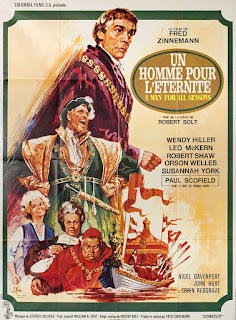
By request from Patreon supporter Peter Rogers, we’re tackling A Man for All Seasons (1966), Fred Zinnemann’s acclaimed adaptation of Robert Bolt’s stage play. Joining Mike are Spencer Parsons and Robert Bellissimo to explore this portrait of Sir Thomas More, played with quiet defiance by Paul Scofield in an Oscar-winning performance. The film follows More’s moral and political stand against King Henry VIII’s divorce and remarriage, a position that would cost him his freedom—and ultimately his life. We unpack the film’s legacy, its courtroom drama structure, and how it reflects shifting power, faith, and integrity during a pivotal moment in English history.
Special Guest: Paul McCudden, Charles Evans Jr. Guest Co-Hosts: Jedidiah Ayres, Spencer Parsons
The Projection Booth continues its spotlight on rare and elusive cinema with The Brave (1997), Johnny Depp’s feature directorial debut and a film shrouded in mystery since its limited release. Adapted by screenwriter Paul McCuddin from a novel by Fletch author Gregory McDonald, The Brave tells the harrowing story of Rafael, a Native American man who agrees to sacrifice himself in a snuff film to provide for his impoverished family.
Joining Mike to dissect this bleak, emotionally charged drama are returning co-hosts Spencer Parsons and Jedidiah Ayres, along with special guests screenwriter Paul McCudden and producer Charles Evans Jr. They discuss the film’s challenging adaptation process, its Cannes debut, and the complicated legacy that followed. We dive deep into The Brave's haunting themes, and controversial reception.
Passions swirl and reality bends in Love Circle (1969), the intoxicating tale of desire, deception, and dangerous games from writer/director Giuseppe Patroni Griffi. Also known as Metti, una sera a cena (Suppose One Night at Dinner), this stylish drama follows a celebrated writer, Michele (Jean-Louis Trintignant), who concocts intricate fantasies about his wife Nina (Florinda Bolkan) and his best friend Max (Tony Musante). But what if his imaginings aren’t so imaginary?
Mike White, Spencer Parsons, and David A. Heath dissect this sultry, surreal web of passion, joined by Andrei Idu, who requested the film as part of our month of Patreon picks. With a screenplay co-written by Dario Argento and an unforgettable score by Ennio Morricone, Love Circle is a hypnotic blend of psychosexual intrigue and high-art aesthetics.
As a follow-up to our episode on The Naked Kiss, Philip Marinello invited Spencer Parsons and Mike to The Substance to discuss Samuel FullerShock Corridor (1963), a harrowing tale of a reporter (Peter Breck) who goes undercover at an asylum where he meets an array of patients who reflect the ills of contemporary society.
Samm Deighan and Spencer Parsons join Mike to look at the 1976 Hungarian film from Zoltán Fábri, The Fifth Seal / Az ötödik pecsét (1976). Based on the novel by Ferenc Sánta, the film is a deceptively simple story of five men who meet and drink in an urban watering hole in World War II. One of them proposes a bit of a thought experiment which colors the world of his companions and eventually manifests in real life thanks to the fascists, the Arrow Cross Party, running the place.
Special Guests: Michael Dante, Constance Towers Guest Co-Hosts: Philip Marinello, Spencer Parsons
Philip Marinello and Spencer Parsons join Mike to look at Sam Fuller's 1964 film The Naked Kiss. The film stars Constance Towers as Kelly, a call girl who turns over a new leaf by becoming the best darned nurse a small town hospital that specializes in the care of special needs kids has ever seen. She’s torn between two men, the sheriff who thinks she’s trash and needs to be run out of town to a nearby brothel (Anthony Eisley) and the successful entrepreneur who holds a shocking secret (Michael Dante).
Constance Towers and Michael Dante (from a Noircon 2022 event) talk about working with Sam Fuller and the making of The Naked Kiss.
A request from Patreon donor Vaughn Collmyer, we're discussing Robert Downey’s 1970 film Pound, an ensemble piece wherein a group of 18 actors play different breeds of dog... and one lonely, lost penguin… all awaiting their fate in a dog pound.
Spencer Parsons, Rob St. Mary, and Mike discuss Downey's film as well as Robert Downey Jr.'s documentary Sr. about his relationship with his father and his father's career.
Spencer Parsons and Rahne Alexander join Mike to discuss Václav Vorlícek's How to Drown Dr. Mracek, the Lawyer (1975). Co-written by Projection Booth favorite Milos Macourek, the film stars Jaromír Hanzlík as the titular Dr. Mracek, a lawyer who is unwittingly trying to displace a group of water sprites from their homes.
Guest Co-Hosts: Spencer Parsons, Matthew Asprey Gear
Czechtember 2022 continues with a look at Intimate Lighting (1965). The first feature film from director Ivan Passer, it’s the story of Peter (Zdenek Bezusek), a cello player, who -- along with his girlfriend, Stepa (Vera Kresadlová), returns home to his village to stay with his friend Bambas and his family.
We kick off Czechtember 2022 with a look at Vojtech Jansy’s The Cassandra Cat (1963). Also known as “When the Cat Comes,” the film is a fairy tale about a little city which lives under the protective eye of Oliva (Jan Bierch). When he was young he almost ran away with the circus which featured an unusual act of a cat which could show people their true colors... literally.
Noirvember 2021 continues with a look at Orson Welles's The Lady from Shanghai (1947). It’s the story of Michael O’Hara (Welles), a sailor who falls in with a strange group of people: A gorgeous blonde, Elsa (Rita Hayworth), the titular lady from Shanghai, her husband, Arthur Bannister, a high-powered lawyer, and his partner, Grisby, a weirdo who wants to fake his own death and pin it on Michael.
Special Guests: Jonathan Brent, Guy Seligmann Guest Co-Hosts: Gianna D’Emilio, Spencer Parsons
Released in 1989, Aleksey German's Khrustalyov, My Car! is set in 1953 agains the death of Josef Stalin and his "Doctor's Plot". The film centers on General Klensky, a huge man with a penchant for cigars and cognac-laced tea, who is doomed to be replaced by a double who will give the right answers during his inevitable show trial.
Gianna D’Emilio and Spencer Parsons join Mike to discuss this chaotic film (which was lambasted upon its screening at Cannes). Professor Jonathan Brent (author of Stalin's Last Crime: The Doctor's Plot) talks about the state of the Soviet Union in 1953 while producer Guy Seligmann provides the history of the film.
We're doing something a little different for Czechtember 2020 with two commentary track episodes. First up, a discussion of Vojtech Jasný's All My Good Countrymen (1969), a tragic tale of a group of friends in post-WWII Czechoslovakia.
Spencer Parsons and Chris Stachiw join Mike to discuss Jasny's lyrical film which was banned by Czech authorities. We also talk about the unofficial "remake", The Moravian Land (1978) and the sequel, Return to Paradise Lost (1999).


 Guest Co-Hosts: Jessica Shires, Spencer Parsons


 Guest Co-Hosts:
 Special Guest:
 Guest Co-Hosts:
 Guest Co-Hosts:
 Special Guest:
 Guest Co-Hosts:
 Guest Co-Hosts:
 Special Guest:
 Guest Co-Hosts:
 As a follow-up to our episode on
 Guest Co-Hosts:
 Special Guests:
 Guest Co-Hosts:
 Guest Co-Hosts:
 Guest Co-Hosts:
 Guest Co-Hosts: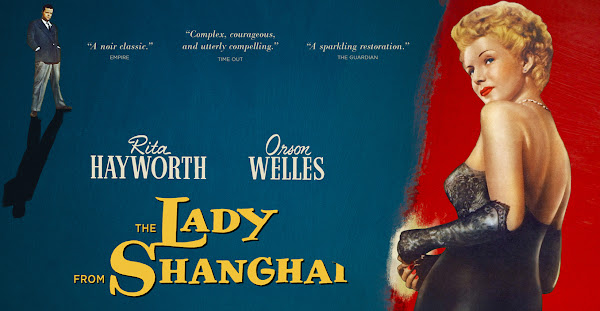
 Guest Co-Hosts:
 Special Guests:
 Guest Co-Hosts: