Show notes
Merola wrote the script as a USC film student mining his own adolescence — a Catholic mother, a fake-named first crush, the general sense of being “unmoored” — and financed it himself, funneling 1,000% stock-market gains from a well-timed Tesla bet into New Jersey’s tax-credit system before approaching outside investors. He shot the film with a crew of first-timers (his editor, his production designer, his producers) in just 20 days, and credits his sound designer with the idea that reordered the final scene, flipping the film’s opening noise into closing silence. After a muted reception out of Tribeca and a near-miss with sales agents, the film found a second life through Letterboxd’s Video Store before landing distribution with Antenna Releasing, who are putting Merola on the road for a five-month, city-by-city roadshow.
Merola’s a philosophy-and-psych double major who treats directing less like genius and more like mediating a fight between departments — which, he argues, is most of what the job actually is.
Follow the film on Instagram (opens in a new tab) for tour dates.
Transcript
An automatic transcript from Spreaker. It has not been proofread, so names, titles and spellings may be wrong, and it does not say who is speaking.
Show the transcript (about 7,200 words)
Hold your ears, folks. It's showtime. People pay good money to see this movie. When they go out to a theater, they want cold sodas, hot popcorn, and no monsters in the projection booth. Everyone pretend podcasting isn't boring.
Turn it off. Yeah, you know, I don't have a crush, okay? I have a girlfriend. Oh. Okay.
Oh. Uh. It's a good girl. She can't look. Say f * * * Jesus for me.
Hey, Dad. I guess what? Hey, buddy. What's up? I have a girlfriend.
Hey, same here. High five. Oh, yeah. Awesome. Good for you.
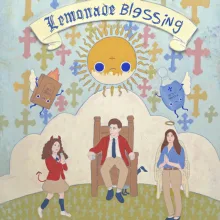
Hey, folks. Welcome to a special episode of The Projection Booth. I'm your host, Mike White. Today, I'm talking with writer-director Chris Merola about Lemonade Blessing, his sacrilegious, sacrilegious, coming-of-age comedy... and the winding road from making backyard shorts as a kid to studying psychology before finally committing to filmmaking. Lemonade Blessing had a popular run on Letterboxd's unreleased gems before Antenna Releasing picked it up for a fall theatrical release.
Had a great time talking with Chris, and I hope you have a great time listening. Enjoy. I definitely want to learn a little bit more about you as far as how did you even become a filmmaker? When does it start? Does it start when you're a kid and you're just screwing around, making little graphic novels or shooting videos with your friends?
Does it happen the first time you hear someone describe themselves as a filmmaker and you're like, ooh, that sounds like, maybe I want to do that? Is it the first time you're like, I'm going to change my major to filmmaking and I'm going to try and pursue that? I don't 100% know when it fully started, but I, from a young age, just really loved I loved reading, loved playing video games, and I love films. And I would make these little skits on YouTube. And in seventh grade, I got my class together.
We made a 40 minute film about a guy who he really wants to buy a candy bar, but he needs to take on all these odd jobs to do it. And he's just hopelessly bad at all of these odd jobs. He just keeps trying to get a different job. I can't do it. Can't muster up any funds.
And I just kept up with making stuff. But when I went to undergrad, it just didn't really occur to me as a real profession I could do. So I was studying psychology to be a therapist. I was maybe going to try and do psychiatry, but I just got my butt kicked by pre-med a little too firmly. And my partner at the time had noted that I was just still always thinking of films, doing the on-campus one-week film competitions.
And she's like, why don't you try and do it? And I was like, okay. So. I had a second major in philosophy and I dropped philosophy for film and I double majored in psych and film. And from that point forward, I think I was like 19.
I started to really think seriously about, okay, what's the next step? Probably I should try and get into one of these fancy MFA programs. And so I tried for that. And then I get to USC and I'm like, okay, I should probably have a few first drafts of some features ready before I graduate. Let me try that first.
When you get to your third year and you're like, okay, I guess I should probably, try and make a move on one of these. At a certain point, it's like you get more and more comfortable with the term. It's almost like it is a loftiness to it. It's like, damn, am I really a filmmaker? Because so much of your time is not actually spent filmmaking.
But yeah, I suppose I am. Having psychology and film, those two things play together very well, at least in my opinion. I agree completely. The thing that's so interesting watching different Sometimes I feel like I watch the film not only just to enjoy the film, but to kind of psychoanalyze the creator, especially given the fact that we get to follow a filmmaker over the course of their lives. We get to see the different things that they're wrestling with over the course of their careers.
And I found that some filmmakers are more naturally in tune with their unconscious. I'm thinking of David Lynch, for example. And then other filmmakers have a more rigorous, I would say, conscious approach to the craft. And you think of people like, I don't know, maybe Kubrick or Fincher, where they have an absolutely razor sharp control over everything they're doing. They could probably justify everything they're doing with a very long essay.
Whereas with Lynch, it's more just gut level. This feels right. We're going with this. And I just love analyzing those different personalities. Like how do people make creative decisions?
So I just love, I love studying the people as much as I love studying the work that they make. How similar or different are you from the character that Jake Ryan plays? Because I would say, and this is a compliment, there's a little bit of physical similarity between you and Mr. Ryan. I cast him mostly for the personality.
And I felt we had a lot of nice overlap. But it is funny. Sometimes my family members would be like, because we hang out. I invited his family over for a family party after Tribeca. And everyone's like, wow.
It really looks like you. And sometimes they'll just interchangeably refer to the protagonist as Chris. They'll be like, yeah, when you did that, I'm like, wait, guys, it's a movie. I didn't know. Come on.
But I would say I'm a child of divorce raised in Long Island, New York, who went to Catholic high school in 2012. I had a devout Catholic mother. I fell for someone who gave me a fake name and told me their parents were divorced and I felt a lot of guilt and a lot of a sense of being unmoored. I felt a bit chameleonic, like I was never really fully sure about how I felt. I felt very almost drunk on other people's feelings and thoughts.
And so depending on who I was in front of, I would mold myself like putty in my own hands. And so I think the script and the character is very much a an embodiment of those things. And of course, we both really like video games, both enjoyed Zelda Wind Waker to dissociate from some of the pains of childhood. So, you know, I think there's a lot of overlap. Of course, a film is a short duration, so you can't always get everything in there.
But yeah, I would say I relate to the guy for sure. When did you decide that you were going to make this into a feature? This was the first screenplay I wrote. I was in my first year of USC and at USC, the sort of ideal alumni is Ryan Kukler. Like he's the most recent large scale success from the school.
And so, you know, the lore gets passed down of like what he was doing before he graduated. And I'd heard that he had written five first feature drafts before graduating. I was like, well, all right, I got to make it happen. I didn't end up doing five. I did three and Lemony was the first one I wrote.
I wrote it out of order. I basically, in a notebook, made bullet points of memories that were salient to me about my adolescence. And I noticed connectivity between them. Okay, here's me and mom. Here's me and my first partner.
Here's me and my friends. Here's me and my faith. And so I basically would just write one of the scenes that I wanted to write for that day. And this was nice because the inertia gets overcome if you're feeling conflicted. sad, you can write a sadder scene. If you're feeling kind of goofy, you can write one of the more skit like scenes.
And so yeah, before I knew that, I think I had seven weeks in, I had a first draft. I shelved it for a while. I let it sit for two years. Then I came back to an early 2023. I rewrote it.
At that point, I had my three drafts from USC and I had to consider which one I wanted to make. And so I just passed them around. And I heard back from people in my life who I was close to. And my roommate, Abhi, who is one of the co-editors on the film, he really responded to Lemonade. And that gave me a lot of, I guess, confidence and hope.
And so from that point forward, around March of 2023, I said, okay, let's start prepping it. And so I came into USC as a spring admit. So we were going to graduate in December of that year. So I decided, okay, Let's try and shoot this in July of 2024, about a year and three months from now. That'll give me enough time to complete my studies while also focusing on all the different aspects of what it takes to make a film.
Forming the LLC, hiring the lawyers, doing fair use clearance to make sure that your use of copyright material doesn't get you sued to hell, this, that, and the other thing. So I would say it was iterative. I told myself I was going to do it. I wrote it in my journal. I told people I was going to do it, but it doesn't really feel real until the ball is rolling enough.
Enough things have happened that progress starts to be made outside of yourself. You've hired department heads and they start prepping things or your producers are doing work or other people are talking to you about it and you realize it's starting to take a life of its own. So I would say I started the fake it till you make it process in early 2023. And by the time I got on set, I was like, I guess we're doing it now. Skipped over what I would think would be a very important thing, which is, okay, yeah.
So I started showing these drafts around. It sounds like there was already a green light somewhere. So where was that green light coming from as far as I can make one of these? That's a situation where I had some pretty fascinating luck on my side. When I was an undergrad, I started investing all of my life savings on the stock market and just taking some kind of wild gambles.
And between 2019 and 2023, I actually experienced 1,000% gains on the market. I basically just invested in Tesla stock pre-Elon going even crazier. He was crazy back then, but he was less crazy. he was less crazy than he currently is. And so I had a significant chunk of the capital for lemonade. And so when we were prepping it, we did research, we're going to shoot in New Jersey, where New Jersey is one of the most competitive tax credits in America.
And so we would approach investors with the pitch of basically, you're guaranteed some of your money back, nobody's going to have to risk any more than than I am, I'm putting skin in the game. And if you lose everything on this, you still will get a write-off against investment income. This ended up being convincing for about 1% of the people we approached, which over time, we were able to cobble together 15 investors in addition to my investment and get the budget together for the film. This was all happening concurrently. So as I was prepping it, I was essentially taking the gamble that we would get everything in time.
And Nothing will make you work hard. And that sort of gamble. I worked so hard just because I was so worried about us not getting it in time. Just had to do a lot of writing letters, zillowing, nice looking houses in the area and hoping that people had disposable income with which they could inject into the film. But yeah, that was part of the concurrent journey.
The investing part just seems insurmountable to me. It's pretty wacky for sure. I think I was very self-sabotagingly just throwing myself into it. I've actually reflected in the years since making it that I don't really know if it's possible to do what I did then sustainably. I think it almost requires a certain chip on your shoulder, a certain almost big vacuum inside of you, like a feeling that you need to prove something to yourself or to others.
And it's not even necessarily the healthiest motivation. But it definitely got me through. But it was pretty brutal. I was anxious almost all the time. And always like oscillating my feelings about the film.
I had a lot of ambivalence. There were days where I really believed it and days where I was like, oh my God, it's just so traditionally structured. And we've already seen these Catholic high school movies. And I'm so tired of this dialogue. And it's just, you have to keep it inside because you have to project some degree of strength and inspiration and hope for people. but internally it can be quite brutal.
And that's something that I wasn't really familiar with because so much of what you do with filmmaking is the externalities, the canon of film history, who has succeeded, who had the dogged, incredible experience of hearing a thousand no's until they heard the one yes. It's like, one thing I wish I knew is how many of the no's would be coming from my own head. You know what I mean? And so that was crazy. But I had a lot of help, of course.
I teamed up with some good friends who we rolled up our sleeves and we figured it out is the best way to put it. Yeah, I was wondering if you had any sort of like mentor or if a producer came on board, but just that you were able to use your friends, it's huge. The idea of a rising tide lifting all boats is really, it's genuine because if you give someone the opportunity to do something they've never done before on a big scale, the level of trust that shows in like People get so excited. People are like, yeah. None of my producers had produced a feature.
My production designer had not production designed a feature before. My editors had not edited a feature before. Being given the chance to do something for the first time when you do it, it's impossible for the brain to rely on heuristics because there is no blueprint. There's nothing to fall back on. You have to go through a novel problem every day.
And of course, people make mistakes the first time they do things. But I think there's a magic to it as well because it's so fresh. People are willing to work really hard in those situations. So what I found was I was trying to find a lot of mentors, but it was a little hard. I'd go to my professors at school and I'd be like, hey, do you have any examples of budgets for films in this range?
I'm trying to budget this film. They're like, to be honest, no, your budget's so low. I don't really have a sample of how much this is supposed to cost. And so it was just a matter of just It was iterative. It's like, okay, let's go to a person with this day rate and this budget for production design, this budget for costumes, and let's see what people say.
And people leverage their experience against us to say, hey, this makes sense and this doesn't. And you just grapple. You just grapple with people and you honestly take their input in. And over time, the budget shapes itself. The schedule shapes itself.
You just show it to people. They let you know that's going to work. That's not going to work. I often find that the act of directing was answering the tug of war, trying to call a truce between departments because everyone's advocating for themselves, but nobody can get everything they want because there's limited time and limited resources. So it's quite a mediator position, I realized at the end of the day.
But yeah, I wouldn't say we had any out and out mentors. There was a few, I had a friend, Jamie, who was an accountant in New Jersey who we wanted to bring on as our accountant for production, but we just couldn't afford him. And he gave us some really good headstarts on the tax credit and ways we could capitalize properly because there is a lot of minutiae involved with the New Jersey tax credit. It is not as simple as I showed up in New Jersey, used my credit card in New Jersey. It's like, you got to prove it.
You got to generate business registration certificates for everything. It's kind of hell. And yes, we did have some help on the tax end of things, but I'm not going to lie. A lot of it was us just bumbling and fumbling our way forward a little bit. Did you find that anybody became your right hand as you're going through this process?
There were a lot of right hands. On the producing end, my good friend Raza from USC was the first person I brought on. He read the first draft. We were in the back of a film distribution class. And I was like, hey, would you be interested in producing?
And he's like, yeah, let's do it. And literally since then, it's been three years, he's still always putting 110% in. And he's also just a very... very bright man a few words you ask him to do something he's like yeah cool and he just does it he's just he's also a freak with watching films he watches like 500 a year we're talking about logging media that man watches movies it's crazy but then i also would have to shout out harrison my dp harrison is unbelievable he's not just our dp he's our colorist he also he just figured out the other day how to do a dcp because our distributor was like we're fumbling around with it. And the DCP we got for our first screening in Brooklyn was a little desaturated.
And Harrison was like, screw it. I'm going to teach myself. I'm just going to teach myself how to do the whole thing. And he did a fresh DCP. So there are a few people that to some extent, I feel like they might even care about the project more than me.
And you do need a few people like that in order to get a project to the finish line. You can't do it alone. Everyone in the project worked really hard, but Those are a few of the, oh my God, they went so, so hard in the paint for us that they just, I would consider them the right-hand people. This doesn't look like a first-time feature. Of course, I knew it was going in, but just, I was like, God, who was behind this kid making this, and sorry to call you kid, but I'm old.
I'm like, who's behind this kid that's like just... This looks fantastic. The acting is great. The sets look great. The story is fantastic.
It's just what is going on. So that when I hear this DIY spirit that is carrying you through this whole thing and that your crew and your friends are just exhibiting, it just makes it even more impressive that this film came together the way that it did. Oh, thank you, man. I really appreciate it. It took me a while.
I think I definitely had a bit of a mourning period after Tribeca because it took so, so long for us to find a home. So it took me a long time to believe in the film. And it's sometimes, yeah, it's easy to just be like, I guess we failed. I guess that's it. That's why I'm just so thankful to Letterboxd because if they had not taken a chance on us with Video Store, we probably wouldn't have found Antenna.
We wouldn't be about to embark on a five-month roadshow. And this film just would not have found audience. Genuinely, that would have been it for us. So I don't know. It's crazy.
I have a feeling, Mike, that there are a lot of people that are doing just what we're doing. And there's probably much better films and much more impressive things going on that they just don't see the light of day. Because honestly, we have a very specific gatekeeping system in the industry that is it's not it's letting in a very particular type of film i guess that's the way i put it yeah. Can you talk a little bit about the kind of the nuts and bolts of this whole thing with tribeca with letterbox with antenna because i'm familiar what's going on but i'm looking at press releases i'm more in i can't say i'm in the industry but i'm more in the know than maybe some of the listeners. So can you talk a little bit about that?
When you make a film, you got to get it out to the theaters. And normally the person that does that as the distributor, they team up, they put some money into advertising the film, they book you the theaters, and in return, they take a chunk of the money. Normally, in the 90s, early 2000s, you go to a festival and distributors go there and Or in the 90s, if you made a film on your own, good for you. You're probably going to get a distributor and you're going to go to theaters and you're going to do well and you're going to be okay. Increasingly, after the democratization of technology in the 2010s with the DSLR revolution, everyone can make a film.
Everyone has the technology to complete a film. So we have a saturation of product in the marketplace and exhibition itself, distribution itself has become the new bottleneck. And so- As hard as it is to get into a festival, which for Tribeca, it was about 13,500 films were submitted for our year and about 100 films were selected, 12 of them in competition. We were in competition there. Even among those 12 films, only one got what I would call a traditional distribution deal out of Tribeca, and that was Rosemead.
They went with Vertical, and Vertical gave it a more standard theatrical release. And so it is very, very, very hard to get the attention of a distributor, much less even hope to make any money. Because another thing that's changed is that previously distributors would give you a certain amount of money, a minimum guarantee while they start recouping the cost of the film. So basically the idea is they give you X amount of dollars and then they would put some printed advertising costs into the film to distribute it. And as money comes in, they pay off the printed advertising as well as your minimum guarantee.
And then you two could both make money in perpetuity. Now, of course, in practice, Hollywood accounting has a bit of a reputation. And for good reason, oftentimes minimum guarantees are the only things that filmmakers see. But increasingly, filmmakers are not getting minimum guarantees. So I can say for Lemonade, we didn't receive any offers with any minimum guarantee.
So there's no money upfront that was offered to us in any sort of capacity. And this is difficult, it's stressful. You go to these festivals, you team up with a sales agent who's going to take about 10% of everything you earn on the film in order to broker the film and sell it. Now, the sales agents are probably going to take on more films than they expect to sell. They are hoping to get a slam dunk at festival because then it's the shortest amount of time between I hop onto this project, I sell this project, i.e. the quickest turnaround for profit.
So the longer that your film doesn't sell the less effort they're going to put into it. And that's just the system. So unfortunately, what we found in the case of Lemonade is, you know, the film had a certain polish to it that they were expecting, hey, I think this will sell. It didn't. And we weren't really hearing from them.
And so I, after wrapping in Lemonade, I started producing a feature for a friend. And so I was focused on that, but I was kind of getting frustrated. And I think around the nine month mark, I'm like nine months out of festival. I'm like, I think I need to just try something on my own here. So I just started emailing around because I saw that Letterboxd had announced its video store platform.
And I was like, I think we'd be really good for this. I think our vibes are similar. So it took me about two months to get in contact with Letterboxd. But when... We did.
They really liked the film. And so Letterboxd is an interesting part of this whole distribution pipeline that we're talking about. Letterboxd does something interesting. They will actually release your film online for a month for a very high price, a festival ticket price. And this can gather attention for your film.
It's like a supercharged digital film festival. Now, it's notable that this is a non-traditional market. Typically, you're going to go to theaters and then you're going to go to digital. To go from digital to the theaters is a little unusual, but I do believe that in a world where attention is the ultimate separator, it's actually a really good idea. And it worked out in our case.
We went on the video store. We did quite well. We got a lot of press, a lot of buzz and antenna and I got connected. I reached out to them outside of our agreement with our sales agent and I was able to broker a deal with them on our own. went our separate ways with the sales agent, wish them all the best. They have a lot of stuff that they had to do.
So I understand. But yeah, Antenna is a lovely company. They're incredibly filmmaker forward. They're founded by filmmakers and the deal terms they offered were stunning to say the least. I won't offer super particulars, but I will say this normally, like I said, printed advertising fees are, they're a debt and they come out of your, your money. antenna does not charge print and advertising as a debt.
They pay out of pocket for print and advertising. And the split that they made with us was by far the most favorable split of any offer we had been made. That really incentivizes me to go out on this roadshow and make a ton of money. So that's my, my, my special interest rant about distribution. I don't know.
Was that, did that kind. Of, I've had friends who've made movies and they just kind of disappear after a while, or they're just waiting for, like you said, for distribution. I've got a friend who worked 20 years on a documentary, and he's still waiting for some sort of a streaming platform that will not just completely rob him of all of the work and the effort that he put into it. I'm preaching to the choir. It's not an easy thing.
It's really not. And I think there needs to be full transparency on that front. I live in my dad's house. I've been living in my dad's house this whole time. You cannot afford to pay rent and do this.
I haven't made a cent on Lemonade yet. And it's been three years I've been working on it. I had to defer my rate for cashflow purposes. And even my rate was pretty low. So the real thing here, it's actually a broader economic thing where in order to, I think, tell a story, you have to live life.
You have to suffer a little bit. But people who are suffering, they often don't have enough money or resources to tell a story. So you actually have these camps, broadly speaking, not trying to generalize, but the people who have the money to make films, they don't always, in my opinion, have the best stories to tell because there's just not as much of a soul there. There's just not as much suffering behind it. And then the people who do have a story to tell, they don't have access to the institutional help to get it out there in a big way.
So there's this like thin Venn diagram overlap of like, some people kind of are able to get to some degree of resources and they hopefully have something to say. I hope I'm not being presumptuous by putting myself in that camp, but you know, I, I felt like we had a story here and I felt like I was lucky enough to have resources. And so I think that's the problem here is that just the stuff that gets made, it's like, You had a friend at CAA or your buddy is Chuck Norris or whatever the fuck. And they make a cameo or whatever. We'll have you.
And it's like, there's just a lot of luck in the world, unfortunately. And a lot of people do not have enough time and money to stay in the game before their luck turns around. It's not a cheap hobby. That's for sure. Not at all.
Not at all, brother. The life savings ruiner. You did work on this. It was one of the first things that you ever worked on. I'm always so curious as far as the evolution of a project.
The movie that I got to see, how close or distant is that from those early drafts that you're putting together? One thing I've discovered about myself is I'll write, let me call them myopic or irreverent first drafts. I think that I have some trouble taking my feelings seriously. I think that I tend to have an unmoored or almost disembodied experience with reality sometimes. And so my first drafts, they feel a little surreal.
They go for the laughs more, and they tend to only flesh out the protagonist's world and everyone else. They provide structural conflict, but their characters are not as fully realized. So the initial draft of Lemonade had the features that you know of from the final film, the sacrilegious dares, the general vibe. Structurally, they're relatively similar. But the side characters just did not have as much empathy or life extended towards them.
And the dialogue just needed improvements. And there was just ways in which I hadn't thought of how to make certain sequences more visual yet. Because that's another thing is as you start honing it, you realize you're like, okay, I've got a pretty dialogue heavy film here. How can I shake it up? Like, how can I introduce visual montages to kind of break up the film?
So I would say, The first draft ended early. There's a flashback sequence at the end of the film. And the first draft ended at the end of that flashback sequence. There's no resolution. And it was a bit more depressing.
It was suggesting a deterministic outcome that we are doomed to repeat our childhood wounds infinitely, essentially, because we're ending where we're beginning. And I think that's what... felt honest to me at the time. But over the two years of working on the film, I got a little more hope that we can transcend our childhood wounds. And so even down to the final edit of the film, the very final scene that you see in the film was actually initially supposed to begin the post flashback secrets. It was supposed to be like, we're a few months later.
And now this is how John starts his day. But I realized that if we did it that way, we were ending with him and his mom. And it was becoming a story about a boy and his mother rather than a boy taking his first steps from the nest. And it was actually my sound designer, Shuby, who had the idea. She's like, well, wait a minute.
If you start the film with noise, with parents arguing, what if you end the film with silence, the duality of that? And I was like, oh, you're so right. And so Shuby really gave the idea for reordering that ending. And that was an incredible idea. And I was really happy with that.
There ended up being a really interesting duality because the first shot is a young boy looking outside of himself to escape pain. But then the last shot is a boy now older looking within to escape pain. I was like, wow, there's a nice duality to that. Totally circumstantial. But These are all these sorts of things that shift.
I storyboarded the whole film about a year before we made it. But sometimes you show up on set and you're like, screw the storyboards, do something different. Sometimes you do something different and you're like, why did I do that? Why did I go away from the storyboards? Oh my God, what am I doing?
It's like, you get a little dazed and confused sometimes, but Lemony got more empathy. It got more, the world expanded and our love for the characters expanded as it went. I also combined The character of Angelo was two separate characters. It was the raunchy friend and the kid with the Bible and the dad. And I thought combining them would be interesting and more elegant.
And so stuff like that shifted. I'm just so glad to hear how open you are to these other suggestions, that you're looking outside of yourself, you're listening to this. I can't remember which director it is, if it was Altman or somebody else, where it's just like... Bring me all your ideas. I want to hear every single idea.
I might not act on them, but I want to hear them because everybody's here to make this the best film that we possibly can. I love that is your attitude. Oh, thank you. Yeah, dude, auteur theory is ridiculous. It's frankly patriarchal.
It's this idea of the lone male genius. Ooh, so smart. It's no shot, man. It's a team sport. As director, you're mostly mediating.
You're mostly acting as a peacemaker. And if you ever have authority on anything, it's only because you've just spent so much time with the story that you feel like you know what it wants. But really, it's not about you. It's like everyone collectively is working on this thing outside of you. And it's the story.
Weirdly enough, I actually had some trouble accepting authority on set. I remember at one point, Abhi told me, yeah, and he said my name, but he said the director. And the way he said it sounded so haughty. And I was like, ew, don't. ew dude but then obby got insecure he's like you just looked at me with disgust man i can't believe you just looked at me like that i was like no i'm not looking at you disgust i just don't want to i don't want to be called that but it's like i am the director but it's so i have to figure that out like i do think in the future i could probably just put the kibosh i probably accepted too many ideas because sometimes people give me an idea for a shot and in my head i'd be like i don't fucking need that shot but i was like yeah sure let's do it in the future i'm gonna put my foot down a little bit more but Yes, it's a tour theory is, in my opinion, a little ridiculous.
Where are people going to be able to see this movie and where can they find out where they're going to be able to see this movie? Antenna releasing our distributor has all of our screenings available on their website. Right now we're recording this in September. I don't know when it's going to come out, but I'm going to be on the road with this film at every screening until at least March of next year. We are hoping to drum up enough sort of groundswell that we can move from a roadshow model, which is different city every night, to a wide theatrical model, which is we go out to 100, 200, 300, 400, 500 theaters.
And we try and just have a great per theater average and make a nice return. So, you know, keep following us on Instagram at Lemonade Blessing. Follow our distributor antenna on their website. You can find tickets. We are basically screening at least five days a week for the next five months.
We'll be hitting all 48 continental states as well as Canada. And honestly, I might try and squeeze. Let's get to Alaska and Hawaii too. Why not just make it 50? I don't know when that's going to happen yet.
But yeah, this is truly just a boots on the ground. I will be there. You want to hang out? I'll be at the screening. I'm excited to show it to people.
And hopefully, kind of similar to the way Hundreds of Beavers did it, like hopefully word will spread organically and it'll get to more people. And then we can make another film. Mentioned that you were producing for somebody else. Are you working on other projects while you're doing this whole rollout? Yeah, I have two features that I'm kind of ready to go on.
I got management out of Tribeca, so we've been pitching them around. I've got one that I would call more commercial that should be more of a slam dunk to get funding for, and then one that's less commercial. I'm really hoping I get funding for the wacky one because I'm very excited about it. Yeah, I just hope that The thing that was kind of special about Lemonade's prep is I took so long to prep it. I just hope in the Hollywood system, you could get Greenlit and then you're just on set in a few months.
And I just hope that I can lock in and make that film. If I'm so lucky as to be able to even make another film, that one, give it the time that it needs to really gestate and have the world and the characters be what they need to be. But yeah, always trying to write every day. I try to journal three pages a day and transcribe my old journals and just keep the wheels spinning. Chris, you have an open invitation.
Whenever you have something that you want to talk about, even if it's just a BS, you can come back on the projection booth. I would love to have you. Oh, thank you, man. Dude, I would love, it's a great conversation. I feel bad.
I bloated a lot, but you asked really good questions and I think they deserve really lengthy answers. So I appreciate you. And yeah, I would love to come on and then talk about a film or, Yeah, really, anything. One thing before we go, I need you to say fuck Jesus for me. Yeah, fuck Jesus.
There you go. You got me. Fuck Jesus? No, you ran into him by the park. I do feel bad.
Jesus, I got nothing against Jesus. It's just, he's a nice guy. It's really the power structure that built up around him that is a little tough, but yeah. Chris, thank you so much, man. This was such a pleasure.
Oh, dude, right back at you. Thank you, Mike. Yeah. Thank you. Hallelujah!
Brothers and sisters, hallelujah! Hallelujah, hallelujah, hallelujah! I want you to dig deep into your pockets and tell me how much you love Jesus! . . Thank you. Come on, give me another chance, man And everything will be okay One in addition, man And you'll never have to worry about giving your free.
Will again Because it's God's will, you have built a bond And played for the people that you'll tap it on Ignorance is all the strength that you need To be a servant of the kingdom That means...
Watch
Comments
No comments yet.