
Show notes
Mike talks with both filmmakers about earning trust from wary subjects, including anti-vaccine filmmaker Mikki Willis, who took two years to say yes; shooting at the Red Pill Expo in Des Moines with no crew but each other; and a stash of footage that could become a film of its own.
Follow Brad Abrahams on Instagram (opens in a new tab) and see where Gimme Truth is screening (opens in a new tab), including Windsor and DOC NYC in November.
Transcript
An automatic transcript, tidied into paragraphs. It has not been proofread, so names, titles and spellings may be wrong, and it does not say who is speaking.
Show the transcript (about 5,700 words)
Hold your ears, folks. It's showtime. People pay good money to see this movie. When they go out to a theater, they want cold sodas, hot popcorn, and no monsters in the Projection Booth.
Everyone pretend podcasting isn't boring. Turn it off. Turn it off. So, and it's got, you know, little movements, you know, from just here.
See, just from a couple inches away. Security is important, especially, you know, us with the new message. People in our group have died under very mysterious circumstances. You know, suicides where people had no indication of depression or anything.
Things like that. Hello, everybody. Now we're going to give you some pointers on how to deal with aliens without any weaponry. When they're up to no good, which is pretty much all the time, if they're coming at you and they're reaching for you...
Bring up your arm here and start chopping away at their throat like this. I got a call from a lady and she basically said we've been watching your videos and you are considered a pest. If a lot of your stuff gets seen by more people, if you start to network with others, you could become a potential threat and at that point they will take you out. For a while I was making laser weapons, laser guns in the garage and they're not toys.
And if I had this medieval Europe, I could just wipe out a whole army of knights with it. They'd all be blind in a matter of seconds, and then I just, my minions would go over and take care of them, you know. Hey folks, welcome to a special episode of The Projection Booth. I'm your host, Mike White.
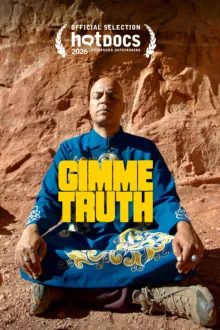
Today, I am talking with co-directors Simon Ennis and Brad Abrahams all about their documentary, Gimme Truth. The film goes deep inside of modern conspiracy culture. Approaching true believers in secret space programs, medical misinformations, and all manner of wild rumor-mongering with curiosity and empathy rather than mockery. Gimme Truth premiered at the Hot Docs Canadian International Documentary Festival in Toronto back in April 2026, went on to play the Fantastic Fest, and is headed to the New Next Festival in Baltimore.
Had a great time talking with Simon and Brad. Apparently, I had met Brad years and years before in Baltimore. So that was nice to catch up with him, also to meet Brad, and to talk about this really interesting documentary. Thanks so much for listening.
Enjoy. Simon, tell me a little bit about your background and how you got into filmmaking. I always wanted to be a filmmaker. My original childhood dream was maybe to be a detective, but that kind of went away by the time I was six or seven and I wanted to make films.
I was always obsessed with movies, especially old movies. My parents both kind of come from film. My dad owned a rep cinema in Toronto before I was even born. So I would grow up watching old black and white movies, Marx Brothers, the Basil Rathbone, Sherlock Holmes movies, Fred Astaire and Ginger Rogers, stuff like that.
And I was always pretty obsessed. And it actually kind of gets into how Brad and I Connect because I know Brad had a similar story. I think I saw Twin Peaks when it first came out, so when I was like eight years old, because a great friend of the family used to take care of me said, oh, Simon, you love mysteries. This show is a mystery.
Maybe you'd like it. And I remember watching it, and the first scene where they find Laura Palmer's body, I was very disturbed by it. And then you have Dale Cooper driving into Twin Peaks and talking into his dictaphone. And I just never seen anything at all like that.
And I remember asking Bob, who's a friend of the family, who showed me this, why is this like this? And he said, there's actually a thing called a director who makes it. And this guy's name is David Lynch. And the reason this feels this way is because of him.
And that just opened my eyes to what that job was. I was obsessed with movies, but really cared about actors as a kid. And then that was like, oh, you can just. Daydream and follow things and kind of live in worlds that you create.
And that was very appealing to me. So I was writing scripts and stuff and making videos even in high school. We went to film school with Brad about 25 years ago. And we were both into weird shit.
We both were very interested in fringe ideas, fringe societies, weird writers like William Burroughs, Robert Anton Wilson. The John Ronson book, Them, which became very inspirational for our movie. We both dropped out of film school and I dropped out and then decided, look, if I'm going to drop out of school, I should make a short and try and play at the Toronto International Film Festival from Toronto. So I did that and it worked and made a few shorts that played at TIFF and other places.
And then my first feature, which was like a John Waters-y dark comedy called You Might As Well Live, played at Slamdance and won an award, played a bunch of other places, including you Maryland Film Fest, where I think we met. And then I also fell into documentaries. So my first doc, Lunar Sea, about people who were obsessed with the moon, premiered at TIFF and Seth by Seth West and other places. And then subsequently, I've done some other film jobs and directed a bunch of TV.
And now I'm on a run of more feature documentaries. The Hobby Tales from the Tabletop is my documentary about... Modern board game culture and that premiered at South by two years ago and was also at New Next which were a Gimme Truth is about to play and kind of at the same time Brad and I got together and decided to make a project co-direct which was the first time for me and the first time for him we usually make our own movies and it was just it was an amazing experience very collaborative we kind of came out even closer friends than before which was nice because it could go one way or the other and so now we're on a run With this one, we premiered at Hot Docs.
It was a great response. And then took a little break just because of the festival calendar and then had a amazing a couple screenings at Fantastic Fest for our U.S. Premiere. The crowd really responded well.
And this is the kind of movie because of the subject matter where by the time we're done the Q&A, there's still 25 hands up. And so, yeah, so that's a long way of how I got into film. Brings us to kind of where we're at now. And then the next thing I'm doing, I'm in development on a pretty wild horror movie.
So I'm kind of getting back into the narrative space. But in a perfect world, I hope to kind of just go back and forth because I love the process of making a documentary, going into these worlds that exist and going in. And both Brad and I have a very similar approach, which is why it worked so well for us to collaborate with just real curiosity and empathy and immersing yourself. Into a world, into a subculture.
So I love both discovering the worlds that exist out in the real world and then also diving into the worlds inside my head and bringing those to life. And Brad, how about yourself? What got you interested? My mother was too scared to watch Twin Peaks alone.
And so she was like, Brad, will you watch this show with me? There's this creepy little man and I'm not able to get through it on my own. So yeah, I started watching with her. And similar to what Simon said, I just had never seen anything like it.
So like, interestingly, yeah, it was TV that kind of got me into this idea that you could make movies or make imagery and atmosphere in this totally new way. And this way where you author it. It's the authorship, that idea. And that just, that got me started, got me going.
And I started doing, yeah, I had an old... Super 8 camera, started just filming things with friends in the woods, doing stop motion, and just got started from there and never stopped. And after film school, though, I had a bunch of debt. So I ended up in the wrong track, which was the commercial world, making commercials, making branded docs, and was stuck there for quite a while, unfortunately.
And documentary was a way for me. To break out of that because you just don't need almost any resources to start, right? You just start. And that's how I started my first feature doc.
So I started working on a feature before any shorts and just started filming with this man who had a strange story in Hoboken, New Jersey, who claimed he lost his virginity to an extraterrestrial woman. And I was like, maybe there's a story here. I just started filming and turned into a feature length documentary. That did really well.
It's still like an evergreen title, kind of a cult hit. And then I was like, actually, it's really hard to make a feature. I should start making some shorts. Did a bunch of fun short docs, one short narrative doc.
And you don't want to get stuck there either. And then thankfully, the phone rang during COVID and it was Simon. And he said, do you want to make a documentary together? And it's about conspiracy theories and conspiracy culture.
I'm like, I'm already completely ensconced in that world. I'm on a podcast called the QAA podcast that's about conspiracy culture. So yeah, already very immersed. And so it was immediate, yes, I wanted to work with Simon because we'd always wanted to work together.
And then also to kind of get into this world a little further cinematically and really be able to sit with the people instead of just report on it, to spend time with these people. Because I've always been interested in fringe phenomena like UFOs, Bigfoot, parapsychology, all of that. And while there's a deep interest in the phenomena itself, even... Larger than that and deeper than that is the question of why we believe it why we're drawn to believe it and then why do some people believe it's so hard that it takes over their life completely and conspiracy theories is where we see that the most in culture right now where it becomes a complete identity and since then I've been like Simon developing a narrative feature called fur which is it's based on a real account not a true story but a real account Turn of the century, West Coast, Canada, about a man who he has a romantic relationship with the Bigfoot.
Does he lose his virginity to the Bigfoot? No, he doesn't. He and Simon's friend could get along. He doesn't lose his virginity to the Bigfoot.
It does get romantic and highly charged. And then you have a couple other doc ideas and development and hopefully be working on them with Simon again very soon. We'll probably get into it. But yeah.
There's a big puzzle piece from our filming with Gimme Truth that never made it into the actual documentary. That could be its own entire feature-length film, and that might see the light of day at some point. In the case of Gimme Truth, the project came to me, and Brad and I had been talking about collaborating, and it just made a lot of sense. This is something we've both been into for so long and used to talk about, and yeah, he's immersed in it with his podcast work.
So it really made sense and also I feel like in this case I was the Brad's mom too scared to watch Twin Peaks but by themselves I'm like okay if I'm gonna go to the Red Pill Expo in Des Moines Iowa I need Brad to be next to me for it we need a buddy this was just from the subject and the literal spaces we were going into it was very good that we had each other to look after each other and to... To go in with the sensitivity, we shot the movie completely ourselves. So we were the only crew almost every shoot. We're both used to directing with small to relatively medium-sized documentary crew.
Maybe it's two other people, maybe it's seven other people. But something like this, both for gaining trust, knowing how to act in these spaces, and keeping a low profile. And in some cases, we never got into any situation that was actually physically dangerous, but we could see it from where we were in some places. So it was just, it was very good to have that.
Just don't go into the woods alone. Mental illness is not catchy. You can't just pick it up from a toilet seat, but I know how it is to feel uncomfortable around that situation. So I love the idea that you bring a buddy and that you two are paired up because it, yeah, it seems like a scary world to go into.
And I don't know, maybe that's just me, but I'm curious what you guys felt as far as entering into this. And how did you make those decisions as far as where you're going to go? You're talking about, Simon, that you wanted to be a detective when you were younger. I feel that documentary work is detective work.
Yeah, it is. It is, or at least it's detective work somewhat. I'd say it's more like being an explorer. But yeah, it's kind of the same things.
It's following threads and letting the case unfold in front of you. We started... With a bunch of conferences that we were interested in. This is like casting this film, quote unquote, the subjects, finding the subjects, was very difficult on this because first of all, we actually explicitly wanted to avoid people that were very clearly mentally ill.
That would have been quite exploitative and we weren't interested in doing that and we are not psychologists or anything like that. We don't presume to have the expertise to be able to handle that. And a lot of these places, you do see a lot of people who have mental illness that's not really being treated, and this is how they are treating it. And so those were subjects that we definitely wanted to avoid.
Although, of course, you talk to everyone that's there, just maybe not on camera and get their story. But this was a world that we knew a lot about and were following, but weren't actually a part of. We don't share these beliefs. And part and parcel with the subject matter is a very high level of skepticism or suspicion or even paranoia.
So it was very difficult to find subjects. We went in very, we weren't undercover. We weren't trying to fool anybody. We would, when we approached anyone that we, turns into one of our main subjects in the movie, one of the first things we would say is we don't necessarily agree with you or we don't agree with you.
When we were talking to Mickey Willis, the filmmaker who made the Planned Parenthood series, who's a very virulent anti-vaxxer, we emailed him. Because we were interested in his story. And the first thing we said is, we don't agree with you, but we're curious as to your story. And we want to get to know you more and where you came from and what led you towards this.
And his reaction was instantly, he was like, that shows you have a lot of integrity that you're telling me right off that you disagree with me. A lot of people from the mainstream media, which we aren't, we're independent filmmakers. We're not CNN or something. He feels like they sort of have.
Don't show their intentions going on. And we were very clear that we were like, this is who we are and this is what we want to do. And we showed him some of the stuff that we shot with Yao Kim, the melotologist who begins the film and Arcturus Ra, the star seed. And so he saw what our approach was like, but yeah, just being very clear and open and really going in with curiosity and empathy.
Even if we, in some cases, in the case of Mickey, disagree with him and think that what he's doing has caused harm in the world. But we're not trying to fool anybody. We're trying to be pretty open-hearted and off the cuff. I appreciate hearing how you were able to approach these subjects because I was very curious as far as what that relationship is.
Because, of course, I'm seeing the 90-minute, 120-minute version of this, but there's that whole life outside of this. And I'm so curious, like, even how long it took to put this together and some of the trials and tribulations that you went through making this. With Mickey Willis. It was...
Two years of back and forth before he was like, all right, fine. You guys have worn me down, basically. So that's on the extreme end, along with people we courted for even longer that it just never materialized for various reasons to both Justin and Arcturus Ra, whom when we approached, they just immediately said, yes, when are you showing up at my house? That was the case for a lot of the UFO.
Related stories just because it 's there's really not that much negative stigma in culture about it's nothing that's going to really get you in trouble but of course with what some of the other people are getting into like the medical around medical conspiracies and misinformation which can lead to somewhere quite dangerous they're a lot more guarded for sure or if it's veering into bigotry, etc. It's understandable why people are... Are going to be more cautious about letting us into their lives. And then also, like Simon said, paranoia, like if it does veer into mental illness as well.
Like we did film with some individuals that we then decided not to because of hints around that. Yeah, and then outside of filming, all of our interactions were just very friendly. Before and after filming, my text, Arcturus Rar, Justin, if we see something... Alien-related in the news.
They'll send us pictures. Yeah, just because we're in their lives, right? It's very intimate. They're being very vulnerable with us.
We're in their homes. We're watching them make food. With Erica, she even led us into that would be a very dark corner of her life with her daughter and the abuse and everything and how she's repairing that relationship and even giving us permission to film her daughter and the rest of her kids. It just shows how much they trust us and how much we have to earn that trust over the years.
And it's a lot of responsibility for us to take and then for us to decide how we portray that on camera too. It was really tricky going to some of these spaces, like even the conferences. Our first shoot that we ever did was at a conference that was about the idea of a secret space program that is abducting children, training them as child soldiers. And then...
They're fighting in intergalactic wars and then coming back to Earth and have their memories wiped. So a lot of the people at this conference felt that is what kind of happened. And it was a very dark place. There was like quite a lot of untreated trauma and mental illness there.
And I would say grifters being predatory and taking their money. And that was the first thing that we shot at. And we got kicked out after a day and a half for being. Feds being CIA.
And like the vibe there turned very dark for us very quickly. Yeah. You just had to abandon the shoot. So there were times when Things started to feel a little bit hairy.
I would say like I didn't feel particularly comfortable at the Red Pill Expo. We're both from Toronto, Canada, but Brad lives in Austin now. So you go there, it's a film festival or like a board game convention or like anything like that. You get a badge.
And in this case, the badge just said your name and where you're from. So it was Brad had one that said Brad, Texas. I had one that said Simon, Canada. And there were a lot of questions about that.
How did you get across the border from the open air concentration camp that Trudeau is running? Etc stuff like that it was pretty funny I did come up with a pretty a pretty easy and fun way to redirect the question like Canada because there's very right-wing people and I wasn't a fan of Justin Trudeau who's a big a big punching bag for the right in america so I'd say oh yeah I'm from Canada but don't worry I didn't vote for Justin Trudeau I in this case like I wasn't undercover and this was not on camera it was just like somebody talking to me in the hall I didn't mention that I would probably, that I was voting for another party that we have in Canada, which is more of like a Bernie AOC, like socialist, like farther left than Justin Trudeau thing.
But I could, I could very naturally and without lying at all, talk about how I thought that this Canadian prime minister they hated was a bit of a phony and a like PR stunt man. So yeah, but there were things like that. But we did feel uncomfortable in certain places. And then not uncomfortable in others.
I think both of us, we are skeptical, very skeptical. And I think anyone who is kind of smart and informed should be. We're very skeptical of the powers that be, of the mainstream media, of stuff like that. Even talking with Mickey, we're not anti-vaxxers in the least.
But do I have skepticism that like big pharma is their main thing is making money and shareholder value more so than actually? Healing people? Yeah, I sure do. I think that this stuff should be questioned, not in the way that Mickey is.
We can relate in some ways. Have you seen this film with some of the documentary subjects? No, unfortunately not yet. So we, one, we don't really have the means to fly them out to every screening, but we just haven't been, besides Austin, and we did invite Mickey to the screening and we just didn't get a response.
I don't know if it went to spam or what, but. Well, probably didn't go to spam because we'd been emailing back and forth with him. But yeah, I think we told him, we said that it's a genre festival, but it's a mainstream festival. You probably, people will probably disagree with you.
But again, just in the spirit of how we wanted to have that conversation, we would love for you to be there. We'd love to keep the conversation going on that stage. And maybe he was busy. Maybe he wasn't interested.
Maybe he thought that it wasn't going to help him or something. But yeah, we just. Didn't hear back. We were really looking forward to it.
And he's often out of town. That 's also why it took years to film with him. He's constantly busy. But yeah, when we're in, if we play somewhere in like New York, then maybe Eric can come down.
If we're playing in Sedona, then Ra can come. Anywhere in the Bay Area, Justin would come. We'd be more than happy for any of our participants to see the film. We think that they would all agree that they're portrayed fairly, that that is their story.
Obviously, with a documentary, a lot of the narrative and the storytelling is done through the editing. It might just be that they're like, why did you have me right next to a guy who believes in this? I don't believe in that. That's crazy.
It's possible that 's something you hear. But other than that, I think when it comes to just their stories, we feel very confident that they'll be pleased with how they're portrayed. One of the things about conspiracy theories that I find fascinating is the language. And just the terms and things.
And I'm sure, Brad, with your podcast, you've gotten familiar with some of these. So when somebody brings up, say, the Rothschilds, you're just like, okay, there we go. Tick the box. I'm curious, did you have to ever ask for interpretation or did you know pretty good where these conspiracy theories were at?
Yeah, we didn't really need an interpretation. Whenever anyone got into the weeds, we'd let them know, like, again, This isn't necessarily about the intricacies of the theory itself. We want to know about you. We want to know about what makes you tick, how you got into this, how this came into your life.
So we'd keep pulling it away from that because there definitely is a tendency to go long and deep on every little detail. And we had some phone calls with people who aren't in the film. There would just be hours and hours talking about every little facet of every theory. But yeah, we're well-versed enough.
That nothing was really a Curveball. And the theories themselves, we didn't get into any of the very deep government conspiracies, like a JFK-type conspiracy theory, or even too deep into 9-11, where there's just so much history and people have done so much research into it that you're like, I don't know, I can't really respond to that because I don't have that knowledge base. And also, we're not debunking any of the theories in the film either, so it doesn't really require it. That we are able to rebut or that we do know every detail ourselves.
So what's happening with the film now, Simon? Like I said, we world premiered at Hot Docs in Toronto, which was great. We just had our US premiere at Fantastic Fest, which is my first time there. Brad had played before and has very quickly become one of my favorite film festivals.
We're going to be at New Next in Baltimore, which I just think is terrific. We both are big fans. Of Eric Hatch and what he's doing there. The heavily curated boutique film festival, I think, is actually the most exciting thing going on right now.
We've both played in big festivals like TIFF and South by Southwest and places like that, and it's wonderful to be there, but there 's something that's so much more special about highly curated, super cool festivals. And then there's some more that we can't tell you about yet that have not been announced. That we're very excited about. But we might.
But yeah, we're very excited about and there's going to be some some very cool screenings in big cities that, yeah, we just can't wait to share this with more audiences. And yeah, like I said, it's funny. This is the first film I made and probably the same with Brad, where we weren't just going for a positive reaction. The last movie I made was about board game culture.
It's like all I want to do is give people like joy and make people feel happy. And kind of get into that world. This movie, we haven't actually gotten so far much of a divisive reaction, but we're very open to it. We can, I can totally see how somebody that's on the extreme right or somebody who is part of the truth movement might feel like, oh, this is bad.
You're not putting check marks next to our theories. I don't like this. And then on the other side, it's like we anticipated that People who are like very woke might be saying it's, why are you letting them talk and not saying this is wrong at all moments. But thankfully, and we learned this pretty quickly at hot dogs with both the crowd reaction and the reviews that were coming out, that people seem to get what we're trying to do, which is literally just put a human lens on these people and on this division that's going on in society.
Maybe that understanding can help kind of heal the divide a little bit. And so far, that seems to be really coming across. So we're really looking forward to it. But I would, this is the first movie that I've made that I would be not unhappy if somebody raises their hand at a Q&A and gets really mad at us for one reason or another.
That would be interesting. And yeah, it would have been amazing if Mickey had been at that screening and we could have, maybe he would have felt it was fair. Maybe he wouldn't have. I think he would have.
Even though that the movie does make clear that we're not on the side of anti-vax stuff, but if we had gotten into like a big sort of discussion or he had with some of the audience or with us, I'm, I think we are like. We're looking forward to some version of that happening at some point. It will happen at some point. Yeah.
Yeah. And again, like we're not, we weren't trying to make something that was a super provocative or edge Lordy. Obviously the movie does not have that tone, but it's just. Dealing with this kind of subject, it kind of gets people going and for good reasons, really.
Where's the best place for people to keep up with this and see where it's showing? On my own site, I've got a page and it lists upcoming screenings. So if they just go to bradabrahams.net, then they can see that. I'm at this underscore is underscore SciGuy and Brad is...
I'm bradwtf. Thank you so much for your time. It was so nice, Simon. I'm so glad we were able to connect again.
Let's definitely talk a little bit sooner than another 15, 20 years. And Brad, it was really nice making your acquaintance. Yeah, likewise. I never seem to finish all my food.
I always get a doggie bag from the waiter. So I just keep what 's still on shoe and I take it home. Save it for later But then I deal with Fungal rot, bacterial formation Microbes, enzymes, mold and oxidation I don't care I've got a secret trick up my sleeve I never bother with Baggies, glass jars, Tupperware containers Plastic, cling wrap, really a no-brainer I just like To keep all my flavors sealed in tight With aluminum foil Never settle for less That kind of wrap is just the best To keep your sandwich nice and fresh Stick it in your cooler Eat it when you're ready Then maybe you'll choose A refreshing herbal tea Lovely.
Oh by the way, I've cracked the code. I figured out these shadow organizations. And the Illuminati know. That they're finally primed For world domination And soon you've got black helicopters Coming across the border Puppet masters for the new world order Be aware There's always someone that's watching you And still the government Won't admit they faced a whole moon landing Thought control race Psychotronic scanning Don't mind that I'm protected cause I made this hat from aluminum foil Where I had this foil lined in case an alien's inclined To probe your butt or read your mind Looks a bit peculiar Seems a little crazy But someday I'll prove There's a big conspiracy.
Watch
Comments
No comments yet.