Special Report
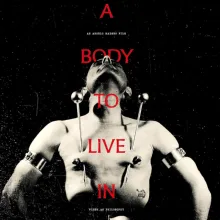
Angelo Madsen on A Body to Live In (2025)
Show notes
The film is currently playing at venues across North America. Check your local listings or visit https://www.abodytolivein.com/ (opens in a new tab)
Transcript
An automatic transcript from Spreaker. It has not been proofread, so names, titles and spellings may be wrong, and it does not say who is speaking.
Show the transcript (about 3,800 words)
Hold you is bo it's showtime. People say, good money to see this movie. When they go out to a theater, they want cold sodas, pop popcorn, and no monsters in the protection booth. Everyone pretend podcasting isn't boring. You can call me Ronder, you can call me here.
That's not too hard once you get used to it. Here he was a Sufi mystic that was misunderstood about using piercing as a way of opening your consciousness. His name was fuck here, who's your fart? And I never intended to use that of the didn't in the statue convention, and somehow it stuck. He had a tendency between visual art, spirit, body, and sexuality, that everything flowed or could flow from one to the other, that there was no real separation.
He really started owning that title performance artists. We were making art through our lives. Whips are getting pulled out and people get getting flogged, and like the biggest none of this. Was a clichea like the nineties hadn't happened yet. And an aids took so many of our people away.
Because of these experiences, I've actually been able to see and feel what it's like on the other side. Hey, folks, welcome to a special episode of the Projection. But I'm your host Mike White. On this episode, I'm talking with Angelo Madson all about his new film, A Body to Live In. It's a documentary film all about Fakir Musafar.
If you're unfamiliar with that name, you might have seen him in the old research book Modern Primitives. It is a wonderful, fascinating documentary. I love the way that it's put together. Really enjoyed this one. I would highly recommend it to folks to check out.
Maybe not for the fan of art, but gosh, what is Thanks so much for listening, and I hope you enjoyed this interview. I absolutely loved your documentary. Definitely want to talk to you about that, but I'd like to know a little bit more about you and how you decided to get into filmmaking because you've done art exhibitions, installations, music, film. You're like quite a talented person. Pikes, I couldn't make a decision.
That's how I got into it. Always gravitated towards the arts, visual arts, writing, and music, so visual arts and music were my big things. I was not interested in film at all until I went to college and I went to art school, and I thought I was gonna be a painter. And then I discovered sound art, which is something I'd never learned about. And then I discovered video art, and I was totally smitten with those practices and I had never even heard of them before, and so once I stumbled upon these, I was kind of like, Oh, this is what I want to do.
I pivoted. I still was in lots of music projects and bands, put out records, toured, but really started getting interested in films. And then I also was doing DIY film projects and started working for a nonprofit where I was doing films with other people as well. Developed more skills there. Yeah, that's how it started.
I never actually went to film school. My work really comes from the language of music and the language of visual art. The language that you use in a body to live in. I love the aesthetic of it. There's always something happening.
You really feel the film as a medium. Did that come from you or did that come from the materials that you were able to gather both. I like to think that the film will tell you what it wants to be. And there were a few clips that I was just so interested in I wanted to create an environment around them, and they didn't really Often what happens when you like approach a film with a struct sure in mind is like you use that a structure infol it no longer works for you, and then you abandon it and then you do something else. Right, there was a few clips that used live overlays, and I really liked those, and so I started thinking about how I wanted to use overlays, and how I wanted to think about negative space, and now I wanted to think about the history of photography also, so trying to let the history and the materiality kind of guide the esthetic.
I was thinking particularly about like negatives and reversals. So like when you develop what it was, you have negatives. That's part of the practice. So how can I integrate the idea of the negative into an aesthetic worldview or create an aesthetic universe that integrates this idea of the negative also integrates the idea of the still image. So that's why you get this sort of like more stop motion movement instead of like animation or flicker.
The idea is like for you to actually remember that the moving image is a still image too. How did you find out about your subject? How familiar were you with the person before you started this endeavor. I was both very familiar and also very limited. I had met him in two thousand and three and got to know him kind of slowly over a span of years, and felt like when I started the project, I felt like I knew about him, and after a lot more learning, I was like, oh, Iman knew a little bit, which I think is true of any situation where you die of fully into someone's history, you only know the tip of the iceberg.
It was a crazy fascinating time getting to sift through this material and experience it. The research part is actually one of my favorite parts of any projects. Research and posts my favorite parts. But yeah, I had seen the research publication when I was in my teens. I think it's not in a friend's house, but I didn't know when I met the Cartil three, I didn't actually know that was the same person because he was twenty years later and I'm not going around looking for, you know whatever, this random artist.
And then later on my friends was like, oh, that's the person from you know, the magazine. I was like, oh crap. Cool, And then I got one of his monographs. My good friend was collaborating with his wife on a project and she brought home the monograph and it was stunning. It was hundreds of beautiful portraits from spanning from nineteen forty four to two thousand or something, and that was just like totally blown away by the portraits, not by the like fetishi erotica, which is only like one piece of the puzzle with him, but by the photographs themselves.
He came to see one of my films in twenty seventeen and we had a really conversation afterwards, and at that point I started thinking about if it might be possible to do something with him. And then he passed away, and then I sort of picked the conversation back up with klil. Tell me about the archives, because yeah, you're talking about the research and just the amount of material you were able to find, the audio interviews, the film clips, the photographs. What was that like getting your hands on some of that and was it all already archived or did you have to start searching every place. Rock Here documented most of his stuff very meticulously, and he kept a lot and so that made it very helpful and easy.
He was very good with documentation. He also knew he was dying, So the thing he did during that nine months or so was get his archived horner. So I was really lucky. You know, a lot of materials were cataloged and somewhat easy to find. It was also a situation of, like, I have a really unique set of interests.
When I like approached this kind of content and finding the things that I was interested in that nobody would know to look for, that was the challenge. I wanted to see things that were from the private club, you know what I mean. I was not interested in necessarily, like his interview on CNN. There's plenty of those. There's tons of interviews on like TV shows and talk shows and whatever, and those are less interesting to me than some of the things you see, Like you know, the little video of the Annie Sprinkle made where he's like dressing up in a course it in tuxedo.
You know you'd only see click with that, but that's an hour long where she just films him dressing up with a texido over his courset. So those things I was really interested in, those things that were buried that nobody had cataloged or found or knew what to do with and that was at the end of a tape that had been taped over. And so a lot of things I found that I was really excited about were things that were miscataloged or were at the ends of tapes, because those are the things that I think he and Cleo thought were like less important in his archive. But then like the photographs of the interviews, the more straightforward things. I also was really interested in the poems because no one knew that about him, and I was trying to bring out these textures of his personality that you wouldn't see in interviews with the media or in reels he had made for advertising things or whatever.
This is going to be a weird compliment, but I love the title of the film, A Body to Live in Thanks, and just this idea of like our bodies being this kind of transitory thing, and just the way that he affected and manipulated his own body as his art and as his life just meant so much. As I was watching this, I was trying to figure out a title, and I didn't know what to do. And I'm thinking, thinking, thinking, and he used to like to say body is the door to spirit. That was one of his little phrases, body is the door, body is the door to spirit. He would say other things and little sayings he had that were kind of adjacent to that.
The idea of a door, to me was a too little of a work, and so I didn't want the word door in my title. I was like, that's not gonna land. That's that doesn't land for me. You know, how can I approach that same concept as a little collection of words that do something powerful together and still open the same idea? And so that was kind of where I landed.
And then I imagine, did you do all the music for this as well? I did. Yeah, I loved music. I will say I had great samples to work from, and that does tremendous another work, so like Jessica Kavong's violin work was central to that. My friend from high school's baritone sax film work was amazing, which we recorded in my bedroom, Masia Bassett.
Sound artist Pauline Olavero's. I don't know if you know anything about Pauline Lavero's, but she was a really important figure in the sound of art universe. But as it overlapped with realms to study at consciousness, she had this whole approach called deep listening, which is basically about trancing out, was sound, and so I was really excited to be able to use some per accordion pieces. And then same with other films, like if I'm using work by other artists, I can really only use it if they give me free rein I have to be able to cut it the way I want to cut it, remix it even like maybe read record pieces or we then new recordings with it. So as long as I'm allowed free reign on remixes, I can use it.
And they allowed it, and it was great, and her work is all archives that a place called the Ministry if not in Upstate New York, but I think that I think the two of them would have so much to talk about and shared so many similar interests, and it felt really special to be able to put them in post more conversation. How many people did you interview for this? Not that many. I kept it pretty close to his collaborators to steal the collaborators. I think there's eight people in the film, and then there's two others that were interviewed that were not featured in the film, or three actually, and those were unfortunate because they're awesome.
They're just like amazing interviews and amazing figures and so much of their own rich art history in life story. And that was true the other interviews too, obviously, like it's just really hard to narrow down content like that. But I just couldn't figure out good placement in context of everyone else. So those hit the floor. One of them got made into a two channel installation actually piece that's showing it.
The one ARCRI is in LA this weekend. And so it wasn't a total loss. I said, got to make something of it. And then you know, some interviews I did once, and some interviews I did like six times. You know, a lot of them I did twice.
Most of them I did twice, but yeah, so ten eleven. And then you know the archive, the interview material that was archival was insane. Ways unto what was your relationship like with Cleo as you're making this. Cleo is a very strong personality, and I'm also a very strong personality. I think sometimes I'm like, who am I don't know.
I think I'm a very strong personality when it comes to like artistry and decisions, and so you know, it was a dance. It was a delicate dance. And it was also you know, she was really really deep grief when we started, because it was like quite soon after his death, and she really likes to have her hands and everything. And I'm a pretty internal person in my working process, so it was new for me to be guided through an archive in this way. And then once our relationship solidified and we developed our banter, our style of communication developed, they got really easy.
And once she started sort of seeing where my interests were, it got even easier. So, you know, I think she's very protective of the archive, rightly so because she doesn't want people misrupresentcing the work. And so, you know, it was a situation where it was like me being like, here's what I'm interested in. She's very smart, so like you could just tell her like complex shit and she's on board with you, you know. So like I was just like, look, nobody wants to watch a film where I just worship guy.
That's boring. If you don't allow me to really portray his flaws, this isn't gonna work. I'm not trying to put it in a bad light or whatever. You know, it's just like it all can't be enlightened embodiment and it all wasn't and she's very responsive to like thoughts that make sense. It was a lot of give and pique.
I will say, at the end of the day, she saw the rough cut and she had one thing she want changed, which I changed, and it was a very easy ask. She had one thing she wants changed, guy said no to and I was able to explain to her why that felt important to me, and she understood. At the end of the day, there was no resistance whatsoever over what this film became. It just took time for us to build, to like build our collaborative relationship and the way we understood each other because like strong personalities, we just had to like figure out how do we think together? And she was instrumental.
You know. The film could not have been made without her. And she gave me everything. She gave me everything I could want, you know. She gave me things that she felt insecure about getting me, you know, and which I put in a special file called double check.
There's a special file for all the things that she's like, I feel concerned about getting this to you. I don't know. She's not credited as a producer, but she's doing a lot of producing work, you know, like in terms of like getting me access to things, getting me contacts, getting me resources. She's doing a ton of producing work. And you know that's the kind of like buying the scene stuff that a lot of times people who are participating in documentaries or subjects and documentaries don't be credit for that kind of stuff.
How did the pandemic affect you? Oh? God, we got screwed, lost about eight thousand dollars. We had two different rests. Actually almost threw in the towel on the project, which would have been devastating.
But basically, our first round of production was fully scheduled for April twenty twenty. That was the first full round of production. So we had ten days in La ten days in San Francisco, We had a cinematographer, we had all Airbnb's books, we have flights booked, we had our interview schedule was half locked. Our research ships were lot. I mean we lost a lot in that situation, and so that got canceled obviously, and then took a breather.
I finished my other film, Look Like Current. I was Okay, it's fine, I need to finish this other film anyway. I'm gonna push it out and we'll come back to this film as soon as North like Current is out on its journey. A spring twenty twenty one rolls around, Delta Wave hits, everything's shut down again again. We had ten days in La ten days in San Francisco fully booked in March twenty one, and at that point in time, Airbnb wasn't doing refunds anymore.
We lost a lot of there. It sounds like petty to be like it was expensive, but basically the pandemic kind of screwed me for starting the film. You know that I had like twenty thousand dollars to start with, you know, and I was like, Okay, we're gonna run with this, figure it out, like well, get money as we can. And basically it was gone before it started. So I was really disappointed and disheartened, and then got back on the saddle had some extra money come through.
I'm really lucky with the Catapult Film found and Left Foundation often are like first in on my projects, and it's really grateful for them. But we were able to reschedule and we were scheduled for August twenty twenty one, and that was our first round of production. Where can people see some of your other films? Because I was looking for North By Crime because it sounds great. North by Current is an interesting one.
It's about my family, so it's a very personal film, and my niece and nephews are and they're about to become teenagers at this point, and I just had different feelings about Hoigh wanted that film disciminated in the world than when I made it. The problem to me is not that it's a personal film. I don't mind my personal life being out there, but it's a shared personalness. It's my relationship withness sister, my relationship with my niece and nephews, and it was important to do at the time we did it. It came out in twenty twenty one and played on PBS.
Grasshopper is the distributor for that film, so it can be rented for institutions or libraries through Grasshopper, so it's available for libraries or community groups. It's just not available to individuals. And that's partially just that things change. Tell me about A Body to Live In? Where is that available?
What's the next step for this film? A Body to Live In has spent the last year doing film festival screenings, which has been exciting, and now it is entering its theatrical distribution with Altered Innocence, which is the deal that I'm very very excited about. Been following Alter Innocence for the last ten years, very much appreciate the quality of work that they distribute and the breath of it and it's specificity. At the same time, there's a lot of breath, but there's like a lot of specificity, but it feels niche in a way that it feels important to me, and so I think it's kind of a dream fit. So we'll be in La this week for a week, and the next week be New York for a week, and then the week after that New Orleans for a week, and then we have lots of little one offs here and there, a couple of days, three days in Seattle, a day in Portland, Oregon, a day in Portland, Maine, a day in San Francisco, I probably a day in Austin.
You know, just one off events going on. But there is a special edition Blu ray coming out that will be on Amazon next week people can pre order and it's going to have lots of behind the scene stuff, which I'm very excited about including cut interviews and it's going to have a really beautiful photo log some people can you unseen photographs from the film. Mister Madison, thank you so much for your time today. I really appreciate this nice. Talking to Mike.
What were my job? He wants up? Clown? We want jump? We want jup?
Shut up, no backs, n do that job till. You want jump. You want to try when you want jump? Joy Wow, we want jup.
Comments
No comments yet.