Episode 688 · Film year 1987
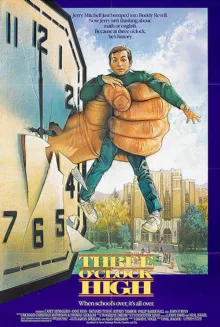
Three O'Clock High (1987)
- Special Guests
- Richard Christian Matheson, Phil Joanou
- Guest Co-Hosts
- Agatha Luz, Tim Luz
Show notes
Tim and Agatha Luz (opens in a new tab) join Mike to discuss how the film is an exercise in style which sets it apart from other typical high school movie fare.
Labels: Agatha Luz Barry Sonnefeld Phil Joanou Richard Christian Matheson Richard Tyson Steven Spielberg Tim Luz
Transcript
An automatic transcript, tidied into paragraphs. It has not been proofread, so names, titles and spellings may be wrong, and it does not say who is speaking.
Show the transcript (about 32,900 words)
GENE WILDER: Hold your ears, folks. It's showtime people pay good money to see this movie. When they go out to a theater, they want cold sodas, hot popcorn and no monsters in the projection booth.
Speaker 2: Everyone pretend podcasting isn't boring. GENE WILDER: Turn it off. I guess I should have known from the beginning. It was gonna be one of those days.
His name is Jerry Mitchell. Hi, Jerry. Jerry. Jerry.
Jerry. Hi, I'm Jerry Mitchell. I'm with the school paper. He just met the new kid in school.
The guy's the closest thing to Charlie Manson. Ever seen Weaver. Now we're gonna have a fight today after school. He's got six hours to get out of it.
It's been quite a morning, Jerry. I can say that again. You try running. I wouldn't leave school without a good reason.
He'll try bribery if I can get the money. Do you think you'd do it for me? Ravel will never bother you again. Guaranteed you'll drive robbery and who you were given to Mitchell law until finally, the fight is on you and me in the parking lot.
Three o'clock, Jerry's got a lot on his mind. 10 seconds, but he's not thinking about math or English five seconds because at three o'clock, he's gonna make history. RICHARD CHRISTIAN MATHESON: There isn't gonna be any today. MIKE WHITE: Welcome to the projection booth.
I'm your host, Mike White with me. Once again is Miss Agatha Luz. Also back in the booth is Mr Tim Luz. TIM LUZ: It's going to be one of those days.
MIKE WHITE: We wrap up comedy month with a look at Phil Jew's 1987 film three o'clock high. The film stars Casey Sasho as Jerry Mitchell, a dweeb high school student that runs awry of new student and general Malcontent Buddy Revell played by Richard Tyson shot mostly by Barry Sonne Feld. The film is an exercise in style which sets it apart from other typical high school movie fair. We will be discussing that and spoilers as we go along.
So if you Don't want anything ruined, please turn off the podcast and come on back after you've seen the movie. We will still be here, Agatha. When was the first time you saw three o'clock high? And what did you think?
AGATHA LUZ: I may have been in high school when I saw it for the first time? I know we ranked at it. So it was definitely not when it came out. I felt like it was pretty standard there at the time.
Very John Hughes, but with a little, a little quirk reminded me a little of one crazy summer and its episodic nature, but I've actually grown to appreciate it quite a bit while researching for it. If it's definitely grown on me a lot more. MIKE WHITE: And Tim How about yourself? TIM LUZ: Mostly I remember first just seeing that amazing movie poster for this.
I think it was a Drew Struzan one in the video store. And I just loving that image. I definitely didn't see it in the movies. I think I caught up with it when it started to show on HBO a few years after its release and just really dug it even though I, you know, wasn't in high school yet, I was looking forward to high school and junior high.
I'm very silly at the time and this kind of formed what I thought this and Breakfast Club and the John Hughes films formed what I thought high school was going to be and I was hugely disappointed in high school, not in the movie. The movie is great. MIKE WHITE: I'm obviously older than you two because I saw this while I was in high school didn't see it theatrically. I believe that Phil Juno has talked about how this movie disappeared pretty quickly.
And that was the case for me. I really only remember running into this on cable. Maybe I rented it on VHS. But I really think that this was a cable movie.
I just remember seeing this probably on HBO or one of the other many movie channels that used to be around and I just fell in love with it. I just love the stylishness of it. I know that Janu has mentioned in the past that he was very influenced by Martin Scorsese's. After hours.
He even said he was influenced by Road Warrior Jaws and it's a wonderful life. But I Don't think I had seen after hours at that point. In fact, I'm, I'm positive I hadn't and I Don't think I was even that familiar with Sonefeld work from his work with the Coen Brothers At this time. I think I was seeing blood simple and I know for sure I was seeing raising Arizona when I was in college.
So this was a brand new experience for me when it came to this type of camera work and this type of active participant that the camera is and I loved it. Absolutely loved it from one of the very early shots with the camera going around Jerry and just, you know, going underneath the bed, the close ups of the clock next to his bed, the close up of the clock and the opening, there's so many great shots in here and then that the story supports it. It's not just an exercise in style, but there's actual substance to this as well.
Really made this a very impactful film for me. TIM LUZ: Yeah. And I like how that style really gets you into Jerry's mindset and his paranoia and his increasing desperation as the story goes on and it gets more and more trapped in this box trying to get out of this fight that he's kind of destined to face. MIKE WHITE: I suppose the closest thing I saw to this type of camera work was probably Evil Dead or Evil Dead Two.
And even that, you know, it's a very different feel to it, obviously, a horror movie versus this. But there are, I mean, almost horror elements to this. Buddy Revell is a monster. I'm always surprised when he talks because it just feels like he's Godzilla almost.
And Godzilla as far as I know, I mean, he communicates but he doesn't talk, he doesn't speak the English. TIM LUZ: I saw raising Arizona for the first time right around the same time and thinking that it had that same kind of energy and especially those type of shots where it suddenly speeds up midway through and slows down when it settles on something not realizing that it was Barry Sonnenfeld responsible for the look of both movies. So I didn't even realize that until watching it again for this, that it was Sonnenfeld, you know, credited as a lighting consultant, but clearly the actual cinematographer.
MIKE WHITE: And I'm trying to remember why he was credited as lighting consultant. And he doesn't even talk about this in his autobiography, which I found very remarkable. His stories in there are terrific, but I guess maybe just he was on too many things that he didn't do everything or maybe he just, this wasn't as important of a film for him as other things. But I think that he brings so much to this movie.
TIM LUZ: I think in some of the extras they mentioned he wasn't part of the Union yet. So I think there was a way to get around that so they can still have him shoot it, but, you know, not have to deal with that problem. But yeah, he just brings such a vibrancy to it. I'm stunned by that opening shot.
Well, what would have been the opening shot of the film originally? That shot of the clock that comes down, we meet yearly Smith and the cheerleaders. We follow them to the next group of people, to the next group of people and then finally into the building, finally landing on Jerry and his sister. That is such an amazing opening shot because I kept looking for a hidden cut somewhere in there.
And as far as I can tell though, they speed up a little bit to get the pacing right. There are no cuts in it that it is one interconnected shot of somebody apparently coming off a crane and going handheld all the way into the building. That's amazing. AGATHA LUZ: And it's the kind of shot that you wouldn't expect from a film like this which I particularly loved.
I'm always a one take shot person like I want to see the actors go through all of these raw emotions all at once. I love traveling in and out of conversations as a viewer that shot just had it for me. I got the lay of the land on top of it. TIM LUZ: And it predates the Copa Command.
I shot from Goodfellas. MIKE WHITE: And I would say that this is giving us more information. I mean, I know that Scorsese was giving us information about Henry and his relationship and just the way that he's talking with these people and the way that the world is opening up for Henry Hill and kind of stunning Lorian Broos character as they go into the copa and that she is entering into this new world of Gangsters. But with this one, you've got all of that dialogue, like you were saying with Yardley Smith and then moving on from her to another person to another person, to another person and each one, it's one continuous conversation basically, but it's coming from different people and they're all adding to it and poor Jerry, he doesn't seem to hear that conversation.
Otherwise he might know to not touch Buddy Revell in the bathroom because he's a touch freak and we get this whole thing set up and I love that, that's the setup to our film. And then that we also go back to that at the end of the film to kind of book end it and then hear all these new stories about this hero of ours with Jerry Mitchell. TIM LUZ: And I like how it's setting up a lot of elements that we're not sure are true yet until they happen in the movie, we hear about him supposedly playing football and, you know, attacking some coach and we find out he did play football later.
Of course, the brass knuckles that at first were like, ok, that's probably exaggerated. Oh, no, he really does have brass knuckles that he uses on people. Ok. After we see the stories that spread about Jerry, the idea of, ok, there's a kernel of truth, but it gets twisted into something weird and bizarre and bigger as time goes on.
AGATHA LUZ: So one of the things that I like about that shot for character for Jerry is that he's very much not of the school. There's this whole ecosystem around him, but he's so focused on what he's going through his teenage angst that everything external from him doesn't matter until of course it comes crashing down in his face. TIM LUZ: He just kind of like has his little, his little spot in the school. He doesn't stray out of it.
He does get into any of these groups or anything like that that he kind of keeps his head down and figures. MIKE WHITE: If he follows the rules and goes to all of his classes and does all the tests properly, he'll be fine and he does sort of until this particular day he has one major transgression and it just all snowballs and yet to your point, he's an outsider also because he's working on the school paper so he's meant to be this observer and writer. The one that documents the things, not the person that does the things I found it funny that we Don't talk about teen movies too often on this podcast.
But I believe the last one we talked about was just one of the guys main character also is a journalist. So I found that kind of weird, like, maybe I was just attracted to journalism movies for from high schools. But you know, that's the whole thing that puts him on his path is, oh, there's this new student who's making a lot of waves. We want you to do this profile on him.
And that's really what sets him off on this very errant quest and that he does all of the wrong things and yeah, just everything snowballs and that's what I also enjoy about this is that it feels very, very well thought out and just all of the pieces fall into place in a very nice way. You know, this leads to this leads to that, which leads to that misunderstanding, which leads to that misunderstanding and just continuously as you said, snowballs and makes his life more and more miserable because Jerry, I like him. But at the same time, it's kind of nice to see.
I would say the universe is punishing him. TIM LUZ: I related to Jerry quite a bit when I first saw this as a, as a kid. And then especially when I was in high school because I did kind of occupy that place of just keep your head down. Don't look anyone in the eye.
Just get through this, get through these four years and get out of there. AGATHA LUZ: But Jerry goes a step further. He also works for the school store. So he has an enormous amount of responsibility.
He's in charge of money and inventory and opening and closing. So that puts closer to a teacher employee than to a student. So he's occupying this, the space in between roles. TIM LUZ: It also made me think that between that and the school paper, he's thinking, you know, extracurricular activities for college, he's already thinking ahead to making his college applications look that much better.
So when Dolinsky actually threatens that later, he's like, no, no, Don't talk to, you know, the college admission boards Don't do that. MIKE WHITE: You know, he's banking out a real good letter from Mr Rice, the Jeffrey Tambor character, you know? Oh, Jerry's got all this responsibility and I've counted on him and he's the one that came up with this great idea to, I Don't know, sell pencils or something. It just seems like he, yeah, he's just gearing up for that.
I'm here for four years. I Don't want any trouble and I just want to go on with my life whereas this thrusts him into a whole new realm of things and I Don't know if everything will be all right at the end of this movie, but it feels like things will be a lot better. I mean, Philip Baker Hall is still not satisfied, but I mean, that whole, it's a wonderful life ending I think is what is going to satisfy him. AGATHA LUZ: When it comes to Jerry's character as well.
I really wanted to address the opening scene that wasn't originally part of the script. We see his room and it's covered in these music posters that you wouldn't necessarily expect. He's, he is the police and Madonna, he has a guitar. Does Jerry seem like a person who would play a guitar but maybe deep within him is hidden.
This rock God. You Don't know, maybe this was some dream, but it opens up this possibility for his character. This room just gives us so much information. TIM LUZ: I also couldn't help but notice the U Two sign, I started to wonder if Jonah had already moved on to Rattle and at that point and just stuck it in there as a little Easter egg.
I'm not sure. MIKE WHITE: I think that he had started working with you two before this movie came out. I Don't know if that was during the shooting of this. And I Don't know if this opening is reshoots to kind of set things up a little bit differently.
Feels like maybe it was it shot differently. TIM LUZ: Like the color temperature is a lot warmer. It doesn't look like Seinfeld shooting it So I got the sense that it was a late edition to the movie. Yeah.
Going back to Jerry's future after this though because it's got the high noon structure which I mean, I can't really get out of my brain. There's a lot of western vibes to this. I kept, I kept thinking of that Gregory Peck movie. The Gunslinger and that now that he's beaten up this bully, all the other tough guys in the school are going to challenge him in some point in the future.
This is going to be the rest of his high school time is fighting off. People who want a shot at the title. GENE WILDER: I was just walking down the street and I heard a voice behind me say reach for it, mister. I spun around and there I was face to face with a six year old kid.
Well, I just threw my guns down and walked away. Little bastard shot me in the ass. TIM LUZ: In fact, I was thinking the ending with all these new stories that are spreading about Jerry. Remind me a little bit of the man who shot Liberty Balance.
That whole print. The legend thing of this, this guy, this meek guy who takes on a bully and gets this giant reputation that he maybe doesn't quite deserve. MIKE WHITE: Another newspaper man type story. Yeah, definitely print the legend.
Richard Tyson does a great job in here and I've always been a fan of his, I love that. His character's name is Buddy Revell. And I think somebody on some of the extras talks about how everybody refers to these characters as their first and last name and the names of these characters are just kind of, they say them enough times that you are never going to forget Jerry Mitchell or Buddy Revell though, I might have occasionally mixed him up with Buddy Repton from Christine. TIM LUZ: Thinking the same thing.
I was starting to wonder if that was on purpose. Like all these bullies are all Buddy. Yeah. And they all have the leather jacket and the long hair.
Yeah. MIKE WHITE: He also reminded me a little bit of Ricky Linderman who is the Adam Baldwin character from the my bodyguard movie as well. So I'm like, yeah, Buddy Ricky. TIM LUZ: I thought he was interesting as a school bully at least cinematically because he's not really interested in inflicting pain on people just for his own joy.
He really seems to just want to be left alone and it's not until you know, that boundary is pushed that all of a sudden he feels like he has to work off his aggression on Jerry. But otherwise he doesn't really want to mess with people. He doesn't want people talking about him. He just wants to kind of kind of like Jerry occupy his corner and be left alone and that's it.
AGATHA LUZ: It's kind of a weird honor code. TIM LUZ: Yeah, which gets broken a little bit when he decides he has to bring brass knuckles to beat up Jerry. AGATHA LUZ: But I mean about that, if we jump forward to that, I think what it comes down to is in the script and I Don't think they did this in the final version. They, the rumor was that the brass knuckles were for when he had to beat up groups of guys.
So the fact that Jerry is now just dying for this fight at the end, he's just dying for it. He has to bring up the brass knuckles because I think Buddy was a little afraid of this aggression. TIM LUZ: I think so too. Actually that he wasn't expecting to be challenged by Jerry.
It's like, oh, now what is this guy doing that threw him off a little bit?
Speaker 7: I just figured, well, you give me so much power. Why is that, do you think? Well, I haven't felt just one person for so long. I've been specializing in groups by lead gangs for local charities, that kind of thing.
MIKE WHITE: Yeah, he just wanted to beat him up and go about his business. I think just show him, do not touch me in the future, please. TIM LUZ: I also, that was really interesting the moment when Jerry tries to bribe him to stop the fight and, you know, as soon as he hears $300 Buddy stops and turns around, you get the sense. Maybe bunny needs some cash.
Maybe he's kind of down on his luck because even he's kind of cagey, like, just to stop the fight. Right. No, no catches. He's, he's like he needs, he's almost like I need that money, but I'm a little wary of this and it's a kind of an interesting turn for his character because he doesn't seem to care about much of anything.
But once that money gets mentioned all of a sudden he's like, yeah. Ok. Sure. AGATHA LUZ: It does show vulnerability.
MIKE WHITE: Because you wonder what his home life is like. Or at least I did anyway. I'm just like, what, what does he come from? That he dresses the way he dresses the way he acts the way that he acts that he is from this other school.
Did his folks move him here? Did he have to leave the other school? I mean, maybe if there was like a really well written profile about him in the school newspaper, then I could get all these answers and made me wonder how many of those stories we hear about him are actually true or exaggerated. TIM LUZ: Maybe he isn't quite as bad as everyone makes him up to be.
Necessarily. We see he's definitely smarter. He can do the math and he reads Steinbeck. So there's a lot of weird, interesting surprises with this guy.
AGATHA LUZ: And you could go so far as to assume that he started out kind of like Jerry and over time just morphed into the person he is. I mean, he still has great intelligence but his version of leave me alone has gotten very physical. TIM LUZ: Sorry, I'm just perching Buddy in that sweater with like, you know, the slick back hair and everything though. MIKE WHITE: He's like two heads taller than Jerry.
Is that scene of them in the bathroom together where you get to see them in that nice like long shot and you see both of them together in front of the urinals and you just see how gargantuan Richard Tyson is compared to poor little Casey. I mean, it really makes a stark difference. TIM LUZ: I started to pay attention to how they were shooting Tyson in the movie and how much of his coverage is an up angle at him. There are very few shots over him like there's that shot in the bathroom when he flings Jerry into the toilet and then a couple of shots when he seems to be less of a threat.
Like when Craig, the other guy is hired to beat him up when he stands up against him, it's one of the few times the camera is over, Buddy. And then when Jerry actually pays Buddy off and Buddy's walking away, it's one of the only other times after that it's just the fight, but every other angle is up at him and looming over the frame. And in one scene, it looks like Jerry would be like 5 ft below him when he's confronting him at the lockers just the eye lines make him look like he's 10 ft tall. AGATHA LUZ: So, about that bathroom scene, just a couple of things.
First, there's a clock in the bathroom, I mean, there's a clock basically everywhere in this movie and that's great. And there's a great reason for it, but there's a clock in the bathroom. Yes. Vincent did put him in this position.
He has to interview Buddy but nobody forced Jerry to talk to Buddy while he was at a urinal. That's his transgression. He's broken a social code. MIKE WHITE: Time and place, time and place.
AGATHA LUZ: Yeah, exactly. Like, maybe if he had approached him in his locker, it wouldn't have been a beaming up situation. TIM LUZ: I think if he had long, as long as he had avoided touching him, he probably could have gotten out of it. He probably, it wouldn't have even registered on this guy's radar if he had just not patted him on the arm.
That was it. But I still kind of hold Vincent a little responsible that moment when Jerry gets the assignment and there's that weird little knowing look from Vincent at the other desk, like, oh, here we go. Like, almost like I'm gonna put Jerry on this and see what happens. And I Don't think he was counting on this necessarily, but he figured some interesting trouble.
That would make a good story for the paper. I think. MIKE WHITE: I Don't know. I Don't know if he's that diabolical, but Yeah, I guess I wouldn't put.
TIM LUZ: It past him. He has access to a switch blade somehow and is not above planting it on somebody. AGATHA LUZ: So he just keeps making things worse here. Take on this, take on this article.
Oh, and by the way, I'll help you get out of the problem by putting a knife in a locker. TIM LUZ: Oh. And that money you stole to try and get out of it. I gave some of it to the guy.
MIKE WHITE: Sorry, there are times where Richard Tyson looks a lot like Val Kilmer. TIM LUZ: I was thinking the same thing, some of his deliveries too, that sort of laconic delivery that he has. MIKE WHITE: I think he does a really good job though. I really like him a lot.
I like Richard Tyson when he shows up in good things, especially like kindergarten cop. I thought he was terrific in, but there's not a whole lot where I'm just like, oh, yeah, Richard Tyson and I kind of wish that there had been because I think that he could do a really good job. TIM LUZ: I was looking over his filmography for this and forgetting that. Oh, yeah.
He had all these little bit parts in the Farley Brothers movies or in Black Hawk down. And, yeah, he's, he's a really decent actor. He's a good presence. He's intense.
I remember that, cop show he was on with John Ashton Hardball that only lasted like a dozen episodes. But I remember actually like him in there because he's kind of the jokester on that one. It was such a weird switch after seeing him in this. MIKE WHITE: Yeah.
I Don't think I've seen that but I can't imagine him being a jokester. Yeah. TIM LUZ: It was, it was really weird. Maybe why it didn't last very long.
MIKE WHITE: Well, then it's funny because with Casey, I just know him from his very early roles, like, mostly back to the future and stand by me where he's just kind of in the background. I can't remember if he's the guy that's wearing the 3d glasses or not, but he's one of the OK. Yeah, he's one of the creeps that hangs around with Biff. TIM LUZ: I didn't realize he was in that until after I saw this.
So then going back and seeing that and noticing Billy Zane, like, oh my God, there's all these.
Speaker 2: People in that movie. MIKE WHITE: I always forget that Zane's in there. TIM LUZ: Yeah, it was funny to see him on the bullying crew in that film after seeing this. MIKE WHITE: And I want to say he was in amazing stories which probably put him on the radar for this movie because this whole thing and we didn't talk about this or I didn't mention it was all a back when Steven Spielberg was presenting and producing so many things like we talked about that when we were talking about Gremlins and a few other films.
I mean, there was a period of time where if it wasn't a Spielberg film, but it felt like a Spielberg film, he's probably just behind the scenes producing it. TIM LUZ: Yeah. Until this view, I had no idea that this was sort of a semi Amblin production or that Spielberg was involved at all. It does explain why the Jaws Out to Sea Music suddenly starts playing during the biology class on the old film there because I was like, how did they get the rights to that otherwise?
But you're right with Shama, I forgot he was in that amazing stories. The mission, he's the guy trapped in the turret on the BB 17 bomber. I love that episode. I love amazing stories.
In fact, Matheson wrote my all time favorite or his father wrote my all time favorite episode. The Doll, the John Lithgow one. I absolutely adore that one. I think Jono directed that one.
And that was such a sweet episode that makes me cry every time I see it. MIKE WHITE: Yeah. And to think that this was his first feature film is just remarkable that he was able to pull this off. I wish it had been more successful and I Don't know necessarily why it wasn't.
Maybe I have to think that maybe the advertising or something because this ticks so many of the boxes that I appreciate. And maybe it's just that I'm a weirdo. TIM LUZ: I think the studio just got cold feet because it was different and they were like, oh, we Don't know what to do with this. If it had been more John Hughesy, they probably would have put it everywhere.
But, and that's the pity because if it gotten enough of a release, I think it would have been a big hit. I think it would have really clicked with people. Same way that the Coen Brothers stuff like, like raising Arizona did. MIKE WHITE: Well, there's one character who I'm always confused about and maybe you guys can help me out, which is Annie Ryan as Franny parents.
TIM LUZ: Yeah, that's going to be a discussion because. AGATHA LUZ: So I obviously I'm a girl and in high school, yes, there was a lot of this is my identity for this year. This year. I'm going to dress, like, I'm going to business.
I'm getting ready for the world and then the next semester you're in ripped jeans and t shirts because you found a punk band. You really like, I'm on board with her ever shifting kind of, persona. She's a strange one. She's definitely the kind of girl who would like Jerry.
I think she sees a lot more in him than he's actually displaying to anyone else in the universe. I'm not sure what it was you didn't connect with, for, with her character. MIKE WHITE: It just felt like there was maybe more to her because she just kind of shows up. Those little thing drops out, comes back a little bit later, like the stuff with like Ethan, her Spirit guide.
It's just like I was hoping for more of her, especially because I mean, I'll be honest, I find her incredibly cute and very charming and she's kind of that manic pixie dream girl that we see now or have seen in the past. I should say so much and she's barely in this. I just really wish that she had been more and I Don't know if she's just there as one of many love interests because you have the older girl that shows up at the store often. You have my most favorite Caitlyn.
Oh, he, I was a big tales of the Gold Monkey fan when I was younger and so seeing her in this and especially her big passionate kiss with Jerry was pretty nice. AGATHA LUZ: So there's, the girl next door, you know, the one you grew up with that you did never really saw coming and then there's the un unattainable hot chick and we have both of those plus a little older woman in the mix. And I think we're gonna find with Jerry that he's gonna, he's gonna end up with her. He's, he's definitely going to be in a relationship with Frannie.
Frannie's timing is just as bad as his though. TIM LUZ: Yeah, I think you can see it in the fight when, when, Buddy throws her and that's what really gets Jerry's kind of goat up and where he starts really challenging Buddy. And you see with that kiss at the end, every time there was a scene with like Frannie there and Karen the other girl, like, why has he been looking at K like Jerry? Hi Jerry with that monotone voice just like, oh God, I just found her so boring.
Frannie is strange but kind of delightful in that. The script made it seem a little bit more like a lot of her affectations are sort of so she can get close to Jerry that she's really interested in him. I Don't know, watching the movie. I feel like no, she actually really is into this whole Spirit guide Ethan thing and that scene where they kiss in the school store and it does something to her and it's not clear what like is it that now she doesn't feel like she needs these affectations now that she's had this actually bonded to some degree with Jerry because she seems a lot more normal from that point on in the rest of the movie.
AGATHA LUZ: She's a woman now. But true. I mean, it is a little fairy tale moment where she sheds all of her illusions and is now a real girl. There were parts Bree and Frannie could have, you know, swapped some scenes here or there not really swapped.
But Frannie could have benefited from having some of the conversations with Jerry that Bree had, especially in the school store. Not the, well, she could have even said that it wouldn't be Grand Theft. Yeah. I think that conversation could have worked better with Franny.
MIKE WHITE: Yeah, I agree. And I'm surprised though that I do not mind his little sister because she is primed and ready to be an annoying character. But luckily she's not, I mean, going back to, just one of the guys she could have been as annoying as the little brother in that movie. Thank God she's not.
She doesn't have, you know, Playgirl magazine, spread out all over her wall and stuff and just be a total horn dog. She's smarter than Jerry and yet she's not obnoxious about it. TIM LUZ: She can be a little bit of a pill like that opening scene where it's clear she's been up for a while and didn't bother to wake Jerry up. She's just been kind of sitting there like, oh, by the way your alarms going.
AGATHA LUZ: That's the only clock in the house that doesn't work in the whole movie. The one clock that doesn't work is his alarm clock. The alarm has been going off for ages, but we Don't hear anything. So I Don't know if the alarm had just worn out and then he smacks the clock to turn it off even though it's not on and the hands fall off of the clock.
It is a broken clock. TIM LUZ: Something else about, Bree that I didn't notice until watching it again today. I love the moment when Frannie gets in the car and they're talking about possibly going on a date and you just see Bree kind of crawl up in the back seat staring at her and then Frannie kind of turns around and looks at her like what? And I got this sense that Bree kind of looks at Frannie as a weirdo.
And one of the reasons I think Franny likes Jerry is because Jerry is accepting like when she does that last year, it was punk this year. It's sixties and Jerry says, oh, she's just trying different things that Jerry is accepting of her various modes and everything like that. And I think that's one of the reasons why she likes him because he is so accepting of her. AGATHA LUZ: He does have some offbeat friendships.
Vincent is included in that quite a bit. Jerry has an openness when it comes to other people. He's willing to accept them for what they are rather than what other people are saying, which might be why he felt comfortable approaching Buddy at all. That's true.
Yeah. And why he was willing to make peace and be friends later on. TIM LUZ: Even when it comes to the stuff about Ethan, he never kind of shoots it down or judges her for it. He actually kind of maybe plays along to some degree.
He actually treats it like it's real for her sake. I thought that was really interesting. AGATHA LUZ: I agree with what you said, but not quite because it's real for her. And he acknowledges that it's like he just, he's not going to trample on her beliefs.
TIM LUZ: Exactly. Yeah. Like he actually asked, well, what does Ethan think of my chances? Like he's, he's playing along with it to some degree.
MIKE WHITE: I love all the little touches, you know, he talks about the hands falling off the clock and things and you mentioned the use of the Jaws music. I love that that's going against that cricket and the Scorpion video or film loop which is just so violent and actually shot for the movie that it wasn't an old school thing that they, you know, repurposed for this. I also love his one teacher and I'm trying to remember which one. She is the oldest teacher how every time she passes by Jerry, she's just talking about like, you know, destruction and the, yeah, the gladiatorial games.
Yeah, there's so. AGATHA LUZ: Many little background, Easter eggs in this movie. All of the banners. We made a list of.
TIM LUZ: The tr the timid, destroy the Panthers, torture the Panthers tigers, destroy Panthers and Panthers. Skin the Panthers that scene with the history teacher. Every time she always gets interrupted by somebody taking Jerry out of the room at the same moment and when she turns around, you can see behind her, there's a sign saying the four stages of cruelty, the production design in this, like sprucing up the school set. They used all these little details are so good.
Like when he gets into the biology class, I love that. There's a big sign about fire alarms and fire drills and we're going to have one of those a couple scenes later, like all these things are just kind of seeded in there and set up. MIKE WHITE: And that use of the high school, that gothic look of that particular high school they found in. Where was that?
Utah, right? Just looks fantastic, especially at the end with all the kids, like the picture behind you guys with all the kids hanging out. It looks fantastic. It was a really, really smart idea to film at a high school like that rather than one of the California, like more modern type buildings.
TIM LUZ: And it hits me because at least the exterior looks a lot like the high where I went to high school, that same sort of all kind of tan brick work, that kind of got the gothic look to it. I will say our student store sucked. It was like literally a cabinet that they opened up once or twice a day. It was not an actual store also, we didn't have a library as special as they did.
That was a very nice library. MIKE WHITE: It was a great library and apparently the same person designed that, that designed a library over in Egypt that Evie worked at in the mummy. TIM LUZ: Oh, no wonder why he keeps putting the shelves too close together. MIKE WHITE: It's just like, please spread them out a little bit.
Let one fall without knocking all of them over. TIM LUZ: I also noticed in the background I've seen besides the knight in shining armor, there's a lot of like framed weapons on the wall, all like axes and faces and things. Like there's this sense of violence in every wall of this school just like hovering over Jerry at every moment. MIKE WHITE: The two bald guys that we have in here, Mitch Pale as the Duke, the just so annoying.
I mean, I Don't know about you guys, but we had like a few security guards at our place and they were just so annoying and then that he seems to report just directly to Wojtek Dolinsky the and I Don't even know what Dolinsky thing is. I thought he was the principal at first. So we have a different person. Ok?
For discipline versus the principal. AGATHA LUZ: His room is hysterical. He has a list of students, two different columns. One was kids who stayed after.
I can't remember what the other one was. TIM LUZ: There was Tardy and I can't remember what the other one was. Ok. AGATHA LUZ: But he has all of these books.
Yes, some very disturbing World War Two books. TIM LUZ: And a secretary named Eva was like, like Eva Braun and I love the contrast. And when we finally get to see o's office and it's much more of a normal place. And as a result, I feel like Rourke feels a little bit more powerful because he feels like a real person where Delinsky is kind of a cartoon and you can't quite totally take him seriously.
Also, he and Duker have both being bald. Like they have this weird little cult that's inside the school. It's creepy. MIKE WHITE: Yeah, we should probably mention that Eva is played by Shirley Stoller, one of my favorite character actresses of all times.
She's so good. I wish she was in here more, but she's just one of many familiar faces. I mentioned Jeffrey Tambor before having John P. Ryan as Mr O'Rourke.
He is. Oh, he's so good. And I'm wondering if this kind of informed his role later on in class of 1999. You know, I think it was only a few years after this.
TIM LUZ: Yeah, I think maybe 90 I think. Yeah, I noticed, John Rothman from Ghostbusters, the head librarian there who's like Mr Medved, which I wondered if that was a Michael Medved reference in there. And of course, Alice, no large Marge as the nurse makes the most of her like two or three lines. Cobbler.
MIKE WHITE: So gross looking little Paul Feig as the hall monitor. I was like, oh, ok. TIM LUZ: Yeah, there were a lot of people just like, hey, I know that guy, that guy looks familiar and of course Philip Baker Hall who I didn't know who he was when I first saw this and now going back and seeing, you know, from all the Paul Thomas Anderson movies in secret honor. And he just brings this gravitas to that tiny little part.
MIKE WHITE: If so feels like this is the early part of Bookman, the library cop from Seinfeld. TIM LUZ: I just really wanted to see if his first name was Sydney. Like in Midnight Run hard eight again, just one more Sydney for his filmography, but he had a very Jack Webb kind of character. Just you get the sense he doesn't trust any of these damn kids.
Yeah. MIKE WHITE: And I love how he's Jerry's got that perfect record. Like you were saying, this is the one day that everything just goes to shit for him. And it's like you've never been in this office before.
I Don't even know, you know, none of these people, the disciplinarian, the principal, they Don't know who this guy is because he said he just stays in the background going to keep my head down, going to make it through here. I Don't think he's winning necessarily maybe awards or, you know, Laurels for his student journalism. He's just right under there and nobody paid attention to he plays. TIM LUZ: And I like that his perfect record makes him more suspicious to all these people.
Like Delinsky is like, I've seen your type before. You think you make it look like you're fine. You're a normal person and then you try and get away with bloody murder. MIKE WHITE: And he had this whole movie is just this whole series of him trying to solve one major problem in or in making things worse by creating other problems, you know?
Oh, well, I can get out of this by getting detention. I can get out of this by having a fire throw. I can get out of this by driving away and everything just adds more and more gets to his car to try to drive away and there's that switchblade and the steering wheel which is then going to come back because they reported that there was a switch blade in his locker and just that gets him even in more trouble. And I just, I love that, like you said, Snowball just keeps building, keeps building and just the pace of this movie.
And then you've got that Great Tangerine Dream Score, which I love that Geno is just like this is way too dark, but I'm like, it works, you know, like I know that they toned it down a little bit, but I really find that that kind of cool, you know, German techno rock that they are doing really fits well for this and does almost make things feel alien. Like you're in a high school, which is a very familiar setting, at least for all of us on this. And then you put the music behind it makes it even stranger. TIM LUZ: Yeah.
Like any other Hughes movie probably just be, you know, a whole bunch of jukebox selections, bunch of songs that they could put on a soundtrack and to not go that route here is really interesting. Plus there's a lot of tracks in there. I'm like, oh, that sounds like near dark. That sounds like Miracle Mile and I love the soundtrack.
Both those ones. So that made me very happy. MIKE WHITE: And then the fight itself at the end really pays off. I did not know, you know, the watching this the first time I was like, well, the fight can't happen.
We just can't have that because Jerry's gonna get murdered and that it actually, you know, it's very well choreographed, I have to say, and then the pacing of the fight, I mean, the fight itself is basically like a mini movie where you have all of these different lifts in action and this character does this to this character and just all of those interactions just in that little circle of all those people out in the parking lot. TIM LUZ: And how many plot lines it's resolving. You have Franny kind of stepping to defend her man.
You've got Vincent trying to kind of make up for what he's done to Jerry over the course of the day. You've got the whole thing with Mr Rourke kind of getting on Jerry's side, all these different plot lines, Delinsky running off in fear and the Duke are getting knocked out. Every little plot line kind of comes to a head in that scene. I will say one problem with the fight scene for me though is that it made me think that school fights would be that way.
And once I saw them in my school and there were a lot of them. It's much more like, you know, two cats fighting each other just and it's over in 20 seconds and somebody's bleeding on the floor. And then our security guys, most of whom looked like they could work for drug dealers because these big burly dudes would break it up and that'd be it. It definitely made me think it was a lot going be a lot more theatrical.
Most Fancy places like this never get past a punch or two before they're broken up. You know what I'm saying? There's almost natural instinct not to upset the hearn. So all I gotta do is get in one good punch play defense and wait to continue the western theme.
I was thinking of appaloosa where it's like, you know, gunfights aren't these long drawn out things. It's over in two seconds. But yeah, I love that fight scene. It's, the moment when Jerry finally scores a good punch on Buddy and they both have the look of surprise of like, oh my God, I did that and Buddy's like, oh my God, he did that.
He's looking around the crowd, like I can't let them see me get beat up by this guy. AGATHA LUZ: It's also possible he has never been punched in the face before because who wants to stand up to him? He's an attack while the defenses are down kind of person? And that's why I think there's quite a bit of fear in this final confrontation for both of the characters.
Buddy and Jerry. TIM LUZ: If you're right. And he was like, Jerry and picked on then, yeah, having this kind of killer rep would be his big defense that no one would dare challenge him. They'd all be afraid of him.
In fact, maybe he spread some of those stories that were going around the beginning of the movie right now. AGATHA LUZ: All he has to do is hit one kid per school basically and he has exactly what he wants. He'll be left alone. MIKE WHITE: When all those people show up at the store.
And by the way, my student store also sucked. Like there's that place where the guys come in to buy the paper off of Jerry. Like that's as far as you could get into our store. You couldn't actually go in the store.
You could just stand at the barrier. So very odd. And I Don't remember if I ever bought anything. I remember that's where you picked up your books.
But when they're all giving the money to Jerry and helping him recoup his losses at one point, Buddy. Comes in and I love how he's got his hands, you know, in a fist and it's almost like she's going to punch him out and then he gives over the money. It looks like there's a little bit of a smile on Buddy's face. At least to me.
TIM LUZ: The tiniest little smile. Not too much, just a little hint of one cheek going up a little bit and that's it. That's all he'll, he'll show. It's just a little respect what I like that.
MIKE WHITE: They both have matching black eyes too. TIM LUZ: It's funny that whole scene of the school story because I kept having high noon in the brain. It's almost like the inverse of that movie where the whole town abandons Gary Cooper pretty much to his fate in here. The whole, the whole community shows up to help him out.
Partially, I think. Well, we know that Vincent kind of organized some of it. But I also think because he put on a good show for them, they were entertained and they want to pay him back for that. MIKE WHITE: There's the gladiatorial games again.
TIM LUZ: And that one is like, it's a, it was a really good thing. You did, Jerry. It made me wonder. Ok.
Is he like striking a blow for all these little guys out there? Maybe too. I kind of think he is. MIKE WHITE: I think he's the hero to the common man because, you know, he's the one who stood up against the bully.
He's the David versus the Goliath and he actually wins. AGATHA LUZ: That opens up a really interesting question for me. Does he deserve the win? MIKE WHITE: By that point?
He has been punished by the gods enough that he does deserve that last little thing. I Don't know, like he'll probably, like you said, get that reputation and everything. Maybe he's going to get a date with that teacher, but I doubt it. I think to your point, he will finally wise up and realize that the perfect girl is right there the whole time for Franny.
Right? That's always how these movies work. I think he deserved it. What do you think.
TIM LUZ: In terms of using like the brass knuckles, they were going to be used on him? So I think that's kind of fair game. AGATHA LUZ: No, I meant the money. MIKE WHITE: The money, I thought you meant the win.
AGATHA LUZ: Well, no, the win of recouping all the money so that his, he isn't in as much trouble as he necessarily would have been. Had he not been able to replace the money he stole. TIM LUZ: Yeah, I think he deserves that. I mean, he was going to pay it off to not fight.
He fought anyway and therefore he didn't get his money's worth. So he deserves to have that money back. And yeah, I'm ok with him, with the community coming together. AGATHA LUZ: I Don't know.
I feel like his two major transgressions, one of which I think is just social and funny in the bathroom just talking to somebody. And the other is that he steals and demolishes his place of work. TIM LUZ: Well, the demolishing was an accident. It's just that fire extinguisher got out of control.
He didn't totally mean all of that. And we do get the sense that after the whole thing with Craig goes awry that he was hoping he'd get all the money so he could put it all back. MIKE WHITE: That's a, that's a really good point, I think. Yeah.
And I think really more than anything, it's a sign for that he's accepted now by the rest of these yahoos in his school. Yeah, he is seen. TIM LUZ: I think it's also a sign that his priorities have shifted. I mean, early on he talks about how he can't ditch class because I got a book report and I have a test in this thing and, you know, by near the end of the movie he's like, flunk me.
He kind of realizes all this high school stuff that seems so important and so dramatic doesn't really mean as much compared to, you know, getting your face flattened by a psychopath. MIKE WHITE: No, that was me in senior year where I was just like, oh, I got accepted into college. I Don't have to worry about these grades anymore. I Don't have to take a second semester of physics, with one of the worst teachers in the whole school.
I'm ok. Now I can just take a study hall and be ok with it. TIM LUZ: Oh, God. Their algebra teacher.
That guy, the guy who talks like this, I swear. I had that teacher in high school actually. MIKE WHITE: Who was a real guy from what I remember. Right.
TIM LUZ: Which is weird because he has a great screen presence. He's terrific. He's really funny. That little pause where it's like, you know, it should match where you were in your old school.
It said so much. That little pause. MIKE WHITE: He reminds me of the guy who's trying to question the owner of unpainted huff Heinz. Nathan Huffines in Nathan Arizona, I should say was the child?
Was he wear anything when he was abducted? Nobody sleeps naked in this house. The officer, if we're going to put an A PB out, I need a description, they're better trained to intervene in a crisis situation. TIM LUZ: What was he wearing a dinner jacket?
What do you think he's wearing his damn jammies child was wearing his jammies. You happy? There's a very Coen Brothers quality to a lot of the characters in this, whether these weird quirky, bizarre people that the film is not quite looking down on, but kind of like, are these people strange groups. AGATHA LUZ: Of stereotypes which I kind of love because I mean, so are our major characters where they are all stereotypes?
TIM LUZ: I hate to admit I was probably kind of close to the film, guys who are trying to follow them around to make their little documentary when I was that age. So those guys, boy, they're obnoxious. MIKE WHITE: Pain is fleeting film is forever, right? TIM LUZ: I love the pay off of that of Jerry just grabbing their camera and smashing it over the car.
Such a nice ending to that. And I love how you can see them in the background of shots too, like preparing their shots of Jerry walking through the hallways here and there. It's, it's really nice and subtle. MIKE WHITE: One of the shots that I like the most in this is after Buddy has beating up the guy who was sent by Jerry to beat him up and that whole thing in the library with all the shells falling and of course, revealing those two behind the shelves in the back is great, but I just love Buddy with the blood on his finger when he shushes them.
What a shot. TIM LUZ: It's like you have no idea what his reaction is going to be to seeing them there knowing that they put this guy up to it and then that's, it's just that and just calmly walking out, you try to pull something over on me or the whole thing with the test where, you know, he clearly didn't really need to cheat. I Don't know if it's a case of he's trying to get Jerry in trouble, which seems to be what, you know, the writers intended. I always took it more as like it's a test for Jerry.
He wants to see what Jerry is made of. Is he, is he gonna crack? Is he going to let him cheat? Is he going to try and take the responsibility for this too to try and cover for Buddy?
It's almost like he's this weird catalyst for Jerry, the whole movie of like trying to push him to see just how far before he breaks. AGATHA LUZ: He definitely plays mind games. I mean, why wait until three o'clock to beat somebody up unless you're going to play mind games with him all day. MIKE WHITE: God, that dread.
I Don't know if either of you were ever in fights in elementary or high school or anything, but quite a few, quite a few man that dread that I will kick your ass in the parking lot after school and you just live with that for even 15 minutes. But it could be hours and hours. It's just the worst feeling and like I still, if somebody says like, oh, we need to talk, it's just like, oh, just tell me now, tell me now I can't take Tom Petty. What said the waiting is the hardest part.
He wasn't wrong. TIM LUZ: I remember I was working at a Blockbuster for years and they got a call, hey, is Tim gonna be in tonight? And they're like, yeah, good. I'm going to beat him to death with a baseball bat click.
And so I come into work like did I recommend the wrong movie to somebody what's going on? Nobody showed up. Nothing happened. But for the whole night and somebody would enter the door and I'd be like, ah.
AGATHA LUZ: I never have taken the day off. TIM LUZ: I didn't know until I got into work. They, that was the first thing when I got in there. They're like, oh, by the way, somebody is going to come and kill you.
Bye. See you put those movies away. MIKE WHITE: Once you put on that Blue and khaki, you are obliged to keep that on for at least 6 to 8 hours. TIM LUZ: But yeah, I went through a lot of fights in high school.
I didn't win all of them. I want a few. I like to think. But yeah, it was pretty bad and so a lot of this really does Ring true for me and bring back some emotions I totally forgot about.
MIKE WHITE: Yeah, my, I'll beat you up after school were more elementary school. I want to say around like third grade. And then the, I can't say I got in a fight in high school. I remember being stuck at a an away game for the football team because I was in the marching band and I was just like, would you hurry up and lose already?
We're already losing. It's cold as fuck out here. We need, you know, let's go, let's get on the bus and this big jock is just like, you better pray that they win because I'm gonna kick your ass otherwise. And I was like, all right, and then totally forgot about it.
And then probably about a week later he saw me in, the school just walked up to me and just punched me right in the face. And I was like, that's it. Of course, he didn't get suspended. I almost did.
TIM LUZ: It works. MIKE WHITE: Yeah. Oh, yeah. Yeah.
Well, it helps that he wasn't, he was out of the football team that night. He normally played and the coach of the football team was the vice principal so his boys could do no wrong. AGATHA LUZ: Our high school is like that too. Lots and lots of sports money.
So everybody on the sports team got a pass. TIM LUZ: I do remember it was less like in school, but like the way to school and the way back that I'd have trouble, like, I remember one time walking to school and some guy walks up to me and asks who I like in some basketball game. I'm like, well, I Don't really follow basketball, like, just pick one. I think it was Phoenix and I can't remember else.
So I said no, no, Phoenix. And he punches me in the face and that started a whole series of fights with this guy. So clearly he was just looking for an early, it was. AGATHA LUZ: Your correct answer would have been the Chicago Bulls.
TIM LUZ: I Don't think Chicago was the other one though. I Don't know who the other one was. He was clearly just looking for a fight. I Don't think it would have mattered.
Which I said it was really weird. MIKE WHITE: I Don't know. Maybe Pistons, maybe, but at any rate, maybe I ought have said demaggio. All right, we're going to take a break and play a pair of interviews.
First off, you'll hear from screenwriter Richard Christian Matheson And after that, you'll hear from director Phil J and we'll be back with both of those right after these brief messages. MALCOLM MCDOWELL: Hello, everyone. This is Malcolm Mcdowell. I just wanna say that, this is a request to listeners of the projection booth podcast to become patrons of the show via Patreon.com Patreon.com/Projection Booth.
That's pretty simple. I think you can do that. It's a great show and Mike, he provides hours of great entertainment. So now it's time to give back.
My little druggies, settle down and take a listen and have a sip of the old Moloko and then you'll be ready for a little of the old in Out in out real horror show. Bye bye. MIKE WHITE: I'd love to know how you got involved in stone and what it was like working with all of the talented people that were on that show. RICHARD CHRISTIAN MATHESON: Oh, man, you're one of the only people that knows about stone.
My former writing partner, Tom Soy, who I also wrote through Atwood. We were under a seven year deal. We had done some work at Universal and they liked what we did. We wrote some episodes of The Hulk and I think we wrote war episodes.
And then one of our episodes got wove him in along with an episode. But the guy that created the shows Ken Johnson into a film. So the film was actually released in Europe and they were trying to improve, I think their youth demographic, the Universal. So they were hiring pretty young writers.
One of them was also Frank Lupo who went on to work with Steve Hill when we were put under the seven year contract. I was 19. In pretty short order. We were the head writers of Quincy, the old Jack Klugman girl.
That's a good, I was like, it was a really good show and I think you're not an easy guy to work with. He was very exacting and went through a lot of exec producers and I'm a huge fan of his. I just think he's fabulous on whether he was doing the captain in death ship. My father's one hour twilight zone or the odd couple, he could do no long, just a fantastic actor but very exacting about Quincy.
And so we were the head writers. Our EP was Don Belisario who went on to create magnum and Quantum leap and a whole bunch of stuff. He became quite a force and we there was an evening where he was feeling particularly frustrated with Codman who was, who was just being, again, very exacting. And a friend of his came by who I'd never met, who I just thought was fantastic right away.
And I was Steven J Camel and he came by, he was the hot shot on a lot. Steve was writing all the pilots. He'd already done, Walk Ford and Beretta, he was baba black sheep. And so we, it was just the four of us after hours in Don's office and it was just very easy to connect with Steve.
We really liked Jim and I think he really, he responded to our writing. We had written an episode of Quincy called Doctor Moriarty who was about a guy in medical school that Quincy had gone to medical school with, he'd been flunked out and he went on to become an embittered person and he decides he wants to challenge Quincy to see who really was the better student who really understands medicine better. So he becomes Moriarty to Quincy's Sherlock Holmes in the episode, right? It's a really, it was a really interesting idea.
We wrote a good script and Cannell really dug it. So he was working on a show to get back to your original question with Dennis Weaver. That was gonna be a kind of homage or was going to view as its drop me off point. Joseph WBA who is the cop novelist and he asked us if we would write an episode on the Bourbon.
Sure, we liked him so much. And, so we wrote an episode called the partner about a guy who he partners with, who's just really bright and is able to get to the bottom of things so quickly. And what becomes clear after a while is that he is actually perpetrating these crimes so that he can, he can seem like he's brilliant, but it's actually him doing it. And I think the show aired, you may know better than I Don't think it aired too many episodes.
I Don't think even 10 episodes were aired. And as far as I know, this has been a great mystery of mine is, was that episode made, I believe it was, but we never saw it. And as the you on, we then went to work for Steve K as a writer producer and it, and then after we left Steve and I became very close friends and he wanted to become a novelist and he'd read my novel created by it was a thinly veiled assassination of the television business set against a Jekyll Hyde kind of a storyline where a guy creates a show, the hottest, most, most dangerous action show on television.
And the lead, the main character begins to come to life and demanded more of him, right? So it had been sent out to Brandon Toff got a great quote, William Free and like a great quote. It's in print. You can, you can get it on Amazon and it got sent to Steve Campbell.
And this is some time after I'd left the company and we, our friendship began after he got the book, that's when it officially began. And he said his office called and said, Steve wants to have lunch with you. And I hadn't seen him horribly 10 years. And I thought because I had, it's pretty scathing.
It's, I think it's very wickedly funny. I'm making fun of the executives and I'm making fun of ridiculous shows that they get enthusiastic about and the protocols and all of the bureaucracy and the ego. But I can see where somebody who was neck deep and all of it might take offense. And by that point, I think we Tom and I had also worked with a in selling, worked with him for two years and written pilots and stuff for him.
And we'd also, I believe at that point we'd all three o'clock, I had already had already come out. So we were in and doing all kinds of stuff and, but I hadn't teased him at dinners. So I thought he's probably gonna take me out and just told me that I'm, I was biting the hand that fed me that I was being dishonorable in some way. That's what I, that was what I was afraid of.
So he takes me out to lunch and he's just, I can't believe this fucking, but he always was fucking everything fucking that fucking, that he was just blown away by this novel. And he said this is the official step for me and wanting to stop doing so much of what I'm doing in television. I want to become a novelist and I became like his mentor about how to do it all. And he had been lying.
I mean, it was like a Joseph Campbell. I mean, it really was it. So I'm not just invoking Joseph Campbell. It was a remarkable journey because I had held Steve in such a steam and just, he's a, just a wonderful guy, just very even temperament, nice, you know, really took good care of people, you know, at his funeral, there must have been 1500 people.
It was like Princess Diana's funeral. It was just incredible and we learned it. So he began to write novels and he dedicated his first novel to me. And so talk about a journey, right?
Because after we worked on stone to what's let me rewind back to that. We continued to Universal and worked on I think I was l and sent a link to stone. Come to think of it. It was Levinson or Lake, right?
Never met them. And I of course, like everybody else had such respect for their writing. And to this day, Columbo is such a joy, but we stayed there. We continued to work on when you're under a seven year contract, they just move you from show to show.
So the show. So we were working for Glen Larson on, I Don't know, Battlestar Galactica and working on just different things. And we got to know Frank Wipo who was about our age. At that point, I was probably 22 years old, but I remember when we were doing Quincy, I was 21 and it was, it was very daunting.
By the way, it's not like we were prodigies. I think we were really good. And I know the things we were good at, but it's still very daunting because the amount of pressure and the amount of deadline deadlines that you're under is just ungodly. So even if you have your act together and you've got talent, you've got to be able to call upon it under circumstances that are endlessly stressful.
It's like you're, it's like you're in battle and you gotta make sure that you aim straight and you Don't pause because everything is moving so fast. We got to know Frank. He was the ep on some of the Glen Larson shows. And then Steve Cal started, he had already put his company together when he was doing his stone, but now he was going to really stand his company.
He had gotten a huge infusion of money from one of the studios, maybe Paramount. I forget. And he, it was going to be a huge production deal for Steve and he wanted to expand his company. And so he did, and he hired Frank.
Frank became his second in command there along with Juanita Bartlett, he took over the I Love Lucy office as a parent, which were pretty groovy. Yeah. And we had been working, I think at that point, we'd left Universal and we were working on a show called The Powers of Matthew star Prom. And I really had writers and producers and we were all sharing this kind of like Park Garden area, like the Lucy offices were 300 ft that way.
And then our offices were, and we had the old mission impossible offices. So we got to know another young guy named Patrick Heber who was working for Cal. Pretty sure. And I had been a ski instructor and he had met Steve and he and Steve gave him his first real opportunity as a writer and he really did well with it and he went on and co created Hardcastle and mccormick and Tony on Jump Street.
So we all became pals. We were all 25 years old at the most. And they wanted us to come over to Camel's Company and between Steve and Frank and Patrick, it was just like a very natural move for us. So we went to work for Steve and we worked with Steve for, I think about five years, something like that.
And then we got an opportunity and we worked on a, we wrote, I mean, we had to rewrite all the different scripts that came in some of which were better than others. And we wrote, I Don't know how many a Brahman six or seven. So we probably had our hands in 3030 scripts easy. And we have credit on, I Don't know, seven or eight of them as writers.
I can't even bring around many. And then we worked on Hardcastle and then we worked on Hunter and then we got, and we worked on another show called Stingray. These were all the kennels company. We had the offices on their wood board and it was great.
It was like the sixth floor. It was all writers and producers and everybody was funny and quirky. So it was a really interesting place to work, you know, a lot of, a lot of high level sarcasm. It and talent.
Everybody there was, they were legitimately talented and Steve is great. Steve was our fearless leader and it was just, it was, it was fantastic. So we'd gotten an offer take point. I'm trying to remember.
I think we were, we chained agencies, I think to CAA and we got an offer for Warner Brothers to work on a show over there gonna be the television version of stir racing and they were gonna quadruple our salary. Retail. Yeah, I know. And so we, yeah, at that point.
We were, wait, you're young. You work at Steve was the hottest writers company in town. And so the agents of course, really use that to great to their greatest sales advantage. And so they went to different, different people would inquire and they would, of course, talk about us.
And I'm not sure they quite, I think it was more like triple, I think it was quadruple now that I think of it and, but it was a lot, it was a, it was suddenly, it was like, whoa. And Steve just was not in a place where he could economically swing it because he was built, he was building or had built a studio up in Canada, the North Shore studios because of the tax advantage of working up there and using a certain amount of Canadian sort of tax write offs and all that. It was much less expensive to film up there. And he handled six shows on the air.
He was really being, he had to be very mindful, but he was true to form great about it though. We were under contract with him. He said, look, I Don't believe in holding anyone back. I never do that with anyone and absolutely true about him.
And if you have an opportunity, this is something you guys wanna do. Ii I poured it. Send you with my blessings. Remarkable because we were doing great there and we loved him and he like so it was just at this opportunity kill.
So we're working on, I'm gonna swing now into three o'clock. I watched this. So we were working on ST Gray. I think we were the supervising producers, your record exec producers.
I forget which we were and it came, went, it just didn't have the Magic of the film by any stretch. But it was pretty funny. We were working for these two guys named Larry. Larry Rosen and Larry Tucker and they called the company, the Larry Company.
Was it the we were always fighting about which Larry was really the first Larry in the Larry title of the company, right? MIKE WHITE: That was the Larry Tucker who wrote a bunch of stuff for Paul Mazursky. Was it. RICHARD CHRISTIAN MATHESON: And they Yes.
Yeah. They wrote Bob K Carroll and Ellis. MIKE WHITE: Yeah. And he was even in a blast of silence.
RICHARD CHRISTIAN MATHESON: The old Alan Berry. He's Yeah. Yeah. Yes.
Really great guys. Just great guys. And I remember Larry Rose and I'll never forget that. You remember these little moments of praise, right?
We wrote our first script and he came in and he shut the door and you're always ready for anything. You're ready for people to say, get your, get out of here, man. You guys are totally, you're off, you're missing all that. He shut the door.
He said, I want to tell you guys something. You guys are gonna be stars. Wow. Wow.
Wow. Thank you. And I always had very, I Don't know if you would call them big ambitions or just a lot of ideas for things that would be films that would be, I had ideas. I had a lot of, I had a knack, I still do, but I always had a knack for hook for something that could be a film.
I ended up selling 15 spec screenplays and you, each of them had a hook, some of them, I co-wrote some of them. But oh, you have to have a central hook that is really Mertle. And so my mind just operated that way. So I said to Tom, I had this idea that came to me and we were in our office as Warner Brothers and the idea and I wrote it down.
It just dropped in my head. It took 20 minutes. It's, it is a guy who gets challenged to a fight after school and we're gonna watch him going through each class, watching him trying to get out of this fuck, trying to get sent home, trying to bribe his way out of it. Just everything until he finally has no choice but to face it because to do otherwise would be an admission of such profound cowardice that it would essentially poison the rest of his life on some level, right?
And sometimes ideas, they just drop into your head. Boom. It was like that. And I had five pages of notes.
And I said there should be some guys that are in the audio visual club and they want to take film and there's some girl that has ignored him and then when she hears that he's gonna be in a fight, she gets interested and then the different faculty members and how this guy Buddy, there's more to him than there appears to be that he's not just a thug that he is actually very smart. And that this is some sort of weird way that he even what he says in the military. I have to, I'm gonna have to blow off some steam. I gotta work it off.
And that this is his weird 3d chess game that he plays with people. Not even 3d chess. It's simple but that it is, it's manipulative. It isn't just bottled up rage.
You know, there's something more than so all the notes came together just and Tom was like, yeah, it's great. So we had meetings set up in different places around town for different projects. People want to meet you and hear what you're thinking about doing and maybe pilots or whatever. And so we would go when it was companies that were studios in particular, production companies in particular for film, we would tell them some of the ideas that we had and mention this one and they were like, yeah, but nobody made a move on it.
Nobody optioned the idea, nobody gave us some money to develop any. So I said, why Don't we just write it? And we'd written a couple of other things on spec adapt wage. And so we were, we really loved to write and continue to this day to love to write it.
We just, we found great, I think, joy and inner definition through, through writing. So we would stay late at the stir crazy offices and we'd, we'd probably write from 6 to 10, something like that. It didn't take us all that long. And we, at that point, we had also been writing for amazing stories.
We got an opportunity to write for amazing stories. And the way that came about was my father who you probably know something about was the, he was the story consultant in amazing stories. And he and spiel went way back because of Del, right? And he talked about us and Steve thought, oh, I really want to meet those guys.
We sounded like like we were on definitely on a very blazing patch and that we were doing things that would be of interest to him, to Steve. And so we wrote two amazing stories and then I wrote my own amazing story and Steve called us in. I remember I was out of town with my family, with my folks in my and I remember I got a call, Steve wants you in his office on Monday, Steve Spill like with gel with every lunch with gel. I ready for him to slap me and say, how dare you think you're in this business?
And then, and I just remember saying to my dad, I Don't think he would like have us come in to tell us that we were like, we fucked everything up right up. So we went in, he was very praising of the work that we had done. And he asked us if we were available to write a film to rewrite a film called Harry and the Hendersons. And we said, what have you if you want yard work done?
But and he was so nice. God was a nice guy. He talk about success brings out the truth and who you are. He was just a very gracious, very down to earth guy.
And it was at the m at his offices that Amblin and yeah, it's just, it was just, it was really exciting and it felt very validating at a really deep level. So we did the rewrite and at that point, we were really good at punching things up and come out with little one line phase. And so we, I knew we had nailed it and he got back to us, loved it. And so he said, come here, I want to talk to you guys.
So we went back in there and we're strolling around in outside an AM one. He said, I wish to put his story at work is beautiful, it was like a beautiful gardens and everything. And you're just walking around talking to Steve like, it's just a guy, he's just like a pal and he says, hey, do you guys like the, do you like popsicles? Right?
Yeah. You like root beer for whatever the flavor. And he, and he says he'd really like some popsicles and you hear this voice from a walk from a tree, we'll be right there, Steve. Yeah, wherever he is.
And he said, look, what else do you guys, what else are you doing? And we, and we had finished this draft of three o'clock high at the time, we called it after school and CAA had submitted it to a couple of different companies. They turned it down including AM one. And we said this, he said, oh, that sounds really interesting.
He said it was submitted and it was passed on here. He said really, he didn't know that. He said that sounds really interesting to me. And he told us that when he was a kid, he'd been picked on same thing with Aaron Spelling boy, Aaron had also bent it and he said, I really like to read it.
Ok. So we, the agent sent it over that night and the next day he made an offer and I'm trying to remember if we were still working with Aaron Spelling doesn't matter, but either were working or had been working. Erin we have one year deal with Aaron. Really a nice, also a really nice man and she was interested in it.
And then Marvin Davis, the big oil potentate his son who was at that point, then a producer, he too was interested in it. And then of course, our agents did their agent Magic and now we had I believe 10 offers all over town. It was crazy and it was fast. And so our agent said, you gotta talk to everybody before you need to decide what to do.
And we people who had passed on it when we pitched it, by the way, people who had passed on it when they read the script, they wanted, they want, we had been consecrated because Spielberg wanted it. And so we'd go in and we'd meet with people and we do not with people. We'd meet with the presidents of the network. Suddenly you're like, you're, you go right to the head of the line and they call it flavor of the month.
But until it begins to go tepid and thin, it's, you feel like you're just the king of the world. So we're all these meetings and all these studio presidents would tell us their story about how they've been picked on. A lot of them are like short guys, little tiny guys, they're not big looming gun. So you can see where it might have happened.
And so we had a lot of offers a lot. And we obviously there was no question in our mind that we wanted to do it with Spielberg. And he said, look, I'll promise you if you, if you go with me, it will not be rewritten, it will, it will go exactly as you wrote in. He said, I have one request.
Would you drop the voiceover because we had voiceover in it. So it was like there he was, he was the biggest thing I'd ever seen in my life. That kind of shit, right? It wasn't overdone, but it was, there was voiceover.
You could hear Jerry, what Jerry was saying only Jerry. We were like, yeah, sure. And it was a good suggestion. It would have been distracting I think.
And then Aaron one, you made an even bigger deal. And I guess it was Steven said to Aaron, why Don't we do it together? And so my first call where that plan was not only launched but confirmed. I was somewhere and I was on, this is before cell phones and I was on two pay fonts, heating quarters and one on one with Spielberg on the other was a valley.
Oh Wow. Yeah. And Tom had been tapped in somewhere and I'm like, ok, crazy man, crazy. Then Spielberg made us an overall deal because we, he also had us come in and talk about other ideas and I remember him calling, this is another one of those I forget about this.
But every now and then it comes back to me, I remember him calling me and saying, you have the finest story mind encountered in 10 years. And I think he didn't mean plotting. I think he meant exactly what I said a minute ago for ideas for having a hook. And I was like, oh, so he, everything was in the right configuration for him to put us under a deal and he did.
And so we, he put us under a deal to write f and we came up with one that we were really jazzed about and then another one and then I think they began to change their business model. I Don't know all of what happened, but there were other people that were all, not too many, but there were another maybe three writers that were under overall. Pardon me? Writing deals for Amblin and all those deal lapsed, including ours.
So I Don't know what happened. I it couldn't have been, he was disappointed because the whole reason we're in that deal was that he thought we were great and that he was really excited about this new idea that we had and that we'd written it all out. He was just thrilled. So I think they just had a business.
I think it was a business like that. So we never took it to long one. Then we were off and running to, I'm trying to remember was that so that was. Yeah.
So then Tom and I continued to, we got actually we, at that point we had eight film deals. Oh, it's crazy because there's so much insecurity and doubt in this town and once they have somebody and it's not just somebody, Steve Spielberg, it was the cardal richelieu of show business. Say these guys are good, then everybody goes, then they must, it's really about that complicated. I remember at one point somewhere along the line, they had wanted us to be the executive producers of macgyver.
And I remember going in to meet with them and they passed on us. I think they didn't feel that we were the white shit or that we had of it. We just didn't have enough examples of things that would be appropriate from a diver which, but we actually did anyway. Then after the whole thing, the Spielberg, they came calling and they just kept offering more and more money and you guys were like, there's nobody would be better from a guy.
I can't use the word depressing. That's not the right word, but it's eye opening. It's eye opening because you think I'm the same person I was yesterday. But now I've been, as I say, consecrated now you have a scepter.
So we just continued on and with all these different movie deals, we had a 22 picture deal at Disney, a two picture deal at more nervous Paramount. I forget all the, it was a lot of them and they were all interesting and we ended up writing a film for MD M about a guy that buys his first car and the car is a disaster. It's supposed to be this cool car and it's a disaster that film got made called My New Car. And then I think we were, we were, we were on a couple of different shows.
We had moved into comedy as well. We worked on a show for a friend of ours in Norma Seberg who was doing a show at Columbia. And then he introduced us, he had been one of the writers on Blazing Saddles and he introduced us to Mel Brooks. And so then we started with Mel Crooks and yeah, it was great.
We were working with Mel on, just the three of us, Mel K and myself. We were and we'd meet in his office in on 20th century at the 20th century. What we, the idea was a mom and pop mortuary in a town. They got it all tied up, right?
And then this kind of cool forest lawn operation is gonna move in because there's new housing that's being built. So that like the Harvey Corman Exec and it's, we called it at your service and it was just going to be this war like between this really slick successful like a like not even a cemetery. It was more like a more formal than it's gonna have gardens and fouls and this mom and pop operation. I remember a gag we had where it was, they were doing stuff in their house.
They were doing all the, all the postmortem stuff in their house to get him with people ready for their funerals and all that stuff. And I mean, he wanted to get, I think somebody like Marty Feldman who was going to be their assistant and they do all the stuff downstairs and you hear him coming up the stairs and it takes the gag is that it like he's ascending a 10 story building. There's that many steps and it's only down to the basement. And I, and I remember Mel coming up to that and it was just, it was so wild to just hang out with him that he was really funny, of course, and we'd go and have lunch with him at the commissary and people were very, everybody loved them.
They can always say hello. And it was cool to be, to just be part of its whole little world for them. And my favorite part though was when it would, we'd need it like maybe five. It was, and it was like this time of year as I recall because it got dark early and he would start to talk a bit more seriously about things.
He'd been one of these producers on the Elephant Man and he was, I would say intellectual, which you never saw. Right. That was not the gear that he played. But these conversations would go on for, I Don't know, not that long, but even they were notable because he was being not bleak, sad, dark, nothing like that.
Just serious, talking about serious things in a serious way with, I think what we're insights of depth, a sort of, I think, personal revelation, whether he poised it that way or not, or pod it that way. And so that was an incredible experience. And then I think our last stop before Tom and I went our separate ways was we were working on a show for a guy named Michael Jacobs who had done my two dads. And he had done these very successful sitcoms.
He had heard about us and he wanted to meet us that he wanted us to work on a show he was doing called dinosaurs, you remember dinosaurs like and he, but he had another show, he thought we would be Union more suitable for because he said that our writing was character, so character Rich and he was doing a show called The Torkelson. And so we were again, remember supervising producers, yo ZX, either way we were and we did that for a little bit and that show came and went. So many of them do, most of them do. And I'm thinking back back at Universal.
We were also working night writer, all these different weird things. That come and go. And Mrs Columbo about that one. Not a bearable idea, but it came, it went.
And so we parted ways. We just thought this is the time, it's a time to do that now. And so that's are, that's, that is the long version of like my, hi, my friend. MIKE WHITE: How did you?
And Tom Sillier meet. RICHARD CHRISTIAN MATHESON: We met at the advertising offices of JC Penney in downtown LA. I was 17. I had just gotten out of high school and they were looking for a junior copywriter and I submitted some, I was just always very nimble with words.
I could just, I just always, and that's just so witty. And I was trying something started and I remember writing a paper and one of my teachers saying, I Don't know what you said, but you said it so well, I'm giving you an A plus. I remember thinking, ok. Ok.
Now I'm in business. Right. And so they hired me my little, I'd say office. It was my cubicle, but I was 17.
It seemed, it was really super cool. And then they were looking for another junior copywriter. And then this guy came in from CO A and he was, I was 17. He was probably 20.
And that was Tom. And they said we were gonna give you some products, go home and write some ads. And he said, how about if I just do it right now? And they said, OK, so they put him in the conference room, he went in, he wrote some ads and they hired him.
And so we struck up a friendship and then there was another writer there, another junior thought Julie Kirgo. And she and her sister became a very successful writer producers. And so that's how we met. And I went briefly because I wanted to have some semblance of her actual life.
And I went to a college in Staro Florida. I was gonna go to Cornell. I had, I been admitted to Cornell and I thought, I Don't know, it's cold, everything's uphill and even downhill is uphill in Cornell and Ithaca. And I had heard about this place in Sarasota where the, I guess the it's a fairly wealthy community and they wanted to have a substantial collegiate presence.
So they had gotten, what was the former waterfront estate of John Ringling from, from Ringling. Brother was born in the Bailey Circus and they, I Don't know it was given to them or they bought it or what they did, but they turned it into this college called New College and they advertised it as Harvard under the palms. So there were a lot of high sat people there and it was a pretty wild, interesting, not wild but quirky eccentric. And it was a strange place.
The Ring Lane was a very wealthy guy. The circuses were just huge all over the world and he had bought, just to show you the Hurst Castle. He bought an opera house in Italy called the Oslo A Solld Hallo Opera House. He had it taken apart and shipped to service and had reassembled.
They also had on the campus, a clown college because the circus was still operational and that's where people went to learn how to be clowns. And years later I was, I had written a film that I was producing with my friend Norman that starred David Strathern and David. And I got, we were just talking about this and then he went to that clown column and I said, you did not. Nobody went there.
Come on. Are you kidding? He said, no, I went, yeah. So I was dating a girl that was majoring in laughter that term.
Never do that. That's a tough company to keep person who's always looking, crying out different kinds of laughter. I left New College. In fact, here's what I was about.
They found at Duke College. I'm working on paper about dust Coppi. One night I electrical material is, and I'm writing this paper and I'm thinking, and I had, I starting to write a couple of short stories. I wrote one short story and it was submitted to Esquire through my father's literary agent who thought it was really good.
And I got a letter back from Esquire and they said we're, we're thinking about publishing this. And ultimately, they just, they decided not to, but it was a really close call and they really liked the writing and I thought damn, and I knew I wanted to write prose. And so I'm working on this paper at three o'clock in the morning and I'm sitting here thinking how many other guys and women, young women are sitting in their rooms in their college dorms right now writing the same damn paper, whether it's about the Grapes of Wrath or it's about dust, not to what fruit is about.
And what I really want to do is write. And I had gotten, while I was down there the next day I got a Blue letter from the UK. They used to do these letters in this beautiful Blue, thick TSU almost and then you would open it and fold it. I Don't know if you could, you ever saw this?
But they were, they were really quite extraordinary looking and it was a guy that wanted to buy a story that I'd read and I was like, oh my God. So I called my dad and I just said, look, I really wanna just be a writer. I Don't think there's anything here that's going to accelerate my hopes and my goals. And if I'm looking for a writing mentor who better than you, right?
And we always had this incredibly easy, wonderful relationship together. So I left New College and I came home and then I started picking up little odds and end jobs, writing film reviews, book reviews, this and that. And I got in touch with Tom and I said, hey, you want to try and write a couple scripts together? So we went on.
So we wrote a couple scripts and three months later, we had an agent and then about a year later, we were under that seven year deal at Universal. So had I stayed at New College, I think everything would have resembled the same path the trajectory, but everything just would have taken longer. And I think in a way because what Universal was really trying to do, as I mentioned was alter their demographic. They want to get a younger audience.
I think probably the young, younger was better to be four years older. I looked young so they wouldn't have known anyway, but it was being in the right place at the right time and then I just started to write prose and started to publish that separate from all my screenwriting stuff and then novels and here I am. MIKE WHITE: What was your experience like on three o'clock high? Did they keep you around or did they say thanks for the script?
RICHARD CHRISTIAN MATHESON: See you, they were very respectful and even though there were these multiple offers, you never know what you're going to be getting yourself into really by a script. I remember my father telling me a story about he had, there was a show long ago. About World War Two called Combat. And he had written a novel called The Beardless Warriors, which was this very celebrated critically celebrated novel.
And it's a wonderful book about young soldiers and pretty in war. And so he was the perfect guy. They were thrilled to get him. He wrote the pilot.
They called him. And, I think it was a half hour show, I think. And he, they said this is brilliant. Thank God, thank you.
You know, and he was thrilled and he called back and he said, could you guys send me a copy? I'd love to, I'd love to see a copy of the official script. So they sent it to him and he called them back, he read it, he called them back and he said, I think you sent the wrong, you sent me the wrong script. That's how much they had changed it.
Wow. My dad and I wrote a script that we sold to Tristar that starred Dan Aykroyd and Gene Hackman and it was just thrashed, thrashed. It was on spec, we wrote it on spec and sold it and we sold it for a lot of money. So you think they're not going to mess around with it too much, right?
They must be pretty excited about it, but they did, it was just, it wasn't unrecognizable, but it was, I'll, I'll give you an example. It was gonna be about it. It was about a hockey player who was sociopathic when his team, when they didn't hit a particular score and he was, he was the big celebrity on the team. He would get really upset and he had to deal with that.
And so he would kill someone that was the basic idea of it. Then he'd use a hockey skate and that was his weapon. And the team that goes to the detectives look into these crimes, one of them is been there and seen everything kind of guy and he's partnered with a young guy who is brilliant but has multiple personality syndrome. So every time he's under stress, he fractures into these different other characters.
And so it was right in that period where Lethal Weapon was just doing major business. And so people were thrilled about the beginning of the screenplay. Ok, so the rewrite is instead of all of that. Now it involves porno film starring Adolf Hitler.
What else can I say already? You just go? What? Really?
You're kidding. Right. You can't possibly be serious. But so there you go.
So as far as three o'clock I win, Steve is true to his word. It was a very, a happy experience for us. MIKE WHITE: Thank you so much. This was so nice.
RICHARD CHRISTIAN MATHESON: You're very welcome. MIKE WHITE: You've been making movies for how long high school before that were you born with the camera in your hand? PHIL JOANOU: Me almost. It started with my dad's super eight camera when I was 14.
Years old. I started making Silent Super Eights. Let's see, that would have been in 1975. Then I saved up by, it's so Spielberg and it's the joke.
I had a paper out. I saved up my money. I got a sound camera, then I got a projector and then my friends and I started making sound Super films with and I got a little editor back then. It was a pretty complicated process.
You literally had to take your film cartridge parade came in cartridges about 2.5 minute cartridges. And then you put them into a pout and you'd mail them to Kodak and they would mail you back the little reel. So it was really funny and you shoot in mail and they get your film mail mail. And so I did all that.
And before I went to film school, I think I had made about over 1012 short films. The longest one, I think it was about 48 minutes long and was a musical. And by the way, if people want to see any of these carly, anyone does. But if they did, they're on my website, which is Phil Joanou director.com and they're all under high school films.
I mean, I didn't put them all up but high school films and then there's my US C student films are there as well. MIKE WHITE: Yeah, it was so nice to be able to see Last Chance Dance finally, after hearing me for so long. That was great. And checking out the other films that you were so ambitious.
PHIL JOANOU: Yeah, we went crazy. I was lucky in that. I grew up in a small town here called La Kanata, which nobody's really heard of, but it's near Pasadena Glendale here in southern California. And it's very American graffiti to have 11 long drag.
Not a lot to do near Los Angeles, but not in the hipster center of anything. It was just this very kind of sleeping bedroom community. So we had a lot of time on our hands. There was no internet, there were no iphones, there are no ads, there was no streaming, there were no VHS or DVD.
In fact, there was no cable. We're growing up with three channels, there was no Fox, it was CBS, ABC and NBC and KTL A, the local station, channel five, channel nine and channel 13 or the three local stations, we had to come up something to kill time. And I had this group of friends. We just loved movies.
We loved movies. We went every weekend. This is when movies cost $2.50 to go see when I was really young. There were still double features where you could see two movies for that, for even less than when I was really young.
So going to movies was really a cultural ritual still when I was young. And I'm so glad I feel so lucky. That was the era I grew up in because choice was limited. And that really funneled you into every funnel everybody into this cultural phenomenon known as really going.
And you would go and see the, I remember when Star Wars came out and the lights in. So we went opening day and it was all, was talking about, it was just, it was, that was it bar. And now people released a $200 million movie. They're like, yeah, see it streaming.
Maybe Don't, I Don't know, bald guy. I go, I Don't go, I Don't know, maybe I will, maybe I won't. And that's a bummer. That's a shame for movies.
But we were inspired. It wasn't just me, I had all these friends that loved movies and we were all, but, you know, it all starts out. You're all kind of budding actors and we all thought we knew we were doing and we didn't. But yeah, I got really serious about film making at a young age and I just loved everything about it.
Everything, I love the camera aspect of it. Lens's thing, camera movement. If you look at some of these films, we were, I would sit on like the hood of a car and my friend would drive and we do the equivalent of long steady cam shots that go on and on. And it was really, it was suspicious if you, if you look at the films now, you can take your iphone and it's got built in stabilization and everyone's got the rig you can run around the.
So you would look now and be like, and, but when you really realize it was on this little strip of film and this wonky camera that you had to do manual focus, there was no seat. It is auto focused manual book you met you. But that auto it didn't have auto exposure. But the problem with that was that you tilted towards something bright.
It would go dark, right? But then it's dark, it would open up there. So I did manual which mean time like writing the exposure and of course, if you and there's no attitude because you're not shooting negative, you're actually shooting trip, right? With positive though.
So the film that went through the cartridge was the film. You got that literally the same physical felt there was no print as called reversal stack and a reversal stock is very unforgiving. If it's too dark, you're dead. If it's too bright, you're dead.
So all home. My understanding of filmmaking because you screwed up and back then we're eating a shot like the end of the world. We didn't understand what take two was, everything was take one. There's no take two.
I said when Philip Bellman up my money to do it twice like what you did, that's what went in the movie. So for never take two or no, I didn't even understand. I was like, what do you do more than what except? Yeah, I started out with all that fell in love with the camera, the acting, the movement lighting a little later because I didn't have any lighting equipment, editing, music, sound effects, special effects.
The whole thing was it really was to be honest with you, Mike, it really was my favorite time of filmmaking. My favorite era of filmmaking was my super eight era. That was of my entire career. So from kind of high school to early film schools, I did five super eights, my first year at US C and that ST eight because it was just you the camera few actors and you had to be really resourceful.
If you look at it in the US C Super eight. I filled one in Las Vegas. I did a World War channel one. I did a period piece.
I did a Chinatown Sam Spade called the Dick and then black and white in color and then used both formats. It was for the pure creative joy of it. And that was my, that really was my favorite era. MIKE WHITE: And of course, when you're doing black and white in color, you're actually doing black and white stock versus color stock.
You're not just going in and desaturating the colored stock. PHIL JOANOU: It's a real deal switching cartridges and the exposure is all different. And like I said, what you film what you got and there was no waste. There was no waste, just basically had absent and then we'd go now I also really learn about in camera editing, they call it.
So you're not just shooting a bunch of stuff and edit it later. There were no extra shot. So in all those films, there was no shot unless the whole maybe sequence didn't end up. But even that didn't happen, everything we shot was in and so that really affected and it's really just a time and money.
You couldn't, it was even in my brain that you would do shots, you wouldn't mute. Why would you do? And so that really did influence my professional filmmaking to this day to this day, I still shop list out my entire films before I shoot them every shot. And I went on tracked it and there's not a low budget can be called Trippi I made where we just had no time and money and I li I tracked and there were literally eight shots that weren't in the movie.
It was so tight. So I was also the editor on it. So it was easy to track. I was just like, wow, I wanna look at every setup.
I was bored one day and I went through all of them and literally so all the way jeez, 30 years later, whatever that was, I was still basically at a camera because to get the math movie, no time and money and 3 million is a lot more super a processing but still shot in five countries. That movie. So it was, it was on a shoestring 3 million. But yeah, it really influences like something but I never had as much fun as I did making those cigars.
MIKE WHITE: When you went off to college. I'm sure your folks were like, ok, great. You've been doing this for so long, did they say? Oh, you should probably go to medical school as well to have a backup plan.
PHIL JOANOU: Never, once I was, I just, I think it's funny, this aspect of what happened to me in my life is just pure law. I was born with parents who were just supported. All of us. I had three sisters and myself and we just were, if you put in the time and if you put in the effort and if you showed a consistent focus and interest in something you were totally supported, it was like, hey, I think I wanna, I Don't know, I wanna be an NFL football player.
I wanna go to football camp, but you've never even played tackle football. What the hell are you talking about? So it wasn't ridiculous. We weren't coddled into every little bobby we like suddenly became a big deal.
But when you're a kid, I started with the silent, probably even before 14, goofing around with it and then it just got so that by the time I'm out of high school, I'm making these 45 50 minutes, 35 25 38 minute films. I'm in my room like day and night. I caught the all white friends and doing it and then showing them and getting my school to open up a gym and putting up a screen and hundreds of kids coming in to watch the films and I in my high school just kind of became a thing. My kids, I have three kids.
Now, if my kids and my first, my oldest is going to be a freshman in high school year. If he was doing that, his freshman sophomore J I think what I'm gonna go back, they're gonna, oh, why would I suggest a backup when the kid is into it already? Were they probably nervous whether I'd ever make it or not? We had no Hollywood connection.
We had no, we were lucky out or my parents didn't know a single blow, nor did I in the Hollywood system. But I, my dad in particular really believed that if you put in the work and they focused and committed over time, you'll go your way. You really owned your crap. We work your butt, that thing.
Like you can know everything there is to know. But if you Don't put in the work, it's worthless. It's just knowledge, so knowledge about the hard work, knowledge of that putting in the effort, knowledge of that sacrifice, I had to change colleges. Which I didn't want to do to go to film school.
And because I got rejected by UCLAS film school. And so I ended up over at US C not by choice and I really didn't want to go to US C I was not a fan of US C as a school at the time. And all I did in college was focus on, felt like I did not have the college social life experience. I did not have like, everyone's having fun party and football games.
I was like, felt that's all I cared about for better or for worse. So I was lucky in that I was supported by my parents from the get go on the other side of that. Luck is I put in the effort and I always say to people like, and even growing up, you say, oh, they're so lucky you knew what you wanted. I was like, I did fall in love with something young but you still have to put in the work.
So you gotta get in there. It's, you gotta put in the effort. So my parents never once question. It's really funny.
So we'd be at the Christmas party or something and other people in our time like, oh Philip, Philip, what are you gonna do, Philip if this drifting thing doesn't work out? And I'd be standing there and my dad goes, he'll be a director and they'd be like, oh, ok, he'll be a director. So it's pretty cool. You'd have your dad just staring down the local dentist saying, you know, chill out Buddy.
He's gonna be a director that helped my, that helped me to believe in myself. And I was really lucky to have those parents who, yeah, they never questioned the dream. MIKE WHITE: Tell me, how did you go from the US C to amazing stories. What was that journey like for you?
PHIL JOANOU: So I, but UFC I studied up on people that had come out of US C and gotten into the business quickly, particularly a guy named Kevin Reynolds who had made a film, his UFC student film was called Fan Dango. And then Steven Spielberg saw Fan DGO and turned it and let him turn it into a feature. And I was like, that's what I want. I literally again, I just, I had stuck with love and I was like, seems to me the way this works is you got to leave US C Rod Howard did it, George Lucas did it, Bob Zama did it.
I was like, you leave US C with this film. Now it ends up, they only make six of them a semester. It's called the 480 that they just is the name of the course. I was like, OK, I have to leave with the 480 that I wrote and directed and then that'll be my calling card and fingers crossed.
Someone will see it. So like these, I did. So that was my goal. It's very specific.
480 leads two opportunities without 480. You're on the long road, you're on the slow burn. I, what happens about 250 kids. I Don't know what it is now.
But back then 250 kids would turn in their scripts and they narrow it to 15 and then they would narrow it to six and those six filmmakers would get to shoot their scripts. The first time at the end of my senior year, I did not make the cut. I didn't even make it to the 15 just boomed up. So I was like, OK, I cannot have gone to college for four years without this 480.
There's just because no one's gonna look at your little silent super a bullshit. You have to have that 48, every guy and gal that came out of there was something at 480. So I was like, no, no, no. So I stayed an extra year.
I stayed another semester to submit again. And then I did get the film through the second time. And that whole semester, all I did was break down walk and I made the first time, talked to all the teachers, talk to the people that were on the committee, figure it out there, that a whole semester, figure it out what went wrong. And then I made sure that when I submitted my script the second time it was in, there were a whole bunch of prin and that it was correct and it got through.
So I got to Lake My 480 they have a big screening at the end of the year. So after, after five years in college, God for five years, like, and it's do you, oh, do you stay? And my parents were like, if you need the 480 you got ST and I stayed 1/5 year and again for support. And then they have this big screening and they show the six films.
And at the end of that screening instantly enough, you the first person that asked to meet me up the aisle of the screening to do at the Academy Theater because it's like the student film thing and the Academy theater in the film at of the aisle comes this very tall gentleman Rich says, hi, I'm Ivan re but I love your film. Would you come see me tomorrow at Warner Brook? And of course this was the summer of Ghostbuster. Yes, I was very aware of who Ivan Reitman was.
First person I met in Hollywood was professionally was Ivan Wright. And what I think happened was and I've never been able to confirm this is that once you hear the kid is meeting with Ivan, right? And Hollywood is, it's like once that happened and people are like, I want to see this film, what did I see that night and US C makes tapes available. So everyone was calling up US C and getting the tape three quarter inch tapes back then.
And somehow Spielberg got a hold of it from US C saw it and called me at my home. I was living at home, I graduated. He's hoping something would happen. And about a week after the screening, I got a call from Spielberg and I went over and met him at Hamblin.
And in that very first meeting, he handed me what was the amazing story called Santa 85 and said, will you direct this? And it was just, I would say it's like a flu, a fairy tale and all that. But also in all honesty, I didn't in my mind ever see a path to that outcome. But I studied and for people interested like in this, like I really had studied how has it worked for people before me?
And I think it's a really good technique for any business because not through the film business. How did if you all start a company in a certain area? Study how other guys did it, other guys and gals did it and then, you know, and then to put in your own life, of course, I didn't copy somebody's film, but I copied the path like I need, copied their path. So I just copied the path of all these guys and it paid off.
I never would have predicted it would pay off that way. And that's how I got in to meet Steven and then things went well in amazing stories and I, he gave me an opposite Amblin and I had an opposite Amblin for five years at Universal with head. MIKE WHITE: Is it true that you worked on the script for Flo Of The Navigator as well? PHIL JOANOU: I did so at the exact same time as all this was happening, Jeffrey Katzenberg had just moved over from Paramount to Disney this 1984.
And that's really the year that, that, that Katz and Eisner started the new Disney with the Disney that we know now it was a dormant dead studio. People really Don't know that in the seventies and the early eighties, Disney was when I went over to the Kats gave me an office too. So actually at one point I had an office at Disney and I Don't know why and out of 23 and I'm like, what the hell? Honestly, Mike, it was a whole like, watch what I expect to this.
It was very perplexing, confusing and frankly, a little scary, to be honest with you, I was scared out of my mind. I was like, I wanted this to happen, not this fast, it happened really fast and I had no time like I had made all these plans for so many years and then it was all happening like in three weeks, it was just all the agents and managers and producers because once Spielberg Katzenberg and Ivan Reitman had decided they wanna do something with you and they were making offers and stuff. I had no agent. I had no lawyers.
I was like, funny aside, the very first movie that was offered me that week after my student film, Teen Wolf, the Teen Wolf was the first movie I was ever offered in my career. That's Michael J Box. I'm like, what am I like? This was three days after the screening.
I like we showed it on like a Tuesday night and Thursday, I'm in a room with Michael J Fox. They're saying, will you direct Teen Wall? And you know what I said, I said another pool. They get the third.
They, you Don't know my last per was 60. 0, what did you, what? I'm too scared because I was like, I can't just three days after spring and I can't say yes to this. I didn't even, I was so scared by the whole, but I just was like, I need some time to think about this like or to stand like how weird was AAA F.
So anyway, I, yeah, so Katzenberg brought me over to Disney and he actually brought me over first even before Steven gave me an office and I think a little competitive thing, Steven was like, why do you have an office over there? Jeffrey gave me one and the place was empty. There was a ghost tent. I was on the same floor in the same hallway with Michael is here, Frank.
Well, and Jeffrey Katzenberg and me this animation building, they have these hallways and where the execs are. And they put me in the same hallway with them because that's how empty it was. They were like, oh, just take that watching Eisner. Goodbye.
Get by this gentleman named Frank Wells who unfortunately died in a helicopter crash. But he was huge and bringing Disney Rabbits time. And I was like, this is just bizarre. I had written a script in B school because Fandango, right?
Because like you gotta leave not only with the lady but with a feature screen plot. So then boom, you say if you like my movie, you'll like this. And the theme of the script was very similar to the theme of Last Chance Dance. And that was called that, that, that movie was called a town called Chant Romantic Comedy.
Similar to Last Chance Dance, like an romantic comedy and action comedy. Really? So anyways Disney bought it got through said I'll take it. He read it and we'll take it.
I like, oh, ok. So I had a script at Disney. I had amazing stories at and when at office at Disney. And in the meantime, Jeffery said, hey, will you read this script?
Go fire the Nati where you want to make it while we were having trouble with screen play. So when you look at it and see if there was any, if you had any ideas. So this is a true story. So he gave it to me, I Don't know, Thursday or something like that.
I read it. I was like, oh, I have ideas for this. So I sit in my office, I'd already gave him my script. I wasn't writing anything else then.
So I was like, let me just see if I can fool around with this. So I spent the weekend, the whole weekend almost didn't go home and rewrote the script and because I didn't understand the game, I thought he wanted me to rewrite it. He's one of my idea if I had any ideas. But I thought he'd asked me, I mistakenly thought he asked me to rewrite it.
So Monday through and I was like, oh, here's that script you gave me is, oh, no, I already have it. I go, oh no, no, this is the one I think I fixed. He was what? So yeah, you asked me to try to fix it.
So I just did some stuff and then they read it that week and they're like, I just one minute we'll get back to you. And so they hired me to rewrite it officially and I ended up doing a draft thinking, yeah, I'll just make these changes again, not knowing anything. And I ended up getting credit. My first credit.
Actually, it wasn't my first credit. So my first credit is actually special visual consultant on Star Trek promotions picture. But that's another story and the Robert Wise version. And so anyway, my second professional credit and I was like, oh man, I can't have, I was so again, freaked and nervous about everything that was happening so fast.
I said, I Don't want people to think. I'm gonna be like a Disney kids movie guy. You know, if that's gonna be my impression and my student film was a high school movie. So I was like, oh, there's gonna think I write for kids.
And so I used a student and Catherine was so pissed at me. He was like, what being mean? You're gonna use a student and I'm, I Don't wanna be like this a kiddy with, it's like a little kid movie in the spaceship and funny aliens and stuff and oh my God, he was so pissed. So I used the name Matt mcmanus.
But yes, that was me. MIKE WHITE: All right. So now I have to ask about the Star Trek story. PHIL JOANOU: My in high school, my senior year of high school, my girlfriend's dad was a bank and he helped finance a company called Apogee, which was the effects company run by John Dykstra who had done all the effects on Star Wars created something called the Dykstra Flex, which was the camera that went down into the all the mo he invented motion control with a bunch of other guys, Richard Edland and he pretty much it was him and Edwin for George Lucas.
But then after Star Wars Dykstra didn't wanna stay up in Northern California and he came down to L A and he started Apogee. So he needed financing. My girlfriend's dad gave him the loan and he was a great guy, the dad and he asked, he knew I loved movies. I wanted to work in movies.
He knew and unbeknownst to me, he asked Dykstra and his guys would, could you bring on a P A and you know how it is? Yeah, the banker guy want that some kid as a P A just put him. Yeah, say yes. And it was a huge movie, right?
They put him in a corner will be fun. How we go get coffee and burritos will be fun. So I became a P A for the summer at Apogee where they were doing all the effects with Douglas trouble who brought you Blade Runner and 2001 amongst other incredible sci-fi and close encounters. So anyway, so Trumbull and Dykes were over there and I started out my job was painting every spray painting everything black because when you shift motion control miniatures, everything in the room has to be black and just the miniature is bright look, the Enterprise and the Klingon ships and all that stuff.
It was all so and it was all, it just Star Wars. So he brought all the Star Wars guys in and I stud it all. I knew who these guys were. I, you gotta understand.
I was like a film side to go geek. So I knew who Graham mccune, the model maker was, who built all the models for Star Wars. I and Doug Smith the camera. So what I did was I spray painted everything black all day with a mask and a little booth spray.
That was my job horrible. But I stayed at night and because they were working two shifts 24 hours because they were behind. So then I'd stay at night and I'd do little runs, guys like I would stay and get him dinner and go, just hang out off the clamp. And one guy, one camera man was like, wow, you're just like, so Jet talking to me and I told him about my hopes and dreams.
He said, you let me show you how this. So, oh, I'd love to learn. I'd love to learn. So he showed me it was this camera system that they had built for the movie.
So he showed me how to work it. Let me try it and stuff like that. I became like the puppy, the little puppy mascot. I would stay until 2 a.
M. So this guy who had taught me this proprietary camera system, it was for two sequences in the movie and he got him an offer to go shoot something and there was a big deal. So he was gonna lead and this funny story, a little bit of funny stories he had taught me so well. He asked me to be his assistant.
So they had moved me out of the gate booth and now I was like loading film for this guy and getting the rig set up for him. And it was a very complicated thing. So I would get it all set for him. Then he'd come in and do his thing.
So he's gonna lead and they're all pissed at him. You can't lead. You're the only person who knows how to run this system. We built the system for you.
This is all your idea. How can you do this? And I'll never forget there's a big meeting in our camera area. There are all these different areas of company and in our system area and it was Robert Wise, John Dykstra, Douglas Trumbull, the cameraman and me.
So I'm sitting here with a guy who edited Citizen K Direct Bid Sound Of Music and West side story and I'm in the corner. I just, I'm back in the corner like the little that's ready to go get coffee. So they're all just, it's very tense. We're like, how could you do this Joyce?
What are we gonna do now? We're gonna have to train someone that's totally behind. Nobody knows how to run this except you. And the guy goes, there is one person in how to run it.
They're like who? And he points back in the corner at me this fiddle and Robert Wise, his face just turns beet red and he goes the kid that fuck give you in a did I have to? Yeah. Now he's on his feet little fast.
It's gonna feel my the hell is going on here. He is Christ and he storms out and I'm, it's like first director Tantrum. I ever saw Hold Me and I was so proud Robert Weiss called me the fucking kid. I was like, this is awesome.
I want to get t-shirts made fucking kid, Robert Wise. Anyway, so he worked out and Dyer was the coolest guy beard, long hair laid back. He, oh wow. Ok.
Yeah. And he looks over at me and dice goes, can you do it, Phil? It's like you do you know how to run it? He could and the guys get, I'll train him up on the little details and that goes, Bill.
You do it. But, and trumble just whooped out of her. So I did, I for about 2.5 months, I shot two special effects sequences on that system for the movie and I was just alarm and so I did every day came in, shot at da like why? And coming in for daily, he glared at me so pissed and so con never spoke me again and the doctor is so cool and they liked what I did and now I wasn't in the Union.
Obviously, they were breaking a lot of rules by letting me be a cameraman guy. You had to be a Union cameraman because there was a camera position. But they just, they were, it was so crazy. It went under the wire and in the end they surprised me and I went, they invited me to the premiere as the credits rolled up rather than A P A.
They gave me a credit of special visual consult. MIKE WHITE: When Steven Spielberg first started off, especially during the TV movies and those kind of things, he getting a lot of crap because he was so young like you did, you know from Robert Wise. So when you get to your first feature to three o'clock high, how is the crew treating you? How was that experience?
I mean, because times have changed, possibly. PHIL JOANOU: Possibly it most were pretty good. I think there was the tacit understanding that I was backed by Steve. Steven was the producer of three o'clock high.
This is what happened. People ask me this all the time. So this is what happened, Aaron Spelling owned script, not Steven, but I was always aware of the scripts who were floating through Universal and Sid Scheiber that of the studio who was Steven's mentor, who put him on all the TV stuff. Do old jaws, et that's Sid Schein So Sid always floated, what was going on by Steven and Brinkley, let Steven cherry pick if you want it.
And to this day, Steven will read a script and say, hey, and we will do that but build right that then because it was Universal and the other British just oh, and that's why you'll see greasy names on Stevens movies because sometimes he goes, oh, incredible script. He didn't necessarily develop it more. Mostly he done once in a while. He'll pick something up and go wow.
So anyway, in this case, they'd given him three o'clock guy for Amlin to see if he wanted. But he was like, it's Aaron Spelling who at the time was like the biggest name in TV. And I wanna the oldest from Aon. But when he gave it to me and I said, yes, he look, Aaron Spelling's not really producing this.
The guy that works with Aaron got named Allen Bryce and he's not really producing it. So we got no real producers on. So here's who we do. I'll produce it.
He gave me the guy who produced live as story shows. David Vogel and David who had done all of the amazing stories. But as well as my two episodes I had done so David and I jumped on Steven oversaw it and I only met Aaron Spelling once he had dinner at his giant mansion, which was very strange. And that was so he took it over, but in the end didn't take credit, didn't want to push.
It was an Aaron Spelling production and quite frankly, he didn't think it was com I think if Stephen had thought it was gonna be a hit, if he thought he was gonna go out and make $100 million I'd have gotten the old Elmo at that point. But when he saw it, he didn't think it was gonna be a hit. He thought it was gonna be a minor film and a good first step for me, but not, it wasn't gonna be flash. So why put his name on it?
That would be a flop which would bring even more attention to it being a flop. Quite frankly, I could see the logic of it. Steven Spielberg mentors this kid and they both, that's a headline. Would I flop?
No one gave a crap. No one in the media, the town gave a crap but no one in the media care. So I think everyone knew on the crew to answer your question, your actual question. What knew that was backed by Steven I brought in Barry.
So which is an interesting story to shoot it. He was in lawn Union DP at the time. He was not in the Union. He'd only really done blood.
Simple. People. Look back. Oh, Barry was a nonunion guy with one credit at the time and I just love blood simple.
And I thought what's simple? Was great. Temp and Coen Brothers. Look for good Clark HJD did not want to hire Barry because he's not in Union.
You can't have an RDP. And I went to Steven which like a cry baby. And I went to him and Stephen said, ok, total. They hated when I would do this when I'd go to Steven.
Then he called Sid and Sid would override them. And it was, I liked you before we got along great. But still, it was like, it was a weird thing because even could veto anything they said. So Steven said, no, he likes the guy.
I like the guy, get him. So that's why on the movie Sonne felt as a visual consultant or something like that or lighting consultant type thing. And we had to hire a Union DP who came to the second and just hung out. We picked him out.
He's a nice guy, this guy, I think he was in retirement age. And so he got some extra money in retirement and it was fine but hes a problem. But so the crew was like, who the hell is this Sonnet though guy? New Yorker.
And as you probably see with the big mouth and the big berry, big personality, even a big personality. I'm a big personality and I was like, whoa, that guy on a big personal triple X personality. And so there was a lot, it was cool. Like everyone here's the thing.
Here's how it works. If you come to a set, no matter who you are, if you come to a set, whether you're a first timer or your 20th move and you know what you want and you have your shot list, you're like, come on, everyone, here's what we're doing. The first shot is over here. We're gonna track in the bad guy, gets out of the car and goes in the school or goes, ok, let's go.
They just wanna know what they're gonna do. That's what they want. They wanna work, crews, wanna work, they wanna know, you know, and they wanna be told and then that a little bit lower, a little bit higher. Good.
Now if you come in, you're like, oh Trine, look at this. Cool. Where would I book the car? Where would the bad guy, Barry?
What are you thinking? They're like, oh crap. Here we go. Or stand around for an hour and a half while this kid figures out what the hell he's doing.
And then you started. I, well, no. Rip out the Dolly track. I didn't mean over there.
I met your, so if you're like that and you're indecisive and you're not sure and your arms are getting done, you'll have her belly, you will have them just go, someone take this shit over. This is crazy, especially their first time. But even though huge f is like you be eased. How many directors I hear I've never seen them directors never see directors threat.
But I've heard these stories where guys just come around and go, what are we gonna do today? And the crew wants to jump off a cliff because this, what the hell or how much time he's had six months to practice and he's still trying to figure out what he wants to do for me. When they see that crazy shot list. I mentioned earlier.
I go, oh, here on day 30 here's what we're gonna do. We're crane down so be ready for that. They're like what? We're only on day 12.
What are you talking about? Day 30? And since we're here, I just wanted to mention when we come back, we're gonna do the clay from the window that changes everything even on State of Grace off New York Creek. I had this like my Key Grip was the guy who'd done all city and the Mets movies and we went on the tech scout and they had my shot list for State of Grace and it was looking but my ass that is not the guy.
This kid did not do a shot list for the whole movie. They did not believe it. I was, I'm going through all the way. I'm talking now and then he just came looking at me like jeez, it's gonna be a long summer.
So first day of shooting, we had scouted it on the tech scouts, call me JB brute said, ok, remember like I said, pray down here, our comes in here, Gary Oldman gets out over there. Then we come out over here. He's like the list, here's the list for today, print it out. And we were like, I Don't know, at the end of that first day, this Key Grip, who Jon Jonathan Demme actually faked.
This is how great this guy was when he won the Oscar for Silence and Lambs. That's how good this guy was. He thanked his Key Grip. So anyway, Billy Miller was his name and it's an incredible thing.
I've never seen anyone thank Key Grip in an Oscar ceremony. But Billy Miller comes up to me and says, Alex from Lame and all his movies, you're the only director I've ever worked with the king with a shot list and did what he said he was gonna do besides sitting LA met and I was like, I haven't started crying. So anyway, that's the thing the way you went over a cruise by knowing what you want and being prepared. MIKE WHITE: Do you ever do storyboards as well or just the list?
PHIL JOANOU: No, I really like storyboards. I use storyboards only in an action sequence where there's stunts anything dangerous because people or effects because people need to know. Ok. This layer is Blue screen.
This layer is CG. This layer is stunt people when you do get an effect sequence. Obviously, storyboards are, are a very efficient way everyone, you see, I have to, when you do anything dangerous, it's good to have them like car thing, car is gonna roll this way then that way. And then obviously everyone understands where it's gonna be.
It's just a giant waste of time for me to have a guy or a gal or even sometimes there's two or three of them drawing everything. And I know in my head like I know what the shot is and I can explain the shot to you and the DP gets it. I'm like it's a 24 millimeter wide angle low. We push into the room and they're in the corner whispering.
Ok? I need something to draw that. We've seen the room. He knows what the 24 looks like.
He knows what I mean. And we'll figure out exactly where it's going to push in on the day. What I Don't like about boards is people see it and they'll come to you and go. You'll go.
Ok? Hey, guys, where are the cars for that street? They'll go. Oh, but it wasn't in the drawing.
The street wasn't in the drawing. So we didn't know we needed cars for that street. Like no, the drawing is just drawing a drawing. Some guy drew it.
He didn't draw it wide enough. I didn't make him redraw it because oh my God, there's 2000 drawings and it's just too much. So you'd be amazed how people look at those drawings are like what he's what they drew. They Don't need, I Don't need to do what's in the drawing and he'll say the line but it's not in the drawing or it's not in the board.
It drives me insane. So I Don't like to use them. They're too literal. People take them to literally takes too much time.
It's not cheap. And we'll see with a I how that all changes, but it's not cheap. And I prefer to spend my time shortlisting, working with locations and doing and, but like I said, if you're doing Indiana Joe, those are the guys underneath the truck and then on the front and bending off that. Yeah, you board that like we've all seen in those great books of storyboard Spielberg does because everyone needs to know what the effect is, what's fake.
And so those kinds of sequences need to be boarded quite often just because there's so many moving parts quite often you'll shoot them at different places and times they won't shoot it all. In what, in that case they did shoot it all in one location. Then you had AJ team but often, oh, that part is Blue screen that's on the stage, that's on the rooftop, that's on a different street that's over there. That's the stud car, that's the hero car after.
If we'll drive in this one, the stud men drive in that one and you need the boards to differentiate all that. So in that case, they're great. But as far as three o'clock high, it would be a giant waste. There'd be no reason at all.
Or state of. MIKE WHITE: One of the things about three o'clock high is that visual style? And I'm curious what your relationship was with Sonnenfeld. As far as, hey, we're gonna do this, we're gonna wrap the camera around the bed, we're gonna go here.
There's that camera is so active in the film. PHIL JOANOU: Actually 3D PS. It wasn't just Barry. So Barry shot in, he you all with me and then the entire opening sequence like dropping down the bed and all that was shot in post in L A.
The whole H of the sequence leading up to the school was shot in L A by a different DP. And then all the inserts, every insert, the clock, the walker combinations, the test, but all those detail shots R they were all like 250 inserts in the movie. We're all shot on stages in LA. I didn't shoot those during you talking, you know, the time to do all these little inserts.
I did those just, we brought everything back and shot all the details on stage with a third DP. So with 3D PS on it, the style was absolutely not anything frankly, Barry had anything to do it at all. And el being part of it, he was into it. He was enthusiastic about it.
It was obviously a book he liked and continued to use frankly afterward. But it was actually taken from Martin Scorsese's after hour, the book style design of the movie, I basically in my mind said this is after hours in high school, this is Griffin Dunne solo trying to get out and no matter what he does, he cannot escape solo in a one night sequence. This is Jerry Mitchell in high school. He get out no matter what he has to do.
It's gonna end in this big conflagration at the end. And it's basically after hours in high school. And that's where all the clocks and that's where all the Dolly zooms and that's where all the JJ JJ and low wide. Those honest to God, it was done in the ending fight.
All the tricks in the fight were taken from Road War, taken from George Miller's the second Road Warrior. They call it Mad Max two now, but it was called Ro Road Warrior at the time. And all the, I got all that was Road Warrior and oh and raging ball, the raging ball, Road Warrior. And after hours.
So that's because there was no people like all the colors and saw it and you think they think, but they Don't realize the timeline is way after three o'clock hot. So all that serf s stuff that came after three o'clock. So I wasn't ripping off Barry or Collins. I was ripping off Scorsese and George Miller and those are the really my free films that it patterned after and it was the collaboration with Barry was OK.
All right. MIKE WHITE: When we were talking about the movie, we kept talking about Jerry and character of Jerry, how would you describe what Jerry Mitchell's motivations are? What he would be like. Had Buddy never come into his life.
PHIL JOANOU: Oh, he's down in the middle, keep his head down. Try to get mostly A's but gets BS where is just basically keep your head down. Get through school. Figure it out.
Have my little group of friends and just be done with it. I just think he was just, he was on the track for vanilla and he ended up tooty fruity. It ended up insane. I just go to school.
I'm just a guy. I just, I work in the school paper. He's just a guy. He's, that's why Adam just look like the ND, the nondescript sweater, the nondescript outfit, the nondescript haircut.
He's just nondescript. He's just your little every man and he's just trying to get through it. And the last thing he'd want to do be getting in a fight. He wants no trouble from anybody.
Someone upset his teachers. He's just like a people pleaser per se because he's just head down and get through high school and he comes Buddy Revell guys. 000 man. I would not even like, and he gets picked to talk to him.
And he blows it in the bathroom and all hell breaks loose. It's funny. He's just a guy and he's a nice guy and he's a funny guy. He, a little goofy, a little clumsy little thought, inadvertently funny.
He's never had the beautiful girl come up to him. He's got the kooky little girl, dark haired girl is pretty into him. He's got like his funny goofy friend. He doesn't really, his sister is his Buddy actually.
And he just, he just like trying to get through it. How close was that to you? Probably he's more of a troublemaker than Jerry. But in and always in the name of comedy.
So my high school antics were always trying to be funny and I was a little more out front because I like the acting thing and I was convincing people to be in those little movies and I was sort of a ringleader kind of troublemaker. But again, all in the name of trying to get, I just realized that my edge was never gonna be sports. My edge was never gonna be straight. A's, my edge was gonna be my chance was to be storytelling and hopefully with a twist of humor whenever possible and try to create fun environments that people wanted to be a part of.
And you could have an entertaining. I just wanted to entertain myself and my friends really. So I was definitely more out front than Jerry. But if game a guy like Buddy Revell.
It was exactly right. No, no, I will. Well, I'm, there's a lot of Jerry and me and what he does to get out. But the Jerry before it goes wrong, he's in that morning when fitting in circles and the girl was like looking at him and he almost crashes.
Like from there on there's more of me and Jerry, but when Jerry wakes up that morning, probably a little bit more out front than him. But the stuff he does dunker all and I know pussy asshole like that, that that became. So I rewrote that script, the script he originally called after school and the original draft, he very Johnny, very broad, totally different tone did not have the after hours and he was not a dark come but kind of the most memorable scene in the original draft which I did keep almost in its entirety is the kissing the teacher.
He had turn of the screw. That was all in the original script. Really funny. Love that.
But the digger, the brass knuckles Don't fuck this up, Mitchell cheating on the test. All that was stuff I added the Winski gonna kick him out of school, all that stuff. The dean of discipline, the beautiful girl being unin and interested that all will be one. Of course I wrote.
So I rewrote a lot of that script and really turned the tone and try to dial up Jerry B Traps. There was a lot of me and Jerry in those rewrite. MIKE WHITE: When do you get involved with U Two? Because was that before the movie came out, how does that happen?
PHIL JOANOU: And it defies logic. So I had a friend who knew their manager. So I was developing a script of Warner Brothers. And the executive of Warner Brothers had been in the music business and he knew U Two's manager, Paul mcguinness, U Two was interviewing all kinds of directors including Oliver Stout and Martin Scorsese and Jonathan Demme and all these big directors to do a foul, but they hadn't landed on anybody.
And so he, the guy at Warner's pitched me to Paul mcguinness and Paul was like that. Sure, we'll meet him. Maybe it's just you think he's worth meeting. So I met them in Hartford, Connecticut on the last night of the first leg of the Joshua Tree tour.
The only thing at that point I had had released with the two amazing stories which they had not seen. And we went back to the hotel. I met him backstage, they invited me back to the hotel. We stayed up till 5 a.
M. Talking about movies and the whole thing. And then they invited me to Dublin and then I went to Dublin for seven days and they marched me around to every pub, every party, took me to a wedding, ditched me at the wedding, took me to a wedding outside of Dublin and left me there to see if I could make it back on my own. And all of it was a test because when you're on tour, I realized later I was like, you're on a boat and no one's getting off and no one's getting on.
And this boat cruises through all these towns and you're in it together and if you can't fit in, it's not gonna work. They did not want, and this also affected the film too. They did not want something from the outside coming in and taking over their tour. They wanted something to fit in with their and I think with all these other big directors, they realized they would be imposing their big director vision upon the tour.
And you two did not want that. And they told me that the key moment was when they said, what kind of movie would you make with us? And all the other directors pitched their version? And I said, what kind of movie do you wanna pick?
They're like, ding because it was, oh, with us, not on top of us. And they were very sensitive to that ST would show that a lot of times I didn't get what I wanted during the film or why, because we were in it together. You're not filming that and it would have been great and other directors probably would have thrown a fit out of conflict. But I was like, ok, that was the deal.
That was the deal. The kicker and all that is they hired me without seeing anything I'd ever shot. They're crazy. I Don't know.
I Don't know what they were thinking, that part of it. I still just Don't get, I think Paul eventually saw the Two Amazing Stories. But I know the band did and they saw three o'clock high while we were on the road. It came out and we all went to the theater together and watched it out on Long Island.
I'm already hired, I'm already been filming for a month. Oh, he, we like it and they love it. So the one weekend it was out. So they, yeah, I think it, they were glutar frankly, they were less interested in the filmmaker than they were the filmmakers work.
Then they were, could the filmmaker fit in with this mach with this really tight knit. And when you, when I got in, I got all people they'd been with from the beginning when these were people that had been like driving the van when they played pub in Dublin, like the same people. And from day one and the first album forward and the first tour forward all the same. Still to this day.
Still to this day. Their sound engineer at the fear is the same guy that was with them when they were doing collapse and the Joe early. So anyway, they needed someone to fit in and that's why they took me to do Lennon. That's why they introduced me.
Bono would take me to his best friend's on Gavin Friday and just leave me. Bye. And they'd have dinner with Gavin and his wife. Like I didn't even know who this was.
I Don't know what's going on and then Gavin would go, hey, I think you'll fit in. That's how it happened. MIKE WHITE: Tell me about your book and what are you working on now? PHIL JOANOU: Oh, it just happened.
It was my first novel, The Bar No, Apple books, et cetera, et cetera. And I just, the thing was as we've all known, streaming has changed. Every streaming has changed movies, but we Don't need to go into it. You can read about it virtually every day.
It was New York Times had a thing just the other day about why movies are so mid now was the, was the headline and it's really changed. Moviemaking. I like Moon. I love movie streaming is fine.
Long form is fine, great. Movies are tight. They're supposed to be two hours ish now they're 3, 3.5, whatever. But still there are a story beginning, middle and annually you turn it off, whatever you do it's over, that's the story and that's just become very hard to do, very hard to get done, very hard to do.
And it's different now in every way. And I finally like, you know what? I banging my head trying to get these various movies made, these various scription made. I'm just gonna write a book.
I've had it. I've always wanted to try. So I spent four years writing that book and loved every minute up. It's a coming of age story set in 1973.
It's loosely based on my upbringing, but none of it's true that none of it actually happened. But the environment is where I grew up and the family environment is where I grew up. And I just, I loved every is my favorite creative project. A Super Eight Arrow is my favorite filmmaking project.
But just creatively as an adult, I've never had a better creative experience in writing that book. No movie I ever made was as satisfying because here's why Mike, no budget, no schedule. I Don't gotta get stars. I Don't, gotta worry about the studio.
I Don't got to worry about the producers. I Don't, it's me and if it sucks, it's me and if it's good, it's me and if it's boring it's me. And if you think it, the writing is bad, it's me. It's just, and the line of communication is directly to you, me, to you.
I wrote it, you read it, you think it sucks, throw it away, whatever. But I can, I go, I didn't really want that actor. They really wanted me to take Richard Gere. I wanted Dan Day Lewis, but they wanted Richard Gere and I had, and it's fine and gear was fine.
But I think Dan Day Lewis would have. Right. Not that I would have got from Dan Day Lewis, but that's what I wanted and I never even got to try it. So now, so I put that out.
It's self publishing. The reason I self published, I never sent it to agents. I never sent it to publishers. I never sent it out.
I Don't want to hear it. I had a lot of notes. I did. I hired a professional editor to help me for a very big publishing house and paid in to nail me and beat me up and I cut a lot and changed.
And then I, when I, well, I did all that because I didn't want it to be the unprofessional. But I didn't, I wanted creative in book which this guy was amazing, creative way, but I didn't want them for all the ending and this and we think the page jobs, it's real. It's a longer book. It's a long book and I Don't wanna hear it.
It, I, my whole life I, all I get is notes. I'm sick of the notes. I want to do it my way and live or die on it. I have sold 78 copies and I would want to back the hell off of my mad ass hit, prove my point.
But I could do it myself. Here's the thing I loved it. So now I'm on my second book right now called Five Wives. And this one, I am going to attempt to publish professionally.
I'm gonna tell me to put my head in the fire and see what happens. And then I'm about halfway through about 200 pages into that. And that's what I'm doing. I will say that the U Two guys have poked their heads up.
We'll see if maybe something interesting will be coming out of the deep vaults of rattle and maybe later this year, we'll see if something interesting should occur there. We'll find out that's nothing official yet, but that could be fun. And I am attached to a movie called Thunder Punch that Seth Green is producing and we've got a couple of actors attached and that may go like this summer we'll see. So I'm still quite out the movie thing.
It's a great script and again, back to three o'clock in kind of a still an instructor darkly comic, but a little bit more emotionally revealed than three o'clock high. It's in New Jersey in 1987 and together the year three o'clock, I'm ra and he and I'm really hoping that goes, it's a great script, but you never know it's that. So I've got a film brewing, a new book, brewing. Maybe something with The Crazy Irishman.
That could be a fun year. MIKE WHITE: Phil, thank you so much for your time. This is great. PHIL JOANOU: Oh, thank you, Mike.
I and hey, if you want to talk again down the road about stuff, I'm sure so long winded, but it's been a lot of stuff. MIKE WHITE: All right, we are back and we were talking about three o'clock. Hi. And I mentioned, you know, we had talked on the show a few times about a few other teen movies.
We talked about one crazy summer and better off dead. We talked about just one of the guys, but I'm curious as far as what your guys' takes are. I mean, for me, I grew up during this golden period of high school movies. I was there.
I Don't think I saw, I know I saw a few John H use films in the theater, not every single one. But I mean, for me, like the eighties, especially the late eighties were just this golden period of time for high school movies. What were some of your favorites? AGATHA LUZ: Better off dead from the first time I saw it?
I was in love and I was way too young for it at that point. But, it's kind of the story of my film life. It had everything I could have wanted animation characters that were larger than life. TIM LUZ: I'll admit I was always a Breakfast Club fan again, partially because they just had a really gorgeous library in that movie.
And I really wanted a school, I wanted to go to a school that had a library like that with a bizarre abstract statue. I could throw baloney at. But that never really happened. MIKE WHITE: My God cusack was just like the king of the school as well.
I mean, showing up in things like 16 candles and the sure thing. TIM LUZ: As I mentioned, kind of high school movies set me up for a different experience than what high school actually was. It's funny because I remember, you know, the John Hughes type movies beforehand and then when I went to high school and after I'd see a lot more movies like 187 with Samuel L Jackson be like, yeah, that's a little closer to the high school that I remember. MIKE WHITE: Where did you grow up.
TIM LUZ: In the city of Sin? So yeah, it was not a friendly place. AGATHA LUZ: You know, that movie lean on me. That was more of my middle school experience.
TIM LUZ: I remember seeing it after the class of 1984 and being like, yeah, that's pretty close to high school itself was more just it's almost like my Vietnam, I've blocked out a lot of it, which is a bummer because I took six years of Spanish, you know, between junior high and high school and I can say maybe two sentences in Spanish at this point and one of them is to complain about, oh, there is dust, which is I keep over o what dust? MIKE WHITE: My high school was so white bread we literally had I think Four African Americans in our entire school.
I think we had maybe four Asian people in our school. I mean, it was really, really white. AGATHA LUZ: That was also my high school experience, very, very white. So when I'd gone from middle school where I was a minority of people who looked like me did not exist in my school to the opposite.
The culture shock was incredible. TIM LUZ: Mine was actually pretty well racially mixed to the point where there was unfortunate a lot of racial tension. It is funny though. We had a very high Hispanic population.
I remember at graduation, everybody with a Hispanic last name, there'd be a giant cheer. And then I came up and, you know, my last name was, there's like, yeah, what, who's that? Who's this white kid for us? MIKE WHITE: Like, the big scandals were like, oh, that person didn't make it an honor society?
Oh, ok. AGATHA LUZ: I was just telling Tim earlier that in my high school the big scandals were, oh, my gosh, the nerdy kids snuck into the school and stole the final exam or somebody's parent got them at all so that they could study for the sats just really, really first world problems in my school. TIM LUZ: It was more like who set off that weird sort of pepper spray bomb in the stairwell last week. That happened a couple of times.
Actually, one thing I did want to bring up from the movie, there were a couple of things in this that really remind me of my high school days, the biology class that had that wall of weird specimens in the jars. That was my biology classroom. And I remember always being a little distracted by some of the creepy stuff that Mr Lundgren our teacher kept back there. And I also remember he also have tons of animals and he, some of them he would have to destroy at the end of the year unless, you know, somebody would take them and he had a bunch of frogs and there were six of them.
So we took them home and they were the reservoir frogs and we actually identified all the spots on their back. So we had Mr Pink, Mr Blonde, Mr Blue. We had the whole group there, like in the movie, they didn't last very long, but they were cute. MIKE WHITE: Yeah, that's horrific at the same time that he was going to destroy those animals.
That's awful. TIM LUZ: If nobody wanted them. That's kind of the way it had to be. I'm just glad we didn't take out the crayfish.
These things would smell like crazy Mike. AGATHA LUZ: You didn't say which high school movies you were really connecting with. MIKE WHITE: The John Hughes ones are probably the ones that were the most similar to our very white high school that I used to love Ferris Bueller when I was a kid, loved Ferris Bueller. And then somewhere in college I watched it and was just like, I fucking hate this guy.
This is the guy who gets away with everything. This guy needs to pay a price and he never does. And I'm just like, now Ferris Bueller makes me so angry when just few years prior to that. I love that character.
AGATHA LUZ: I grew out of that movie too for very similar reasons. Like when I was a kid I was like, yeah, he gets away with all this stuff. This is great. But as I grew up, I realized, no, he's actually doing a lot of very dangerous and obnoxious shit.
So maybe this isn't the best role model. TIM LUZ: Yeah, I always sympathize with Cameron. So I didn't like Ferris very much. But one thing that was weird is they would always show that in my high school whenever they had like something went wrong and oh, we're showing a movie.
It would always be Ferris Bueller and we're like, is this the movie you really want to show to these students? But they didn't care. MIKE WHITE: Yeah, it's weird that I am more sympathetic to the principal than I am to Ferris now. But I mean, like other Matthew Broderick films, like some of the scenes in high school in things like war games.
I could kind of get behind that hackers later on when I saw that one, I was just like, OK, the school itself kind of reminds me of that. But yeah, there wasn't anything that really just reflected back my high school experience. I think the closest you get is probably, like, better off dead. At least that's the feeling that I had all the time and just that kind of dread, you know, I wasn't, well, I was suicidal but I wasn't as suicidal was Lame.
So, I didn't try to, you know, off myself in the garage or anything. TIM LUZ: I do remember. It was a couple of years after I graduated. But the faculty, I remember feeling like I was the Elijah Wood sci fi nerd character who was beaten up regularly.
So that one kind of rang true for me. MIKE WHITE: Yeah, I Don't know if I think I must have seen that one because I remember reading the script for that because that was Kevin Williamson and. TIM LUZ: Robert Rodriguez directing. Yeah.
MIKE WHITE: And he was just on fire. Well, and Rodriguez was on fire at that time as well. And yeah, Williamson hot off of scream. I was like, what else has this guy done?
I have to read everything. I have to see everything. Yeah, I like that movie. TIM LUZ: It was fun.
AGATHA LUZ: Oh, we have the weird ones like never been kissed where it's somebody infiltrating a high school and from that adult perspective trying to relive high school glory but realizing that it's not like that at all. TIM LUZ: Or along the same lines hiding out with John Cryer, which is kind of another take. How do you do fellow kids a few years? Later, like election, which, that's kind of the movie you look at as an adult looking back on high school and what those times were like because that's another one where I find myself kind of siding with Matthew Broderick's character, even though he is a terrible, terrible person.
In that film. MIKE WHITE: He is a terrible, terrible person. But, yeah, it's almost like Ferris Bueller on the other foot now. I just want cupcakes.
TIM LUZ: I shouldn't have said it. MIKE WHITE: Well, it's like, I kind of wonder when they started making high school movies. I mean, was that cashing in on the juvenile delinquency thing back in the fifties? And we started with, like, high school confidential and those types of movies.
Or things like that. I Don't know. MIKE WHITE: Or did we go back further than that? I can't really think of.
I mean, I'm sure they probably had like, I Don't watch like the Andy Hardy movies and stuff. So I'm trying to think of like younger actors that would have possibly been in something like that. Like the bowery boys didn't go to high school as far as I know. AGATHA LUZ: It's a little off, but in, 1944 I accused my parents high school delinquency.
And yeah, it's not a great movie and MST Three K notoriously made it and it's an excellent episode. It's a high school, like adjacent film. TIM LUZ: I almost feel like it reflects that shift in the audience when they started to realize that all these teenagers were going to the movie around the fifties. So it's like we'll start catering to them and showing their story on screen in movies and that just kind of kept continuing going because.
MIKE WHITE: I'm sure that there were some high school films in like the seventies, especially exploitation films, like swinging cheerleaders, those types of things. But it doesn't feel like it was as nearly mainstream and like, you know, I Don't know, Dustin Hoffman stars in this movie or some. AGATHA LUZ: Greece from Greece and that was a major one. I think that's still a Touchstone for a lot of people.
TIM LUZ: For that matter. Carrie. AGATHA LUZ: Oh my gosh. MIKE WHITE: Yes.
Well, with Greece, I was cashing in on the whole fifties craze, which was kind of going back to Blackboard Jungle and things like that. But, yeah, no Carey was a good one and there's definitely a lot of high school in that. TIM LUZ: And for that matter, then you go into TV, kind of because Greece led to happy days and that certainly is stuck in that era and that kind of high view of high school as well. MIKE WHITE: But you spent way more time at Arnold's than you spent in that.
TIM LUZ: But it was always kind of the high school looming in the background. MIKE WHITE: That's, but then to your point, you've got welcome back. Hotter and then eventually, while there was room two 22 which I never saw, but I think that was a high school set thing and there were things like hanging with Mr Cooper, which kind of took the mantle of welcome back Carter after by the head. TIM LUZ: Of the class.
Yes. Oh boy. MIKE WHITE: Which I feel like those are kind of cashing in on the John Hughes things going back to that. AGATHA LUZ: It's interesting that it seems to be more prevalent in TV, than in film.
And then we have all of the teen dramas. Like I'm just gonna say because I can't remember one off the top of my head besides Riverdale Bells. TIM LUZ: 9021. AGATHA LUZ: Oh, yes.
Yes. TIM LUZ: It's such a traumatic period for people that it has to be examined and dealt with. At least it was a traumatic period for me. I know for some people it's like, oh, it was such a wonderful time.
I'm like, shut up. MIKE WHITE: You know what I think of all the high school movies now that we've been talking about this for a while, the one that popped up that feels the most similar to me is Napoleon Dynamite. TIM LUZ: It definitely has. Just that, that's the real quality to it.
MIKE WHITE: Yeah. Oh God. Because there were a lot of times where it's just like, why is this happening? What is going on?
How can I get out of here? TIM LUZ: I think I just remembered the most realistic one from around that period. Welcome to the dollhouse. That one is just, that hits a little too hard.
MIKE WHITE: All right, we're going to take another break and play a preview for next week's show right after these brief messages, Nicole Baker could have had any man in Utah. She chose Gary Gilmore, a cold blooded killer and there was nothing she wouldn't do for him. Police officials have reported that Gary Gilmore and his girlfriend, Nicole Baker have just attempted suicide. The Pulitzer Prize winning best seller of the Executioner's Song Sunday night.
That's right. We are switching gears for a month of requests from our Patreon donors. We are starting with a TV movie, the Executioner song. Until then I want to thank my co-host Agatha and Tim.
So what is the latest with y'all? TIM LUZ: Well, we're still podcasting at www.cinemas.com. We've been taking a little bit of a break just because our schedule have been a little crazy lately. AGATHA LUZ: But, well, yeah, I've transitioned into a new job in New Hours.
So we're just kind of giving it a pause while I adjusted, but we have some episodes coming up a one that links into a local cinemas production of which they're showing The Quick And The Dead. TIM LUZ: So we're going to be talking about that one. And by the time this is out, I'll probably have my coverage of Salem Horror Fest up. That's been pretty fun this weekend and it's going on for next weekend too.
MIKE WHITE: So, yeah, I'm really looking forward to hearing your coverage of the quick and the Dead. That is such a favorite of mine. So much fun. AGATHA LUZ: And we're gonna be talking to the, programming manager at this point.
Yeah. TIM LUZ: Programmer of Cinema Salem. Our local cinema that's been doing a lot of cool midnight or late night shows and that's going to be one of them. They're doing that.
MIKE WHITE: And, Django for Western month, talk about crazy camera work. What Ramy does with his films. It just, I love it, especially the sun shining through the gun wound and an amazing cast. TIM LUZ: I mean, weren't really the people they are now when they made that movie but now you look back and like, oh my God, that guy, oh my God, this actor just so many cool people, whatever happened to that young guy that was in that movie.
MIKE WHITE: I think his name is like Leon Leonardo something dicaprio. I think he did a couple of art house movies. AGATHA LUZ: I think I Don't remember the name. TIM LUZ: He did that one with Johnny Depp, but that's about all I remember that Australian guy went on to do a few other movies too, but I can't quite remember.
MIKE WHITE: Well, thank you so much folks for being on the show. Thanks to everybody for listening. If you want to hear more of me shooting off my mouth, check out some of the other shows that I work on. They are all available at Reading Way media.com.
Thanks especially to our Patreon community. If you want to join the community, visit Patreon.com/projection booth. Every donation we get helps the projection booth take over the world.
Watch
Music credits
- "No Detention" - Tangerine Dream
- "Kill Him (The Football Dummy)" - Tangerine Dream
- "School" - Nirvana
Links & resources
Related episodes
Episodes that share keywords with this one.
Raising Arizona (1987)
Shared: Cinematographer Barry Sonnenfeld
Joseph McBride, Keith Gordon, Rob St. Mary

Sgt. Pepper's Lonely Hearts Club Band (1978)
Shared: Agatha Luz
Dianne Steinberg, Agatha Luz, Andrew Nette
Comments
No comments yet.