
Show notes
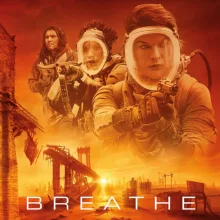
Breathe opens on April 26, 2024.
Transcript
An automatic transcript, tidied into paragraphs. It has not been proofread, so names, titles and spellings may be wrong, and it does not say who is speaking.
Show the transcript (about 2,500 words)
Speaker 1: Hold your ears, folks. It's showtime.
Speaker 2: People pay good money to see this movie. When they go out to a theater, they want cold sodas, hot popcorn and no monsters in the projection booth. Everyone pretend podcasting isn't boring.
Speaker 3: Turn it off.
Speaker 4: I'll be back as soon as I can try not to kill each other while I'm gone.
Speaker 3: Oxygen levels at 20% dead. Yes. Hello, ma.
Speaker 5: We haven't seen a living thing in three years. The world can heal if we give it time. We just gotta keep at it.
Speaker 6: Come on.
Speaker 3: Come on oxygen supply at 50%.
Speaker 5: Who the hell are you?
Speaker 6: I know your husband was working on the two generator. You need to replicate it.
Speaker 5: If she could replicate dad's invention, it could be on to something big.
Speaker 6: Ma our air filtration system is failing. We don't get that. 25 people will die but I need to see that machine and I will see it one way or the other. We gotta stop her.
Speaker 3: Oh, making a mistake. I'm not your enemy.
Speaker 6: If they cut off their air, they're gonna die there.
Speaker 3: Hi.
Speaker 6: Think about your daughter and do the right thing.
Speaker 3: What we're in this together, right? We're in this together. MIKE WHITE: Hey, folks, welcome to a special episode of the Projection Booth. I'm your host, Mike White.
On this episode, I'm talking with Stephan Bristol. He is the director of the 2024 Film Breath which is opening theatrically April 26th, 2024. The film stars Jennifer Hudson, Common. Milia Jovovich and Sam Worthington had a very nice time talking with Mr Bristol about this film as well as his previous work, which was See you yesterday.
Thank you so much for listening and I hope you enjoyed the interview. How did this one come about for you? STEFON BRISTOL: I read the script, it was on the blacklist in 2019 and Doug wrote it in a way that's open for interpretation. So I gave my vision for the film to Thunder Road who, who purchased the script for option and was set upstate in New York on a farm.
And I was like this guy being in Brooklyn and we, what we did is that we have to elevate the script a little bit. And one thing I noticed about the script like is that everybody was talking about their children. And I said, well, we should anchor the movie around Zora and touching of Zora because being in the movie, a friend of mine gave me This Native American Proverb told me This Native American Proverb that goes something like we don't inherit the Earth of my ancestors. We borrowed it from my children.
So, and you use that kind of proverb. MIKE WHITE: Where did you actually end up shooting? This was this Brooklyn or was this more in a computer? STEFON BRISTOL: No, we shot it in, outside of Philly summer.
2022. We, I wanted to shoot in Brooklyn. We shot it in a small town, small city called Chester. P A great small town community was a very cool, they've already experienced filmmaking in their town being used for filmmaking and they did I think Creed two or three there.
I'm not sure which one and it was very supportive. They allow us to do a thing. It was very curious about the film because it's predominantly black towns. When they heard Jennifer Hudson and Common was on set.
He had to curb a lot of enthusiasms there. But there were love, there were love such a love to and we want, I wanted to show in Brooklyn, but it was right after the pandemic. So the tax centers for filming in New York put. MIKE WHITE: It's got such a great look to it too, especially all of the outside pieces.
Can you tell me a little bit about your DP? STEFON BRISTOL: Oh Felipe Vera, my man, my man, 100 grand. He went, we go all the way back to NYU graduate film school. He's from Spain, great cat from Spain.
He did all, he did most of my work in film school and he did my first feature Phil C yesterday as well. And he's a very meticulous person and very creative and thoughtful guy. We didn't just want, we want to make sure that what we wanted to do for the world it represented on screen. So like the idea of it all is that when oxygen is depleted from the planet, the blue that nice bright and blue sky is not gonna be there because that because the oxygen that's that what makes the sky blue.
So we say we wanna make this take away that and we want and an Earth that's have a little bit of oxygen. There's no Earth at all. It's another planet. So we wanted to repre represent Earth as Mars on screen.
So we came up with the idea of making the atmosphere very orange. We got a we got an inspiration from Blade Runner, the latest Blade Runner movie. When you know when you visit Las Vegas that scene, it's become an inspiration there, but we wanna make sure that the atmosphere is indicative of how Mars will look like the planet Mars will look like. So he used this different orange filters to help capture that kind of feel.
And then we tweaked it and post the photo. MIKE WHITE: And what kind of challenges did you have when it came to all of your actors or so many of your actors having masks on? STEFON BRISTOL: Let me tell you those masks were made by hook or by Crook. It was made by the brother of the costume designer, Alicia Silverstein, her brother created those masks and equipment apparatus and there was, it was made so quickly and rush and so hard, we haven't had enough time to really build those masks.
And every time the actors will wear those masks, there are tapes where the mask will fall off. And what's crazy also is that the actors can't even hear each other a big like to stop in mid take. What did he say? Well, he just, he's funny.
There are a lot of times they couldn't hear each other. They really had to project to the mask and speak up and, but the actors was very, they embraced it and it was hot. We shot it during the summer and over 98 degree heat over 100 degree heat. They're wearing all these long sleeve stuff because it's typically if we have to wear long sleeve because since the oxygen is out of the atmosphere, you would get hurt by the Up ray.
So you have to wear long sleeves that only makes sense. And the actors hated that shit. So it was quite a sound. MIKE WHITE: You have the ad r all of their dialogue.
STEFON BRISTOL: We had a great sound mixer and sound designer for the film. So no, I was surprised like, and I thought it was gonna be the AD R basil, the, our producer thought he was gonna do the ad R goodbye. Everybody thought they're gonna come back. No, it's actually was they cleaned it up pretty nicely?
MIKE WHITE: Yeah, it was pretty good. You talked about the importance of children for this story and this is the second movie now, third with your sh short version of See you yesterday. And I don't, I haven't seen the earlier shorts and that you're working with kids a lot. What kind of challenges is that for you?
STEFON BRISTOL: You gotta prepare for attitude. They're always, they don't wanna work for work. They don't want to go over and over again. They have to prepare for that damn attitude, attitude.
You're lucky. The child labor laws is here. Go to work now, man. They're challenging in a way that they love to challenge you and then that helps you grow a lot of patience and they get, they have a lot of great imagination and insight.
There are times I had to pause and really listen to their ideas of the, a lot of the times their idea is do the script or they have a concern culturally for them that want to represent for the film. And that only helps the movie, the movies propel push forward. MIKE WHITE: So was the mural that I can't breathe mural? Was that in the script or is that something that you added to it?
Because I thought that was brilliant. STEFON BRISTOL: I added to the script and then I added my script. The nod is obvious. So I'm not gonna spoil it to, but it's very important.
I did that. MIKE WHITE: I did see see you yesterday. Was that another pandemic film or did you shoot that before the pandemic started? STEFON BRISTOL: No, we shot that.
We shot out 2018. It was a pandemic that was released in 2019 and then 2020 it had like a resurgence a little bit because it was because the protest was happening that year. That summer people saw People Correlated, which is beautiful. Thank People Correlated.
My film to what was going on and a lot of programs and schools and educational, what have you pamphlets when I had my movie on the list and to represent the movement that was happening that summer. That was a big summer. I was in New York when protests started happening and I was really touched that people thought about moving to help what was going on that time. MIKE WHITE: How was that?
Adapting your own work? Going from a short to a feature. Did you already have the feature in mind? And you paired it down for the short or did you expand out?
STEFON BRISTOL: It was expand it? So it was like first I had before I did the short, the first I had two drafts of a feature. Then I was en encouraged to then make that into a short because I really wasn't ready to do a feature film yet. Then when I made that short film, I went back to my feature script that I wrote the first two drafts, right?
But I threw those two drafts out the window because the short film informed what the features need to be. Does that make sense? So Akm Paji had to start from scratch, which is fine, which is fine. As a first time filmmaker that short really helped facilitate not only my voice but what the movie really needed to call.
MIKE WHITE: What attracts you in a project? Do you even have your next one picked out yet or are you still looking if. STEFON BRISTOL: They tried me to a project? But it all starts with the script.
The script ain't good. I'm throwing it out but there was one movie that the script was trash, but I needed to make this move and that was Gordon Hema away and the realm of, and I'm working that with Spike Lee and Lord Levin, Beatrice Levin, the watchman and Hellboy, the latest Hellboy. And that's about an American gun slinger from America teaming up with the Ethiopian princess to stop fascist Italians and raising ancient market in the dead. A lot of different ways of project tracks will sometimes it's just a kernel of an idea or but at the end of the day, if the script ain't tight.
MIKE WHITE: I usually ask filmmakers about the challenges that they face when they're making a film especially a feature film, you've got the mask falling off, you've got 98 degree heat, you've got child actor. What went well for you? What were the things where you just like? This was the easiest part of the whole process.
STEFON BRISTOL: There was nothing that, that was easy. Every day was a change. Every fucking day was a change. You know, like.
MIKE WHITE: What were some of the other things that you're running into? STEFON BRISTOL: And I'm trying to, I hold my tongue in that. MIKE WHITE: What was the editing process like for this one. STEFON BRISTOL: That was challenging as well?
When we had in the script, we got a lot, we shot and it was really shooting everything we had in the script and we just changed. We, you know, there's a process, there's always a process about things when it comes to writing, right? There's always a process and the process is that the script that the film is written, script, the film is berit during set and the film is rewritten again during post. And we did a little lot of rewriting and post because what we thought would have worked that, for example, like on the script, we had a lot of close ups and images of each person really apparatus.
Their time is taken away, we actually see it. But once we try to put that on screen, it just got confusing and it didn't work and then it raised more questions and whatnot and it's, it's, it just doesn't make any sense. But because she was in the house and she was like, it was just too much. So we have to take that.
But I ship that away and allow that to be implied. That's so that's one thing and then it was up, she went. So that's just one criminal thing of post and then Ariana so is such a wonderful editor. She did all of Andrew Dozen's work.
And what I the reason why I hired her because not only she does a great human being and such a charming person and she's like a sister to me. Now, the movie Mother Joy from Andrew Dozen was one of my favorite movies of all time. And Ariana did that movie. So I wanted Greed is a movie about a mother and daughter trying to survive and whatnot and I just didn't wanna make it but you stand in love action.
But I want it to be quiet. And so sometimes I want it to be about the family, about the acting and performance. And I needed someone like Corian to do. And it took about a year because we had to bring in another editor who to help us with the action because I'm still green in the action space and Ariana as well.
So we brought out the another editor to help us with uplifting the action beats Mr Bristol. MIKE WHITE: Thank you so much for your time. Thank you. STEFON BRISTOL: No, thank you so much, man.
Comments
No comments yet.