Special Report
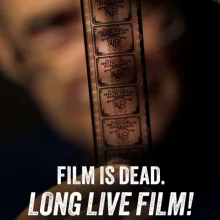
Film Is Dead! Long Live Film! (2024)
Show notes
Find out more at https://coldeyefilms.com/ (opens in a new tab)
Transcript
An automatic transcript, tidied into paragraphs. It has not been proofread, so names, titles and spellings may be wrong, and it does not say who is speaking.
Show the transcript (about 7,000 words)
Speaker 1: Hold your ears, folks. It's showtime.
Speaker 2: People pay good money to see this movie. When they go out to a theater, they want cold sodas, hot popcorn and no monsters in the Projection Booth. Everyone pretend podcasting isn't boring.
Speaker 3: Turn it off. Welcome to my nightmare. Oh man, this is embarrassing. The complete history of film just doesn't exist.
Basically, everybody threw that history away. And as collectors like me that jumped into the bins, garbage cans started collecting stuff. And then when people started saying, hey, what happened to this film? Somebody in the woodwork had it.
Speaker 4: Let me give you my theory on film collectors of my generation, which is admittedly most collectors we've handled film for so long that its molecules have become fused with hours and we've become part film. As a matter of fact, we become movie monsters. And that's really what film collecting is. One long monster movie.
Speaker 3: All little kids who just love the magic of that image being shot out of a projector and have everyone just sit back and go. Oh Amazing. I could give you a list this high of the busts that had been made by the FBI and for the first time. MIKE WHITE: That going to jail.
The judge said six months and didn't say suspended afterwards and they hauled me off in handcuffs.
Speaker 6: They were concerned that we were making videotapes. They don't understand film collectors, film like it wants film, they don't want tape. And so here we are exhuming the remains of what was very important and significant that has not been recognized and not been preserved for future generations.
Speaker 4: Wow. I love the fact that we're all in the fight. The good fight together. MIKE WHITE: Is this a fight you're gonna win?
No, I don't think so. And yet if we don't try and we've lost already. Yeah. I would say that the greatest thrill in handling all of these archival materials is to have passing through your hands, the actual history in the making.
So it's, it's a thrilling occupation.
Speaker 3: I preserved it for 50 years, but I'm not gonna be here that much longer. So we have to pass it on to somebody who really does this all the time. It didn't suck. Did it?
Why be like everyone else, you know, be unique, be special. MIKE WHITE: Send us the therapy bill. Welcome to the Projection Booth. I'm your host, Mike White.
On this episode. I'm talking with director Peter Flynn. If Peter's voice sounds familiar, it's because he was a co-host on a few episodes as well as a guest a few years ago talking about his earlier documentary, the dying of the light, he's back and he's talking about his new film. Film is dead long live film.
It is a great documentary all about the passion behind film collecting. If you can remember the discussion that I had with Dennis Bartok and Jeff Joseph about their book a 1000 Cuts. That is a great companion to film is dead long live film. Go on over to Cold Eye films.com where you can find out more about the movie and find out where it's playing near you.
Thank you so much for listening. And I hope you enjoyed this interview. How did film is dead? And I won't say the full title every single time.
How did that come about for you? What was the impetus to make this documentary? I had wanted to make a film about film collectors for a long time and I just, it's gotta go back maybe 10 years or more. I set about talking to various collectors and I found that most just weren't comfortable talking with me.
They were really, weren't comfortable with the idea of being on camera. They were a little nervous about letting other people know what they had in their collections. So I just gradually moved away from that idea and I settled on making a documentary about film projectionists which became the dying of the light. And when I finished the dying of the light, I still wasn't done with that world.
I loved it too much and I didn't want to leave it. So I went back to this idea of the collectors. Maybe it was a case of the times having changed. Maybe it was the case that I'd had this film out and people understood where I was coming from.
All of a sudden doors began to open up to me and people were eager to talk about this wonderful world. So I spent it, ended up being another six years of my life, but it's been a very happy six years and I'm reluctant to leave it. Are they a community? Do they know one another?
Did one of them lead you to another or how was that? That's exactly how it operates. And that's how it started with the film projection documentary. It was the same.
It's this very small self enclosed community. Everybody knows everybody and you talk to one person and that person connects you to another. So pretty soon you're at the epicenter of this very little small kind of twilight community almost. It was an underground community for quite a while because of the legalities over owning films collectors, many collectors had films in their titles that technically weren't theirs to own.
So there was a reticence there and in the seventies, in particular seventies and eighties, there was a huge FBI crackdown on private film collectors, many of whom being perceived of as Bootleggers and pirates and the shockwaves of that is still persist to this day. So people are very, it's a very self enclosed group, but I found them very welcoming, very warm, welcoming group of people with a love of a very specific kind of a very specific kind of sin Ofilia. Now, with dying of the light, your previous documentary, you're dealing with a community of people that are maintaining, they're almost for lack of a better term.
They're like rearranging the deck chairs on the Titanic. At least some of them are because you're capturing a world that is going away for better or for worse, I think. Much more for II I agree. Is there crossover between the film collectors and the projectionists?
Were there some of the same subjects? Yes. Yes. Yes.
Very much. Many projectionists are film collectors and many collectors are projections by default. So there was a very much a cross pollination and indeed many of the several of the characters that appeared in the dying of the light reappear in this, in this show which lends the two films a nice compatibility, the juggernaut of digital really upturns everything. And the dying of the light was very much a film about what was lost with the arrival of digital.
And this film I like to think of as being a little more positive in that this film is looking at what's been saved, what's being saved by collectors, but still at the end of the day, yes, we're rearranging deck chairs on the Titanic and the lifespan of film and the lifespan of the collectors themselves and the majority of collectors are Boomers is limited. That lifespan is limited and it's running out. And I think, you know, we're really in the last ages of this culture. Yeah, I really liked the angle of preservation and just that so many of these folks are not just in it for.
What can I get my hands on mind, mind, mind type of thing. I think there's even one of your subjects talks about that daffy duck type of situation, but they seem to be much more into the idea of this is our heritage. We need to preserve our heritage. There is definitely that hunter gatherer mentality at work with collectors, the desire to go out there and many of them use this term in the wild.
Got to get out into the wild and find this film, whether it's in dilapidated, abandoned old movie theaters or in somebody's garage or storage facility that, that hunting the thrill of the hunt mentality is there. And for many, I think it ends with that doesn't go any further. But naturally, the people who are going to gravitate toward me are the people who really want to share this. And I think increasingly that's the case now that everybody sees the writing on the wall, everybody sees the end of film as a physical medium and as a and the end of analog Sinop Theia for want of a better world as a culture.
So there is this urgency felt amongst collectors, particularly those who are advancing in age to pass this on to give it out in part because they don't want their lives work and their life's passion to just end. And in part, I think because they realize that that something very valuable and something very lost, lovely is going to be lost. Yes, for me, that idea of passing it on became the only real interesting and compelling angle to take on this subject. The movie begins speaking of in the wild, it begins with film cans, equipment, all these things that are literally in the wild.
It looks like they're in a field. Tell me more of the background of that whole situation that we come upon in the first few seconds of the film. That was the first shoot I ever made. The first shoot I had on the films and I went with a film collector.
So the estate of another film collector who was ailing in the hospital at the time and would eventually pass away. And this collector was very much in the hoarder zone and he had run out of space in his home. He had run out of space in the several garages and the adjacent buildings that he had built to accommodate film. And he was now that the collection had spilled over into the surrounding forest.
So there was projectors, there was cle lights there was machinery that came initially from MGM, just lying out there and rotting and rusting in this forest exposed to the elements. And there was also film, there was wheels of film and it was to me, it was like, it was the perfect metaphor for what's happening that the film was built with a very limited lifespan in mind, it would run in a theater and then it would be done and the studios and the copyright holders never perceived initially of it having a long lifespan.
And so all of this stuff was doomed to be thrown away, forgotten and left to decay. And that was the starting point of the film. And where do you go from? There you go to the people who are trying to reverse that and fight against that inevitability if you will.
But yeah, that was that. And I knew while I was shooting that this is where the film has to begin. It has to begin at the end. How did you even decide what the shape of this movie was or did you figure that out in the editing phases or did you have a plan going out with the shoot?
Yeah, it's, that's always difficulty. That's the big difficulty with a documentary is to try to find the shape and the steams in the film. So I was very lucky. I had this real bombshell of a first shoot that, that kind of gave me some of the real, the visual metaphors for the film.
But it wasn't until I started to shoot with Lou Derenzo and Lou had a small part in the dying of the light and we had become friends. And then I approached him again with this new film in mind and we became great friends over the years and Lou was older, he was in his late sixties, early seventies and he had spent 50 years collecting film. He wasn't in the best of health and he was looking at the inevitability of passing on and witnessing his life's work disintegrate. So he had made it an effort to pass on his collection to archives and libraries and not only pass on his collection, but pass on his knowledge and he began to train others in operating and handle film.
And so with Lou, I realized what this film was about, it had to be about passing this stuff on. And it wasn't simply about passing the physical prints on the films themselves on. It was also about passing on the equipment and the know how the knowledge and know how to take care of and handle this film. All three go hand in hand.
And Lou set it up, Lou to find what the film was going to be about. And unfortunately, he recently passed away. He had always joked with me that the film would end with his name and two dates and he was right. It does, it ends with his passing on and, but it gives that, that, I think that added meaning to the film that none of this lasts and we must, we must fight the good fight and save as much of it as we can forgive me for not remembering the gentleman's name, but the person who tells you up front, you're gonna have to edit a lot because I'm going to forget things and string things along.
I think I could have watched a two hour documentary just on him. Oh, that's fantastic. That's Stu Fink. Stu Fink is a great collector.
And again, I've become a great friend of mine, but Stew is a, is an old school radio DJ. So he has that patter down and he can speak and he knows his film history, all of these collectors, they have that they have such knowledge, such a wealth of knowledge that never really gets past outside of this little bubble of a community. So I think once I arrived on the doorstep and turned this camera on for many, there was just this sense of OK, let's go. I've got so much to give you and time is running out.
And so yeah, Stew was one of one of many people in the film I think who are very eager and spirited, have great passion and love for this and are eager to share it. But stu is also, he's not blind to the mania and the craziness that, that, that lies at the heart of a lot of this, a lot of this film collecting this, this urge to collect all, hold on to this stuff. I was really glad that you even address the idea of this being a very male dominated abby for lack of a better term. And just that we're not going to hear a lot of female voices in here.
I do like that. You do have some women in this film, especially the wives, the mothers, they're almost the victims of this mania that is going on. You know, I realized very quickly that the world of film collecting isn't just about the film collectors themselves. It's also about the people who have to live with it with the dying of the light.
The film was confined to a workplace, it was confined to the Projection Booth. This film is much more intimate in that you go into people's homes, this is people's lifestyle. And so I realized very early on that it was necessary to talk to wives and mothers and sons and get a sense of the impact that this has on family members and often that impact is devastating. It's not always positive, but it needed to be addressed.
And I did my best to do so in a very honest and balanced fashion. While at the same time acknowledging the benefit that, that these, that these collectors have brought to film history, but that benefit wasn't always extended to the family members. It's not an easy passion to live with. What were some of the toughest things about making this film that race against time and the sense that if I don't get this person, if I don't shoot this activity, whether it's a, an archive coming to a collector's house to remove this film.
If I don't get this moment on camera, it will never happen again. And so there was that sense of the ticking clock, the time running out and the necessity of having to grab that moment. So there was that sense of difficulty and then there's just the pandemic arrived and life itself gets in the way it took a long time to make. But I think taking your time to make a documentary is important.
How much traveling did you have to do for this one quite a bit? I'm based in Boston. So I tried to hit as much of America, the Midwest, the south, the north as much as I could. But what you find is that collectors are collectors, whether you're in Los Angeles or Boston or New York or Dallas, collectors are fundamentally the same and they tend to cluster in the major cities in around the major cities for a whole variety of reasons.
Largely because that's where the big marketplaces for films were. That's where the film depots were when back in the days of film and film was being shipped around the country and it was being stored in warehouses. These tended to be near large areas within the northeast, from Boston to New York to Philadelphia. There's a whole ecosystem of film collectors and film collecting.
And at times I didn't have to travel that far, although I made it a point to represent as much of the country as possible. But I'm spoiled being in the northeast, being in Boston was a huge film culture and community and a lot of film being screened and then being close to New York and New Jersey and Philadelphia, there's a very big and active film collecting community there. So I didn't always have to travel too far from home to find an interview. Interesting people.
I suppose your partner and your son probably felt a little bit abandoned like the film collectors, spouses and family that they had you. They were your documentary widows. Absolutely. And you know what?
I don't share that mania of film collecting. I don't have a film collection, but I have a different mania and that mania keeps me on the road and it keeps me with a camera in my trunk. And I go and I make these films that never really make any money. Am I any better than these collectors who have devoted a life to film collecting?
I don't think so. I think I have a, just a different level of a different area of preoccupation and craziness. And that is the toughest, I think the toughest part of making a film like this in the way that we make a film like this ie independently with no real budget and institutional support is trying to juggle family life with being on the road. So it's, that's the difficult part.
But I'm very lucky in that I have a very narrow focus and not a whole big range of interests and this kind of, I'm very happy just to do this and nothing more. I don't need to take vacations. I don't need to stay home and watch the latest ball game. I'm happy in this little world, but it is difficult to juggle family like this.
I'm sure you well know with this runaway juggernaut of a podcast, it's very difficult to maintain a hobby and an interest like this. And I do consider this a hobby. I would be a fool if I considered film making a business because it certainly isn't or a career because it certainly isn't. So this is really just a hobby.
I was really impressed by. I'm sure that some of these collectors collect feature films, but you really focus on almost the ephemera of the ephemera, like the trailers or interstitial cartoons, like these pieces that would be the first thing to go and that they are being preserved and being preserved so lovingly by so many of these people. It's just remarkable and just things that you would never think that you would be able to see ever again. When we think of film history, we think really of the history of 35 millimeter theatrical film specifically, we think of features.
So the history of cinema is the history of the studios and it's the history of genres and then the star system and the great directors and all of this stuff. And in thinking about history that way, we forget about all the other aspects to film, whether it's the theatrical trailers, whether it's the Snipes, the coming soon coming Friday, Thursday, Tuesday. Here's what's at the snack bar in the drive in those type of things. We forget too about all the 16 millimeter educational films that were made.
We forget about the industrial films that were made and we forget about the whole movies, the whole movies from 1923 all the way up into the eighties. And so all of these don't get considered in the bigger equation of film. And this documentary, what fascinated me and one of the things that most interested me in making this was it allowed me to focus on all of this other stuff that we just don't think about. So it was a real eye opener and an education for me.
That film isn't just this, it's all of this other stuff. And then you have to look at the bigger ecosystem of film preservation. The archives have a limited finite set of resources, financial and people, power and space and et cetera. And so they can only take care of a certain percentage of the film that's out there.
And for obvious reasons, they focus on the quote unquote big titles, right? So the studio titles, the important cultural, the landmark films, that's what the archives focus on. So all of this other stuff gets lost. And if it weren't for collectors, private individuals, people who just out of a love for this stuff decided to devote their lives to saving it, deserving it, passing it on this stuff wouldn't exist, it simply wouldn't exist.
So that was, I think the other reason that I wanted to make this film was to acknowledge the real value that these collectors play in the big ecosystem. I have to tell you, I really like the way that you shot this one. Of course, I like how you shot dying of the light as well. But in this one, some of the shots of the film itself as you see it running and just capturing those images and just the way that you frame those shots, some of them are just remarkable.
Thank you. I'm a film fetishist. What can I say? And film really is a fetishistic medium, isn't it?
It's all about looking at things with intense interest and focus. And so for me, the quintessential film shot is a close up and the closer you can get into this stuff and really lean in and look at and look at the beauty and the texture of it is what it's all all about for me and film is so we don't think of it as something physical anymore, unfortunately, but it is, it's something that is tactile, it has texture, it has a feel and that was something I felt I needed to get and capture to convey to audiences. Today. I'm 51 years of age.
I was born in 1972. So by the time I really came of age and began to embrace film, VHS was already on the scene. So anybody my age and younger really doesn't have a strong connection to the physicality of film and the projector and the sound of the projector and the smell of the bulb burning and the dust on the bulb. And so that's what I wanted to get at was that the eroticism, the tactile nature of film?
So yes, you go close and you go close and she can go. But thank you. That's nice to hear. That's nice to hear from one film fetishes to another.
We are almost the exact same age and I was very lucky that my folks had a super eight projector. So I did get that sound ingrained in me and the smell of the screen when you would open it up had a very particular scent to it. Oh my goodness. I grew up in Ireland and just that solo culture didn't really exist there.
I have a vague film being screened only once in my school. So it wasn't something regular for me at all. But yeah, you and I really are of the VHS age. We dipped our toes a little bit in the old analog culture.
Naturally. Understandably, the bulk of collectors are of the boomer generation. And when you think about it, the boomer generation in Western or American history is the only generation to have been completely and utterly saturated by film. They had it in the hall in the form of eight millimeter, they had it, they had and then they had it in the school in the form of 16.
And of course, every neighborhood and big picture palace was running 35 millimeter film and maybe 70 millimeter film. So film was everywhere and that didn't exist prior to the Boomers and it didn't exist after the Boomers. So there's something about that analog Sy Ofelia that is fundamentally rooted in the boomer experience and that baby boom experience. And of course, that experience and that culture is now dying out.
And I think a lot is going to be lost in our understanding of film as a consequence of that. So I think yeah, it becomes beholden to people like you and me to spread the word on that a little bit more. And there are younger collectors but not as many. And for somebody in their twenties now to want to get into film, there's not a lot out there anymore and what's out there isn't in good shape.
It's decaying and we have something called vinegar syndrome with safety film. The film loses its plasticity and its flexibility and it gives off this vinegar odor because of the discharging gasses. And that's lethal. And so much of that safety film from the fifties onwards is going vinegar and of course, it's lost its color.
So yeah, there isn't much impetus for somebody to get into film collecting in this day and age. I was really glad that you focused a little bit on the nitrate and the difference between the nitrate and the safety film, especially the image quality. I was in a very enviable position last year. I, well, every year that I can, I've been going to the Nitrate Film Festival out in Rochester and to see the third man projected on Nitrate.
And then because the last two reels weren't in that great of shape. They also showed part of a safety film version of one of those last two reels. The image quality, I couldn't even begin to describe how the image quality was so different. It felt like I could walk into the screen when I was watching the nitrate.
Whereas the safety it felt OK. Yeah, this is a oh nice, beautiful image and everything, but I don't feel as drawn in as I did with that Nitrate print. Yes. Yes.
No. Absolutely. Absolutely. And so nitrate film was in existence right up until the early 19 fifties.
And for the most part, film stocks are much slower in those decades, which means the grains, the film grains are much tighter, which means the image is sharper and higher in resolution. And that's, yeah, that's something that most of us don't get and see. And there's because it's so hazardous, it's highly flammable. There's only a very limited number of theaters that can run nitrate.
So to see, Nitrate is a real treat. Yes, I sent to the Nitrate picture show only once and it's remarkable. But I have to say I've seen a lot of nitrate while making this film and that's one thing about that older generation of collectors, particularly those with a projectionist background who would have maybe started projecting in the forties or fifties and they were not scared of nitrate. It wasn't something today.
It's w we gotta isolate this and keep it cold. That older generation didn't feel that way about my trade. It was, you took care of it. You were careful in handling it, but it wasn't necessarily something to be scared of.
So I met collectors who would regularly run this stuff in their living room. So I saw a lot of nights up up close and it is, it's absolutely be a nitrate print like the third man from the late forties as a resolution. That's sharper and better than anything running in a multiplex today on so called four K digital projection. It's remarkable, isn't it that something 70 years old is superior to what we have today?
But then you also get the warnings from the projectionists that say we can probably run this another five times. We can maybe run this another 6, 10 times at most or less. There are so many films that they have to so carefully check every single slice, every single sprocket hole, maybe they'll get another run of this. And it's just, it's amazing to me to know that as this film is unrolling in front of my eyes, it's one of the last times anybody will ever see it.
Exactly. Exactly. Now film is becoming an archival me. So all of this film that circulated for 50 60 70 100 years circulated through the theaters and through the theater exchanges and then wound up in the hands of private collectors who screened it for themselves and their friends and then sold it to somebody else who sold it to somebody else who then died.
And it was, it ended up in an estate sale somewhere and somebody else got it that really flowing circulation of film. All ends in the next few decades, all film will end up in an archive where it will sit on the shelf and be taken care of, but it won't live in the way it's been living for the last 130 years. So we're really, at the end of I think something very, very specific in film history. It was a real thrill and a and an honor to be able to document aspects of that before it's gone for good.
What were some of those things that you saw that made you just pause and say, wow. So the Malkin's collection, Carl and Don Malkin's who were two New York based camera operators and early pioneering preservationists. They worked for Moma in saving a lot of the early nitrate film stock, transferring it to safety film and then preserving that way their private archives. I had some astonishing stuff somewhere here in my office.
Of course, we're on podcast here, but I'm showing this to Mike here and from my office, this is a little strip of Lumiere film from 1895. It was from the first year of Lumiere's filming because it has round sprocket holes and not the standard four per 35 millimeter frame that we have today. And I've got a range of other little bits and pieces that I got from the Malcolm's collection because I got close to the people who were archiving and preserving it, stuff that is so unique and so valuable. And here it is in a basement in Scarsdale, New York or in Central New York somewhere.
Just history. Little bits of film history still in private hands. Remarkable. And then of course, when people know that you're making this film, they say I have this reel here.
Do you want it? I ended up at, when I finished this film last year, when I finished shooting, I ended up donating all these bits and pieces. This brick and BRAC I had acquired over years of shooting this documentary to the Library Of Congress and they were World War Two Air and nitrate reels, news reels. I want to say that I donated by another collector, the oldest piece of film that is now in the Library Of Congress, a piece of film from France that dates back to the 18 eighties and all of this was just in private hands just sitting around.
So I think that was the real, that was the real eye opener and just to be able to hold it and look at it and put it up to the light and look at these images that are as alive today as they were 100 years ago was a real, a real thrill. Yeah. So what's your process when you go out to shoot an interview or shoot something? Do you come back and immediately catalog it and write down all the bits that you think you're gonna use for in the edit or how does that go for you?
I try to edit as I go and as I'm editing, I'm establishing the style, the look and the feel of the film and I'm also establishing the themes. And so you added all these little separate segments and then you get close to the end or what you think is the end and it's never the end and you begin to piece them together and it's just kind of clunky mess, but you begin to eventually see the structure emerging. So I shoot and I add it as I go. And then there comes a point when you realize, OK, this is what the film is.
So these are the pieces I'm missing and then you have much more direction and you go in and you fill in those missing pieces. And this was a tough one to structure you so many different characters and personalities and it ran the risk of being very repetitive. Come on into my archive. Here's what I've got, look at this and look at this and look at this and then we go to somebody else who does the same.
So it, what I realized early on that one of the ways to structure this was around the life cycle of film collector and particularly the Boomers, they have that same, same law generic arc in their film law. They start off as children and there's that early encounter with film in a basement, running an image on a wall or a sheet or a screen and the falling in love with the mechanics and the projector and then you move from eight millimeter films that you got as a kid to 16 millimeter films better quality. And then you hit your teen years, you become a little rebellious and you say this isn't enough.
I want the forbidden fruit. I want those TV prints that I shouldn't have. But I know somebody who knows somebody and I can get those. And then the real maniacs graduate from 16 millimeter television prints, the 35 millimeter theatrical prints.
And then now you're waiting outside the doors of Film depots and you know, slipping somebody 1020 30 $50 and you're walking out with a print of Casablanca or a Warner Brothers cartoon, a looney tunes cartoon. And now you're in the major leagues and then you hit your middle years and you've got this great collection. Some of it has to be kept quiet because it's technically not yours. It's the property of the studios and then you get older in life and it's, it, these prints are heavy and it takes a, it takes an effort to put them in the projector and you can use them less and now they're in danger of decaying and you've got to pass this on and who's gonna want it?
That cycle was something that all of these collectors shared. So it was a way to structure, the film became a way to structure it, particularly in the middle section of the film. Has long lived film is that had its premiere yet, we will be premiering it at the end of the month, March 28th at the Barrymore Film Center in Fort Lee, New Jersey just across the river from New York in the birthplace, birthplace of American cinema. So very happy and very excited for that.
And then we'll do the festival circuit and it'll screen in venues. And so through the summer and into the early fall, we'll have a theatrical roll out and then it'll end up on streaming and maybe physical media will get some DVD s and blu rays out there. But yeah, it's about to hit the road. Is this gonna be a trilogy?
Are you going to do another film on film preservation? Perhaps I would love to. And it's a, I wasn't finished with this world when I finished the dying of the light and I'm still not entirely finished with it now. But I don't know, these films take a long time to make, I'm getting older and family demands are, are increasing.
My son now is four. He's demanding more time and it's difficult to juggle everything. So, I don't know, I have a few ideas and I don't really wanna say anything out loud because I know half of them will come to fruition. But I'm not entirely done with this world yet.
We'll see. And then you're professor, correct? Yes, I teach at Emerson College and that's the day job. That's what keeps the bills paid I gotta balance all that too.
I gotta balance all that too. Yes, a full time job. Family lights and making documentaries on the side. Yeah, it's a lot.
But sure, what else would we be doing? What else is there to do? We all have to have something to keep us busy. Right.
Exactly. Exactly. Yes, Peter. Thank you so much.
I really, I can't recommend this film enough and I'm super excited for more people to see this and I'm excited to have you back on the show again. I gotta get you back on next year. So you can be another co-host. Yeah, I'd love to do that.
Absolutely. Whenever you got a list of titles ready, send them along you. So where's the best place for people to keep up with the film and where it's gonna be? You can visit my website which is Cold Eye films.com, Coldeyefil, ms.com and details on the film will be found there.
And if you're in the New York tri-state area, come along to the Barrymore Film Center on Thursday, March 28th at 7:30 p. M. We'll be screening the film, Dad Peter Flynn. It is always a pleasure talking with you.
Thank you so much, sir. She really is Mike. Thanks so much.
Speaker 4: Let's all go to the lobby, let's all go to the lobby. Let's all go to the lobby to get ourselves a treat, delicious things to eat and the popcorn can't be beat the sparkling drinks are just dandy. The chocolate bars and the candy. So let's all go to the lobby to get ourselves a treat.
Let's all go. I'll be for your convenience. We have an attractive refreshment stand in the lobby with buttered popcorn, gold and good and hot from the popper. Your favorite candy, wholesome and rich with a flavor treat for every taste, ice cream and other good things to eat.
Plus delicious Coca Cola. Enjoy ice cold Coca Cola at our refreshment stand right now.
Comments
No comments yet.