
Special Report
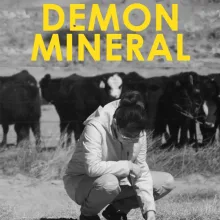
Demon Mineral (2023)
Show notes
Mike talks with filmmaker Hadley Austin about Demon Mineral, a feature documentary that looks at radioactive contamination of Navajo lands. The film recently played at the Slamdance Film Festival.
Transcript
An automatic transcript, tidied into paragraphs. It has not been proofread, so names, titles and spellings may be wrong, and it does not say who is speaking.
Show the transcript (about 3,100 words)
Speaker 1: Hold your ears, folks. It's showtime.
Speaker 2: People pay good money to see this movie. When they go out to a theater, they want cold sodas, hot popcorn and no monsters in the projection booth. Everyone pretend podcasting isn't boring.
Speaker 3: Turn it off.
Speaker 4: The rugged plateau de prospectors and geologists. Located one of the rarer elements in rural uranium twist. No, I used, I thought, I thought I now no, he could so be shit with that. And I said, oh, you either.
But you are. Yeah, he is. He, I mean, Mohamed. MIKE WHITE: This is what the remaining uranium ore dangerous.
Speaker 6: Of course, it's fine. But in this family there's eight horrible deaths at the hospital when they were taking samples of the youngest one that passed away. The doctor asked her, did you by any chance live near a mine?
Speaker 7: You start to understand how hot the radiation was. I mean, I have no idea what I've been exposed to and I don't know how long I've been exposed to it.
Speaker 3: We would to, for hr 34 05, Chairman Wal subcomittee is meeting today to hear testimony on the legacy and the future of uranium. Mining. MIKE WHITE: I hey folks, welcome to a special episode of the projection booth. I'm your host, Mike White.
On this episode, I am talking with Hadley Austin. She is the director of the 2023 documentary demon mineral. It is all about uranium and the contamination of the Navajo reservation. I would say it is a great companion piece with the film Downwind, which we spoke about.
I think two years ago, the film recently played at the slam dance film festival and hopefully will be coming to a theater near you. Definitely keep your eye open for it. And I hope you enjoy the interview. Tell me a little bit about you and how you got interested in filmmaking.
HADLEY AUSTIN: I don't know what's a conventional path to filmmaking. I have no idea. But in the circles I run in, it's a little bit strange, but I was an activist and a teacher for a very long time. And then around 35 I quit teaching because it's the worst job on earth.
And I made a film, Demon Mineral. MIKE WHITE: What caught your interest about this story? How did you find out about this? HADLEY AUSTIN: It was for me a return to my roots.
I lived in a border town to the Navajo Nation for a very long time. And at a very pivotal time in my life, I lived there when I was in my very late teens, early twenties and worked on this issue today. They call the kind of work that I was doing water protection. But at the time, it was just a lot of advocacy work for people whose water table had been impacted by coal mining and uranium mining and pus mining.
But then many years later, I was, I went to the standing rock protests to bear witness. I was actually really ill. I didn't participate in anything but I was, it was just such an, it was an amazing environment. It was such an astonishing moment and watching the news coverage, I was so moved that everybody cared so much about this water that hadn't even been damaged yet.
And I was thinking about this place where I used to live where people hadn't been able to drink the water for generations. And not long after that, I met the film's DP Yoni Goldstein and I was like, I really wanna make a film about this and he was like, yeah, we should just do that. So we did. MIKE WHITE: Wow, it sounds so easy.
HADLEY AUSTIN: Yeah, it was 5.5 years of, it's really hard work, but I'm really proud of the film and I'm really proud of everybody who's in the film. It's an important moment for the issue. The first new uranium mines in eight years have just opened in the United States around the edges of the Navajo Nation. So I do hope that the film which is in and of itself, it's an art object.
It's a lot of things, but I hope it's also a useful tool for starting discussions about this. MIKE WHITE: Tell me a little bit more about the filmmaking process and how you went about helping to craft this documentary. HADLEY AUSTIN: It has a really unconventional structure for so many reasons. One of the reasons is that one of the main characters is the land and so incorporating the land as voice and a presence, of course, requires a different kind of approach.
And another reason it has an unconventional structure is because it was made very collaboratively with the people who are in the film. And so the participants of the film had every space to weigh in, especially on their portions and any portion that was filmed in their immediate community, but also on the film as a whole. And so because it was made very collaboratively, was not necessarily made with commercial aim. I think it's like an incredibly digestible and approachable film.
But I do think that process resulted in a film that is in many ways more a tapestry or a constellation than a super traditional character art or something like that. And it was really important to me to bring in the archive to document the past as well as the present. And the archive comes in vintage footage, but it also comes in an actual text documents. And that was important to me because we live in this sort of strange moment where a lot of things is construed where a lot of things can be made up.
And so though wanted to make the bibliography present in the film. So there's a lot of primary source document present in the film. And I do think some of that also might be because for 10 years before I made this film, I taught history. So that may be part of why.
But it's also a film. Last thing I would say about the construction is it's a film that moves at a very slow pace. It and that I don't think in any way makes it boring. But I think that it's, it was made with collectively with a group of people who are much more careful in their speech and that it is part of it is part of a culture to just be very mindful about what is said and to consider the implications and to try not to offend anyone, not even the land.
And that thoughtfulness, I think results in a kind of thoughtful film. MIKE WHITE: Yeah, I really appreciated the playing with structure and that it wasn't just a series of talking head interviews. We've seen that 1000 times before. So I really like that.
You went away from that. How quickly in the process did that idea come about or was it always part of the mix always? HADLEY AUSTIN: Yeah, I think talking head has its place and there certainly are interviews with individuals, Secretary of Interior Of Holland is interviewed in a fairly traditional fashion in the film. And I think that I think the talking head is really useful for conveying certain kinds of information in certain kinds of ways it's efficient.
But I always wanted to capture, this is a place that I love and this is a community that I feel personally deeply indebted to. And I really wanted to capture authentically the vibes. And I think that doesn't happen with just a single person on camera. That's a very constructive environment.
So we tried to work in more intimate spaces, have intergenerational conversations and use that as a way of informing the viewer. MIKE WHITE: How did you gain the trust of your subjects? Because this is pretty close knit group, I imagine and just to be an outsider coming in or how much of an outsider were you perceived as? Do you think?
HADLEY AUSTIN: I think it's important to note that I am an outsider. I think that and I think of the people in the film as the participants of the film, they are stakeholders in the film's journey. It was made to be useful to them. They're all this is their life's work.
Their life's work is showcased in this film. And everyone who worked on the film had aimed that were collaborative and were mutually supportive. But also people were coming at this with their own individual aim, Doctor Rock, who's in the film right now, he's teaching it in a, this might be a useful educational tool for him. Whereas Terry, she's currently always working as an advocate between her community's interests and getting some federal funds to clean up the mines in her area and to ensure that there's not nuclear storage in her area.
So she might use the film to work with government agencies and form them as to why or whatever. Everybody's got their own a games, even though these aims work together. We were working in a space of deep mutual trust. Everybody was active in every part of the process as much as they wanted to be.
And I think that was really important. Documentary filmmaking can be very extractive. And this is the film about extractive industry. We really didn't want that.
I think in terms of, I don't know, in the filmmaking world, they call it access in terms of that. This was my home, not my ancestral home, but it was my home and these folks are friends and friends of friends. Our translator was my ex boyfriend's mom. I think that certainly that doesn't hurt a lot of people want to approach mistreated communities with respect and don't know how to guess that I certainly this was my home.
And so I did know how to be respectful. I knew how to show up at an elder's home with coffee and flour. And, but I think more than anything, it was just an attitude of humility. I was never really thinking about the film.
I was always thinking about them and that doesn't make me a saint or anything. The attitude was never the film needs this thing. The attitude was always, how can we work together to make this film? And I think that in the end the film is, that's why it's beautiful.
That sounds really hippy, dippy. But I do think it's true. MIKE WHITE: It is beautiful though. It's very beautiful.
And I know you said that you met your DP and he was instrumental in starting this process with you. Tell me a little bit more about him and tell me more about your crew that you worked with. HADLEY AUSTIN: The only Goldstein is a cinematographer and a film director. He had a film that came out sadly, right, as the pandemic started to rage called The Machine to Live in.
And he's been a cinematographer for very many films. And yeah, it was his idea to shoot in the black and white and infrared, which I think it was a great idea. Someone called it a visual Geiger counter in the film. I think that's true.
And for a long time, it was just the two of us, I inexpertly ran sound and he filmed and the people we were collaborating with would help us carry the stuff of the mesa. And then we got some funding from the Redford Center and we were able to hire some crew and that was a relief So there's live music performance in the film and that live music performance was captured and live mixed in very, I think it's worth noting challenging conditions because it was still COVID. So this was like outdoors or inner barn. This wasn't like a sound studio situation by a guy who's a great sound person and also a cinematographer himself and he did some of the drone footage.
His name is Orlando Skidmore. And yeah, if you ever need crew out in New Mexico or Arizona, go, go reach out to Orlando and Ma a mountain film. And then I think also very important to note, of course, is our sound designer, Julian Flavin, who's clearly a genius and normally makes these kind of trippy, really heavily layered soundscapes. But our film has a very delicate hand.
He did that just so beautifully. And then our editor, of course, Tim Fret did all of the very fine stitching that I think gives the film its ultimate cohesion. And I was so moved by what he did because sure all editors have to do this, but he really had to educate himself about the issue and who these people are and all of the science. He was starting from zero and the rest of us who were working on the film, we've been working on it for years and in terms of the content, some of us for 2030 years.
But I think he did a beautiful job and he really gave it a lot of his himself. MIKE WHITE: Yeah. When did the people that are in the film finally get to see the film throughout? HADLEY AUSTIN: We did a first cut, like a bad first cut on purpose.
We knew it wouldn't be great. It was just, we needed to see how it was looking and what else we needed to shoot about 2.5 years before it was finished. And anybody who was in the film who wanted to see it, saw it, then I would like to send out the emails and make a viewing party, you know, make a Google Doc and a form, a Google form and it was come to the viewing party, we'll watch it over zoom or watch it on your own time. If you don't have time, if you wanna send feedback, text me, use the Google Doc.
Do what works for you. I guess all they had to do is check their email and it would be there every kind of every six months and then any section of the people were in, I would send them for approval because I think it's important, especially this group of people. But honestly anyone have autonomy over how they are depicted on screen. MIKE WHITE: Was Flame Dance.
Your premiere. HADLEY AUSTIN: No, but it was a big deal for us. Yeah, I think I'm allowed to say this but I heard last night I didn't get to be there. Sadly, because Yoni actually got COVID, which is sad.
We didn't want to expose anybody but we won the audience award, which is our film's first award. So we're thrilled. But our world premiere was at Dach Fest in Germany. And Germany was very kind to us and they filmed us in Castle and also the book and at a festival called Move It, our North American premiere was at a First Nations Film Festival in Montreal.
And then our US premiere was at Mill Valley Film Festival. So slam dance is about six months from our world premiere, but certainly it's huge for us. MIKE WHITE: So what's next for the movie? And for you.
HADLEY AUSTIN: For the film, I don't even dare to dream. I just obviously, I would like it to be as many places as possible. Any home, that's a good home we're interested in. We don't have us or international distribution yet, but we do have academic distribution.
So that's great for us. But yeah, we're hustling the film and hopefully it will land somewhere good and we're working on a number of other projects, two features and one installation piece. And that's exciting for me. MIKE WHITE: I've got Flint just up the road if you wanna come talk about some other bad water that nobody seems to care about.
HADLEY AUSTIN: Yeah, it's infuriating and I live in Chicago now, which is not so far from Flint and it's not comparable in the slightest but Chicago kept using lead pipes until the Federal government actively banned it in 1989. Will I ever live somewhere where I'm not worried about the water. I'm drinking. I guess not.
MIKE WHITE: We've got Flint who has no water and then we've got Nestle who just keeps stealing the water. HADLEY AUSTIN: So Nestle obviously has been acting in bad faith for so long and I don't understand why this affects all of us. I think it's a thing that's really, it was something I was trying to do with the film was make clear that just because this is happening somewhere where you don't live, whether it be the Navajo Nation or Flint, this still affects you because ecology doesn't happen in isolation. Water doesn't just stay where it is and any kind of environmental degradation that impacts hell impacts everyone and don't, I don't understand why that's such a difficult concept for people to wrap their minds around.
MIKE WHITE: Is there a good place for people to keep up with you and with the film? HADLEY AUSTIN: Yeah, we're still working on building a website for the film. If you can't tell, we're a very small group of people making this thing happen, but it's in progress and we have bought Demon Mineral. Com.
So eventually you'll be able to go to Demon Mineral. Com and go to a website and I am active on Instagram At Hadley underscore Austin and that's where a lot of the film's promotion is happening because I am the film's social media manager Hadley. MIKE WHITE: Thank you. So much for your time today.
I really appreciate this. HADLEY AUSTIN: Thank you. It was great to chat with you. You yeah, don't you know, I be yeah, that be real down so.
Comments
No comments yet.