
Episode 673 · Film year 1943
The Ox-Bow Incident (1943)
- Special Guest
- Carl Rollyson
- Guest Co-Hosts
- Angela Mac, Ian Brownell
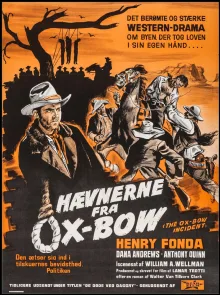
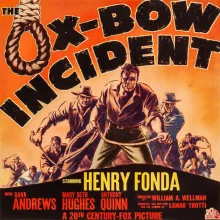
Show notes
Angela Mac and Ian Brownell (opens in a new tab) join Mike to discuss this harrowing tale of vigilante justice while author Carl Rollyson (opens in a new tab) discusses his book Hollywood Enigma: Dana Andrews.
Labels: Angela Mac Henry Fonda Henry Morgan Ian Brownell Western
Transcript
An automatic transcript, tidied into paragraphs. It has not been proofread, so names, titles and spellings may be wrong, and it does not say who is speaking.
Show the transcript (about 20,000 words)
Speaker 1: Hold your ears, folks. It 's showtime.
Speaker 2: People pay good money to see this movie. When they go out to a theater, they want cold sodas, hot popcorn and no monsters in the projection booth.
Speaker 3: Everyone pretend podcasting isn't boring. Turn it off. My dear wife, Mr Davies will tell you what's happening here tonight. He's a good man and has done everything he can for me.
I suppose there's some other good men here too. Only they don't seem to realize what they're doing. They're the ones I feel sorry for these fellas will go a long way to get the guy to kill Larry King. Me remember this ain't just rustling.
It's burger. Wait a minute, man. Don't, let's go off half cocked and do something. We'd be sorry for.
We want to act in a reasoned and legitimate manner. Not like a lawless mob. I thought you liked excitement. Nothing particular against hanging a murdering rustler just the dark but hang it.
What we do with the operation. Gentlemen will wait, aren't even gonna tell us what we're accused of rusling. Never hear of it. Rusling and murder, murder.
You got any doubts, Teddy. I say let's call off this party. This is only slightly any of your business. My friend remember that hanging's any man's business.
It's around even in this godforsaken country. I've got a right to a trial. You getting a trial that 28 are the only kind of judges, murderers and rustlers get it in what you call this godforsaken country so far. The jury don't like your story.
I sure wish we was well out of this year business. It's a way of spending time man taking on himself, the vengeance of the Lord. I think the Lord cares much about what's happening up here tonight. I'm not trying to obstruct justice, but just as this young man says, this is a farce and he'd be murder if you carry it through.
All he's asking is what every man is entitled to a fair trial. Got to go there by yourself or you got to stand before your makeup. You got to stand there by yourself. Nobody here can stand for you.
If you're a chin up, you can only die once. MIKE WHITE: Welcome to the projection booth. I'm your host, Mike White. Joining me today is Mr Ian Brownell.
IAN BROWNELL: Mike. You're talking about my business. Stick to my pleasures. MIKE WHITE: Also back in the booth is Miss Angela Mac.
ANGELA MAC: Well, salutations is nice to be back. MIKE WHITE: We are wrapping up Western Month with a look at William Wellman's The Ox-Bow Incident released in 1942. The film is based on the 1940 novel from Walter Van Tilburg Clark and stars Henry Fonda and Henry Morgan. The two Henry as Gill in art two cowboys who ride into the town of Bridgers Wells, where a messenger brings news of the senseless murder of a local rancher, Larry Kincaid and the rustling of his cattle.
This kicks off a harrowing tale of vigilante justice. We will be spoiling this film as we go along. So if you don't want anything ruined, turn off the podcast and come back after you've seen the movie, we will still be here. So, Ian, when was the first time that you saw the Expo incident?
And what did you think? IAN BROWNELL: I saw this back in the early nineties during the laser disc era, back when you could rent laser discs in major cities like Boston and New York. Like it was regular old video store. Like a lot of kids growing up, I was under the impression that I did not like Westerns that they were boring and old fashioned.
But of course, I didn't really see very many Westerns because they didn't make many when I was a kid. And what I did see on TV was all cut up with commercials or terribly panned and scanned or I didn't see them from beginning to end. So I didn't think I like Westerns until about 1989 when I moved to New York and I went to a double feature at a Revival House that is now long gone. And it was once upon a time in the West and Pat Garrett and Billy the Kid, so a very long double feature, but I came out of that six hours of cinema completely transformed.
I knew that Sergio Leone had made once upon a time as kind of a homage to classical Westerns and that he had cast Fond against type as this ultimate villain. So I was just so curious to see all the films that that movie was based on and learn all about Fonda's this like ultimate good guy. So I rented, you know, Grapes of Wrath and Young Mr Lincoln and my darling Clementine and all these movies and I have become a Western devotee ever since. MIKE WHITE: And Angela, how about yourself?
ANGELA MAC: I believe I was a snooty teenager and my father is hugely into Westerns massive Western fan. And I didn't realize until I was watching it this time that I had actually seen like the last maybe third of the film. It was like, oh, it's that movie because I recall walking through the room and you know, I caught part of it and I remember thinking like God, that guy seems innocent, like how ridiculous, you know, so that was the only part I saw. So it was nice to see the rest of it.
MIKE WHITE: I can't remember the first time that I saw this movie, but I just remember really, it's a gut punch, this film is the good guys don't win. Bad things happen in this movie. I can't say it's dour but it definitely leaves a very sour taste in your mouth. I can see why this was not a box office smash.
But also I can see why it was a critical darling because it is so well made and telling such an important story. And I know I kind of hate when movies tell, quote unquote important stories. But when it came out 1942 didn't really fit with the whole ra ra American type of thing that was going on. We are few years into the war when the book came out in 1940 we were just entering the war and this was not one of those feel good movies that, you're gonna take the whole family to see.
It really leaves an impression. IAN BROWNELL: Yeah, there really are no good guys in this movie. I mean, there are, there are degrees of good and bad but like even the people who would be cast on the side of moral, right are totally ineffectual. So they, at least by Western movie standards are not good guys because they're, they can't save the day.
They, you know, they can, they can speechify and not make an impression on anybody which is hardly an admirable quality. ANGELA MAC: I knew it came out in, you know, the mid forties, but, you know, to really stop and think about it because the writer of the novel Clark. He had said that, you know, he wa he did draw some inspiration from the World War and that he wanted to say that, you know, it can happen here that it has happened here, you know, but in minor but sufficiently indicative ways in a great, many times and it's so true, but it 's, you know, you watch this movie, what, 80 years later and, oh, wow, it's still so relevant.
IAN BROWNELL: Unfortunately, this is a timeless story. It's perhaps as relevant to our current era as it was in the post war period. I could, I've seen this movie a lot in theaters and at home and this time watching it, I was thinking very much about Killers of the Flower Moon because this film like that one is first and foremost, a story about complacency and it's about how participating in or even just maintaining the status quo can be an act of violence in and of itself and. MIKE WHITE: It doesn't hit you with everything right away.
I really like the way that they tell the story. What is this? An hour and 10 minutes, an hour and 15 minutes. And this thing takes you on such a journey.
You start off with Henry Fonda and Henry Morgan coming into town. And I love, I didn't even notice this the first time I watched it. I love that when they're riding into town, there's this dog that crosses their path and then the lash out of the movie is them riding out of town and that same dog is there and it crosses back across the way. And I'm like, oh, OK.
Is this a cycle? Like is this what you're saying? I like we're still doing this guys. We're still figuring this stuff out.
We still have this violence. We still have a mob mentality. We just use mobs in different ways. I mean, there's the literal mob that attacked the Capitol.
But then you also have the mobs of people that will gang up on folks on online and it's just this whole weird mentality like, oh let's dunk on this person or let's just go to a hanging party and we just get this taste for blood in our mouths. But you don't get that right away. You get basically what feels like it's going to be a typical cowboy story. Just these two guys coming into, into town and you know, go to the local pub and getting their drink on and you get, get a peek at this Smith character pretty early on here.
The town drunk is how I would describe him. And he's the only other person that you see until they get inside of the bar. He's just kind of hanging out there. And you know, from the minute you see this guy that he is up to no good and he, I think he might be one of the most detestable characters in the entire movie.
ANGELA MAC: I don't know. He rivals Jenny. IAN BROWNELL: Oh, boy, it's wild seeing Jane Darwell as Jenny. You know, because she and Henry Fonda are in Grapes of Wrath together.
And like, so within a 10 year span she goes from playing Ma Joad the Salt of the Earth to Ma Gear who is like, Karen of the Wild Frontier. She's quite a character and she 's obviously an actress of, extreme range and that laugh or that, that dog thing. Oh, it's right. Like, I mean, when you said about the dog, it almost is like they could ride out of this town and ride right into the same situation but slightly different in another town with another dog and another mob of angry, bored, terrible men.
MIKE WHITE: These guys are so close to being accused of the murder that Dana Andrews and Anthony Quinn and the other guy whose name escapes me right now, but they come into town, they're strangers and there's one moment where they're talking with the barkeep and they're like, oh, anybody around. He's like, oh, yeah, nobody except for you two. And it's like, whoa, whoa, ok. You know, there haven't been any strangers around except for these two guys and there's even like a look that they exchanged at one point when that this messenger comes in and is giving this whole story about Kincaid being killed.
And I kind of like that. They miss the beginning of the story. They go outside and then they come back in and that's when the story is already being told. But they exchange this little glance where I was just like, are these guys guilty?
Like I honestly thought that for a hot second when they look at each other, but really, they could just have easily been set up for this crime as any other innocent person that's walking around. ANGELA MAC: It's so true that everyone has a reason, you know, everyone has a reason to save their own skin or to, keep up this appearance and, you know, keep smoothly, you know, walking through the society wherever they go and now they're in this new town, I guess, you know, the book, I guess the book notoriously spent like 90 pages in the bar.
IAN BROWNELL: And so, well, there's a whole poker game. Yeah, that isn't in the movie. ANGELA MAC: But I guess that's like the biggest attraction of the book that people complained that it was way too long of a setup. But you could see that it was so important that the people there were a bit hot headed but as they are anywhere, like maybe there was cattle rustling.
But, you know, in any other setting there's always a whole list of what you need to do to be considered normal and to be considered acceptable. So you don't have the finger pointed at you. IAN BROWNELL: I have heard people complain that the movie spends too much time, this 75 minute movie. Spends too much time in its first act, which I think is kind of crazy.
But I do think it is. Yeah, I mean, there is a, I like that whole poker game that I remember from, from the book. I didn't reread the book but I have read the book in the past and it is sort of, it is interesting that they spend all this time introducing the characters, like half of the characters or a third of the characters in the bar. And then another bunch of characters after as the posse is starting to get set up.
But interesting that they both of like the film because it doesn't have the poker scene goes out of its way to establish Fonda as this manly man, you know, who, who gets restless and can't calm down without getting into a fight, which is much more expanded on in the book. But it 's also very different for Henry Fonda. Like this is not like Tom Joad or Juror number eight in the, you know, the 12 Angry Men, which this film gets compared to a lot. The theme of masculinity is definitely like constantly woven throughout the film because every character is going on this, some of them are sort of bloodthirsty, but you get the feeling that most of them are, are weak willed, they don't want to back down.
Major Tetley is like this blow hard take charge guy, but we learned that he's a total fraud. He wasn't even in the Confederate army despite the uniform he parades around in and his son is this very ef feminine guy who his father views as like weak and womanly. Francis Ford is the other guy, the old guy and he's obviously old and feebleminded. Then the contrast to Anthony Quinn, he's very masculine.
He can take a bullet out of his leg with a hot knife, you know, by himself. And you know, we just keep all through the chapters that get you to the ox bow. You know, we see Gil lose his lady love Rose map and he's sort of emasculated on the trail there, you know, learning in front of everybody else that she 's married another guy and that guy, you would think he's this sort of dandy from San Francisco. But all the cowboys are really dead influential to him because he's got wealth and he speaks so well and they're all impressed by him when art gets shot.
There 's a moment where he and Gil could leave and not have so much suspicion on them because he's been wounded. So it's like, it's like a little escape clause for them. But art like he, it's like his masculine pride is hurt and he rejects the idea of going back to town and being like, nursed by Gil. So all these, all these things and obviously ma is this masculine woman too to use masculine and feminine in the terms that they were defined back then.
So I do think that that's a lot of what both the book and the movie are exploring is that like what happens? And this is true of a lot of Westerns because a lot of Westerns are about the sort of domesticating or feminizing of these like rugged men so that we can have society because otherwise everybody just shoots each other and the town doesn't get. ANGELA MAC: Built and there is the trope of the Western man. You know that Clark, the writers seem to kind of go back to repeatedly of what the definition of it was and how everyone had to really tiptoe because even when Dana Andrews knows that he's most likely going to be hanged and he cries a bit and then immediately everyone's like, oh, well, don't cry about it.
Like, don't be a woman about it. And it's like, Jeez, there's no wiggle room and yet the woman that's present is the one who's the first to volunteer to slap the horse. MIKE WHITE: Yeah, woman is such an insult in this movie. But to Ian's point, yeah, the most Manish of the women not abiding by that feminine role.
She's so raucous. I mean that cackle that she has when she and Smith are kind of trading secrets and stuff off to the side. We should also say too that this whole thing like there are a couple of exterior sets, but for the most part. We are fully on a sound stage which adds this kind of nightmarish quality to this movie, especially when they get to the ox.
But once they ride out of town to try to find these rustlers that have killed their friend and have taken all of his cattle and we go into this soundstage set where you've got these gnarled trees. I mean, it looks like like the headless horseman cartoon from Disney. You know, it just like you feel the menace from nature itself. And like I said, everything is given this artificiality.
And it 's really, to me, this is almost a noir Western to see just the way that this is shot. I mean, it's not typical noir as far as like flashback structure or any of that kind of stuff, but it's beautiful photography and it's the world is twisted because the people inside of this world are twisted. ANGELA MAC: Well, also there's an aspect of when the me is that the woman who married another man comes roll like rolling through in the carriage. You know, the horses are running along this precarious Cliff Edge and yeah, and it's sort of like death is surrounding them.
You know, they could fall off the Cliff, they could be bitten by a snake. This could happen that could have an end. In spite of all that. The most dangerous thing is your fellow man.
IAN BROWNELL: And I love how artificial it is. I mean, first of all, it's a, it's a brilliant set, not only is that tree really ominous and the way there 's so many characters in this movie and William Wellman is able to, like, keep every character alive. There's like 27 protagonists, you know, like 27 characters and a lot of it takes place in this one set and he's able to keep, you know, I mean, not just basic stuff like screen direction but like, you see all the, as many people like in the background or the foreground so that you never lose track of where everybody is.
And I think also there's something about it being on a set that gives it more of that sort of morality play or parable. It is, you know, it's been compared a lot to a Twilight Zone episode for similar reasons. I mean, not that there aren't plenty of Western Twilight Zone episodes that were shot outdoors, like many of the ones that Earl Hamer Junior wrote. But like, they're mostly on a back lot, you know, there's no scenes where like a stage coach almost falls off a Cliff, like in this movie.
But I think that 's, that's part of what's great about framing it as we sort of start in the Real World. And then we go into this slightly artificial world and then come back into the Real World to reflect on all that went down in this, in this gully or this Oxo and it's just huge. I mean, there's like all, there 's 27 horses on this set. You know, this is, this is a big set.
It's beautiful. ANGELA MAC: And it's, and having that gnarled tree present the whole time, it's like, no matter where the conversation goes, the end is looming. You know, it never strays from your mind. MIKE WHITE: I also love that all of the stuff at the Expo is after dark that we are going into darkness and that the town is the light area.
It's the daytime or it's the night, you know, evening or morning. But once they go off on their journey, they're being plunged into darkness. And I that also really helps when it comes to the photography of those scenes, especially that so much of it looks like it's being lit by firelight and you get that under light to people's faces that make them look even more sinister and you get those great shots of the camera just kind of panning around on all of the guys who are in this Lynch mob and just that lighting makes them all look just horrific because you get this one moment late in the film where it's who stands with these guys who stands against them and when it 's the people that are against them.
Yeah, like you're saying, just like going across these faces and seeing all of these guys and there are so many where you just never get the feeling, but that 's perfect because with the mob. It's more like a beast. And I think they even say it's a beast then than a person. ANGELA MAC: So it's not people, the machine at that point and it feels so helpless when they finally do the count and, you know, your hopes are getting up like, oh, you know, seven people and then you see what they're against and it just seems so ineffective again.
IAN BROWNELL: That's what I was saying. Like, I love how as things get tenser and tenser. It 's like we start focusing closer and closer on the smaller number of characters who are right in there by the fire with the accused men. And we almost at that point start to lose track of how big the mob is.
So when they ask who, who thinks we should, you know, take these guys back to the courts and who thinks we should hang them. And again, Gerald who's major Tetley 's son who's like, you know, the one that's being accused of being so weak and everything is one of the first people to stand for these accused men. So that's an act of bravery. That's one of the few acts of true bravery we get in the movie has come from this weak character.
But then when Henry, by the time Henry Fonda gets there, you're like, oh wow, there's actually, and then there's this very slow panting shot that reminds you of just how big this mob is. And you're like, oh yeah, there's only seven of them against, you know, 24 or something. There's no way they're swaying this group. MIKE WHITE: Fonda and Morgan.
They kind of fade out for a lot of this movie. There are many scenes where you don't really see what they're up to what they're doing. They kind of, again, they're ineffectual. So we just kind of lose them for a while.
We spend more time with Dana Andrews. We spend time with Davies. The store owner. Love this whole thing of how we get to see the sides being picked.
Like we know right off the bat. Like there's this guy Farley who is a buddy of Kincade's, he works with Kincaid. You get Major Tetley who you're talking about and apparently they were trying to change it to make it. Not that he was immediately recognized as a Confederate person, but that uniform.
Come on. That's a Confederate. Yeah, I was like, there's no mista that. IAN BROWNELL: Especially because he's like, oh, that guy thinks he's from the South.
He spent about five minutes in the South. Like there's no disguising what that uniform is. MIKE WHITE: We mentioned ma the Jenny Greer character, the Drunk Smith and then there's Mapes, the deputy who seems as crooked as a dog's hind leg. I love even when Davies is just like, we don't want, don't want Mapes in here and then we go, they go to the judge before they leave town.
They're like, hey, judge what are we going to do about this? And the judge is the first real signal that talking will get you nowhere because no one wants to hear what this guy has to say and he's so put upon where it's just like, oh, dog corner, this is the sheriff's job, not mine. I'm like, what exactly what I was thinking of the mayor from the nightmare before Christmas where he has the two faces and it's always the weak face for this one because this guy is awful. He just has no authority whatsoever.
And he's just like, don't do it, guys, don't go off half cocked on this. And I'm like, you're staying in town judge like you were the one figure of the law. If we don't want Mapes there, why the hell aren't you doing this? But he's just like, not my job.
IAN BROWNELL: No, I mean, that's one of the things I think that is so interesting about this movie and as you said, coming out at a time when we were really, really like, bro America, like we're gonna win this war. We're putting all our faith in our leaders that we have, you know, the judge who is like, you know, he's like a station, he's like an office, but he has no authority. He only has the authority. That 's like, because it has the word judge in front of his name as opposed to like who he is as a man or as a person and then Sparks the preacher, you know who's a African American and like everybody sort of views him, like nobody you can tell nobody is really religious.
Like even when the drunk guy is like, we ought to have a rave written with us cause there's gonna be some pre like they just want to like, kill somebody and they're like, oh, we should bring along the guy to say some words over him when we put him to death. Like, they're not gonna be swayed by any kind of religious, moral argument or legal, moral argument. They think all that stuff is a waste of time. ANGELA MAC: But everyone has, well, except for, you know, our two, visitors to the town, I mean, everyone has such a defined role and I guess that's part of the problem that there's a safety in having your role.
But there's also a danger because anytime you stray out of it, you know, you're in uncharted territory, you become suspect and it's almost imprisoning. IAN BROWNELL: It's just that we're used to the role. Like, you know, we think of the Gary Cooper like, oh, here's the sheriff. It's Gary Cooper.
And we would think here's the judge. It's, I mean, it would be Henry Fonda or, you know, somebody else like somebody of, you know, unimpeachable wisdom. I was like, oh, you know, the judge says we shouldn't do it. So I guess we can't go here.
They like, screw the judge, you know, that blow hard. You know, he takes too long, you know, like somebody will just get him in court and they'll come up with a reason not to hang this person. So we should just take the law into our own hands. ANGELA MAC: That was an interesting line when he said, oh, you know, some woman is gonna throw herself on the judge 's mercy and say that he has a kind heart and they'll let him off.
It was like, wow, I, you know, there's a, an interesting aspect of Clark, the writer that he was really trying to bring a genuine aspect back to Western literature. And I guess, you know, it probably did get out of him with the penny novels and everything and he was trying to add a realism and it makes me wonder how often did that happen? Like that's not what we think of as the West. You know, we think of hanging judges and I don't think compassion when I think of old West judge, you know, do you think of Judge Roy Beam?
MIKE WHITE: And on the other side, like you said, there's Sparks. Who's this? You know, he 's supposed to be a preacher. But I'm just like, who in this town?
And this is me like being totally honest, I'm like, who in this town of all white people is going to go to a black preacher 's congregation. I don't see that happening. If anything he seems like, he's a social exile that they almost are calling a preacher. It's, it's like.
IAN BROWNELL: Oh, I don't even think there's a church in the town. This guy, these people are not members of this guy's flock. This happens to be a reverend or a preacher who ended up in this town, just like Tetley is like a disgrace. You know, everybody ended up this town because they didn't belong in a real town.
You know, like so that you got drunks, you got, you know, people who are, who are just who are not successful, who kind of went out to some place where they could try to make a life for themselves. Apparently there are a few married couples that we hear about that. We don't really see that drove girl's girlfriend. Yeah.
Rose may have been out of town, but it's hard to imagine that this town has a church because we would see it. I feel like we would see the white preacher or whoever would like come and make his speech, but he's not there. The only representative of religion that we have is Sparks and we don't really know much of his backstory except where it comes to hanging and lynching because he's the only person like his brother was lynched. Probably not there, probably like in the South somewhere.
And there's a very key line where Henry Fonda asks him like, oh, what, you know, did your brother do what he was accused of. And he's like, I don't know, nobody knows, you know, like, like, you know, he was just, he was just hung like so many other people. MIKE WHITE: And there's that irony when they call to him the very first time they're like, oh, we ought, I have a preacher and you, Sparks. And as soon as Sparks starts to talk, this heavenly choir begins to play behind him and he sings spirituals and things and that seems to be his only role.
There is that one moment that you're talking about with him and Henry Fonda, which I really, really like this poor actor wasn't even credited in the movie is a lot of the actors aren't credited. I was so surprised when your character, I mean, like I was expecting Margaret Hamilton's name to be in the credits. I'm like, ok, we have, this is already after Wizard Of Oz. IAN BROWNELL: Way after Wizard Of Oz.
Yeah. MIKE WHITE: Ok. She just shows up as this really nasty housekeeper and disappears again. The other person that's, you know, on the good side I will say is Davies, the storekeeper who I mentioned before played by Harry Davenport and I love him.
He's so great and I swear he must have been the inspiration for Professor Farnsworth from Futurama because his voice sounds so similar. IAN BROWNELL: Well, he's in a lot of movies. I mean, he's in Ash and Bobby Sox are playing a judge. He's in the farmer's daughter.
He's in me, in Saint Louis. Like he's definitely an actor that you've seen. This is a great art for him. I, you know, like he's, he is really the Henry Fonda character.
It's just that he lacks the gravitas, everything he says is correct, but he just can't win anybody over. MIKE WHITE: No. And I, to your point from earlier, I so was thinking of 12 angry men and you've got Henry Fonda and I'm just like, no, no, Henry Fonda is supposed to be able to capture the imagination of these other people that are around him, whether they be, you know, racist like Ed Begley senior or just to blow hards like why my blanket Lee J Cobb, you know, or any of these guys like, or the guy who just wants to go to the baseball game, Jack Warden, you know, like he's able to take care of things and just stand up and be like, no, this isn't right.
And everybody listens to him and eventually starts to win people over and then with this one, he 's barely there and he's one of the seven people that stands up for these three quote unquote rustlers and he doesn't make any difference and just feel so bad. You're like, no, no, Henry Fonda, he's the voice of reason. He's, he's everybody's dad. IAN BROWNELL: He's well, yeah, this is 10 years before 12 angry men.
So, you know, like he had already been Abe Lincoln though. I mean, like he definitely had this, this persona. But I mean, I think that's one of the things I like about this movie. I totally get why the comparisons to 12 Angry Men.
But I do feel like this is not the Western 12 Angry Men. If it were, it would all take place in that set in the Oxo. But this is much more about like, you know, it's just a more, I wouldn't say cynical but just more, it's less appealing to our better angels and more just depicting like, unfortunately, this is kind of how humanity is. MIKE WHITE: When, when you finally do meet the three quote unquote rustlers, they're all asleep by the fire.
So being woken up by these strangers, they have no idea what's going on and you feel so bad for these guys because you in your heart as a viewer figure out pretty quickly that they are not guilty of this stuff, even though there 's evidence, quote unquote that 's being presented against them. Like Dean Andrews doesn't have a Bill of sale for these cows that he has. One has the Anthony Quinn character has, has, has Kincaid's gun. Yeah.
IAN BROWNELL: And like, and poor dad, he's, he's John Ford's older brother who I believe Francis Ford Coppola is named after I but don't quote me on that and he's just totally befuddled. MIKE WHITE: Has no memory of things. He just keeps looking to Dana Andrews. I mean, he calls him dad and has this affectionate relationship with this guy and basically he's the protector of this old guy.
And he's just like, hey, he can't think straight anymore. This is like an old school dementia type of thing. So don't trust what he has to say. And meanwhile the guy is just like, oh, yeah, the Mexican did it.
And it's like, no, don't, don't mess up to this. Right. It's so funny to me because this is way before house Un American Activities Commission because this whole thing of like admit it, admit it, you know, did something wrong. You really need to say that you did.
Don't worry, you know, like if, if you admit it, I will let these other two go or whatever it is, you know, like you'll be the only the one that hangs and the other two will go to jail. It's so that pressure to make people talk and to admit their guilt, even though these guys aren't guilty. IAN BROWNELL: It establishes in the script that like if they admit it, then it's totally legal for them to hang them. And there's like, it's kind of like a get out of jail free card for them all if they can get a confession.
ANGELA MAC: But I thought it was brilliant when they first approached the campsite that in addition to sleeping peacefully, they looked so defenseless, like curled up, you know, snoozing. But also there weren't any cans strong or anyone keeping watch, you know, it, even though there was evidence, there was a lack of certain things that a guilty party or nefarious people would have done. And they were literally, you know, just mobbing these defenseless people. That was just it was wonderfully shot.
IAN BROWNELL: They are not sleeping like men guilty of any kind of crime or even aware that they would even be that anybody would come looking for them. This is not like a well traveled space. They don't, they don't expect to see another soul until they get back into some more populated area. MIKE WHITE: Dana Andrews has just moved over from what did they say?
Los Angeles bought this old ranch. He's out there to fix it up with his wife and his two children and bought some cattle from this Kincaid guy and Kincaid was out on the range didn't have the receipt to give to him. Sounds reasonable to me. But then they're like, oh, has he ever done that before?
To a few people? And they're like, not that I know of. And it's like, well, that's good enough for me. It's like, oh no, this is not open and shut case and man, oh man, I Francis Ford is great.
But between Anthony Quinn and Dana Andrews, especially Dana Andrews, this is killer performance from both of these guys and Andrews just you feel for him so much and you just watch his eyes moving. You watch every time he takes a deep swallow and you're just like, wow, this guy, he could be more histrionic and I'm surprised that he doesn't go there. But I think so much of when he's underplaying it works even better. ANGELA MAC: Well, and there is an aspect of, you know, going back to that trope of the Western man that they, you know, summarily dismantle every aspect of Dana Andrews life.
It's like, what are you doing out here then? Well, I bought this property, it's like that property. Only an idiot would have bought that property. And then like, well, you bought these cattle for cash.
So it's, and I don't know what line tipped me off, but it seemed like he must have overpaid in order to get the guy to sell them. So he's a fool, you know, more money than brains. It's like before they even find the gun they have just obliterated that he's not one of them, you know, he's not together, he's not really a cattle rancher, he's not in the group. IAN BROWNELL: Yeah.
And he even has a line. That's something like, you know, because I'm a fool doesn't make me a murderer or something like that, which is an excellent point. But, you know, I mean, this is a pretty early role for Dana Andrews. Although he gets above the title billing, he definitely been in some movies before.
I mean, that's one of the things I've always, I mean, I love Dana Andrews as an actor, one of my favorite films of his, this Curse of The Demon. And you wanna talk about an unshakeable, unflappable character. I mean, he's basically this skeptic that doesn't believe in the supernatural and even when like a monster is literally attacking him, he's just like stone face going, oh, there's a perfectly rational explanation for this, you know, so it is really fantastic to see him break, you know, like he has this sort of stoic Dana Andrews persona that we know from film, the wires that he would do later, this sort of unshakeable guy.
And yet we see that break down in this movie because he's so in over his head and he knows about halfway through, he knows he's not getting out of this, you know, you know, especially like when mom's like, this is all the jury you're gonna get pal, you know, like he keeps thinking that there's gonna be a way out and then he just, all of a sudden realizes these people have made up their mind. There's nothing I can do. It's great. This is also an early performance for Anthony Quinn.
But man, this is such a great Anthony Quinn performance because he doesn't talk. ANGELA MAC: Well, Anthony Quinn, mid forties. I mean, I don't know, he was amazing. IAN BROWNELL: I know because he 's lean and yeah.
No, he's, he's looking good but he's just so slick because, you know, he doesn't talk for so long. He feigns not being able to speak English and then once it's established he's like, so you speak American. Hi. He's like, yes, ma'am and 11 other languages as well.
But only when it suits me, you know, it just, it's great. It's such a, such a cool character. MIKE WHITE: It's like, I want a whole movie of just him, you know, just him out on the range. Yeah.
How do you meet Dana Andrews? How did these guys get together? You know, but also all. IAN BROWNELL: The shit that he's confessing to the other Mexican when he knows he's gonna die like Dana Andrews or somebody says something like, like, but that's a hell of a life, you know, like, but it's like, yeah, I bet it is.
I want to see the five movies about that character before he got here. MIKE WHITE: Yeah. And I love that he does know all those languages that he's much better educated than every single person that's there. I have a feeling that Dana Andrews is much better educated than every other character that's there.
I mean, Henry Morgan at one point is just like, you know, I can't read when he, when Fonda is trying to get him to read the letter. These guys with the exception of dad who is very befuddled, but the other two guys are taking care of dad and they seem like they're very educated people and they don't fit in and with that and then that's kind of like a Mark of again, weakness. You know, education is very feminine as well. We can't forget that we don't want these educated people running around.
We want real manly men who don't even know how to read. IAN BROWNELL: He's educated in matters that don't make sense in that world. Like he doesn't know he overpaid for like a four year, you know, a farm that has been dormant for four years and he doesn't know that he's supposed to get a Bill of sale. Like this is obvious stuff.
This guy is obviously stupid, but he 's not stupid. He's just from Los Angeles. MIKE WHITE: That fucking Drunk Smith. Every single time they turn around, he's mocking them and the whole thing how he keeps holding the noose up to his neck and making faces and stuff and you're just like that piece of shit.
I mean, it just makes you so angry at these guys. ANGELA MAC: Well, especially when, when it came down to it. Mr mugging with the news at every opportunity was the last one who was stepping up to actually hang them. If you're going to be a.
MIKE WHITE: Dick, I can't slap that horse. I don't want to slap that horse. Yeah, I do. IAN BROWNELL: Love that when Major Tetley sort of assigns people to, you know, essentially pull the trigger.
Obviously, he 's assigning his son because that's the whole point. He wants to toughen up his son. But then, you know, like he's like, all right, who's doing it because obviously he ain't doing it, you know, and like, nobody will do it except ma she's like, I'll do it. You fucking pussies.
Like she's, she's just really, you know, she is so she's bloodthirsty for it. But you know, that guy, he's not the drunk guy. He's not, he doesn't necessarily want to do it. He's all talk, but then he doesn't do it.
MIKE WHITE: One line that does not age very well is when Dean Andrews says, I thought there was one white man among you. IAN BROWNELL: Well, you know, it 's, it's interesting. Yes, I thought he said, right? You thought, right?
No, it's definitely white. It's almost. MIKE WHITE: Yeah, it used to be a big phrase, like when people, when you would do something. Yeah, when you do something nice for somebody.
Oh, that might be white of you. And yeah, I'm glad that that's gone out of the parlance. IAN BROWNELL: I do think though. I mean, yes, I think Dana Andrews character is probably just as racist as all the other white men in the old West.
But I think he is also like, it's two things. One, it's like he's like, you know, he's at the Edge of his rope and that's often when our worst qualities come out. But I also think he can be using the presumed racism of the mob that's against him trying to point out that they're acting like s cages, quote unquote when they abandon law and order. You know, like is, you know, it's a line that, like when you see it in the theater with an audience today, like, everybody laughs or cringes or whatever.
But I actually do think there's like, there is some meaning in that line. It can be taken a number of ways. It's a phrase that I think originally did mean, like, fair minded, but it could also mean hoity toity. There's an alternate sort of slang use that means something like, oh, you think, that was a really well meaning thing that you did?
But actually it was not helpful at all. And Spike Lee kind of does a fun spin on it. And she's got to have it where his character when they're doing the Thanksgiving scene and he sort of looks to Jamie, one of his rivals for Nola Darling's affection and he's like, yo, Jamie, I gotta make a deal with you. I'll split time with Nola.
I'll take her for three days a week and you can have her for four and Jamie just looks at him and goes, oh, that's mighty black of you. It's, it's pretty funny. And then he goes, yeah. But I get the weekends though.
MIKE WHITE: Yeah, we don't even see these guys until 35 minutes into this film and by an hour and five minutes I think it is, they are being hanged. So you have them for that chunk of the movie. It really is like this mini movie within the movie. It 's like like you guys were saying, it's with this sound stage and everything.
It feels like this is the play within the movie. It feels like it's movie on either side and play in the middle almost. And this whole thing of Tetley wanting his son to whip the horses and when he says I'll have no female boys bearing my name. Jeez.
Oh Pizza man. IAN BROWNELL: Yeah. And the book gets, as I recall way into that, like he despises his son. But his son also looks and acts like his late wife.
So he can't, he sort of twisted up about he loved his wife and he hates that his son is so feminine and yet that qual, those qualities actually remind him of the woman that he loved. And, you know, he's obviously a very fucked up tortured soul and, you know, can't live with himself at by the end of this movie. But as I recall, the book is narrated by the Harry Morgan character and he's pretty judgmental about Gerald. He's sort of disgusted by him and his feminine weak willed ways.
Like, I mean, that's another thing that I think is so interesting about the novel, but that is transferred to the film to a certain degree. Obviously, it is, it's a romantic, it's a little bit Hollywood. I it has a slightly more justice will prevail. And then because the end of the book, as I recall, the sheriff shows up and it 's just like, well, I can't try all these people.
So I'm just gonna pretend like none of this ever happened or there was a snowstorm or what or like he basically, whereas in the movie, he's like, I'm not gonna give you guys any leniency. I hope God has mercy on your souls cause I ain't gonna have any mercy. And there's this implied sense that like eventually justice will prevail although not for the people who are dead. But in the novel, it's sort of like, yeah, everybody's pretty much gonna get away with it except for the many people who can't live with themselves or can't just reach the end of their bullshit life like Major Tetley who killed themselves.
ANGELA MAC: Well, I thought though with the mention, well, the repeated mention of how people get off there. The judge takes so long that justice basically isn't doled out to anyone despite what the sheriff always says. And then the dog, you know, walking across the street at the end again, I kind of took it to mean that it was just bluster that, I mean, it didn't seem like the guys at the bar like they felt guilty for sure. But it didn't seem like they were afraid of like, oh God, I'm going to go to prison or I'm gonna be hanged.
I mean they didn't seem particularly concerned. IAN BROWNELL: No, I don't, I don't think, yeah, I think you're right. I don't think they do, I just think that the movie in a way that, like, you know, a Hollywood adaptation does it? There's, there's that sort of feeling for the audience that, oh, well, there is a sense of right and wrong here and there is a sheriff here.
But, like, even when you start to think about it, you're like, is this sheriff actually gonna try all 25 of these people based? It's like the whole story. Yeah, like only on the word of Davies. Yeah.
Like that's the one witness. Like, that's probably even in a really fair hearing, that's probably not gonna fly. You know, who's gonna be the jury. You know, those guys, you know.
MIKE WHITE: They have to import them from someplace else. The moment when they find out that not only is Larry Kincaid, not shot but that he's fine and that they found the guys that rustled these cattle and it's one of those, you came five minutes too late type of things. And to your point as far as the book versus the movie, I think it was very, very smart to, well, to amp it up as far as these guys are guilty, they aren't going to get away with it. At least that's what we hope.
But again, justice is slow and kind of blind here. But the letter having Dana Andrews writing this letter and I don't think they ever see what 's inside the letter in the book. But having the letter be one of the last things that happens in the movie, reading this letter and that amazing shot of Henry Fonda reading the letter Henry Morgan in front of the camera and his hat is obscuring Henry Fonda's eyes. So you just see the top of Henry Morgan's face and the bottom part of Henry Fonda's mouth and him reading this letter, which is such an indictment of all of these a hole people that populate this town.
ANGELA MAC: Which is sort of the justice statue with the blindfold is kind of what it brings to mind. IAN BROWNELL: Yeah, it's, it's obviously a wonderful ending and it's the thing that's so good about it is it's, it's not super clear, like, actually just you bringing that up about the justice's blind stature. I'm like, ok, that makes sense. Like, because in some ways it's like, it's so unheathy handed because it doesn't call to mind anything else because I've never seen a shot like that.
I don't associate somebody, a blind man reading a letter like there's just no precedent for it. So it doesn't feel preachy or didactic or anything. It just feels like this sort of final summation. But it's like, it's like a, you know, to put it back in 12 angry men terms.
It's like a, you know, summation by a lawyer, but the verdict has already happened and the death penalty is al already been administered. So in the end, it 's like, oh, so if only we had, had this summation before, but nobody wants to read the letter and it's not in the book. So it 's a really, really interesting and effective addition to the movie. MIKE WHITE: By the time he reads the letter, we already have Tetley getting confronted by his son and when his son just lays it all out, just call him every name in the book, basically.
Really, you know, telling his dad at off after all of this time and then you go into the bar and you have all of those guys there and you get to compare that scene versus how they were at the beginning. So fun loving and all this stuff and just like, you know, music playing and yeah, card games and all these things going on and here they are just this murderer 's row literally of faces at the bar. IAN BROWNELL: I wouldn't say it 's fun loving. I mean, they go into that place.
It's pretty bleak and they've got shitty whiskey and everybody in there seems like kind of a jerk. So it 's. ANGELA MAC: They're like here's our painting of a woman. IAN BROWNELL: Oh, that painting.
MIKE WHITE: Oh my God. Painting is, yeah. They really spend some time on that painting. IAN BROWNELL: So much time when I ran this for some friends last week because I wanted to, you know, obviously watch it again to prepare for the podcast.
And when we finished it, that we talked for a good like 15 minutes about that painting because it spends so much time for a 75 minute movie. And we were all trying to figure out like, you know, what, what is the meaning behind that painting? And then I did go back and look at the book to see is so much time spent in the book on that painting. And it, and it is, it's almost taken word for word.
But the painting is basically like a woman on a bed and a guy coming out in a door and like, there's sort of discussion, they characters have the bartenders obviously, like, I feel bad for the guy. He never gets there. And Henry Fonda is like, ah, I think she could do better, but I do think there's something in it that has to just do with like action versus inaction and tension like there's he Westerns are all about action. And in this painting, there's this ominous feeling that something's going to happen, but it can never happen because it's a still image.
And my friend Garrett who was at the screening pointed out at the end. He said, you know, when Major Tetley's son is cursing out his violent arrogant father, he's like you loved every minute of it. You prolonged it. You know, you could have just hung those guys, but instead you just were like dragging it all out.
And in some ways, the painting is like this prolonged tension where you actually never get to the end. You know, you're just sitting in the tension of it the whole time. It 's anticipation, like the anticipation is of whatever is gonna happen to that woman is actually what t likes more than killing the people. It's the cat and mouse sort of poking at them and him being able to strut around in his Confederate uniform, anticipating the justice that he's gonna dole out.
And I thought that was a pretty interesting observation. But yeah, it's, it's a lot, it's a lot of time is spent on that painting. MIKE WHITE: It really reminded me of Henry Fusilli, the nightmare. Obviously, there's no incubus sitting on her chest.
But the horse that's in the background of that painting is basically the guy for me, the guy that we're waiting to come forward, just her position and everything just reminded me of that. It's probably not true. But that's what I was thinking when I saw it. ANGELA MAC: He did look like a lecturer Creeper.
IAN BROWNELL: Totally like Peter Laurie sneaking in her. ANGELA MAC: I hope he had to pay extra this movie. MIKE WHITE: Like I said, it's a gut punch. It really hits you.
And when they let the cat out of the bag that everything has been misinterpreted, the messenger that came in was totally wrong about all this stuff and it just built and built and built to this fever pitch. I was curious what you guys thought about the use of the Red River Valley because that's a motif that returns an audio motif. IAN BROWNELL: It's only music in the movie, like all the spiritual. Yeah.
Yeah. Yeah. There's, yeah, exactly. And that heavenly choir you were talking about.
But, yeah, there's no real score for this movie except I think three times you hear Red River Valley played in this kind of melancholy way. I mean, that 's, you know, that's a song about how beautiful and wonderful the West is and it's played like a dirge. MIKE WHITE: Yeah, it so is. IAN BROWNELL: Listen to the version from planes, trains and automobiles.
So it's a lot more upbeat. There was a great story that Henry Morgan told about the really tepid response to this movie like that. He went to a preview screening, I think, I don't know if it was at Fox or if it was just like somewhere in a L A test screening place. And Orson Welles was in the audience and so, like the movie ends and there's like no applause and it's pretty quiet and there's just this feeling of like, oh, the movie didn't go over so well.
And Henry Morgan just said, like, on his way out Orson Welles kind of took him aside and just looked at him and said, they don't realize what they've just seen, which I thought was just such a cool story because it, I mean, who knows? Some of these stories are totally apocryphal, but it is, it just sort of sums up like people really didn't realize like this movie didn't do well. And not surprisingly, it was hard to, you know, I think William Wellman wanted to get this movie made as soon as the book came out, like he read the book, he took it to a lot of studios and nobody was super excited to do it.
Zan wanted to do it but, you know, on a very low budget because he rightly didn't think it was going to make money and. MIKE WHITE: Didn't on the, I can't remember which company put it out. But on the blu ray of this, the keynote, the audio commentary is kind of weird because it's no, no. But like you've got William Wellman's son talking and then you have this professor talking and they are obviously recorded at very different times and there was no one that edited, edited them together in such a way that they didn't contradict each other.
So there's a lot of contradictions when it comes to that. But I do, I really liked Wellman's son in his commentary. IAN BROWNELL: He was anecdotes are super fun. I always like listening to like the children of people who liked their parents in Hollywood.
Like there 's so many that obviously didn't for good reasons, but like he obviously has a lot of respect and admiration for his dad and also totally knows who his dad was and also knows the image that his dad liked to project. And so I think those stories are very entertaining but yeah, the commentary track on that keynote disk, there aren't a lot of bonus features. There's just a commentary and that sort of A&E style biography of Henry Fonda. But I was frustrated because the writer and producer of this movie is not mentioned at all in the commentary track by the I think his name is Dick Julian.
He's a an academic, but I'm always frustrated because of our obsession with the auteur theory. And, you know, every single thing that is a, I'm not saying that Wellman isn't a fantastic director. And didn't this project started with Wellman, like it didn't start with Lamar Trotti who's the producer and screenwriter, but he has never spoken about not once on the commentary track and every decision is like credited to Wellman and Wellman is really the equivalent of an anti auteur. Like he, his son even says, like he felt like movies should not carry any signature from the director.
Of course, his films do have stylistic elements in common, of course, like most films, but it's not like Trotti wasn't a wonderful writer and a wonderful producer. You know, he wrote Young Mr Lincoln. He wrote drums along the mohawk. He won an Oscar for Wilson.
He wrote No, there's no business like show business and the Razor's Edge and Bell Star. And I wish I could find this. I was looking for it. But William Faulkner, apparently who, you know, had a fascinating and fraught career in Hollywood himself.
He apparently did not love the book, The Oxbow Incident, but was so impressed with the screenplay that he wrote TROIA, a letter phrasing, which is very uncharacteristic for William Faulkner. And I think it's fair to say, you know, he Faulkner did not love screenwriting. He didn't take it as seriously as novel writing, obviously. And, you know, he's kind of like one of these people who sort of felt like he was stuck in a factory, turning novels into screenplays.
And then all of a sudden he saw something that he felt, oh, here 's another guy doing this except they created a piece of art. So I looked, I tried to find that letter. I do think that letter exists because I remember reading it in a, in a biography of Faulkner. But you don't say enough about people who are not directors and this is not like some fly by night person who just came in and, you know, cut and paste pieces of paper from a novel and made it into a screenplay.
It's a very, very thoughtful adaptation that I'm sure had, you know, multiple contributors. ANGELA MAC: He did a brilliant job just cutting that 1st 90 pages. And because it really, I felt that it had a immediacy to it, you know, that you are settling into the characters, their banter and you like them, you're there with them. But then it takes off so quickly and that had to be hard and to make the choice, like we'll just cut 80 pages.
IAN BROWNELL: Cut the card game. I mean, the card game is a huge, huge, really thematically important expository section of that book. ANGELA MAC: But he was absolutely right to do it. I don't think, I just think it would have softened the punch if we would have been at the card table.
IAN BROWNELL: Well, then it's too cerebral. I think part of what it's doing in the novel is like, you know, setting up ideas of rules. Like, I did skim the book and I found a whole bunch of things that I jotted down before we recorded. But like, there's, there's a line about how justice looks different indoors than outdoors.
And which is a, it's a very clever line. But I think also like the card game establishes like, ok, we have all these rules but like poker has rules, but part of the point is to cheat or, you know, bluff or change the rules and that gets into some of the masculine stuff too because they wanna, one of the guys wants to play a game that's, you know, not that's considered like a woman's version of poker or something like that. It's great in the book but would have been not, it would not have been very cinematic. MIKE WHITE: All right, folks, let's go ahead and take a break.
We're going to come back and play an interview with Carl Raison. The author of Hollywood enigma Dana Andrews. Right after these brief messages.
Speaker 7: Remember the stories that kept you awake at night living in that closet Dr Fenner. Can you still hear the screams? I love having the children for dinner all from your television set in the night gallery. A dark side, midnight viewing the horror anthology podcast.
Join hosts, Father Malone Mike White and Chris Statue. As they exhume some of the most infamous horror television of all time midnight viewing from weirding way. Media. MIKE WHITE: Can you tell me how you got interested in writing and how you started your career in that?
CARL ROLLYSON: I got interested in writing, I think because of certain teachers, I was an undergraduate at Michigan State University and as a freshman, I had the good fortune of taking a course in modern American thought and language. And there was a he was actually getting his phd from Michigan State and he was a ta a teaching assistant, but he wasn't like just any teaching assistant. He was President John Hannah speechwriter and he took writing so seriously and saw a promise in my own writing that it was a powerful influence on me the power of the word because he took it so seriously.
He wasn't like simply a teacher grading papers. This is a man who knew something about writing. That's how he was financing his education by being a speechwriter among other things. And he went on to an academic career.
And then there were other professors, one who recently died and Thomas INGE I took a course in Southern literature from him as a sophomore. And that he said after reading one of my papers, he said this is easily a graduate school quality. And then I got published, I was an honors student at Michigan State and that got published in a volume called honors college essays. And I remember the director of the honors college saying to me, Carl, you know what this means?
And so what does it mean? He says, you have ink in your blood with all that behind me, it was my destiny. MIKE WHITE: So what did you do after college? CARL ROLLYSON: I taught, I got a master's and phd degree from the University Of Toronto and I taught in a private school, actually a girls school high school on the main line in Philadelphia.
And then got a job at Wayne State University. And then eventually, once I started doing working on my books, particularly Hollywood Figures. I found myself traveling to one coast to the other and I was in Detroit teaching a way State University. And I said to my wife, I said we have to move to one coast to the other.
And it turned out the job that, that I got was in New York. And so that's where I taught for 30 years. I'm retired. MIKE WHITE: Now, how do you choose your subjects?
CARL ROLLYSON: It, there must be something about them that speaks to some aspect of my experience. One of the reasons I've been interested in actresses that I, before I was an academic, I wanted to be an actor and I was very involved in community theater in college also. I did some television work in Detroit, and did summer stock and that was a fantastic experience, but it also taught me that the is the director of the Playhouse said there may be 400 good jobs in the country for actors. And I was too bourgeois, too, middle class, too out of to live a life of poverty for my acting.
And so teaching became a different kind of performance for me. So that's part of the story. MIKE WHITE: Anyway, what brought you to Dana Andrews of all the actors that have been around? CARL ROLLYSON: It's again, I think the fact that like me, he, by the time he was in college, he wanted to be an actor.
I was, I started as a drama major before I became a literature major. And the difference between Dana Andrews and me besides talent. Is he had a professor like I did at the Texas University who said you've got it, you've got something that, that as an actor and his family wanted him to be an accountant and he did take some Macauley courses. But mostly when I looked at his college record, they were full of incomplete.
What happened was he eventually, first he went to New York and got nowhere that you were talking about a man in his early twenties and then he went out to the West coast and by the time he gets to the West coast, it's 1930 there's a depression and he 's pumping gas. But as he's pumping gas, there were two guys who owned the gas station and they were the ones who said, also were impressed and finance his career. I never had anybody like that to bake all me for one thing. So I was very interested in that.
But the other thing that interested me was so, all right, 1930 3132 it's the depression. There are other personal things. My father was also pumping gas during the depression in California and they were born within a year of each other. And I always, my fantasy is maybe they could have met each other to gas station attendance at any rate.
Andrews was very involved in community theater the way I was. And then he got a place at the Pasadena Playhouse and, but now we're talking about 1937 1938. In other words, he's been at this for 567 years. See, that's what I wasn't willing to do.
And so that's what interested me is, how could somebody when your own family is telling me this is nuts. You can't, you're not even making poverty wages and it's the depression and he was taking odd jobs, he was driving the school bus among other things as well as pumping gas. And so to people of a middle class background for their child to take such a risk in such dire economic circumstances just seem crazy. So I've been attracted to figures like that.
They're not all like that, but they all have this kind of intestinal fortitude and belief in themselves. And I have the same belief in myself as a writer. But acting is you're depending on so much else to happen to break your way. And I saw in summer stock, so many actors with real talent who never really caught up that is, they never were really the one exception was Christopher Lloyd.
But that's another story for another day. But most people like me weren't gonna go anywhere. MIKE WHITE: What kind of challenges did you have? Writing the book about Dana Andrews?
He had a decades and decades long career, taken a lot to just even get through the movies, much less his life. CARL ROLLYSON: Yeah, it was, I had help. I was fortunate the way the book came about was his daughter, one of his children, his daughter, Susan had been working with the biographer for several years and then suddenly he dropped out of sight and she was so disappointed because she didn't want a book about her father. And so she called up the University Of Preston Mississippi.
And she had somehow learned about the Hollywood Legends Series, which I edited, but she didn't talk to me directly. She talked to the head of the press and she said, do you know of anybody who might want to write a biography with Dana Andrews? And the head of the press said, I'll talk to the head of the person who's directing the Hollywood Legend series, Carl Raison and see if he knows somebody. So she called me just like she said, she would and she said, Carl, do you know anybody who would want to write a biography of Dana Andrews?
Now, my favorite movie was Laura, the film that made Dana Andrews a star. And again, there's an autobiography on it here, Dana Andrews plays the detective with plainclothes detective. That's what my father was and my father 's, his job was investigating the numbers rack in Detroit. And my father had much of the same effect, the same kind of demeanor reserve that the Dana Andrews character has.
And also the character, people who know Laura, the character is a kind of biographer. He's becomes obsessed with Laura reading her letters and looking at her portrait. So that's what biographers do. So this movie had a very special meaning to me.
I have to confess other than Laura, I know very little about Dana Andrews, the head of the press. When the head of the press said to me, do you know anybody who would like to do a biography of Dana Andrews. I didn't hesitate and I was working by the way on another biography at the time and I said, yes, I do know. And she said, oh, I said to me, I wasn't gonna refer this book to anybody else.
And at that point I didn't know what his daughter was like. I didn't know whether the other members of the family would Cooper other than the films, I didn't know how much archival material would it was? Did he write letters? Did he write a diary journal?
Anything like that? Actors often don't do that. The next thing to do was to talk to Susan and his daughter and she couldn't have been more lovely and welcoming. I had, I had to tell her the first one of the first things I had to tell her was obviously I want to talk to you and I want Cooper operation from any in the fam anybody in the family who want to talk to me.
But you have to realize that I'm an independent biographer. I don't want you to think of this as an authorized biography that is that you have the right to veto. I said I'm gonna show the book to you. And if you think I got some things wrong, please, I'm sure you'll tell me.
But in the end, it's my book. And so we came to that kind of agreement about doing the book. So I had that and then I really got lucky because he had kept a journal of his years in Hollywood. His early years up to the point of his stardom.
Actually, he stopped by the time he was in Laura, he stopped writing this journal. But I had the whole story. Bequest Actor on his doubts and he was taking singing lessons because he had a very good voice than he did light opera in Los Angeles and so on. I had that material and then he did write letters.
In fact, at one point, he thought of himself as a writer and thought he might do sue writing, which he didn't do. But he had a writer's sensibility I would say. And so the more I learned about it and then I started interviewing people who had worked with him and that we were still alive. There are a lot of people who died by the particularly people like Norman Lloyd, who, who just had a great character actor who worked with Hitchcock a lot.
I'll tell you what Norman L said. He said Dana Andrews was a Prince among men. He called him. Nature's gentlemen.
There was such integrity to Dana Andrews and he was first under contract with Goldman who would practically tear his hair out because there were no romance. Dana did his work and he went home to his family said there was no scandal at all. So, that was tough. But it wasn't a problem for me because people loved him and his family.
There were things about Dana Andrews. I, if there's a dark side, it says alcoholism, but his family was completely open about that. And so was he what? And the, and the other great thing about it is also when you deal with alcoholics, my father was an alcoholic.
So I know this very well. The ending is not a good one. In David Andrews' case, he actually was able to quit drinking. Not only did he quit drinking, but he made television commercials for the government when they did drunk driving campaigns.
And in one of those commercials, he said, I'm a very fortunate man when I was drinking, I did drive, I could have killed somebody. So he was an extraordinary person. MIKE WHITE: Where do you see the Oxo incident fitting in his path to stardom? CARL ROLLYSON: It is right on the path to stardom.
It comes just a little bit before Laura and it is the, he had been in films before that. He had small bit part in the Westerner with Walter Brennan and Gary Cooper. And he had played second lead to on power. So he was definitely in the mix.
But at that point, he was what was called a character leader, a second lead. He wasn't thought of as a leading man at all. And although his role in the Expo incident is certainly not the role of a leading man. His performance is so outstanding people, paid attention.
Peter Henry Fonda paid attention, important directors like Otto Preminger started to pay attention to him. It's it that role is done with such sincerity. And I try in my biography, Dean Andrews to explain the quality of his acting. And that this was the first film, perhaps in which the director William Wellman and the supporting cast simply created a vehicle in which he could shine the way that they shot him.
The use of low angle shots and high angle shots. The whole story of the lynching was so beautifully choreographed that when the light in a sense turns on Dana Andrews, I don't think for a moment the audience, not the people who discovered him and think he's a rustler. I don't see how the audience could ever think that character Dana Andrews plays is guilty of Russell. It's just I say this in the book, it's just he is so sincere.
And this finally gets through to the character that Henry Fonda plays. He sees the basic decency of Dana Andrews and these other men are just, they're out for blood. They wanted to hang somebody. I once showed this film in Texas at the University that Dana Andrews went to.
They had a Dana Andrews film festival and they showed this film and there's a line in the actual incident where a guy says I'm from Texas. We know what to do with Rust as we hang them and the audience just roar. It was just an incredible moment to see that show with an audience in Dana Andrews native town with Un Schultz, Texas. It was just amazing that the Sam Houston State University crowd really appreciate the film and took it in a good spirit.
They understood what that film was about. MIKE WHITE: What I understand the film was very critically lauded but not a box office success. CARL ROLLYSON: It wasn't. And William Wellman knew you wouldn't be a box office success and he had to promise Darryl Zadek, the producer of 20th Century Fox, I'll do whatever schlocky piece of work you want me to do as long as you let me do this film, Darryl Zan might have had some hope, but then Daryl Zana's wife set up the film was released.
How could you let them hang Dana, you know, do that, you know, you can't do that to your star. Of course, he wasn't really quite a star then, but she certainly saw his potential. So it was a critical success. He lost out to Casablanca.
It was nominated for an Academy Award. Andrews wasn't nominated. So people thought very highly, this film an interesting thing I found out when I did my biography, William Faulkner spent a lot of time in Hollywood and didn't often didn't have very good things to say about Hollywood. There's a letter from him to Lamar Trotti who wrote the screenplay of the Expo incident saying this is a fantastic piece of work.
Congratulations Faulkner simply didn't write letters like that. Even when he did think things like that, he rarely actually wrote to a fellow artist to say something like that. That was just incredible. MIKE WHITE: Did the Oxo incident help open doors for him?
Was he really noticed because of that role? CARL ROLLYSON: Yeah, it was just as I say his standout role, it still took a while when he was auditioning. Really for the detective's role with Laura Zani wasn't sure, but that had nothing to do really with Dana Andrews. It's just he wanted, for instance, he didn't want Clifton Webb who's just wonderful is Wal Go Wecker and Laura, he wanted another trend r his name, a heavy set actor to play that role.
But once he saw Clifton Webb, he just fell in love with the role in the part and actually became friends with Clifton Webb to such an extent that when Darryl Zan's daughter got married, he asked Clifton Webb who was a great dancer before he was a film actor, a great dancer on Broadway. He took dance lessons from Clifton Webb. And the other thing I'll say about what, where I know we're not talking, we're supposed to be talking about Clifton Webb. But the other thing I wanna say about Clifton Webb is he fell in love with Dana Andrews and I know this, I don't know how serious it was, but he wrote a very loving note to Dana Andrews.
Dana Andrews when he got on set and he took one look at Clifton Webb and he said to Clifton Webb, he said, who's your tailor? He loved this, the tailoring of his clothes. So they hit it off immediately. And then it was just the, and it 's funny because if, if people who know Laura, there's this tension with the, as the detective, he's supposed to be the vulgar person who although Wecker looks down on and it, that, that is all acting because the two men really loved each other.
MIKE WHITE: Dana Andrews just seemed like such a great noir protagonist. He just had that kind of every man appeal to him, but he just also felt put upon I just, I love the way that he would carry himself in the noir films. CARL ROLLYSON: He let the camera read his face. Gary Cooper does this and both Gary Cooper and Dana Andrews have a mentor that there was actually no personal.
There was some between Cooper and Ronald Coleman. Really none between Coleman and Dana Andrews. But they both Cooper and Andrews looked up to Ronald Coleman. If you look at both Coleman's silent and then his talking films, he is a writer with trend.
He's an actor with tremendous confidence who lets the camera read his space. He's you're not conscious really of him acting at all to such extent that John Ford said, Ronald Cloman is the greatest actor I've ever worked with. And Raymond Massey said there isn't anybody better, but he does it so seamlessly, so effortlessly that people think he's not acting. But we're not here to talk about Raul Coleman.
Although I am gonna put in a plug to say that 's that he is the subject of my, of a biography. I've just finished. MIKE WHITE: I was gonna ask that at some point. So I'm glad that you beat me to the punch.
What were some of the biggest challenges writing about Dean Andrews? CARL ROLLYSON: But the biggest challenge is that in this sense, it's like Coleman, even though he did have this diary and he did write some letters. He kept a lot to himself and there are some of the roles he plays are like that too where you can read the character's emotions on his face. But he doesn't actually say them, he doesn't articulate them.
There was a lot of this, I had a lot of discussion with his daughter, Kathy, as well as his daughter, Susan and his son, Steven. He had another son who had died very young before he was 30. So I couldn't speak to him. The there was that there was looking for the implications of what he's actually thinking and feeling that's, that was a very important part of it.
But as I say, I did have the diary, I did have the letters, I did have the testimony of some other actors as well who worked with him because I had such co-operation from the family and the actors that I approached were all very cooperated. Although no biography is easy to do. One of the things that, that I probably I didn't have with Dana Andrews is and many of my subjects are liars. He was not a liar.
And you could corroborate most of what he said he had done. And he was also not a politician, which meant he didn't always behave well at Hollywood parties when he should have said nice things to producers and things like that. He wasn't always the most cooperated and yet on set with his fellow actors, I've never read about one and certainly never interviewed one who had a negative thing to say about him. MIKE WHITE: Ultimately, what did the family think of the biography?
CARL ROLLYSON: They liked it? So I'm still in touch with the family which tells you so sometimes the biographers do books on families and there's a falling out. It's like a love of fair. And then the book comes up and they say, oh, that's not, they knew their father's faults.
Yeah, but they loved him and he was a tremendous family man. So that nothing in the book surprised them. Many of the things they told me were very private, confidential things that they were willing to share and they knew that he would be in the book and there are cousins of his that speak well of the book. So it's been just a fantastic experience working on him and I still think about him.
But I would be surprised someday if I write some more about him. He's that type of character. MIKE WHITE: You mentioned the Ronald Coleman book. Do you have your next subject already lined up after that?
CARL ROLLYSON: I'm not, I'm probably gonna take a break. I'm 75 years old. I'm in excellent health, but I've done so many books and I'm working on a book now, but it's a very different sort of book. I've been reviewing biographies of presidents since the year 2003 and I kept waiting for the book to come out.
That was about how the presidency has been shaped by those who wrote about it. And there is no such book. And so the title of the book is Making the American presidency, a biographer shape history. So that's what I'm working on right now.
And after that's gonna take me close to my eighties. I'm, I'm not sure you know how much gas is gonna be left in the tank to go back to the pumping gas metaphor. I'm ju I just don't know it, but I will throw out a subject anyway. I, if I do another one, I know who it's gonna be.
If I have the energy and the will and the discipline to do it e bargain. She's just fantastic. She appears in my Dana Andrews biography in a film that most people don't know, called Curtain Call at Cactus Creek. It 's another of my biographical subjects in it, Walter Brennan and it was a favorite film of his and her interplay with Vincent Price is if you pardon the expression priceless and the two of them together just really hammered up and have a repartee and the back and forth.
That's, that's just tremendous. I'm tempted. We'll just see how I feel and how things go. There have been a few books on Bar.
Not a lot. She did a memoir, she did an autobiography. But I think certainly there's, there's more to look at and her kids, Mr Allison. MIKE WHITE: Thank you so much for your time.
This has been fantastic. CARL ROLLYSON: Thank you. Yeah, I know I go off on digressions. That's what happens when you interview someone who's done a lot of biographies.
MIKE WHITE: All right, we are back and we are talking about the Oxo incident and Angel, you got a chance to listen to that interview. What did you think of that? ANGELA MAC: Well, there were two things that stood out to me. I mean, the mention of the Texas crowd's joyous reaction to the line like I'm from Texas and we know what to do with kettle rustlers there, coupled with the director's wife's reaction I believe of like you hung Dana Andrews.
Like, how could you do that? I mean, because Dana Andrews did such a compelling performance and the audience had more than ample reason to believe that there was a possibility of a, in a sentence at the very least. But brings to mind the like the thread of Lynch mob horror because like in Oxo, you know, it was obvious to some that were present for it that he was probably innocent. But I think, you know, typical Lynch mobs, the aspects that are so painfully obvious in hindsight, if they were so thoroughly obscured by the hate or the lust for vengeance in that moment.
But there's also that false confidence of like, oh, well, my brain doesn't have such a faulty switch. Like I wouldn't commit such a foul act unjustifiably, but none of us are without risk of being moved by a mob or mistakenly thinking that we know better. You know, it's 2024 we know better than to string up an alleged cattle rustler on the nearest tree. But the crowd still cheered at the mention of it.
And it's kind of scary. MIKE WHITE: And you mentioned Twilight Zone before and Angela had mentioned to me the idea of this being kind of like the another Twilight Zone episode. The Monsters are due on Maple Street and I could definitely see that. ANGELA MAC: Oh, you know, I just, rewatched it for this it's interesting that, of course, you know, in that, you know, they immediately felt the blood on their hands, but it was crazy that, you know, this was cattle rustling and murder.
But they'd only had one person suggesting that it actually even happened and, you know, in the Twilight Zone not to spoil that one, but it was just one person suggesting what it might be. So it was, you know, a similar eerily similar. IAN BROWNELL: Due to the egregious treatment of Native Americans by Hollywood. The Western has a really bad rap these days.
Like too many people lambast old Westerns as antiquated and racist and misogynistic while simultaneously they will fall all over themselves to praise the progressive attributes of mid century science fiction, completely ignoring the many anti racist and misogynistic aspects that are easily found in film and TV, of that genre in that period. And, you know, Westerns may have racism and colonialism kind of baked into them because they're wrapped into the whole idea of American manifest destiny. But you know, I just think that Twilight Zone Star Trek, you know, some like a lot of those types of shows are based on this idealized fantasy version of American liberal democracy going out and colonizing the cosmos in the case of Star Trek.
But it's ultimately a very similar attitude. It's just that, you know, one is looking back in the past and one is projecting, you know, like the past is fact. So we're look, we can look at the fact and say, we can look at the past and say, oh my God, look how terrible it was. But in the future, we can kind of fantasize that, like all those problems will be gone.
And I'm not saying that to like, you know, shit on science fiction or anything. I love science fiction, especially from the fifties and sixties. But I do just object to this idea that sci fi is somehow progressive and Westerns are somehow regressive because I think they're both imagined genres that tell stories in an imagined past or an imagined future. But the whole point of them is to comment on contemporary themes and issues and there are lots of amazing Westerns from this period and from the fifties that do just that, you know, and we, it's not like, I mean, a film like the Ox Bow Incident is absolutely an outlier, but it's not like the only outlier.
There are dozens and dozens of amazing movies like this that exist in that genre to comment on things just like Twilight Zone episodes do. And in some ways, I think they're more sophisticated because they can spend more time and they don't, they don't necessarily have to, they don't have to spell things out quite as clearly as often happens in sci fi of the fifties and sixties. MIKE WHITE: I mean, this whole month I'm trying to like, heck to remember how the selection of these movies came about and I want to say it was some sort of like series of listicles of unusual Westerns or really great Westerns.
The thing that I've liked about this whole month is been taking a look at these Western films where you have these pieces. You know, you've got your Lynch mobs, you've got cattle rustling, you've got hanging, you've got saloons, you've got just all of these different pieces that you can move around on this big chessboard of all the Western milieu and each one of them inject something different. And you're talking about sci fi and what I like about sci fi is like, oh, you can explore so many different things with sci fi, but you can do the exact same thing with Westerns.
You can have very unconventional Westerns and it actually is pretty easy when it comes to subverting them because you already have all the pieces on the board. And now you can start to remove things or add things or change things around. IAN BROWNELL: Such a good point. I mean, I think that's one of the reasons why and I would include horror as well as like those three genres, sci fi, horror and Westerns are so well established in terms of their tropes, in terms of the basic themes that you don't have to spend a whole lot of time world building, as we like to say, the world already exists.
So you can go in and you just tweak one or two things or you tell a slightly different story within those parameters and it can be quite profound and definitely, you know, in the era of, you know, the code, like during the Hayes Code, you needed genres to separate you. And it's funny, I actually think nowadays where we don't have a code and pretty much anything goes, I actually think it's it's period pieces that take place like 30 years ago that actually fulfilled this. Like sometimes I feel like when you make a Western now or a sci fi movie now that has any commentary on contemporary life, it just feels so heavy handed because you're not, you don't need to bust out of some kind of regulatory system and be all sneaky and everything.
Whereas if you just tell a story that happened, that actually happened or, you know, whether it's a true story, a fictional story that happened like 30 years ago, it can have the same effect and make you kind of go wow, this actually, I remember this, like, this wasn't that long ago. It's just removed enough that it feels otherworldly, but you're just like Jesus Christ, we're still doing this, we're still playing out the same stupid culture or, you know, and we're not getting to the heart of, you know, the problems that we actually really need to fix as a society.
We're so focused on this trivial stuff or this like hot button stuff, but it doesn't feel hot button because it's not set in the here. MIKE WHITE: And now you look at things like the blending of sci fi and Western things like the Road Warrior where you're like, ok, this is very Shane. You know, this guy rides into town, nobody can solve this problem. You know, if you want to get out of here, you talk to me kind of thing or, you know, even like mash ups of like, again Phil Noir, but sci fi and then you've got Blade Runner.
But yeah, I just love the way that Westerns can be this vehicle to tell these different stories you mentioned once upon a time in the West. I mean, that could be a Western or could be a look at mythical characters that are coming to the end of their days. You know, because Westerns are this myth of America and when you peel back the myth and start to see something like Oxo incident where you're just like, oh yeah, really bad shit happened during this time. It's not just all black hats and white hats.
You've got a lot more to this and sometimes nobody's right. ANGELA MAC: You know, you hear it from people often like, oh, I don't really like Westerns. But if you ask them like, what do you feel a Western? It's like, oh, well, John Wayne might have black hat and it's like, oh my God, you haven't seen Westerns.
IAN BROWNELL: I have this issue sometimes with my co-host on my podcast because they all don't like Westerns because they literally feel like all Westerns are about people about murdering Native Americans. And really there are so many Westerns that don't even have Native American characters and they refuse to call those movies Westerns, they call them frontier movies. And I'm like, come on, folks like these are Westerns. Like there's a long rich tradition of Westerns where the villains are cattlemen.
They're basically the equivalent of corporations today, you know, like, and obviously, I love John Wayne Westerns too. I think I would have disagreed with John Wayne if I lived in his time and would have gotten in many political arguments with him. But like, again, the Searchers is a perfect example, like John Wayne can't live in the domesticated world of is being built at the end of the Searchers, just like the characters in once upon a time in the West, the good characters Cheyenne and the man with the harmonica man.
Like these guys don't stay with Jill and build the town because they actually are on, they can only exist in this sort of like untamed, you know, world and once the civilization actually comes, they're out of place, you know, and that's a really timeless and interesting theme. It doesn't make them terrible people necessarily, it just makes them interesting characters. MIKE WHITE: Yeah. The only mention of Native Americans, there's when Henry Fonda is asking about any women in town and the bar keeps talking about.
There's a, what a one eyed paiute old lady. And then they mentioned that this place is better than a paiute graveyard. That's the first line in the movie, which is straight from the book too, which I was like, as soon as I read that in the book, I was like, oh, ok. They're gonna do some pretty good adaptation here.
So hats off again to the screenwriter for the way that he picked that up. It's not all just Native Americans folks. I mean, that can be a great thing. We talked about that shooting Native Americans, but that can be a great trope.
We talked about Run Of The Arrow with Rod Steiger. Absolutely Bizarro movie. But I mean, it was dances with wolves 40 years before dances with wolves. This guy gets adopted by this tribe of Charles Bronson as the native chief.
IAN BROWNELL: And another great Henry Fonda movie is Ford Apache. You know, like relationship between John Wayne and the Indian chief in that movie is very interesting. It's similar, you know, I mean, there are so many better, like John Wayne made Cheyenne Autumn, which people call his like apology movie. There are so many actually interesting engagements between white colonialist murderers and civilize and the Native Americans in some of these movies that people are very dismissive simply because they're directed by John Ford, which, which is missing a lot of the point.
Now, I love stagecoach. I don't think the way Native Americans are depicted in stagecoach is, all that exemplary. It's pretty bad, but there's so much other great stuff about stage coach is very similar, less dramatic necessarily, but still very similar to this movie about society and about, you know, all kinds of. It's another movie that where every character isn't necessarily a type, but they are, they do represent different factions of humanity in ways that are just still, I think very, very relevant.
ANGELA MAC: You know, there's a point, speaking of ancestries and the portrayal, I didn't know if there was like a wink and a nudge that we were supposed to pick up or not. But, the man who was allegedly murdered Kincaid and they're like, oh, he was an Irishman, you know, and he's the salt of the earth, the best Christian he sang. And this is like, wait a minute, they're saying that he sang all the time. Is that a nod that he was like drunk singing?
And obviously there's not really a church per se. So how was he the best Christian? And so I wondered if that was supposed to be also a thing of like, once you were accepted, you know, people were willing to think the world of you. IAN BROWNELL: Well, also not just accepted, but I also think like once you become somebody's cause and God, do we see this every day today.
Like all of a sudden you are lionized. Like, if you're out to get somebody because they have wronged somebody else that somebody else goes from being just an ordinary flawed human to, like some kind of elevated reverend. Oh my God, they were the best person in the world and this horrible person came into our house or came into our country or whatever. And, like, ok, you know, like, you really don't need to lay it on that thick.
You know, if somebody's murdered then, yeah, we should like, you know, find out who murdered them. But, you know, I don't murder is bad whether they're or not. Yes. Yeah, we don't.
It's like the more you build somebody up, the more hollow your argument goes, I think, you know, unless somebody really was an established pillar of the community. But I do think there 's a little bit of that, of just sort of exaggerating this guy, Kincaid's value to the community and how much he was loved by everybody. I think actually in the book doesn't the Harry Morgan character know him and not even like him. I don't, I don't remember but I feel like he's not like that may be something that's not in the book.
It may be in the movie that they're like, oh, yeah, this guy was great and he sang so beautifully in the church. But I love that idea that he 's Irish and he sang so was he a drunk? Maybe, you know. MIKE WHITE: After you said that Angela, I was like, oh, yeah, that makes a lot of sense.
What other Westerns do we think can carry these subversive messages? What are some of our favorites when it comes to this stuff? ANGELA MAC: Reminded me of high plains drifter came to mind with, well, if they were able to enact vengeance, I guess, for cowardice. But, I guess that is the merging of like the sci fi paranormal with the Western.
But with the similar trope. MIKE WHITE: Though, you could always explain quote unquote, explain that movie away that it really wasn't Clint Eastwood that was getting murdered and coming back as this vengeful spirit. But it's so much better when you do read it that way. It 's such a better movie that way.
IAN BROWNELL: Obviously, there's High Noon, there's the gunfighter, there's all the Anthony Mann, Jimmy Stewart Westerns. There's the Bud Beneker Westerns with Randolph Scott and like, I mean, the first heck and pa movie, which also has Randolph Scott Ride the high country. That's what I always come back to because like, that's a movie that's a movie almost like, not quite like unforgiven, but like, it's a movie where the Marianne Hartley character has this, like, romanticized idea of like what going to this, like, mining town is going to be like and marrying her sweetheart.
And when she gets there, it's like all these people are going to rape this woman like these people are awful like this is, there's nothing romantic about this at all. Horrifying. And obviously, you know, man who shot Liberty violence and, I mean, God, there's just countless 3, 10 to humor and I mean, these are, I'm just mostly trying to think of the old ones, older movies, but I, well, I thought the man who shot Liberty Balance is kind of like the Bizarro Oxo that you have someone actually do what needed to be done.
MIKE WHITE: Well, and that's also a whole lot about masculinity too. I mean, the whole thing of Jimmy Stewart being this kind of dandy from the east and coming out here and really needing John Wayne to basically be his protector. And this whole thing of like, what's legend, what's truth and you know, print the legend because that's the better story to tell. You know, if you were to tell the Oxo incident, if somebody from the town were to tell this story that we'd be exonerating our murderers here and we'd be really just completely condemning those guys that got hanged.
IAN BROWNELL: Well, a lot of people, you know, when it comes to the man who shot Liberty violence, like feel like I don't think the moral of the man shot Liberty violence is that it's necessarily right to print the legend because otherwise the film wouldn't spend the whole time deconstructing the legend and telling you that the legend was all bullshit. So I feel like it can be a little reductionist to go like, oh what a bad moral cause I don't think that's the moral of that movie. But I do think that part like a lot of these movies, this idea that there's just like one, there's this lone figure who does everything, right?
Any movie where one person that does everything right? It's not going to be very interesting. And the thing that I love about that movie is like, you need both types of men to make a society. You need the, you need the Jimmy Stewart who are, who, you know, some people might make fun of as goofy and gangly and feminized or whatever.
And you need the John Waynes too. Like, you know, you just gotta make sure that you don't have the John Waynes in the judge seats or in the presidency or in all those other things like there's, there are roles for all different types of humanity. And I think part of what these movies are saying is that not like everybody has to fit in their predetermined role, but that we shouldn't reject, you know, we shouldn't just say like, oh well, that type of person is a bad person and this type of person is a good person. Like that's, that's one of the things that's so wonderful about Westerns.
They are inherently a little bit simplistic, but in their simplicity, they kind of point out how actually not hard it is to figure out how to live life, well, how to build a society. It seems so impossible. But, you know, I mean, that's one of the things I loved about poor things just to take jump to a completely contemporary movie that isn't a Western. But, you know, I do think that movies that, that kind of sometimes take a simplistic view can also be like, oh, you know what, actually some of this stuff is that ridiculous?
Maybe we should just try to be better people and then the world would be a better place. And that's not necessarily a terrible theme to leave an audience with. ANGELA MAC: I feel like I'm turning pink just hearing all this. IAN BROWNELL: Are you saying I'm being socialist?
ANGELA MAC: You're a commie. I, but it's OK. I agree. MIKE WHITE: Just name names and you can go about your business.
All right, we're gonna take another break and play a preview for next week's show Prince in his first motion picture or he created the music. He lived every bit of it. He risked too much for the one thing that meant everything. You Prince, the story.
Purple Rain. That's right. We'll be back next week with a rather grab bag month of films starting with a discussion of Purple Rain. Until then I want to thank my host Ian and Angela.
So Ian, what have you been up to lately? IAN BROWNELL: I got a whole bunch of things in the Hopper, but I actually can't talk about any of them yet. So I will just say you can hear me every month on the Brattle Film podcast talking about movies with the fine folks who run the historic Brattle Theater in Boston or Cambridge Massachusetts. And you can follow me on Letterbox and at my own blog, Film, Five Thousand.Com and Angela.
MIKE WHITE: How about yourself? ANGELA MAC: I'm working on some scripts. So stay tuned. Hopefully they come to fruition and get funded and yay and don't get fed by COVID on the set.
MIKE WHITE: Well, thank you so much folks for being on the show. Thanks to everybody for listening. If you want to hear more of me showing off my mouth, check out some of the other shows that I work on. They are all available at Reading Way media.com.
Thanks especially to our Patreon community. If you want to join the community, visit patreon.com/projection booth. Every donation we get, helps the projection booth take over the world.
Speaker 9: You got yourself a brand new har Monica. Mail order this big old catalog. I hope you can learn to play it like Lonnie G Glass and while you're at it, you ought to learn a verse or two G and Fleming T or Salty Dog. And Oh, how about Polly Wally all day in sleep?
You know, the only song I ever learned to play on my $2.98 harmonica that I got from Wayne Raine in Cliff, Texas C. Empty clip. Texas was then she said farewell to my French harp and me. Oh, you go ahead and play it, Bill.
I see. You're doing pretty good on your new heart Monica. But don't you think you ought to learn about one more tune? You know, you hold it like you're gonna eat a handful of and sometimes you suck in and sometimes you blow friend.
Now, please go. How wall, like I said, the only song I ever learned on my $2.98 harmonica that I got from Flint, Texas from Wayne Rainy. And was, then she, well, to my Frank.
Watch
Music credits
- "Please Don’t Play Red River Valley" - Johnny Cash
Links & resources
Related episodes
Episodes that share keywords with this one.
Nightmare Alley (1947)
Shared: Composer Cyril J. Mockridge, 20th Century Studios
Samm Deighan, Andrew Nette
Jumpin' Jack Flash (1986)
Shared: 20th Century Studios, Ian Brownell
David H. Franzoni, Kevin Lehane, Ian Brownell
Beyond the Valley of the Dolls (1970)
Shared: 20th Century Studios
Doyle Green, Dolly Read-Martin, Marcia McBroom, John Lazar and others
Trouble Man (1972)
Shared: 20th Century Studios
Robert Hooks, John D. F. Black, Mary Black, Heather Drain and others
Comments
No comments yet.