
Show notes
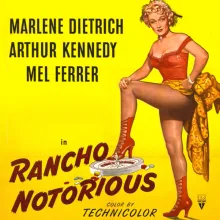
Haskell goes on a quest of hate, murder and revenge where he makes friends with a gunslinger named Frenchy (Mel Ferrer) and takes refuge as the Rancho Notorious which is run by Altar Keane (Marlene Dietrich) with a whole host of potential suspects.
Labels: Fritz Lang Jonathan Penner Marlene Dietrich Otto Bruno
Transcript
An automatic transcript, tidied into paragraphs. It has not been proofread, so names, titles and spellings may be wrong, and it does not say who is speaking.
Show the transcript (about 13,900 words)
Speaker 1: Hold your ears, folks. It's showtime people pay good money to see this movie. When they go out to a theater, they want cold sodas, hot popcorn and no monsters in the projection booth. JONATHAN PENNER: Everyone pretend podcasting isn't boring.
Speaker 3: Turn it off. A young man is full of adventure and eager to do what he can. May be a joy but don't send a boy to the moon. Work of a man.
Speaker 4: While lean the magnificent. It was hard for a man to look at her and keep to the rules. That was her try. That was for trying too hard.
Mel Ferrer wanted for every crime under the sun. There wasn't a jail he couldn't bring to reach the woman who wore his brand, Arthur Kennedy. Driven on to find an unknown killer.
Speaker 5: Men are funny and all men are jealous French. She only gave me one of these. What about that? Oh dad.
It was part of my cut Kinch gave it to me. It was Kinch. What's the matter? Now?
The game is over and I can tell you what's been choking me every minute since I chased after you. I'll tell you who wore that brooch before you did, it was a girl, a girl that I was going to marry a girl. The last time I saw was lying on the floor, out braised and butchered by the man who took that from her and gave it to you for 10% of her life. You're not going to meet Verne.
He wouldn't have me because I belong to you. I know like a word of you. I'm asking you, where are you going away away from here? The body gunders or the golden dollar or the Arca or any saloon?
That'll have me.
Speaker 3: I'll kill you before you do. MIKE WHITE: Welcome to the projection booth. I'm your host, Mike White. Joining me once again is Mr Otto Bruno.
OTTO BRUNO: Mike. Happy to be here as always. MIKE WHITE: Also back in the booth. This time as a co-host is Mr Jonathan Penner.
JONATHAN PENNER: We are gonna need a bigger boat. MIKE WHITE: We kick off a month of discussing some classic American Westerns with a look at one directed by a German emigre Fritz Lang with Rancho Notorious released in 1952. It is the story of a ranch hand Vern Haskell, played by Arthur Kennedy and his quest for revenge after his fiance is killed by a couple of low darn what are not fit to breathe air. Yes, it is a story of hate, murder and revenge.
We will be spoiling this film as we go along. So if you don't want anything ruined, go ahead and track down the movie and come on back after you have seen it, we will still be here. So, Otto, when was the first time you saw Rancho Notorious? And what did you think, sir?
OTTO BRUNO: The first time I saw it was about 72 hours ago, I had actually never seen this one before. So I was very, I mean, I had heard of it for years but I had never seen it before. And the first time I watched it again today, but the first time I saw it a few days ago, it struck me as odd actually, certainly not a typical, western. I don't think of that time period there.
Of course, I shouldn't say this probably, but we're here to have a serious discussion. But as I'm watching Marlene Dietrich, all I can think of is Lily Von Stup from Blazing Saddles, everything from the singing to the sitting backwards on the chair. I mean, Marlene gives it the all to us in this film. It's really not a bad western, but I'll tell you the other interesting thing for me that, that struck me most obvious, thing that struck me was, I don't feel that Arthur Kennedy, he just doesn't pull off a western for me, in this film.
He especially, you know, he's supposed to be, I understand he's compelled in this movie by Hate Murder and Revenge. But he really in my opinion chews up the scenery in a couple spots where it almost kinda, I can't take it seriously, you know what I mean? But overall it is still, I mean, it's, ultimately it's still Dietrich, it's still Fritz Lang and it's, it is interesting. It's a good movie to watch.
It's just not a great western, in my opinion. MIKE WHITE: Jonathan. How about yourself? JONATHAN PENNER: Well, I'd seen it relatively recently when I found out we were gonna be doing this.
I also had never seen it, had always heard about it. I kind of mixed it up with Johnny Guitar somehow I think in my, in my mind, right. But I think the truth is we wouldn't be talking about it if it wasn't Fritzl and it wouldn't be, wouldn't have been the interesting picture that it is without Fritz Lang. You know, I think he and Dietrich had, had an affair at some point is my sense and she seems to be battling with her own past as the Von Sternberg or woman that he had created in the movies.
And I think Fritz Lang wanted something. I'm calling him Lang. I'm calling him long because I'm listening to the two of you. I don't know.
I, you know, and it's one of these things, right? You folks at home, you know the name that you've read a million times and you've discussed in these forums. But did he say Lang or long? I don't know.
She feels very constrained by her, by her history. To me that, that he was either trying to get her to break out to play it a little bit differently or she was trying to break out. And he said, no, no, we, you know, they made me hire you, honey, you gotta do that thing with the sitting backwards on a chair. The crazy thing for me about the, about the movie, I think you're right is the casting, right?
And you get to see, you know, we, most of us watch sort of classic movies that have been Damed classics. And then you see a movie like this and it's got, who are these two guys who were, if not big stars? They worked in Hollywood for years and years, he was nominated for like three Academy Awards or something over the course of his, of his career. And I think it's because he was a New York actor who was coming up right around the time that Brando had come up Montgomery Clift.
And everyone was looking for the next guy and that style was the, that style, you know, they wanted that New York actors studio thing that he seemed to bring to the table and he's not a bad actor but he's, you know, no one talks about, oh man, we gotta go see the next Arthur Kennedy movie. You know, it's, let's go out and see an Arthur Kennedy and Mel Ferrer, you know, is a guy who, he was in war and peace. That's where he, you know, he and his wife, Audrey Hepburn worked together. He did a lot of stuff.
He was obviously a very smart, talented, gorgeous guy. He's 20 years too young for this part. They put a little gray in his hair to try to make him seem old enough to be this old gun slinger. He looks like he's 12 years old.
You know. So, but that's like the Hollywood system. That's who they, that's who was around. He was hot enough that they cast him and Fritz.
Like said, I don't care. Ok, let's go shoot. You know, they had two minutes for each take and they shot and shot and shot. So I found it fascinating to watch and we could talk about the movie itself.
I really enjoyed it, but mostly because I'd never seen it. The reason we keep saying hate or revenge is because there's this wacky song about Chuck a luck and we'll talk about Chuck a luck. I'm sure it was originally gonna be called like the ballad of Chuck Auck. OTTO BRUNO: Yeah, the legend of Chuck legend, Chuck.
JONATHAN PENNER: Fuck that means. And that part of the story, what's a Chuck A L, you know, as he tracks down what a Chuck Auck is and the singer of the song goes murder and revenge about five times over the course of the movie, which makes it really weird to a modern sensibility and annoying. MIKE WHITE: A little annoying. JONATHAN PENNER: I mean, it's, it's like, becomes camp, you know.
Was it ever not camp? Is the question in 1952? Is that like? Oh, yeah, this is a cool, serious movie with this guy singing.
Hey, I'm not gonna do it again, you know, in the middle of the movie. I don't know. I don't know. MIKE WHITE: I had never seen this one either and it just kept coming up.
I was like, ah, we haven't talked about nearly enough Westerns on the show. So I went out and I did a whole bunch of like, all right, what are the best Westerns? What are the most, the best unseen Westerns? What are things that I should be looking at?
So, came up with a very unusual list. And oddly, I think almost every single one of the movies that I'm talking about this month has a big ballad at the beginning or had a song that would take off outside of the movie itself. It wasn't like the man who shot Liberty Valance, which is a phenomenal song, but I don't think that's actually part of the movie, but 310 to Yuma, I can't remember if Johnny Guitars got one. Well, yeah, High Noon's got a fantastic song.
But what, what's the other one that we're talking about this month? This one is like a musical, you know, this movie, it remind me like, Yeah, she sings songs. They've got the best of the year that takes us through here. And it really reminded me of Fritz Lang's.
You and me, which I had never seen until last year up in Rochester, New York where it was a crime drama about all of these criminals that all worked at a department store. And I was like, oh, well, that's kind of similar to this ranch that Marlene Dietrich has with all of these criminals that work there. It drove me crazy looking at the trivia for this one. And it was like, well, this was originally supposed to be called, you know, chuckle or legend or Chuck a luck or whatever.
But then they changed it to ranch on notorious. And that didn't make any sense because there is no ranch. And I'm like, yeah, there is stupid. This hideout for all these notorious bad guys, you know, like Jack Elam spends his summers there, like, you know.
JONATHAN PENNER: Before his eye went really holy shit. Yeah, it's interesting what you're talking about that Fritz Lang has the sort of criminal enterprises as you were talking. It made me think of M of Dr Mabuza, you know, maybe it's just easier to shoot or interesting to shoot criminals kind of sitting around talking about being criminals, which is, which is a lot of the second half of this movie. Actually, it was interesting to me watching them.
Are they going to split this up? Can they trust each other? They don't trust each other. They're good criminals, bad criminals, people who fall into it and the implication at the end of the picture, spoiler alert is that this guy has trained himself to be a killer and now he's gonna go ride the range as a, as a killer.
And he started off as a perfectly innocent man driven to rape, murder and revenge and his life is going to end at the end of one end of a bullet. You know, I think. MIKE WHITE: You've got the musical aspect, which also you and me as a musical. But this feels much more like some of Fritz Lang's films noir than it does even a western.
I know he made at least two Westerns before this. The one about, was it Jesse or Frank James? I can't, I think Frank James, there's at least one other, but really with this whole idea. So the movie starts off with like it basically starts where a lot of other movies end where you've got the man and the woman and they're going to get married and, you know, gives her the ring and she's got this jewelry and then he leaves and in comes this bad guy.
Was it till is the guy's name or Kinch? Kinch? Kinch. Kinch comes in with his partner and Whitey with the worst haircut.
This guy's got the worst general custard style haircut and they rape murder and revenge. Well, they rape and murder, this poor girl. And that sets our main character, Vern the Arthur Kennedy character onto this path and it becomes this whole investigation where he is just like, oh, he's gone. He's listening to these stories.
You've got all these flashbacks. It's not typical noir as far as like this isn't told as a flashback. We've got these flashbacks in here and these flashbacks are amazing, especially as he gets closer and closer, he gets little hints of stuff like meets this guy in a barbershop who mentions alter keen and you're just like, oh what the hell is, what is altering is an person? Yeah.
And there's mention of Chuck a luck at that point and you're like, what the hell's going on and then he moves on after he has a gunfight with that, he moves on and he meets this whole gaggle of guys on this porch, including Fred Mertz himself. William Frawley, sitting there sitting there. JONATHAN PENNER: Like kicking stuff and he almost going like, I'm so mad, you know, I'm really frustrated. Sort of Fritz was saying, show us how frustrated you are.
Fred, show us more frustrated, Freddie. OTTO BRUNO: I feel like I might be the TV addict here among the trio. Oh, no, for sure. That particular sequence and that flashback and everything in the flashback.
You have the Professor Russell Johnson from Gilligan's Island. He runs the Chocol L ring. The guy telling the story is a character actor named Dick Elliott who played Mayor Pike in the Andy Griffith show. He was that there were two Mayors on the Andy Griffith show.
Dick Elliott was the first one and then, sadly, he died, like in the second season. And then Fred Mertz, William Frawley plays. What's he, what's he play the guy who, and the plays at? Baldy?
Baldy. Baldy. Yeah. There you go.
Baldy. JONATHAN PENNER: And Superman is in the movie too. OTTO BRUNO: Right. George Reeves.
JONATHAN PENNER: George Reeves with a scratch on his face playing this sort of ladies man stud. You know who, who, of course Arthur Kennedy suspects because he's, he has a way with the ladies. You know, he doesn't imply that he's a rapist. MIKE WHITE: And when he sees the scratches on his face, he's just like, oh, those could have come from my gal because that was back in August.
OTTO BRUNO: And by the time he catches up with these guys, it's springtime and that's the last shot they show of her when you see her dead body as they show her fingernails and yeah, you know, we talk about that. JONATHAN PENNER: She was raped in the film and there's, of course you don't see anything. It's all done outside. You're sort of with a little kid who's playing in the dirt and he hears sort of two screams and then they, you know, go inside and as Arthur gets there to find his beautiful, the dead body of his beloved, somebody says, like she was spared nothing and that's enough for the audience and for him to say, holy crap, I gotta get these guys and the audience is like, you gotta get these guys and you see nothing, hear nothing and it does it all so artfully.
I really loved that, that, you know, in a modern movie, they would have spent, they really would have put her through it. And the truth is, the story is not about that. It's about this guy is driven to hate murder and revenge. MIKE WHITE: Your mile mileage may vary with this movie.
It is an unusual film, but I feel like while I'm watching this in the hands of a master, I'm in the hands of somebody who knows how to handle this and knows how to dole out information to me, knows how to shoot a scene. So I feel like I'm safe while I'm watching this and I'm just like waiting for the next twist or turn because Lang just can do. JONATHAN PENNER: That, which in the first half of the movie come like, I mean, maybe of course, of the whole movie, it only gets a little muddy for me. And how did you guys feel about this?
The actual emotion that she was going through? Whether they were really saying that she was falling for him, that he was falling for her, that he was over his girl and he could have a life with alter teen and then he, and then he throws it back in his, in her face, that incredible scene about, you know, you see the blood and all the innocence on the blood of the innocent on the floor. I was, I didn't know exactly how I was supposed to feel about the two of them. OTTO BRUNO: That's a great point is that when I watched it the first time, that's exactly what I'm thinking.
I'm thinking, wait a minute is Vern actually falling for her now. And you do believe that. I mean, again, I give Fritz Lang credit for this. He dr he draws you into that to think.
Oh, he's even, he's falling under hers be now. But then as soon as he gets the information he needs from her as to where she got that broach, then bingo man, he turns on her so quickly and so violently that you're thinking, wow, he even sucked me in because I thought he was actually falling for her and clearly he wasn't, he just, he was on the trail of that information and he would do whatever he had to do to get it. And you know, he, in my opinion, his acting was better with alter trying to get his information. Then ultimately, it is when he kind of goes over the top a little bit for us.
MIKE WHITE: Well, I did read an interesting article talking about was this, you know, this is 1952. This movie comes out, you've got a German actress, the main, you know, above the title I think is Marlene Dietrich. And then you've got Fritz Lang in the director's chair. Is this Lang working out issues with what happened in World War Two?
I mean, this whole thing of like Arthur Kennedy when he's just like, look around.
Speaker 5: You the king. What are you seeing there? A bedroom or a morgue? Look over here.
So that, what's that? A court or a graveyard? MIKE WHITE: And he's like, he's like addressing Germany at that point and then that her lover's name is Frenchy. I'm like, ok, that's interesting.
All right. I can almost see where you're coming from with that stuff because I was like, yeah, there, it is very interesting that she's, she's almost reprising her role of Frenchy when she was in Destry Rides again, which I always thought was a sequel. I never realized that there is no dry, that Deter Rides again is the name of the, yeah, that, that's it. So even though I guess there was a dry movie that was made like decades later.
But anyway, yeah, I was like, this is a very particular choice to have her in here and also her wardrobe is very interesting and I guess there are some times where she's got like these Lily Von Sto type outfits and then she's also dressing a drag at the same time, which is, you know, like, that's like Marlene Dietrich's whole stick, right? Is like playing with the whole gender roles and stuff. But like, I think the first time he rolls up on her when Rancho Notorious, she's got jeans and the shirt on, she's got dirt on her face and stuff.
And then like later on you get to see it and we've already seen in flashback, the glamorous alter keen as she's writing that guy across the floor where he just thinks that's the funniest thing in the entire world that he's laughing the entire time as he goes into the flashback and then laughing on the way out. And I'm just like, this looks like it's right out of the Blue Angel. This is what she would do to that guy in that movie. You know, this is, it was like Marlene Dietrich's Greatest hits almost.
JONATHAN PENNER: The idea and it is an idea of a, I don't know, good time girl, right? A saloon girl. They would never say she was a prostitute, but she was madam. She was, I don't know what she was, she was that, that icon of Westerns.
They never say she's a hooker prostitute, but she's making her money somehow and not just by selling singing songs in a saloon, right? And then so she gets out of that and you know, years later she settles down running this criminal enterprise with dirt on her face, wearing ranch hands clothes. If they did it, that movie today, the transformation would be kind of absolute right? She'd have cut off her hair or something like that.
She'd be much tougher and you don't, I mean, I don't believe Marlene Dietrich has lifted anything heavier than a cigarette holder in her entire life. You know. So they could dress her up like that all they want. But she's not, you know, and she can act tough, you know, my cut's always 10% you know, put it on the table but you don't believe she's gonna hit anybody or do anything to anybody didn't.
I loved it. I love seeing her. She's, she's, she's radiant, but it's just movie star casting. OTTO BRUNO: Apparently.
Lang and Dietrich had had an affair years before she talked about this film in the years following it. She did not like this film, she did not like making this film Lang, of course, as I'm sure you guys already know, but he was notoriously not a favorite director of most actors because he could be very brutal and cruel, I guess and set to most actors. But I don't know if, if he made a crack then or if he did this in later years. But he talked somewhat about how much makeup she had to use because I remember and this, this is 1952.
So what she's, she's like 51 now when this movie gets made. So she is getting a little long in the tooth, but she's not giving an inch on it. JONATHAN PENNER: And again, she's old enough to play the guy who plays Frenchie's, you know, mother. OTTO BRUNO: Well, that's, that's like what you said is that, is that the oddest thing about this is the casting.
It's just we, it's just, and it, and the strange, the two strangest are Kennedy and Ferrer. They just don't seem to fit in. I mean, even, I know Mike, got a kick out of, I think his name was John Doucet. The guy who plays Whitey, with the, with the long, the long locks at the beginning, he was in a ton of Westerns.
Jack Elam obviously was in a ton of Westerns. The other guy who was strange that I didn't really remember from too many Westerns was Dan Seymour. He played the Indian, like he was supposed to be half Indian or something or something or something. I think his name was.
Well, that's Dan Seymour from, you know, to have and to have not, that's what I think of when I think of Dan Seymour. JONATHAN PENNER: But the character guys played, you know, it's like today you're an Indian. It's like, you know, you see the filmography of Boris Carlo for one of these real superstar character guys. You're from India, you're, you're, you know, you're from Egypt, you're, you're from Africa, you're from wherever the hell you're from.
You're Polish today and, you know, character actor played everything. They never cast anybody except these, these guys, you know, it makes me think about, about the producer, right. This was an Rko picture. This was a Howard Hughes production.
And did he just not have the male stars under contract that some of the bigger studios had? I don't know, I guess I, if I've done more research, I'd be able to sit here and say, well, you know, Howard Hughes didn't have the male stars, but it just makes me think. How did this particular cast come together? I did in my research, I did find one like Call Sheet or a or a day out of day shot shot list and they were literally giving him five minutes per set up, something like that.
It's breaking, broken down from like 936 to 941. Shoot the Master, then you push in, shoot the close ups and I don't know how quickly this thing was shot, but that's what it looks like, right? It was, you know, is there a single close up in the old movie? I don't know if there is.
OTTO BRUNO: Things I've read have said that Hughes was ironically very tight with the buck. The only person he ever spent a lot of money on for a filmmaker for a film was Jane Russell. But beyond that, I don't think. JONATHAN PENNER: There's a perfect example, right?
Who none of us can. It was a huge expensive movie, The Outlaw with Jane Russell who played Billy the Kid. What's the guy's name? I don't even know.
OTTO BRUNO: He was a nobody. Yeah, he was a nobody. Yeah, he had no career after that. Whoever the guy, I can't even remember it now.
But like you're saying, those character guys could do anything but then Arthur Kennedy and Amal Ferrer as good as they are, they can't do anything. You know, it's just not, it's not quite the same. JONATHAN PENNER: Casting is so interesting in that way. It's like folks who were hot.
Maybe they didn't even use that term. They were under contract. They were a rising star, somebody who's up and coming and he had some success in this movie or that movie. And then you look at a picture like this and you say, well, how the hell did they get these two guys?
It's because at the time they were taking a shot and they were hoping that they turn into Tom Cruise and not Judd Nelson, you know, who were both up and coming guys, 40 years, whatever it is again, Arthur Kennedy worked till the day he died. Both these guys wound up in Europe shooting bad exorcist rip offs and wound up on Columbo and you know, they worked forever. Mel Ferrer was a producer and a director. Also, he was one of the producers on Wait until Dark helped his wife Audrey who was a much bigger, became a much bigger star than, than he did.
MIKE WHITE: He's had one hell of a career. He shows up in the oddest places he's in that. I'm sure you've seen this one. Jonathan.
The visitor from 79 Jesus. JONATHAN PENNER: Oh, boy. MIKE WHITE: But he's, he makes everything better that he's in, but he's usually just not in it very much, you know, he just will show up for a couple of scenes and then do his thing. I like him in here but he does disappear for probably half of the movie.
JONATHAN PENNER: And he's, to me, he's an actor, Arthur Kennedy is taking some chances, right? He's playing the much more emotional part, but he's really putting himself out there successfully or not. And Mel Ferrer was a kind of actor who would never fail. He's the kind of actor who would never fail.
He played a very, very tight sort of range. Well, never went too high, never went too low. He was gorgeous to look at, he's this big strapping guy and he was just kind of there like a million guys who are not Gary Cooper or Clark Gable or Cary Grant who were much more than that, but they needed to put a body in there. And so they'd stick somebody like that.
I'm, I'm denigrating him and I don't mean to what I'm saying is he was not an untalented guy, but he's not a brilliant actor. MIKE WHITE: He was a type, basically, he's kind of like white bread. JONATHAN PENNER: Exactly. You know, he'll first do no harm, right?
He didn't fuck the movie up. He just doesn't make it sick. MIKE WHITE: And, yeah, Arthur Kennedy, he reminded me so much of like a Van Helen just like the way his eyes and, yeah, he was a, he's an odd, odd looking person. There's the.
JONATHAN PENNER: Three of us who look like we do. I mean, you know, he was, I mean, he was a, he was off because he looked like a human being. That's, but, you know, he didn't look like a movie star, but he just looked like a guy. MIKE WHITE: I almost wonder what would it be like if, if Kennedy and Ferrer had switched places because Ferrer is to your point, it is just a little bit of, you know, gray that they're putting in his hair to make him look older.
Really? He could probably have played more of a wet behind the ears. I'm trying to find this person and become that investigator. I haven't, I'm not familiar enough with this filmography to know if he's ever been in a film noir because I think that would probably be interesting if he was that antagonist trying to track somebody down.
And then, you know, you've got Arthur Kennedy who seems like he could be more of that seasoned gunfighter if he wanted to. So it's interesting the way that they have this, I think. JONATHAN PENNER: Mel Ferrer is younger than Arthur Kennedy. MIKE WHITE: I would not be surprised.
JONATHAN PENNER: Ii, I, you know, we can do our little, somebody's typing away now. No, he's not. He's get somebody's watching typing away, but they're basically the same age. And it's always funny when, you know, well, there's the kid, it's like when you watch The Sting and Robert Redford who is great and had an Oscar nomination for the part is the kid.
He's the wet behind the ears kid who's about to go into his first big con after being in the, in the small time league, you know, I mean, and he's three years younger than, than Paul Newman or something, you know, who's the old grizzled guy? And it's just, well, because we could get them. How do you wind up with him as the kid and him as the old grizzle guy? Because they said yes.
And that's how you wind up, you know, with casting like that. OTTO BRUNO: Just so we know Arthur Kennedy is only three years older than Mel Ferrer and Marlene Dietrich is 16 years older than Mel Ferrer. JONATHAN PENNER: So Arthur Kennedy is playing a, you know, a 17 year old. I mean, you know, this is really what in those days he was about to get married to his sweetheart.
They weren't married. So he's maybe he's 18, he's 20 years old on a ranch and Mel Ferrer has been out and about, you know, he's, he's old gunslinger, somebody's coming up who's gonna be faster than him is coming up behind him and he's actually three years younger than Arthur Kennedy. It's, it's fucking weird. It's hilarious.
Right. OTTO BRUNO: You know what I was thinking of earlier when we were talking about the fact that Kennedy's character is driven by hate murder and revenge. It's really a western character that could have been played by Jimmy Stewart and directed by Anthony Mann. At the same time, the Stewart character that he was playing for, man.
And these Westerns at. JONATHAN PENNER: This is Winchester 73. It's like what you're talking about. OTTO BRUNO: It's around, yeah, they're all around.
They're all like 50 to 56 or something. Like they're in that general area, 49 to 56 something like that. JONATHAN PENNER: Maybe, maybe, you know, this notion of the guys and I'm making this up as I go. But if you know, you were off to war, this is a little later, you know, if you, if you came back from the war and your woman had some done something else been with somebody else thought you were dead, thought you had moved on the, you know, these stories of guys who will spend their lives searching for, trying to make up for what they lost the promise that he had for his whole life.
He says we're gonna have a ranch, we're gonna have four kids or, you know, let's have, what did she say? MIKE WHITE: Like one new one, every August. JONATHAN PENNER: Yeah, one for every August as I'm sitting there, I'm saying, oh, so in December when it gets real cold, they're gonna cuddle up, make a kid. August, they're gonna have a kid and, you know, let's have 12 kids or something crazy.
MIKE WHITE: Right. Yeah. I'm like, she's never gonna not be pregnant, you know, and he's gonna. JONATHAN PENNER: Spend the rest of his life.
I don't know, filling in that hole of what he's lost. OTTO BRUNO: And of course, as the father of three children, immediate thing I thought of was, oh, that's funny lady. Once you have the first one, by the time that next December comes along and that kid is three months old, you're not gonna have the time to Yeah, exactly. JONATHAN PENNER: Get off of me.
Get away from it. MIKE WHITE: I agree with you. Like, man and Stewart could have definitely done something like this but you don't get the weirdness, then you don't get the barber trimming one guy's hair and shaving the other at the same time. What the fuck?
I was like, wait a second. Is he really doing that? JONATHAN PENNER: They cut the budget or something right? There was another extra and he needed an extra $5 if he was going to cut the guy's hair and they, yeah, I don't, I mean something crazy happened like that.
All right, you do both. It was a one day shoot. You know, it's, you're just doing about nobody will pay attention. MIKE WHITE: You get the fight between Frenchy and Vern and it can't be handheld because the cameras probably weighed 100 and £50 at that point.
But they're doing something with the camera. Yeah. And I'm just like, what is happening right now? I thought like, because some of it was actually out of focus.
JONATHAN PENNER: I was like, this is interesting and then there were the 22 or three clearly studio set dialogue scenes that are supposed to be out, out in the in with those big fake rocks, right? These crazy hand pain like painted by one of us. I mean, again, there was some not by me because these were beautifully, you know, we had painted but there was no, I mean, maybe an audience would have sat there and not known the difference, but it's so clearly not shot on location that it almost becomes its own meta moment.
You know, it was kind of fantastic actually weird. Exactly, as you say, weird. It almost felt like a, like a modern version of Metropolis or Siegfried or something like that. It was so clearly artificial.
OTTO BRUNO: Yeah. And a lot of the articles talk about that and I didn't, that didn't bother me. I'm kind of like you guys. I kinda liked it in a weird way.
There was no mista that it was that it was not real, but it really, again, it wasn't, I'm always, my attitude always is a as long as something doesn't take me out of the story, I don't really care and that doesn't really take me out of the story because it's really not a western about being on the trail really, you know, so much of it is shot in the ranch or in the saloons or, you know, it's not one where there was a cattle drive or something like that. So that wasn't that important to me personally. I mean, my, I caught that thing too, the whole thing about with the barber doing two men at once and I'm looking at that and I said, I have never ever seen this.
JONATHAN PENNER: And maybe it's so funny. Maybe it happened to Fritz once in Germany. He said, no, no, it'll be funny. It's good.
Do it. The people were wonder of it. OTTO BRUNO: Well, I know I'm wondering is like, is that supposed to show that the town is growing too fast so they can't even get enough bar? I mean, I didn't get.
JONATHAN PENNER: It but I think you're giving it honestly too much credit. I think they didn't want to pay the guy. They gave all the lines for one guy to the other guy and they saved some money to just, you know, let him, let him, they said if there's two guys, they wouldn't let the two of them fight, one of them would jump on the guy or some, some logic thing like that. You know, I.
MIKE WHITE: Like this whole setup that Marlena Day's character Walter Keane Bizarro name that she had where she's taking 10% of the cut of anybody that wants to stay at her place. She's taking 10% and then it can stay there. It sounds almost like as long as you want, you do have to work and there's no fighting I think is the other rule and I can't remember. There's no asking questions.
There you go. Great setup. And then at one point during the movie, all of the guys get mad at her and I'm like, where did this come from? JONATHAN PENNER: Because she was taking the money?
She was because she was a less bad criminal than they. I mean, something like that. It reminded me, have you guys read? It's not in the movie, any of the movies of the getaway, but in the book the getaway, it ends in me in a place like this except it's literally hell, the bad guys you can get across the border.
That question of like, well, OK, we're gonna get across the border and get away. Where do you go? The Federales are still after you? And there's a town somewhere in Mexico, run by criminals for criminals, but you got to pay for everything.
And if you can't pay, once you've run out of money, you're gonna kill each other or you're gonna sell your body or you're gonna sell your body parts. I mean, it's literally literally hell and this isn't that obviously, but this notion is this a modern notion, was this a noir notion that there was these hell pits of criminals that, that, that criminals could work together and take care of each other and of course they were gonna turn on each other all the time. That's nothing that I've seen in a modern movie except maybe Reservoir Dogs or something.
I don't know. I'm just sort of spitballing here because it's an interesting concept that they didn't make a hell of a lot out of that. There's this place that you can go run by the most gorgeous woman literally on earth and she runs it with an iron fist. You know, it's kind of weird.
OTTO BRUNO: Right. When I was watching this the first time I thought, gee, they could make more of a movie just about that idea. And yes, Mike, I was with you. I was like, really 10%.
I don't think it's a lot because it's not so bad. Right? You're saying you're so safe here. Nobody knows.
And you have this clearly, they have this system set up. I mean, they've got the lookouts but then they have some alternate place to go to if someone comes in like the Law or somebody else that they have to escape from. I mean, they had that system down. They got everything, you know, they wiped every trace.
JONATHAN PENNER: And Marlene Dietrich sings to you for 10% of the cut for. It's actually not a bad idea for. Where's the Rancho Notorious TV? Show?
You know what it is? It's the, it's John Wick. It's the, it's the, what's the name of the continental? MIKE WHITE: It is totally the continental.
OTTO BRUNO: Yeah. By the way, the other thing that I thought of and I think I read this in some of the articles too was the big heat, which was Fritz Lang, which was, is either the year before this or the year after this. Basically, it's almost the same exact story because, you know, in big heat, it's, it is his wife who gets killed in this one. It's his fiance.
But then the whole rest of the picture is that quest for revenge. So when you said earlier, Mike about this being like a noir, it's like a western noir. And again, I think being inside, instead of being, you know, on a lot of location shooting, I think that lends itself more to the noir feeling of it as well. MIKE WHITE: Yeah, you don't get the vistas, you don't get Monument Valley.
I mean, the closest thing you get to that. Well, of course, there's the fake stuff which is great, but you get, I think the very end shot, you get more of a naturalistic thing. And even with that, it's kind of odd because you get the narrator, the singer comes back and you got Kennedy and Farrar and they're just riding out into the distance almost. It looks like they're either buddies or lovers.
Let's going off together and then you get the singer being like, oh, yeah. And they went off and they shot each other and we don't know if anybody survived. I'm like, what, what a weird way to end this. JONATHAN PENNER: I thought what, what, what they were saying was that, that was, they were like ghosts, not really ghosts, but they left it as if they had died and now that they're gone they can move forward into, you know, the new adventures, something like that.
OTTO BRUNO: And I couldn't figure any of that out. And the second time I watched are Smart. MIKE WHITE: That's speak for yourself. OTTO BRUNO: The second time I watched it today, I'm like, I'm gonna make sure I keep my eyes on what they're wearing right before we see them riding up and neither of them are wearing the same thing.
So it's obviously not either of them or it's them, it's their ghosts who changed wardrobe or it's two other guys or I don't know what. MIKE WHITE: Well, of all the things guys brought up Howard Hughes earlier and I think of all the things he had an effect on the ending and I'm like, ok, it's, again, it's kind of appropriate for this movie. It's off and you don't exactly know exactly what's happening. So, kind of makes sense to me that he would be like, no, no.
Yeah. First off, change the title, nobody knows what Chuck a luck is. And Chuck a luck. It's so, it would be so weird.
Had they called this the legend of Chuck Luck because Chuck a luck is how French she makes her money and how she escapes the clutches of Baldy. And you've got that whole thing of, you know, Mel Ferrer comes over and it's like, no, no, I'll man the wheel. Thank you very much because we know that the game is fixed. But poor professor from Gilligan's Island doesn't know that she's not chilling.
Yeah. Yeah. She's not shilling. She's not like, look at how easy this game is.
I'm going to make all this money. This is fantastic. He doesn't know that. And then by the time like the fix could be in Ferrer comes over.
It just like, I'll take care of this wheel, don't worry about it. So he ends up giving her money basically. And then after that, there's no more. Chuck a luck in this movie.
JONATHAN PENNER: After all that searching for Chuck Auck. That's the first half of the movie. And then you go to Rancho Notorious and no, you also go to prison. OTTO BRUNO: No, the ranch is called Chuck AO.
It's not, that's why in the film, the film is named Rancho Notorious. JONATHAN PENNER: But the ranch is Chuck where they're heading to the ranch after the money she earned with the wheel because she got that. MIKE WHITE: But I was gonna say like there's no game though at that point, there's no Chuck a luck game at her place. JONATHAN PENNER: There is this weird sequence.
The classic, I'll get myself thrown in jail with the guy that I'm trying to befriend so we could break out of jail together and then I'll be his partner. MIKE WHITE: See, oh, I saw that in 1000 Spaghetti Westerns. JONATHAN PENNER: This was not the first version of that scene, but the political situation in the town is very much of the post-war Lang Lang. MIKE WHITE: Oh, that whole thing is amazing.
JONATHAN PENNER: Where, where the political parties are both totally corrupt. They're going to lynch each other. The sheriff is corrupt. Everybody's corrupt.
You know, and awful and venal and it's like, it's a way of showing that the, that the system is so fucked up that these two guys are the only logical folks in the world essentially who are living on their own by their own wits that yes, they're criminals, but at least they're not corrupt, you know, which is classic, but also interesting. I loved it. OTTO BRUNO: Well, wait a minute. I thought the party coming in was Law and order.
MIKE WHITE: Yes, it was the Law And Order Party. And of course, the Law And Order Party follows Law and order those politicians. OTTO BRUNO: I mean, if they were gonna hang him. Well, no, actually, technically the new sheriff is going to try to keep them from hanging them.
That's why he leaves. Remember at one point he leaves and leaves the old man there to keep an eye on them. MIKE WHITE: Well, it's the old sheriff. The old sheriff was so in bed with these politicians that as soon as the new sheriff leaves, he's like, yeah.
No, he's. OTTO BRUNO: Out but he knocks out the old guy who was with the new sheriff. JONATHAN PENNER: I mean, it was pretty great. Right.
It was cool. OTTO BRUNO: Yeah, I mean, I thought it was, I thought it was a more idealistic view that this new Law And Order Party is taking over. Now I'm more with you that the Law And Order Party would be probably the Law And Order Party for a month or two until they get deeply entrenched in power. JONATHAN PENNER: No, no, they were, they, I mean his film and if, you know, I'm sure if you haven't seen it, Fury right.
It is an incredible indictment of lynch mobs and, you know, not only the American system, it's an indictment of the American system, but also of Nazi Germany. I mean, he split that was in 36. He had just gotten out by the hair on his chinny chin chin and it was a devastating political allegory. You know, it's a great.
OTTO BRUNO: That's a great movie. JONATHAN PENNER: It's interesting that after 792 podcasts that Westerns which were ubiquitous, I mean, they were the American cinematic form have fallen so far out of favor to sci fi, to horror, to noir, to thrillers and to, I don't know what other, some of the other pictures that you that you tend to handle. But Westerns were the thing, everyone made Westerns and on TV, for the first decade or 1530 years of TV. It was all Westerns, Bat Masterson and Bonanza and Gunsmoke.
These were the biggest, biggest shows on TV. And so that they're falling out of favor, it may be worth talking about. I don't know. But that they had these songs, these ballads, these American kind of song structure, You know, what was the movie about?
I'm gonna tell you the whole story in 30 in three minutes. As I sing you the story, story of rape, rage, murder and revenge. And the whole thing is structured around this fucking weird song, right? You know, it begins with the song and it ends with the same song.
It's a. OTTO BRUNO: Weird song, by the way, written by a gentleman named Ken Darby. And I recognize the name of Ken Darby because a lot of these guys in the like thirties and forties, they were like orchestrators and arrangers and stuff and they'd work for the record companies and a lot of these different guys would have later on. It was famous on television with Perry Como, the Ray Charles singers.
There were a group called the Ken Darby singers in the thirties and forties. They would back Bing Crosby. Ken Darby backed Bing Crosby. I'm not that old.
No, but I'm a big Bing Crosby fan. I spoke and I have a radio, I've had a radio show for 24 years where I play music basically from the thirties, forties and fifties. Fantastic. This movie, I just checked the dates this movie came out in May of 52 and High Noon came out.
I think the end of the July of 52. So they both use that, that ballad, you know, to kind of carry the story and tell the story. But no one really remembers this film the way they remember High Noon. JONATHAN PENNER: Also shot by an Emma Gray Fred Sinnaman was also a Austrian.
OTTO BRUNO: You know, I only know this because I'm teaching a course right now on Dean Martin. And the next course I'm teaching is on Howard Hawks. Howard Hawks comes along seven years later and makes Rio Bravo basically directly because he High Noon angered him so much because the hero is like, you know, a cowardly guy who doesn't wanna fight these guys by himself. So he goes out and gets the Duke to take on this whole town with just one or two, you know, with a drunk and old man, you know.
JONATHAN PENNER: And Ricky Nelson, right. Ricky Nelson. Does he sing the story of Rio Bravo? Is there a song?
MIKE WHITE: There is a song but it's not the legend of Rio Bravo, but. OTTO BRUNO: It's just the Rio Bravo rolls along and it's Dean who actually sings it, I believe in the movie. MIKE WHITE: You get that amazing musical sequence with Ricky Nelson. JONATHAN PENNER: Dean Martin and Walter Brennan, sitting there singing, right and the singing, I think, take a class on Dean Martin and one on a, but it is, it's interesting that both those films High Noon and Rancho Notorious made by Austrian Jewish emigres taking on these American classic American bore themes, I guess, you know, and doing, doing stuff.
That's so at the time, probably out there, I mean, High Noon, which is still a, you know, it's a classic, classic fabulous film. I don't know, what was the reaction to it were people like, oh my God, there's a western with Gary Cooper playing a coward or playing a guy who is not sure he wants to fight. That's crazy, you know. I don't know.
OTTO BRUNO: Yeah, I mean, it was a, I mean, it was a hit, I mean, they won the best picture, I think the song I think also won best song I believe. I know it was nominated. Yeah, I know it was nominated. I don't know.
And then the other thing again, I hate to go back to this, but when I'm listening to this song in, you know, Hate Murder and Revenge song there, the ballad of Chuck a Luck. Again, it made me think of Blazing Saddles, which of course, Mel Brooks got Frankie Lane to sing without knowing that the film he was singing about was a comedy. He just thought he was recording AAA. So, yeah, he just thought he was recording a song from western.
JONATHAN PENNER: You ever thought about what the hell does that mean? What is it? MIKE WHITE: Yeah, you can't really ride a blazing saddle tour easily. OTTO BRUNO: He came from the fifties.
I mean, that's when he was most popular. And, like we're saying all these songs, all these movies are in the fifties and they're Westerns and again, the fifties, like you said, television, there was some two or three year period where like 40% of the shows on TV. JONATHAN PENNER: All had songs, right? They called him ba ba Master's son.
That's when I remember. MIKE WHITE: Well, and then, and Gunsmoke was like the longest running television program until The Simpsons. OTTO BRUNO: The Simpsons, I think. Yeah, they were 20 I'd say about 24 years, something like that.
MIKE WHITE: That, that almost sounds as long as Law and Order. JONATHAN PENNER: And I wonder, I mean, our audience, your audience, I don't know how old you are but I'm old. Right. I'm si, I'm six.
I'm 61. OTTO BRUNO: How old do you think? I am 70 nine. JONATHAN PENNER: No, I don't.
MIKE WHITE: I think you just turned 60 like three days ago. JONATHAN PENNER: Three days ago. Nice. January 9th is my kid's birthday.
OTTO BRUNO: I'm January 7th. I just turned 60. Mazel Tough. And I'm not amused.
JONATHAN PENNER: Does anyone know who James R Ness is out there? Does anyone know Lauren? No, you and I do the like in the world, you know, these were the hugest TV stars. They were not huge movie stars but they were huge, huge, huge TV stars.
Household name, superstars. I'm not sure people could pick out James Arne in a, in a lineup. Many folks probably not. I could fuck her.
I know who he is. MIKE WHITE: I could, if he was dressed like a giant from outer space, he was the thing. OTTO BRUNO: I would, I even know who Richard Boone is. How many people remember who Richard Ramsey?
JONATHAN PENNER: But he was also, what was his name of? Have Gun Will? He was Paladin. Paladin.
Yeah. MIKE WHITE: Well, and he was also in a shit ton of Rankin And Bass movies. So that's where I know him from. Yeah, he was the, he was in the last dinosaur.
He did the voice of Smaug. He was in, yeah, and he was also in one of my favorite movies, Winter Kills. OTTO BRUNO: I think I was introduced to Boone by those two, latter, latter day John Wayne Westerns, which was Big Jake. And then of course, the last one, the shootist.
He's in both of those and he's fabulous in them. I guess we. JONATHAN PENNER: Could talk all night. They're just rapid holes worth falling.
And there are, you know, Fritz Lang Long, Marlene Dietrich. I mean, some of these folks are what a pleasure to watch this movie. Honestly, I've never seen it. Somebody, you know, you asked me would I do one of these?
I said, of course, I would I picked a movie I'd never seen to see, you know, a cool movie. I've never seen. My kid was like, why did you pick a movie? I haven't seen, why didn't you pick one that you knew by heart?
Like, what the hell is the fun of that? I know it by heart. I want to see some. MIKE WHITE: That's totally the right attitude because there are too many people where I'm like, hey, you wanna, I haven't seen any of these movies on this list.
I'm like, so I haven't seen half these movies on this list. This is for me to educate myself that you love, you hadn't seen. It's as much for me to educate other people as it is to educate myself. You know, this is like, all right.
So I'll get, you know, I'll, I'll pick out a movie, I'll find as many articles as I can and books and all these things. Like I was surprised just the paucity of materials when it comes to Rancho Notorious. Like, there's not a lot of criterion edition of it. There's no audio commentary.
There's not like a BF I book dedicated to, you know, like I was thinking, oh, this is going to be a bigger movie just because there are a lot of articles about it online. But like, and there's some scholarly articles as well because this is a very interesting movie. There's a lot of layers to it and you can read it in a lot of different ways. You know, like, just I'm trying to remember, there's one author who is just like going through like, well, altar can be alter like a, like something that you put something sacred on or it could be altered, like to alter something to change.
Something got into like castration, anxiety and all this stuff. I'm like, wow, ok. You know, good articles, nice writing on all this. But I'm like, it feels like there should be more, it just feels like that this should be more of a known, we should.
JONATHAN PENNER: Transcribe this, this profound conversation and type it up and. OTTO BRUNO: Well, you know, I think some of those really heavy academic articles about things like that, just my own personal opinion from, from the masses. I think a lot of that is total bullshit. Most of the directors said basically the same thing that, you know, when they asked some of these directors.
Well, what did you mean when you had him drive down the wrong side of the road? And I meant that he was in a hurry and he wasn't paying attention. That's all I meant. There was nothing.
JONATHAN PENNER: Meant that the light was, you know, we had 30 minutes of the Dark to turn the car around would have taken too much time. So we just fucking went for it and I'm sorry, you noticed it. But, you know, anyway. OTTO BRUNO: Yeah.
Yeah. I some of this stuff I think is, I mean, some of it is fun and fascinating and I do think I'm not saying that nothing that you see in a film has a deeper meaning. Obviously it does in a lot of films, but sometimes some of those articles, the stuff they pull out I just think is crazy stuff. The only thing I really found book, like I'm sure you guys have probably read this.
Who the devil made it? You know, the Bogdanovich one with the different and he had Lang in it. So I read the Lang interview. I had seen more Lang movies probably than I had Dietrich movies.
And that's why when you asked me whenever it was, you gave me the list of like, what would you be interested in doing this year? I picked one that I know very well. I picked one that I had seen once few years back and never seen it before or since. And then I picked this one which I had never seen before and I picked this one because it was Dietrich even more so than being Lang.
I was interested in seeing more Dietrich stuff. Cause just in the last few years, I've started to go out of my way to watch a De Dietrich film when I can. She's like you say, she's a fascinating figure and you know, when you read and listen to some of the things from her daughter, you know, Maria Riva. Some of the things she had to say about her and all of the different, men and women that she had relationships with and, she's just astonishing and then the whole thing about how hard she worked during World War Two, how much she hated Hitler, you know, and that, that whole thing.
And again, now until I read this, I did not know that aspect of Lang's life about the fact that supposedly Goebbels had offered him the leadership of you for a and he said, well, let me think about it and then got on a train and left for Paris as soon as he. JONATHAN PENNER: Got his money and hid his money, like in the, in the cafe car or something. It's a great. MIKE WHITE: Yeah, it was a great, I think it's based on real life, but there is some fictional stuff to it.
The screenwriter Howard A Rodman, he wrote a book called Destiny Express, which is all about that last little bit of Lang Fritz and Thea Von Harbo and the way that they left, oh, wow, Germany, that's really good. JONATHAN PENNER: It's a great book, The Thea Von Harbo Story and her heart of his career or his part of her career, she's an extraordinary figure. Must have been an amazing character and probably doesn't get nearly enough credit for the success of Fritz Lang launching his career, his talent is obvious. But she wrote all of those early movies that he did or co-wrote them with him.
You know, I. MIKE WHITE: Was hoping in one of those articles, there would be more about the actual jewelry that Verne gave to his fiance that then that Kinch takes and then eventually he doesn't gift it to alter, but that's her cut is that piece. And then when Arthur Kennedy sees that on her, on her dress, just the whole movie stops. Like he goes from basically being turned on by her to like horror in his face and the way that they're cutting like the cut over to Mel Ferrer and he's just like smiling and kind of nodding his head.
Then they back to Kennedy Kennedy's whole face is just like falling and falling and then they start to do like these quick cuts with all of the other bad guys at Rancho Notorious. And I'm just like, oh, ok. This is great and that's like almost dead center right in the middle of the film. It's like you still have half the movie to go at that point and suddenly just kicks everything into gear.
JONATHAN PENNER: Hank robbery in a shoot out. And I mean, and the, and the, and the scene in the bar, the solution, you know, almost shoot out is fabulous. It's really, that. OTTO BRUNO: Is an interesting scene because it, the way he shoots it, like she's singing and she's singing and she still has the thing draped over that piece of Julie for the long, like for the first half of that song and then she moves it and then all of a sudden, like you're saying, he's kind of getting drawn in by her and then all of a sudden she takes it off and he sees it and then if you remember which I thought was kind of really interesting how, when she's done singing, all the guys are like, you know, applauding for her and they gather around her and he's like, basically jumping in there and trying to shoo them out of the way, like he's gonna rip it off her right then until one guy says the lookout and the lookout comes right there in the window and it's like cut off all of a sudden I thought that was really cool the way that was done because, you know, he's about to destroy everything right now.
And like you say, you still have a half a film to go. MIKE WHITE: Then he has to suddenly regroup and then he starts to change and becomes that whole. Like, I would love to give you the jewelry and fine dresses and just starts to chat her up and all this. And then, yeah, to your point, you're like, oh, did he start to really fall in love with her or what's going on?
And then more than the other criminals that are there, then you suddenly have to start thinking because he seems to have formed a genuine friendship with Frenchy and now he's stepping into this and he's fucking over Frenchy and I don't think he actually means to, but then that causes this whole other. JONATHAN PENNER: Rift or anything for hate murder and revenge. The other great super movie cliche is when French, she and she come back together after a long time on the ranch and he picks the fireplace and then he grabs her and embrace and he should cut, cut down to the fireplace, the flame goes.
MIKE WHITE: Up, the flame goes up. I couldn't believe that. I, in my notes, I wrote the flame goes up. They are fucking, yeah, exactly.
JONATHAN PENNER: But that's what I love is like the audience could all knew what was happening. We all know, you know, let, let us use our imaginations and it's like there it goes, you know, rub two sticks together. OTTO BRUNO: Speaking of great Germanic and Viennese and Austrian directors that, that's one of my all time favorite Billy Wilder stories where he was upset when he shot the film, the seven year itch because I guess on stage it's quite clear on stage that the yell and the Monroe character sleep together in the play.
But in the film, of course, it couldn't do that. And Wilder wanted, he said to the, to the producers, whoever who said you can't show that. And he's like, no, no, no, all I want to show is the next morning when yells getting up out of bed, he finds a hairpin on the match on the bat and they said no, you can't do it. And he and Wilder was so pissed off because it was so subtle.
You know, like you're saying, John, that people, it wouldn't be, it wouldn't be obvious, but it would be enough so people could know what had happened. JONATHAN PENNER: So that anyone who'd ever had sex would know what it meant. Right. Right.
OTTO BRUNO: Right. And that's why they just be like, oh, if somebody left a hairpin and exactly, if it's a 10 year old kid, they're not gonna know what the hairpin is. MIKE WHITE: Yeah. This movie is rife with cliches but they spin them in such a way that it doesn't feel like, ok, here's the scene.
Ok. Oh, it's the group back at the hideout. Something went wrong with the robbery. JONATHAN PENNER: Speaking of it's Lang's, it's, as you said, you really feel like you're in the hands of a master because somebody else's hands, it would have just been a real programmer and we wouldn't be talking about it today.
I guarantee it. Even with that guest, as you said, there's a lot of day trick pictures that you haven't seen because they were made by, we've all seen Touch of Evil a couple of times. That was her, even five years from now where, where hes not hes to Wells really brings her out of retirement to play another version. Of this part.
Right. And he really drags her through the mud, you know, in that little to repeat or wherever she's working, you know, wherever. OTTO BRUNO: What was touch of evil. 61 or 59.
JONATHAN PENNER: 57 or eight, I think. OTTO BRUNO: 58 58. Ok. So I think, witness for the prosecution, I think was 57.
Right? JONATHAN PENNER: Another version of this character. OTTO BRUNO: Another, that's a great, that was, that was always the one I knew best because I was a big Wilder fan. So that's where I may have.
That's probably where I saw her first, except that, of course I saw, Blue Angel in college. MIKE WHITE: Oh, yeah. Well, it's mandatory. OTTO BRUNO: Right.
Yeah. JONATHAN PENNER: Yeah. Who directed Des Des Rides again? I don't, I don't know, off the top of my head.
OTTO BRUNO: That's 1939 I believe it's not Marshall. Is it? MIKE WHITE: Everybody at home is yelling George Marshall? JONATHAN PENNER: It's, of course you knew.
Wow. OTTO BRUNO: Yeah, that is a fun movie. And of course, that's interesting that it was Marshall because of course, that means that the studio felt it was more of a comedy than anything too because that's what Marshall was pretty. JONATHAN PENNER: Much it is.
Right. I mean, that's, that's, that's more of a, right. OTTO BRUNO: There's the other little, the other, just tiny little moment in this film that I kinda, I'm like, wow, I like that. They, you know, that they put that together like that is how remember when at the ranch and the sheriff's deputy or whatever notices that the fresh horse tracks had let out of there.
And then he comes in to kinda, you know, save the day with the idea of, oh, they got away from me. They're in another canyon and he goes over to the guy and he's like, let me see your hands. And of course, we know from the beginning of the film that he was in fact a ranch hand. So he do, he says, oh yeah, you couldn't get that, you know, unless you've been doing that for 10 years or something like that.
That was another one of those really little kind of subtle moments that I kinda like that someone took the time to think of that, you know. MIKE WHITE: Want to show him as breaking that horse and actually proving some value around the ranch itself. I really like the final gun down that happens in this movie, especially this whole thing of there's a rifle at your back and then you see Arthur Kennedy take care of the guy with the rifle. But then there's a one of those stones that, that you can sharpen blades on out there or wet stone and the guy there scraping and breaks through the ropes and then gets his gun anyway.
So, and then that whole thing of how alter takes that bullet for Frenchy. She loves him that much and she jumps in front of the bullet and takes it and then, I don't know, but I was seeing the way she's laid out on the bed looking very similar to the way that Arthur Kennedy's fiance was laid out in that jail or in that, that, that store. OTTO BRUNO: Yeah, that's, that's good. I actually didn't think of that.
Yeah, that's true. That's true. JONATHAN PENNER: Were they the only two women in the entire movie? OTTO BRUNO: Yeah, I think they were, right?
All intents and purposes other than the horse race on the back of the cowboys, right? JONATHAN PENNER: But, you know, talking about like, characters who actually said. MIKE WHITE: I don't think anybody speaks. Yeah, I think it's almost all male voices other than those women die.
OTTO BRUNO: Yeah. Well, you know, the other thing about that final shootout, Mike that I thought was really interesting and also frustrating and I felt like that was probably purposeful. Is that Kennedy spends this entire movie, right? He's on this quest for revenge to kill the guy who killed his fiance.
And of course, in the end, he's not the one who gets to kill him. Frenchie kills him. And I'm like, wow, that's not fair. JONATHAN PENNER: Well, because, because revenge is a cold, he says it in the song, right?
It's, it's a cold day. Sure. It's a cold ride to hell or whatever the hell the song is that, you know, if you're gonna take that, if you're gonna take up that gun for revenge. You're gonna kiss, you're gonna step into hell, basically.
Oh, yeah. MIKE WHITE: A lot of movies, like Two Graves. Yeah. When he can confronts Tch and he's slapping him and like, ok, well, here I'll give you a gun, you know, and just like, goading him, goading him, goading.
JONATHAN PENNER: Him and then to shoot him and not just shoot him in the back, not just, you know. MIKE WHITE: Yeah. And then the freaking sheriff comes in. I'm like, oh man, and then that bar man sells him out.
OTTO BRUNO: That's another funny thing when you think about the time a the time in which it was made 52 and the time in which it's set the 18 seventies that a guy could legitimately protect himself by not being willing to engage in the other guy. I mean, nowadays, they would just blow you away. They don't care, they felt threatened, right? Stand your ground, right?
But that was like the best defense was to literally do nothing. MIKE WHITE: All right, gentlemen, let's go ahead and take a break and play a preview for next week's show right after these brief messages.
Speaker 8: Remember the stories that kept you awake at night living in that closet Doctor Fenner? Can you still hear the screams? I love having the children for dinner all from your television set in the night gallery. A Dark side, midnight viewing the horror anthology podcast.
Join hosts, Father Malone, Mike White and Chris Stew as they exhume some of the most infamous horror television of all time midnight viewing from weirding way.
Speaker 9: Media Ben Wade stole everything in the old West from gold bars to ladies hearts. Don't anybody move if you move out, Kelly and his game was the roughest and toughest in the territory. I know a man dropped dead from looking at his wife. My own grandmother fought the Indians for 60 years and then choked to death on lemon pie.
But for this hired gun catching Ben was the easy part. If you start across this 8 ft between us, I'm gonna pull both. JONATHAN PENNER: Triggers at once. Getting him aboard the three tender.
Yo, that was something else. Now, what do you figure you're gonna die for Van Helen and Glenn Ford 310 to Yuma? MIKE WHITE: That is right. Western month continues next week with a look at 310 to Yuma.
Speaking of Frankie Lane singing a theme song until then I want to thank this week's co-host Jonathan and Otto. So Otto, what is the latest with you, sir? OTTO BRUNO: Well, Mike, you know, I just have my nose to the grindstone working on two books right now. A baseball book which right now the plan is, it'll be published probably next year 2025 by mcfarland.
And then I'm working on the Dean Martin book that you and I have discussed. So, there you go. MIKE WHITE: When's that Victor Buono book coming out? OTTO BRUNO: Got it with the Victor Buono 2026.
MIKE WHITE: Actually. OTTO BRUNO: Victor Buono, I showed Robin and the Seven Hoods to my class today. And of course, Victor Buono is in there and we talked a little bit about Victor Buono. You're right, Mike, the people, the people are interested in.
Victor. JONATHAN PENNER: That's a great, that would be incredible. I want to read a Victor Buono book. OTTO BRUNO: Yeah.
But see, Mike, unfortunately, like you just said about RTO Notorious. Not a lot of information out there. MIKE WHITE: No, you're gonna have to talk to the widow to the children. OTTO BRUNO: There was no widow.
JONATHAN PENNER: Why was that? MIKE WHITE: Robin? And The Seven Hood is one of the funniest opening credit sequences ever because of the whole thing where they're animating the eyes looking back and forth. And then you have both Sammy Davis Junior and Peter Falk in that movie.
JONATHAN PENNER: So together they make a pair of eyes. MIKE WHITE: I have, well, they didn't do just the one eye for them and I'm like, come on, this would be perfect, an opportunity missed. And Jonathan, how about yourself? What are you working on?
JONATHAN PENNER: I'm working again for the Tribeca Festival. We are doing escape from Tribeca. Again. We have, I can't tell you too much, but I think we're showing The unknown with Lon Chaney and Joan Crawford with an incredible superstar presenter that we haven't locked in yet.
But if we get him, I will tell you about him, an amazing, amazing person. We're trying to get the 50th anniversary showing of Sugarland Express. We are hoping to have the 20th anniversary of Saul with the filmmakers with Juan and Whell and Tobin Bell films like that. We're gonna have a really great program this year.
So if you guys are in New York, early June, you're gonna come to Tribeca and play with me. Escape from Tribeca. MIKE WHITE: Well, thank you so much guys for being on the show. Thanks to everybody for listening.
If you want to hear more of me shooting off my mouth, check out some of the other shows that I work on. They are all available at weirding way. Media.com. Thanks especially to our Patreon community.
If you want to join the community, visit patreon.com/projection booth. Every donation we get helps the projection booth take over the world on. No one dies, the two die 284, the man number.
Watch
Music credits
- "Chuck!-A-Luck!" - Frantic Flintstones
Links & resources
Related episodes
Episodes that share keywords with this one.

The Big Heat (1953)
Shared: Director Fritz Lang, Dan Seymour, Fritz Lang
Patrick McGilligan, Jay A. Gertzman


Stranger on the Third Floor (1940)
Shared: RKO Pictures
Stephen D. Youngkin, Maitland McDonagh, Samm Deighan
Comments
No comments yet.