
Special Report
Charles and Thomas Guard on Deadshot (2023)
Show notes
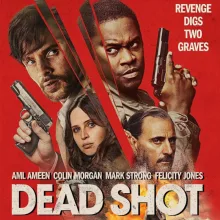
Mike speaks to directors Charles and Thomas Guard about their latest feature, Deadshot (2023) which opens at select theaters August 18, 2023.
Transcript
An automatic transcript, tidied into paragraphs. It has not been proofread, so names, titles and spellings may be wrong, and it does not say who is speaking.
Show the transcript (about 2,400 words)
Speaker 1: Your ears. It's show time.
Speaker 2: People pay good money to see this movie. When they go out to a theater, they want cold sodas of hot popcorn and no monsters in the projection booth. Everyone pretend podcasting isn't boring.
Speaker 3: Running off. What is it? And you can lose them in the woods. I'm not leaving you.
They're not after me. You are about to be prosecuted for murder or you can work for me. What's the situation, sir? Being and they've been giving London a taste of the troubles.
If I could use a dead child like you, I'd say that's a step up from a man in your position.
Speaker 4: I'm going after the soldier that killed Carol. The man you want is working for the police. What's the purpose are you visiting? I'm looking up an all round does no longer live.
Speaker 3: We're gonna make them pay for this, do whatever's necessary, pregnant woman have nothing. I'd like to finish this. Let's flush him out. I can't run away from this.
Forgive me. MIKE WHITE: Hey, folks. Welcome to a special episode of the projection booth. I'm your host, Mike White on this episode.
I'm talking with Charles and Thomas Guard. They are the co-director of the new 2023 film called Dead Shot film will have a limited theatrical release starting August 18th, 2023. Be sure to check your local listings. And I hope you enjoy this interview.
Obviously, your brothers, you've got yet another brother who also worked on the film. Your dad has been in the film industry. Were you pretty much always faded to be filmmakers? A mum was.
CHARLES GUARD: In the industry too. They met in the studio. She mum was an animator and then an editor who had just brought up in it and always loved it. And both our parents had a great love of film and had a huge be to max collection of video tapes that we were obsessed about.
When we were younger. THOMAS GUARD: We have a photograph of the two of us in Monument Valley looking through an a flex camera in the middle of a road, one of those giant roads and Tom's looking through the camera and I'm holding it and I'm probably three and Tom's probably five. It was always part of our lives and. MIKE WHITE: I just can't get over how long you've been actually working in the industry already.
CHARLES GUARD: We trained in the camera department. So we became assistant camera technicians and really loved that loved working with cameras and working with camera men and women. And it was almost our natural home with the camera department. And then when we started making films, we used to muck around a lot together with video cameras, like many people do and make things at home.
But when we got to university, there was a comedy group Cambridge called The Footlights, Famous Comedy Group that people like the Monty Pythons and Fran Laurie, people like that came out of and one of the guys there to write a script and short film and we started prepping it and obviously all the students just had no experience working on films or and didn't really understand what was required. And I had to call Charlie up and say, look Charlie, you've got to come up and help me out here because this is a nightmare.
I'm never going to be able to do this on my own. And Charlie hadn't even started Cambridge yet, but zoomed up and that was the first time we properly collaborated together. THOMAS GUARD: Yeah, I just finished working on Judge Dr and I knew that I was coming up to university. So it was, yeah, it was.
But yeah, it was the first time and it would just work really well. The night before she told me going, sitting in that restaurant like scratching out storyboards and so anxious about what you were doing. It was crazy. CHARLES GUARD: But yeah, everyone was like the students were like a 6 a.
M. Call. Are you kidding me? THOMAS GUARD: What was amazing about that was, it was the first time that in a very Semiprofessional capacity we were doing basically what we had always done back to the days of monument, like looking through cameras, setting up shots and just coming up with fun ideas of how to go about capturing something on film, whether it was a performance, a mood, a kind of, you know, something.
CHARLES GUARD: Is the first screen role of Olivia Coleman as well. So she'd done a lot of theater and she was doing a lot of theater was a great star or even then. But I think it was the first time she'd done something on film video. I say, well, as we were cheating on, it was a great experience.
It was fun. MIKE WHITE: I'm always curious when it comes to directing teams and especially when it comes to brothers working together. How do you guys divvy up the work? Like when you're working on something like dead shot is one doing the in front of the camera stuff while the other one's dealing with the behind the camera stuff.
I'm like, how do you guys actually divvy up the work? THOMAS GUARD: We tend to keep it very organic. It's a very kind of fluid. It's all very much grows out of the conversation that we're having, we've been having with the actors that we've been having with each other in terms of the story and the direction of the story and everything just really evolves out of that.
We tend not to divvy up any roles. It's not like one of us will deal with the camera and one of us will deal with the actors. I think the Pang Brothers China, one of them preps one day and then we shoot that day and the other preps the other day and he will shoot that day. The ROTA goes Monday and Wednesday, one of them is directing Tuesday and Thursday.
The other ones that's not really our speed. MIKE WHITE: Tell me more about dead shot. And where did the idea come from? CHARLES GUARD: We were shown the script by our agent and Ronan Bennett had written a couple of drafts and Chris was producing it and the project had never quite got over the line and had stalled and Chris was trying to reinvigorate it and had always believed in it and center to our region and we jumped at the cat and mouse in it and the conflict between the two lead characters and we came on board and a reflected it with a lot of stuff that was going on in the UK at the time, which was a lot of sectarian and politics really in a way with Brexit and those kind of struggles and that kind of became a feel for it, for the story.
MIKE WHITE: Yeah, I found it very interesting that it's set during the troubles, but it does feel so contemporary to your point that it does feel like there is the lens of 2022 2023 looking at these things that were happening in the past, it was shocking. THOMAS GUARD: The more we explored the subject matter, the more shocking we found it actually how relevant it was to today. We very much went in with this pitch of making Holland and Keenan, these incredibly kind of toxic males who these arch manipulators taking characters like Michael and Tempest who perhaps have more innocent desires in their heart, but taking those characters and manipulating them into a place or putting them into a place where they were capable of enacting these kind of atrocious acts of violence.
That was something that, that we felt was very contemporary and was a worrying similarity really with what we're all going through now in terms of the politics and the world we live in. But there was, yeah, it's, we also, we really tried very hard to tap into the kind of more universal aspects of the story, this idea of revenge and how hate and revenge and that thing that, that, that can, that Engine can be so universal. It doesn't necessarily need to be totally wrapped up in the world of politics, like the troubles or Brexit or any of these politics at the moment, you definitely lent into that.
And that was something that we felt we could turn into a very compelling and entertaining narrative. MIKE WHITE: Compelling is a great word for it because it is very much that and your two main actors are just riveting. CHARLES GUARD: Yeah, they were phenomenal. Colin Morgan who plays Michael is from South.
So he really had lived and breathed many of the things in the film and he was very familiar with it and really connected with it on a personal level. And a also felt a deep connection to it too, with his background. And both of them brought so much to it for those personal reasons. We feel they gave very instinctive emotional performances, which was a real treat in an action thriller.
So we always love to go a bit further than is possible. And definitely they brought, they lifted it up, lifted up the action and allowed us to access something that possibly you don't normally find in a film like this, which is what we'd really hoped, which was what our ambition was. MIKE WHITE: I think you definitely succeeded. It doesn't just feel like two guys going after each other for no reason whatsoever.
Just for petty reasons, there's some real connective tissue inside of this film. And you really feel the struggles that they have with their own personalities as well as the world that they've been put into. And you guys really capture that time period very well. It must have been quite a bit of a challenge to make the world look like it once did.
Yeah. THOMAS GUARD: With the kind of with the budget that we were working with and the time that we had, we knew that we really needed to find a location or a city to set the film in that would allow us to stay true to how we like to shoot, which is on as big a canvas as we can really. And we don't like that. They're kind of following just actors just on their faces and staying with that.
You love. It's so nice to be able to see a period film when you do have whites and you can, you can inhabit the city and make that a character in the story. When we found Glasgow, we'd shot a commercial there actually years ago and always been really impressed with it and felt that it had that kind of grandeur of a really big city. But it also had pockets, large pockets that were seemingly untouched for years and years.
And that was what we set out to achieve was being able to find a city that that hadn't been developed where the property developers hadn't moved in and converted everything into kind of very *** and span flats and stuff. We wanted mud on the streets. We wanted big city blocks that still hadn't been rebuilt since the war where bombs had fallen and wiped out buildings and they had cleared rubble. But there were still these urban wastelands that were there that felt to us really important.
And Glasgow was amazing at being able to throw that out for us. It was changing so quickly though. We would scout stuff in prep and we would come back to it and it was different. They already had scaffolding up.
So it was a real challenge. We felt very lucky that we were making it when we were making it because in six months time, if we went back there now could be a different city. It's extraordinary how quick urban change happens. MIKE WHITE: What were some of your other challenges making this one the time?
CHARLES GUARD: Just the time we had to shoot quite complicated action sequences in a way, those limitations actually forced the visual style out of the process, which was really interesting. We'd always been influenced by films like the French connection and the breathlessness of it. But actually, we found ourselves just by default good going into that mode because it was the only way to actually get through some of these sequences was to adopt that kind of style. It was quite liberating in a strange way that the limitations actually played in an interesting aesthetic.
MIKE WHITE: Can you tell me a little bit about your DP? Because the cinematography on the film is remarkable mates. THOMAS GUARD: He's an amazing DP. Mattes rude.
He's Swedish and we've worked with him for a number of years on commercials and he hasn't done too many films. He's done some films in Sweden. But for somebody who is as highly regarded as he is in the commercial and music video world, it was a real honor to be able to work with him on this because we were just so excited when he arrived because going around showing him some of the locations that we had found and showing him some of the city. It was really exciting to see how, how fired up he got about, about that rawness and the grittiness.
And yeah, he was amazing. It's brilliant. MIKE WHITE: TP I'm really excited for more people to see the movie, Mr Guard and Mr Guard. Thank you so much for your time today.
This is wonderful. Thank you so much. THOMAS GUARD: Thanks. Thanks Mike.
Ok.
Speaker 8: That must, now, it will be an offensive, must be prepared to break the enemy's and right. I got honored. Yes.
Comments
No comments yet.