
Episode 635 · Film year 1997
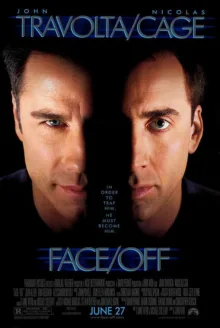
Face/Off (1997)
- Special Guests
- Mike Werb, Michael Colleary
- Guest Co-Hosts
- Samm Deighan, AJ Black
Show notes
Samm Deighan (opens in a new tab) and A.J. Black (opens in a new tab) join Mike to discuss this landmark action film while screenwriters Michael Colleary and Mike Werb talk about the long, strange history of the movie.
Labels: AJ Black Gina Gershon Joan Allen John Travolta John Woo Michael Colleary Mike Werb Nicolas Cage Samm Deighan
Transcript
An automatic transcript, tidied into paragraphs. It has not been proofread, so names, titles and spellings may be wrong, and it does not say who is speaking.
Show the transcript (about 28,300 words)
MICHAEL COLLEARY: Your ears. It's show time.
Speaker 2: People pay good money to see this movie. When they go out to a theater, they want cold sodas, hot popcorn and no monsters in the projection booth. MIKE WHITE: Everyone pretend podcasting isn't boring. Turn it off.
What are you asking me to do? MIKE WHITE: You're asking me to break the law, risk my neck and you're asking me to put in the dark, all the people that love me and trust me the face. I'll do it. Yeah.
What do you want? Take one goddamn guess? Plan B. MIKE WHITE: Let's just kill each other.
Welcome to the projection booth. I'm your host, Mike White. Joining me once again is MS Sam Degan. Also back in the booth is Mr AJ Black.
AJ BLACK: I'm ready for the big ride, baby. MIKE WHITE: We kick off sci-fi July with a look at John Wu's face off. It's the story of two rival hockey players Sean Archer and Castor Troy who find themselves in the heat of the drive to the Stanley Cup in all seriousness. It's the story of Sean Archer played by John Travolta, an FBI agent whose son was killed by his enemy.
Castor Troy played by Nicolas Cage six years later, Troy has planted a bomb somewhere in L A and after he's accidentally put into a coma, Archer must put on Troy's face in order to find out where the bomb is. Has anyone actually listening to this podcast? Never seen face off? I am totally curious, especially amongst our younger viewers, but hey, if you haven't seen it, go out, check it out, come back after you have, we will be here and you won't be sorry.
So Sam, when was the first time you saw face off? And what did you think? SAMM DEIGHAN: I saw it when it came out? And I believe it was my first John Wu movie and I was just like, what the hell is this?
This is maybe the greatest thing I've ever seen, which I think should have given me a clue that although of course, I didn't have the context to put it together at the time but should have given me a clue that I would have come to just love Hong Kong cinema, especially Hong Kong action cinema because I think this feels just like a Hong Kong movie in so many ways that makes it pretty unique among Hollywood action films, even though it came out at a time when action films were dominating and were super popular, but it still manages to feel so different.
MIKE WHITE: How about yourself? AJ BLACK: Very similar. Really? I'm equally old enough to have seen it when it first arrived in 1997 at 15 years old.
So you can imagine how much this ticked my box is. SAMM DEIGHAN: I was, I was 14 and it was like. AJ BLACK: So it's teenagers. Like this is like, yeah, awesome.
And I, yeah, I would have gone to the cinema to see and it too very similar. Fried my brain a little bit because I think I'd seen on VHS because like most of us we were renting at the video shop back then before the age of streaming a DVD. And I saw Broken Arrow. That was my John Wu history there.
And I hadn't seen some of the Hong Kong stuff. I'd heard of it, but I'd seen Broken Arrow. Broken Arrow. Obviously.
I don't think it's quite as good as this, but it's definitely as loopy at points and it's crazy. And I really enjoyed that. This was just a whole other level of great and visiting for this podcast. I hadn't seen it for a long time and I just, it just trans, it really did transport me back to 1997.
It just threw me right back there and it is genuinely, it is unique. It is really different from a lot of the stuff that was made then. And I just couldn't imagine anyone making this film in this way now. Like it is so unusual and brilliantly unusual.
So, yeah, I loved it straight away. MIKE WHITE: I was familiar with John W at this point. I had seen the killer, the better tomorrow films, Bullet in the head, Hard Boiled. When he moved over to the States, I was right there watching Hard Target and Broken Arrow.
Face off. Nevertheless. Yeah, totally blew me away. This is the closest I think that he made.
Like you were saying, Sam, this is the most Hong Kong of his American action films for me. This is kind of the pinnacle, you know, like I agree. Broken Arrow. It was, yeah, kind of goofy and had some moments and stuff and it was great seeing John Travolta just chewing up the scenery in that one.
You're out of your mind, ain't it cool? And her target also had some great moments. What kind of a name is? Chance?
Well, my number 21 after this, I used to really like Mission Impossible too, but rewatching it again. It's, it's a, it's a slog paycheck just never really did it for me. So yeah, he just kind of, you know, this, this was the top for me and just to have Travolta and Cage and just that they are kind of perfect for this movie, this whole idea of them being able to over emote, you know, just that melodrama that we saw in the Hong Kong films, they're able to bring that as well as just the intense mugging that they are perfect for both Cage and Travolta are the biggest hams in the world and it is perfect for this type of movie where you have to vacillate between the Haines, the mugging, the over emotion of this.
And I'm gonna be bringing up, I'm gonna be bringing up Hard Boiled and the killer often in this discussion because those movies share a lot of these ideas of, you know, the cop and the killer and the killer and how similar they are. You know, when you've got Danny Lee sitting on the couch and he's kind of feeling where Chaa and Fat had sat before and the same camera movement going on. You get a lot of those movements in this. You get a lot of the parallel lives of these characters and just the inter cut between the two stories because really, it's almost like you have two movies here and you just kind of cut them together where you've got, you know, the Sean Archer movie and you've got the Castor Troy movie and they intersect at times kind of Star Trek two, the wrath of Khan where they intersect at times.
But we never got to see Con and Kirk go hand to hand. They're always talking through a screen and this one man when they come together, there's a lot of fireworks sometimes literally. SAMM DEIGHAN: AJ made this point a minute ago that you would never be able to really see a film like this today. And as much as I think Tom Cruise is an absolute lunatic, I have some respect for him for insisting on real stunts for the Mission Impossible series.
But I can't imagine anyone agreeing to the stunts that happened in the, I would say 1st 20 minutes and last 20 minutes of this film, like, looks so dangerous. And even though there are sequences where you can definitely see that it's a stuntman and not either of the leads, it like doesn't take away from the sheer operatic amazing. Like it just, it feels so real and it so clearly is not CG I it's not in front of a green screen. It's like they are actually blowing up boats and anything that John Wu could get his hands on.
I feel like he blew up at the end of this film. A plus. MIKE WHITE: Yeah, there's so many explosions. I forgot about all the boats that explode at the end.
SAMM DEIGHAN: Of the and the boat that drives through the boat in order to make it explode. I totally forgot about that. Not that I'm trying to jump to the end here. AJ BLACK: But you got to love this era of Hollywood though, haven't you?
Where everything would just blow up immediately? Like any car that goes off like it, like it just, it's just the best. It is the best. I tell you what though you mentioned in Tom Cruise though.
I totally agree with that point. I'm, I'm a big fan of him on screen and because of the fact he will absolutely just go for broke and do anything. Maybe it and that obviously then John will go, John W goes and works with him in Mission Impossible too. And to be fair as much as that, he's not even close to being as good as face off.
It feels like he's trying to remake face off in some senses with that film in so many ways because he's got the two dual people, you've got the hero, the villain, you've got literally the faces coming off and the mass and all that kind of thing. And a lot of the action sequences again are similar. You know, you've got a big tussle on sort of a beach bit. You've got these two guys who are dark reflections of themselves.
You've got chases, you've got, it just feels like he's this, he's like his ultimate goal, this kind of movie that he does with face off with this, exploring this duality, exploring these, these archetypes, but he never manages to pull it off in quite as entertaining. And as Zany a way as he does here and it work. SAMM DEIGHAN: Ringo Lam and John Wu both ran into the problem when they started working in Hollywood that they basically had stars and producers kind of take control away from them in a lot of ways. And I feel like maybe the reason why face off is so perfect is because this was really, I feel like the one instant where he just called all the shots, like even down to, you know, your joke in the intro about this is not a hockey movie, making sure that the slash is in the title.
And I just, I wish he had had more chances to have a budget this huge and to be able to have such tight control over the production because I don't know for sure. But I assume that wasn't the case with Mission Impossible too. I feel like Tom Cruise kind of runs the show there. MIKE WHITE: And I know that Paramount and specifically Sherry Lansing was like, I want a John Wu film and that's what she got.
This was the one with the least interference. It's interesting, the writers are really involved in the production of this and really trying to ensure that Wu's vision comes through. It's like they said, oh yeah, we were doing this writing and then we went to see the Killer and we realized that we had accidentally written a John Wu film and I was like, well, that's good. You know, I'm glad that you figured that that out and he kind of flirted with the project early on, but he was like, oh no, it's way too sci-fi and then moved on to a few other directors and went through all these revisions and they were losing the sci-fi through the script in all these revisions.
And then when it came back to him, he was just like, hey, it's perfect. This is great. Now, we've lost that. We are 20 years in the future and it's much more of a potential 1997.
Obviously, you know, the surgical techniques are not as perfected. We don't have people swapping faces and bodies as far as we know, maybe Q and I would tell us differently, but, and we don't necessarily have these ultra high tech prisons as far as I know. SAMM DEIGHAN: We probably do, we probably do. MIKE WHITE: Yeah, I mean, this whole idea of putting the prison out on the oil Derek.
It's funny that at one point, Stallone and Schwarzenegger were talked about with this movie and then they would go on later on to make a escape plan which is super similar when it comes to this ultra high tech prison type of thing. SAMM DEIGHAN: If they had kept that original idea to make it more futuristic, I feel like it almost would have been too close to something like demolition man, which it does and I love it, but it feels, I think because it is futuristic, it feels like more cartoonish in a way and part of why face off is so great is it has that Hong Kong melodrama at its core.
It's like when things aren't exploding or when people aren't just like punching the shit out of each other. There are these like serious emotional sequences and I can't imagine this being anywhere as good if there had been a different lead pair like Stallone and Schwarzenegger, I think would have made it great in a different way. But, like, can you imagine who was it originally supposed to be? Michael Douglas and Harrison Ford?
AJ BLACK: Like, it would, it wouldn't have worked because that's the thing. The eccentricity of Travolta and Cage as people is a massive reason. I think why this works and why in Broken Arrow Travolta and Christian Slater don't quite work as well together, even though they're not exactly the same characters. I know, but you've got the bad guy and the good guy doesn't quite work in the same way.
Whereas these two are just, they're both a bit crazy as people and they have that like a bit like the Tom Cruise thing in the sense that, you know, they're eccentrics and they do things in a different way. These two though are Zaia, aren't they? They can bring that wild eyed who think to their performance and they can go, I mean, there's so many seeds in this where Cage is vacillating in the moment from laughing like a maniac to crying, you know, and it's brilliant. No one else could do that.
No one else could pull it like him. SAMM DEIGHAN: John Travolta has given a lot of really mixed performances throughout his career. But anytime I hear someone say like, oh, he's just not that talented, I'm like, you got to watch face off where he plays Nicolas Cage for 70% of the movie and he, I think this is good. This is my favorite role of his entire career.
Like, he's just so good, like, down to the sort of like shoulder and like hand gesture mannerisms that he kind of leans more into in the second half of the film. Perfect. MIKE WHITE: Oh, yeah. Some of the things that he does where he's, like, not doing the face hand thing, which was always disturbing to me, but I.
SAMM DEIGHAN: Hate, I hate the face hand thing if I saw my dad for the first time after thinking maybe he died and he just like, and his hand down my face instead of giving me a hug. AJ BLACK: No, he does, he does creepy towards his daughter. Incredibly. And his wife too.
SAMM DEIGHAN: Yeah. AJ BLACK: Yeah. Yeah. Yeah.
MIKE WHITE: Yeah. When Adam comes in at the end again, jumped to the end. Dominique Swain just like runs her hand. Jamie runs her hand over this kid's face and I'm just like, wow, what would you think of that if that beautiful older teenage girl came up and rubbed your face like that?
I'm like, what the hell was that? SAMM DEIGHAN: It does. It makes it feel kind of sci-fi like they just have a different social standard for, you know, affectionate greetings. And it's, did you just run your hand right down someone's face?
MIKE WHITE: It's a dog too thing. You know, dog too. Family would do that to each other. SAMM DEIGHAN: Maybe they got it from face off.
AJ BLACK: Is this an example though, in a way of how that, those American conventions that wo in some ways, either dials down or he strips away or he says just go for it are visible. Whereas if you'd had an American filmmaker, I mean, I think, I think I read that Andrew Davies who made the fugitive was at one point interesting. Or it might have been Hard Target. I'm not sure, sure, actually, maybe it was hard to target, but a more conventional American director anyway, someone like that wouldn't, you wouldn't have had those kind of, those kind of things.
I think in there, I think that's where Wu is bringing that in and then just saying, just go for it, you know, just do what's in your head and then you get things like the face that and that's great because it adds that extra reg, it adds that extra strangeness to it that register that you just so it's just off, but it works, it works so well in a way their dynamic reminds me a little bit of like Sherlock Holmes and Moriarty, not so much in the stories but in some of the film adaptations where you get this sense also kind of like Batman and the Joker, even though on the surface level, it seems like you have the good guy and the bad guy idiot, you made me remember you dropped me into that bag of chemicals that wasn't easy to get over and don't think that I didn't try and you killed my parents.
What, what are you talking about? I need, you made me first a bad brain. I mean, I was a kid when I killed your parents. I mean, I say I made you're gonna say you made me and how child is you get, you wouldn't get a guy with glasses.
SAMM DEIGHAN: On, would you? They're both deeply weird people and that, that, that's why it sort of works that they swap. And I love that they kind of get enmeshed in each other's lives. And those sequences where Caster is like a good husband and a good father in his own way.
At least for a couple of scenes. It's wonderful. MIKE WHITE: How ironic is it that Danny Masterson plays a rapist in this movie. SAMM DEIGHAN: When I was rewatching it last night?
I clocked that's who it was and so disgusting. MIKE WHITE: I was like, is this your inspiration, Danny? Like what's going on? But yeah, when Travolta kicks the shit out of him.
Oh, it is great. Foot through the window of my car. AJ BLACK: Oh, I love it. That is powerful.
Like you've got to have a powerful leg and foot to be able to do that. Like that is, you know, and that's the thing Travolta can, he can pull that off, can't he can pull off that powerful action man dynamic there. He makes that you don't think, oh, this is ridiculous. He absolutely pulls that off, you know.
And I, yeah, that sequence where he beats the shit out of that guy is. SAMM DEIGHAN: I wish he would do that in real life or, like, drop him out of a plane or something. You know. He's a, he's a pilot.
MIKE WHITE: Yeah, which never comes back unfortunately. Like, I know he was supposed to take off from the prison in that helicopter, but just didn't work because we know that he can Fly a helicopter and stop a plane with his helicopter, which is great and sort of defies the laws of physics in a lot of ways this whole movie defies the laws of physics. AJ BLACK: The thing I keep thinking of in terms of the technology is obviously the faces you might be able to make the faces work. But the bodies like, you know, there is no, there is no way his wife wouldn't notice he's visibly different.
You know, it's just you really have to do. SAMM DEIGHAN: Or anyone else. Like they have this really weird line towards the end when Nicolas Cage says something about like what it's like to wear Travolta's face. And he says, and also your body and it's like, whoa, whoa, whoa, this isn't a body swap movie.
There was no surgical body swapping. No, no, they did. MIKE WHITE: They sculpted the stuff I remember he talks about getting rid of the love handles and doing like the hair implants because both of these guys especially Cage are hairy motherfuckers. So, it's like very specific, the pattern of the hair and, yeah, it gets rid of the scar and all that stuff.
It's kind of wild. SAMM DEIGHAN: I guess you can't overthink it too much. MIKE WHITE: No, no, no. This movie will fall apart as soon as you start to think about that stuff.
It's just the whole thing of like, oh, yeah. And we can heal you really fast. So that way you can show up at the secret prison, you know, a day later after you Torch the entire Walsh Institute and all those poor people in there. I mean, just the levels of violence in this movie.
Sometimes you're like holy cow and then having to put Sean Archer as Nicolas Cage in all of these positions where he has to shoot all of the people that he would normally be working with. You know, he's takes out so many people. I know occasionally it's like I shot that guy in the leg. Oh no, I shot that guy in the foot but there's times where he's just like, yeah, I'll throw up this can of sulfuric acid and shoot this and it'll explode in these guys' faces.
I'm like, OK, yeah. SAMM DEIGHAN: That sequence is just evil. I think there is one scene where he stops himself towards the second half where he stops himself and says an FBI agent's name and the guy looks at him like, but I mean, and he knocks him out instead of shooting him. But it's like you would think that that would happen about 100 times.
MIKE WHITE: And no, it just happens the once, it's like telling the Terminator not to kill all those people in Terminator Two and he's just all those knee shots that he's doing. SAMM DEIGHAN: One of the things that really drew me in when I first watched it is when he first goes to prison and he's trying to be undercover, but like is sort of mentally trying to make the transition from this serious kind of humorless sad sack grieving FBI agent to a character who's basically kind of the Joker. He, when he starts beating the other prisoner, you get the sense that like he's enjoying himself and maybe he's not really that far from Castor Troy after all, it's so good.
MIKE WHITE: Well, I think Tony, you alluded to that moment earlier with the whole crying and laughing stuff. I mean, that whole I'm Castor Troy, I am Castor. I mean, that is just one of those amazing scenes that reminds me because we spoke about Hard Boiled years ago on the show and there's the moment where Tony Leon has to shoot his boss in front of Anthony Wong in order to prove his loyalty and he shoots him and he's got this big smile on his face. And then as soon as he walks away from the crowd, you see the anguish come onto his face and it's like that little moment becomes huge in Facebook.
It's like they just explode that. So now it's, I'm cast Troy, I'm cast. It's like screaming and everybody's going at it and then you get the look on Cage's face, which is beautiful and then he brings it back to the joy and the glee and sometimes when he gets his, like when he's talking with his brother and he has to like put on the crazy face and I'm like, that's pretty good man. And that it's Cage putting on Cage's crazy face is so good.
SAMM DEIGHAN: Hard Boiled Tony lung. You know, he's one of my favorite actors and I think he does that kind of tortured melodrama. So well, there's so much about face off. That is, as you mentioned earlier is definitely similar to Wu's heroic bloodshed movies like The Killer and Hard Boiled.
But it also I think really inspired Infernal Affairs which Tony Long is in and it's funny to watch them back to back because Infernal Affairs, it's like a realist non sci-fi version of these two guys kind of switching roles, but it feels so much darker because they aren't expected to have those kind of like psycho over the top moments. MIKE WHITE: That was the whole thing with watching Infernal Affairs. The first time that I didn't get until I watched the Departed was I was having such trouble telling the leads apart in Infernal Affairs.
And then when I watch The Departed, I was like, oh, I'm supposed to have trouble telling who these leads are apart. But luckily it's American actors. I recognize them a lot more, but at the same time it's like they just kind of mesh and pass each other and you don't know who's the good guy and who's the bad guy. Which is a great thing.
Very, you know, like you were saying, it comes out of Hard Boiled where it's like the undercover police officer versus the hot handed super cop. And we don't know exactly where one starts and the other one ends. I thought that was internal affairs is a great, great movie. AJ BLACK: That feels like the key of it.
It is, it is very much exploring that idea of the binary. We're not good or bad. It might be in this almost comic book, sort of hyper real world in some sense. But that there is that blending of those personalities, there are points where they almost feel like they lose touch with who they are in versus who they're pretending to be, as we've said.
And I think that being more traditional, more straight laced actors in a way, I don't think you would have been able to communicate that in quite the same way. Both of these, these guys can play crazy and serious and down to earth at the same time, I is why they can switch so quickly between these, these points and you can have scenes where even they don't seem to know who they are anymore or they're starting to lose their grip on reality. And that's brilliant because it then also allows you to see a softer side of Castor or like a more human side of Castor.
And then the same time you can see where Sean may be. He's genuinely, he starts the movie quite disturbed anyway, doesn't he? You know, he's grieving a dead son. He's, I think you might, you might have made the point, Michael or suggested it before where he might actually be on the verge of suicide when the film begins.
You know, he might be conti contemplating it. So he's not ok. You know, even though he's the conventional hero, he's not ok. You know, so the fact that you've got these characters and they confuse between each other, that is, I think why this film is so interesting and why it actually is so exciting in the end of the day as well.
Even, even though it comes down to the fact you want the good guy to prevail over the bad guy, it just gets a bit messy or by the end. SAMM DEIGHAN: I kind of wish that they had kept that alternate ending where he, you know, he looks in the mirror and sees Castor Troy and you get the sense that because like, you know, I know we've already discussed that you can't really apply realism to this film in any way. But you have to think that like for somebody like Travolta's character who's so devastated by the death of his son.
And like six years later, he's still obsessed. He would probably be pretty psychologically damaged by being forced to kind of inhabit the body of his son's killer. And also the fact that we have a Hollywood movie that opens with a kid being shot to death on a carousel. Amazing.
MIKE WHITE: That was one thing you could always count on Hong Kong movies for was like child death. I mean, things like the heroic trio when that baby gets the nail in the back of its head. Oh my God, crazy. Right?
And you're like, this could never happen in a US film. AJ BLACK: Wasn't Wu's original plan for Hard Boiled that it would be about a baby killing. Yeah. Yeah.
And then, and then he changed that because he sort of went well, I don't want people to get ideas, which is a good thing, right? But yeah, the fact he's not afraid to go there, you know, and suggest that. Yeah, it's really powerful because there's no way in a million years. Hollywood conventional Hollywood to say.
Yeah. Ok. That's ok. You know, they just wouldn't do it.
MIKE WHITE: When you're talking about the confusion between the characters when they don't really know who they are anymore. The moment when Nicolas Cage as Sean Archer starts to apologize to Gina Ghan as Sasha Hassler and what he's talking about it almost sounds like he's apologizing to Joan Allen if she was in the room, like when he wakes up and he says Eve and he continues to talk and it almost sounds like he's talking to Eve. But at the same time, you know, the dialogue doubles as the first time Castor Troy has probably ever apologized to Sasha and she doesn't know really what to make or anyone the first time he's probably apologized to anyone ever, I've said and done some things that made your life harder.
Speaker 6: I know. How would you when he left? He never looked back. I just know.
MIKE WHITE: And then at the same time, you're like, well, is that Castor Troy apologizing or is that Sean Archer apologizing to Sasha? Because he has made her life hard. You know, he's made every woman in his life has made it hard. His daughter, his wife, main squeeze of his enemy.
I mean, he's probably done a lot of horrible things and that's so much of this is that we know he's a flawed character at the very beginning of the film, the way that he treats his wife treats his daughter. I love when his daughter has to lie about like, you wouldn't know me anyway, like you wouldn't even recognize me. And I'm like, oh yeah, that's going to come up later. There's a lot of clever lines in this script.
SAMM DEIGHAN: I love that in that scene with Gina Guha when they're kind of alone for the first time. He's also out of his fucking gourd on drugs. And it's such a perfect addition to the script because it feels like something that Castor Troy would do. But it also makes it harder for him to internally sort out who he actually is.
But I've always been curious what those drugs are supposed to be. It's like they empty two capsules into water and drink them. But the way that they both react it seems like they just like snorted a whole bunch of Ketamine or something like immediately dissociating and, you know, there's that great line where he's like no more drugs for this man. AJ BLACK: Do you think that might be a holdover from a more futuristic sci-fi idea where maybe by then they had a drug that was the ultimate sort of, oh my God drug in a little capsule and they just drink it.
I don't know, maybe it's that kind of thing that it's sort of a future idea. MIKE WHITE: Yeah, they make a mention when he's talking with an unrecognizable Thomas Jean as one of his. SAMM DEIGHAN: Oh my God. He looks like such a nerd, right?
MIKE WHITE: So it doesn't look like Thomas Jane, but he says something about like something about bad Quant and I'm like, oh OK. Quant is the fake drug in this movie? Ok, I got it. So, yeah, it might be that sci-fi holdover.
I mean, it's not as devastating as slow. Mo, the drug from dread. SAMM DEIGHAN: But, which is so good. Yeah.
MIKE WHITE: But definitely seems to do a good job for this guy. SAMM DEIGHAN: Yeah. It's almost like Ketamine and DMT combined. But instead of having to snort it or smoke it, you can just conveniently crack open a capsule into some water and drink it and then be out of your mind.
AJ BLACK: Is that the same scene where he see, he hugs the boy and he starts going Michael, Michael Michael. SAMM DEIGHAN: And she's like, she's like, whoa, you're scaring him. AJ BLACK: Yeah, because he's, you know, because that boy would be like, what's going on. Yeah, I think it's, it's just the way he does it though.
It's just full of like, oh my God, it's just real sort of that melodrama is just right there. MIKE WHITE: Yeah. And it's like that kid is not Michael. His hair is way worse than your son's was.
It's got that Adam Rich haircut. I'm like, what are you doing in 1997? Kids? Didn't look like that, did they?
SAMM DEIGHAN: I think they did. I mean look at, look at like what was his name? Jonathan Taylor Thomas. He when he had that like weird bowl cut thing going on.
AJ BLACK: Oh, the bowl cut was very nice. The kid, the kid hair in this reminded me of the kid in Li Lia with Jim Carey. That hair. That was very naughty boy hair.
MIKE WHITE: Yeah, late nineties, especially in almost every woo film. There's our main heroes and then there's their adjacent, you know, like in the killer, you had Danny Lee had his superior and then Charlie and Fett had his kind of handler Sydney and he also had that relationship between those guys or did they have a relationship and just, you know, was that whole dynamic in this one Archer really doesn't have that support network, which is key because he needs to be totally alone and isolated. Once Tito and the Cch Pounder character die, they're them.
And Colum Fior are the only ones that know who he really is. So he's completely cut off. And then you've got on the Castor Troy side, Pollack, who I find to be a fascinating character. And I really love the performance again where you're just like, where is Alessandro Novoa coming from with this character?
Is he like late and homosexual? Is he? He kind of like at one point he looks like a super villain where he's got kind of reddish hair and the green shirt. I thought I was thinking of like the Joker or more likely the Riddler, he's just so squirrely.
I love how squirrely he is and he's got the bedhead hair going on really a great, great performance. SAMM DEIGHAN: And then also that when he dies, spoilers that really affects, you know, Castor Troy and suddenly he knows what loss is because he doesn't seem to have known before that in a way his performance reminds me of some of the later Sam Rockwell performances where, where he does play those kind of super smart but very squirrely manipulative, like, fundamentally up to no good kinds of characters. MIKE WHITE: Yeah, like an Iron Man Two or something.
SAMM DEIGHAN: Even like Alan Cummings character in, Golden Eye where it's like, there's that super, super smart character who appears to be kind of weak and effeminate but really is like, capable of pulling the strings in the background. MIKE WHITE: Yeah. And you wonder who's more vicious sometimes. You know, he seems a little slow but other times you're like, oh, no, this guy's got a lot of gears in his head that are just clicking away and that he was the one that even designed that whole super bomb that they have.
AJ BLACK: He's also got the delivery that Nala gives it. He's so odd. Like, it's a really strange kind of voice going on. You know, it's, it's really unusual.
SAMM DEIGHAN: That suggestion that he is kind of like the Riddler a little bit like their performances and even their roles on a script level do seem to be pretty comic book informed in certain ways. But also the Greek mythology references. One of my, like first loves once I learned to read as a child was, I would just like, read encyclopedias of Greek mythology because, you know, that's just what I did. Yes, nerd.
But when I first saw this and realized that these two brothers, I don't know if they're supposed to actually be twins in the movie or just brothers. But the fact that they're named after Castor and Pollack, it's kind of like you have to kill one in order to actually defeat the other because they seem so closely linked. And I think it's important, as you said, that Sean has to be alone in contrast. Although he does have Margaret Cho inexplicably on his team of FBI Agent.
Like, how did she wind up there? MIKE WHITE: Yeah, that was strange casting but I was glad that it happened that awkward delivery of, did you just have a surgical procedure? SAMM DEIGHAN: It's such a good joke though. AJ BLACK: About the Greek myth mythology stuff though Castor and Pollock's great, but they really try and nail it home, don't they?
With Troy? Like just in case you didn't get the idea. SAMM DEIGHAN: With Troy and with the somewhat creepy naming of Adam and Eve, he like, I was like, OK, what, what is this? MIKE WHITE: The commentary tracks are interesting on this, especially because they're almost duplicate of each other.
There's one with the two writers and then one with the two writers and John Wu. So a lot of the stories that the writers tell are identical between the two commentary tracks and they're probably pretty close to what you're gonna hear later on when we hear the interview with them. But they were saying at one point that Nicolas Cage as Sean Archer has no place to go to and one person he tries to go to is Castor's mom's place. And you don't really realize that until she opens up the door and, you know, it's this really decrepit old lady and all this kind of stuff.
And her name Helen Troy. SAMM DEIGHAN: Of course, although if they really were students of Greek mythology, her name would be Lada. That also makes sense because there's this line, this just like quick throwaway line that's always kind of bugged me where he gets a look on his face. And this is, you know, Nicolas Cage playing John Travolta.
He gets this kind of upset, revolted look on his face and it might be his brother. But somebody says to him like, like what's up? You look like you just fucked your mother. AJ BLACK: That's his, that's his guy in the crew, isn't it the bold guy?
Yeah. He says that to him. Yeah. Yeah.
SAMM DEIGHAN: Yeah. That's Yes. Which it's so it's also so weird that Nick Cassavetes is in this but he's great in it. And I cannot get enough of that scene where they just are constantly repeating face off to each other.
Perfect. You want to take his face. Yes. MIKE WHITE: His face, eyes, nose skinny coming off the face.
Apparently that went on for a long, long time. What we see is the cut down version, believe it or not. SAMM DEIGHAN: No, I do believe it because I know that Nicolas Cage loves to improvise, which can have great results on screen, but I'm sure it is very frustrating. If you're just like trying to work and get a scene filmed.
AJ BLACK: Didn't we also let Cassavetes, like, write his own dialogue quite a lot, a lot as well in this film? So that's interesting. You know, maybe that, maybe the fuck your mother thing came from him, you know, who knows? SAMM DEIGHAN: But it would have made more sense.
I mean, it doesn't have to make sense. It's a great insult but would have made a different kind of sense if there had been actually a scene where you get to see the Troy's mother. MIKE WHITE: And then there's that incestuous relationship between Sasha and Dietrich. And when they kissed later on, they had to actually cut away from the kiss because the kiss went on for so long and was so passionate and I'm like, oh wow, ok, like, and Cassavetes had all of these thoughts around their characters at one point because he ends up getting killed Nick Cast.
So get another loss and in her mind and in Sasha's mind, it is Sean Archer that kills her brother, but it was actually Castro in Sean Archer's body. And so now she's got this thing against Sean Archer. And so when she shows up at the church later on, she was talking to Wu she wanted to shave her head in kind of solidarity with her brother and he was like, no, no, everybody's just gonna be staring at you in your head. SAMM DEIGHAN: I mean, I think she has something against him from the beginning though because he tries to press her into giving Castor's location and sort of threatens her and says, like, well, we'll take your son away, not realizing whose son it actually is.
MIKE WHITE: Yeah. And not realizing that he's almost being as bad as Castor Troy. You know, he's not murdering the son, but he wants to separate the son from the mother. And it's like, oh what are you doing?
You know, you should know of all people who should know that bond needs to stay intact. AJ BLACK: I think that's also a great example in a way though of like thematic and narrative foreshadowing because obviously at the end, he has to adopt that boy and he decides he's going to take the child of his, of his nemesis, you know, and bring him into his family. And that's amazing to think that you've gone from a point where he would have like he was going to do that to Sasha. And then at the end, he adopts the boy essentially.
Although I did think at what point is there any kind of like social services gonna get involved in and maybe say, is this a good idea to have the this boy to come and live with you and your family after what has just happened? But yeah, in that, in that sense, I think that's quite a nice way of doing it. MIKE WHITE: I have the bedroom already set up. We're going to rename the kid as Michael because I have all this Michael paraphernalia in here.
SAMM DEIGHAN: That's definitely one of my movie, Pet Peeves. I feel like it happens so often in Hollywood movies where at the end there's just like a kid left behind and someone's like, you know what, we'll adopt this kid and there's never any suggestion that like to adopt a random child is kind of an onerous legal process. It's like, no, this kid just lives with us now, which I think is I part of me wishes that a couple of years later we could have gotten a sequel that shows that the kid is like just like Castor Troy and now the Archers have to contend with this like mini super villain turning into a teenager in their house.
AJ BLACK: There's a leg a sequel idea. If ever we heard one e do it now with the grown up Michael or whatever. SAMM DEIGHAN: I mean, I mean, he, you have to think like he didn't realize Castor Troy was his dad until right before the ending of the film basically, but like he still was raised by Sasha and her brother and they clearly have, as you just said, some kind of incestuous relationship. So like even though Sasha is very adamant about how she doesn't want him playing with guns, like that kid's probably pretty fucked up.
AJ BLACK: 100%. Yeah. Absolutely. Even, even, even if, even if in horrible moments they go put your earphones on, listen to.
SAMM DEIGHAN: Listen, listen to Olivia Newton John. MIKE WHITE: If there's one weak moment in this movie for me, it's just, that becomes so maudlin and just the counterpoint of her with that syrupy song compared to all of the violence that's going on and just when the kid wanders and he's got that the lights coming up underneath him and he holds his arm out like he's some sort of like alien or something. I'm like, this doesn't necessarily work for me. I understand why it's here.
But this is kind of my least favorite part of this movie. SAMM DEIGHAN: It's so deranged. MIKE WHITE: There have been so much talk about a face off sequel for years, like even up to 2023 they've been talking about it. Adam Wind, who I didn't, he do like the Kong movie a few years ago.
They've been, there's been talk of him doing it, but I think it's going to be one of those like escape from New York things where it just hopefully never happens or. SAMM DEIGHAN: If it does happen, maybe we'll get like Willem Defoe and Robert Pattinson facing, facing off. AJ BLACK: I'd be well up for that to be fair. SAMM DEIGHAN: Yeah, I would be fine with that.
Yeah. Yeah. MIKE WHITE: Yeah. I've always wanted to see a movie where Tom Waits makes a Frankenstein monster and it's Ron Perlman.
Oh my God. SAMM DEIGHAN: That would be so good. MIKE WHITE: Because it's like that air of Frankenstein in here too. Like when he wakes up, when Cage wakes up without a face and sits up straight in that bed.
And it's kind of, it's kind of Frankenstein meets the invisible man a little bit for me because he's got all the bandages around his face and everything and then just going. Oh yeah, that was crazy screams. I love the crazy screams that he does. SAMM DEIGHAN: His behavior is also very invisible man.
That was always one of my favorite Universal monster movies just because he's such a deranged villain, like just gleefully chaotically evil. And I think that is exactly Castor Troy. The invisibility formula turned your father into a raving lunatic. MIKE WHITE: That's right.
Talk to your men. I've been on this stuff for over a week now and I'm still perfectly sane. I rule the world with my secret. Just all the shackles are off and he just wants to be naughty.
Not only is he naughty as far as the violent stuff, but then also the sex stuff and just his whole thing about peaches. SAMM DEIGHAN: Oh my God. It's, it's so funny. AJ BLACK: But so peach for hours, I could eat a peach for hours, which is hilarious.
MIKE WHITE: And I love that. That's the line that they use to train his voice. SAMM DEIGHAN: That's one of my favorite scenes because I never want to hear John Travolta say that ever. But like it makes perfect sense when Nicolas Cage says it.
MIKE WHITE: Oh yeah. And then it was probably on the undercover agents, she probably had a microphone going. He got a nice clear recording of that. And what kills me is that every time he talks about that?
Eating a peach for hours? I think about that line from wild at heart where it's sailor talking about his first seduction and the woman walking him up the stairs, she turns over, peels off them orange pants, spreads her legs real wide and says to me, take a bite of Pete. AJ BLACK: My favorite moment is when he's dressed as the priest at the beginning and the guys are all singing and he comes in and he basically starts mushing and just when he's going, that is incredible. It's incredible.
And then he just goes and les around like a 15 year old girl or whatever in the choir. It's, it's, I mean, it's dirty, it's really filthy. It's the sort of thing again. You wouldn't, they wouldn't do it today.
They just wouldn't have those creepy moments in there where and to be fair. I mean, this isn't funny. They're funny obviously, but he's, I mean, he assault so many women in this film. So many, so many.
MIKE WHITE: He basically rapes Eve, you know, like under the pretense of being her husband, he has sex with her many times. SAMM DEIGHAN: That is one of the elements. And certainly I didn't realize this when I first saw it, but that's one of the elements that I think makes it feel so much like a Hong Kong film because whether you're talking about those heroic bloodshed movies or category three films, there's so much sexual assault and sexual violence that is used to signify just how awful certain characters are. And so it's like the fact that that's pretty much the first thing we see from his character.
I could imagine Anthony Wong in this role so clearly or even Simon Yam. MIKE WHITE: Well, I could see those two guys and Ed in Danny Lee, who, what was it? He was in one of those wasn't Ebola syndrome. I'm trying to remember which doctor Lam was it where he's just completely, completely off the hook as well.
SAMM DEIGHAN: Well, so Danny Lee is such an interesting example because I feel like kind of like Travolta, he can play those more downbeat serious characters and, you know, famously is often cast as a cop in Hong Kong movies. But every once in a while you see him be so deranged. Like, I don't know if you've seen it, but there's this movie called Twist that Danny Lee directed and he stars as this cop trying to track down this extremely chaotic, amazing criminal played by Simon Yam. And you think it's gonna be this sort of cop versus crazy criminal movie, but he arrests him pretty quickly and it turns out to be this movie about like extremely sadistic police brutality that this, that it's so insane.
There's, if, if anyone, you know, hasn't seen a lot of Hong Kong movies, I would say content warning involving ice, that might be a bit hard for some viewers. But it's, it's like this dialed up to a million. Have either of you seen a movie called The Machine? So I don't know, the director, I've only heard about this recently.
It stars Gerard Pardo. It's, I think it was made a couple of years before face off, but it apparently has the same plot but is more of a psychological thriller than a sci-fi action movie. But I was trying to watch it before we did this episode, but I have to see it and I will report back, but apparently it's pretty deranged French movie, I assume if it's no, no explosions though, from what I understand, no boats driving through other boats. No, which like automatically makes it inferior.
But what can you do? MIKE WHITE: Did you guys get a chance to see the Indian film? That one is kind of similar as well. AJ BLACK: Was that before?
Was that after? Was it a remake? MIKE WHITE: Some people describe it as the Indian face off, but I can't really say that it is. It was definitely after, but it was AAA guy who his fiance or girlfriend was being threatened and he's going against all these criminals that are threatening her and really want her for themselves.
He ends up going against them. He gets in a horrible accident. His face is completely screwed up. So this doctor puts a brand new face on him and he becomes, he's one of the two guys from Triple R, the nut swarthy guy, the guy with the cop from Triple R and he ends up going out and like, goes and gets revenge.
Nobody knows who he is, he knows who they are. He kills off all of the four people that were terrorizing him and that basically killed him. And then right in the middle of the movie, like literally right at the one hour, 22 Mark, you know that we've seen and then there's an hour and 22 left in the movie. It's great.
It suddenly switches and now all of these people after he's like had his revenge, all of these people are after him because of his face because of what the person with the old face had because the doctor put the face of her son onto him and her son had all these problems. Then suddenly we're thrown into like flashback territory and then we come out of the flashback and then we're him trying now to defend himself. It was really good and everything. Speaking of Wu everything is stylized like no, no shot goes by without like a little push in or a camera move or just like he's the ultra cool guy where everything you know, it's like when Castor Troy gets out of the car and his coat billows out like a cape or something, it's very similar to that.
Everything is hyper style. SAMM DEIGHAN: That scene always reminded me a little bit of another one of my favorite movies as a teenager. Con Air where he has that great scene where he steps off the bus or whatever it is and his hair just blows. AJ BLACK: Didn't they film those back to back?
I'm sure they did the same. MIKE WHITE: He like literally he was done with air on a Monday and he started face off on a Tuesday. I'm trying to remember. They said that he had to shoot a very intense emotional scene, right?
When he got there. And I can't remember which scene it was because there were so many intense emotional scenes and face off. I'm like, take your pick, you know, it could be him in front of those mirrors where he loses his shit and he's got that coat rack and he smashes the mirror with the coat rack. And I love all these mirrors in this especially, you know, we've got the famous back to back shot of it.
So take your pick of all of the different woo protagonists and antagonists. And when we get that great back to back in this and that their backs are against mirrors and they're looking at themselves when they're about to shoot, oh. SAMM DEIGHAN: It's so good. It's so good.
AJ BLACK: I love the line as well where Castor just says, you know, we've tried, I've tried to live your life, but let's just, let's just agree that we, you know, we can't do it. So let's just kill each other. That's so good. It's so good.
SAMM DEIGHAN: There's a certain amount of logic to it for sure. AJ BLACK: Cos we've seen that up to this point, haven't we? We've seen them both. I mean, obviously, you know, Sean doesn't wanna live Castor's life, but he's had to as a result of everything that's gone on.
Castor's kind of just got decided he's gonna try and do this and then they've got to the point where it's just so it's great the way it builds up to that. It is so good, so good. SAMM DEIGHAN: That's one of the plot elements that makes it feel kind of unique to me is like, while there are, you know, we've been talking about all these films that have these kinds of really close opposite characters. But this premise that a psychotic super villain would be able to become the head of the FBI.
And he's like, how can I pass up this opportunity? But he just can't do it. MIKE WHITE: That whole contrast between when he walks into the office after killing quote unquote Castor Troy and everybody's plodding and they've got the champagne bottle and he's just like, yeah, send it back and then no, he takes that champagne and he's like, this is for this agent. This agent.
This is basically like, fuck you guys, how dare you celebrate? All of our friends are dead. Boom. Sets that bottle off and he goes, and then contrast that to later after he disarms the bomb and he comes in and he just holds out his arms like Travolta is always doing this like Christ like in this movie and he's like holds out his arms and he's just basking in the applause.
But then that's also great because you have the counterpoint of in the first scene, he leaves Eve on hold and in the second scene, he is like, oh tell the president. Yeah, I want to talk with my wife, tell the president to hold on. AJ BLACK: There's just so many, there's so many funny moments like the bit where he's told that he, you know, his colleague and his friend has died has died and he just goes, oh, well, you know, shit happens and the delivery of that is amazing. Absolutely amazing.
SAMM DEIGHAN: I would love to read an interview with like a former undercover specialist because there's so many of these movies, definitely this happens in Infernal Affairs as well. But where somebody goes undercover in this really like long term dangerous project and of course, none of them are more dangerous than face off where he's literally becoming the criminal. But how realistic is it that only one person would know that you were under cover and there would be zero records. It's so insane and risky.
AJ BLACK: For this precise reason if in case something like this went wrong, you know, I mean, it's unlikely anything quite like this would happen. But, yeah, exactly. There would be some kind of trail, wouldn't there. SAMM DEIGHAN: But the fact that, like, he's so wildly different and by he, I mean, that Sean Archer, once he becomes, once Nicolas Cage puts John Travolta's face on, like, how does nobody figure it out?
He's like the complete opposite personality. MIKE WHITE: Just the way he walks and he's got his hand up by his stomach and he kind of struts and stuff. AJ BLACK: So it's, it's quite funny on that regard that when Sean as Castor comes to his wife and says, you know, not me, this isn't him, you know, all this kind of thing, the scene afterwards where she, where Castor comes in and he basically puts his hands on her and he says, I know I haven't been myself lately. It's like, have you not realized this before?
Like obviously, yes, it's so funny. MIKE WHITE: But yeah, and I swear there's got to be references to other movies in here as well, like when he gets to Eve by giving her a foot rub and I'm just like, this is pulp fiction right here, this whole discussion of the foot fucking master, you know, and I am shocked that Castor does not go after Jamie. I mean, he's got that one look at her ass and he's just like ok. But it's like he knows that she's forbidden fruit and can't go there and if anything, he then tries to make her his protege the whole thing with the knife and all that kind of, yes, I love that.
AJ BLACK: They do go out their way. It, maybe it's a very nineties thing, but they do go out of their way to kind of other Jamie, don't they? I mean, you've got that shot where, you know, it's quite funny that you don't see her face at first when he goes back to the house and she's faced in the window and then he, she turns around and they zoom in, she's a goth, you know, it's that whole thing. SAMM DEIGHAN: Like, except she's, she's not like just a goth.
She's like a Jean Simmons. Goth. MIKE WHITE: Yeah, I'm like, who is the advisor on this? You know.
SAMM DEIGHAN: Yeah. As a teenage goth watching this movie. I was like, well, she's a poser. MIKE WHITE: When she, you know, the way that he says you look different every single week and it's like she's really trying to figure herself out because later on the way her hair looks and stuff, she doesn't have the makeup as far as I remember, but it's all about the hair in a later scene.
I'm just like, yeah, she's really struggling for identity. She's the kind of person in high school that you stay away from. AJ BLACK: Sean is trying to, he's sort of, he doesn't understand what she's trying to express herself whereas Castor in his own weird perverse way a little bit like, yeah, you go for it. You be, you know, in a way and it's, I mean, he's, he's obviously manipulative and weird and pervy but there is that side of him where maybe Sean could, should be a little bit more like that towards his daughter in terms of giving her that space to express herself.
You know. So that's the, that's where this film is interesting. SAMM DEIGHAN: It's like he has this really intuitive understanding of what both the wife and the daughter need from him and is able to give them those things. Like there's, there is that great line where he says to her, this isn't you.
And it's like he doesn't know her, they don't have a history. He just like, can see that she's struggling and is dealing with all of this stuff and going through being a teenager and he's like, you know what this isn't you, but like, take some time to figure it out. Also, here's a knife to stab rapists. MIKE WHITE: I love that thing where the next morning where Eve is like, where do you think you're going?
And that whole thing of going to visit Michael's grave. And there's a little bit extra to that scene which I kind of wish they would have kept in because as they're going back and forth, he finally realizes a little of what's going on and he's just like, I'm so upset, you're gonna have to drive because he has no idea where this grave site is at. It's like, I wish that that had stayed in there, but instead they just kind of cut to the car at the, you know, and you don't see who is driving that. But then again, that moment of pathos where Castor Troy has to face the grieving mother of one of his victims And just to see the emotions that she's going through, the emotions that he's going through.
I mean, this movie really lives and dies by the performance of Joan Allen. She really holds this whole thing together. She's the glue man. SAMM DEIGHAN: So there's this great line at the end where they're at the church and the shootout is about to begin.
And Castor actually says, I didn't mean to kill your son. It was a mistake like I was just trying to kill you. But you have to think like he wouldn't have been moved to apologize at all if he hadn't spent time with her and had to go through that. And it's so obvious how much spending time with her has changed him.
Although I do like that, it doesn't change him in the sense that he becomes kind of heroic. It's like by the time she sneaks off to test his blood at the hospital, you can tell that he's just being kind of possessive and controlling and paranoid and it's like his true nature is finally starting to emerge. Like he's, he's bored of playing a part and is just like settling back into being himself. MIKE WHITE: Where does he get those two goons that just join him at the hospital?
Like as they're marching through there and those goons stick around until the end of the movie. I think they're dispatched right at the end with the Mexican standoff. SAMM DEIGHAN: So I'm pretty sure you see them at the beginning because the one guy who's this Irish actor whose name is escaping me right now, he is in so many things. He's in the motorcycle show.
So he's, he has a big role on Sons Of Anarchy. He plays an ira terrorist in Sin City. He's like a demolitions expert. He's so great and I wish that he had bigger roles like he does in Sons Of Anarchy, but he looks so young here.
I almost didn't recognize him. I wish they had given him some lines or a character or something. AJ BLACK: Yeah, this was probably before they knew what he could do necessarily, maybe. Yeah, he's because he's great.
He is really good in Sons Of Anarchy particularly. Yeah. So this the ca the supporting cast in this is some, so many really good actors pop up in this, don't you? I mean, you mentioned like Conor and CC pound, you know, people like that, but he's just seen these little roles, you know, these people, it's like Wow, they're in it.
They're in it. It's great. MIKE WHITE: Like I said, I didn't know Thomas Shane was that guy in prison. Yeah.
Margaret Cho. I mean, the guy that plays buzz, the guy that he calls him by name and doesn't kill him. He's pretty good as well. Yeah.
It's amazing to see some of these great faces. AJ BLACK: Half president. Is he really a fish boss as well who comes into like, two scenes as well and just barks at him like that. MIKE WHITE: John is the prison guy.
SAMM DEIGHAN: Oh yeah, such such a stacked cast. And the guy that I was thinking of his name is Tommy Flanagan. Very, very Irish part of why he gets cast in so many of these like tough guy gangster roles is because he has these scars on his face from like an actual knife fight. MIKE WHITE: And the person we have, I mentioned John Bloom A K A Joe Bob Briggs as the prison doctor.
SAMM DEIGHAN: I know I always, I always forget that he has a cameo in this and every time I hear his voice before it's like you hear him talk before you fully see his face and it's like holy shit. It's Joe Bob. MIKE WHITE: You talked about that boat chase at the end and that boat chase is hilarious because it because you can tell that so much of the time it's the stunt doubles that are doing this. But apparently he shot Wu shot all that stuff up front and cut it together and let the studio see it.
And the studio was just like, ok, yeah, let's give you some more money for this, which was really smart and they just kind of figured out later on, like, where they needed to insert and you can definitely tell where they needed to insert Cage and Travolta. And it's like, occasionally it's like, oh, here's Nicolas Cage falling off of this boat or here's John Travolta driving this thing. But yeah, it's, it's so stuntman spectacular. And just the one stuntman who's holding on by the chain and basically like water skiing on his shoes.
Wow. What great stuff. SAMM DEIGHAN: Such, such amazing stunt work. MIKE WHITE: Oh, yeah.
And it takes that cigarette boat chase from the killer and just amps it up so much. SAMM DEIGHAN: Correct me if I'm wrong. But I think he originally planned that for Hard Target. And there are some, of course amazing stunts in Hard Target.
Like I'm pretty sure that when I die, Wilfred Brimley firing a bow and arrow from a galloping horse at Lance Hendrickson is going to flash in my brain. But in a way, I think it makes more sense here because this is just such a bigger, more over the top story than Hard Target in a way. MIKE WHITE: Yeah, it definitely is. I mean, Hard Target is very isolated to Louisiana, the bayou and then a little bit of the city and just how dangerous the city is versus how dangerous the swamp is.
SAMM DEIGHAN: Hard Target feels much more working class in a way that face off feels big budget. Like all the characters just have actual enormous budgets to play with because Castor is this basically super villain and you know Travolta's character has force of the FBI behind him. Also the scene where he kills his boss and pretends it was a heart attack. It's, it's, it's one of those scenes where I feel like it's a case of Castor doing something for Sean that Sean should have done a version of like his boss is such a fucking asshole that like you're not really sad when he gets killed in a way.
AJ BLACK: It's him having fun as well, I think, isn't it? Because he just delights him basically saying I'm cast a try and then push. MIKE WHITE: Neck chop that whole I have a confession to make. And then he uses that line later on and Eve and you're like, oh fuck, he's gonna kill Eve.
But instead it's that I've been acting differently here. Let me give you the massage and do all these things for you that, that loser Sean Archer never would have before when he's reading her diary. And just like, oh, how dare you? SAMM DEIGHAN: He reads that line where, where she talks about how date night was canceled and they haven't had sex in two months and he's just like, what a loser the writing in this is so good.
AJ BLACK: But it's when he's rubbing that in his face, then later when he, when he goes to see him in the jail and he said it might have been beforehand. But, and he's basically going, oh yeah, I'm just going to go home and you know, fuck your wife and he's like, did I say that? Oh no, did I say that to you? Like, it's so good, like it's evil.
It's, it's wonderful though, isn't it? You just sit there thinking, oh, this guy is such a bastard. He's great. MIKE WHITE: So good him with that newspaper.
That whole confrontation in the jail. Oh man, where he's got the newspaper in front of his face and then you realize that it's got the story of all those people that died in the fire that he caused and yeah, just him Gavan around, isn't it? Cool kind of thing? And then when he goes in to talk with Pollocks later on and he starts talking about how, you know, how would you feel if you had to wear this?
You know, this, this hair, this ridiculous chin. I love that the. SAMM DEIGHAN: Way he sort of like inflects that he's going to be in jail for 100 years. It sounds, it sounds like a little kid taunting another little kid on the playground.
That same sort of like vindictive personality streak I love at the end when he's dying, he just starts cutting Travolta's face. MIKE WHITE: I'm kind of glad that doesn't come back that he isn't super scarred at the end. SAMM DEIGHAN: Their surgery is so high tech as to sort of be. You just have to accept it.
MIKE WHITE: Top doctors from DC, they're on their way now and the screenwriters know they're just like, yeah, whenever it gets too impossible you just skip on, you know, I think they actually use a lot of Roger Corman Lines when they're talking about. Just like, yeah, it doesn't really matter. You just cut to the next scene and people don't need that explanation or you. SAMM DEIGHAN: Well, it's a sci-fi movie.
Oh yeah, it totally is. MIKE WHITE: Well, and I love those little things like when Eve is on the phone to Margaret Cho Wanda and she's like, oh, you're never going to believe this. And then next time you see them, she's like, oh Archer. SAMM DEIGHAN: She totally believes it.
But I also love that the entire surgical team is wearing bright purple. Kind of makes it made me think a little bit of one of my favorite Cronenberg movies. Dead Ringers where their surgical outfits are just like scarlet, such a wonderful stylistic touch. MIKE WHITE: What I never realized until doing my research for this episode that those are animatronic bodies that they're cutting into it, that when they wheel the two bodies together, that those aren't really Cage and Travolta that they are body doubles.
And I'm, I'm curious if that body double ended up in the unbearable weight of massive talent. Pedro Pascal's character has the standing Castor Troy in his collection and he's got the two golden guns. Is this supposed to be me? It's or a task?
Just look at the guns custom Springfield armory made specifically for the film. If you don't mind me asking how much did you pay for this disturbing statue? About 6000. I'll give you 20,000 for her.
I'm sorry, Mr Cage, but this is not for sale. I don't think they ever say the name of the film by name. I don't think they really talk about many or any of his films by name. They just kind of like nod and wink type of thing.
But to see those two golden guns and that creepy looking Castor Troy, I was like, that's pretty cool. And when that showed up in that movie, I was very happy and that they get to use those golden guns too. SAMM DEIGHAN: Those guns are amazing. I've definitely seen some people in reviews call out the fact that there's a continuity error with the guns and like how he should have had them already.
But it's like, who cares the guns are cool? MIKE WHITE: Those guns are really wicked. I mean, it's basically like a samurai sword the way that he keeps him on his back and that he pulls them out that way and does that great leaps sideways off of the plane and he's firing the guns. So chow un Fat And then when Castor Pollock tries to do the same thing and I'm like, yeah, you're an amateur kid.
AJ BLACK: We get some woo woo, don't we? Here in terms of the stylistics, like, pretty sure we get some dobs, don't we? We do, we do, don't we? MIKE WHITE: That a church is lousy with doves.
SAMM DEIGHAN: Like you would think that a church during a funeral service wouldn't, it wouldn't want there to be like a bunch of birds on the ground. But this is a John Wu film. So doves are a prerequisite. MIKE WHITE: The church that is right there on the beach, which is a very strange place for it.
I mean, like you could be done with services, throw on your swimsuit and go, you know, hit the waves right there. SAMM DEIGHAN: It's such a great set piece though. It's so gorgeous and you know, of course, makes that great transition into exploding boats. MIKE WHITE: Yeah, the end of this movie is really intense and it just goes on forever.
They are fighting, you know, they fight in the church, they fight on the boats, they fight on the sand, we will fight on the beaches. It's just like on the landing grounds. It really goes on for a long time to the point where you're just like, these guys have to be exhausted by now because I'm exhausted as a viewer. AJ BLACK: But you need that, don't you?
You need that opera? I think you said Sam. It's operatic you need that kind of, you know, ending. Don't you have to something like this the way it's been built up as this great conflict between these two guys.
You know, you couldn't have ended it in any other way. I think you need that kind of epic scale to it. SAMM DEIGHAN: And few things are more disappointing than like a superhero movie or a crime action film that pits a main hero against a main villain. And the ending is just kind of flat or like it's over very quickly.
It's like, no, I want to be here for 30 minutes watching and beat the shit out of each other. MIKE WHITE: These guys have been chasing each other for over six years. So you know, they have a long history. So yeah, having a 30 minute fist fight in various locations that sounds good to me and the fact that it ends with a harpoon gun and again, that very crucified look where he's got his arms out with the harpoon through him.
I'm like, oh man John, well, your Catholic imagery is really coming through. AJ BLACK: This is also where Mission Impossible two to go back to that briefly doesn't work as well because they she tries to do the same thing where they have that long protracted beach fight at the end, which is full of kicks and jumps and slow move. But you get you literally, I'm always just checking my watch thinking is this done yet? Like this is just dragging here because the conflict between those two isn't nowhere near as interesting and it doesn't really work and it feels like, yeah, you've had some good action sequences, but after a while that beach fight goes on way too long with this.
You really never feel that you really, you're there and you really want to see them fighting because it's built it up so brilliantly in the running time. MIKE WHITE: What it's like the hospital scene from Hard Boiled, which is basically a movie unto itself. You know, it starts with, you know, everything calm and here's this flower that I put into your pocket that you don't know about. And once you find the flower, then it's time to, you know, set the alarms and you just go through all of that and again, it's like so many different locations within the hospital and then you move outside of the hospital at the very end.
So it's kind of like this where you've got the, you know, the church stuff and then you move outside of the church, but then you keep moving outside of the church, to the boats, to the beach, you know, and kind of similar to the killer as well where you've got the whole confrontation that takes place in the church there and then eventually moves outside and that heartbreaking scene of Jeff and Jenny crossing each other and not knowing because they're both blind at this 0.0 God, I can have those great moments because this to me fits into that pantheon of like a better tomorrow.
The killer Hard Boiled. And then this one, it really feels like these are all of a piece. SAMM DEIGHAN: Even something like a better tomorrow two, which is one of my favorite movies of all time. It similarly has this ending that goes on for like 30 minutes and I feel like the way to sustain those endings, it's like you have to do what he does here where it's not just people kicking each other for half an hour.
It's like they transition through different weapons and it becomes increasingly high stakes. I mean, better tomorrow too. It's like there's a samurai sword that comes out of nowhere. There are explosions, there's gunfire, then there's everything.
MIKE WHITE: Well, a better tomorrow too. It's interesting as well as a better tomorrow and even into the killer and Hard Boiled, you've got multiple protagonists in there. Of course, you've got your main protagonists. But then you have, you know, you've got Tony Leon as well as Chao and Fat and it's really kind of tough to tell who the protagonist is in that film and each one are doing their own things until they kind of come together and then they split apart again.
And then you've got, I can't remember the woman's name in that one. Sat Sally. Y because she was in the killer. But you've got, you know, madam in that and she's doing her own things and then eventually Chao and Fat runs into her and then it's like the whole save the baby sequences.
So this one is interesting because you don't have all those multiple protagonists, like after the church, like, well Gina Guan gets killed, she sacrifices herself for Eve, which is terrific. And then they kind of drop out for a while. It becomes really Cage and Travolta just going at it for a long time. But then he manages to keep it fresh without having, you know, your chow young Fat and that guy with sunglasses, having the big face off in the house at the end of better tomorrow too.
I mean, you didn't have that to rely on. You don't have those secondary and tertiary characters. SAMM DEIGHAN: But I do like that, Jamie is allowed to wound both of them before they break off and have their solo ending fight. It's like she gets a shot in and the knife comes back.
And to me that is the real sign of great writing is when you introduce these lines of dialogue and these plot concepts and then you return to them to show how things have progressed. And there's so much of that here. MIKE WHITE: All right, we're going to take a break and play an interview with the screenwriters of face off Mike Werb and Michael Kaleri right after these brief messages. MIKE WERB: Classy is a film journey to the East.
A curated streaming service, offering the best of contemporary and classic cinema from Eastern Europe and Asia using coupon code mic 50. You can get classy membership for just $5.50 a month, giving you the opportunity to sample award winning films, documentaries, silent masterpieces, classic comedies and more. You could also get access to the classy journal exclusive cast and director interviews, video essays and watch lists. Visit Klas SI K I dot online and sign up now to start your adventure in film.
MIKE WHITE: I'll start with you, Mr Cleary. I would love to know a little bit more about you and your background. And where did you grow up? And how did you get into film?
MICHAEL COLLEARY: So I was born and raised in La Clair, New Jersey, which is like a suburb community of New York City. My dad was as a young man, was in like a trying to break into acting in New York and he was in the fifties era with like, you know, Ben Gazar and guys like that, he was in the actors studio and he really wasn't making it. And he got married to my mom and started having kids and he got a job working in television, which was a very new medium in the fifties. He ended up becoming a writer for the Captain Kangaroo Show, which is a baby boomer kind of classic morning show in the Bay Of Sesame Street.
And so I kind of grew up in a household with a writer, although my father was very much like, dear war man, but when he was working, he was like a machine. I kind of grew up watching how that worked and being, although we had relatively stable life for most people in the business back East. And, you know, we lived in the same town and all that stuff. But I think, I think that's sort of just by osmosis, ended up leaning kind of more as a kid.
I love the movies. And anyway, so the college I just sort of fell into this was the early eighties and it was like the year of the movie Brats and Steven Spielberg and George Lucas and a lot, everybody I went to Berkeley undergrad and like literally all, everyone I made friends with wanted to go into the movie business and most of them went, ended up going to UCL A with when I went and that's where I met Mike and Mike. MIKE WHITE: You grew up in California? I did, I grew up in L A San Fernando Valley, first generation American.
My dad is from Northern Saskatchewan. My mother was born in Berlin, hence my dual citizenship and possibly three citizenships to come. If I want to work in the Eu Michael Colleary is Irish citizen ship so he can, he can work well, not Britain, but most places there anyway. Yeah.
So I, that's correct. I grew up in L A. MIKE WHITE: What got you interested in film. Seeing Raiders of The Lost Arc.
I graduated college and was sleeping on a friend's couch and basically cut off financially from my parents who couldn't understand why they'd spent all that money to send me to college in the first place. And, I was in a punk band and I went to, you know, somewhere in Sherman Oaks, the Lorena Theater, I think, and saw Raiders of The Lost Arc and I was just completely blown away by it. And I just kind of said to myself, I want to do that. That and the fact that if I got into film school where I did fortunately and met Michael, I could extend my youth a little bit by still being in college, getting, working toward my M fa degree and also getting a shit ton of student loans because, well, that was the 11 of the reasons I met Michael was I was taking two buses to get to UCL A and didn't even have my own apartment.
I was in a Howard Subs class. What was the name of that class? Michael film structure? Oh, yeah, film structure, which I learned so much about film from that.
And from Howard's class, I was complaining about how late the bus was the last bus. And somebody said, pointed at Michael and said, oh, I think that guy lives in Toluca Lake, which is I don't know if you're familiar with the L A at all, but it's adjacent to North Hollywood. And so, you know, I befriended Michael in sort of a mercenary manner, I guess. But he started giving me rides and then we started, you know, giving each other feedback on our screenplays or teleplays or whatever we were writing at the time and we just really hit it off and it worked out very well.
MIKE WHITE: Now you both had your own successes on your own. You know, the Death Wish movie, The Mask. What was the impetus to actually start writing together? And what was your first project together?
Face off? Ok, so you wrote that even before Dark Man Three? MICHAEL COLLEARY: Yes, that's how we got Dark Man Three Die. Dark Men Die, which was initially supposed to be the sequel, but got pushed to being the third film.
What happened was that got made first, it was a, you know, it was a vod movie, Sam Ray and Rob Tapper at Renaissance Pictures, which is based at Universal, had read our face off speck. And that was an odd meeting when we met with Rob and Sam, it was just about the Dark Man sequel and we were supposed to, you know, well, we'll come back and pitch you ideas and it was probably the only time in our career. Sam just said, well, I really love this script and I touch, trust you guys will come up with something fine and let's just make a deal.
Wow. Yeah, I know. So that was drove. MICHAEL COLLEARY: Away like saying, did we just get a job?
It was like shocking. MIKE WHITE: I guess that fits because I remember Dark Man has that whole thing with the fake faces and everything. Yeah. Only not 99 minutes.
MICHAEL COLLEARY: That is how we got the, got the job and to go back to how we got started. Yeah, we did, we sort of making our way into the business and Mike was, Mike was doing Mickey's way more successfully at that at that time. Certainly. But so it was the, it was the year of the million dollar spec you know, was Lethal Weapon and Shane Black was like making millions of dollars and you could go pitch or if you had a speck with a gimmick, the agents could make, you know, manage an auction with the studios.
And there was this brief golden, maybe couple of years where, where you know, you could really, your career could take a huge bound forward. So we got together and we like, as Mike said, we always gave each other notes on our separate stuff and we said we should write one of these big action movies and then we got together, we said, ok, let's try because the two of us are working on it. Jake, we thought, oh, take half the time. Well, despite the student debt, it debts.
It was not completely financially based. We often went to action movie together. So we were, you know, we were pretty well versed in what was coming out and we were very excited by these films. And that's when Michael said, came over and said, why don't we write one together?
And Michael just written this spec that he had sold to MGM Archangel and I had written a gangster biopic for Columbia, based on Machine Gun Kelly, previous who are working together on this. But, you know, they're both action packed and, you know, with some humor, dark humor ended up being more in face off than either of those two scripts. But anyway, that was sort of how it happened. So we just started meeting and previously to that we had continued our self driven education that we had got at UCL A by meeting with the two of us and a couple of other UCL, a friends, film school friends.
And we just, we were just meeting and pitching ideas to each other and trying to make sure that we kept writing instead of putting it off. Like it's so easy to do. MIKE WHITE: Where did the idea for face off come from? We weren't thunderstruck by some moment of great epiphany and said, oh my God, that's a great idea for a movie.
I don't think we ever thought that we were, as Michael said, very engaged in finding an interesting action movie to work on and one of the things I think, you know, Michael will probably give some more backstory to this. But one of the things that was annoying us by a lot of the clone action films that had been coming out, I don't literally mean clones, I mean, copycat films of Diehard et cetera. One of the things that struck us was how increasingly the bad guy was less and less interesting. We were asking each other, why can't there be balance here?
Why can't the bad guy be as interesting as the good guy? And that sort of evolved into why can't the bad guy be the good guy? And then we have to figure out how that works. But Michael will give you a little history before beforehand about, about the ideas we were pitching each other.
We led to Facebook. MICHAEL COLLEARY: I think that the our kind of organizing principle was at the time, all the studios were looking for the next Diehard. Diehard blew the mind of the studio system and you know, self contained very simple thing to understand action film. And then they made a bunch of them after Diehard, this, you know, Sequels, et cetera.
But then they ate Diehard on a bus, Diehard on a plane, die on a train, all of it. So we got, when we got together, one of our first things we sort of tossed around was, well, what about Diehard in a prison? We had never seen that hadn't been made yet, you know. Well, you know, off the top of our head, it was a little bit like white heat.
Like we had been, we fans of the Cagney movie, you know, undercover guy goes into the prison but he gets caught up in a riot prison, riot like Avia and he has to survive and if anyone finds out who he really is, he's dead. You know, that, that was sort of the very, very tiny little peppercorn size germ that, that kind of grew into face off. You know, Mike made a good point, which was Attica. We talked about it for maybe a day and Mike said, you know, attic is kind of grim.
It's not much fun. And he goes, what if the prison is a futuristic prison? And then when he, when those two ideas came together, that's when it sort of started to take, take on what became the film, the tone of it. And then Fortress came out and there was a.
MICHAEL COLLEARY: Fortress that I don't know if you ever saw Fortress with Christopher LA? Yeah. Yeah. Quite a, quite a good film for you underrated.
We thought that inspired us a little bit too, but we just kept throwing ideas back and forth about how this thing is gonna work. I mean, and the fact that it was now set in the future opened up a whole science fiction element that we sort of backed into really more than anything because it became about we can, how does in solving, in talking around the big creative problem or challenge? Which is ok. So you have a guy go undercover into a prison and he ends up with a fake identity.
Obviously, how is he unable to convince others? Like a shit goes sideways? Why doesn't he just walk up to a guard and say, hey, I'm really so and so, you know, check the internet. Well, the internet wasn't around her that but you get the idea and we said, well, he has to change his, how can he change his appearance?
And then how do we do that and so forth? And so that's really kind of how we backed into the whole, the whole idea, which was, well, if he's gonna change into the bad guy to resemble a bad guy by futuristic magic, technological magic, maybe the bad guy becomes him. And we ran around a few scenarios about how that was gonna work until we just landed on sort of the mono and mono thing. And that took about, I don't know, might you say how long before we kind of hashed all that on a few days?
It was a holiday weekend. I don't remember. It was, it was. A lot faster than, than this conversation.
One thing also that just sort of happened at the time was, had remembered being terrified by my aunt when I was a child who, you know, we walk and would sleep over her house and then at night with my cousins and at night and, she would retire to her bedroom and she would say, well, it's time for me to go take my face off and go to sleep, which at the time I found horrifying and had to be, my older cousins had to sort of calm me down by remi, you know, explaining to me that that just meant makeup, that she wasn't literally going to become a faceless person or anyway, so that sort of played into it a little bit.
MIKE WHITE: I remember reading a while ago that people were saying, oh, the original draft was so much more sci-fi than what we saw. But I have to say what we saw was pretty darn science, science fiction. It was a lot more. We had the original draft we had, it was set in San Francisco.
The escape from prison took place underwater at the bar when the Bart goes under the, you know, Oakland, San Francisco Bay Bridge and we had the trolley car, most of the trolley car operators were lower level primate, primates orangutans were operating the trolley cars. The opening action sequence did not take place on Merry go round or in the L A Convention Center. The opening action sequence took place. The sequence took place in a, an Oregon Bank which literally was a bank that the bad guys broke into, to show that they were storing all these different, you know, body parts.
MICHAEL COLLEARY: A young couple tearful young couple go into this organ bank to buy a kidney for their ailing six year old, supposedly, supposedly. And, you know, and it's just like, it's just like getting a home loan, you know, you deal with a broker, you know, banker and all this stuff and it turned out they were there to. Rob was significantly more science fiction, but the structure was the same, the characters didn't change that much. I mean, the number of children that the Archer Fam family had shifted et cetera.
But once we broke this story, which didn't, you know, on scene cards and started laying it all out regardless of how futuristic it was or wasn't the structure remained sound. I mean, there were some changes depending on which, you know, there were three directors total on the film, depending on which director we're talking about. We had to make some seismic changes that we weren't that happy with. Although ultimately, of course, we were quite happy with the man who directed the movie because he understood it more than the other two.
MIKE WHITE: I'm trying to remember who the other directors were. I keep hearing about the different casting but not the directors. Yeah. MICHAEL COLLEARY: The first, the first person attached was Rob Cohen who had made Just Made Dragon the Bruce Lee story.
It was a low budget movie. So he was really hot for a moment there. He went on to make a lot of bigger movies. But yeah, he was the first guy who was direct who, who, and to Rob's credit.
Although Rob had a lot of notes that we did not agree with in terms of story and stuff. Rob was the guy who, this was it. This was when the group was set up at Paramount. After Warner, we got it back from Warner Brothers and Rob, I have to say was very, very helpful in sort of persuading or that's the point, not quite the right word but making comfortable making the head of the studio comfortable with the idea that this should be an a list movie, not, not a sort of action programmer that the best way to make this movie was not to get action stars, but to get good actors.
Names were being floated by us. It was it Brian Bosworth and yeah. MICHAEL COLLEARY: Yeah, Dolf Lungren and you know, whoever was the action flavor of the kind of moment, Jean Claude Van Damme and all that. And we kept saying no, we should aim higher, aim higher, a higher.
And fortunately, Rob Cohen saw it the same way and sort of that, that remained kind of the plan even with the subsequent directors was no, let's make this a big AAA more a better movie. And Marco Brambilla was the other director who did the demolition man. MIKE WHITE: I remember reading that they were talking about Stallone and Schwarzenegger for a while. MICHAEL COLLEARY: So Stallone and Schwarzenegger at that time were the two biggest movie stars in the world.
And certainly in this genre of the two biggest movie stars in the world and they hated each other, which they will freely admit at this time. And so that was, that was really when we were starting out and it was super sci-fi, that was sort of our golden dream. Like we're gonna get Stallone and Schwarzenegger because the other thing about the movie, which Travolta and engaged did brilliantly was whoever you cast had to have a persona, they had to bring a person into the movie for the other person to mimic. And so, you know, that was the fun of the film.
So if you had Arnold and Sly, well, my God, they have the two biggest sort of cartoony personas in the world. And so you could put a lot of Arnold's be back, you know, in Stallone's mouth and so forth and that becomes the fun of the mo some of the fun of the movie. But we never really expected them to actually ever do it because it, that would have been like insanely. We told, actually told that to the producer Steve Bruer and he like turned white, like we could never, you could never pay them enough money to be in that film.
So anyway, but that's how I, sorry. But interestingly enough, both of them had some thoughts about face off. We found out later and Mike. Mike can actually tell you about a, well, our meeting with Arnold years later after the movie, the only thing about Sly I know is while we were in pre-production, again, the producer Steve Ruther, who was really the guy producing the film came in and said, Sherry Lansing, the head of Paramount called and said, Sly wants to, we're going in May or whatever with Sly and Sly wants to do it, but he wants to do a rewrite and he wants, and he wants to play both parts and Steve Ruther, God blessed and said, no, we're not doing that.
That's a big, no. Talk about blowing up the concept when we were spitballing ideas about this, you know, about the whole storyline. It was, how do we do, how do we have two actors play good and evil without, you know, voodoo or without them being identical twins separated at birth and, you know, angels with dirty faces or whatever. 111 who becomes, you know, a criminal and the other who becomes a cop, you know, that sort of thing.
We didn't want to do that. And so that was not gonna happen. Unfortunately, the producers agreed. I just to backtrack a little, I have a slightly different memory about Rob Cohen and, you know, getting a list actors, I certainly who wouldn't want a list actors in their film.
But my memory is a little different that our push to make it less, more of a psychological storyline and less of a less concentrating on the action bits. Was that Michael Douglas read? MICHAEL COLLEARY: Now? That is correct.
I mean, when we went in it with Rob, we laid out all this stuff and what Rob ended, you know, that we wanted to downscale the, you know, the sci-fi and make it more real and have good actors. And Rob was very much simpatico with that. Let's put it that way because he said, I don't wanna make this. I mean, this is strictly Rob's ambition too, which was, I don't want to make this movie unless it's with a list of actors, you know, that doesn't help my career at all.
He was quite upfront about, about that. But he, but as I say, his main, the main thing he did was make that, you know, kind of get the heads of the studio on board with that idea and get them invested in that idea that that's really all I was really talking about. But because there we did have a lot, we did have to work pretty hard. Well, we did face the challenge of once we set up a Paramount with new producers and new everybody and Marco and everybody of downscaling our own script, right?
Like pitching our own script to people and saying, hey, we want to change it. So it's not what we originally wrote, which, which can be kind of potentially a prickly conversation to have. But thankfully, we had producers who were of the same mind. When we met when Michael Douglas read every draft we wrote and there were a lot of drafts because, you know, at that point, John Wu was on his direct and there were two previous directors and notes from Joel Silver's Company and then initial notes from Paramount before John came aboard.
And so, but Michael had read every draft and he sat us down and just wanted to know what's important to you in this story. Why did you write this? And you know, and then by the time we were like, not used to somebody's producer asking us those questions and there were great questions that he's very smart guy, great producer. And he just said, look, you know, you guys have to write that and this is an opportunity to get actors.
Don't worry about the action. We have a great action director. The action will, will, will come through fine. This is an Edgar Allan Poe story.
I think he said this is a psychological thriller and you need to, the more we concentrate on that, the better luck we're gonna have getting actors who can do action rather than action stars who might be able to act. I'm not saying that Stallone and Schwarzenegger can't act because they are so good at what they do. But, you know, so at that, at the end of that conversation, we said, well, Michael, you know, why don't you just start it with Harrison Ford? And he just laughed and said, no, I'm just producing this one.
MICHAEL COLLEARY: He was making the game. He was about to go make. The game regarding Arnold. It was very interesting because we had circled around Arnold for a while and or Arnold was circling, circling around us at the time.
I'm not sure. But anyway, he obviously didn't make the movie. And then we had met, we had written an, another script for Warner Brothers called it was an adaptation of the novel Top 10 and it was about, you know, somebody's knocking off all the, you know, FBI S Most wanted list one by one because he's pissed that he's not on the list and, but it turns out there's a deep cover FBI agent who is on the list who's there looking for bigger, bigger glory. And so we, you know, we work with Arnold about that and then we'd also were working, we did a production rewrite in Mexico with Andy Davis and Arnold on this movie called Collateral Damage.
Was it Michael? Oh, no, it was so Arnold. Anyway, Arnold invited us to visit him on the set of the sixth man. Was it Michael did the.
MICHAEL COLLEARY: Sixth day, sixth day, sixth man. MIKE WHITE: Yeah, the clone movie. Sixth day, we went to see him and he was, he's such a nice smart guy and he made us lunch and we had a good time and, you know, he had to get back to set and he was walking us back to Michael's car when he just, and this is again how self-aware he is other than trying to convince Michael Colleary to get a prenup. He told us he's, you know, he said, oh, you know, you know, after whatever, all this time, we've never, we never talked about face off and we're like, oh, well, we were told that Maria thought the idea was stupid and just wouldn't work.
And that's why you passed and he just laughed. He goes, well, you know, she makes a lot of decisions in the family but not all my career decisions. No, that wasn't the reason. And we're like, oh, you wanna tell us what the reason was?
And he said with my accent and what I can do as an actor, I just didn't see myself playing both of those roles. And we're like, oh, ok. You know, whatever hugs, we got in the car, we're leaving and we're like, did his superstar and we were like, just tell us that, that he was, you know, that a part wasn't right for him. I mean, we were like, shocked.
I mean, you don't hear that they're generally such egomaniacs. Maybe I shouldn't say generally, but so many of them are and oh, I can do anything and all that. Not Arnold, he knows himself better than anyone. And we were just struck by his honesty and his humility, great guy.
Too bad. We didn't get another chance to work with him again, but maybe someday, maybe we'll write the rep, the expendables tent. MIKE WHITE: So when does will come onto the picture? Wu came on very early on actually, when I think when it was at Warner Brothers, is that right, Michael?
MICHAEL COLLEARY: Yes and no. So John Wu had a parallel journey with this for a while. That that was out of our sight. We had no idea.
We found out much later because John kept taking John would do interviews after the movie came out and said, well, I took, I took out all the sci-fi in the early scripts and Mike and I were like scratching our heads. Like by the time John came along, that was all gone already. We had had two directors ahead of him and we had done that. So we asked his partner, Terence Chang and Terrence started to laugh and said, well, here's why he goes back when, before John King to make Hard Target back, you know, in the early early nineties 1990 Joe, we had sold, we had optioned face off to Warner Brothers and Joel Silver was the producer in 91 unknown to us had gone to Hong Kong because Hong Kong cinema was starting to break around the world and These Chili Hark and all these Ringo Lamb and all these great directors.
So he had gone over to Hong Kong and like a like a like a recruitment drive when he bought a stack of scripts and one of them was face off. We didn't know that but he had a million projects, Joel Silver at that time and John had read it and said, oh, I like it but it's too sci-fi. So flash forward a few years. And John's now in Hollywood, he's made Hard Target.
He's made making Broken Arrow, which is when we met. Actually Sam Ray introduced him to us at the premiere of Hard Target because we were working with him on Dark. And that's when we met John. But in the meantime, we had Mike and I had gone to the new Beverly Theater, which is now owned by Quentin Tarantino and we were just went to the movies and we saw Hong Kong films.
Let's go check them out. And we saw The Killer with Chau Fat. And when it was over, we were like, oh my God, face off is a John Wu movie. Who is This John Wu person?
And that's when we mentioned it to Sam Ray in a meeting like that week we were working on and he's all serendipitous. And we said, oh the Ral Tapper, oh, have you heard of this guy John Wu, he's like, oh, we just, we just hired him to do. Our movie was Jean Claude Van. And we were like, oh my God, please introduce us.
Well, he did actually at the screening for Hard Target. That's when we found out John had heard of Face off and knew about it. And we had a meeting with him. He had just started Broken Arrow, but we had a meeting with him at Fox or wherever he was and he went in and he said, oh, face off is the best action script I've ever read.
And all of a sudden we were like, can you direct it? And he was like, well, I making this movie, it'll be a year. We were like so that's when Marco Brambilla was involved got involved and Marco just didn't work out. By the time Marco didn't work out, Marco couldn't really cast the movie, but he wanted to cast it way young.
He wanted to go younger, he wanted to go in the thirties which made no sense to us. Like, like our late twenties. No, it was 20. Yeah, it was mid to late twenties because Nick was still in his thirties when we made the movie.
That's true. MICHAEL COLLEARY: Yeah, that's true. So anyway, but so by that time Marco kind of played out John was available again. And then fortunately my agents at William Morris at the time repped John Wu and rep John Travolta and it just sort of started coming together.
MIKE WHITE: Yeah. And then obviously they had the relationship from Broken Arrow as well. So when does Nicolas Cage Travolta loved Wu, oh, he loved John Wu? Well, Cage came in.
Cage. Cage floated into the, into the script earlier because Paramount was shooting Nick of time with Johnny Depp, which they, you know, had very high hopes that it was going to be a huge hit, but it was in production at the time or maybe it was in post, but it hadn't come out yet. So they were very high and Nick had read this script. I think it was at IC M there with Tracy.
Anyway, Nick really wanted to do the movie, really wanted to do it. And we were excited about Nick, very excited, but Nick hadn't had his run of the Rock And Con Air. Those things hadn't happened yet. MICHAEL COLLEARY: He had made just at Paramount around that time.
He had been in the remake of the Richard Woodward movie, Kiss of Death and it had bombed. And so they were not high on Nick. They were gonna, ok, Nick, if Johnny Depp made the film and we were like, oh God, do we have to do like bone extensions to cover the height difference too? And you know, there's always that already all the issue of dick size was coming up in every other meeting.
And so we didn't have to you know, we knew how to handle that, but we didn't know how to handle the bone except which they're now doing by the way. But Michael Douglas to his credit, kept chasing down Johnny Depp on the set of Nick in time and was showing up and trying to get him. Ultimately, we heard that he passed, he passed because supposedly he either thought the movie was about hockey or he didn't like the title or something like that. Anyway, after several weeks of courting him, not the two of us, although indirectly through our script, he passed and then I think Nick won his Oscar, right.
Yeah. And then John Travolta came aboard and it just became a great, I mean, we were thrilled, we couldn't believe how lucky we were. MICHAEL COLLEARY: There was a lot of luck involved. In fact, John Wu, when he came on board wanted John Travolta to be in the movie.
But John Travolta was already scheduled to make a Roman Polanski movie in Europe, the double. So you've heard the story. So John, you know, there was no way Travolta was gonna come back and make another doppelganger kind of movie and that fell apart. So we got, there was a lot of things that went wrong for other people that ended up benefiting our movie.
So yeah, you never just, it all aligned somehow. MIKE WHITE: Is Wu the kind of person that keeps the writers around or are you just like Hey, good luck. Take care guys. Most directors would be like that.
John was the best, literally 100% a plus rating, the best. He treated us like any other above the line or any other department head. Of course, costumes had to be there and production designer, Neil Zak and hair and makeup and we were in charge of the script. And so there was only one day we weren't on set a six month shoot.
He insisted not that he had to like us because we want to be there. But yes, he insisted we be there every single day for the entire shoot. And it was the experience not ever replicated in our careers, but it was, it was great. He's great.
A total mensch, such a good guy. MICHAEL COLLEARY: Literally, we met him and shook his hand when he came on to face off. I think, I think that was it. When he came on to face off, we visited at the editing room for Broken Arrow.
And literally the first thing he said to us was I want you guys to know the little boy has to be in the script at the end. And when he said that we were like, oh man, this is like we were. Shocked that he just didn't say, oh, we have to redo all the action sequences. He never talk all about character for all the prep, all he wanted to talk about was character stuff that was it.
And then of course, you probably know this. If you've listened to our, any of our commentary tracks, we weren't able to shoot the kid at the end, we were told that the last minute that we could not have the boy at the end and you probably know this, that they felt it was a European ending and you don't want the devil's spawn coming into your household at the end of this film, it's fine for Europe, but it's not something that American audiences were going to accept. So we didn't shoot that. And then we did our, you know, we had did our test screenings which were fairly harried and rushed because Titanic's release was pushed from summer to December 25th.
And I believe that makes it 25 years ago. We only had 10 weeks of post production on a six month shoot, which was very tough for, you know, not for us, but for everyone else. Anyway, real issue is we did our first two test screenings and on the second test and the numbers were very good. But on the on I think it was the second test screening where they, you know, they ask questions to the audience and they have to fill out these, you know, paper report cards and things about what they like or they didn't like it or whatever, even though it was never asked about the ending.
Two thirds of the audience took their time to write in whatever happened to Adam. There's that little boy and so we all met at a Mexican restaurant after that screening in Burbank or Glendale. I can't remember where it was exactly to our shock. Again, the humility and honesty of the people at Paramount Michael Douglas, Sherry Lansing who was in the studio at the time.
They were like you guys were right. We need to do something about the end and then the next day. MICHAEL COLLEARY: Yeah, the next day John Wu's office called they were, you know, the phone call, who was you call? Because I obviously.
Forget I don't phone rings. I pick it up as John Wu. He's like can you send me the last five pages of, you know, whatever the production draft or the previous some some draft? I don't remember the date on it and I was like, oh yeah, sure John, I didn't ask why I knew why.
So I called I called Michael. I woke him up and you can take it from here. MICHAEL COLLEARY: Oh, that's right because I had had a message on my machine that I didn't return from John's assistant. Mike says he wants the last five pages of the script faxed over.
That's how long ago it was. I was like, what does he want that for? Like, is he too impressed or something like did someone? I had never occurred to me in a million years and Mike starts screaming at me.
No, you are on, they're gonna shoot our ending. I was like, oh, really? So the cost of whatever it was half a million bucks. I don't know.
We had to get that location back in Pacific Palisades. Joan Allen, coming back, Travolta, Dominique Swain Child who played Adam and we got our ending back. And I mean, I actually, before I called Michael, I was like in, I was in tears because we were so happy that, you know, this movie, we didn't know whether the movie was gonna be successful at the box office. You don't know.
But you know, our dream project had gotten made on the highest level possible. It was two, not just two, but Gina G and you know, and Joan Allen and the whole cast and Thomas Jane and Margaret Joe, I mean, we could go on and on and we were sad that we didn't have that ending and suddenly we were gonna get it back. And so, yeah, it was kind of pretty dreamlike for us. MIKE WHITE: How else did the script change as you were making it or did it?
We had to make, make some big changes. I remember Nick being furious when I stupidly spilled the beans on him that the big, his big, biggest action sequence when he escapes from Erawan prison, you know, is supposed to because we show if you remember the very early on in the film, we see that John Travolta, that Sean Archer can Fly a helicopter. Well, when he escapes in that action sequence within Awan Prison, suddenly we realize we're on top of an oil rig and all that. There was a, you know, a supply cargo helicopter that had just landed and was unloading food and stuff.
He steals that helicopter and then there's this massive helicopter chase which we still love looking at the storyboards for and he ditches the helicopter into San Pedro Harbor and there's this, you know, it's filling up with water and then it was actually our, I think our favorite action sequence as well and it got cut for budget and time and you know, it was, I don't know, it was like a $4 million sequence or something. So we couldn't go. And boy II, I thought we were the ones most upset about it, but Nick was like furious for a while and I frankly don't blame him.
MICHAEL COLLEARY: Yeah, it was a lot of production stuff like the airport in the beginning that we had different like the Oregon Bank. I mean that was long gone, but we had, we had different scenes for like how they get caught, how the brothers get caught and nothing satisfied John Wu particularly. And we finally sat down in the production office one day and just said, all right, fuck. What would they do if they just planted a bomb?
What logically would they, would they be thinking about right now? And it was like, oh, get away. Ok. So that's how we kind of landed on this sort of private airport.
And then we went into John pick to John and John in his office had all these like toy trucks and cars and stuff in his, on his coffee table. And we just, we went in and we literally blocked out how it was gonna work. The jet goes down the jet, the car cuts it off, the jet turns around, you know, the whole thing and John didn't really say anything. He just sat there and said and we left and then like five minutes later his assistant calls and says, when can you have the pages, John wants the wages.
The big funny one was how Nicolas Cage, how Castor gets literally gets caught and how he gets, you know, incapacitated and we kept pitching to John didn't like, you know, we had him electrocuted, we had him frozen, we had him fall off the roof. We had, we had everything and then I think Mike said, let me give this a shot and he did, he did the engine, the big jet engine and get blown back by the engine and we sent it to John and just never heard anything and we thought, oh shit, you know what's gonna happen? Like we never heard back.
And then finally after maybe coup maybe a couple of days. We said, well, how do you feel about the jet engine? And he goes, oh, we're doing it like, like that was it, that was it. And then that's what Mike was saying about John, which was, it just was just business as usual in a way, like once he got what he needed, he just moved on to the next thing, you know, it wasn't like a lot of, he just didn't, he just had a very good sort of shorthand, I guess is the best.
Well, the jet engine, it's easy to understand why he liked that best because it was the most visual. It was the most fun. It was organic to, you know, private airport hangar. I mean, you know, anyway.
Yeah, it was, it worked, there was another scene that got cut, it's still in the script but another scene that got cut it's in, I think it's an extra on the, you know, in a deleted scene section on the DVD. Maybe it's just on the Blu Ray. I don't know. Anyway, when Travolta has that fight with Joan Allen saying he has to go back, but he can't tell her what he's doing after promising her, he was basically gonna become a desk jockey at that point.
Now he has to go on assignment again. He goes into their deceased son's room, Michael's room and, you know, all the totems of their dead boy's childhood and he breaks down in tears and curls up in the little, the little kid's bed and we were told that nobody wants to see him cry. And we're like, oh my God, he's so good in this scene. But that, that didn't make it into the theatrical release.
Is it in the deleted scenes, Michael? I can't, I believe. MICHAEL COLLEARY: Yeah, I believe it is. Yeah.
It's in some version of it. Yeah. And then there were other alternate endings we had written, I think one of which was shot, which implied that it may not be all so happy in that home. MICHAEL COLLEARY: And that wasn't, yeah, that we were sort of finessed into writing this where like the thing with the mirror, John wanted this thing with the mirrors and we were like, yeah, I don't know if that's sending the right message.
But you know, we'll say this, one of the things that I frankly proud of is for a movie that scale and this is actually testament to why it would be good to keep writers on the set because except for that one scene, there were no res sheets. There was never a point where like they tested it and they had to cop out 12 minutes in the middle. Like what's happening on India and Jones five now. Is, oh, what's happening on that movie?
MICHAEL COLLEARY: Well, they've reshot the movie like three times. I mean, David kept write it again. Did. MIKE WHITE: He, I wanna say he's involved but I'm not sure if he's listed as screenwriter or not.
MICHAEL COLLEARY: But anyway, I think one of the things about the script was people read it at the studio and they couldn't really follow it. Like they couldn't tell who they were afraid to sort of, like, pick at it the way a lot of scripts get sort of improved. Because they, because they were afraid they would pull the thread and make the whole thing not make sense. So we were fortunate in that regard that we were around to kind of protect that because there were times people in the mix came at us to like, what about this?
What about that? What about this? And we would just say no, that will ruin this part of it or, you know, won't add up at the end. And so people would back off.
So that was really kind of it was really just production stuff. It was, they took us down like when they found the prison location that initially the art department was gonna build the prison, but it was too expensive. And so Mike and I would get a call to go, go to some location and then figure out with John and he would walk through the blocking of how he wanted to use the location and then we would generate the pages, things like that. The climax scene at the church which we shot at a production, converted an old, I think a derelict or shuttered bathhouse into the church where the second to the last sequence takes place that was initially 11 or 12 pages of production days.
And we were told very late in the game to cut it to five. And so we had to trim out a lot of stuff, but, you know, they were right. It worked, it works fine and the movie is super long. Anyway, it's ridiculous.
MICHAEL COLLEARY: That scene was initially gonna be exterior graveside service for Lazaro. In which Archer was gonna use that sniper rifle, the same sniper, you know, Sasha was gonna bring him the same sniper rifle that Castor used to shoot his son. We wanted Nicolas Cage up on a hill with the rifle. Reprising that moment from the beginning.
Obviously, it's Archer under the skin, but they said we can't do a big outdoor thing. It's just too gigantic. We can't cover it, we can't pay for it. So it became this more intimate, you know, and John, by the way, it was very late in the production and they came to the West and we're like, oh at least I was like, oh my God, what are we gonna do?
And John, we just said, basically said, don't worry about it. I know exact, don't, don't, not stress about this. So we wrote, you know, and then he just shot the shit out of it. I mean, he knew exactly what he wanted and it almost matter, everything that happened between the people was the same, but he just knew exactly how he wanted to do it inside that place.
So that's the benefit of having a guy who's directed like 40 movies direct your film. MIKE WHITE: What were some of your favorite memories of making the movie? One of my favorite moments was, and it wasn't during production. It was when the actors had signed on and Steve Ruther was having, one of the producers was having a dinner, small dinner party at his house to welcome Nick and John aboard.
And we were invited and John was there first. Travolta was there first. And so, you know, it was really nice, Michael Colleary had already met him and gotten notes from him. I was out of town, but I hadn't met him yet and he was super nice.
And while we were talking all of a sudden, he stopped responding to our questions and was like looking in between our heads past us and, you know, enter Nick Cage. And so immediately they started, you know, chatting up and talking about the script and we just sort of faded into the background while they were talking to each other about their own mannerisms and things they're sort of famous for. And you know, and it was just kind of hilarious and equally exciting and thrilling for us to witness these two great actors talking about what we had written and how they were gonna make it work.
There was a palm tree, there wasn't there like a palm tree on its patio that we kind of went behind the palm tree, you know, like watching them almost through a duck blind and we shook hands and we were like, it's going to work, it's gonna work. Yeah, it was a, that was our epiphany moment. Like with these two guys, it actually is going to work. We don't have to worry about that part of it again.
Box office side, we don't know. But anyway, that was, that was a great time. And what we. MICHAEL COLLEARY: Didn't know at the time, but that this certain experience thereafter was Travolta.
John Travolta, among his many talents is an incredible mimic. He and he kept the crew amused with all kinds of impersonations. But he just walked right into Nicolas Cage and how he walked and how we talked and how we would she? Oh yeah, those guys just had a blast.
I'll be kind of mimicking each other. So another memorable moment for me was my cameo in the film. I don't know if it was memorable in a good way. But so I was very nervous.
I had a couple of lines. I'm in the hospital scene because John Wu insisted he was like, wait a second. We have Joan Allen, a great actress who is playing a doctor and we don't really see her being a doctor. So before, after Nick breaks out of prison and calls her, we need a scene before, just before her duties as a doctor is going to be interrupted by that phone call.
But by her supposed husband, the man claims to be her husband, of course it is her husband, but it doesn't sound like him anymore. So John cast me in the role of the father of the little girl who's being treated. Of course, I was very nervous and didn't know how to play it. And so Gina Guha and Joan Allen, mostly Joan.
I think Joan took me aside and rehearsed me gave me some really what I thought awesome acting tips. She's like, look, you only have a couple of lines. It's clear this girl's all bruised. I'm the doctor who know who suspects what really happened to her.
My line is, you know, where she asked the little child the little girl what happened to you or something like that? And I interrupt and you know, say she fell off her big wheel or something like that. I don't remember exactly the dialogue was and she said something like I'm talking to your daughter, not, I asked your daughter not to not you or something. And Jones take was look, you have beaten up your this child and you are being confronted by a female physician, but mostly your emphasis on female, you're not intimidated by this woman at all.
So, you know, so whatever. So I thought, oh, great. That's a great, great, great note. I know how to play the role.
So I don't remember one instance where John rushed into the middle of a scene after a tape and started telling the actors what they were doing wrong. But I did my take and Joan nods at me and smiles camera, the camera was on me at that point, not the reverse shot like you did it. Like gives me a thumbs up and all right. Nice, nice job.
Thanks Michael John comes out of the set goes. No, no, no, that's totally wrong. You are afraid of this woman. She scares you take off your glasses and start getting very nervous.
So she knows that you're the bad guy or something like that. And I was like, ok, so I did it the way he wanted and he was very happy with the next time Joan was like, oh, I'm so sorry, don't apologize. I think you had the right take. That was another memorable thing.
MICHAEL COLLEARY: And then I guess the conversation we had with John Travolta about his ridiculous chin. That was a good one too because we got, they were shooting it and we got sort of summoned to Travolta's trailer which we had really never, certainly not for notes. So we've been to his trailer a couple of times just to try to chat. But, and he said, look, we're shooting this and I just, you know.
Are you making fun of me? Is what he said, a slightly. MICHAEL COLLEARY: Different take, which is, I think that he certainly knew what the joke was, but I think he wanted to make sure we knew, you know what I mean, that, that we weren't. And he said, are you guys making fun of me or what?
And we said no, oh my God. No, I mean, you know, I mean, consider the context you're Nicolas Cage, you're Caster inside and you're a raving narcissist egomaniac and even the face of John Travolta is not good enough for you. Fame is most handsome, one of the most handsome men in the world, you know, recognizably handsome men in the world and that's not good enough for him. And he goes.
Yeah. Yeah. Ok. Yeah, I got it.
And then of course that his reading, you know, the way he did the scene was just hilarious. I just loved that and I mean, it was just got. A big laugh in the theater. I certainly for every screening we went to.
MICHAEL COLLEARY: But yeah, so that was kind of fun, but we did, it definitely felt like a little just like for kind of squirming because we didn't know what he was gonna say. And then he went on about that scene, which was he goes, but there is something else wrong now, it's like, and he kind of like went back and forth there. It doesn't, there's some energy machine, there's something going on. And what we realized was he wanted the last line in the scene because in the script, it had ended with Alessandro Nola Pollock saying, well, now I am the best one with the brain, the good looks or something like that.
And he went back and forth and back and forth and we were like, well, you mean like you want to put a button, you should be putting a button on this. He's like maybe. And I said, well, we just, we just said the most obvious thing which was like to and he goes, yeah. Yeah, I say, and we were like, ok, I mean, we're not gonna argue with him and it's in the movie he goes and it is, it's kind of a fun man.
I mean, he makes nobody exaggerates the French language like John. MICHAEL COLLEARY: He makes a meal of that one word anyway. So that was kind of, I mean, that, that's the part that just you can't, you can't recreate that kind of thing in your, you know, in one's career. I mean, as Mike said, I mean, it, that was a once in a career experience and I've had, I feel like I've had very good experiences otherwise and, you know, happy ones.
But the thing about face off was, and I know I've said this in the past before, which is, it took seven years to get made from the time we cooked it up to the time it came out was basically seven years and three directors and two studios and tons of producers and executives, 35 drafts but never got sick of it. It was always fun to work on e even the little detours that we were sent down. It was always a pleasure to work on it. So, and that's not always certainly the case.
You know, you can burn out on, burn out on stuff, even stuff you like. But that, that was always fun to work on. And yeah, made a lot of laughs. MIKE WHITE: So the movie makes over $100 million to somebody then bring up the idea of doing a sequel endlessly.
MICHAEL COLLEARY: So the sequel is a bit of a journey too. So the whole time and Mike, you can please correct me. But the whole time we're in production, by the way, when people from the studio would come down, all they did was complain about how much they were paying John Travolta and Nicolas Cage and Nicolas Cage. He was signed on into the movie.
And right before he was about to start and apparently we've, we learned from inside sources. He does this like all his movies. He tries to back out the last minute and you typically that you ended up having to pay him a little extra to kind of refocus him. So he had done that on face off.
And so all they did was complain and complain and complain about how much they cost. So when the movie came out, even before it came out, they were very happy with what they were. See, you know, the anticipation was good. And the producer asked us, do you have any guys, you know, have you thought about a sequel?
And we said, well, first of all, you're not gonna, John Travolta was caged. The characters can't switch faces again. That's absurd. We have a lot of ideas, by the way, I should preface, we had some great ideas about a sequel.
It just didn't involve them after complaining for six months about how expensive they were, what a pain in the ass they were. The studio is like, oh if you're not gonna do volt engage, we're, you know, we're, we're, we're interested. We wanted to do initially with two women and have the same techniques. And then we pitched Paramount a summer series where we crossed the racial boundary because we felt like we had to, you know, up the ante on the sci-fi s surgery element.
But yeah, it didn't happen. And then you probably read, there's been all this, although I haven't been crickets for the last several weeks or if not months about the director of Kong versus Godzilla. He and his writing partner have done drafts. And so we don't, we don't know, I mean, we talked to one of the producers that we were supposed to get a script to read, but we never have.
MICHAEL COLLEARY: But of course, things have changed. It's 25 years. I mean, you might get Travolta and Cage might be willing, you might be able to pay them on to the movie. I think they're both very tickled by the fact that the movies it has endured to a certain degree.
In fact, in fact, I don't know if you saw the Nick Cage movie and there's a lot of faceoff references in that and he's even said it's one of his favorite films, which is very flattering for us. So, I don't know. I mean, you might be, they might be able to really get those guys on in some capacity, but I don't, we don't know what the take is yet. MIKE WHITE: Yeah, it was so great seeing that dummy of him with those guns.
They never identify it in the film as being face off. I mean, you know, but they don't ever say I found that a little annoying. MICHAEL COLLEARY: I liked the film a lot. I was very entertained by it.
But the whole time I sat there going God, it should be better there. There's so much more that this movie could be and should be. And why did, where were Nick's friends? They could have stunt cast, that movie.
I'm sure Nicolas Cage after his career could have gotten tons of people to show up for free essentially and be in the film and whatnot. So, but it was enjoyable. It was definitely enjoyable. And Pedro Pascal was quite good.
Yeah. MICHAEL COLLEARY: Quite good. MIKE WHITE: Have you guys thought about suing the people that made the escape plan because it's a futuristic prison that set on a boat with Stallone and Schwarzenegger in it. MICHAEL COLLEARY: I never saw it.
So, maybe we should see it or the statute of limitations is not up yet. Yeah. Come over, Mike. We'll watch a skate plan, a scape plan.
MICHAEL COLLEARY: There's been a couple of them actually, I think only one with those two guys. But there have been a few after like they did. With I just looked it up again. Yeah, it's, it's nine years, almost 10 years old now.
MIKE WHITE: First one better get on it. So, what are you guys working on now? MICHAEL COLLEARY: I have a show that I produced, worked on. That's on CW right now called Professionals with Tom Welling and Brendan Frasier.
And we're coming up to the last couple few episodes which we shot in South Africa and then the same producer and I are working on a comic book adaptation. It's sort of like a version of not the crow, but it's sort of in the similar vein of the crow. So that's what I'm working on right now. Mike just swore to back TV.
Waiting for actor response, say sort of in the vein of the great, I love history and takes place in New York in the late 19th century and it's a crime. One of the two dream projects for me, we'll see what happens. And I have another thing that can't really talk about right now, but that contracts are being negotiated. MIKE WHITE: Do you still write together at all?
I hope so. I hope so. MICHAEL COLLEARY: We haven't really, I mean, I'm hoping of course, fingers crossed that if this adaptation I'm doing with the producer of Professionals goes that Mike will come aboard and save our bacon every day. But you know, it's sort of at the moment we're sort of just on parallel tracks.
But yeah, with any time. MIKE WHITE: Mike and Michael, thank you so much for your time. This was so great talking with you guys. I really appreciate that.
Right. We are back and we are talking about face off and we've talked a little about some other face swap movies. I was reminded a lot of seconds while I was watching this, this whole idea of the plastic surgery that can make you from an old man from John Randolph into Rock Hudson. You know, that's a great one.
I think during that episode, we talked a little bit about suture, which is a great film that I don't think enough people have seen where it see Twin Brothers, but one's played by an African American actor. The other one's played by a white actor. But yet nobody can see them as different people. They are identical in the film.
It's really kind of a cool concept. Sam, you brought up LA machine, which looks amazing. I am now going to have to track this down when the German VHS cover machine. It, the, yeah, the machine that he's in the cover of that, it looks so much like the total recall machine.
And I'm like, oh, yeah, I guess I am really a big fan of the whole idea of putting someone else inside of someone else's head. You know, like we talked about Free Jack forever ago or there were those, I think Ryan Reynolds was in two movies in one year where he was swapping bodies with people, which was really strange. I'm like, are you trying to bring back this trend or something? SAMM DEIGHAN: Those are so interesting because they're so close to being body horror.
But instead of leaning into the horror elements, it's sort of like, what if Cronenberg's The Fly was just a sci-fi movie and not a horror film. And I feel like you get some of that in these because they really fundamentally are all about this issue of identity. You have this idea in your head or at least a lot of people do of this sort of like cut and dried version of who you are. And I think a lot of these movies explore how nebulous that actually is and how identity.
It's not this fixed thing, but there's sort of a whole range of people's personalities that come out in sometimes very funny and sometimes very horrifying ways. AJ BLACK: Quite an interesting decision to ground this in the present day of 97 and not make it, you know, because like something like total recall is set in the future, you know, and you understand why that's set in the future with all everything that goes on there. But it's like, yeah, this bringing it back to the present and having some of those futuristic trappings that we talked about that you just go with, it gives it more a sense of you want, I think you understand a lot more the character motivations and you understand a lot more of those and even, you know, it's hyper real and it's melodramatic.
You get what this identity crisis is. You get what this duality is about does have those fundamental archetypes to it. And it worked. I mean, you could have done that in a science fiction setting, but I think doing it in the present is a braver choice and that's why it's so such a unique movie, ultimately not.
SAMM DEIGHAN: To bring up Demolition Man again. But I feel like something like Demolition Man or Total recall or even like Super Mario Brothers, I think when you take a plot and you set it in this futuristic world in these more mainstream movies, so much of the plot time winds up being about the sort of fish out of water thing. Like, let's explore how the future is different. And I don't think that always ages very well while I still love some of those nineties movies set in the future or in different universe is this, I think feels so un aed in a lot of ways because it's grounded in that melodrama.
MIKE WHITE: For the record, those two Ryan Reynolds films, I was trying desperately to remember them. It was self slash less. So you got your slash like face off in 2015. That was a Tartan Singh film and then a criminal in 2017, which was him and Kevin Costner, I mean, it's been amazing and it's another stat cast, but it's the last ditch effort to stop a diabolical plot.
A dead CIA operatives. Memory secrets and skills are implanted into a death row inmate in hopes that he will complete the operative's mission. SAMM DEIGHAN: So sort of like face off in the matrix. AJ BLACK: Who's who there, who's on death row and who's, is it?
Reynolds is on death row? MIKE WHITE: I wanna say Reynolds is on death row and Costner I think is the bad guy that he's trying to catch. And I can't remember who dies, that who needs to be brought back. SAMM DEIGHAN: I somehow haven't heard of either of these movies, although I guess that's, you know, not that much of a surprise.
MIKE WHITE: I've seen both of them because I love body swap movies. AJ BLACK: So I think I saw Selfless. Selfless, but I can't remember much about it, which was the better one, Mike. MIKE WHITE: I think self less was the better of the two of them.
But that felt much more Free Jack to me and I love Free Jack because that one's a dying real estate mogul transfer consciousness into a healthy young body. But soon finds that neither the procedure nor the company that performed it are quite what they seem. SAMM DEIGHAN: So I haven't seen Free Jack, but I have heard good things about it, but that also sounds kind of a lot like Westworld, this idea that you can implant your consciousness in a new body that happens to look like a younger version of you and how horribly wrong it goes.
AJ BLACK: And how morally complex it can become as well. Absolutely. Yeah. SAMM DEIGHAN: And I guess I didn't think about Westworld in the context of face off until literally this minute.
But I think it, they touch on similar issues of how, when you're put in these different circumstances, you, it changes you and you become maybe less moral or capable of violence and sadism. Yeah. MIKE WHITE: It is weird because you think about yourself just living. It's like I don't see myself, you know, like other than when I look in a mirror, I don't see myself and I just see through my eyes and it feels almost like, you know, it's that, well, I'm a transparent eyeball kind of thing.
It just feels like you're there and you're just in motion, you see your hands, you can see your body, but really, it's so much just what you see going forward. So how much of an effect if I looked in the mirror and saw a different face, would it have? It really puts a weird trip on your head. SAMM DEIGHAN: Well, there's this crazy thing where, and I don't entirely know if this will work for everyone or how exactly it works.
But apparently if you sit and just stare in another person's face after like, 5 to 10 minutes you start to hallucinate. AJ BLACK: Does it work? Is it? Yes.
Oh, wow. SAMM DEIGHAN: Yeah. I mean, I haven't tried it since I was a teenager. It's very strange and it sort of feels like if you do things like, if you know what lucid dreaming is, you can make your brain go into all kinds of crazy trance States where you will hallucinate a little bit surprisingly easily.
But I think it's just like it starts to confuse the connection between your eyes and your brain. And it's, it's not like being on acid, but it is sort of like a low grade hallucination where it's almost like that feeling of when you try to spell a word out and the more times you spell it you're like, is this word even real? Yeah. Our brains are very easily confused.
AJ BLACK: Obviously what we see in a mirror isn't what someone else sees when they look at us in many ways. You know. So really when, if you're faced with that situation, like you say, Mike, where you look at a different face in your body, it's, it's going to trigger something in you where there is an uncanny aspect to that. And I think it is identity is crucial to so many concepts, science fiction concepts, but with something like this, it's really, it really gets under, well, pardon the pod, but under the skin of what of what this is about?
There you go. Thank you of what this is about, you know, in terms of what we're capable of and the flip side of. Yes, OK, you can, you might end up becoming less moral but actually can, can you become more moral in a weird way? Can somebody, you know, are we capable of change?
You know, it, there's so many like underlying philosophical concepts to this kind of thing really and face off obviously doesn't go into that in a, in a, in that sense, but it's, it's sort of lying there underneath it. Probably the case with a lot, a lot of these movies, it's just, it's lying there under the surface really for you to take away what you need to. SAMM DEIGHAN: And that's why it's still so wonderful. MIKE WHITE: All right, we're going to take another break and play a preview for next week's show out of the imagination of Ralph Baky.
Speaker 2: Master of animation comes the story of a mystical land in the far distant future. A land inhabited by enchanted creatures, a land ruled by Wizards, leaders of tomorrow's master race, the evil black wolf wizard of darkness, who summons up the creatures of hell and launches an army of mutants monsters and unspeakable horror upon the gentle people of Montana. Only one force stands in the path of black wolf's evil horde, the wizard of good, the Messiah of peace, the mighty avatar. You got to be kids.
I'm too old for this sort of thing. Ralph Bay's epic animated adventure Wizards rated P G. MIKE WHITE: That's right. We'll be back next week with a look at Ralph Basie's Wizards until then I want to thank this week's co-host AJ and Sam.
So AJ man, you are freaking busy what's been happening in your world lately, sir? AJ BLACK: And I don't wanna bore you for an hour. So the best thing to do is go to my link tree, link to R dot ee forward slash AJ Black writer. And you'll find links to various bits of writing, podcasting books.
I'm writing, et cetera. The newest thing I guess is my newest podcast, which is called at the Movies in the nineties, which is quite relevant to what we've been talking about today because it's basically gonna do nineties movies. Just, it's just a big nostalgia kick basically. So that's just, that's just started.
So you might enjoy that if you like this. But yeah, that's the best place to get me. So I don't have to spend an hour making this podcast way too long. MIKE WHITE: Sam, how about you?
You want to spend an hour talking to us about what you're up to? SAMM DEIGHAN: I'm gonna try to also do a very short version of the million things that I've been doing. So you can always find me on my podcast, Twitter, The Death Nerve. I also have a Patreon where I'm about halfway through a year long series covering every single Jean Luc Godard film, which is head spinning.
I've recently started working for vinegar syndrome as a special features producer. And one of the things I worked on recently that I'm really proud of is this box set of post apocalyptic films from this Polish director Piotter Shulkin. It's called the Apocalypse trilogy and highly highly recommend it lots of really wonderful stuff in there. MIKE WHITE: Do you know when I watch those movies the first time?
Freaking March of 2020? Wow, that's a, that's a bleak, it was very bleak that whole month. It was Mike White March at the Kulturecast I chose, oh, let's do kind of obscure sci-fi from Foreign Lance. And so it was like that the letters from a dead man just these really super depressing.
Oh my God just ripped my heart out. It's like when we did the seeds of man, you know, it's like Oh God, that's brutal. SAMM DEIGHAN: In March of 2020 I, in March and April of 2020. I, the opposite of you.
And I watched the 1st 50 Jess Franco movies and can't, can't believe I survived that. But I, you know, I'm still here to tell the tale. MIKE WHITE: I think you're better off for it. SAMM DEIGHAN: It was really fun.
It was the exact kind of escapism I needed rather than the bleak apocalyptic sci-fi when everything was bleak and apocalyptic as it still is. MIKE WHITE: Well, thank you so much folks for being on the show. Thanks to everybody for listening. If you want to hear more of me shooting off my mouth, check out some of the other shows that I work on.
They are all available at Weirding Way Media dot com. Thanks especially to our Patreon community. If you want to join the community, visit patreon dot com slash projection booth, every donation we get helps the projection booth take over the world. Good chance.
Feel you and a fee win. Yeah, you shit. Look at yourself and make up so and yeah, some look at yourself. Yeah.
Watch
Music credits
- "Hangar Shootout (alternate)" - John Powell
- "Man in the Mirror" - Ward Thomas
Links & resources
Related episodes
Episodes that share keywords with this one.
Hard-Boiled (1992)
Shared: Director John Woo, Paramount Pictures, John Woo
Beth Accomando, Jess Byard

A Better Tomorrow (1986)
Shared: Director John Woo, John Woo
Karen Fang, Kenneth E. Hall, Barna William Donovan, Beth Accomando
Star Trek: The Motion Picture (1979)
Shared: Paramount Pictures, AJ Black
Alan Dean Foster, Jon Povill, Walter Koenig, A.J. Black and others

Airplane II - The Sequel (1982)
Shared: Paramount Pictures
Ken Finkleman, Robert Hays, James A. Watson Jr., Al Jean and others
Comments
No comments yet.