Episode 634 · Film year 1993
November Men (1993)
- Special Guest
- Paul Williams
- Guest Co-Hosts
- Paul Cronin, Andras Jones
Show notes
Andras Jones (opens in a new tab) and Paul Cronin (opens in a new tab) join Mike to discuss this under-seen film while filmmaker and provocateur Paul Williams discusses his career.
Transcript
An automatic transcript, tidied into paragraphs. It has not been proofread, so names, titles and spellings may be wrong, and it does not say who is speaking.
Show the transcript (about 28,900 words)
Speaker 1: Hold your ears folks. It's show time. JOHN TURTURRO: People pay good money to see this movie. When they go out to a theater, they want cold sodas of hot popcorn and no monsters in the projection booth.
Everyone pretend podcasting isn't boring. Turn it off the assassination of the president of the United States. Is it real or just a movie? What are you doing?
Just the fucking secret service is gonna throw you and the film in jail as soon as they. PAUL WILLIAMS: Find out about this. JOHN TURTURRO: But somewhere the plot started twisting. That's when I knew he wasn't talking about making a movie.
There are an awful lot of angry people out there. One little push that could happen. He just wants me to help him shoot the president. I like it does.
It have to be the president. All you need is a gun. The willingness to exchange your life for his. He keeps interviewing every kind of radical he can find, he found some real dangerous people.
How come I feel like this ain't no movie no more man. But somebody forgot to tell me. PAUL WILLIAMS: I have to know now. JOHN TURTURRO: And when do I get to see the rest of the script, the rest of the script is up here.
How do you like to make the film of a lifetime? There's so much power in that spot. If you suspect that I knew I would stop him from killing me. We agreed to make this real and not to make it at all.
ANDRAS JONES: I'm starting to get scared. JOHN TURTURRO: Flax just move sometimes a line between fantasy and reality is only an illusion. I made Dugo a killer. He's my creation, art.
What would it take for you to give this whole thing up? I said, let's go moving. I Don't think so. The November man, you still Don't trust me.
MIKE WHITE: Do you welcome to the projection booth. I'm your host, Mike White. Join me. Once again is Mr Andras Jones.
It's just a movie. Also joining us is Mr Paul Cronin. PAUL CRONIN: Our generation became might have beams. MIKE WHITE: On this episode.
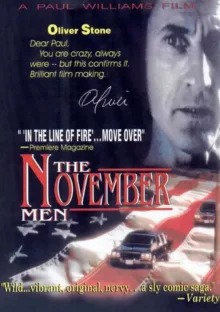
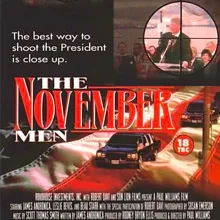
We are discussing Paul Williams', the November man released in 1993. The film tells the story of Arthur Gwen, a filmmaker who gets the idea of crafting a film around the very real assassination of George HW Bush. He enlists his partner and production manager, Elizabeth and his friend and technical advisor, Vincent Duggo. We will be spoiling this film as we go along.
So if you Don't want anything ruined, please track down this movie and come on back after you have, we will still be here. So, Andres, you brought this title to my attention. So please tell me, when was the first time you saw the November Men? And what did you think?
ANDRAS JONES: I discovered the November Men on a troller video tape in my local video store in Olympia in the early mid 19 nineties, like probably around 1995. And I loved it. It blew my mind. It's one of those back in video store days or record store days when you find something that you have no knowledge of at all, no preconceptions.
And it just, you feel like I, this is my movie now and that's what it was. I carried it with me for years. Every time we would meet film fans, people were really a film obsessives. I would bring it up.
No one had ever seen it, no one had ever heard of it. I thought I got to the point where I was just thinking, I'm insane that I had. This film doesn't even exist and I love it so much. And then years later when I started doing The World Is Wrong podcast with my friend Brian Cully who probably sold me the video tape.
Actually from video one in Olympia, I knew we had to do an episode about it. And when we did our episode, it was around the time of the trial of the Chicago Seven coming out, which is a film that I really like. It's a very well made film, but a real insult to the history that it's covering. And so we ended up doing the November Men as a sort of like instead of watching this piece of shit trial, the Chicago Seven, you should watch the November Men, which really captures the spirit of that time in a different way.
At the time, I wanted to track down Paul Williams, but I had no idea how to find him. And finding Paul Williams, the director as we get into is a little bit difficult because there are so many different Paul Williams and he has not been very good at promoting himself or keeping himself online. But I was able to find the screenwriter James Andronica who plays Dugo in the film. And I ended up conducting two very long interviews with them over three hour interviews that I called down to about two minutes.
And I mean, it took about two hours. And after that, James trusted me enough to give me Paul Williams email. And when I reached out to him, so I reached out to him and he was living in the Brazilian Jungles and he liked the podcast that we did about the November Men. And he was like, hey, I've written a memoir.
Would you like to read it? And he sent it to me and I loved it. I was, it blew my mind and he was like, can you help me get it published? And I was like, I'd love to, maybe I could help you make a podcast about these stories.
That's about the time when our other guest here came into the picture of the Paul Williams story and actually did help him get his book published, which is now called Harvard Hollywood Hit Men and Holy Men. And when I pass it over to you, Paul, I'm. PAUL CRONIN: I'm gonna start the other end. I'll start with Paul, I think.
And I started with no men and thread through to Paul. But for me, it all starts with Paul maybe four years ago, contacting him through the late Ed Pressman. I think I'd been in touch with Ed's son about something or a friend of mine knew Ed's son. So I got in touch with him and got in touch with Ed and Ed put me in touch with Paul.
And what so intrigued me about Paul was that I was on the back end of a very long research project about the student protest movement. At the end of the 19 sixties, the historical documentary that yielded a lot of research and a film and a book. And I got intrigued by the notion of all, what are the fictional representations of this history, right? What are the feature films made probably at the time?
More or less to cash in on it kind of thing? What were the films made at the time? And Paul Williams, the revolutionary with John Vot made in 1970 or released in 1970. I've watched a lot of them a lot.
And I think I can say that Paul's the revolutionary is just the most intriguing, the most dignified, the most rigorous, the most interesting. So through that I contacted Paul and as just like with Andres, a very interesting guy, very genial friendly guy, got to talking, told him what I was doing. Sent me the manuscript of his book. Thought it was great.
Did some light polishing on it, sent it to Patrick mcgill who then forwarded to the University Of Kentucky Press and the rest is history. I did some minor polishing of the text with Paul. He got it. He's a writer, good writer.
Really. It was a great book. So from there, I discovered the other films, starts with the revolutionary November Men is a wild film. Very interesting piece of work that we can, I hope we will, we should unpack a little bit today.
MIKE WHITE: Yeah, this was definitely a first time watch for me and just again, Andres, thank you for bringing this one to my attention because I Don't think I'd ever heard of it before, either under this title or it was released under a different title over in the UK, I believe. And that's the version that you can find out on archive dot org though. You've journal uploaded the version with the trauma trailers, which is just amazing to see those trailers from all those years ago. The Sergeant Kabuki Man was fantastic that weird dance thing that they're doing at the beginning.
Bizarro stuff. The housewife Tao Housewive the hell. I never heard of that. What the hell.
PAUL CRONIN: Like, you just have to wonder how many other films like this are there out there that we've missed? ANDRAS JONES: And a film like this is gonna get lost in the midst of all that. I, it makes sense and at the same time I feel like it sticks out. So I, that's just my taste.
PAUL CRONIN: Yes, I watched it this afternoon and considering the speed with which it was made and the cost in which with which it was made, it really is a very good film. It really just hang together very beautifully as a film and was always trying to wrong foot. You has a great sense of humor. The film on the address, I'm curious to know because Jimmy and gets the screenwriting credit, but was the idea fundamentally Pauls.
ANDRAS JONES: And the idea was Pauls, but the screenplay was James. There were some speeches that Paul wrote and he has, he actually complains that it Jimmy made me cut out a bunch of my best speeches. So obviously, there was the division of labor gave James the right to cut Paul's speeches. So it's a, it's his script and those two had worked together quite a few times before correct on Nunzio and then again, later on Mirage and they were really good friends and were a part of Meisner acting class that John Void started in L A and then David Proval continued when John Void got too busy to keep teaching and they were in that class and it sounds like that was an amazing class.
Vince Ario was in that class. Andy Garcia later, I should say the most recent season of The World Is Wrong. Podcast is based upon Paul's memoir. It's called The Other Paul Williams.
And in that he taught, there's a whole episode where he talks about what a big influence the Meisner acting technique was on him and his filmmaking and how it led him to want to be more of an actor in his films than just a director. You didn't say Mike, what did you think of this film? I'm dying to hear. MIKE WHITE: I thought it was really interesting the way that they put it together and just to Paul's point, the way that they wrong foot you through this whole thing.
There are a couple of things where I was like, ok, this one, the CIA agent or government agent, the guy who comes to them lying and says that he's got AIDS and then he comes back later on with a different story, but he's been tape taping them the whole time. I'm just like this guy is obviously a government agent. So there are some pretty obvious things in here, but at the same time, they just keep pulling the rug out from under you and just the relationship between, I Don't know if I'm gonna be using the actor's names or the character's name.
So I guess let's stick with the characters right now. Arthur who's played by Paul Williams and Elizabeth, who's played by Leslie Bevis. The relationship between those two also keeps you guessing because is she going to the government agents on purpose? Does she, should she not have, is she trying to sell him out?
Why it, does she forgive him? Is he really sleeping with this waitress? Does she forgive him for that? Just all of these things where I'm like, what is their relationship?
And then you never know what's going on with Dugo, the James Andrea character where you're just like, this guy is really out there? Has he snapped or is he just going through some stuff? He is a lifelong Marine who's been out for a while and really wants to get back to it. And I think he doesn't know how to live his life unless he's in the service or has a greater purpose than himself.
I wish it looked better because that VHS of the trauma one would look a lot better, but it feels like this movie's just been forgotten and I really Don't think it should have. And it's tough to find too that we talked a little bit about that. But I just kept coming up with that Pierce Brosnan film, the November man over and over again, even if I was quoting November man and putting in Paul Williams and putting in 93 it just kept taking me to Pierce Brosnan, but finally managed to get a hold of it. ANDRAS JONES: It's almost like there's a conspiracy almost to keep Paul, will it keep us from Paul Williams?
PAUL CRONIN: I think you say that, I think. Did I hear you're right, you said that the characters, we're not quite sure, you know who they are or what they're really thinking maybe. But the character that Paul plays Arthur Gwen, that's the real hinge of this in a sense. It's as if Arthur doesn't himself know whether he's really making a film, whether he's making a film or whether he really wants to call the president.
So there's this very interesting kind of creative ambiguity going on because you just never quite know who the fuck this guy is because everyone's telling him he doesn't want it that he wants to kill the president. And he says, what are you talking about? I'm just making a film. You Don't really believe him.
And then Paul does this all this wrong footing bit. And that I wrote down this great line that so this guy that turns out to be a secret service agent who apparently is making a documentary the making of, and Paul says, when he hires him, he says, oh, he hires the guy and he says he's gonna make a movie about the making of our movie, which is a wild lie. Really. It's not as if he's gonna make a movie about our movie.
It's just, he's going to make a movie about. So this is the metal level of this film which just goes into comic effect at the end, what, two or three times he just keeps on doing it right. He keeps on giving us another layer of this thing. It's very funny.
It's becomes very funny and I enjoy that about Paul's films. He has a great sense of humor, Paul. And if you've spent any time with him, Paul likes to laugh. ANDRAS JONES: And I should tell you.
So there's just like little deals that I details that I got from James and Paul. And one of them that's interesting, that guy who plays that agent. I always thought he was a pretty compelling actor. But the only reason he's in the film is because he basically ran this pro product.
There was a production space that he gave Paul and James a deal on. And when they were auditioning, he came in and did an audition and his audition piece was amazing. He said it was amazing. And then at that point, they were planning on just shooting it on video, but they had shot so several things on video and they, and then they showed it to me like now you should really do this on film.
It's, it's better than video. And then when they had to go back and redo it, they said he never hit that level again. And they, according to James, at least they were like, oh, he's not a very, he's a very, really bad actor, but I think he's fantastic. I think he's very funny and very compelling and I love the scene with him and the hot dog and the one armed man.
And that, that's a great little bit of weird business that I love. MIKE WHITE: Yeah, there are some strange details in this movie and it just adds to the overall picture of the oddity of this and it really does all work for me. There are times where I'm just like, ok, that's a little clunky, that's a little rough. But overall, I was pretty happy watching this and I just really like the idea of stealing all this footage of the real George HW Bush and then wrapping that as we are going to murder this person.
Look at how close we can get to the president and I love that opening title card where it's, this was made within the letter of the law as of 1992 as of 2001 when the Patriot Act passed this movie is illegal. Now back then they were ok. They were covered legally making this, which is wild. ANDRAS JONES: The low budget ness of it actually lends if this were a bigger budget film, you'd know what it was.
But when you're watching it as a low budget film, you're like, did they actually try and kill the president in 1992? Because it looks like I, if you told me that these people were arrested for trying to actually do it, I would most I could be can I could believe it because it is so the whole film is stolen and ratty around the edges. Like, yeah, it's a sneaky film. MIKE WHITE: That's a really good word for it is sneaky.
JOHN TURTURRO: I fear you're underestimating the sneakiness there. MIKE WHITE: And like I said, I was not familiar with this one at all. I knew of some of Paul's work. Like you mentioned the revolutionary dealing with the Berkeley to Boston, 40 Brick Boss Bag Blues and out of it from 69 I think I had heard of NZO before.
But after that, I had not heard of any of the movies that he had done and November Men is right. Sorry. November Men is right there in 93. No, I had never heard this film before.
And yeah, I agree that Raines does help make this feel more real and I appreciate it's not going for mockumentary, fake documentary, any of that kind of stuff, but there are a little bit of elements with that. But really this is told much more as a narrative. It just, it really works. ANDRAS JONES: It gives me a similar sensation that I get from F for fake.
The movie is, it's just playing tricks with you in a way that it's almost like the film can't quite hold its own joke. The joke is spilling out over the sides and asking you to do this extra work. But I can't think of many films that have that quality of this director is pushing themselves and us and using the medium like the messiness or in this case, the messiness with it, I think also Wells is using different kind of messiness with his editing to break our brains in a way which I love. And if you could think of any other films that are like that and point that you think of that are like that point me in the direction of them because I, that I think that is my cinematic take.
MIKE WHITE: I know that there are some comedians or more comedic folks that will make fake documentaries that you really think are real, which I Don't think necessarily falls into what you're doing that I'm thinking of Andrew Garland or Huck Bako. And I know those two have worked together in the past, especially Huck Baco. I used to see a lot of his shorts when I would go to Micro Cinefest in Baltimore. And he did one gosh, he did a whole series of food movies and they were all basically sabotaging food and getting revenge on people.
And it took me a long time to be like, is he really doing this or is this all fake and there was one where Glin was in it. But I know girl and girl is a piece of girls, not the nicest person in the world. So I was like, he could be doing this, he could be participating in this revenge plot. So yeah, really messes with your brain because I have.
PAUL CRONIN: No idea what you're talking about. It sounds fascinating. MIKE WHITE: I'm trying to remember because Gerland had one more mainstream type film and I'm pretty sure Btco worked on it with him. There was one Baco film that I loved a lot called until there are none where it's, he tells this story about how, oh God, it's been a while since I've seen it.
Somebody that he knew got killed by a bald eagle. So he decided he would hunt and kill every bald eagle until there are none. The last exorcism was their mainstream entry. If you've ever heard of that from 2010?
ANDRAS JONES: Ok. How do you want to unpack this film? MIKE WHITE: Like the most compelling character for me, it might be Dugo. It might just be because he is, he's the loose cannon in this and there's a lot more Dugo as the movie goes on than I thought there ever would be.
I really thought this was gonna focus on Arthur and especially that they start off with Tom Hayden on TV. I'm just like, oh wow, ok. This is really gonna talk about sixties politics and where we are now. And 92 when this was made.
And just maybe they would talk a little bit more about what George HW Bush was up to at the time. But really, as we go along, this becomes Duo's movie for me so much. ANDRAS JONES: And there's another interesting piece of the story is so it was a very, very small crew and James Andronica's brother-in-law is a guy named William Grillo and he's the guy at the end who is playing the Dugo character in the fake movie. He's the one at the end.
And where James Andronica comes up to us and says, hey, that was, he gave me a lot to work with as the technical advisor. Did you? That was really great. And then he walks away from me, he says, but it was just a movie.
And according to James, that line was improvised. And again, according to James William Grillo was Paul doesn't 100% corroborate this. So you take it as you will. But according to James William Grillo was the most valuable player of the shoot.
He was just a production assistant who helped in all these different ways including creating the exploding head effects in the, in that scene. So he's, which I think is one of the most like that's a very impressive big money effect for such a small movie and really well done. And yeah, and he just, he was talking about how William Grillo in a lot of ways was Dugo. He was a special ops guy and that informed his writing of the character, but also informed the whole film because according to Paul, like their crew is like a seven or eight person crew to make the movie William Grillo was, yeah, he was a big part of the production.
He and he passed away a few years after the film, but he's unheralded and important part of it. And, but in terms of the film, he actually ends up playing a very important role for the last wrong foot. Oh, and there's another piece that, that Paul, maybe when we get to the end, we'll talk about the alternate endings. MIKE WHITE: So just a few weeks ago, we covered a movie called The Last Supper, which was all about these bleeding heart liberals that eventually start inviting more right wing type folks to dinner.
And then every dinner would end with them being poisoned and dying and the liberals like thinning the herd of the conservatives. And there's this whole thing of the left never does anything. The left is completely ineffectual. We've tried nothing and we're all out of ideas type of people.
And then this movie is saying almost the exact same thing. There is no left left, the left will never pick up a gun, the right will always have the guns and be able to take out the left. And you read that kind of garbage on Reddit too. If you look in the wrong places.
I really like this whole idea of. Oh, yeah, we actually are mad. We are pissed and we will take out this guy. So I really wish they had spent a little bit more time.
Like I said, talking about why Bush, why take him out? I think his son was a lot worse though. Papa definitely spent a lot more time in the CIA and probably had his fingers on a lot of really dirty pies. But sitting here from 2023.
So 2030 years after the fact, Jesus, 30 years later, I'm like, God, I do, I barely remember George HW Bush. Other than when he moved across from the Simpsons and Homer was just torturing him with it. PAUL CRONIN: It feels like a very benign era from where we're sitting. But as you say, it wasn't quite so benign.
There are two sequences as I recall where Paul essentially does a kind of medium cool. He does a has re wax the riff where he builds himself into a real life event, which is the opening more or less the sequence at the beginning where Bush comes out of the plane. And this is, it's a quite an extraordinary image actually when you think about it. So Paul was basically speaking the lines, but now he, as I recall and I of this, right?
He wasn't, he post dubbed the lines. He memorized that and he does it extraordinarily. Well, you mentioned the pressure he's under because if you lose that shot, then you Don't have a shot. That's it.
You have a one, you have one take at this thing. And then I'm sorry, there's another sequence where Paul is very clearly. Oh, it's during the convention, it's at the convention where now, where was that? Where was the Republican convention in 1992?
It must have been, I can't remember. But anyway, so Paul gets on the convention floor and in the book I'm working on. So Paul's memoir was out earlier this year. But when I got to working with him, he sent me the key to a storage unit in Los Angeles.
And next time I was over in Los Angeles, they went the storage unit. It's just remarkable. Pulling out boxes of material, photographs, negatives, reels of film, paraphernalia, photographs slides. So Paul and I put this book together and it includes many interesting documents, including some pages from his FBI file.
And he also had a CIA file, which I think is quite impressive in a sense in one way. I Don't, I've done a lot of work in that era and I've not come across anyone having a CIA file. They're certainly not that extensively. But also so the reason I mentioned this because in this book, we print the letter that he wrote to the White House, basically saying we're an independent, you know, he made up a news company.
I can't remember now. ANDRAS JONES: It made up a fake news company and asked for press credentials and they said no, they said no, but he used the letter, the letter had to. PAUL CRONIN: Right. In fact, he just, I think he brought the letter, the rejection letter knowing that in the heat of the moment, he could just flash it and they would see White House at the top of it and that's apparently what he did and he got in and they set up and they got that extraordinary shot of the president getting off.
And, but given the fact that the film is somehow about assassination, political assassination, you do wonder how easy it was to get that close to the president 30 years ago. One wonders if, for example, Paula's crew was searched in some way or, but if there's this interesting that it's another layer to the film in a sense, the fact that's how he got that shot by basically lying. Probably he broke any number of federal laws to get that shot actually. So I shouldn't have said that.
MIKE WHITE: I can tell you that when I was in college, it was right around this time. It was the time when Clinton was campaigning and he came to the University Of Michigan campus and one of my best friends who's still one of my best friends today, he just staked out the place and somehow ended up talking with the right person because he can talk to anybody he's one of these like, very genial just always is listening. Paying attention, really does a great job when it comes to that. And he ended up talking with somebody and got us press credentials to shoot the Clinton speech.
So we were literally up on these rafters where it was like CBS, CNN US NBC. And it was like, what are we doing here? And I have this like little camcorder. They all have their big machines.
I've got this little high eight recorder and I'm like, this is freaking nuts that we were able to do this. And not only that, but then when the rally gets over, we go and we track down Clinton and shake his hand and then he's going to go through like Rackham Auditorium and come out the other side. So we said, you know what, let's go shake his hand again. So we ran around the building, got to the other side and when he came out, we shook his hand again.
I was just like, how did we do this? How do we? Yeah, of course, he was a candidate but they give candidates a lot of security as well, but it seems like impossible that we managed to get that close with him and also shoot all this stuff with the my little consumer grade camcorder. PAUL CRONIN: I think it might be relevant somehow.
The pole plays Arthur Gwen. Clearly it's relevant. Somehow he purports to be this kind of assassin of the left. And the implication is why would there be an assassin of the left to kickstart a revolution?
Basically, at a certain point in his life, Paul would have signed up for that kind of thing. There's he tells very interesting stories in his book about the moment where he basically stepped back from that world of politics, of the potential kind of catastrophe that those kinds of politics could render when he's working with the Black Panthers. And they, he's in Algeria with them. And they essentially ask him, will you go back to New York and be a the appointment and determine where we can build film hospitals and this kind of thing.
And at that point, Paul says, yeah, OK, I think I'm a little bit a little over my head here, but 11 gets the sense that Arthur Gwen in this film is never over his head. You get the sense that if somehow his film could somehow be used to start a revolution, whatever it may be or his actions, then he would run with it. It's Paul, by the way, he gives a really good performance in this film. Yeah, he does.
The guy's not just a film director and actually, Andres and I were talking earlier completely coincidentally last week, Paul got, I got an email from an archivist at Yale Uni at the Yale Film Archive. Long story short. They found some reels in a New York movie. A New York laboratory with Paul's name on it and they got it transferred and it's pristine beautiful footage.
Four reels, half an hour each. No sound black and white of Black Panther rallies in New Haven. In 1970 Abby Hoffman is there, Jerry Ruben, Bill Conor, not Bill Dave, who I interviewed one time is there along with Tom Hayden there. So there's a direct connection between November Men and this footage.
There we go. Because This November Men opens with this very painful bit from Tom Hayden talking about the death, the deaths of Martin Luther King of in the FKRFK. Martin Luther King. It's the other way around Martin Luther King.
RFK and the pain. The line I spoke at the beginning, our generation became might have been, that's a terrible kind of existential indictment of yourself. Really. It's just the sense of we have no power over ourselves just because 33 bullets has wiped out an entire generation.
It's so bleak. The fact that Paul would open with that. He's a very dark and cynical kind of streak to him. Even though this film, I find it genuinely funny.
I find it really quite amusing the way that he plays with the, as I say, these levels of reality. And there's the dream where, where the FB agents having the dream. That's one version of it. But then completely transparently the scene where the guy goes and buys the lens and gets into a fight and just as when he's about to kill this guy, we hear car and it turns out we're making, it's a scene from a film and as he just keeps, keeps on doing it again and again.
MIKE WHITE: Yeah, that he's able to do that to us. We should have known that it was a dream. We should have known that was an action sequence. Like, but yeah, he just keeps doing it when he yells cut the second time.
I'm just like, really, I fell for it again. But luckily I Don't get mad at this. ANDRAS JONES: And I should say according to Paul, when he started this, he really did want to shoot, he did really did want to assassinate George Bush. And he did like, ha as he got further into the film, he, his path was the, was like the path of the film at the beginning.
The director really wants to kill George Bush and use his movie to do it by the end. The director is just making a movie about someone who wants to do this. And it sounds like that was Paul's process. When he filmed Tom Hayden.
When he filmed George Bush, he really thought on some level again. I Don't know if it was like, I'm going like, I want to kill George Bush or I am going to kill George Bush. But it was definitely I want to and I want so almost like an acting exercise like a method actor, I'm going to live as if I am this director trying to carry out this thing. And then at a certain point as he tells the story about a month into it, he got more into the machinery of making the moon movie and realized that was just a mind game that he was playing with himself.
But there was a point in the making of this where he was on the same level that our Arthur Gwenlyn. MIKE WHITE: I love the whole thing too. How they're talking about. I mentioned there is no political left, left in the country left will never pick up a gun.
And then there's a line in there about only millionaires are listened to in this country and I'm just like, oh for fuck's sake, it's only gotten worse over the years. You know what, why Don't we put a businessman in charge of the country? That sounds like a great idea. ANDRAS JONES: Now, only billionaires are listened to him.
Billionaires can get a, get a time of day. MIKE WHITE: I see a news headline today about Jeff Bezos marrying his longtime girlfriend or whatever. I'm like, who gives a fuck? This is not American royalty.
These are American oligarchs guys. I Don't need to care about who's dating who in the world of billionaires. ANDRAS JONES: Thank you, Paul's background is he was an economist. He studied to be an economist.
You understand money. It will make you very cynical about America very quick. PAUL CRONIN: He was around a lot of money. And our address is referring to something, the elephant in the room, which is that for a time, Paul was married to, I'm not sure if she could be described as one of the richest women in America, but she had a few bucks to her name.
It was family money. The Sears Robot fortune. A very interesting family that she was a part of. But, and Paul got to know them.
He married her, I think they married in 67 and he walked, they divorced in 71 and he walked away without taking a penny, which I think says an awful lot about the guy. MIKE WHITE: I find it very funny that Robert Davi is in this movie just because I Don't think the Robert Davey of 2023 would be in a movie, anything like this. He's definitely crossed over and he's making movies for the other side kind of thing. He revels in those James Woods, Kevin Sorbo Dean Kane type politics.
And I'm just like, what is he doing in this movie? This movie isn't really super leftist to me because of the whole, like, non vilification of George HW Bush. But like I said, I can't see Davi being like, oh, sure. Yeah, I'll be in your movie about how You Want to Kill George Bush.
ANDRAS JONES: The story about that is that they made the movie without Davi, then they took it to K and got a bunch of excitement about it, but everyone was like, you gotta have a star. So Davi was friends with and with James Andronica. So Paul calls back and is like, hey Robert Davey, will we be? We do a scene in our movie?
Do was like, yeah, I'll be in the movie as long as in one scene, I'm on a horse in one scene, I'm shooting ski. There was something else and then he did all three of them. It was such a weird thing for him to ask for. Davey comes in at the last minute to help out his friend James and James was definitely James is a really interesting guy.
He had a whole screenplay that he had been working on for a long time about the day of the Kennedy assassination. So he, and yeah, he's one of those guys who left and right is a rib. It's very hard to pin down like you talk to him. He sounds like a leftist.
But according to Paul, he was always the pushback against Paul's more left wing politics. Yeah, I think it's, I think it's probably because Paul is an Ivy League guy who grew up in an academic family and James was a guy from the streets in Brooklyn, a real, like an almost made man kind of guy. MIKE WHITE: So they wanted a star but wasn't both star enough. The guy beat the living hell out of young Henry Hill as soon as he showed up on screen.
I was just like, oh Mr Hill, I'm sure I've seen him in other things, but I sure do recognize him from Goodfellas. ANDRAS JONES: You think both star is a bigger star than Robert Dove? MIKE WHITE: No, I Don't, I was just joking around who was in Fletch. Come on.
I do have to say I did recognize James Andronica as soon as he showed up on screen because he has been in a lot of stuff. And I definitely was like, oh yeah, I know this guy's face very easily, probably because he was doing a lot of acting in the seventies and eighties. And that's my wheelhouse. ANDRAS JONES: The story on him is that he was amongst among the Italian American actors that were, they came out to Hollywood.
He was the one who was regard like Robert De Niro was the actor James Andronica was the real thing kind of thing. And supposedly Tarantino asked him to be in reservoir dogs and told him to go take a leap that he was a Hollywood phony. So that's and Veronica, that was his thing. He was, he took a great deal of pride in being the legit version of the thing that the guys like Pacino and De Niro were pretending to be.
PAUL CRONIN: I found a piece of paper in Paul's storage unit relating to Nunzio and it essentially was a one page statement unsigned, noted, it was unsigned, but it basically said I hereby give four days of my time to the Nunzio production, Robert De Niro, it was not signed. I'm not sure if it was wishful thinking on someone's part or if it had been somehow arranged, they just never got it to him because they realized trying to shoo one, Robert De Niro into Nunzio. It doesn't sound like a great idea. But anyway, there was clearly some connection, a sense between and did it Andro and know De Niro.
ANDRAS JONES: When he talked about De Niro, he was always like his mom was like, he was like, he got him in all these great acting classes. Of course, he's going to go on. He's when he was a privileged snot nose kid, he got to be do all this stuff. He wasn't actually in the streets fighting like I was thing that's that James Andro could take.
But I think that it is De Niro even though he plays tough guys as an artist, he's, he was given opportunities to develop himself as an artist when he was a young teen and a teenager. And by the time he was in his early twenties, he wasn't just playing what he was. He had, he had, he could, he knew that place, but he had the skills to developed, he developed his skills in a way that James who came from a rougher background was not able. Yes.
PAUL CRONIN: But yeah, it's all true. At the same time, Andronica's scripts and performances in Nan November Men are impressive. He's a very good, very compelling performer and this is why I asked you about the scripts. But the script of November Men, or at least as it came out in the film, I know I've got a draft of the script that was in Paul's Boxes.
It's different. Tom Hayden is there, for example, as I recall, I have to check that at least in one draft. But anyway, he does great work as a writer and performer in both these films. And as you say, he with Duo, he plays Dugger, he placed himself at the center of this film.
You Don't you think Arthur's the center of the film? But maybe it's Duo, actually. ANDRAS JONES: We Haven't talked about it but one of my favorite things and I think it's a bit that like actually transcends the cheapness of the film that whole bit about the wolf, the lope wolf and the shot, the way that is shot it is, it's a heartbreaking but genuinely heartbreaking scene. I feel like, yeah, it does feel like it's a, it that little bit could be in a bigger budget movie than what it is.
He was a genuinely tortured person and a very soulful person who had a lot of demons. And according to Paul, they, there was a lot of darkness in the time that they spent together, but they were very close. MIKE WHITE: Yeah, some of those scenes like him fighting with his wife, Marina, the scene with him and his baby, the fight that they have where he takes the fork and bends it. It's such a simple thing, but it really works very well.
And yeah, you never know what's gonna happen with this guy. And the whole thing of him and his neighbors down the hall, they moved to this real shitty apartment and he's got these loud neighbors down the hall. As soon as they come to the apartment building, there's all these cops outside. I was just like, oh, he finally took care of business with these loud neighbors.
And when they do that flashback, he mentioned the head blowing up scene. Holy cow. Was that amazing? ANDRAS JONES: This film has way more amazing things in it than it really should considering how low budget it really seems.
MIKE WHITE: It makes a lot of sense to the way that they set up the crew. You've got like, who, who's gonna be the patsy? You know that they are planning on pinning this on somebody. And you've got the lady who's just out of prison.
You've got the African American gentleman. But really, you've got these two Iraqi American gentlemen and you're just like, oh for sure they're going to pin this on these two guys. And I also think the whole idea of Dugo is so smart right off the bat. He's just, oh, your whole plan of using a remote control helicopter to crash into his limo with all the C four on it isn't gonna work at all because all the radio waves are gonna get blocked because there's a Black Hawk helicopter that's gonna be flying overhead, blocking all of these radio signals.
I'm like, ok, that's really super smart. But then they still seem to be stuck on that idea. And yes, there's a twist on that towards the end. But again, it's, we're being wrong footed.
We're like, why are they still sticking with this? What's going on? Maybe there is a tie into this earlier scene where he's looking at these wires and again, very clever stuff. PAUL CRONIN: But do you think the Arthur Grenland wants to kill the president for real?
That's tough. ANDRAS JONES: I think he starts out wanting to like, clearly he doesn't because he goes and tries and stops, it tries to stop it. But I think this film is slippery enough that it gets to have it both ways. PAUL CRONIN: I would argue it might be to its credit.
I think maybe I'm not sure I find the film to be really refreshing and fun to look at and interesting and thought provoking for me for any number of reasons. So I think to its credit, it's be very gloriously ambiguous and makes no bones about it. And Paul at the center of it is just winking to us throughout this film in a way. So I enjoy the spirit of this film.
I think it's good. I think it's good. MIKE WHITE: When he's talking with Eric Clancy, the guy who came in and said, oh, I've got AIDS and now he's coming back and oh, I'm, I need s a insurance for my baby and all this, Paul looks down, Arthur looks down and there's the famous life cover with Oswald on there. I just laughed out loud.
I like wrote in my notes. Ladies and gentlemen, we have our patsy. ANDRAS JONES: Then he has that scene in the car with both stars. I can't believe he's eating a hot, I love people doing eating scenes.
He's eating the hot dog like, oh, I can't believe he thinks I'm gonna, he's gonna totally Oswald me. He thinks I'm gonna be the patsy. PAUL CRONIN: Pure Oswald. He calls it Oswald.
It's like Pure Oswald. He thinks he's gonna be the patsy. It's a good moment. It's a very funny in Paul's book.
He speaks quite movingly and I've seen the photographs that he subsequently took in DC, but he talks about discovering about the death of John Kennedy for the first time. I forget. Now. I think he's walking on campus, walking on the Harvard campus.
And then they go down, he and some friends go down to DC and he takes photos at the funeral and I'm working on a Brian De Palma project at the moment. And the Palmer who is three years older than Paul was, is, it doesn't take a genius to look at his films and know that he was utterly obsessed with the Kennedy assassination. And to a certain extent, one can't say an entire generation was, but it certainly impacted Paul and it impacted Brian in very big ways. And you can see it seeping through several of their films all the way through really just as I say, gloriously to November Men.
MIKE WHITE: Just at the most basic level, the whole, the idea of shooting versus shooting, the idea of we're framing up these shots, but we've got to cross hairs in the middle of the frame. Is this being shot through a scope or is this being shot through a lens? It's very smart to have that basic confusion at the heart of this movie and to be able to use those words interchangeably and mean something so different. But you never know.
Is he talking about shooting the President or is he talking about shooting the President? And it's a great simple eloquent thing. PAUL CRONIN: Also the way the film is edited, there's some pretty interesting things. For example, as I recall, we hear her voiceover and we wonder what her voiceover is and it turns out she's spilling all to the FBI the way Paul cuts these sequences together.
He's a good filmmaker. I enjoy his films. They're unpretentious, they're entertaining, they're thought provoking. I think he's something and I was gonna get to this footage, the Bobby Seale Black Panther, New Haven footage from 1970 which he writes about in his memoir.
It's really well filmed it. He's got a big heavy 60 millimeter camera on his shoulder and he's getting really good images out of it. ANDRAS JONES: Yeah, there's one scene where they're in the car and he's driving with is Warren Beatty driving the car. PAUL CRONIN: Warren probably is driving.
Paul says that I he probably gave you told you where in the film to look. But you could see the back of Warren's head and then you could see John John Ason too, right? ANDRAS JONES: And then yeah, but they're driving by and the people are running after the car and saying. PAUL CRONIN: Fuck, it is pretty wild that this film showed up.
This footage showed up over 50 years later. ANDRAS JONES: In the Paul Williams world. We're very you for Paul Cronin and I've been reading this book and working with all for the last year and a half and more. I think we both have like anyone who's working with him when he talks about this footage, you're like, oh my God, where is it?
Where is this Black Panther footage with you? And Warren Beatty? And like where is this? And of course, you figure it's, of course, it's lost forever.
And literally this week like two days ago, it became available, which just makes you think that anything like Magnificent Ambersons is possible. PAUL CRONIN: There's gonna be, there's a lot of stuff showing up archives. We're moving from a this moment where a generation that was steeped in that kind of analog technology is clearing out their cupboards. So there's a lot of interesting stuff that's gonna come to light.
I think I've been doing it for 20 years myself. Going into storage units, the greatest place on Earth storage units. You never know what you're going to find. MIKE WHITE: And you're talking about how competent he is as a filmmaker.
And I will say the whole end sequence before we get to the rug being pulled out yet again, if not multiple times. But that whole end sequence, I was on the edge of my chair. I really didn't know what he was going to do when Paul and Elizabeth or Arthur and Elizabeth end up getting shot. I was genuinely, I think I gasped.
I did not see that coming and just him crawling across that parking lot roof trying to get to the car to hit it and set up the car alarm. It's really tense. PAUL CRONIN: Paul knows how to make films. The guy knows how to make films.
ANDRAS JONES: And all of that. So much of that is just stolen. It's pure gorilla filmmaking. He's running across the street, that street is not locked off, that's stealing shots right and left.
I love it. PAUL CRONIN: Wonder where they filmed the scene in the military base where Dago goes back and asks for his job back. My, when, if I see a film like that in a film like this, I think to myself, how do they get that shot. Don't worry too much about the drama of it.
It's a well done scene. It's actually a very well done scene when he go do, goes back and said she goes to his former commanding officer and just says you gotta take me back. It's a really, again, a really bleak moment in this guy's life. ANDRAS JONES: You're a pussy and deal with it.
PAUL CRONIN: Yeah. Right. The guy says if you were a real Marine, you wouldn't have come back here motherfucker. But it's a really harsh thing to say.
Do you remember? What do does he just stands there? But just in complete silence processes what this guy said to him and just turns to him and says, and walks out and the guy just says, Marine and as he walks out, it's a, it's really brutal stuff. Andronica does it.
Well, I like this guy. ANDRAS JONES: I encourage not, this is not just pure self promotion, but the episode of The World Is Wrong podcast. So we get about the November Men. I encourage people to it.
James actually died earlier this year. So we Don't, there's, there isn't much documentation of him and from talking with him, I get the sense that not many people have sought him out to talk with them. It's one of the things I'm most proud to have documented on the show. He has a lot of stories to tell and he's a very interesting guy and I hope people will check that out.
PAUL CRONIN: I wonder if Pitt Bill did try to check it because he does, like, I've got a guy who would chase you off his porch with a shotgun. You know what I'm saying? I wonder would. ANDRAS JONES: Be a handgun, I think for him it would be a handgun.
MIKE WHITE: There are so many times where I'll be watching a movie or a TV show and things are going really wrong and I will literally sit on my couch and I'll say and cut it because I know that we are in a dream sequence or something is being filmed. And when that final and cut happens in this movie, I didn't see it coming, did not see it coming. And then we like cut to the big rap party and find out that everybody's really OK or are. ANDRAS JONES: They or are they because it does, it's still, and he does one last turn, which I'm so glad that he gave it, that he gave it that last turn.
I want, it needs to end on an ominous. Let you, I see. I love that music, that little car, that carnival. It's so creepy and so funny.
It's the perfect tone for it when you get to that and he's there. The William Grillo, the real Dugo in the movie is about to take a shot at the next president. I'm a connoisseur of assassination films. And I think like this stands right there with the best of them.
Absolutely. What are the other ones? Well, view. I'm a big fan of suddenly the Frank Sinatra Sterling Hayden film.
PAUL CRONIN: I gotta tell you, I'm gonna, I'm gonna suggest something to you that Jonathan Demme's remake of Manchurian candidate is as good, if not better than the original. Discuss. ANDRAS JONES: I actually, I do really like, it's hard to say better because I love the original so much, but it certainly isn't a waste of, it's a reasonable redo. And I, while I'm watching it, I'm not missing the other one.
PAUL CRONIN: I remember thinking, I it's been a while since I started it. I was quite terrified by it. I thought it was really well done. MIKE WHITE: I've never actually sat down and watch it because I can take Denzel in small doses.
I love Liev Schreiber. I Don't know. And then I really appreciated all of the Asian actors that they had in the originals so much that I was like, I Don't know. And I will also say that after Philadelphia, I was just like, yeah, I'm done with Demi for a while.
Unfortunately, he was done with me as well and the rest of the world at a point. But later Demi I Haven't checked any of it out check that would have, I can't speak to gracious, beloved Rachel getting married. Any of those. ANDRAS JONES: I dug it, I did dig remake.
I did, but it's one of those things where no matter how much I dig the remake, you're not gonna beat the sort of the zeitgeist e synchronicity of the Manchurian candidate. That's it. Does the Manchurian candidate does the thing that I love most in films where the film is great on its own merits. But there are things happening in the culture around the film that are informing the film and making the film a vehicle of destiny in a way that the filmmakers could never be aware of.
And that's my favorite Magic trick that film plays. So there's no way that any that you could afterwards redo that. But I have to agree as Paul say, when I think about it, like there are things that it can do and say that the original film couldn't. And that's part of the strength of the original film.
But still like the I, one of the things that's really chilling is that the scene where the lead Liber character kills his love. We won't, I Don't want to go into, we said we'll do spoilers about this. We want, we Don't want to do spoilers about that man in candidate. But there's a way that again, just like a modern film, it can do the violence in a more graphic way than they could in the original.
And in that case, it actually makes it more heartbreaking to see him commit these acts of violence. MIKE WHITE: So I watched the trailer which was tough to find, it was very tough to find a trailer for the November Men. Oh, really? And the last shot of this trailer is a scope shot of Bill Clinton.
And so Paul, you made mention of killing the other guy and I was just like, ok, it, so you, Andres, I think you alluded to earlier, the alternate endings of this. So what is happening here? ANDRAS JONES: The original ending of the movie had him shooting Bill Clinton, had the William Grillo original Dugo Killing. Like the last shot is him aiming at Bill Clinton?
But I, do you remember why Paul Paul? Do you remember why they took it out? Maybe they do, they just not that. PAUL CRONIN: I think that there was a distributor who was troubled by it and insisted on some cuts.
I forgive me. I'd have to check the by then. ANDRAS JONES: Yeah, by then Clinton was already president and I it's a, it's a weird place to draw the line at on this movie. I Don't know, it's like we've had all this nudity, but then one particular person's nudity, we can't have, you've had this whole movie about a lot of killing and a lot of assassinating.
And that was the original ending and it does not make it in the film, but I find it wonderful that it made it into the trailer. MIKE WHITE: Yeah. And I'm gonna have to see because I saw the trailer through PLEX because I have a PLEX server and it goes out and it finds trailers and pulls them in. I'm gonna have to see if I can somehow download that trailer or something so I can put it onto YouTube because there's no trailer for this on YouTube.
As far as what I could find. ANDRAS JONES: I'm all for pirating everything about this movie and getting it out there. Let's beat the conspiracy. MIKE WHITE: So guys, let's go ahead and we're gonna take a break and we're gonna play an interview with the director and Star Paul Williams, the author of Harvard Hollywood Hitman and Holy Men, a memoir right after these brief messages, heading.
Speaker 7: To the movies, reserve your seat before the show on Fandango. Find times, read reviews and buy tickets to your favorite theater. Fast and easy on the Fandango app or Fandango dot com. See what's playing near you, watch the trailers, grab your seat.
All that's left is choosing butter or no butter as if that's a tough decision. Every movie, every feeling every time that's Fandango your one stop before showtime, buy your movie ticket. Now on the Fandango app or Fandango dot com. Classy is a film journey to the East, a curated streaming service offering the best of contemporary classic cinema from Eastern Europe and Asia using coupon code M 50.
You can get classic membership for just $5.50 a month giving you the opportunity to sample award winning films, documentaries, sign and masterpieces, classic comedies and more. You could also get access to the classic E journal, exclusive cast and director interviews, video essays and watch lists. Sign up now to start your adventure in film, the classic drama East of Eden starring James Dean and classic western Rio Bravo starring John Wayne are now available for the first time in crystal clear four K ultra HD. Look for them on four K ultra HD and digital visit WB 100 dot com.
For more information. MIKE WHITE: Why the book when you wrote it sounds like you had tried to write your memoirs before. List off a few other titles through out there. Why this time and why that particular title.
PAUL WILLIAMS: I had always planned to do a memoir at the end of my life because I really dedicated myself from early on, probably because I was trying to hide who I was that I would simply have a series of experiences I'd read Hemingway and Fitzgerald. And when I was quite young and I always had a sense of mortality from very early on, very bizarre that way. And so I knew I wanted to find out what life was and that the only way you can do that is to really go through a lot of experiences. That wasn't my plan.
But when I go to see my friends and it turns out the Dalai Lama's teacher is there to give me the teaching for the highest man on the planet. Or I go to see my friend Burt's friend Huey P Newton and with all of the far left were lawyers and he asked me to stay because I was the one who could figure out why the chairman of the jury would vote to have him convicted of second degree murder. And none of the other lawyers there had an answer for him. I said, look, that black chairman of the jury thinks he's saving your life.
If you get a hung jury, the next chairman of the jury will vote for first degree murder. And that's when he said, hey, you stay behind. But anyway, I go, I think I'm finished with my political stuff. And then Bert Schneider invites me to go to Cuba.
And I say, yeah, I wanna meet Fidel and I'm the only guy who knows Francis Coppola, the candy Bergen, Terry Malik, Bert Schneider, other people. Nobody knows Francis Coppola. So I'm delegated to bring him into the group. And so when I go to his hotel room in Mexico City, I say, hold on, Francis.
Just imagine you Fidel Castro, what you would you like most to have from us? And Francis puts out a bottom lip and I said, I'll tell you what a Spanish subtitled print of Godfather Two. He's a goddamn hero of the movie. I guarantee you.
If we bring him a print, a Spanish prince, we'll get to meet him. So Francis got on the phone called Madrid and arranged to have a prince sent and we waited two extra days in Mexico City before we went to Havana. So we could bring it with us since I'm telling this story. Now, in the process of answering why I wrote the memoir now.
But this is another sort of the kind of experience that happened that when I'm in Havana, after about 10 days of traveling around, we finally meet Fidel after he gives a speech to a half million people and who are there for the celebration. He tells them, believe in yourselves, believe in the revolution and they keep going. Fidel. No, you're but no, but so we meet him down behind the stadium and he comes and he says, comes to the group and we asked him a series of questions why he killed the people in the stadium and stuff like that.
And he says revolution is serious business. We gave him a chance to get out. They didn't get out. They wanted to tell us well, he was anyway.
So anyway, he says, hello, each person when he gets to me, he whispers in my ear, he's, he says, do you play basketball? So I'm like 6 ft three. And I said, yes, I do, I do my best. I said, OK, I'll meet you tomorrow at this school.
God, you bring your guys, I'll bring mine. I said, ok, you got a game. My two guys are overweight Francis and overweight Terry Malloch. I figured I'd, I'd be able to handle it.
Then he goes to Francis who's standing next to me on my left and he says, I hope you Don't mind. But we've stolen Godfather two out of your rooms and we're now reproducing it for our people. And Francis says, hey, it's not mine. It's paramount.
Anyway. So things like this be a great story to go into what happened with the Dalai Lama's teacher who the Dalai Lama says, I'm very privileged to have met this man. He taught me so much. I met this guy.
I spent three hours with him and he sent me out extraordinary trips. I didn't even know who he was. I called him dingo like the Australian apex predator dog. His name was actually Dil 10.
I found that out. 20 years later, I was in the Denver airport waiting for a plane and suddenly an apparition like 12 ft by 12 ft of this guy came in front of me. I couldn't believe it. And I was trained in psychology perception at Harvard and wrote some books about stuff I'm feeling, I know how the brain and the eye operate.
So I checked it out. I looked up, the image didn't look up, didn't move up. I look to the left and right. No, the image stayed there.
So I knew it wasn't a hallucination for my brain. And after about a half a minute disappeared, you know, and about 10 years after that, I found out that dil the guy who appeared there died on that day. Anyway, there are things like this that happened throughout my life at from reading the book. And I realized that when I got older because I did have the advantage of studying with some very high llamas in addition to Digo Fancy.
And yeah, it became clear to me that I would have to empty myself of these memories. If I were gonna be more serene in the present time, less interested in the past, I feel like Kung Fu Panda, the past is history. The future is a mystery. That's why they call the present for gift or for that.
Anyway, but it's basically Kung Fu Panda got a Kung Fu Panda and Buddha. They're both on the same page, right? So anyway, I knew that I would have to go through this process of writing all this stuff down. I also knew it was pretty extraordinary stuff.
And in 1980 it was it 1990 or so I hired the top oral historian of the United Nations woman named Mira Aah, who had written a wonderful books on women's liberation in Egypt, a small subject. But she was quite brilliant. And I paid her to interview me for two hours a day for 10 days because I knew I had all these the story when I took my first psychedelic trip was Peyote with David Carrigan and Barbara Hershey. And I met Ma Scolio who knew I was even taking Peyote, they just gave me this stuff to take and it was an extraordinary trip.
So anyway, I knew I'd probably forget the details of these various events. So I had her interview me and I, it was transcribed and so I had that. So that's why so much of the stuff is so fresh. I couldn't have remembered that much detail.
I'm almost 80 years old then anyway, I knew I would be writing the story. I knew that I had created this life of searching, seeking, trying to learn, you know, most people, if they were married to the richest woman in the world would have lived that out. Or if they were in Hollywood and became directing Bobby Deval and John Boy would have lived that out or with Huey Newton and Eldridge Cleaver and they would have lived that out or if they met the high llamas, they would have been trying to get higher and that I just kept moving and trying to understand what my life was about and what, what life is about.
And so I was a real seeker, but I also had this tremendous feeling of the fact that it oh it ends, there's a beginning, a middle and then, and as you get near the end, there's a certain pattern to the life cycle. A little plant rose, it blooms, it dies or I had it as a tutor as it goes on and on Eric H and probably the most famous psychoanalyst of the second half of the 20th century who was my tutor and he wrote a book which Dale Sheehy ripped off for a book called Passages, which was a big best seller. But she took his basic ideas about the stages of life, whether it's basic trust versus mistrust when you're a kid or identity versus identity diffusion when you're a teenager or intimacy versus that when you get your first love or generativity versus stagnation, when you're older, and the last stage is integrity versus despair.
And to the extent that you keep identifying with your ego and your personality is this wonderful thing that will lead to despair because that's gonna end. So it's very important to understand, to let go of your ego. So this memoir in a way is an anti memoir, most memoirs that people write them to tell them how great you are now, what a splendid fellow you were. I wrote this to say this is a history of mistakes.
It's a history of failures, but took the failures of a seeker. In other words, I never lost sight of the fact that I was really trying to find out something important. And so as when I got to this stage, when the integrity versus despair stage applied, I figured, OK, time to write the book and I studied with a Sufi master for a year back in 1973. And I still remember one of the exercises he gave us was to write on a piece of paper.
The name of every person you ever met. He said you just, they're all inside your head. You gotta get them onto the piece of paper and get them out of you. You gotta get clear, you gotta empty your head.
I spent three days and it's amazing if you sit down and try to remember everybody and just Don't be in a rush. Anyway, that was the first stage in the series of exercises where you learn to steal your mind and eliminate thought unless you want to think. I still remember that we had a, there's a very complicated meditation where you have seven points of concentration plus your breathing and it's almost impossible to think while you're doing that. And so the thoughts that come do come, you can hear the voices of the thoughts, most of the thoughts you have are somebody talking.
And my next to last voice I heard was John Boy saying in the editing room, look at every take because I got the good take. I was young, I'd say, oh let's use that one. He says, I will look at every tape, look at every time so that he drilled down next to me. And then the last voice I heard was my father who was a school principal who said, I just heard him say get an A I later had did the what the Sufis call the alchemical transformation.
It's the highest Buddhist meditation that you can't even do unless you can enter Void. It will. It's not like the afternoon yoga. And in that meditation, I did meet my father and he did put his foot on my neck.
He said I did cry and say I'll be whoever you want me to be, just get your foot off my neck. Anyway, the point I'm trying to make is that it was time to write the book and get all this stuff out because frankly, I'm a good storyteller. I'm I could tell stories till I die and never actually see the sunset. So it's time to stop telling stories.
And so I figured, put them all in the book and by the way, I only put in maybe half the stories, the ones that were important for understanding the shedding of the ego and coming to realize the importance of the essential nature of being. So there are a lot of wonderful Hollywood stories I left out because they were just ego aggrandizement. And that's what I didn't want to be in the book. And then the event it, then the pandemic came along very when and I'm in Brazil with people who speak Portuguese, which is karaoke, Portuguese, which I studied very seriously Portuguese, but it was Sao Paulo where they speak Portuguese with clear pronunciation and articulation.
But in Rio De Janeiro, they all say everything they say. Sounds like glaciers. Hear me from glaciers glosser. It's like some kind of Spanish and Russian put together.
I never could learn, understand a word of that, what anybody would say around here. And yet I'm here in a 3000 year old fishing village on the side of a jungle mountain and the pandemic comes so you Don't want to go out and it's a very isolated place. So it's very safe. I had four years to really write it down and just sleep on it each night and wake up in the middle of the night and make your notes.
And it was a perfect writing situation and I got it done. Now, it's a book. It's the fact is I wrote it for myself and then I didn't know what to do with it. But a guy named Paul Cronin was looking for Ed Pressman and called me.
He's a film historian Paul Cronin. He's written some books and a very bright fellow. Anyway, I was happy to help him finally. And I said, gee you know a lot about movie, how would you like to read this manuscript?
He said, yeah, he's a real, he loves to read. So it's great. And so I sent him the manuscript and he calls me back two days later and says, this is great. You should publish it.
I said, fine, you know how to get it published. He said, yeah, the University Press Of Kentucky has the screen classics. They publish all these movie books. I'm sure they publish it.
And I get a call from somebody, a guy named Pat Mcc Gilligan at University Press and he has me talk to the head of the press, Ashley run it. And literally seven days after I asked him to read the script, they said they publish it. So everything in my life has been like that. I didn't go out looking to get this published.
But now it is, it's some, I feel a little bit like AAA Red Dwarf Star. It's dying and just before it dies, there's a little explosion of so anyway, that's a long answer to your very brief question. MIKE WHITE: And I love how all of the things in the title are in the book, The Holy Man, The Hit Man, Harvard, all of this, in that order that you listed on the title. PAUL WILLIAMS: It's just, well, I did go many titles with Extraordinary Life that made no difference.
Harvard and all that, blah, blah, blah. And I think what is it came to me fairly late. And then I had a wonderful friend for 40 years, a guy named Sylvan Deprey who did the storyboards for Ridley Scott, The Gladiator and Black Mark. And he's really a gifted artist and we've been friends a long time and he said he'll do the cover for the book.
And he said, he said, you got any ideas what you want So I sent him a picture of me naked with a book over my privates. And I said, how about this when you project Harvard on my chest or something? So you've seen the cover of the book which is a wolf in a Harvard church swallowing dynamite. He said, when you sent me that cover it made me clear what you wanted to do with this book.
And so it was his and he did a great job. MIKE WHITE: Harvard seemed so crucial and just so many connections that you made that way even to read that all of the people that just happened to be going to that school at that time. And then the impact they made on the world at large as well as your world to see Michael Creighton as brother there. And then end up one of your first films by Michael Crichton.
PAUL WILLIAMS: Really? And that had no connect. It's not because I knew Michael at Harvard Callie at Warner Brothers gave me the Crichton book. He was friends with Creighton.
I wasn't friendly with C Clayton at that point when I was in Hollywood, I was out at the beach with Margot Kidder. But you're right. I mean, on the Harvard Crimson, when I was there, you had Michael Crichton, Andy Doctor Andrew T we, Hendrick Kurtzer, who he ended up writing for the New Yorker, Donny Graham, who became publisher of the Washington Post. All kinds of people were there and then the professors.
John Galbraith was my tutor, sophomore year, Erickson junior year, I went to see Reinold Nebo and Henry Kissinger and it goes on and on and it was quite a lot quite. That's why I, if I had to say there were two guiding principles. One coming from the lower middle class, intense achievement, a high level of need, achievement and auto and academic, autocracy in the family. I did want to know how the smartest people spoke and talked about things.
I had no idea what really smart people were like. I knew how the kids in Massapequa High School were like and half of them wanted to go to the Vietnam War. So I knew something was wrong with their brains. When I got to Harvard, I had no idea that there were people so smart and that was ok with me.
It's ok. I know I'm not the smartest guy in the world. My roommate was Howard Gardner who has become one of the most famous educationists in the world right now doing he was one who talked about multiple intelligences and teaching for understanding. But how he said to me, he was my roommate.
He said, well, you're not the smartest in any subject among the roommates, but you're the second smartest and more top more areas than anybody. And I have been in touch with all these people. I realized I'm pretty smart but I ain't that smart. But I got to hear how they talk about things, how they approach subjects.
And I really was interested in knowing that so I could go through life with some kind of self confidence because I grew up in a principal family where if you didn't feel you were smart enough, you were. So it was important for me for neurotic reasons to know how to sound smart and understand the smartest people. And that led me to all these various people. It wasn't like I was, I knew any of them was important.
It was for my book. I just know, oh, this Henry Kissinger guy, everybody says he's the smartest guy, young professor. And I was a freshman and he was teaching a graduate course in international relations. And I went, I was, I must say I was raising, nobody caused fear this, I think because my father was a real big guy and he didn't mind slapping you around on the behind.
And I was enough frightened of him that nobody else could frighten me. You know what I mean? He is his most frightening guy, you can imagine. And so Henry Kissinger, I went up to him and I said, look, I'd like audit your seminar in International relations.
If I remember he spoke in a thick German accent about that's all you an undergraduate. Yeah, I'm an undergraduate but I'd like to hear. So he allowed me through his course. Now I have to tell you that after four or five sessions of listening, analyze international geopolitics.
I never heard mention of compassion or love. It was all real politic power and it gave me a headache and I left, I didn't like him. And then I was looking and I found a guy named Ryan Hold Nebo who ever heard of Ryan Old Ni. He actually is probably the most important protestant theologian of the last 200 years.
And all I knew is that he said the opposite of Henry Kissinger. And that was a delight to hear this very smart man talk about geopolitics from the point of view of compassion and care. And frankly, by doing economics was the holy grail. If you didn't understand economics, how can you possibly understand what's going on?
Most people are unconscious economic pads in the system and they Don't even realize it. So you're gonna know all the different systems. And I that's how I ended up run rolling in economics and getting John Galbraith as my tutor. And I'm sure I would have been an economist today except for two things which I report in the book.
Of course is when we used to have lunch every Wednesday, Winter House John Galbraith and a few other economics, two teas and one Wednesday. He said, I hope next week I'm gonna have a non economist join me at lunch and I want your permission to bring her to the round table and he was John Kennedy's advisor, ambassador to MD, a professor. Oh, good. Yes, we can object.
Right. No. So the next Wednesday we go in there and I'm, I've read all his books on the sides and I'm really looking forward to somebody telling us how corrupt American capitalism is and the idea that the people who produce products actually make the advertisements to create the artificial needs. So people buy their crap and how immoral that is, you know, that, which is one of his tenants.
And I thought maybe he's bringing some genius here to help us understand that. And when I walked into that next Wednesday's lunch and all the other economists were stunned too. I'm telling you, I saw the most beautiful woman I had ever seen in my life in real life. I had never really seen an extraordinary beauty in real life.
I'd seen pictures or in the movies, but I've never been 4 ft 5 ft away from them. And there was Angie Dickinson. Now, in fact, I learned later, John Galbraith was bringing Angie Dickinson to the White House, John Kennedy to have a little assignation with. But all I knew is who is this person?
She then he said she's Angie Dickinson. She was an actress. And I, that was the moment I said I'm going into whatever field this woman is in, this is extraordinary. And so that was one reason I didn't become an economist and the other one of course is when I got way up in the econometrics, I couldn't do the math.
MIKE WHITE: And when you decided to become an actor, you threw yourself in full board and that's the thing with your whole life. It's I'm not gonna be satisfied to just do this thing in passing. You just dive in feet first. PAUL WILLIAMS: Yeah.
Yeah. And I went into acting because it seemed to me actors were having more fun. I was working my ass off as a director. You gotta think about this and that I go wow, this is, this is no fun.
Rehearsals were fun. I loved rehearsals. But when you got on the set, you had a lot of stuff to do, especially when you're a big director. They got so much help.
It's, it is fun. But if you're a middle level guy, you got to do a lot of the work yourself or a low budget in the beginning. A lot of work never got me an assistant director for the first two. I didn't know better to say, hey, you shouldn't save money on the assistant director.
I also have to direct the actors. That's really why I studied acting because I saw it from the teachings of the Dalai Lama's teacher, the digo fellow. He actually, after he sent me out on these wild distant seeing trips then did something with me called Tantric Theater in which I tried to explain to him all my brilliant theories about the personality and essence and stuff. And every time I came up with what I thought was another brilliant idea, he would make it disappear.
I'd be just in the cosmos again and he had two hours till I was completely empty. And I said, gee, this is just like an actor. You see the Eastern guys, they get empty by detaching by letting go. But an actor, he gets empty by expressing whatever he's feeling he expresses.
But they still both have that emptiness as the place to work from. And so I wanted to make sure I could go to that place in everyday life. The thing about acting is it's not what you find out when you get into acting, acting is being real. It's when you're not acting that you're pretending you're presenting your personality, who you're going as I am a disport person.
I'm a social boy. Maybe that's not real. What's real is how you're really feeling for real. And that's so when you get on stage, you're just pretending, you're pretending the whole trick is how do you have a real feelings on stage?
Get off stage and you can bullshit again, we call it social bullshit. So anyway, I got into acting not to be an actor but to act that is to say do not act, to learn. And that was one of the most valuable things I did. That's later, I ended up living with Karen Blackford for years and she taught me an awful lot too about not only living 24 hours a day in present time, which was I have to say, exhausting.
In the beginning, I had to go home and rest every few days. But eventually I could do it without being exhausted because I left a lot of my ego behind and I learned a lot from her in terms of how how to stay very present. And if you have to do a character, take a stab at it, John Boy, he worked the opposite way. He always built his characters very slowly.
I still remember when we he's before Midnight Cowboy, he was practicing tapping his foot out of tune with music because he has seen in the shower where he has to keep time with the music and he misses all the time. I remember he was very careful with the way he built the character before he really took the full stab at. Karen was the complete opposite. She go full into the character.
And so you Don't like that. Ok. Here's another one. She always took a full sw I still like Julie Christie was my dream girl.
And without going to that, I actually ended up writing her a 20 page Telegram. She actually came and looked me up. It was incredible. But anyway, this is much later and Karen knew I like Julie.
She said I can do Julie it. She turned into Julie for a couple of days. That was really funny. And then I said, I like tough girls too.
And she said, what, who's a tough girl? And I said that girl and truck stop woman, I forget her name now. And she said, oh, I can be tough. And man, she got so tough.
I got scared. Really? Was scared. I thought I was in danger.
It was like Nicole Williamson and be for done. She was frightening and that she was so fucking. MIKE WHITE: Now we've had Ed Pressman on the show a few times before. Can you tell the story of how you and Ed met and how you started to work together?
PAUL WILLIAMS: The Vietnam War was on and anybody with half a brain knew that you shouldn't go to the war unless you wanted to write our generation as naked and the dead or something like Oliver Stone. He went to Vietnam because he was going to write that novel and we talked about it and I was not gonna go to Vietnam and I knew I would not write that novel because of it anyway. So I'm in London. I'm at Cambridge, but most days I'm in London because my girlfriend who turned out to be this heiress had a big townhouse behind Harris where I lived four days a week with her.
So I was in London a lot and Ed was at London School Of Economics. But really he was hanging around Columbia pictures trying to learn how to be a producer. And we met at a Thanksgiving party because it was for my Harvard roommates were there. But Ed had been a friend of one of the roommates.
They had gone to Fieldston School together. So he was at the party anyway, he came up to me because by that time I made three short films at Harvard and he came up to me at the party and says, I hear you make films. And in fact, I had taken all the money I had to the second semester and rented a camera and bought a roll 1200 ft of color film. And I was gonna shoot the next day, this short, which would be 35 color.
I'd only get one take for each shot, but I had planned it out in my head. But anyway, I was at that party that night, he came up to me and he said, I hear you make films and I said, yeah, I make some shorts. He says I tried to make films with my friends at Fieldston. The writer would argue with the director who would argue with the cameraman who would argue with it.
And we never shot it with a film. And I said, I do all the jobs. So the only person you have to talk to is me. And he said said, in fact, I'm shooting tomorrow up in Cambridge coming, you can come and watch.
And when you're shooting the big sex scene. It's by today's standards, it's not a sex scene. You gotta remember this self pornographic internet thing thing meant decades later. Anyway, so he watched to shoot that he loved it.
And then he wanted to form a company right away to make movies. And he often took because I didn't have enough money to develop the film or cut it or anything. I just, my whole principle was go start, go make your film. I have enough to rent the camera and buy the film, shoot it.
Then you find out how you do the next step. And he said, OK, he would pay for the development of the film and the post production. And he had a lot of connections and he, his family was fairly wealthy and they knew people, unlike my family, my father, when he, it's very funny when he went on 57th street to see the revolutionary mo Direct. A couple of years later, I said to him, I said, hey, that you never told me.
But you like, oh no, what happened is he came to me? He said, I just saw your movie on television. It was terrific. I really enjoyed it very much.
I said, how come you didn't say anything? Two years ago when you went to the theater to see it? And he said, tell you the truth, I was sitting in the theater and he was a movie buff and when it came on and said, directed by you. I just, I couldn't see the movie anymore.
Just too overwhelmed. I was sitting in a movie theater watching a movie that you direct. So we had no connections. Ed had a lot of connections.
They owned a big toy company. They need people. United Artists, all kinds of things. So I came, he watched shooting.
He wanted to form a company. I had no money even though I had a very rich girlfriend who said, Don't form the company with that. He's not trustworthy. I said, well, I didn't ask her for a loan.
I needed some finance. And so I signed the paper. We made the movie called Girl and the Beatles had a song out called Girl and we went to see George Martin who was that. He said we couldn't afford The Beatles.
But he had another little group that he'd left play work with a song girl, which they did that that's no longer existence. And we put it on the film anyway, it won the prize for best short dramatic film of the year at the Ame. What's the Golden Eagle Awards? It was before the Academy had any thank for shorts.
So it wasn't a bad film. And that's oh, and then, so Ed said he wants to make features. So I wrote a feature film called The Man Who Killed Man. All about a guy who lives in a, with a woman who lives on park avenue with the very wealthy people in New York.
But every time he looks out the window, it's the crusades. People are killing each other and fighting or it's world war one people. Every time he looks at another one, it's another war from history and that living inside this very rich environment, he gets to avoid all that. And so it was pretty good.
And Ed then took us to see David Picker United Artist and I never would have been able to get in there and they wanted to buy it, said you can have it for free if I can direct it. And David Picker said, how old are you? I said 21 22 I forget no, 22. And he said, I can't get you.
The wild Border directors is a $5 million film today. It would be like 25 we'll buy it. And I said, forget it. I walked out and no, he said, David said to me, you Don't know what a big mistake you're making.
You better go talk to people. I just offered to buy your movie United Artist. I said I wanna direct and I walked out and I came back a couple of weeks later now and now Tom Hankwitz is there? His house intellectual.
The Witches are a big Hollywood family. Oh, yeah. And hey, you're a smart guy. Chris Mankowitz, that's who it was.
Chris Mankowitz. And they said, gee they really like this thing, I want to buy it. And I said, you're not getting it unless I direct. And they both looked at me and they said, are you serious?
I said, yeah. And they said if you're really serious, why you go write a low budget movie and then maybe it was to get you to direct. So anyway, I went off and I spent in John who was shooting pornos and commercials and industrials and the mafia had given him some money to make a little adventure movie. And he offered to hire me for $100 a week to be his assistant.
But I had to write my low budget movie. So I ended up playing cards once a week to make my money and I wrote out of it and then I brought that into United Artists about a year later had another meeting the same as the first one. They said we'd love to buy it. There's nothing.
It was the first fifties. Some, it was before American graffiti. Goodbye, Columbus. That it was before that.
And I said they'd like to buy it. It's wonderful film, blah, blah, blah, blah. I said, yeah, you can have it for nothing as long as I can correct it. And they said, how old are you?
I said 23 right. Well, can't give you think you're too young. So Ed said, I'll try to raise the money privately. So I had to spend a year waiting for Ed to try to raise the money privately, but he didn't try to save his privately.
He went to all the mov other movie studios which took him a year. In the meantime, a documentary I had made at Harvard called about Life in this French village like Stanley Kaufman, the New York film critic showed it on his TV show in New York City. He had 15 minutes of George Roy Hill's Hawaii and 15 minutes of my short film and said mine was much better. So the next night I went down to HB studio because I thought I better learn about a, I thought it was a good idea too.
I learned something about acting before I direct the flu film. So I figured I'd stay acting for you but just not to act but to learn how to deal with actors. And Herbert Berkoff was a friend of Stanley Kaufman's and he had seen the damn movie and heard that it was better than George Ray Hill. So he took me over to his wife Uda Hagen and they took me under their wing for a year.
Robert Duval was doing stuff down there and it was an incredible year. And Marty Scorsese of course, was also running around the same time and we were friends and when he decided we should go study with Haig Mian at NYU, who was having the first graduate course in film in NYU history. And we, and we both decided to do that. And we both got in.
We were the first two students to be admitted, but just then Ed gave up, he couldn't get any major studio to put, give me any money. And his mother said she'd give me $80,000 to make the movie. So I told Marty I couldn't go study. I was gonna make my movie.
And anyway, I just shot very quickly. The first two weeks got way ahead of schedule because I afraid they'd lose that. They'd run out of money. But they really loved the first two weeks of stuff that I shot and they said slow down, we'll get more money.
So I ended up spending 100 and $32,000 and got it done. And of course, John Hamilton was a cameraman and Michael Small was my music. We had all kinds of money. John Boy was in it and we had all kinds of wonderful people.
That was great, but it was very hard on me. I had no, it's just, I didn't have a lot of help. MIKE WHITE: When would you consider your, your first real film where you had those assistants? Were you able to flex your muscles a little bit more?
PAUL WILLIAMS: Yeah, I think it only happened once because it didn't happen on, out of it. On the revolutionary. He had hired the assistant director, stayed in the pub the first six weeks of the shoot. It was terrible.
Finally, the director of photography, got embarrassed of the English crew and said, look, we can't have this go on anymore. We really are more professional in this. So I had an ad for the last two weeks this year. Terrible.
And Ed was in New York. He wasn't even there, so I wasn't well handled. I wasn't helped a lot. And then I guess I'm dealing, I had a really good crew, a full crew.
But you have to remember by that time I was pretty wigged out. I just been in North Africa with Eldridge Fliver and the North Koreans planning a kamikaze attack on Manhattan and the FBI and the CIA were after me. So when I went to New York, I was walking around with a attache case with $50,000 in travelers checks. And I told everybody when this flash of lightning comes on June 19th, this is when they were gonna start shooting policemen, the Panthers in New York City.
I was going to go to London and I'll wait at the Dorchester Hotel, but Don't even look for me. I'm heading straight to the airport. Anyway, it was in that setting and the FBI was talking to the secretaries and my friends. And then later I got on the Freedom Of Information act, the files.
And that's something interesting. But anyway, John Callie sent me the book yelling by Jo Doug Creighton and his brother Michael and then asked me if I want to do it. I didn't even read the book. I said, sure.
I just figured they wouldn't arrest me if I was directing a big Hollywood movie. So, what I, so that movie was just, and then there was a, I couldn't find a guy to play the lead. Basically, all the biggest drug dealers in the country were coming to see me to tell me their stories because I was doing the first dope movie and they give me the best weed. They had cocaine and II I wasn't a doper.
And so I smoke the weed. It was all bud and do some coke. And I'd pass out and I was in the Beverly Hills hotel and I was passing out after seeing every actor and I couldn't find anybody to play the lead. And then finally this young kid comes in, he's smart, he's clever.
He can really play a Harvard guy. Hey, make the film work. He's great. I love them.
And I said, ok, now the film can work. And I tell the kid, I say, look, I know this is gonna sound stupid to you. I'm a big director and you Don't have nobody, right? But I'm telling you're great.
Just like when I first met John Boy, I knew instantly that he was a great act. I feel the same way about you. So here's my telephone number. You call me on Monday and say, I'm the kid who came in who you said was just like John Boy, when you first met him, I said, and I'll hire you for the movie and then some more dope deals.
And I forgot about the kid on Friday. Ed comes by and says they're really upset at Warner Brothers. You Haven't found anybody to play the lead and they're gonna cancel the film. And I remember we walked up on the Blue Scaffolds or hang them high, the Clint Eastwood film.
And I had this premonition, I was being hung anyway. And Ed said, we got it. We got to tell him who was playing the role. So I said, just sign the last guy who came in and he said, who is that?
I said, I Don't know, call the secretary. And so it was a guy named Robert Lyon. So I like Bobby Lyons is a wonderful actor and a good person. He's just not like a Harvard guy.
And so I was like that. And then on Monday, this kid calls me on the phone. And I said, yeah, what's your name? He said, Richard Dreyfus.
I said, oh, no, I have made the biggest mistake of my life. I said that I said, you come in anyway, I'm gonna try to get you in the mood to get him to pay off the other night. And John Lithgow was the guy I had for his roommate to play his roommate and we flew to New York and did improvisations with John Lithgow for a week. They were brilliant together and I came back to L A and I said, hey, we gotta pay off Bob Lion.
And he said, and they said no. So anyway, that's the dealing story. So he was running from the FBI and the CIA and the Panthers and they had this movie and then I didn't get the people I wanted. But John Callie was great.
He gave me 12 weeks and a great crew and was the answer your question. I had the great crew when I was not so great. MIKE WHITE: Can you tell me the story of how the November Men came to be my daughter? PAUL WILLIAMS: I became a Mr mom because her mother abandoned her when she's 12 because she's too big and she's bigger than her mom and stronger.
Her mother couldn't discipline anyway. So I was Mr mom, the laundrette chauffeur taking care of my daughter anyway. And since she was born there, all the presidents were Republicans and I made the mistake of sending her to a little Fancy private school because it was nearby. And at the time and her values got totally screwed up.
She thought the best thing you could do in the world was to be a plastic surgeon and she thought the Democrats were like criminals or something. And I thought this is terrible. This is just I took her out of the school and that's another story. But how did I come to make no money.
So then I decided to kill George HW Bush to show her. And also because I was fed up with the left anyway, but the right didn't like it. They murder you Martin Luther King, the Kennedys, whatever that if you're a left wing radical, you become head of the English Department. So I thought I'm gonna become Earth's left wing assassin and kill George Bush.
And I had a friend at the time who had, I can't say this, but he was, he really was a tough guy from Brooklyn who was my best friend. And I called and I said, we're gonna kill the president and I need his help. And I still remember he had a fight with his wife because his wife said you can't kill a president. It's against the law.
So I know it's against the law. No, no, no. That's the first scene in the movie when they're arguing about it's being against the law. And then Tom Hayden gave a speech at the local synagogue which I photographed and he gave a tremendously moving speech about how there was no left left.
And I decided I'm gonna, I'm gonna, I'll shoot Bush. That's to it. So then the watch riot started and I heard that Bush was coming to L A. So I called the secret service at the White House and said I wanted to kill, I want to shoot George Bush.
I didn't say kill George Bush. Shoot George. And how, how do I go about doing that? And they said you gotta put your corporate letterhead and ID have the I DS go to remote terminal three.
It's seven o'clock in the morning. He's gonna come in on a plane. They'll let you in there. So I made on my Mac, I made credentials and, oh, I just have to say that that two months or a month earlier I'd written to the right White House asking to shoot Bush saying I wanted to do that.
And they'd written me back a letter on White House stationary, the White House signed letter again saying no way in hell. But I had that letter. So anyway, that Bush is coming. I mean, and I invented a company Worldwide Communications WWC.
I put the things on the car and I had WWC I DS around my neck and my girlfriend at the time looked like a Republican, tall, thin, blond, blue eyed Nordic type who was my camera person and definitely distracted people. So that was good. And so we drove out there with the CBS was in front of us, NBC and CNN behind us. We were second car in lines WC.
Oh And so also that pre prior day, I memorized my lines. So the assassin, the what he was gonna say before he killed the person squeaky from, she didn't know how to pull a gun. And Sarah Jane Moore, blah, blah, blah, blah they killed our guys that would kill theirs, blah, blah, blah. So anyway, now we go in through remote terminal three at 7 a.
M. They unlock the doors. Everybody goes in, there's a staging area. They look at everything they show.
Ok. Now you go to the second staging area where they go through your cameras to make sure you Don't have any guns. No. And once you threw it, there they go to, now you have to go through the metal detectors and they inspect your credentials.
And I walk in with Susan Emerson and we have our credentials. A secret service stops us. They said, hey, you're not allowed in here. You see these other people.
That's the White House be court. You see their I DS. That's not an ID. I said, oh, I understand.
I'm sorry, pull out this letter. I said we have permission from the White House and the guy looks at it says the White House and it's signed by the time he said all he lets us in, he didn't bother reading the letter. So we get in and we stand in the little corral, they had to the press people with an X on the floor, on the tarmac and then Air Force One comes into shot big production number. Air Force One is, and the door is open and Bush comes down, he stands there.
We get a great shot of him and if he walks to the right, we'll get our shot when he's done because we'll be able to pan off him on to me. If he goes to the left, we got no shot. But anyway, while he's sitting there talking, like Susan turns around but just mouth the words and have my hand in the shape of a gun and I'm just pretending I'm saying, speaking, you know, and the secret service. So looking at me like I'm a crazy person moving my lips and cocking a gun with my hand, my hand is a gun.
And after a while he start moving in, there's a suit coming from every direction. But I finished my dialogue before they got there and I put my hand down, I stopped off, then Bush finished talking at the podium this HW Bush and walked this way. So Susan was able to pan off Bush onto me. I repeated my last line when she got to me so we could cut it off.
And then I dubbed it later. Anyway, that was the beginning of the movie because I switched from trying to Kill Hw Bush to making a movie about killing Hw Bush when I realized that, yeah, I would die and that wouldn't be good for me. Oh my God. So I might as well like the movie.
MIKE WHITE: That's amazing. Just yeah, the production value of that to know that you're gonna shoot this, the way that you shot it, the way that our mouthing the dialogue and then saying the lines later. So smart. PAUL WILLIAMS: So funny.
It was a fearless. I'm not afraid my friend Jimmy, who's really a tough guy. He's really afraid of cops. Secret service and stuff like that.
But I always have my father. Nobody's nobody. They're all, I get news here. Everybody's a kid.
There are no adults. All the adults are playing, being adults. They're really kids. And I know that so they Don't bother.
The only adult that I really know is my father. MIKE WHITE: If you've got that incredible scene with George HW Bush, do you say? Ok, this isn't a good idea to assassinate the president. And I'm just going to make a movie out of this.
How do you go about doing the rest. PAUL WILLIAMS: Of it, Jimmy and I sat down and wrote the thing, but even there, it was funny because Jimmy was friend of Robert Davis and he was a friend of Schwarzenegger and they were both all right. Layers really. And they thought in a movie called Mirage, I play a character.
Anyway, Jimmy thought I was the world's last communist and that nobody believes what I believed. And I had long scenes, the November Men where I gave some of its left, I gave a few speeches. But I had, if I had left those speeches in everything I said has come to fruition everything. So anyway, basically, we just sat down, we wrote the thing and then we shot it.
MIKE WHITE: What was the life of the movie. Once you were talking about. PAUL WILLIAMS: That and the movie was done, I showed it to a new line and guy named Olas or something said it was seditious and they could do it. But Bob, she was an old friend of mine and he started the company.
So I called him up. I said, you gotta look at this thing. So he looked at it. We had lunch, we ate our sandwiches in the Lionsgate screening room and he enjoyed it.
And when it was over, he said, we can't this wait, this is, we're too big. Now. He says this is you needed us when we did Reefer Madness. And they first their first kind of distribution success 20 years earlier.
So I can and oh, and then what was it? Bill Clinton was giving a speech in San Diego. So I took the print of the b of the film down in San Diego and I was trying to get the secret service to arrest me for having a film but telling the president didn't get arrested. So anyway, back in those days, you could make money selling video abroad.
You went to Milan and you sold the farm, right? So we went to Cannes, I had the movie and I would just walk around the cot and can telling everybody I didn't tell him I was the director of the movie, I would just say to him, I saw the most incredible movie about telling George HW Bush. It's unbelievable. And I basically started rumors all over Cannes about how great the movie was then.
And the buyers all went to the guy John Rod, the foreign sales rep to buy the movie. But Rod said no, they there are no names in it. Just you and Jimmy, they all want, they need a name. So I said that was Robert Dovey but they ro Robert Dobby is great.
He just saw the James Bond movie. He was in another movie. He was big stuff at the time. So I had called Jimmy, Jimmy called Dolly.
I spoke to Dobby and I told him, look, would you shoot a couple of scenes with us when we get back? So we can tell these guys in Europe that it's with Robert Davey too. And he's like, I got a couple of three conditions. What want a box of Cuban Romeo and Juliet cigars in one scene.
I want to be riding a horse and the other scene. I want to be shooting skeet. I said, OK, no problem. And so we told everybody in Cannes that it was with Robert Doy too and we sold enough.
So I got my money back. I hacked my house to make the movie. And when we got back to the States, I shot the scenes with Davi. It was so pretty funny.
I thought to make him the financier of the movie, but he says Don't tell Arnold. MIKE WHITE: Yeah, it's so funny that, yeah, because he is so ultra right wing. And then even your old friend John, boy, the path that he took afterwards. PAUL WILLIAMS: Oh, that's, that was way after John and I were together.
Yeah, I wasn't friendly with John after I went to L A. Oh, no, I still, yeah, I still remember going to, one of the last time I saw him, he was in a beach house in Malibu and he was sitting behind a desk and there was a wheelchair on the, sitting there. And he said, oh, yeah, they want me to do this movie, but I'm gonna have to play it in a wheelchair. I said, are you kidding?
You in a wheelchair? With the Catholic guilt? You'll win, win an Oscar. And so he did, coming home and he won an Oscar.
We just the part after that. MIKE WHITE: Yeah. Did I read that? There's an alternate cut where you get to see what's being looked at through the scope and that it's actually President Clinton.
PAUL WILLIAMS: Absolutely. Absolutely. There's a version where it's Clinton under the crosshairs, which would have been the ultimate irony of the left wing guy trying to assassinate the right winger. And then the right wing crop man gets the idea from this director and he decides to kill Clinton.
And it was very interesting because I'll just tell you the story when it was kind of clear to me that Clinton was going to win the election. I realized we had to kill Clinton and I heard he's, I was coming to L A but I called the secret service and they said I got friendly with the secret service guys. I got some great secret service stories. Anyway, they said gonna be impossible.
In L A. The security is too tight but it's 6 a. M. In Portland, Oregon.
He's giving a speech on the wharf. So we flew up to Portland. It was again, CNN WCC. We were there to shoot hunt and we got the shot.
But, it's very, there's another shot where you see the whole presidential motorcade come, that's a million dollar shot with about 40 cars and 20 motorcycle policemen and all this kind of stuff. During the day. I knew it was in the Americana Hotel in Century City and I went down into the Century City mall, restaurant mall. I could spot the CIA guys really easily.
Oh, the secret service, I'm very good at the CIA too. Later when I did the Pope movie, I got a bunch of CIA stores but the secret service guys, you could spot them a mile away. And so I would go have eat a hamburger or something with him and talk to them a little bit. And yeah, I said him, well, listen, we're trying to get a shot for the movie, which because I knew after he was gonna leave the American hotel and go see Reagan.
I didn't know what route they were taking. So I would know where to set up my cameras. And they said, and they told me something really interesting. They said, you wanna know the truth?
Number one, the president isn't in the presidential limo. He's in one of the back cars. We have two limos and he's in neither of them. The second thing they said was, we Don't know which way they're going.
It's up to the driver in the lead car to decide which way he's going and we all follow him. Wow, it's only at the very last minute that we know where we're going. And they put out the, because they had motorcycle guys block off the traffic in advance to the motorcade. But they only, there were two basic routes you could go either south along the Olympic or north along the southern street and they had cops at both places.
So I just tried to imagine. I was the driver at that time, five o'clock at night. I gotta get to Reagan's from here. No way.
I'm going north. I'm taking Olympics. So I set up all the cameras in this parking lot of with it was raised up and we got the perfect angle and they had come to the guys, we would have nothing said we have the whole real presidential mor. And then of course, the story is we're gonna bomb him with a drone.
Now, nobody about drones back in 1994. Here we are 2023. Everybody's talking drones. I had the first presidential assassination drone by 30 years.
MIKE WHITE: You managed to fool me so many times in the film, which normally if I'm watching a movie and I'm seeing something that I've just can sniff out that it's not real. I be like, ok, this is the either dream sequence or somebody's gonna yell cut, like when they're telling you with the drill and everything. Yeah. Yeah.
PAUL WILLIAMS: Or when the first tele top comes down. MIKE WHITE: It's very interesting how, well, it's aged over the years too. PAUL WILLIAMS: That was the first film with that 50 caliber sniper. And now it's a cliche in every adventure.
Any action movie, everybody shooting is 50 millimeter sniper guns. There were no 50 millimeter sniper guns in movies before the November Men. I had a Marine Corps special weapons expert do. How would we kill the President?
So we had a real 50 cows weapon there. I mean, there's two good stories that come from that one. There was a big boat in the Harbor of Cannes that was abandoned because they didn't pay the taxes. Anyway.
The captain of that boat came to see me because he'd seen a November man that can and he saw that we were using the right rifle and he was an SAS assassin and he came to see me and I was having trouble with Pandora films because they would take, they were gonna recut my movie and take out all the political stuff out and they had all the materials, they hadn't given me any money yet either. So this guy volunteered to kill the head of Pandora for me because they were in an office down the street and I had to say no, it's not.
It's just a movie, Don't tell the guy. And so he went off to fight as a mercenary in Kosovo in that war. We ended up sending him gift packages. Then he got captured.
I had to call the SAS in London. They pretended they didn't know him. The next time I heard from him, he was in Thailand working for the prince to get rid of the poachers of the tigers and then he went dormant. I Don't know what happened.
But anyway, that was from the November Men. But the other thing that happened because there were shots at the Marines. You remember what was Marines when Angola happened when we were preparing to go to war in Angola? I ran down to camp Pendleton with my fake I DS and I stole onto the base.
Oh, wow. It's so much news. Put people down there. We were able to get on to the base and I'm shooting all the, that was all real Marines.
A real, I've wondered. MIKE WHITE: How you got that. PAUL WILLIAMS: Wow. And, but most of my crew was frightened to death.
But I Don't know if there's something wrong with me. I Don't get fright. MIKE WHITE: So you've never directed as far as I know a sequel to anything. But I hear there might be a sequel to your book.
Is that true? PAUL WILLIAMS: There's not a sequel. When is that? I only put in the book vignettes which took the reader on the search for essence and to overcome the personality.
So it was really, if a story didn't help tell that I left it out, but that's like a 200 pages of Great Hollywood stories that I did not include. And then this same guy Paul Cronin who read my manuscript and sent it to class screen classics who published it. I told him I had a store room and Ard filled with stuff and he's a real historian. He couldn't believe it.
He flew out, spent days in the storage room, read all this stuff from the CIA letters, the FBI letters, pictures. I've taken articles, I'd written interviews, I'd given stuff like that. And he was a, it was like for him, a treasure trove for a historian. For me, it was just compulsive works of an eagle maniacs.
Anyway, he got very excited about it. And so he put together this graphic picture book. You we with all kinds of graphic, all the pictures I took as a youngster and older because I had a pretty good photographer and essays I wrote and the lots of stories I didn't put in the book in the memoir and he's publishing the next few months and he didn't have a title for it. I'm good on titles.
I came when the movie business is E and O insurance errors and omissions or so, you know, so I said call the book instead of errors and omissions call it. For example, there's a story where I'm sitting, I had part of the story where Oliver Stone and I are sitting around doing coke. And he, we're talking about why we, I didn't go to Vietnam and he did and about the naked and the dead. And he tells the story about how he and his friend would sit on the river bank with their night sype sniper scope and shoot the bean across the river.
And when the bullets smacked into the people, it would knock them back 10 ft. And that all he left would be the dust that had been on their clothes. So look like a ghost. And I tell that story that Vignette right after I tell the story of my father dying.
So there really was a point in telling that story there. Now I didn't tell the rest of the story which Oliver told me man when they were in Vietnam and you had to go attack those Viet Cong villages and you were in charge and everybody jumped out with their guns shooting, they all had erections and had spontaneous ejaculations. Who knew? Have you ever heard such a thing?
No. Ok. That's the firsthand report from Oliver. Now, I didn't put that in the book, but it's a great part of the story.
It's in the second book and I told him call the second book Emissions Omissions and illustrations Paul Williams anthology. And so that's what it's gonna be. MIKE WHITE: That's fantastic. Mr Williams.
You've been so generous with your time. I Don't wanna take up your entire evening. I hope we can do this again sometime because this was such a pleasure. PAUL WILLIAMS: Listen, it was great to do it.
Really was, you're a sweetheart, actually. MIKE WHITE: All right, we are back and we're talking about the November man, but really more than that, I think we should discuss Paul Williams a little bit. And really, other than that, I would like to know a little bit more if you guys have been able to glean the release history of this. We mentioned before the break, this whole idea of changing the ending to meet the distributor, but there was a distributor.
What happened with this movie? Why do we not know about this at all? ANDRAS JONES: So they took it to K and they got a promise of some kind of distribution, but they needed to add a star. And that's when they went back and shot the Robert Dobby stuff.
And then they took it to Roger Ebert's film, Fes Roger Ebert had a film festival in Chicago and they took it there and it was a huge success. It, Paul, according to Paul, it got a lot of buzz at con and then it had a really big opening in Chicago and the person who the, they, so they got a distributor and they were invited to be at the first or the first or the second Sundance Film Festival. And the distributor was like, nah, like, that's a waste of, that's a waste of our time and money. And instead of going large with it, they sold all the rights on the cheat.
I Don't think it was to troll me. It was to somebody else. And then that led to Troma. But basically, according to Paul, they had this big possibility and instead of sending it to Sundance, they released it in like on a couple of drive in movies theaters and a couple of drive ins in the southeast or something and nothing happened with it.
And then it just went straight to video. PAUL CRONIN: The notion of forgets what is this little Sundance thing? Let's open it at a mall in Denver or something like that. It will be better off there.
It's that kind of thing. So it's a bit unfortunate. Yeah, it got very one indication of the extensiveness or otherwise of this film's release is if you look at the local newspapers of the time it played a few bit, but it got no reviews essentially, which is a dead giveaway. It didn't get an extensive review.
No one believed in it. No one cared about it. I'm fairly certain this is correct in the book that he did actually amazingly make his money back on the film. By the way, it should be said, he, I'm not gonna, I'm not gonna say he mortgaged something or other, but he used his own money to make this film.
That's how much he believed in this film. Now, one might say that's a really stupid thing to do and you might be right. But he did make his money back on this film. As I recall.
ANDRAS JONES: Because of the release of the book, there have been a couple of retrospectives and we got to see a 35 millimeter print of the film that there is a 35 millimeter print of the film that exists and we got to see it at the Roxy Theater in New York and it looks great. PAUL CRONIN: I think it was one of the ones I shipped back from the storage unit. But anyway, it took the Harvard film archive. Yes, we did a actually quite an extensive Paul Williams retro, he came up from his home in Brazil.
This was, when was this last month, was this April end of March end of March? And Paul came to New York and I drove him out to Massapequa, his old stomping ground on Long Island. That was fun. I just take him around the old haunts having him introduced to films it was great.
It was good having him around. ANDRAS JONES: They showed out of it 35 millimeter of, out of it. The revolutionary of November Men And Of Mirage and a non 35 millimeter screening of dealing. PAUL CRONIN: I couldn't find a print of Dealing staggering.
Really. MIKE WHITE: It is dealing even available regularly because I know his movies for a while were very tough to find. PAUL CRONIN: There is ad pe event but apparently there's no print to be had or at least not that they'll give out, which is a, it's a studio film. ANDRAS JONES: Larry Karaszewski is working on setting up a, trying to set up a screening at the DG A of dealing next year.
So maybe he'll be able to track down a print. MIKE WHITE: I was really hoping that there would be more in Paul's book about this particular movie. But he, I mean, there's a few pages worth of stuff, a lot of the anecdotes that we've talked a little bit about on the show, but he keeps things moving. It's such a steady clip in his autobiography.
I My God just, it is so readable. I picked it up one night a few weeks ago and before I knew it, I was on page 50 the next night I'm on page 100. It just moves so fast and he just is so entertaining. These stories are great.
PAUL CRONIN: That the elliptical style of his writing is not to everyone's taste, but it works for me and it works for his story. I think it's a very kind of idiosyncratically written book to a certain extent anyway. ANDRAS JONES: And my understanding is that he like it was a much longer book. He cut it down and then cut it down.
And a lot of what he cut out, he basically cut out a lot of the Hollywood stories and a lot of production stories in favor of the story. He wanted to tell of more of a spiritual journey through from Harvard to Hollywood to Hit Man to Holy Man. But Paul Cronin and Paul Williams have been working on a follow up book that is that indulges a lot more of our desire for the film. PAUL CRONIN: It's gonna be great this book because I've never done a book like it's a very interesting interplay between word and image because we've got these things that Andres was talking about that were removed for whatever reason from the first book and I edit them down and I'm not using all of them.
But there are some great vignettes in that material that never made it into book one. And we're putting it in book two along with all these documents and photographs, for example, in the, in the car out to Massapequa. I'm just remembering this. He started talking about when he was at Harvard one year a I think it was a Supreme Court justice came to speak either to the undergraduate school or the law students must have been the undergraduates because this speaker talked extolled the virtues of law school and was trying to essentially get all these undergraduates to go to law school after they graduated.
And Paul talks about basically standing up and in the middle of this crowd asking this guy a question and essentially questioning the very utility or the very moral kind of fabric of law school. And he sits down and so that that Vignette will appear on the left hand side of the page and on the right hand side of the page will be a beautiful scan of the immaculate. The immaculately kept letter that Paul has his rejection from Harvard Law School. No, I beg your pardon.
I'm so sorry, Paul, if you ever listened to this, his acceptance into Harvard Law School and he was an offer that he ended up never taking up, he did not go to a law school. It's quite an achievement to get into Harvard Law School. Paul did it and decided not to go. Thank God.
That's one reason why the book is interesting. It's this image and word into play, as I say so many interesting photographs that he kept and took. He was a very good still photographer. In fact, we Haven't talked about any of this.
But his early films, his short films rely to a large extent on still photographs and they're very good. I like his shorts. MIKE WHITE: I've always liked that kind of approach to using stills and moving images in a motion picture. And, yeah, his stuff, I Haven't seen those early shorts, but they sound fascinating and I really hope that they get released at some point released.
PAUL CRONIN: We'll probably, I'll ask him if I can stick them on YouTube, expect to see what's going to happen. Well, they do have a pre game on the match. So who knows Ed. Ed Pressman's first production company was the one he formed with Paul in New York.
I'm gonna say in 1967. ANDRAS JONES: That leads to the one of the things that I think Paul and I are both interested in correcting as far as the historical record. If you look at IM DB, the films that were produced by Pressman Williams do not include a credit for Paul Williams as a producer, which is crazy. So we produced, he's one of the producers on Badlands.
He was the one who found Terrence Malick who brought him to Ed Pressman. He also was a producer. He was the guy who found the Paul up, brought him to Ed Pressman. And that's, and they produced sisters and Phantom of Paradise together.
And the fact that Paul has been written out of film history that. PAUL CRONIN: That's I've got documents, Pressman William documents. It's very interesting the array of films that were on their slate. They were basically invited to come in house at, was it Fox?
I'd have to check my memory is so terrible about these things, but there were offers from big studios that they be an in house independent group. And I were talking earlier about this idea that we're lucky to have tapped this interesting story and be able to help tell the story. Paul's story because it's not often someone of that. I think someone as interesting as Paul shows up who really is so unexplored.
But as I always say, Paul's been hiding in plain sight for many years if you have a bad lance poster on your wall. And it says, Pressman Williams on that poster, you know, everyone, the problem being that everyone thought it was the other Paul Williams. This is where Andrews gets the name of his podcast and Paul writes about this. And in fact, as I recall him Tarantino's book at least three times, possibly even four, every time he mentions our Paul Williams, he has to make it very clear that he's not talking about the small, the diminutive singer songwriter as he puts it endlessly.
So there's this address plays with this on his, the name of his podcast, which is a good name because there are at least two other Paul Williams that I can think of as well in the who was somewhat in the public eye around the same time, the editor of Crowd Daddy magazine and there's the famous architect and I'm sure there are plenty more. I'm sure we probably all know Paul Williams. MIKE WHITE: I Don't know how anybody mixes somebody's name up with somebody else's name. It just seems so bizarre.
It never happens to me. But, and, yeah, I actually, I changed my name early on when I was in, like second grade. So I also feel that pain of, I could have been someone with a much more unique name than what I have right now. ANDRAS JONES: And Paul did the same thing.
Paul Williams had the same thing, although he didn't change his name, his dad made him change his name because they wouldn't accept you. He felt like nobody would accept Jews at Harvard. MIKE WHITE: And then he gets there and there's 400 Jews out of 1200 students. That was amazing you.
Your article, by the way, Paul is terrific. How did that come to be? I'm sure you've written for us in this before. PAUL CRONIN: That, that was just something that needed to be written.
I knew the book was coming. So it's an article that was published in the last four or five article about Paul is going through. In fact, it does list some of the unmade projects that Preston Williams are gonna work on. It's all about Howard Hughes and John Void.
MIKE WHITE: The irony of that too. We I mentioned Robert Davi earlier just that John was in all of these more revolutionary left wing films and he has completely left that behind. PAUL CRONIN: If you look at Void's character and out of it. It's a sort of conservative character.
He's a sort of beach blonde bully in the revolutionary. It's almost as if he's a faux revolutionary one. He's certainly on the left or one sense that he's not even actually that political. He's very well meaning that character, but he's extraordinarily naive and not wildly intelligent.
He just follows his emotions, which if that's what Paul's film is about, that's enough as a representation of those politics. It's a fascinating nuanced representation of what goes on. What went on back then. I think John Voight does it very well.
ANDRAS JONES: Supposedly, according to Paul, he wanted John Voight to play the lead in out of it, which I think would have been terrible. I love what Barry Gordon does and I think, but watching out of it and watching John Voight's performance in it as that the tough football guy, he has some moments that are just phenomenal. There's a great scene, there's a great, I, one of my favorite things for actors is just subtle little physical moments that feel like they must have happened in the moment you couldn't really think of them.
My favorite is Marlon Brando in Streetcar Named Desire. When he's taken out Blache Du Bois boas out of her suitcase and there's a little Feather that's flying through the air and while he's talking with her at one point, he just picks one of those feathers out of the air and while in the middle of a monologue. And I'm like, oh, that's just a pure real moment that happens there and there's a great little moment and out of it when John Boyd is at hot dog stand with his girlfriend who was flirting with the Barry Gordon and they're fighting a little bit and he has a hot dog, puts this mustard on his arm and he wipes the hot dog on his arm and then eats it.
You can see he's a special actor, what he became, who knows? But at that time, he was truly on to something as an actor. PAUL CRONIN: It's so interesting. You mentioned that Brando bit with a Feather because I know exactly what you're talking about.
And that was very clearly, obviously, the laws of physics suggest that was pure accidental. And he did intuitively respond to that. But the big question as far as I can see is the glove sequence in on the waterfront when he picks up a glove and puts it on, was that planned? Because when you look at the way he drops the glove, it could have been very carefully planned or it could just be an accident.
ANDRAS JONES: That is, that's the one everyone talks about. And that's why I always think about the one from Streetcar because. PAUL CRONIN: Feather is a good one. Yeah, it's a good one.
MIKE WHITE: You can't fake that if I were to look at the entire filmography of Paul Williams, would there be even more hot dogs in other movies. ANDRAS JONES: I bet there's a hot dog in Nunzio. If there's not, there's gotta be. There were plenty of hot dogs on the set.
I'm sure in the Amazing Life of Marcelo, the cat, I perhaps, I Don't know. PAUL CRONIN: I can't speak to the hot dogs in the work of Paul Williams. So, it's my, I'm working on the phd thesis with that title, but I Haven't done any research yet. ANDRAS JONES: But yeah, I'm really glad you've enjoyed the book, Harvard Hollywood, Hit Men and Holy Men.
I know Paul would want us to say the title like five times and encourage people to purchase it. MIKE WHITE: It's definitely very worth your while to pick that up. And it's available on paperback. PAUL CRONIN: Kindle very easy to get now, I Don't, so I Don't think, I think with enough they only did a hardback hardcover.
MIKE WHITE: Ok. So just hard cover it. Ok. I've got the advanced reading copy.
So that's a paperback. So, yeah, hardcover and kindle that. ANDRAS JONES: This is the one thing we didn't really touch on in this. And I think it's one of the most important things that the book does for those of us who are interested in the history of New Hollywood is.
It shows how important Paul was at the beginning of that, that he, before Coppola got to make his movie, before anyone else got to make their movie, he managed to come out and get his movie made. And even though he shot it in 67 out of it, and it only came out in 69 during those two very important years in the birth of New Hollywood. Paul was right at the center of all of it. And as each new young guy came out, Spielberg Scorsese diploma, they all were pushed off.
And like you got to talk to this Paul Williams guy, he's the one if you're, you Don't talk to the old executives, talk to the young guys. And the young guy that they sent them to was Paul. And he played a very, an encouraging and supportive role in all of those careers. And it's as you get to know as you get to know Paul through his book or as we got to know him in person, he is a very, the things he's interested in it in are not self aggrandizing.
You can see him being the person who's, oh, you want to do this here, I'll help you connect with this person. I'll help you connect with that person just following the flow of inspiration. And a lot of that history left him in the dust. You can see AAA more selfish and self aggrandizing person would have been making the film of the November man about a Hollywood director from the sixties who got screwed over by all of his old pals who went on to much more successful careers.
Instead he's trying to correct his, the, a history that is bigger than him. It falls to people like me and Paul to try and correct the smaller history, which is, if you're a fan of New Hollywood, you have to learn about this guy Paul Williams. If you want to understand that time. And those people, I.
MIKE WHITE: It felt like every time I turned a page, I'd be like, oh, he knew this person too, oh, he knew this person and it feels like he was like the zeal of New Hollywood. PAUL CRONIN: And he's making films as early as De Palmer and Scorsese. But for whatever reason, and he had a good run. He had some bad luck though, as Andros has made mention specifically out of it was shot in 67 but at them, it was about to be released.
And then John Voight got Midnight Cowboy and United Artist decide, oh, we'll wait to see how Midnight Cowboy does and then we'll release out of it and Paul implored them, Don't wait two years to release his film. It is a now film. It will be out of date if it comes out next year or in 90 or even later. And they didn't listen to him and it pretty much died.
The death of a box office, the revolutionary, he was on similar territory in so far as the politics of the moment were moving so quickly that a film that was written in 1968 and shot in 69 and released in 70 or thereabouts even quite seriously if you were shooting at the end of 69 and you were releasing in the fall of 70 there's a political change that the political winds are blowing in any, any number of directions. And so there's a sense that the revolution was out of, out of date. By the time it comes out, he's involved with politics so deeply that when dealing is offered to him, he has to get out of New York and just goes to Boston and Vancouver.
I think it was to make that film. He, his heart was never really in filmmaking. I think I'm embarrassed to say it. I can't even remember the name of my Syd article.
I think it's called the Reluctant Filmmaker or something like that. There's an idea that Paul Williams is a actually a great strong filmmaker, but his heart was never really in it. Certainly not compared to Martin Scorsese with whom he knew at NYU, albeit briefly in, I think 1966 something like that. We're lucky to have those Paul Williams films and we're lucky to have Paul's book and I'm lucky to have cracked open this storage unit because it's full of great riches which I'm putting into this book, which will be out very soon.
Glad we didn't finish it because then that New Haven footage showed up. And I get some sequences of that in the book. MIKE WHITE: All Right guys. Let's go ahead and take another break and play a preview for next week's show.
Speaker 8: I've been chasing this guy ever since I joined the force. He has no conscience and he shows no remorse. The mastermind behind numerous bombings and political assassinations. A felony list, a mile long murder, arson, kidnapping, terrorism.
You name it. He's the most dangerous and brilliant criminal mind. I've ever known for years. I've been watching him tracking him, studying his every move.
I know every mannerism, facial tick gesture. I know him better than he knows himself. And now after all this time, I finally figured out a way to trap him. I will become him.
I Don't care if I live. You're not having any fun. Are you Sean try terrorism for hire? We'll blow some shit up.
It's more fun. Plan B, let's just. MIKE WHITE: Kill each other. That's right.
We are kicking off sci-fi July with John Wu's face off. Until then I want to thank this week's co-host Andras and Paul. What have you been up to lately, sir? ANDRAS JONES: As I said, I've been working on finishing up the fourth season of The World Is Wrong podcast with exploring the world of Paul Williams.
And for our fifth season, I'm not quite sure it's gonna be a bit of a grab bag. There are some interesting interviews that I have that are coming in and I recently released on the World Is Wrong feed, an interview that I conducted in 2019 with Lily Gladstone, who's the star, one of the stars of Killers of the Flower Moon. She was a guest on my radio Eight Ball podcast, asking a question to the pop oracle on that show. We, it's a question by songs at random and interpreting them like musical tarot cards.
And she was on as a, as an actress, friend of our musical singer or our musical guest who they worked together on land rights issues in Missoula. And then obvious, obviously, this week, she really had her coming out at fun and is seems like the breakout star of that film. And so we re-released that and that's available on our feed. I just finished up an album.
I've been working on for eight years. I'm a musician as well and a songwriter and the record is called Recognize Deescalate and Decode and that should be available in the fall. And Paul Cronin and I have been talking about some collaborations that I'm very excited about and maybe since they involve film and film artists, I think that it might be something that your audience will be interested in. And unfortunately, I can't talk about it in much depth right now, but very exciting stuff to talk about.
MIKE WHITE: Coming down the pipe early, early stages, early stages, I won't ask you about that, Paul, but I will ask you what other things that you've been up to. It sounds like you're neck deep and more Paul Williams stuff. But what else are you, do you have going on. PAUL CRONIN: The Paul stuff?
Nearly finished? Just working on various books and films? That's what I do. I mentioned some Brian De Palmer material, which is definitely coming together in an interesting way.
Two, possibly three books, some material about a guy I've been working on for many years, Alexander Mckendrick, the British American filmmaker, sweet, made, sweet Smell of success 1957. So just getting on with things plenty plenty going on. ANDRAS JONES: What about what have you been working on with Werner Herzog? PAUL CRONIN: But I've known Werner for a long time doing a I think.
Oh, I'm not sure how, what the hell we're doing a book for Tash. Oh, nice. So one of those big photo books again, early stages, School Wexler. ANDRAS JONES: How about the high school stuff?
PAUL CRONIN: The has school stuff was done years ago. Sorry, I projecting into the future here. But I worked with Haskell for years. Made a documentary about medium, cool, did an audio commentary criterion about medium cool, that kind of thing.
Writing a try, just write a book about medium core. Oh, that's yes one thing about November manner, which is interesting, coincidentally for me because it deals with the late sixties political era, but it also deals with this fascinating moment of cameras and film making and films about cameras and stories about filmmaking. There are many examples of this that take place at the time. But for me, they all kind of stem from medium, medium cool.
This, this Linchpin film, the both the E Clare cameras that they use in November Men. These great, they look like they're from the late sixties. I Don't know how old those cameras are, but I'm fairly certain I spotted the E Clare cameras in November Men and those are the ones that Haskell shot I held in my hand. Haskell's E Clare camera one time.
That was fun. Very heavy machines. So, yeah, Werner Haskell, I just connect with people and introduce most. ANDRAS JONES: I'm gonna prompt you for one more thing.
Can you talk a little bit about what you're working on with the cow Arts Star Wars? PAUL CRONIN: So Alexander Mckendrick was a filmmaker for many years and then in 1969 became the founding Dean of the film School at Cal Arts, the California Institute Of The Arts where he taught for many years where one of his famed students was Mr Jim Mangold, who's been Anna Jones film just premier at Cannes. And so mckendrick film school starts more or less in 1970. And there's a very interesting and seemingly unexplored connection between and I've done a lot of interviews on this and put together a little short book which is coming out about just conversations with the students of the film school at who later went to work shortly thereafter, upon graduation, went to work at ILM Industrial Light and Magic, the special effects production company that George Lucas created to make Star Wars and including one Robbie Blalack who unfortunately passed away last year who won an Oscar for the.
And there's some fascinating, just very briefly, there was an optical printer at the film school of arts and many film schools which is to say probably most film schools did not have optical printers. I talked to someone just the other day who swears that he got. There were film students from US C and UCL A who would drive up to arts to try to use the optical printer because there wasn't one on their campuses. And that optical printer was at the center of a lot of very interesting experimental filmmaking at Karts for several years.
Now, one doesn't necessarily know the names of these filmmakers as it were for those in the know they've seen the animation of someone like Adam Beckett. Adam Beckett's a fascinating character. There's a whole book about Adam Beckett. I'm not telling you anything that you can't find online.
You can also find some of his extraordinary animations online. But as I recall when C three, when R two D to gets shot and you see that electricity around him, Adam Beckett did that. So these art students who had somehow been trained to think outside the box, which is more or less what Lucas needed at ILM were recruited. It all comes to what goes around, comes around because of course, who now owns the Star Wars IP and who owns K Arts.
So if you go to the art website, you can buy art, the Star Wars Star Wars, you got K Arts. So you can buy all the Star Wars inflected arts merchandise. It's all a bit weird. But I Don't think anyone really knows because some of these people have since died that I've talked to.
But there's a very interesting unexplored connection between the early K Arts film graduates at Star Wars. Anna actually Empire strikes back as I recall, Pat O'Neill who is in his early eighties now and was a teacher and would teach the optical printer. Pat worked on Empire strikes back. It stands to reason they needed.
If you see Pat o's films, he's an experimental one doesn't want to call him an animator. They're much more interesting than that could go online and watch some of his films. Oh, I tell you, I was at the, I was in LA a couple of weeks ago at the 50th anniversary arts celebration and I bumped into a guy called Larry Cuba. I'll bet you've seen a Larry Cuba film in Star Wars that digital kind of schematic of the death star they watch at the end that was done by Larry Cuba and Larry was a film student at, I really Don't know this history well enough, but I would suggest to you that might be the first kind of mainstream injection of digital the first time in a mainstream Hollywood film, you've seen digital animation.
I could be way off there. But it's certainly there's something interesting going on anyway. So Lara Cuba was there. So, yeah, there's an interesting connection between these expe high experimental filmmakers who've come out of this rather weird film school and they end up going to work on the most populist film franchise in human history.
Just goes to show what everything joins up in the end. It's not far, radical experimentalism on one side and traditions on the other, it joins up in the end, the one becomes the other. Anyway, so that's what art is. One small part of the mckendrick story at Karts Pat O'Neill was there because of the optical printer and the optical printer was there because when Pat says yes, I'll come and teach at, but I need there to be an optical printer.
Alexander Mckendrick said, which one do you want? I'll buy it for you. If mckendrick hadn't have done that, there would be no Star Wars. I'm just kidding.
You get the idea. ANDRAS JONES: And I wanna one more thing. There's a connection here between the two of you, Mike. I saw you post about a month ago about your, about your love of a book called Film as in Subversive Art.
MIKE WHITE: And I love your documentary, Paul. Are you've seen it? PAUL CRONIN: Ok, good. ANDRAS JONES: I was gonna say Paul was a played a major role in the creation of that book, not the creation.
PAUL CRONIN: So the book was published in the early seventies. But when I got to know the author Amos Fogel, 25 years later, more or less around the turn of the millennium, it occurred to me as it had done many people that this book was long out of print. This is a remarkable book, photos and text broadly speaking about what we might call non mainstream cinema, a survey of it a snapshot in the early seventies and a historical look back as well. But the book was out of print.
I called up Random. I basically got the rights back from the publisher on behalf of Amos and I called up Random House in New York and they sent me the original layouts of the book. It was remarkable. And so we did a 2005 reprint of the book based on those plates.
But what they did two years ago was they resourced all the imagery and retypes, set the book. It's an absolutely beautiful achievement and there were lots of corrections that they made anyway, so that you may have. How did you come across the book, Mike? Was it recently?
MIKE WHITE: Well, no, I've been, I think I got that for my 21st, 22nd birthday. And yeah, it's one of those, it's been flu through so much like Midnight Cinema type of book. And yeah, just one of my things for years was trying to track down so many of the movies that were in there just because you just see a still image and you're like, what is the movie that this is from? I have to see this movie.
So that helped me turn on to Teri Yama and a whole lot of filmmakers that I just never would have experienced otherwise. PAUL CRONIN: He's a remark. He was a remarkable guy. He founded the New York Film Festival 10 years before he wrote that book.
And 10 years before that or 15 years before that, I'd set up a film club in New York at a moment to screen independent cinema at a moment when people had no concept probably of what independent cinema was. Cinema was cinema. But Amos was quite dogged in showing the world. Certainly downtown New York that there was a lot more to cinema than, than Walt Disney.
MIKE WHITE: Well, thank you so much guys for being on the show. Thanks to everybody for listening. If you want to hear more of me shooting off my mouth, check out some of the other shows that I work on. They are all available over at Weirding Way Media dot com.
Thanks especially to our Patreon community. If you want to join the community visit patreon dot com slash projection booth. Every donation we get helps the projection booth take over the world and you gotta choose models, right? JOHN TURTURRO: Don.
Yeah, then. Cry out. What about soon? She's married happily.
He as can be while and trust me, I, a twisted sequel by Polanski that it all, but they just had to wait for. PAUL WILLIAMS: This is no dream. This is really happening.
Music credits
- "The Creep List" - David Shire
- "Dylan & Moses" - Andras Jones
Links & resources
Related episodes
Episodes that share keywords with this one.

Showgirls (1995)
Shared: Robert Davi
Rena Riffel, Jessica Flowers, David Schmader, Adam Nayman and others


Comments
No comments yet.